Overview
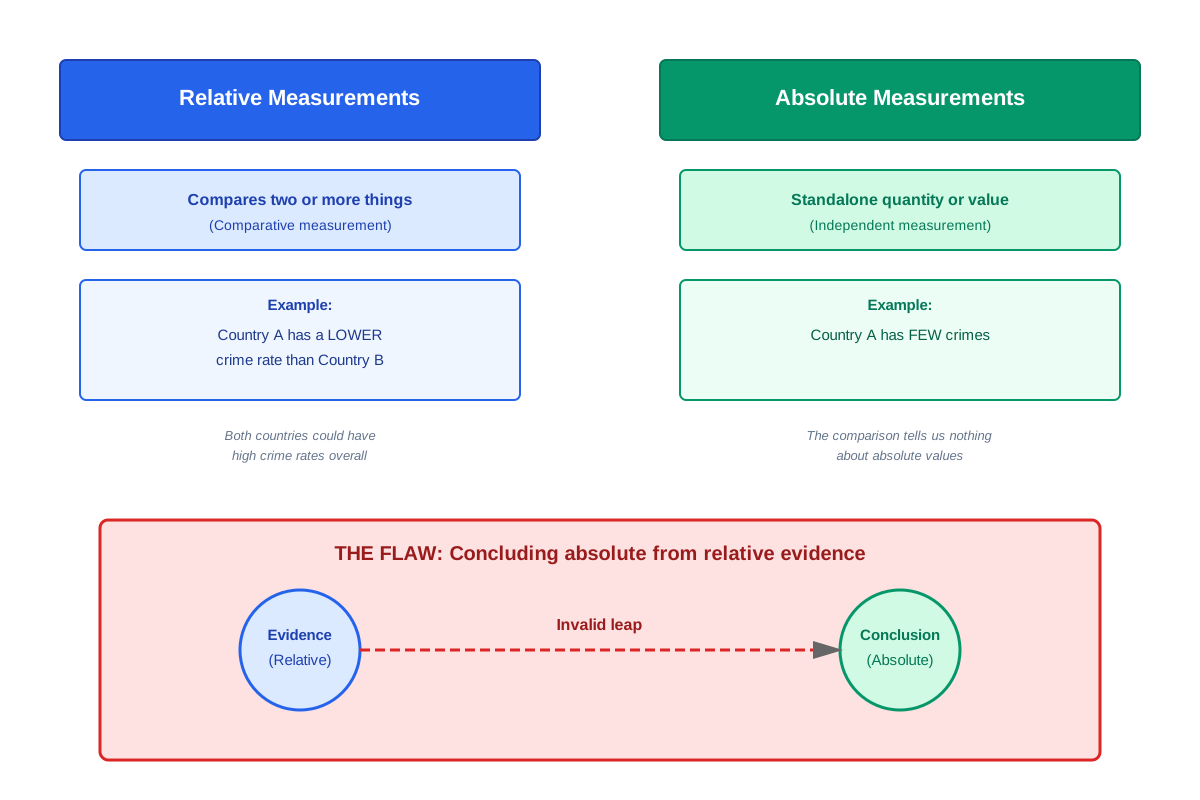
The relative versus absolute flaw represents one of the most frequently tested logical fallacies on the LSAT Logical Reasoning section. This flaw occurs when an argument confuses relative measurements (comparisons between two or more things) with absolute measurements (standalone quantities or values). For example, an argument might conclude that because Country A has a lower crime rate than Country B, Country A must have few crimes in absolute terms—ignoring that both countries might have high crime rates overall. This type of reasoning error appears across multiple question types and requires careful attention to the distinction between comparative and standalone claims.
Understanding this flaw is essential for LSAT success because it tests a fundamental aspect of critical reasoning: recognizing when evidence about relationships between things does not support conclusions about the things themselves. The LSAT frequently presents arguments that shift between these two types of claims, and test-takers must identify when this shift creates a logical gap. This flaw appears not only in dedicated flaw questions but also in Strengthen, Weaken, Assumption, and Parallel Reasoning questions, making it a high-yield topic that rewards thorough mastery.
Within the broader landscape of logical reasoning, the relative versus absolute flaw connects to several core concepts including scope shifts, unwarranted assumptions, and the relationship between evidence and conclusion. Mastering this flaw enhances overall analytical skills and provides a framework for evaluating arguments that make comparative claims. The ability to spot this reasoning pattern quickly and accurately can significantly improve both speed and accuracy on test day, as it eliminates incorrect answer choices and reveals the logical structure underlying complex arguments.
Learning Objectives
- [ ] Identify how relative versus absolute flaw appears in LSAT questions
- [ ] Explain the reasoning pattern behind relative versus absolute flaw
- [ ] Apply relative versus absolute flaw to solve LSAT-style problems accurately
- [ ] Distinguish between legitimate comparative reasoning and flawed relative-to-absolute shifts
- [ ] Recognize the inverse pattern: absolute-to-relative reasoning errors
- [ ] Predict correct answer choices that describe this flaw in technical language
- [ ] Evaluate whether additional information would fix the relative versus absolute gap
Prerequisites
- Basic argument structure: Understanding premises, conclusions, and how evidence supports claims is necessary to identify where the logical gap occurs in relative versus absolute reasoning
- Scope concepts: Familiarity with how arguments can shift scope helps recognize when an argument moves from comparative to absolute claims
- Flaw question format: Knowledge of how the LSAT asks about flawed reasoning enables efficient application of relative versus absolute flaw recognition
- Quantitative reasoning basics: Comfort with percentages, rates, and proportions versus raw numbers aids in distinguishing relative from absolute measurements
Why This Topic Matters
The relative versus absolute flaw appears in approximately 5-8% of all Logical Reasoning questions on a typical LSAT, making it one of the most common specific flaws tested. This frequency translates to roughly 2-4 questions per exam, representing a significant portion of the available points. Beyond dedicated flaw questions, this reasoning pattern appears in Strengthen/Weaken questions where answer choices exploit the relative-absolute distinction, and in Assumption questions where the correct answer bridges the gap between comparative evidence and absolute conclusions.
In real-world contexts, this flaw underlies many misleading statistics and arguments encountered in policy debates, business decisions, and scientific reporting. For instance, a company might claim its product is "safer than competitors" (relative claim) while implying it is "safe" (absolute claim), or a politician might argue that crime decreased relative to last year while avoiding discussion of whether crime remains high in absolute terms. Recognizing this pattern develops critical thinking skills applicable far beyond the LSAT.
On the exam, this flaw typically appears in arguments involving statistics, comparisons between groups, temporal comparisons (before/after), or competitive scenarios. Common contexts include business performance, public health, education outcomes, environmental issues, and social trends. The LSAT tests this concept because it requires precise analytical thinking: test-takers must carefully track what the evidence actually establishes versus what the conclusion claims, a skill fundamental to legal reasoning and analysis.
Core Concepts
Defining Relative and Absolute Claims
A relative claim makes a comparison between two or more entities, expressing a relationship rather than a standalone value. These claims use comparative language such as "more than," "less than," "higher rate," "greater proportion," or "compared to." For example: "City A has a lower unemployment rate than City B" or "Students in Program X score higher than students in Program Y." The key characteristic of relative claims is that they tell us about relationships but provide no information about absolute magnitudes.
An absolute claim, by contrast, makes a statement about a single entity's standalone characteristics without necessary reference to other entities. These claims use language like "many," "few," "high," "low," "safe," "dangerous," "effective," or "ineffective." For example: "City A has low unemployment" or "Students in Program X perform well." Absolute claims establish whether something meets a particular threshold or possesses a certain quality independent of comparisons.
The distinction becomes critical when arguments use relative evidence to support absolute conclusions or vice versa. The logical gap emerges because knowing how two things compare tells us nothing definitive about either thing's absolute status. Both could be high, both could be low, or they could fall anywhere on the spectrum—the comparison alone doesn't determine this.
The Classic Relative-to-Absolute Flaw Pattern
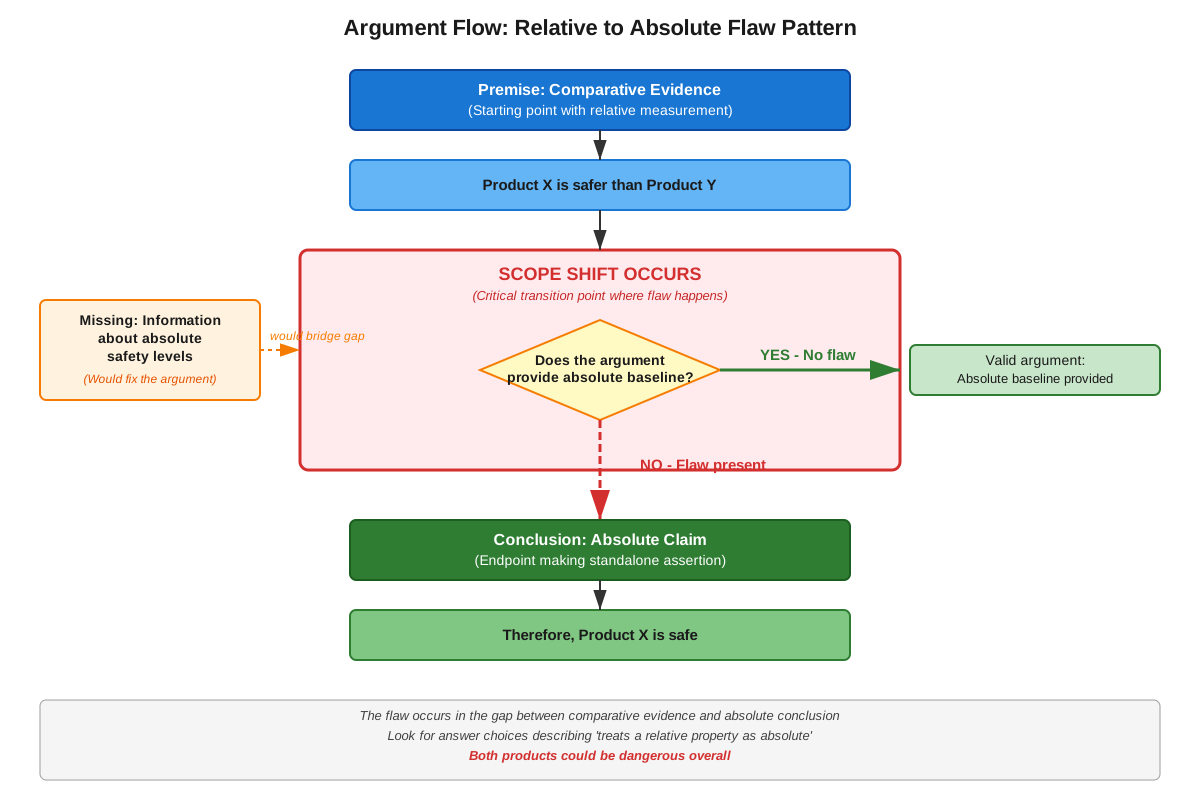
The most common manifestation of this flaw follows a predictable structure:
- Premise: Establishes a relative comparison (X is greater/less than Y)
- Conclusion: Makes an absolute claim about one of the entities (X is high/low)
- Logical gap: The comparison doesn't establish absolute magnitude
Consider this example: "Company A's profits increased by 50% last year, while Company B's profits increased by only 10%. Therefore, Company A is highly profitable." The premise provides relative information (A's growth rate exceeds B's growth rate), but the conclusion makes an absolute claim (A is highly profitable). The flaw is that rapid growth doesn't establish high absolute profitability—Company A might have grown from $1,000 to $1,500 while remaining small in absolute terms.
The Reverse Pattern: Absolute-to-Relative Flaw
Less commonly, arguments commit the inverse error by using absolute evidence to support relative conclusions without justification. For example: "City C has high crime rates. Therefore, City C has higher crime rates than City D." The premise establishes an absolute characteristic (high crime), but the conclusion makes a comparative claim. The flaw is that knowing one entity has a high absolute value doesn't tell us how it compares to another entity—City D might have even higher crime rates.
This reverse pattern appears less frequently on the LSAT but follows the same underlying principle: the evidence type doesn't match the conclusion type, creating a logical gap.
Percentages, Rates, and Proportions versus Raw Numbers
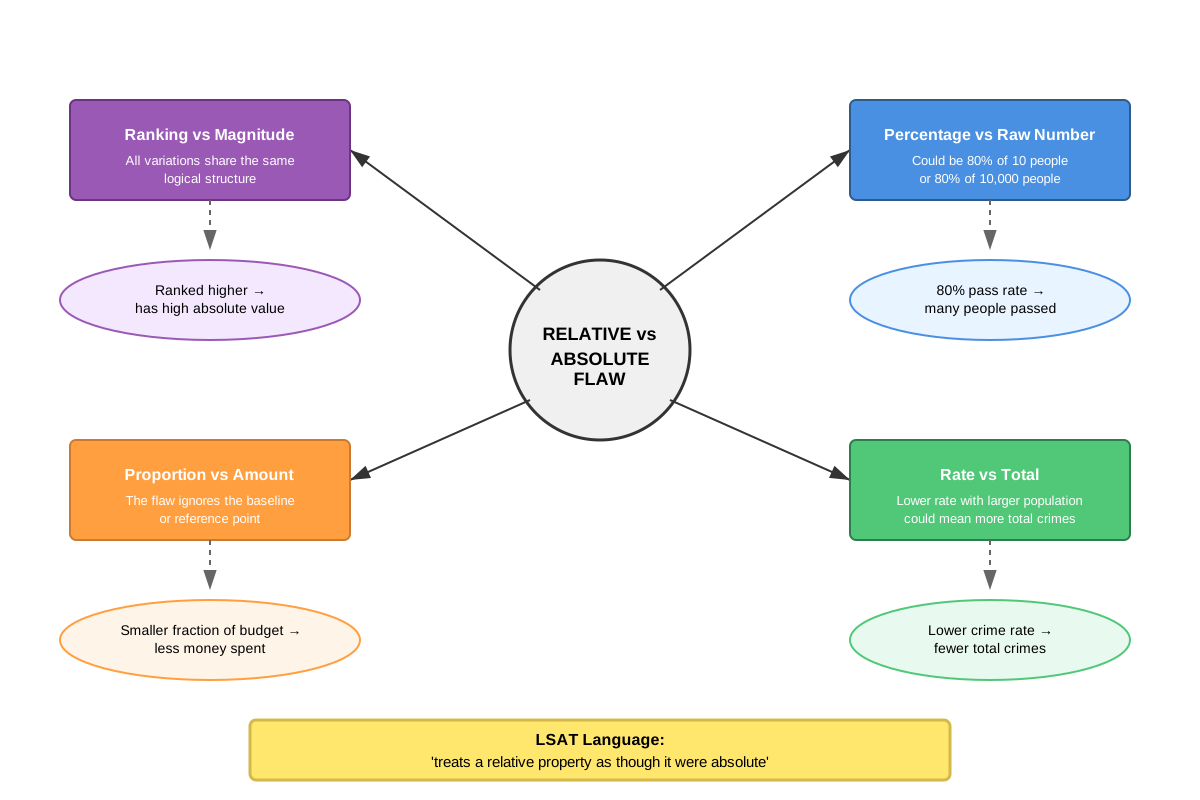
A particularly common variant involves confusing percentages or rates (relative measures) with raw numbers (absolute measures). An argument might note that "the percentage of students passing increased from 60% to 80%" and conclude "many more students are passing now." This commits the relative versus absolute flaw because the percentage increase (relative measure) doesn't establish the absolute number increase—if the total number of students decreased significantly, fewer students might be passing despite the higher percentage.
| Measure Type | Example | What It Tells Us | What It Doesn't Tell Us |
|---|---|---|---|
| Percentage/Rate | 30% of residents support the policy | Proportion relative to total | Absolute number of supporters |
| Raw Number | 5,000 residents support the policy | Absolute quantity | Proportion of total population |
| Comparative Rate | Support increased by 15 percentage points | Change in proportion | Whether absolute numbers increased |
| Comparative Number | 2,000 more residents support it | Change in absolute quantity | Whether the proportion increased |
Recognizing Trigger Language
Certain words and phrases signal potential relative versus absolute flaws:
Relative indicators: "more/less than," "higher/lower than," "compared to," "relative to," "greater/smaller proportion," "increased/decreased rate," "faster/slower growth"
Absolute indicators: "many," "few," "high," "low," "significant," "substantial," "negligible," "safe," "dangerous," "effective," "successful"
When an argument's premises use relative indicators but the conclusion uses absolute indicators (or vice versa), examine carefully for this flaw.
The Role of Context and Standards
Sometimes arguments fail to commit this flaw because context provides implicit standards. If an argument states "Company X's profits are higher than any competitor's, therefore Company X is profitable," this might be valid if we understand that at least one competitor is profitable, establishing a baseline. However, the LSAT typically presents arguments where such context is absent or insufficient, making the relative-to-absolute shift unjustified.
The key question is: does the relative information, combined with any background context provided, establish the absolute claim? If not, the flaw exists.
Concept Relationships
The relative versus absolute flaw connects intimately with several other logical reasoning concepts. It represents a specific type of scope shift, where the conclusion's scope (absolute magnitude) differs from the evidence's scope (comparative relationship). Understanding scope shifts generally enables faster recognition of this particular flaw pattern.
This flaw also relates to unwarranted assumptions: arguments committing this flaw implicitly assume that the relative comparison implies something about absolute magnitude. For instance, concluding that X is high because X exceeds Y assumes that Y is high, or at least that the comparison point provides meaningful information about absolute values. Recognizing these hidden assumptions helps identify both the flaw and potential answer choices in Assumption questions.
The concept connects to sufficiency and necessity in that relative evidence is neither necessary nor sufficient for absolute conclusions without additional information. This relationship helps in Strengthen and Weaken questions: information about absolute magnitudes strengthens arguments with relative evidence supporting absolute conclusions, while information showing both compared entities are low (or high) weakens such arguments.
Relationship map:
Relative evidence → (requires bridging assumption) → Absolute conclusion
Scope shift → manifests as → Relative versus absolute flaw
Missing assumption → about baseline or magnitude → creates the logical gap
Quantitative reasoning → distinguishes → rates/percentages from raw numbers
Quick check — test yourself on Relative versus absolute flaw so far.
Try Flashcards →High-Yield Facts
⭐ The relative versus absolute flaw occurs when an argument uses comparative evidence to support a standalone conclusion without establishing absolute magnitude
⭐ Knowing X exceeds Y tells us nothing definitive about whether X is high or Y is low in absolute terms—both could be high, both could be low, or anywhere in between
⭐ Percentages and rates are relative measures; raw numbers are absolute measures; confusing these is a common variant of this flaw
⭐ The flaw appears in approximately 5-8% of Logical Reasoning questions, making it one of the most frequently tested specific reasoning errors
⭐ Correct answer choices describing this flaw often use language like "confuses relative and absolute," "takes a comparison to establish magnitude," or "fails to establish that the comparison indicates absolute value"
- The reverse pattern (absolute-to-relative) exists but appears less frequently on the LSAT
- Temporal comparisons (before/after) often involve this flaw when concluding something is now high/low based solely on change
- Multiple entities can all be high or all be low in absolute terms regardless of their relative rankings
- Context can sometimes provide implicit standards that prevent this flaw, but LSAT arguments typically lack such context
- This flaw connects to scope shifts, unwarranted assumptions, and sufficiency/necessity concepts
Common Misconceptions
Misconception: If X is greater than Y, and Y is mentioned in the argument, then we know something about Y's absolute value. → Correction: Unless the argument explicitly establishes Y's absolute magnitude, the comparison alone tells us nothing about whether Y is high or low. The mere mention of Y doesn't provide information about its absolute characteristics.
Misconception: An increase in percentage always means an increase in raw numbers. → Correction: Percentages are relative to a total, which can change. A percentage can increase while raw numbers decrease if the total decreases more rapidly. For example, 80% of 100 (80) is less than 60% of 200 (120).
Misconception: The relative versus absolute flaw only appears in arguments with explicit numerical data. → Correction: This flaw appears in qualitative comparisons as well. An argument stating "Product A is safer than Product B, therefore Product A is safe" commits this flaw without any numbers.
Misconception: If an argument compares only two things and one must be higher than the other, then the higher one must be high in absolute terms. → Correction: Both could be low in absolute terms with one simply being less low than the other. The comparison establishes only relative ranking, not absolute magnitude.
Misconception: Strengthening an argument with this flaw requires proving the conclusion is true. → Correction: Strengthening requires only providing information that makes the conclusion more likely, such as establishing that the comparison point has a high absolute value or that the difference between compared entities is substantial.
Worked Examples
Example 1: Business Performance
Argument: "TechCorp's revenue growth rate last year was 45%, significantly higher than InnovateCo's growth rate of 12%. Therefore, TechCorp generated substantial revenue last year."
Analysis:
- Premise identification: TechCorp's growth rate (45%) exceeded InnovateCo's growth rate (12%)
- Conclusion identification: TechCorp generated substantial revenue (absolute claim)
- Evidence type: Relative comparison of growth rates
- Conclusion type: Absolute claim about revenue magnitude
- Flaw recognition: The growth rate comparison tells us nothing about absolute revenue. TechCorp might have grown from $10,000 to $14,500 (45% growth) while InnovateCo grew from $10 million to $11.2 million (12% growth). In this scenario, InnovateCo generated far more substantial revenue despite slower growth.
- Missing link: Information about TechCorp's actual revenue figures or starting point
- Answer choice prediction: The correct flaw description would state something like "takes evidence that one company's growth rate exceeded another's to establish that the first company's revenue was high in absolute terms"
This example demonstrates the classic pattern: comparative evidence (growth rates) supporting an absolute conclusion (substantial revenue) without justification.
Example 2: Public Health
Argument: "After the new public health campaign, the percentage of residents exercising regularly increased from 35% to 52%. This shows that the campaign successfully got many more residents exercising."
Analysis:
- Premise identification: Percentage of residents exercising increased from 35% to 52%
- Conclusion identification: Many more residents are exercising (absolute claim about numbers)
- Evidence type: Relative measure (percentage/proportion)
- Conclusion type: Absolute measure (raw number of people)
- Flaw recognition: The percentage increase doesn't establish that more people are exercising in absolute terms. If the total population decreased significantly (perhaps due to residents moving away), fewer people might be exercising despite the higher percentage. For example, 35% of 100,000 (35,000 people) exceeds 52% of 50,000 (26,000 people).
- Missing link: Information about whether the total population remained stable or changed
- Answer choice prediction: The correct description might state "confuses an increase in the proportion of residents exercising with an increase in the absolute number of residents exercising"
This example illustrates the percentage-versus-raw-numbers variant, showing how relative measures (percentages) don't necessarily correspond to absolute measures (actual numbers of people).
Exam Strategy
When approaching flaw questions involving potential relative versus absolute errors, follow this systematic process:
- Identify the conclusion first: Determine whether it makes an absolute claim ("X is high/low/significant") or a relative claim ("X exceeds Y")
- Examine the evidence: Determine whether premises provide relative comparisons or absolute measurements
- Check for type mismatch: If evidence is relative but conclusion is absolute (or vice versa), investigate whether the argument bridges this gap
- Look for bridging information: Sometimes arguments provide additional context that connects relative and absolute claims legitimately
- Predict the flaw description: Before reading answer choices, articulate the flaw in your own words
Trigger phrases to watch for:
In premises: "more than," "less than," "higher rate," "increased from X% to Y%," "compared to," "faster growth"
In conclusions: "many," "few," "substantial," "significant," "high," "low," "successful," "effective"
When these appear together (relative evidence + absolute conclusion), immediately consider this flaw.
Process of elimination tips:
- Eliminate answer choices describing flaws the argument doesn't commit (e.g., circular reasoning, ad hominem)
- Eliminate choices that accurately describe the argument's reasoning rather than identifying a flaw
- Eliminate choices that describe the reverse problem (if the argument goes relative-to-absolute, eliminate choices describing absolute-to-relative)
- Keep choices using language like "confuses," "takes a comparison to establish," "fails to consider that the comparison doesn't indicate magnitude"
Time allocation: This flaw is typically identifiable within 30-45 seconds once you've read the argument. If you're spending more time, you may be overthinking. Trust the pattern recognition: relative evidence + absolute conclusion = likely flaw.
Exam Tip: In Strengthen/Weaken questions, answer choices providing absolute information about comparison points often strengthen arguments with this flaw, while choices showing both compared entities are low (or high) weaken such arguments.
Memory Techniques
Mnemonic for the core concept: "COMPARE doesn't PROVE"
- Comparisons
- Only show
- Magnitude
- Positions
- And
- Relative
- Evidence doesn't PROVE absolute values
Visualization strategy: Picture a ladder with two people on different rungs. Person A is higher than Person B, but you can't see the ground. Are they high up or low down? The comparison tells you relative position but not absolute height. This image captures the essence of the flaw.
Acronym for question approach: "RACE"
- Read for conclusion type (relative or absolute)
- Analyze evidence type (relative or absolute)
- Check for mismatch
- Eliminate wrong answers
Memory aid for percentages versus numbers: "Percentages are pieces of pies—the pie size matters!" This reminds you that percentages depend on totals, which can change.
Summary
The relative versus absolute flaw represents a critical reasoning error where arguments confuse comparative information with standalone measurements. This flaw appears when evidence establishes how things compare (X exceeds Y, rates increased, proportions changed) but conclusions claim something about absolute magnitude (X is high, many people, substantial amount). The logical gap exists because comparisons alone don't establish whether compared entities are high or low in absolute terms—both could be high, both could be low, or they could fall anywhere on the spectrum. A particularly common variant involves confusing percentages or rates (relative measures) with raw numbers (absolute measures). Recognizing this flaw requires careful attention to whether evidence and conclusions match in type, and understanding that bridging the gap requires additional information about absolute magnitudes, baselines, or the entities being compared. This flaw appears frequently across multiple LSAT question types and rewards systematic analysis of argument structure.
Key Takeaways
- The relative versus absolute flaw occurs when comparative evidence supports absolute conclusions without establishing magnitude
- Knowing X exceeds Y provides no information about whether X is high or Y is low in absolute terms
- Percentages and rates are relative measures that don't necessarily correspond to changes in raw numbers
- This flaw appears in 5-8% of Logical Reasoning questions across multiple question types
- Systematic analysis—identifying conclusion type, evidence type, and checking for mismatches—enables quick recognition
- Correct answer choices typically use language about confusing comparisons with absolute values
- Understanding this flaw enhances performance on Strengthen, Weaken, Assumption, and Parallel Reasoning questions
Related Topics
Scope Shifts: The relative versus absolute flaw represents a specific type of scope shift. Mastering this flaw provides a foundation for recognizing other scope problems where conclusions make claims beyond what evidence establishes.
Unwarranted Assumptions: Arguments with relative versus absolute flaws contain hidden assumptions about baselines or magnitudes. Understanding these assumptions connects to Assumption questions and Sufficient Assumption questions.
Quantitative Reasoning Flaws: This topic relates to other numerical reasoning errors including sample size issues, correlation versus causation with statistics, and representativeness of data. Together, these form a cluster of high-yield quantitative reasoning concepts.
Strengthen and Weaken Questions: Mastering this flaw enables prediction of answer choices that strengthen arguments by providing absolute information or weaken arguments by showing comparison points are low.
Practice CTA
Now that you understand the relative versus absolute flaw, test your mastery with practice questions that challenge you to identify this reasoning error in various contexts. The flashcards will help reinforce the distinction between relative and absolute claims and the trigger language that signals this flaw. Consistent practice with this high-yield concept will build the pattern recognition skills essential for quick, accurate performance on test day. Remember: every question you practice strengthens your ability to spot this flaw instantly, giving you a significant advantage on one of the LSAT's most frequently tested reasoning errors. You've built the foundation—now apply it!
Sign up free to keep reading
Create a free AnvayaPrep account to finish this LSAT guide on Relative versus absolute flaw — plus flashcards and practice questions.