Overview
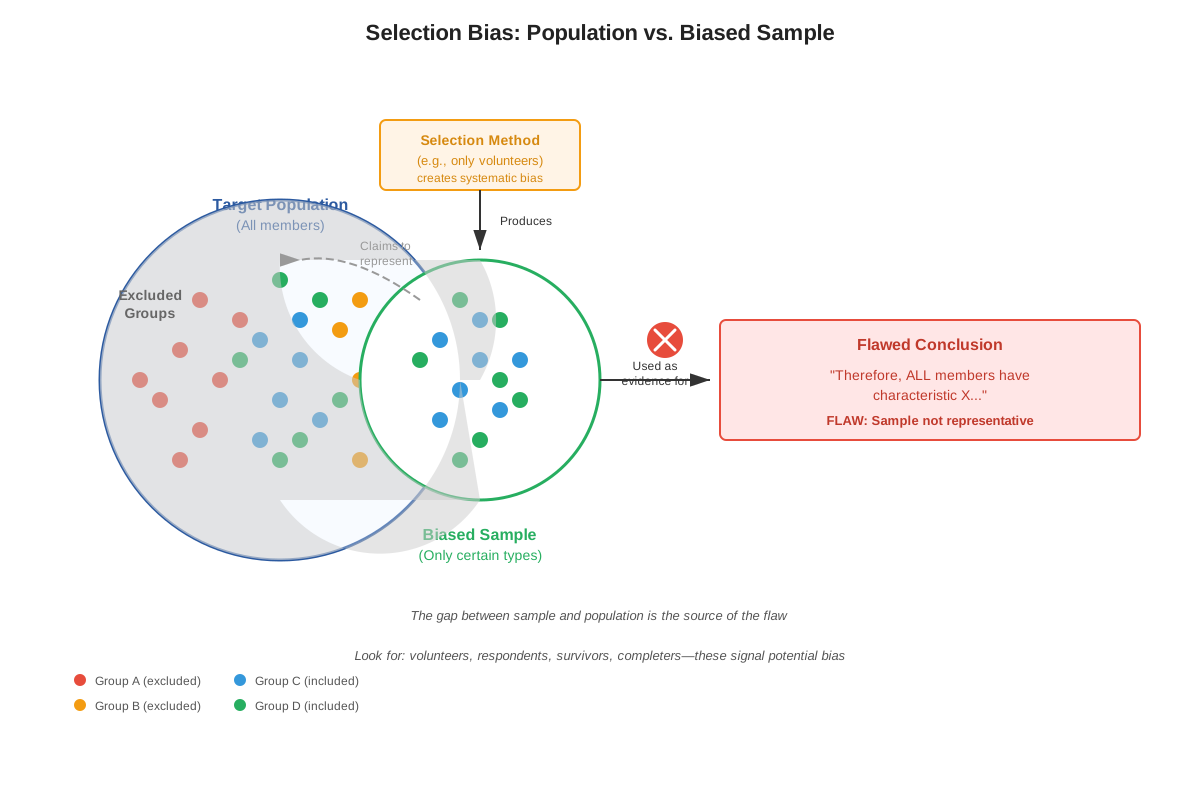
Selection bias is one of the most frequently tested reasoning flaws on the LSAT Logical Reasoning section. This flaw occurs when an argument draws a conclusion about a larger population based on evidence from a sample that is not representative of that population. The sample is "biased" because the method of selection systematically excludes or underrepresents certain members of the population, leading to distorted or unreliable conclusions.
Understanding selection bias is essential for LSAT success because it appears across multiple question types, particularly flaw questions, but also in strengthen/weaken questions, assumption questions, and method of reasoning questions. The LSAT tests whether students can identify when an argument's evidence comes from a skewed sample and recognize why this undermines the argument's conclusion. Mastering this concept requires recognizing the subtle ways arguments can rely on unrepresentative data while appearing superficially convincing.
Within the broader landscape of logical reasoning, selection bias connects to fundamental principles of inductive reasoning and statistical argumentation. It relates closely to other sampling flaws, hasty generalizations, and problems with survey methodology. The ability to spot selection bias demonstrates critical thinking about evidence quality—a skill the LSAT prizes highly and one that underlies success on approximately 15-20% of Logical Reasoning questions across any given test administration.
Learning Objectives
- [ ] Identify how Selection bias appears in LSAT questions
- [ ] Explain the reasoning pattern behind Selection bias
- [ ] Apply Selection bias to solve LSAT-style problems accurately
- [ ] Distinguish selection bias from other sampling and generalization flaws
- [ ] Predict how selection bias undermines specific argument conclusions
- [ ] Construct examples of selection bias to deepen pattern recognition
- [ ] Evaluate answer choices that correctly describe selection bias using LSAT terminology
Prerequisites
- Basic argument structure: Understanding premises, conclusions, and how evidence supports claims is necessary because selection bias involves evaluating the relationship between evidence and conclusion.
- Inductive vs. deductive reasoning: Selection bias primarily affects inductive arguments that generalize from samples to populations, so distinguishing these reasoning types helps identify when to look for this flaw.
- Population vs. sample concepts: Recognizing the difference between a target population and a subset used as evidence is fundamental to understanding why selection matters.
- General flaw question format: Familiarity with how the LSAT asks about reasoning errors helps students recognize selection bias when it appears among answer choices.
Why This Topic Matters
Selection bias represents a critical real-world reasoning error that affects everything from medical research to political polling to business decisions. When researchers survey only volunteers, when companies solicit feedback only from satisfied customers, or when studies examine only those who completed a program (ignoring dropouts), selection bias distorts conclusions. The LSAT tests this concept because lawyers must evaluate evidence quality, recognize when data sources are compromised, and identify when opposing arguments rest on unrepresentative samples.
On the LSAT, selection bias appears in approximately 3-5 questions per test, making it one of the highest-yield flaw patterns to master. It most commonly appears in:
- Flaw questions asking students to identify the reasoning error
- Weaken questions where pointing out sample bias undermines the argument
- Strengthen questions where showing the sample is representative supports the argument
- Assumption questions where the argument depends on the sample being unbiased
The LSAT frequently disguises selection bias within arguments about surveys, studies, polls, observations, and anecdotal evidence. Test-makers craft these questions to appear reasonable at first glance, requiring careful analysis to spot the systematic exclusion or self-selection that compromises the sample.
Core Concepts
What Is Selection Bias?
Selection bias (also called sampling bias) occurs when the method of selecting a sample systematically favors certain outcomes or characteristics, making the sample unrepresentative of the population about which a conclusion is drawn. The key word is "systematic"—this isn't random variation but rather a structural problem with how the sample was obtained that predictably skews results in a particular direction.
The basic structure of a selection bias flaw follows this pattern:
- Evidence is gathered from a specific sample (survey respondents, study participants, observed cases)
- The sample has characteristics that make it systematically different from the target population
- A conclusion is drawn about the broader population based on this biased sample
- The conclusion is unreliable because the sample doesn't accurately represent the population
Types of Selection Bias on the LSAT
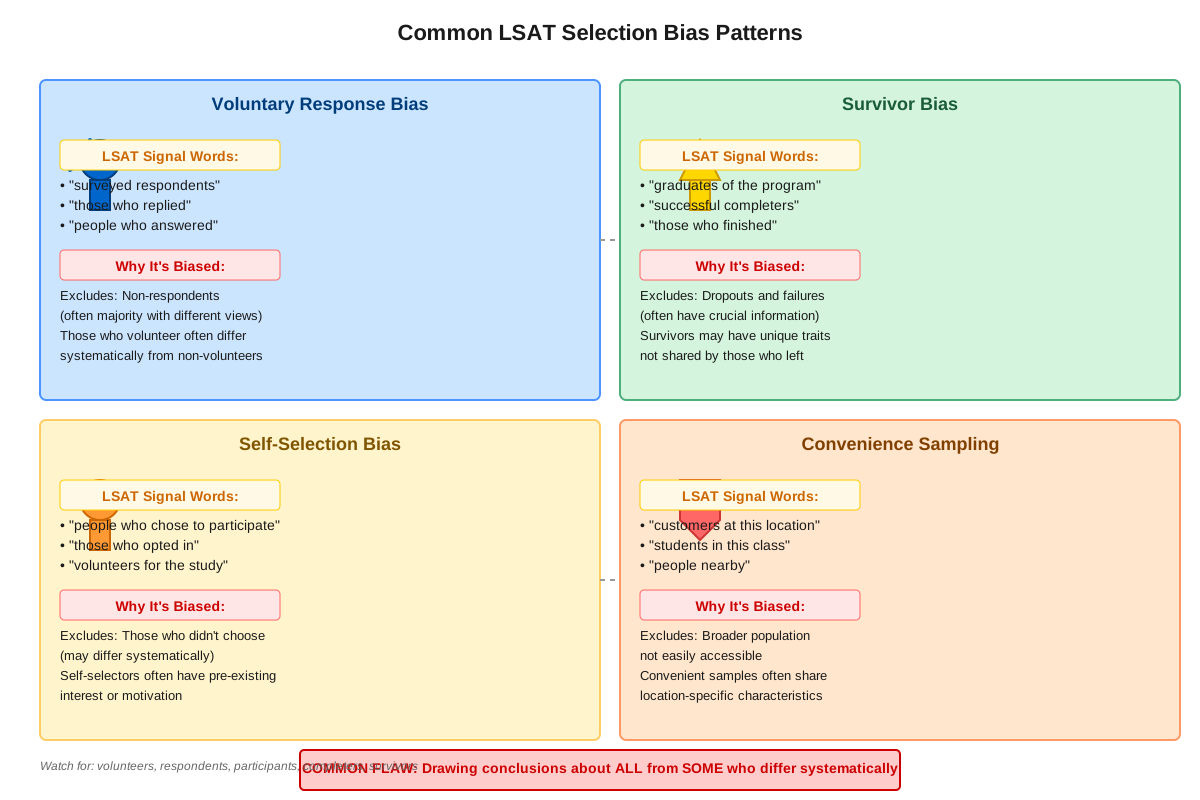
Self-Selection Bias
This occurs when individuals choose whether to be included in the sample, and those who choose to participate differ systematically from those who don't. For example, an argument concluding that "most customers love our product" based on voluntary online reviews suffers from self-selection bias because satisfied customers are more likely to leave reviews than dissatisfied ones.
Survivorship Bias
This involves examining only cases that "survived" some selection process while ignoring those that didn't. An argument concluding that "successful entrepreneurs rarely have formal business education" based on interviewing current business owners ignores all the entrepreneurs without formal education who failed—they're not around to be interviewed.
Convenience Sampling Bias
This occurs when a sample is chosen based on ease of access rather than representativeness. An argument about "typical American voters" based on interviews conducted only at a particular location (like a university campus or a specific neighborhood) suffers from this bias.
Non-Response Bias
This happens when those who respond to a survey differ systematically from those who don't respond. An argument about employee satisfaction based on a survey with a 30% response rate may be flawed if dissatisfied employees were less likely to respond.
The Logical Structure
The reasoning pattern behind selection bias can be formalized:
Premise: X% of [biased sample] have characteristic Y
Conclusion: Therefore, X% of [general population] have characteristic Y
Flaw: The sample is not representative of the population
The argument treats the sample as if it were a random or representative cross-section when it actually systematically over- or under-represents certain groups. This creates a gap between the evidence (what's true of the sample) and the conclusion (what's claimed about the population).
Key Indicators of Selection Bias
| Indicator | What It Signals | Example Language |
|---|---|---|
| Voluntary participation | Self-selection likely | "respondents," "those who chose to," "volunteers" |
| Specific location/context | Convenience sampling | "at the mall," "in this city," "attendees" |
| Survivors only | Survivorship bias | "current members," "successful cases," "those who completed" |
| Low response rate mentioned | Non-response bias | "of those who responded," "returned surveys" |
| Specific subgroup studied | Unrepresentative sample | "among college students," "frequent users" |
Why Selection Bias Matters for Arguments
Selection bias undermines arguments because it violates a fundamental principle of inductive reasoning: evidence should be representative of the domain about which conclusions are drawn. When a sample is biased, patterns observed in the sample may not exist in the population, or may exist to a very different degree. This makes the inference from sample to population unreliable.
The LSAT tests whether students recognize that the quality of evidence matters as much as the quantity. An argument based on 1,000 self-selected respondents may be weaker than one based on 100 randomly selected participants because the larger sample's selection method introduces systematic distortion.
Distinguishing Selection Bias from Related Flaws
Selection bias specifically involves problems with how the sample was selected. This differs from:
- Hasty generalization: Drawing a conclusion from too small a sample (size problem, not selection problem)
- Unrepresentative sample: A broader category that includes selection bias but also random samples that happen to be atypical
- Biased question wording: The sample selection is fine, but the survey questions lead respondents toward particular answers
- Correlation/causation confusion: The data may be representative, but the argument misinterprets what the data shows
Concept Relationships
Selection bias connects to several fundamental concepts in logical reasoning:
Inductive reasoning → requires representative samples → selection bias undermines representativeness
When arguments use inductive reasoning to generalize from observed cases to broader conclusions, they implicitly assume the observed cases are representative. Selection bias breaks this assumption, making the inductive leap unreliable.
Evidence quality → depends on sampling method → selection bias indicates poor sampling → weakens argument
The strength of an argument rests not just on having evidence, but on having good evidence. Selection bias is one way evidence quality can be compromised, directly impacting argument strength.
Population vs. sample distinction → enables recognition of selection bias → allows identification of representativeness problems
Understanding that arguments often move from sample data to population conclusions is prerequisite to recognizing when the sample doesn't match the population.
Flaw questions → test ability to identify reasoning errors → selection bias is a common error type → appears in predictable language patterns
Within the taxonomy of logical flaws, selection bias sits alongside other evidence-based flaws like insufficient sample size, biased sources, and inappropriate analogies. Recognizing the family resemblance helps students categorize arguments quickly during timed testing.
High-Yield Facts
⭐ Selection bias occurs when the method of choosing a sample systematically makes it unrepresentative of the target population.
⭐ Self-selection bias is the most common form on the LSAT, appearing when participants choose whether to be included in the sample.
⭐ Arguments concluding about "most people" or "the general population" based on voluntary surveys or convenience samples typically contain selection bias.
⭐ The flaw is not that the sample is too small, but that the selection method skews the sample in a predictable direction.
⭐ Correct answer choices often use phrases like "unrepresentative sample," "biased sample," or "those surveyed may not be typical of the group about which the conclusion is drawn."
- Selection bias can occur even with large samples—size doesn't fix a biased selection method.
- Survivorship bias involves examining only successful cases while ignoring failures, creating a distorted picture of success factors.
- The LSAT often presents selection bias in arguments about customer satisfaction, product reviews, survey results, and study findings.
- Recognizing selection bias requires identifying both the sample used and the population the conclusion addresses, then evaluating whether they match.
- Arguments that mention response rates, voluntary participation, or specific locations are prime candidates for selection bias flaws.
- Selection bias differs from biased question wording—the former is about who's in the sample, the latter about how questions are asked.
- When an argument assumes a sample is representative without justification, selection bias may be the unstated assumption.
Quick check — test yourself on Selection bias so far.
Try Flashcards →Common Misconceptions
Misconception: Selection bias only occurs with small samples.
Correction: Selection bias is about how the sample was chosen, not its size. A sample of 10,000 self-selected volunteers can be more biased than a random sample of 100. The systematic nature of the selection method, not the sample size, creates the bias.
Misconception: Any sample that isn't perfectly random exhibits selection bias.
Correction: Selection bias requires systematic distortion that makes the sample unrepresentative in ways relevant to the conclusion. Some non-random samples can still be representative enough for the argument's purposes, while others are systematically skewed.
Misconception: Selection bias and hasty generalization are the same flaw.
Correction: Hasty generalization involves drawing conclusions from insufficient evidence (too few cases), while selection bias involves drawing conclusions from systematically unrepresentative evidence. An argument can have a large sample but still suffer from selection bias if the selection method was flawed.
Misconception: If an argument mentions a survey or study, it automatically has selection bias.
Correction: Not all surveys or studies are biased. The question is whether the selection method systematically excludes or over-represents certain groups. Well-designed random samples don't have selection bias even though they're surveys.
Misconception: Selection bias only affects the argument if the bias is explicitly mentioned in the stimulus.
Correction: The LSAT often requires students to infer selection bias from contextual clues. If an argument says "customers who completed our feedback form" without explicitly stating this is a biased sample, students must recognize that only certain customers (likely satisfied ones) would complete such forms.
Misconception: Pointing out that a sample might not be representative is always the correct answer for flaw questions.
Correction: Selection bias is only the flaw if the argument actually generalizes from a sample to a population and the sample selection method is problematic. If the argument doesn't make such a generalization, or if the sample is appropriately selected, this isn't the flaw.
Misconception: Selection bias means the conclusion is definitely false.
Correction: Selection bias means the evidence doesn't adequately support the conclusion, not that the conclusion is necessarily wrong. The conclusion might happen to be true despite the biased sample, but the argument hasn't established this.
Worked Examples
Example 1: Customer Satisfaction Survey
Argument: "A recent survey found that 85% of respondents rated our customer service as 'excellent' or 'very good.' This demonstrates that our company provides superior customer service that satisfies the vast majority of our customers."
Analysis:
Step 1: Identify the conclusion
The conclusion is that the company provides superior customer service that satisfies the vast majority of customers.
Step 2: Identify the evidence
The evidence is that 85% of survey respondents gave high ratings.
Step 3: Identify the gap
The argument moves from "survey respondents" to "the vast majority of our customers." Are survey respondents representative of all customers?
Step 4: Recognize the selection bias
The argument doesn't specify how respondents were selected. If the survey was voluntary (customers chose whether to respond), this creates self-selection bias. Satisfied customers are more likely to take time to complete surveys than dissatisfied ones. The sample of respondents systematically over-represents satisfied customers.
Step 5: Articulate the flaw
The argument treats survey respondents as representative of all customers when the selection method (likely voluntary participation) makes them systematically different. The 85% satisfaction rate among respondents doesn't reliably indicate satisfaction among all customers.
Connection to learning objectives: This example demonstrates how selection bias appears in LSAT questions (through survey-based arguments), explains the reasoning pattern (generalizing from a self-selected sample to all customers), and shows how to apply this knowledge to identify the flaw.
Example 2: Educational Program Success
Argument: "The Accelerated Learning Program has a 90% success rate, with 90% of participants achieving their educational goals. This proves the program is highly effective and should be expanded to serve more students."
Analysis:
Step 1: Identify the conclusion
The program is highly effective and should be expanded.
Step 2: Identify the evidence
90% of participants achieved their goals.
Step 3: Look for selection issues
Who are the "participants"? The argument measures success among those who participated in the program, but what about those who started but didn't complete it?
Step 4: Recognize survivorship bias
This is a form of selection bias where only "survivors" (completers) are counted. If many students dropped out because the program wasn't working for them, they're excluded from the 90% calculation. The argument only examines successful completers, not all who enrolled.
Step 5: Articulate the flaw
The argument's evidence comes from a biased sample—only those who completed the program. This systematically excludes those for whom the program failed (who likely dropped out). The true success rate among all who enrolled might be much lower. For example, if 100 students enrolled, 50 dropped out, and 45 of the remaining 50 achieved their goals, the "90% success rate" (45/50) masks the actual 45% success rate (45/100).
Step 6: Consider the conclusion's scope
The conclusion that the program "should be expanded" rests on the effectiveness claim, which is undermined by the selection bias. Without knowing the true success rate (including dropouts), we can't evaluate whether expansion is justified.
Connection to learning objectives: This example shows a more subtle form of selection bias (survivorship bias), demonstrates the reasoning pattern of examining only successful cases, and illustrates how recognizing this flaw allows accurate evaluation of the argument's strength.
Exam Strategy
Approaching Selection Bias Questions
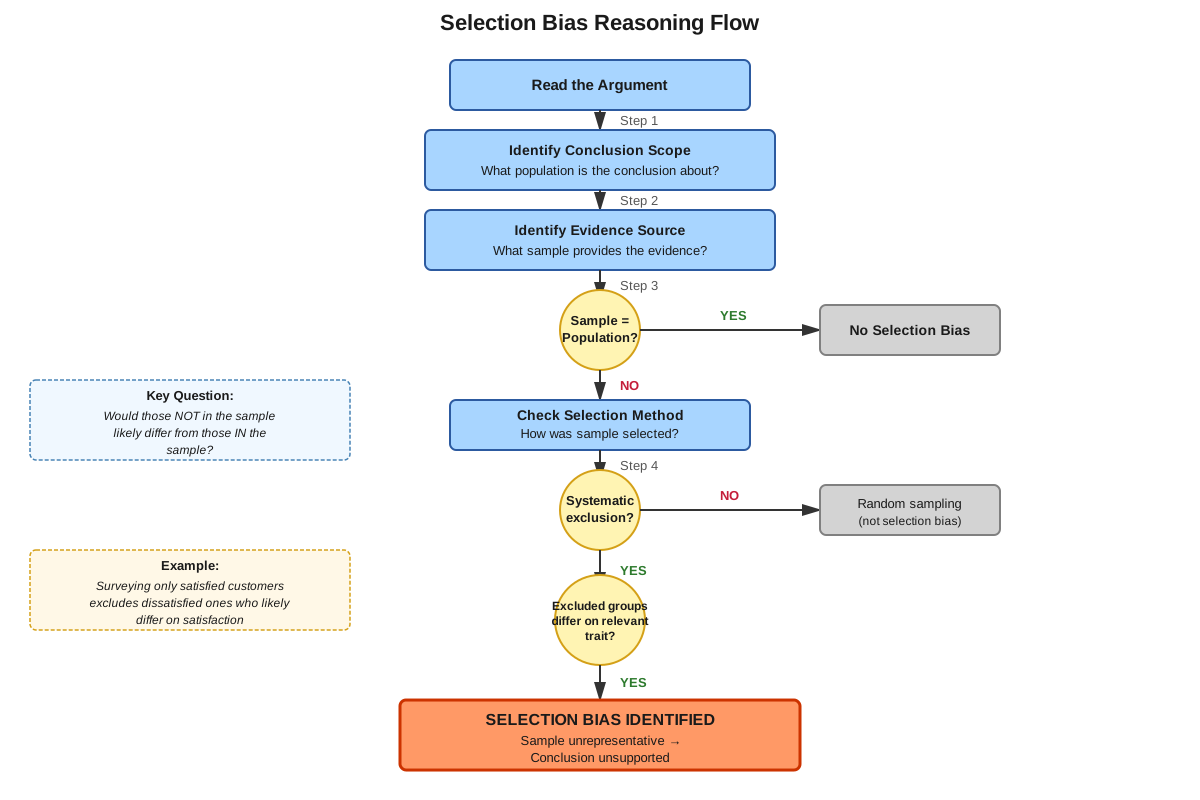
Step 1: Identify generalization arguments
When reading the stimulus, flag any argument that draws a conclusion about a group based on evidence from a subset. Look for conclusions using words like "most," "typically," "generally," "the majority," or "people."
Step 2: Map sample to population
Explicitly identify: (a) What group does the evidence come from? (b) What group does the conclusion address? If these don't match perfectly, selection bias is possible.
Step 3: Evaluate the selection method
Ask: How was the sample chosen? Was it voluntary? Was it from a specific location or context? Does it only include "survivors" or successful cases? Any systematic selection factor suggests bias.
Step 4: Predict the flaw before reading answers
Before looking at answer choices, articulate the selection bias in your own words: "The sample of [X] isn't representative of [Y] because [selection method]."
Trigger Words and Phrases
In the stimulus, watch for:
- "Survey respondents," "those who responded," "participants"
- "Volunteers," "those who chose to," "self-reported"
- "Customers who contacted us," "people who attended," "members who"
- "Successful cases," "current members," "those who completed"
- "At [specific location]," "in [specific context]"
- Mention of response rates or participation rates
In answer choices, look for:
- "Unrepresentative sample"
- "Biased sample"
- "Those surveyed may not be typical"
- "Fails to consider those who [didn't participate/respond/complete]"
- "Overlooks the possibility that the sample is not representative"
- "The evidence comes from a self-selected group"
Process of Elimination Tips
Eliminate answers that:
- Describe the sample as "too small" when the flaw is about selection method, not size
- Mention correlation/causation when the argument doesn't claim causation
- Describe circular reasoning when the argument uses external evidence
- Claim the argument assumes what it's trying to prove (unless it's an assumption question)
- Focus on question wording bias when the issue is sample selection
Keep answers that:
- Identify a gap between the sample and the population
- Point out systematic differences between those included and those excluded
- Note that the selection method could skew results
- Mention representativeness or typicality issues
Time Allocation
Selection bias questions are typically medium difficulty. Allocate:
- 30-45 seconds: Reading and understanding the stimulus
- 15-20 seconds: Predicting the flaw
- 30-45 seconds: Evaluating answer choices
- Total: 75-110 seconds per question
If you quickly recognize selection bias in the stimulus, you can often eliminate wrong answers rapidly and confirm the correct answer efficiently, potentially saving time for harder questions.
Exam Tip: When you see survey or study-based arguments, immediately ask: "Who was included in this sample, and who was excluded?" This question alone will reveal selection bias in most cases.
Memory Techniques
The SAMPLE Acronym
Use SAMPLE to remember key questions for identifying selection bias:
- Source: Where did the data come from?
- All included?: Who was excluded from the sample?
- Method: How were participants selected?
- Population: What group does the conclusion address?
- Likely differences: How might included and excluded groups differ?
- Evidence quality: Does the selection method compromise representativeness?
The "Who's Missing?" Technique
Visualize the argument as a photograph. Ask: "Who's not in this picture?" If the argument is about "all customers" but only surveys "customers who called," visualize all the customers who didn't call—they're missing from the picture. This makes the selection bias concrete and memorable.
The Survivor Visualization
For survivorship bias, imagine a battlefield where only the survivors are interviewed about what makes soldiers successful. All the soldiers who followed the same strategies but didn't survive can't be interviewed—they're systematically excluded. This dramatic image helps remember that examining only successful cases ignores failures.
The Volunteer Bias Rhyme
"Those who volunteer, their views aren't clear—they differ from the rest, who didn't take the test."
This simple rhyme reinforces that voluntary participants systematically differ from non-participants.
Summary
Selection bias represents a critical reasoning flaw where arguments draw conclusions about a population based on evidence from a systematically unrepresentative sample. The core issue is not sample size but selection method—when the way participants are chosen systematically includes or excludes certain types of individuals, the sample becomes skewed. The LSAT tests this concept extensively because it requires careful analysis of the relationship between evidence and conclusions, a fundamental lawyering skill. Students must recognize various forms of selection bias including self-selection (voluntary participation), survivorship bias (examining only successful cases), and convenience sampling (using easily accessible but unrepresentative groups). Success requires identifying when arguments generalize from samples to populations, evaluating whether the selection method could create systematic differences, and recognizing how answer choices describe this flaw using terms like "unrepresentative sample" or "those surveyed may not be typical." Mastering selection bias enables students to quickly identify and eliminate flawed arguments across multiple question types, making it one of the highest-yield concepts in LSAT Logical Reasoning.
Key Takeaways
- Selection bias occurs when the sample selection method systematically makes it unrepresentative of the target population, not when the sample is simply too small.
- Self-selection bias (voluntary participation) is the most common form on the LSAT and appears when those who choose to participate differ from those who don't.
- Always identify both the sample (where evidence comes from) and the population (what the conclusion addresses) to spot mismatches that indicate selection bias.
- Survivorship bias involves examining only successful or surviving cases while ignoring failures, creating a distorted picture of success factors.
- Trigger phrases like "survey respondents," "volunteers," "those who completed," and "current members" signal potential selection bias.
- Correct answer choices typically use language about representativeness, typicality, or systematic differences between included and excluded groups.
- Selection bias undermines argument strength by breaking the assumption that observed patterns in the sample reflect patterns in the population.
Related Topics
Hasty Generalization: While selection bias involves unrepresentative samples, hasty generalization involves insufficient sample sizes. Understanding both helps distinguish between quality and quantity problems with evidence. Mastering selection bias provides the foundation for recognizing all sampling-related flaws.
Biased Sources: This flaw involves evidence from sources with conflicts of interest or motivations to distort information. It relates to selection bias because both involve problems with evidence quality, though biased sources focuses on who provides information rather than how samples are selected.
Survey and Study Methodology: A broader topic encompassing selection bias, question wording bias, and other problems with empirical research. Selection bias is the most commonly tested aspect of survey methodology on the LSAT.
Necessary vs. Sufficient Assumptions: Many selection bias arguments depend on the unstated assumption that the sample is representative. Understanding assumption questions helps recognize when representativeness is assumed rather than established.
Strengthen and Weaken Questions: Selection bias frequently appears in these question types, where showing a sample is representative strengthens an argument, while showing it's biased weakens it. Mastering selection bias as a flaw enables success on these related question types.
Practice CTA
Now that you understand selection bias—one of the most high-yield concepts in LSAT Logical Reasoning—it's time to cement your mastery through practice. Attempt the practice questions to apply these concepts to realistic LSAT scenarios, and use the flashcards to reinforce key definitions and patterns. Remember: recognizing selection bias quickly and accurately can help you answer 3-5 questions correctly on test day, potentially adding multiple points to your score. The pattern recognition you develop through practice will become automatic, allowing you to spot these flaws instantly under timed conditions. You've built the foundation—now strengthen it through application!
Sign up free to keep reading
Create a free AnvayaPrep account to finish this LSAT guide on Selection bias — plus flashcards and practice questions.