Overview
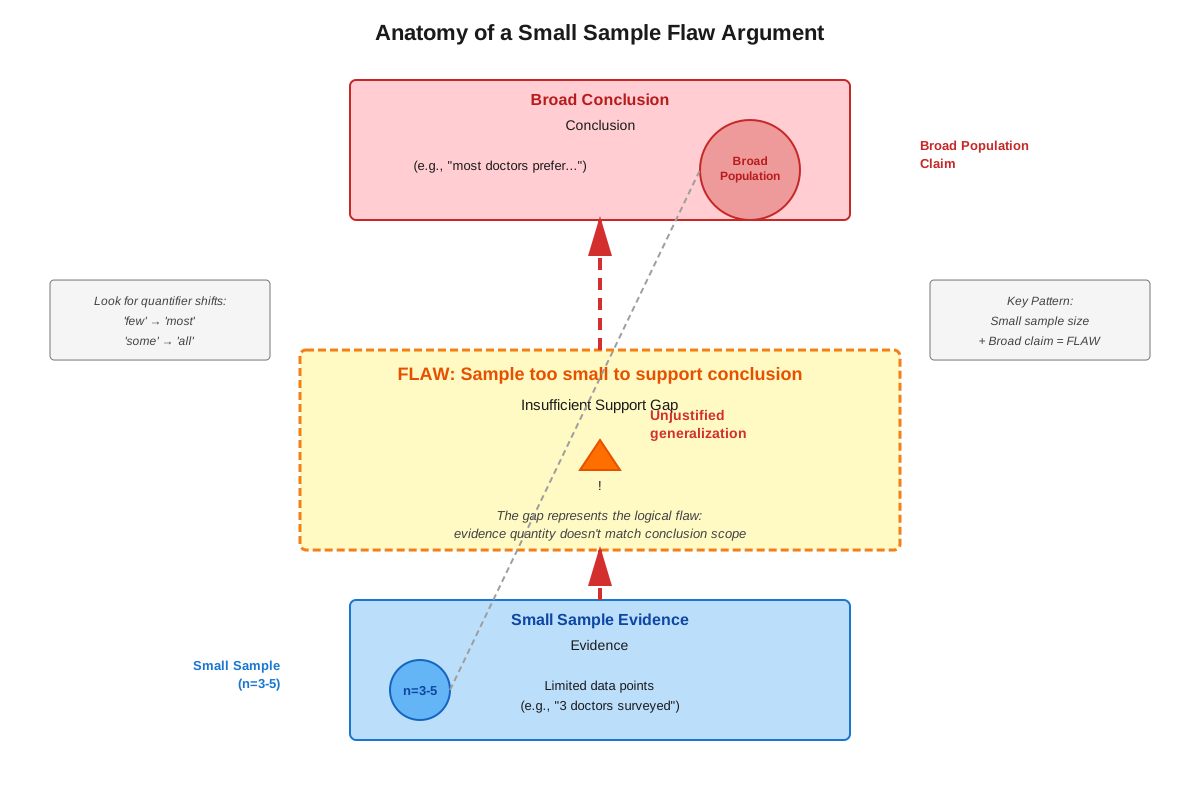
The small sample flaw represents one of the most frequently tested reasoning errors in LSAT Logical Reasoning sections. This flaw occurs when an argument draws a broad conclusion about a large population based on evidence from an inadequately small or unrepresentative sample. Understanding this flaw is essential because it appears in multiple question types, including flaw questions, assumption questions, strengthen/weaken questions, and parallel reasoning questions. The LSAT tests this concept because it reflects a fundamental principle of sound reasoning: the evidence supporting a conclusion must be sufficiently robust and representative to justify the scope of that conclusion.
The lsat small sample flaw manifests in arguments that make sweeping generalizations from limited observations. For example, an argument might conclude that "most doctors prefer a particular medication" based solely on interviews with three physicians at a single hospital. The reasoning error lies not in the quality of the evidence itself, but in the quantitative and qualitative insufficiency of that evidence relative to the breadth of the conclusion. This flaw is particularly insidious because the evidence presented may be entirely accurate—the problem is that there simply isn't enough of it to support the conclusion being drawn.
Mastering the small sample flaw connects directly to broader Logical Reasoning skills, particularly the ability to evaluate the relationship between premises and conclusions. This flaw often overlaps with representativeness issues, where a sample might be both small and atypical of the larger population. Understanding this flaw also strengthens skills in identifying scope shifts, where conclusions extend beyond what the evidence can reasonably support. The ability to spot small sample flaws quickly and accurately is a high-yield skill that will improve performance across multiple question types and contribute significantly to overall LSAT success.
Learning Objectives
- [ ] Identify how Small sample flaw appears in LSAT questions
- [ ] Explain the reasoning pattern behind Small sample flaw
- [ ] Apply Small sample flaw to solve LSAT-style problems accurately
- [ ] Distinguish between small sample flaws and other statistical reasoning errors
- [ ] Evaluate whether a given sample size is sufficient for a particular conclusion
- [ ] Recognize trigger language that signals potential small sample flaws in arguments
- [ ] Predict correct answer choices that accurately describe small sample flaws
Prerequisites
- Basic argument structure: Understanding premises, conclusions, and how evidence supports claims is essential because small sample flaws involve a mismatch between evidence quantity and conclusion scope
- Scope recognition: The ability to identify when conclusions extend beyond their evidence base helps recognize when sample size becomes problematic
- General flaw question format: Familiarity with how flaw questions are structured and what answer choices typically look like enables efficient application of small sample flaw recognition
- Quantifier understanding: Recognizing the difference between "some," "most," "all," and other quantifiers is crucial because small sample flaws often involve inappropriate quantifier shifts
Why This Topic Matters
The small sample flaw appears with remarkable frequency on the LSAT, making it one of the highest-yield topics for test preparation. Statistical analysis of recent LSAT administrations suggests that small sample flaws or closely related sampling issues appear in approximately 10-15% of Logical Reasoning questions across both sections. This translates to roughly 5-8 questions per test, making it one of the most commonly tested reasoning errors. The flaw appears most frequently in dedicated flaw questions but also surfaces in strengthen/weaken questions, assumption questions, and occasionally in parallel reasoning questions.
Beyond exam performance, understanding small sample flaws develops critical thinking skills essential for legal reasoning and everyday decision-making. Attorneys must constantly evaluate whether evidence is sufficient to support legal conclusions, whether witness testimony represents broader patterns, and whether statistical claims in cases are based on adequate data. The ability to identify insufficient evidence protects against faulty reasoning in contract negotiations, jury arguments, and case strategy development.
On the LSAT, small sample flaws typically appear in arguments about consumer preferences, scientific studies, survey results, expert opinions, and behavioral patterns. Common scenarios include: a company concluding that customers prefer a product based on feedback from a handful of buyers; a researcher generalizing about a species from observing a few individuals; a politician claiming public support based on conversations with a small group; or an administrator making policy decisions based on limited pilot program results. Recognizing these patterns enables rapid identification during timed test conditions.
Core Concepts
Definition and Structure of Small Sample Flaw
The small sample flaw occurs when an argument uses evidence from an insufficient number of cases to support a conclusion about a larger group or general pattern. The logical structure follows this pattern: Evidence is gathered from a small subset of a population (the sample), and a conclusion is drawn that applies to the entire population or makes a broad generalization. The flaw lies in the quantitative inadequacy—there simply aren't enough data points to reliably support the scope of the conclusion.
This flaw differs from other reasoning errors because the evidence itself may be entirely accurate and relevant. If an argument states that three doctors prefer medication X, those three doctors may genuinely prefer that medication. The problem is not with the truth of the premises but with the inferential leap from "three doctors prefer X" to "doctors generally prefer X" or "most doctors prefer X." The sample size creates an unjustified gap between evidence and conclusion.
Components of Sample Size Reasoning
Understanding small sample flaws requires recognizing three critical components: the sample (the group actually observed or studied), the population (the larger group about which conclusions are drawn), and the conclusion scope (how broadly the argument generalizes). A valid argument requires proportionality between these elements—larger populations and broader conclusions demand larger, more representative samples.
| Component | Definition | Example |
|---|---|---|
| Sample | The specific cases examined | 5 customers surveyed |
| Population | The total group of interest | All customers nationwide |
| Conclusion Scope | How broadly the argument generalizes | "Most customers prefer..." |
| Required Relationship | Sample must be adequate for population and scope | 5 customers cannot support "most customers nationwide" |
Quantitative vs. Qualitative Insufficiency
Small sample flaws can manifest as purely quantitative insufficiency (too few cases) or combined quantitative and qualitative insufficiency (too few cases that are also unrepresentative). Pure quantitative insufficiency occurs when the sample, while potentially representative, is simply too small to support statistical reliability. For example, surveying 10 randomly selected voters from across the country might give a representative cross-section, but 10 people cannot reliably predict national election outcomes.
Qualitative insufficiency involves representativeness problems—the sample may be drawn from an atypical subset of the population. However, when the LSAT specifically tests the small sample flaw, the focus is typically on the numerical inadequacy. Arguments that combine small samples with obvious representativeness problems may be testing multiple flaws simultaneously, and test-takers must identify which flaw the question specifically asks about.
Recognizing Conclusion Strength
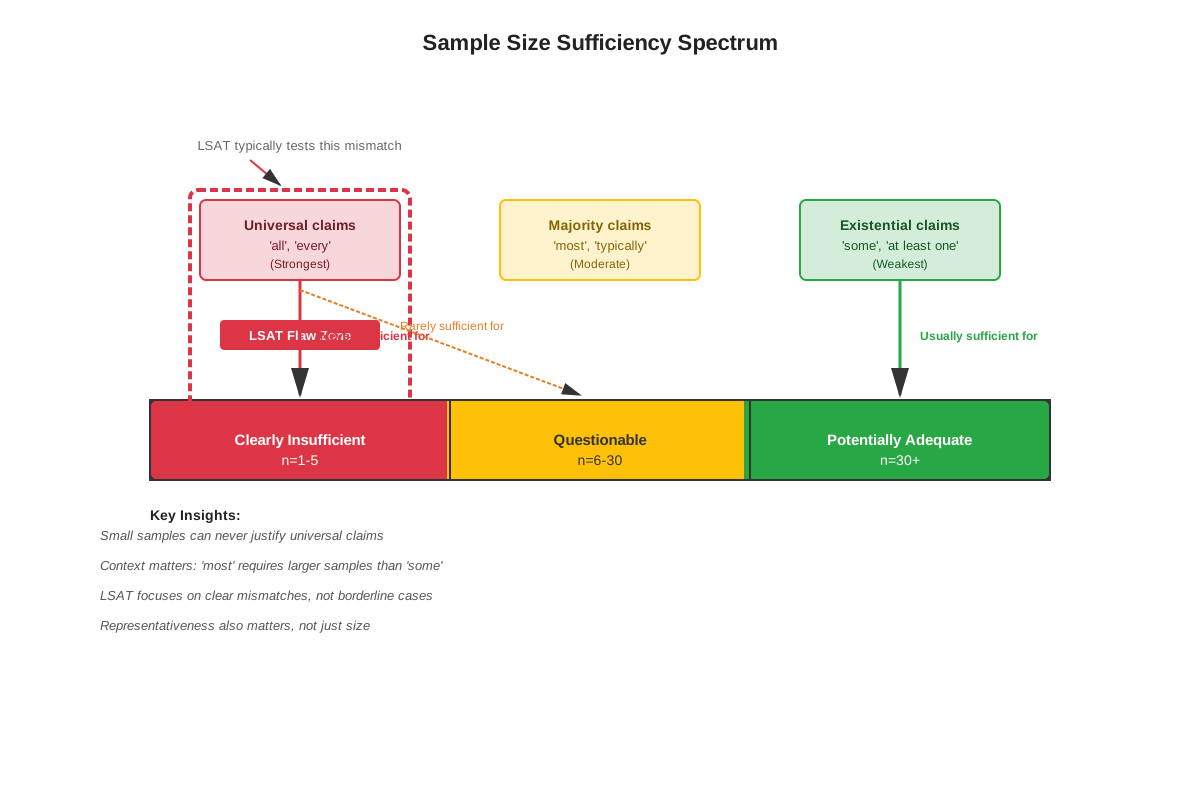
The severity of a small sample flaw depends heavily on the strength of the conclusion. Stronger conclusions require more evidence. An argument concluding that "some members of a group have a characteristic" requires less evidence than one concluding "most members have that characteristic," which in turn requires less evidence than "all members have that characteristic." The LSAT frequently tests whether students recognize this proportional relationship.
Consider these conclusion types in order of increasing evidential demand:
- "At least one X has property Y" (requires minimal evidence)
- "Some Xs have property Y" (requires limited evidence)
- "Many Xs have property Y" (requires moderate evidence)
- "Most Xs have property Y" (requires substantial evidence)
- "All Xs have property Y" (requires comprehensive evidence)
A sample of three cases might adequately support conclusion type 1 or 2, but the same sample would be grossly insufficient for conclusions 4 or 5. The LSAT tests whether students can evaluate this proportionality.
Trigger Patterns in Arguments
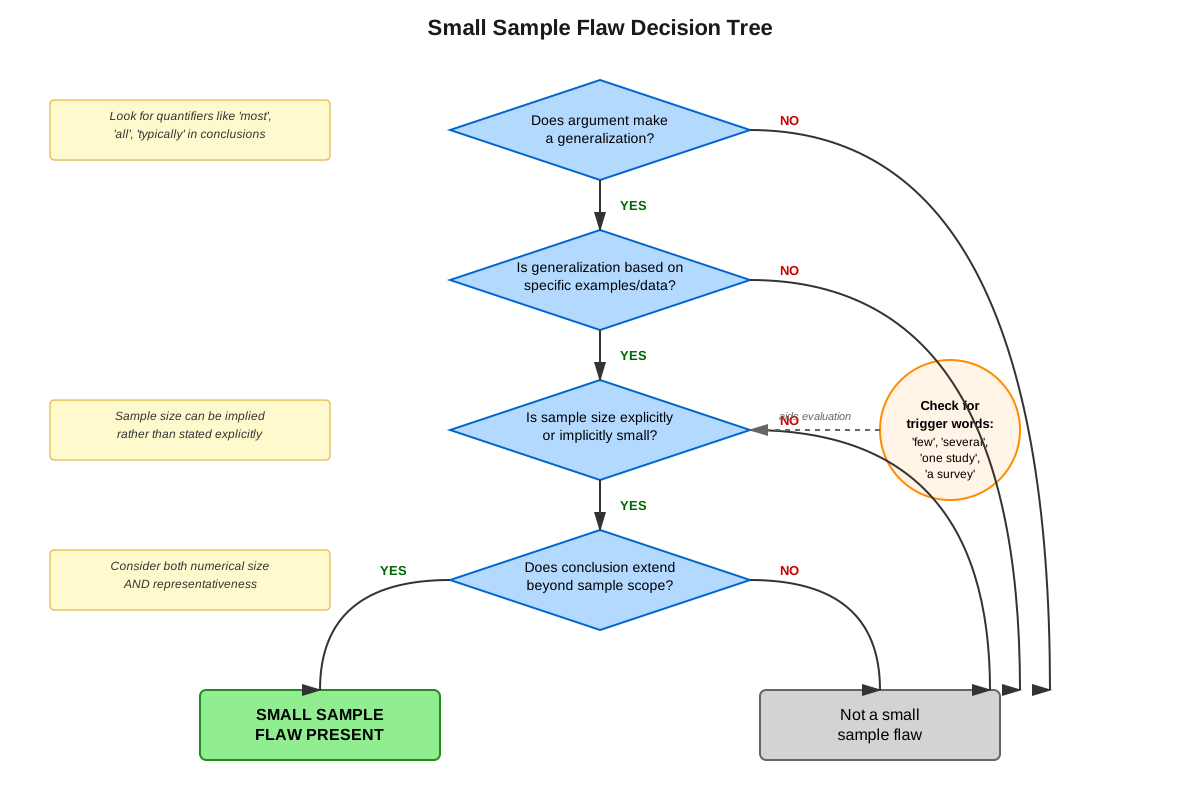
Small sample flaw arguments typically follow recognizable patterns. The argument presents specific evidence (often using concrete numbers or specific cases), then draws a general conclusion (often using quantifiers like "most," "generally," "typically," or "usually"). Key trigger phrases include: "based on a survey of," "interviews with," "a study of," "observations of," "feedback from," and "data from." When these phrases are followed by small numbers or limited contexts, small sample flaws should be suspected.
The argument structure often follows this template: "A study examined [small number] of [specific cases]. Therefore, [broad conclusion about larger population]." The gap between the small number and the broad conclusion creates the flaw. Recognizing this template enables rapid identification during timed conditions.
Concept Relationships
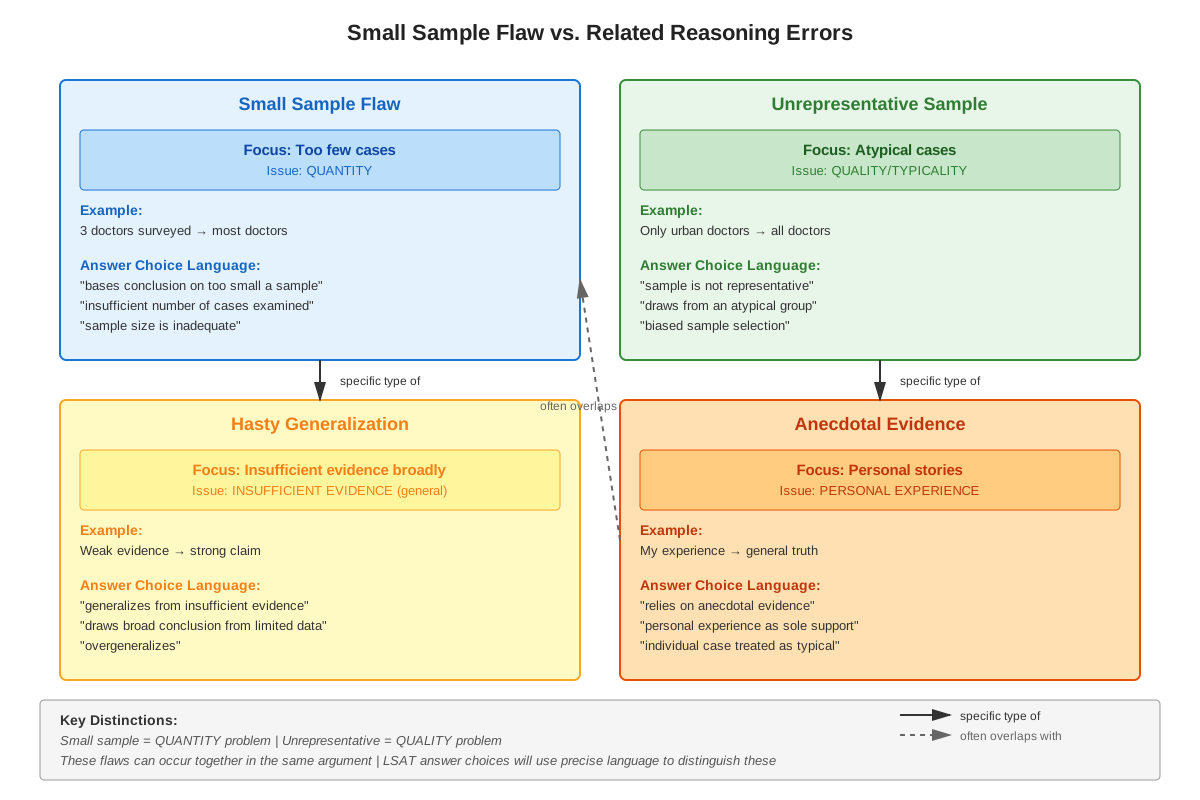
The small sample flaw connects intimately with several other logical reasoning concepts. Most directly, it relates to representativeness flaws, where samples are not just small but also atypical. While these are distinct flaws, they often appear together—a small sample is more likely to be unrepresentative simply due to random variation. Understanding small sample flaws helps identify representativeness issues because both involve evaluating the relationship between evidence and population-level conclusions.
The small sample flaw also connects to scope problems more broadly. Scope shifts occur when conclusions extend beyond what premises support, and small sample flaws represent a specific type of scope shift where the quantitative limitation of evidence creates the gap. This relationship can be mapped as: Insufficient Evidence → Scope Shift → Unjustified Conclusion. The small sample flaw is one pathway through which scope shifts occur.
Additionally, small sample flaws relate to hasty generalization, a broader category of reasoning errors. Hasty generalization encompasses any premature conclusion drawn from insufficient evidence, while small sample flaw specifically involves numerical inadequacy of cases examined. The relationship is hierarchical: Small Sample Flaw → Hasty Generalization → Insufficient Evidence Flaws. Understanding this hierarchy helps in selecting answer choices, as more specific descriptions (small sample) are typically preferred over more general ones (hasty generalization) when both accurately describe the flaw.
The concept also connects to strengthen and weaken questions. Information that a sample was larger than initially indicated would strengthen an argument vulnerable to small sample criticism. Conversely, information revealing that a sample was smaller than suggested would weaken such arguments. This bidirectional relationship means that mastering small sample flaws improves performance on multiple question types beyond just flaw identification.
High-Yield Facts
⭐ The small sample flaw occurs when an argument draws a broad conclusion about a population based on an inadequately small sample of that population
⭐ The flaw focuses on quantitative insufficiency—the number of cases examined is too small to support the conclusion's scope
⭐ Stronger conclusions (using "most," "all," "generally") require larger samples than weaker conclusions (using "some," "at least one")
⭐ The evidence in small sample flaw arguments may be entirely accurate—the problem is insufficient quantity, not quality
⭐ Small sample flaws appear in approximately 10-15% of Logical Reasoning questions, making them one of the highest-yield flaw types
- Small sample flaws often appear in arguments about surveys, studies, observations, interviews, and feedback collection
- Trigger phrases include "based on a survey of," "interviews with," "a study of," and "observations of" followed by small numbers
- The flaw can be corrected by either gathering more evidence or weakening the conclusion to match the evidence available
- Small sample flaws differ from representativeness flaws, though both can appear in the same argument
- Answer choices describing small sample flaws often use language like "insufficient evidence," "too few cases," "inadequate sample," or "limited observations"
Quick check — test yourself on Small sample flaw so far.
Try Flashcards →Common Misconceptions
Misconception: Any argument using a small number automatically commits a small sample flaw → Correction: The flaw depends on the relationship between sample size and conclusion scope. A small sample can adequately support a limited conclusion (e.g., "at least some members of the group have this property"), but cannot support a broad generalization (e.g., "most members of the group have this property").
Misconception: Small sample flaws and representativeness flaws are the same thing → Correction: These are distinct flaws. Small sample flaws involve insufficient quantity of evidence, while representativeness flaws involve evidence drawn from an atypical subset. An argument can have a large but unrepresentative sample (representativeness flaw without small sample flaw) or a small but potentially representative sample (small sample flaw without obvious representativeness problems).
Misconception: If the evidence is true, there's no flaw in the reasoning → Correction: Small sample flaws concern the sufficiency of evidence, not its accuracy. The premises can be entirely true—three doctors really do prefer medication X—but this true evidence is insufficient to conclude that doctors generally prefer medication X. Truth of premises does not guarantee adequacy of evidence quantity.
Misconception: Any mention of numbers in an argument indicates a small sample flaw → Correction: Numbers alone don't create the flaw. The argument must draw a conclusion that extends beyond what those numbers can support. An argument stating "three doctors were surveyed, and at least one preferred medication X" would not commit a small sample flaw because the conclusion matches the evidence scope.
Misconception: Larger samples always eliminate small sample flaws → Correction: Whether a sample is "large enough" depends on the population size, conclusion strength, and variability within the population. A sample of 100 might be adequate for some conclusions but inadequate for others. The key is proportionality between evidence and conclusion, not absolute sample size.
Misconception: Small sample flaws only appear in flaw questions → Correction: While most common in flaw questions, small sample reasoning appears in strengthen/weaken questions (where additional sample data would strengthen or weaken arguments), assumption questions (where adequate sample size might be a necessary assumption), and occasionally in other question types. Recognizing the pattern across question types improves overall performance.
Worked Examples
Example 1: Consumer Preference Argument
Argument: "A technology company surveyed five customers who purchased their new smartphone model. All five customers reported being satisfied with their purchase. Therefore, the company can confidently conclude that most customers who purchase this smartphone model will be satisfied with it."
Analysis Process:
Step 1 - Identify the conclusion: "Most customers who purchase this smartphone model will be satisfied with it." Note the quantifier "most" and the broad scope applying to all customers purchasing the model.
Step 2 - Identify the evidence: Five customers were surveyed, and all five reported satisfaction. The evidence is specific and limited in scope.
Step 3 - Evaluate the gap: The conclusion applies to "most customers" (a large group), but the evidence comes from only five customers. This is a dramatic scope shift from a tiny sample to a broad generalization.
Step 4 - Identify the flaw: This is a clear small sample flaw. Five customers cannot provide sufficient evidence to conclude what "most customers" will experience. Even if these five customers are genuinely satisfied (making the premise true), the sample size is inadequate for the conclusion's scope.
Step 5 - Consider what would fix the flaw: The argument could be strengthened by surveying many more customers, or the conclusion could be weakened to something like "at least some customers are satisfied" which the evidence would adequately support.
Connection to Learning Objectives: This example demonstrates how to identify small sample flaws (Objective 1), explains the reasoning pattern of drawing broad conclusions from limited evidence (Objective 2), and shows the application process for LSAT-style problems (Objective 3).
Example 2: Scientific Study Argument
Argument: "Researchers studying the migration patterns of Arctic terns observed three individual birds over the course of one migration season. All three birds traveled from the Arctic to Antarctica, covering approximately 25,000 miles. The researchers concluded that Arctic terns generally travel about 25,000 miles during migration."
Analysis Process:
Step 1 - Identify the conclusion: "Arctic terns generally travel about 25,000 miles during migration." The word "generally" indicates a broad claim about the species as a whole.
Step 2 - Identify the evidence: Three individual birds were observed during one season, and all traveled approximately 25,000 miles.
Step 3 - Evaluate proportionality: Arctic terns are a species with potentially thousands or millions of individuals. Three birds represent an infinitesimally small fraction of the population. Additionally, only one migration season was observed, though this relates more to temporal representativeness.
Step 4 - Identify the flaw: This commits a small sample flaw. Three individuals cannot provide adequate evidence for a conclusion about what the species "generally" does. While the three birds observed might genuinely have traveled 25,000 miles (true premises), this sample is too small to support a generalization about the species.
Step 5 - Distinguish from related flaws: This argument might also have representativeness issues (perhaps these three birds were atypical), but the primary flaw is the small sample size. Even if these three birds were randomly selected and perfectly representative, three cases cannot support a conclusion about general species behavior.
Step 6 - Consider answer choice language: Correct answer choices might state: "bases a general claim about a species on observations of only a few members of that species," "draws a broad conclusion from an inadequate number of cases," or "generalizes from too small a sample."
Connection to Learning Objectives: This example shows small sample flaw identification in a scientific context (Objective 1), demonstrates the reasoning pattern (Objective 2), illustrates the application process (Objective 3), and helps distinguish small sample from representativeness flaws (Objective 4).
Exam Strategy
When approaching LSAT questions involving potential small sample flaws, employ a systematic evaluation process. First, quickly identify whether the argument involves any numerical evidence or references to studies, surveys, observations, or data collection. These are prime candidates for small sample flaws. Second, locate the conclusion and note its scope—look specifically for quantifiers like "most," "generally," "typically," "usually," or "all" that indicate broad generalizations.
Trigger words and phrases that should immediately activate small sample flaw awareness include: "a survey of," "interviews with," "a study of," "observations of," "based on data from," "feedback from," "a sample of," and any specific small numbers (especially single digits). When these phrases appear in premises followed by broad conclusions, small sample flaws are highly likely.
For process of elimination on flaw questions, eliminate answer choices that describe flaws not present in the argument. If an argument clearly commits a small sample flaw, eliminate choices describing circular reasoning, ad hominem attacks, false dichotomies, or other unrelated flaws. Be careful with answer choices that describe "unrepresentative sample" or "biased sample"—these describe representativeness flaws, not small sample flaws, unless the answer choice specifically mentions insufficient quantity or number of cases.
Time allocation for small sample flaw questions should be efficient because these flaws are relatively straightforward to identify once the pattern is recognized. Spend approximately 15-20 seconds identifying the argument structure, 10-15 seconds confirming the small sample flaw, and 30-40 seconds evaluating answer choices. If you've correctly identified the flaw, the right answer should be apparent relatively quickly. If you're spending more than 90 seconds total on a small sample flaw question, you may be overthinking it.
Exam Tip: When you see specific small numbers in premises (especially 3-10 cases) followed by conclusions using "most," "generally," or "typically," you've likely found a small sample flaw. This pattern appears so frequently that recognizing it becomes almost automatic with practice.
For strengthen/weaken questions involving small sample issues, remember that information about sample size directly impacts argument strength. Evidence that a sample was larger than initially suggested strengthens arguments vulnerable to small sample criticism. Evidence that a sample was smaller, or that the conclusion was drawn from fewer cases than implied, weakens such arguments. This bidirectional relationship makes small sample recognition valuable across multiple question types.
Memory Techniques
Mnemonic for identifying small sample flaws: "SCOPE"
- Small number in premises
- Conclusion that's broad
- Observe the gap between them
- Premises can't support the
- Extensive claim being made
Visualization strategy: Picture a tiny fishing net (representing the small sample) trying to capture information about an entire ocean (representing the population). The net might catch a few fish accurately, but those few fish cannot tell you about the entire ocean's fish population. This image reinforces that small samples, while potentially accurate for what they capture, cannot support broad conclusions.
Acronym for answer choice evaluation: "QUIN" - When evaluating whether an answer choice correctly describes a small sample flaw, check if it mentions:
- QUantity (insufficient number, too few cases)
- Inadequate (inadequate evidence, inadequate sample)
- Number (limited number of observations, small number of cases)
Pattern recognition phrase: "Few cases, broad conclusion = small sample flaw." This simple formula captures the essential pattern and can be mentally repeated when scanning arguments for flaws.
Summary
The small sample flaw represents a critical reasoning error where arguments draw broad conclusions about populations based on inadequately small samples. This flaw appears frequently on the LSAT, making it essential for test success. The core issue is quantitative insufficiency—the number of cases examined cannot support the scope of the conclusion drawn. Understanding this flaw requires recognizing three elements: the sample size, the population about which conclusions are drawn, and the strength of the conclusion. Stronger conclusions using quantifiers like "most," "generally," or "all" require substantially larger samples than weaker conclusions using "some" or "at least one." The flaw is identifiable through trigger patterns where specific small numbers or limited observations in premises are followed by broad generalizations in conclusions. While the evidence presented may be entirely accurate, accuracy does not compensate for insufficient quantity. Mastering small sample flaw recognition improves performance across multiple question types including flaw questions, strengthen/weaken questions, and assumption questions, making it one of the highest-yield topics in LSAT preparation.
Key Takeaways
- The small sample flaw occurs when broad conclusions are drawn from quantitatively insufficient evidence, regardless of evidence accuracy
- Approximately 10-15% of Logical Reasoning questions involve small sample flaws or related sampling issues, making this a high-yield topic
- The severity of the flaw depends on the relationship between sample size and conclusion scope—stronger conclusions require larger samples
- Trigger phrases like "based on a survey of," "interviews with," and "observations of" followed by small numbers signal potential small sample flaws
- Small sample flaws differ from representativeness flaws; the former concerns quantity of evidence while the latter concerns typicality
- Correct answer choices typically use language like "insufficient evidence," "too few cases," "inadequate sample," or "limited number of observations"
- Recognizing small sample patterns enables efficient question analysis and improves time management on test day
Related Topics
Representativeness Flaws: While small sample flaws focus on quantity of evidence, representativeness flaws concern whether samples are typical of the populations they're meant to represent. Mastering small sample flaws provides a foundation for understanding representativeness issues, as both involve evaluating the relationship between samples and populations.
Hasty Generalization: This broader category encompasses all premature conclusions drawn from insufficient evidence. Understanding small sample flaws as a specific type of hasty generalization helps in recognizing the hierarchical relationship between specific and general flaw types.
Statistical Reasoning: Small sample flaws represent one aspect of statistical reasoning errors on the LSAT. Other statistical issues include correlation/causation confusion, percentage vs. absolute number confusion, and baseline rate neglect. Mastering small sample flaws builds skills applicable to these related statistical reasoning topics.
Strengthen and Weaken Questions: Understanding small sample flaws directly improves performance on strengthen/weaken questions where information about sample size affects argument strength. This topic enables progression to more complex question types involving evidence evaluation.
Practice CTA
Now that you've mastered the conceptual foundation of small sample flaws, it's time to cement your understanding through active practice. Attempt the practice questions designed specifically for this topic, focusing on applying the systematic evaluation process outlined in this guide. As you work through problems, consciously identify the sample size, population, and conclusion scope in each argument. Use the flashcards to reinforce trigger patterns and answer choice language until recognition becomes automatic. Remember that small sample flaw recognition is a high-yield skill that will serve you across multiple question types—your investment in practice now will pay dividends throughout your LSAT preparation and on test day. You've built the foundation; now build the speed and confidence that come from application!
Sign up free to keep reading
Create a free AnvayaPrep account to finish this LSAT guide on Small sample flaw — plus flashcards and practice questions.