Overview
The temporal flaw represents one of the most frequently tested reasoning errors on the LSAT Logical Reasoning section. This flaw occurs when an argument makes an unjustified assumption about the timing, sequence, or duration of events. Specifically, arguments commit a temporal flaw when they confuse correlation with causation based on timing, assume that what was true in the past must remain true in the present or future, or fail to consider that temporal relationships might be reversed or coincidental. Understanding this flaw is essential because it appears in approximately 10-15% of all flaw questions on the LSAT, making it one of the highest-yield error patterns to master.
The temporal flaw is particularly insidious because temporal reasoning feels intuitive—we naturally think in terms of before and after, cause and effect. However, the LSAT exploits this intuition by presenting arguments that make subtle temporal assumptions that don't hold up under scrutiny. For instance, an argument might observe that Event A occurred before Event B and conclude that A caused B, ignoring the possibility of reverse causation, common causes, or mere coincidence. Alternatively, an argument might assume that because a trend existed historically, it will continue indefinitely into the future.
Within the broader landscape of Logical Reasoning concepts, temporal flaws connect closely to causal reasoning errors, sampling flaws, and prediction problems. Mastering temporal flaws strengthens the ability to identify other common LSAT errors, particularly those involving necessary versus sufficient conditions, correlation versus causation, and the scope of evidence. This topic serves as a gateway to understanding how the LSAT tests critical thinking about change, stability, and the relationship between past, present, and future states.
Learning Objectives
- [ ] Identify how Temporal flaw appears in LSAT questions
- [ ] Explain the reasoning pattern behind Temporal flaw
- [ ] Apply Temporal flaw to solve LSAT-style problems accurately
- [ ] Distinguish temporal flaws from other causal reasoning errors
- [ ] Recognize the specific language patterns that signal temporal assumptions
- [ ] Evaluate whether temporal evidence adequately supports temporal conclusions
- [ ] Predict answer choice patterns for temporal flaw questions
Prerequisites
- Basic argument structure: Understanding premises, conclusions, and how they connect is essential because temporal flaws involve faulty connections between temporally-ordered evidence and conclusions.
- Causal reasoning fundamentals: Temporal flaws often overlap with causal errors, so recognizing basic causal relationships helps distinguish when timing creates the logical problem.
- Flaw question format: Familiarity with how flaw questions are asked and structured allows focus on identifying the specific temporal error rather than the question type itself.
- Conditional logic basics: Some temporal flaws involve confusing temporal sequence with logical necessity, requiring understanding of sufficient and necessary conditions.
Why This Topic Matters
Temporal reasoning pervades everyday decision-making, from business forecasting to policy evaluation to personal planning. The ability to critically evaluate temporal assumptions prevents costly errors in judgment. When a company assumes past growth trends will continue, when a policy maker assumes historical solutions will work for current problems, or when an individual assumes correlation implies causation based solely on timing—all commit variations of temporal flaws. The LSAT tests this skill because legal reasoning constantly requires evaluating evidence about past events, predicting future outcomes, and assessing whether temporal relationships support legal conclusions.
On the LSAT, temporal flaws appear in approximately 3-5 questions per test, distributed across both Logical Reasoning sections. They most commonly appear in Flaw questions (where test-takers must identify the error), but also surface in Weaken questions (where understanding the temporal assumption helps identify what would undermine it), Assumption questions (where the temporal gap must be bridged), and occasionally in Strengthen or Evaluate questions. The LSAT particularly favors temporal flaws in arguments about scientific studies, historical trends, business predictions, and policy recommendations.
Common manifestations include: arguments that assume past conditions remain unchanged; arguments that confuse temporal sequence with causation; arguments that extrapolate trends without justification; arguments that ignore the possibility of temporal coincidence; and arguments that fail to consider relevant time-related variables. Recognizing these patterns dramatically improves accuracy on multiple question types.
Core Concepts
The Basic Structure of Temporal Flaws
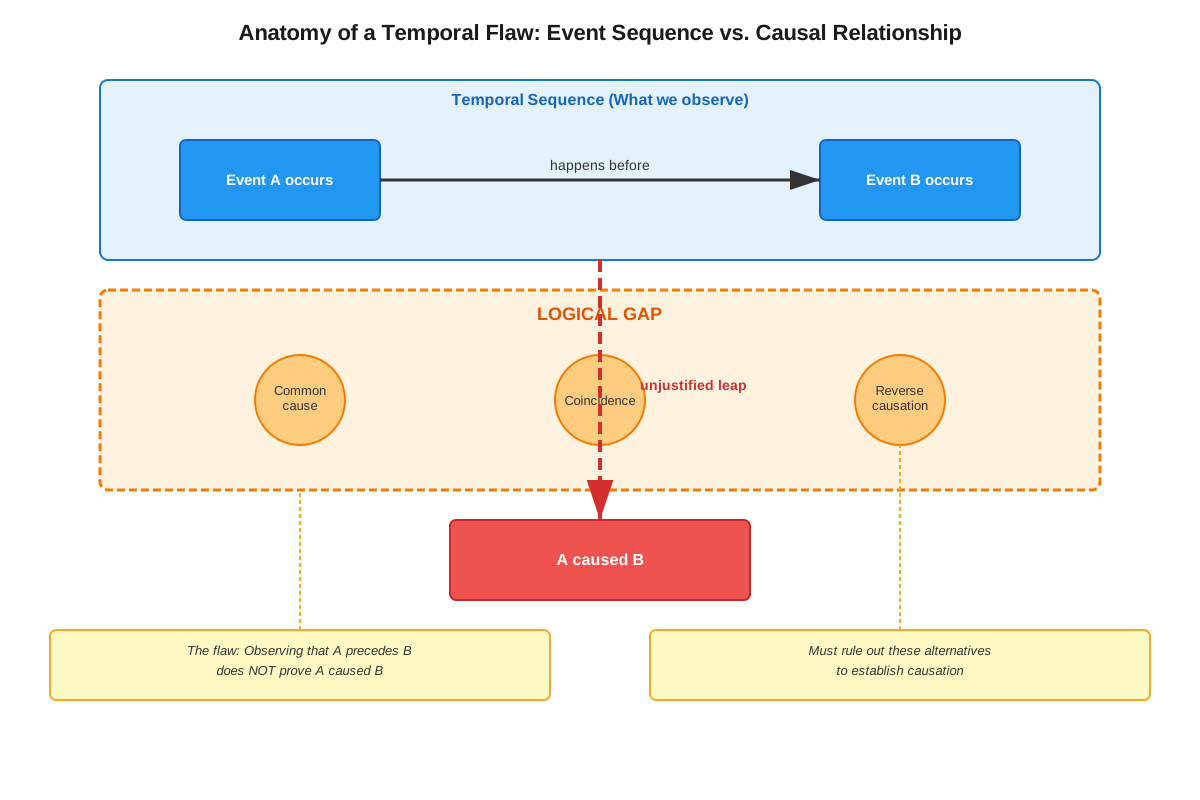
A temporal flaw occurs when an argument's reasoning depends on an unjustified assumption about time, timing, sequence, duration, or temporal relationships. The core error involves treating temporal information as if it provides stronger logical support than it actually does. Every temporal flaw contains three elements: (1) evidence about timing or temporal relationships, (2) a conclusion that depends on temporal assumptions, and (3) a gap where the temporal reasoning fails to justify the conclusion.
The most fundamental form involves post hoc reasoning—the assumption that because Event A preceded Event B, Event A caused Event B. This Latin phrase "post hoc ergo propter hoc" means "after this, therefore because of this." While temporal sequence is often necessary for causation (causes typically precede effects), it is never sufficient to establish causation. Countless alternative explanations exist: reverse causation, common causes, coincidence, or intervening factors.
Types of Temporal Flaws
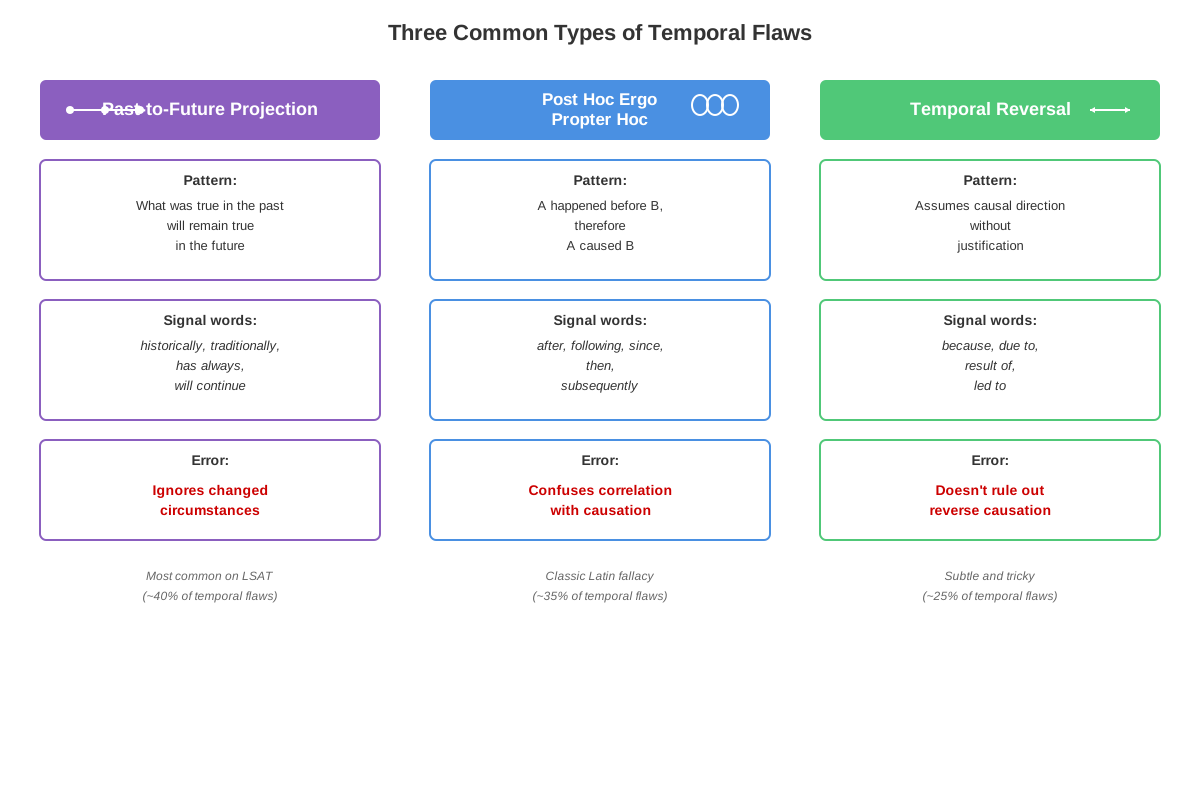
Past-to-Present/Future Projection Flaws occur when arguments assume that conditions, trends, or relationships that held in the past will continue unchanged into the present or future. For example: "Company X's profits increased 10% annually for the past five years. Therefore, profits will increase 10% next year." This reasoning ignores that circumstances change, trends reverse, and past performance doesn't guarantee future results.
Temporal Correlation to Causation Flaws involve observing that two phenomena occur together in time and concluding one causes the other. The argument might note that ice cream sales and drowning deaths both peak in summer and conclude (absurdly) that ice cream causes drowning. The flaw lies in ignoring common causes (hot weather causes both), coincidence, or other temporal relationships.
Reversed Temporal Sequence Flaws occur when arguments assume a particular temporal order without justification or ignore the possibility of reverse causation. An argument might observe that successful students tend to have high confidence and conclude that confidence causes success, ignoring that success might cause confidence instead.
Temporal Scope Flaws involve mismatching the timeframe of evidence with the timeframe of the conclusion. An argument might cite a study conducted over three months to support a conclusion about long-term effects, or use historical data from decades ago to support claims about current conditions without justifying the temporal leap.
Rate vs. Absolute Change Flaws confuse the rate of change with absolute amounts over time. An argument might note that City A's crime rate is increasing faster than City B's and conclude City A has more crime, ignoring that City B might have started with much higher absolute crime levels.
Identifying Temporal Assumptions
Temporal flaws rest on hidden assumptions about time. Common temporal assumptions include:
- The assumption that current conditions match past conditions
- The assumption that observed trends will continue linearly
- The assumption that temporal sequence indicates causal direction
- The assumption that the timeframe of evidence matches the timeframe of the conclusion
- The assumption that no relevant changes occurred during the time period in question
- The assumption that temporal correlation isn't coincidental
Identifying these assumptions requires asking: What must be true about time, timing, or temporal relationships for this conclusion to follow from this evidence? What temporal factors could undermine this reasoning?
Temporal Language Patterns
The LSAT uses specific language to signal temporal reasoning and temporal flaws. Key phrases include:
| Temporal Signal | What It Indicates | Potential Flaw |
|---|---|---|
| "has always been," "historically" | Past-to-future projection | Assumes past continues unchanged |
| "before," "after," "then" | Temporal sequence | May confuse sequence with causation |
| "trend," "pattern," "consistently" | Observed regularity | May assume trend continues |
| "will," "is likely to," "should" | Future prediction | May lack justification for temporal leap |
| "since," "as," "when" | Temporal correlation | May confuse correlation with causation |
| "previously," "formerly," "used to" | Past conditions | May assume conditions remain relevant |
The Temporal Reasoning Process
To evaluate temporal reasoning:
- Identify the temporal elements: What evidence involves time, timing, or temporal relationships? What temporal claims appear in the conclusion?
- Map the temporal structure: Create a timeline of events, conditions, or trends mentioned in the argument. Note what happened when.
- Identify temporal gaps: What assumptions connect the temporal evidence to the conclusion? What must be true about time for the reasoning to work?
- Consider alternatives: What other temporal relationships could explain the evidence? Could timing be coincidental? Could causation be reversed? Could conditions have changed?
- Evaluate temporal scope: Does the timeframe of the evidence match the timeframe of the conclusion? Is the temporal sample representative?
Concept Relationships
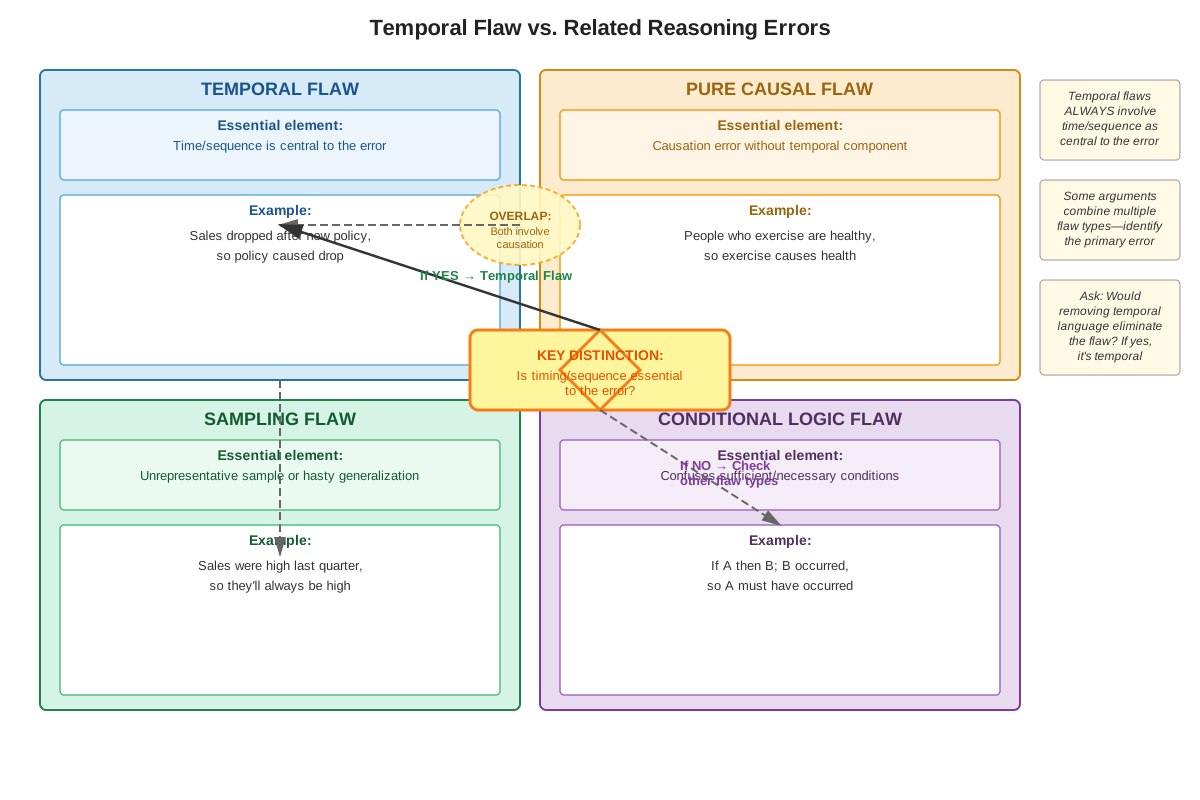
Temporal flaws connect intimately with causal reasoning errors. The relationship flows: Temporal observation → Temporal assumption → Causal or predictive conclusion. When the temporal assumption is unjustified, a temporal flaw occurs. This often overlaps with causal flaws, but the distinguishing feature is that the error specifically involves reasoning about time.
Temporal flaws also relate to sampling flaws when the temporal sample (data from a particular time period) doesn't represent the temporal scope of the conclusion. For instance, using summer data to draw conclusions about year-round patterns commits both a temporal and sampling error.
The connection to necessary and sufficient conditions appears when arguments confuse temporal sequence (A before B) with logical necessity (A necessary for B) or sufficiency (A sufficient for B). Temporal priority is neither necessary nor sufficient for causation, though arguments often treat it as if it were.
Scope flaws frequently involve temporal mismatches—the evidence covers one time period while the conclusion addresses another. Understanding temporal flaws enhances recognition of scope problems generally.
The relationship map: Temporal Evidence → requires → Temporal Assumption → to support → Temporal/Causal Conclusion. The flaw exists in the gap between evidence and assumption, where temporal reasoning breaks down.
High-Yield Facts
⭐ Temporal sequence alone never proves causation—just because A preceded B doesn't mean A caused B; alternative explanations always exist.
⭐ Past trends don't guarantee future continuation—arguments assuming historical patterns will persist commit temporal projection flaws unless they justify why conditions remain constant.
⭐ Temporal correlation requires explanation—when two phenomena occur together in time, multiple relationships are possible: A causes B, B causes A, C causes both, or coincidence.
⭐ The timeframe of evidence must match the timeframe of the conclusion—using short-term data for long-term conclusions or vice versa creates temporal scope problems.
⭐ "After" doesn't mean "because of"—post hoc reasoning is one of the most common temporal flaws on the LSAT.
- Temporal flaws appear in approximately 10-15% of flaw questions, making them high-yield for study.
- Arguments about trends, predictions, historical comparisons, and scientific studies frequently contain temporal flaws.
- Reverse causation is a common alternative explanation that temporal flaw arguments ignore.
- Common causes (confounding variables) often explain temporal correlations better than direct causation.
- Temporal assumptions can be either explicit (stated in the argument) or implicit (required for the reasoning to work).
- The correct answer to a temporal flaw question often includes words like "assumes," "takes for granted," or "presumes" followed by a description of the temporal assumption.
- Temporal flaws can combine with other flaws—an argument might commit both a temporal flaw and a sampling flaw simultaneously.
- Changes in conditions over time represent the most common weakness in temporal reasoning.
- Rate of change and absolute change are distinct concepts that temporal flaw arguments often confuse.
- The LSAT rarely tests simple, obvious temporal errors; the flaws are usually subtle and require careful analysis.
Quick check — test yourself on Temporal flaw so far.
Try Flashcards →Common Misconceptions
Misconception: If Event A always precedes Event B, then A must cause B.
Correction: Consistent temporal sequence still doesn't prove causation. The rooster crows before sunrise every day, but doesn't cause the sunrise. Correlation, even consistent correlation, requires additional evidence to establish causation.
Misconception: Temporal flaws only appear in arguments explicitly about time.
Correction: Temporal flaws can be subtle and embedded in arguments about causation, prediction, trends, or comparisons. Any argument drawing conclusions about different time periods potentially contains temporal reasoning that could be flawed.
Misconception: If an argument mentions both timing and causation, it automatically commits a temporal flaw.
Correction: Not all temporal reasoning is flawed. Arguments can legitimately use temporal evidence if they provide adequate justification for temporal assumptions. The flaw exists only when temporal assumptions are unjustified.
Misconception: Past data is never relevant to future predictions.
Correction: Past data can support future predictions when arguments justify why past conditions remain relevant. The flaw occurs when arguments assume without justification that the past predicts the future, not when they provide reasons for continuity.
Misconception: Temporal flaws and causal flaws are completely different categories.
Correction: These categories overlap significantly. Many temporal flaws involve faulty causal reasoning based on timing. The distinction is emphasis: temporal flaws specifically involve errors about time, timing, or temporal relationships, while causal flaws more broadly involve errors in establishing causation.
Misconception: Identifying a temporal flaw means finding any mention of time in the argument.
Correction: The temporal flaw must be the logical error that undermines the argument's reasoning. Simply mentioning time or temporal relationships doesn't constitute a flaw; the flaw exists when the temporal reasoning doesn't support the conclusion.
Misconception: Longer time periods always provide better evidence than shorter ones.
Correction: The appropriate timeframe depends on the conclusion. Sometimes short-term data is more relevant (recent trends in technology), while other times long-term data matters more (climate patterns). The flaw involves mismatching timeframes, not using short or long periods per se.
Worked Examples
Example 1: Classic Post Hoc Reasoning
Argument: "After the city installed new streetlights in the downtown area, vandalism decreased by 30%. Therefore, the new streetlights caused the reduction in vandalism."
Analysis:
Step 1 - Identify the temporal structure: The argument presents a temporal sequence: streetlight installation occurred, then vandalism decreased. The conclusion claims causation based on this sequence.
Step 2 - Identify the temporal assumption: The argument assumes that because the decrease followed the installation, the installation caused the decrease. This is classic post hoc reasoning.
Step 3 - Consider alternative explanations: Multiple alternatives exist:
- Coincidence: Vandalism might have decreased for unrelated reasons (seasonal variation, demographic changes)
- Common cause: A third factor (increased police presence, economic improvement) might have caused both the streetlight installation and vandalism reduction
- Other temporal factors: The decrease might have started before installation but only been measured afterward
Step 4 - Articulate the flaw: The argument treats temporal sequence as sufficient evidence for causation without ruling out alternative explanations for the temporal correlation.
Answer choice pattern: The correct answer would state something like: "The argument takes for granted that the decrease in vandalism was caused by the streetlight installation rather than by other factors that might have changed during the same period."
Connection to learning objectives: This example demonstrates how temporal flaws appear in LSAT questions (Objective 1), illustrates the post hoc reasoning pattern (Objective 2), and shows the analytical process for identifying the flaw (Objective 3).
Example 2: Past-to-Future Projection
Argument: "The Acme Corporation's stock price has increased an average of 15% annually for each of the past ten years. Investors should therefore expect similar returns over the next decade."
Analysis:
Step 1 - Identify the temporal structure: Evidence covers the past ten years; conclusion projects to the next ten years. This involves a temporal leap from past to future.
Step 2 - Identify the temporal assumption: The argument assumes that conditions affecting stock performance will remain constant or similar. It assumes past trends predict future results without justification.
Step 3 - Consider what could change: Market conditions, company management, competitive landscape, economic factors, industry disruption, regulatory changes—countless variables could differ between the past decade and the next.
Step 4 - Articulate the flaw: The argument fails to justify why past performance indicates future results. It assumes without warrant that factors driving past growth will continue operating similarly.
Answer choice pattern: The correct answer might state: "The argument presumes, without providing justification, that the conditions that led to past stock price increases will continue to hold in the future."
Distinguishing features: This differs from simple causal flaws because the error specifically involves projecting across time periods. The argument might be strengthened by evidence that relevant conditions remain stable, or weakened by evidence of changing circumstances.
Connection to learning objectives: This example shows a different temporal flaw pattern (past-to-future projection), demonstrates the reasoning structure (Objective 2), and illustrates how to distinguish this from other flaw types (Objective 4).
Exam Strategy
Recognition Triggers
Watch for these linguistic signals that often indicate temporal reasoning and potential temporal flaws:
- Temporal sequence words: "after," "before," "then," "subsequently," "following," "prior to"
- Trend language: "has been increasing," "consistently," "pattern," "historically," "traditionally"
- Predictive language: "will continue," "is likely to," "should," "can be expected to"
- Comparative temporal phrases: "used to," "no longer," "now," "currently," "in the past"
- Causal language following temporal information: "therefore," "thus," "consequently," "as a result"
Exam Tip: When you see temporal sequence words followed by causal conclusion words, immediately suspect a potential temporal flaw. The argument may be committing post hoc reasoning.
Question Approach Process
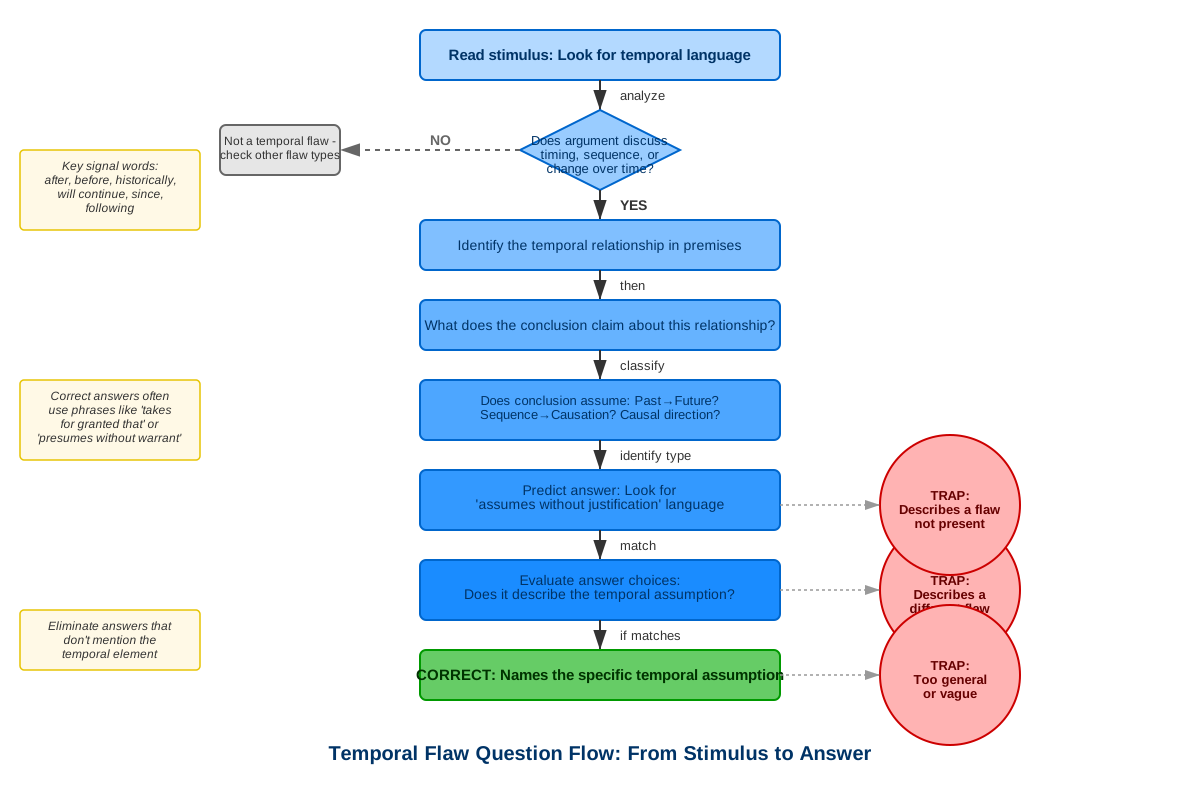
- Read for temporal structure first: As you read the argument, mentally note any temporal elements—what happened when, what trends are mentioned, what time periods are compared.
- Identify the temporal gap: Ask yourself: "What assumption about time connects this evidence to this conclusion?" The gap often involves assuming past equals future, sequence equals causation, or correlation isn't coincidental.
- Pre-phrase the flaw: Before looking at answer choices, articulate the temporal flaw in your own words: "This argument assumes that because X happened before Y, X caused Y" or "This assumes past trends will continue."
- Eliminate non-temporal answers: Many wrong answers describe flaws the argument doesn't commit. Quickly eliminate answers that don't address the temporal reasoning.
- Match your pre-phrase: The correct answer should match your pre-phrased flaw, though it may use more formal or abstract language.
Process of Elimination Tips
Eliminate answers that:
- Describe flaws about sampling, representation, or generalization when the real issue is temporal reasoning
- Focus on term shifts or equivocation when the problem is temporal assumptions
- Mention circular reasoning when the argument makes a temporal leap
- Discuss necessary/sufficient confusion unless the argument specifically confuses temporal sequence with logical necessity
Keep answers that:
- Mention assumptions about past, present, or future relationships
- Discuss causation in the context of temporal sequence
- Reference trends, patterns, or continuity assumptions
- Note the possibility of alternative temporal explanations
- Address the timeframe or duration of evidence versus conclusions
Time Allocation
Temporal flaw questions typically require 1:15-1:30 to complete accurately. Spend:
- 30-40 seconds reading and analyzing the argument
- 10-15 seconds pre-phrasing the flaw
- 30-40 seconds evaluating answer choices
Don't rush temporal flaw questions—the subtle distinction between legitimate temporal reasoning and flawed temporal reasoning requires careful thought. However, if you've correctly identified the temporal assumption, answer choice elimination should proceed quickly.
Memory Techniques
The POST-HOC Acronym
Past doesn't Obligate Same Trends - History Often Changes
This reminds you that past patterns don't guarantee future continuation and that post hoc reasoning (after this, therefore because of this) is fallacious.
The Three T's of Temporal Flaws
Timing (sequence doesn't prove causation)
Trends (past patterns don't guarantee future continuation)
Timeframes (evidence period must match conclusion period)
Visualization Strategy
Picture a timeline with three zones: PAST | PRESENT | FUTURE
When analyzing temporal arguments, visualize placing evidence and conclusions in these zones. If evidence sits in PAST but the conclusion sits in FUTURE, visualize the gap between them—that gap represents the temporal assumption that might be unjustified.
The Rooster Mnemonic
Remember: "The rooster crows before sunrise, but doesn't cause it." This memorable example instantly recalls that temporal sequence doesn't establish causation. When you see post hoc reasoning, think "rooster."
The CHANGE Checklist
When evaluating temporal reasoning, ask: Could conditions have Changed? Are there Hidden causes? Are Alternative explanations possible? Is this Not causation but coincidence? Does the Gap between timeframes need justification? Is the Evidence period appropriate?
Summary
Temporal flaws represent critical reasoning errors involving unjustified assumptions about time, timing, temporal sequence, or temporal relationships. These flaws appear frequently on the LSAT because they test essential critical thinking skills: the ability to distinguish correlation from causation, to recognize that past patterns don't guarantee future results, and to evaluate whether temporal evidence adequately supports temporal conclusions. The most common forms include post hoc reasoning (assuming temporal sequence proves causation), past-to-future projection errors (assuming historical trends continue unchanged), and temporal scope mismatches (using evidence from one timeframe to support conclusions about another). Mastering temporal flaws requires recognizing temporal language patterns, identifying hidden temporal assumptions, considering alternative temporal explanations, and distinguishing legitimate temporal reasoning from flawed temporal reasoning. Success on temporal flaw questions depends on systematic analysis: mapping the temporal structure, identifying the temporal gap, considering what could change or differ across time periods, and matching answer choices to the specific temporal assumption the argument fails to justify.
Key Takeaways
- Temporal sequence never proves causation by itself—"after" doesn't mean "because of," and post hoc reasoning is always fallacious without additional evidence.
- Past trends require justification to predict future results—arguments assuming historical patterns continue unchanged commit temporal projection flaws unless they explain why conditions remain constant.
- Temporal flaws appear in 10-15% of flaw questions—making them among the highest-yield error patterns to master for LSAT success.
- Multiple temporal relationships can explain correlation—when events occur together in time, consider reverse causation, common causes, and coincidence as alternatives.
- Timeframe matching is essential—the temporal scope of evidence must align with the temporal scope of the conclusion, or the argument must justify the temporal leap.
- Temporal language signals potential flaws—words like "after," "trend," "historically," and "will continue" should trigger careful analysis of temporal assumptions.
- Systematic analysis prevents errors—mapping temporal structure, identifying assumptions, and considering alternatives ensures accurate identification of temporal flaws.
Related Topics
Causal Reasoning Flaws: Temporal flaws overlap significantly with causal reasoning errors. Mastering temporal flaws provides foundation for understanding the broader category of causal flaws, including confusing correlation with causation, ignoring alternative causes, and reversing causal direction.
Sampling and Generalization Flaws: These connect to temporal flaws when arguments use temporally limited samples to draw broader temporal conclusions. Understanding both topics together strengthens recognition of scope problems.
Necessary and Sufficient Conditions: Some temporal flaws involve confusing temporal sequence with logical necessity or sufficiency. Mastering conditional logic enhances ability to spot these subtle errors.
Strengthen and Weaken Questions: Understanding temporal flaws directly improves performance on strengthen/weaken questions, where identifying temporal assumptions reveals what evidence would support or undermine the argument.
Assumption Questions: Temporal assumptions frequently appear as correct answers in assumption questions. Recognizing temporal gaps enables quick identification of required assumptions.
Practice CTA
Now that you understand temporal flaws comprehensively, it's time to apply this knowledge to actual LSAT questions. Work through the practice questions and flashcards to reinforce these concepts and build the pattern recognition that leads to quick, accurate answers on test day. Remember: temporal flaws appear frequently enough that mastering this topic will directly improve your score. Each practice question you complete strengthens your ability to spot temporal assumptions, consider alternative explanations, and select correct answers confidently. Your investment in understanding temporal reasoning will pay dividends across multiple question types throughout both Logical Reasoning sections.
Sign up free to keep reading
Create a free AnvayaPrep account to finish this LSAT guide on Temporal flaw — plus flashcards and practice questions.