Overview
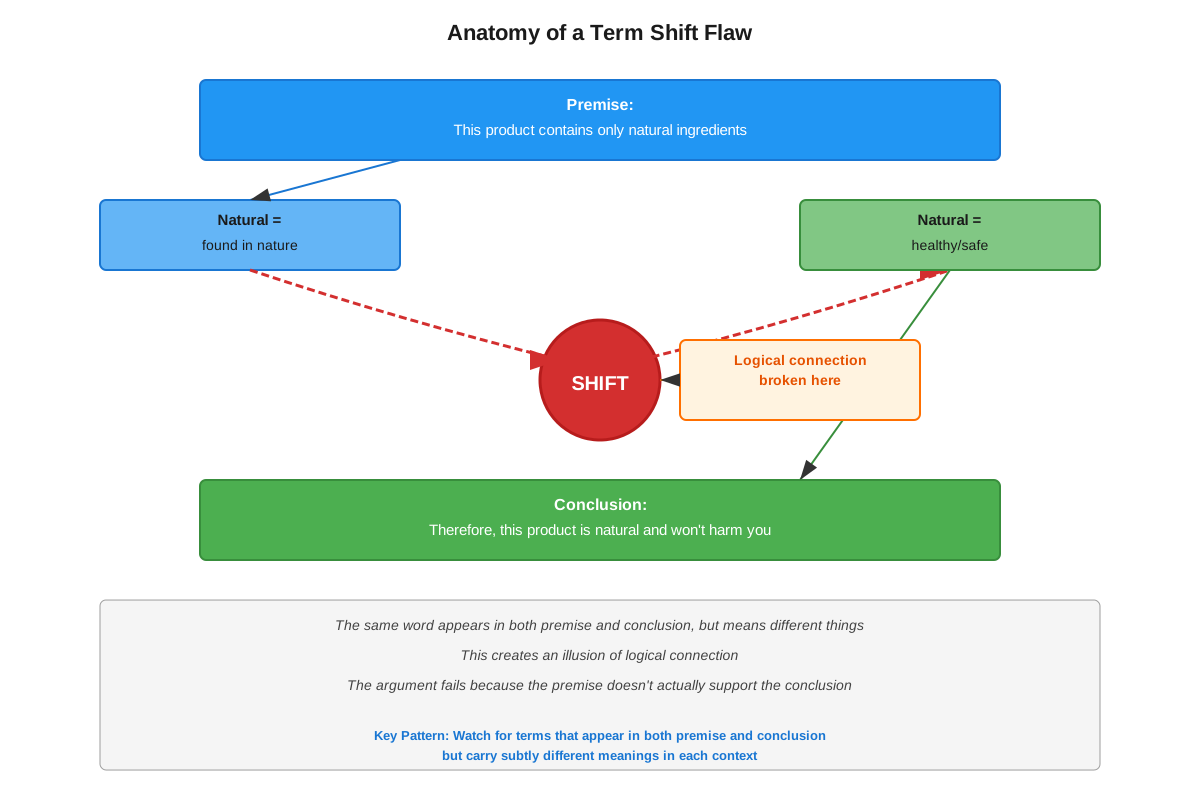
The term shift flaw represents one of the most frequently tested reasoning errors on the LSAT Logical Reasoning section. This flaw occurs when an argument uses a key term in one sense in the premises but shifts to using that same term in a different sense in the conclusion, creating an illusion of logical connection where none actually exists. The argument appears valid on the surface because the same word appears throughout, but careful analysis reveals that the word's meaning has changed, breaking the logical chain.
Understanding the lsat term shift flaw is essential for success on the exam because it appears in multiple question types, including Flaw questions, Necessary Assumption questions, and Strengthen/Weaken questions. The LSAT test makers deliberately craft arguments that exploit the ambiguity inherent in language, testing whether students can distinguish between superficial verbal similarity and genuine logical connection. Mastering this concept typically improves performance on 3-5 questions per exam, representing a significant score increase.
Within the broader landscape of logical reasoning, term shift flaws connect to fundamental principles of valid argumentation. While formal logic requires consistent use of terms throughout an argument, natural language allows words to carry multiple meanings depending on context. The term shift flaw exploits this feature of language to create arguments that sound persuasive but lack logical force. This concept relates closely to other reasoning flaws such as equivocation, scope shifts, and necessary/sufficient condition confusion, forming part of a larger family of structural reasoning errors that students must recognize to excel on flaw questions.
Learning Objectives
- [ ] Identify how Term shift flaw appears in LSAT questions
- [ ] Explain the reasoning pattern behind Term shift flaw
- [ ] Apply Term shift flaw to solve LSAT-style problems accurately
- [ ] Distinguish term shift flaws from superficially similar reasoning errors
- [ ] Predict how answer choices will describe term shift flaws in technical language
- [ ] Recognize the most common categories of terms that undergo shifts in LSAT arguments
- [ ] Evaluate whether an apparent term shift constitutes a genuine logical flaw or acceptable reasoning
Prerequisites
- Basic argument structure: Understanding premises, conclusions, and how they connect is essential because term shift flaws specifically exploit breaks in the logical chain between premises and conclusion.
- Conditional reasoning fundamentals: Recognizing necessary and sufficient conditions helps identify when terms shift between these two logical roles, a common variant of term shift flaws.
- Scope and degree concepts: Distinguishing between different levels of generality or intensity provides the foundation for recognizing when a term's scope shifts within an argument.
- Common LSAT vocabulary: Familiarity with how the LSAT uses terms like "some," "most," "all," and "only" enables recognition of quantifier shifts, a specific type of term shift.
Why This Topic Matters
Term shift flaws appear in real-world reasoning whenever persuasive speakers exploit linguistic ambiguity to advance weak arguments. Politicians might use "freedom" to mean "economic liberty" in one context and "personal autonomy" in another. Advertisers might shift between "natural" meaning "found in nature" and "natural" meaning "healthy." Legal arguments often hinge on precise definitions, and recognizing when opposing counsel has shifted a term's meaning can determine case outcomes. Developing sensitivity to term shifts enhances critical thinking across professional and personal contexts.
On the LSAT specifically, term shift flaws appear in approximately 8-12% of all Logical Reasoning questions, making them one of the highest-yield flaw types to master. They appear most frequently in Flaw questions (where students must identify the reasoning error) but also surface in Necessary Assumption questions (where the correct answer bridges the term shift), Strengthen questions (where evidence must address the shifted term), and Weaken questions (where the term shift creates a vulnerability). Recent LSAT administrations have shown increasing sophistication in how term shifts are disguised, with test makers embedding them within complex causal arguments or conditional chains.
The LSAT presents term shift flaws in several characteristic patterns: arguments about categories where a term shifts from a specific subset to a broader class; arguments about causation where "cause" shifts between necessary and sufficient conditions; arguments about evaluation where a term shifts from objective to subjective meaning; and arguments about comparison where a term shifts its reference point. Recognizing these patterns enables rapid identification during timed conditions.
Core Concepts
Definition and Mechanism
A term shift flaw occurs when an argument relies on a key term that changes meaning between the premises and conclusion, creating a logical gap that undermines the argument's validity. The flaw exploits the fact that words can have multiple meanings, different scopes, or varying degrees of intensity. The argument appears to flow logically because the same word appears throughout, but the semantic shift breaks the logical connection.
The mechanism operates through three stages: First, the premises establish a claim using a term with a specific meaning, scope, or reference. Second, the conclusion makes a claim using what appears to be the same term. Third, upon careful analysis, the term in the conclusion carries a different meaning, broader scope, or shifted reference point than in the premises. This creates a logical gap—the premises no longer support the conclusion because they're actually discussing different concepts despite using the same word.
Categories of Term Shifts
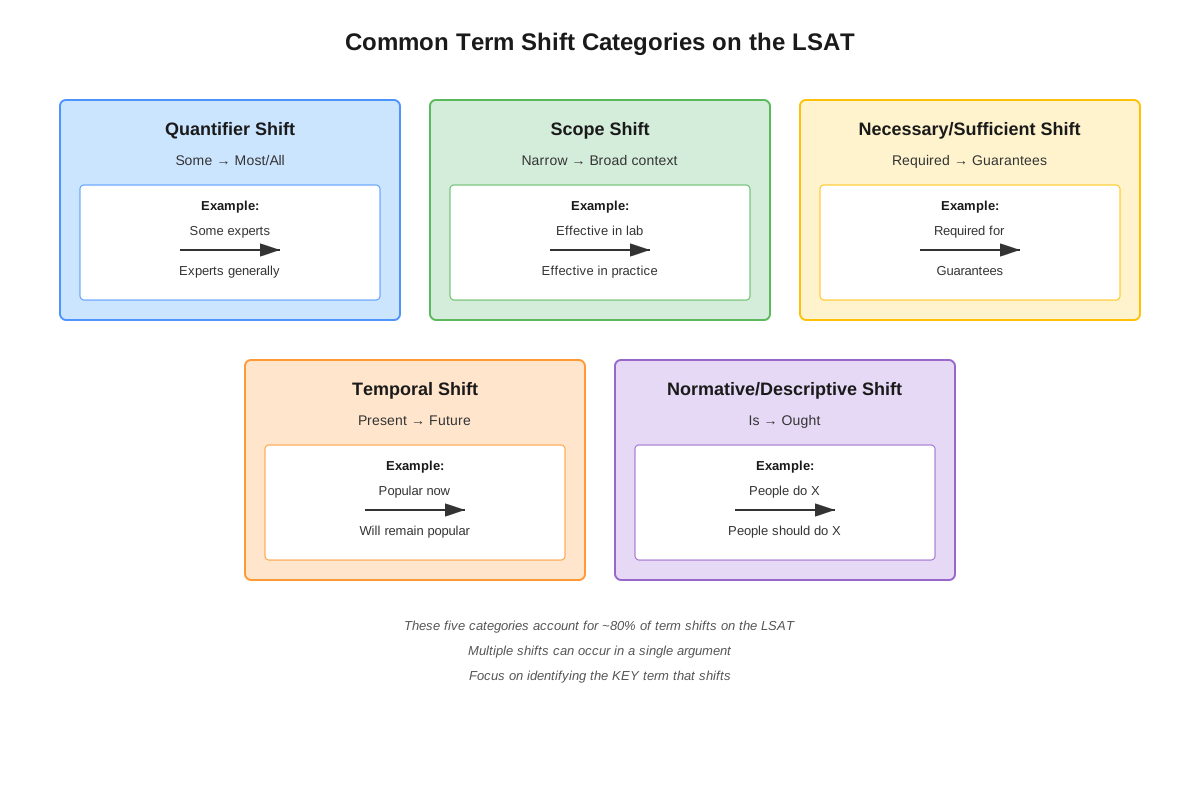
Meaning Shifts occur when a word with multiple definitions is used with one meaning in the premises and another in the conclusion. For example, "bank" could mean a financial institution in the premise but a river's edge in the conclusion. On the LSAT, these shifts are typically more subtle, involving words like "natural," "effective," "successful," or "responsible" that carry multiple related but distinct meanings.
Scope Shifts involve a term that moves from a narrow, specific reference to a broader, more general reference (or vice versa). An argument might establish that "this medication is safe for healthy adults" (narrow scope) but conclude that "this medication is safe" (broad scope), ignoring children, pregnant women, or people with certain conditions. The LSAT frequently tests scope shifts involving:
| Premise Scope | Conclusion Scope | Logical Gap |
|---|---|---|
| Some members of group X | All members of group X | Overgeneralization |
| X in specific context | X in all contexts | Context ignored |
| X under certain conditions | X universally | Conditions ignored |
| X in one time period | X in all time periods | Temporal shift |
Quantifier Shifts represent a specific type of scope shift where the quantity or proportion changes. An argument might establish that "most experts agree" (a majority) but conclude "experts agree" (suggesting unanimity or near-unanimity). Common quantifier shifts include:
- "Some" → "All" or "Most"
- "Often" → "Always"
- "Can" → "Will" or "Must"
- "Possible" → "Probable" or "Certain"
Reference Point Shifts occur when a comparative or relative term changes what it's being compared to. An argument might establish that "Product X is more effective than Product Y" but conclude "Product X is effective," shifting from a relative comparison to an absolute claim. Similarly, "expensive" might mean expensive relative to similar products in the premise but expensive in absolute terms in the conclusion.
Normative/Descriptive Shifts involve moving between factual claims (what is) and value judgments (what should be). An argument might establish that "people generally prefer X" (descriptive) but conclude "X is better" or "people should choose X" (normative). This shift conflates popularity with quality or moral worth.
Identifying Term Shifts in Arguments
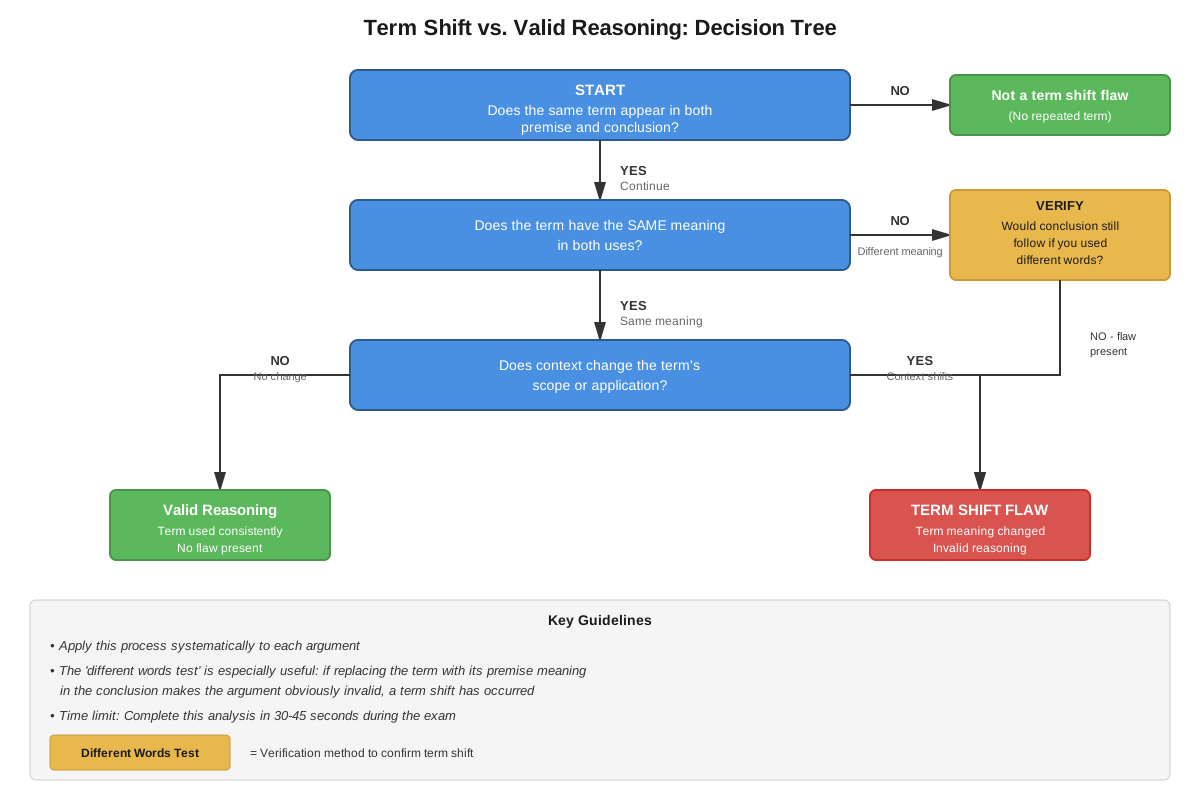
To identify term shifts systematically, follow this process:
- Locate the conclusion and identify its key terms—the concepts that the conclusion makes claims about
- Find where those terms appear in the premises and note the exact context
- Compare the usage by asking: Does this term have the same meaning, scope, and reference in both locations?
- Check for implicit qualifiers that might be present in one location but not the other
- Evaluate whether the shift breaks the logical connection between premises and conclusion
Critical questions to ask when evaluating potential term shifts:
- Does this term have multiple possible meanings, and if so, which meaning applies in each instance?
- Are there implicit limitations or conditions attached to the term in the premises that disappear in the conclusion?
- Does the term refer to the same group, time period, or context throughout?
- If the term is comparative or evaluative, is the standard of comparison consistent?
- Would substituting a synonym or definition reveal that different concepts are being discussed?
How Answer Choices Describe Term Shifts
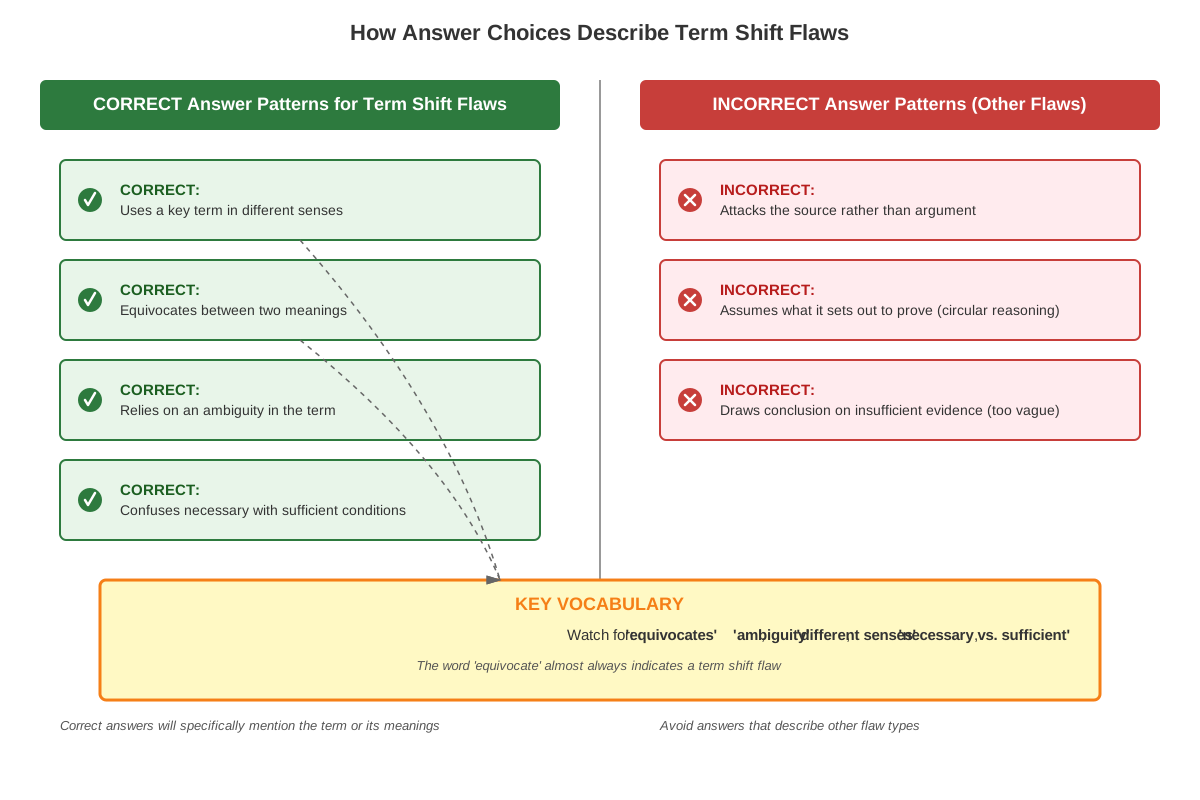
When Flaw questions test term shift flaws, correct answer choices typically use specific language patterns. Understanding these patterns helps with rapid answer choice elimination:
Direct description: "uses a key term in one sense in a premise and in another sense in the conclusion"
Equivocation language: "equivocates between two meanings of a crucial term" or "relies on the ambiguity of a central term"
Scope language: "treats a claim about some members of a group as though it applied to all members" or "generalizes from a specific case to a broader conclusion"
Shift language: "shifts from discussing X in one context to discussing X in a different context" or "confuses X with Y"
Incorrect answer choices often describe other flaw types or describe the term shift inaccurately (for example, claiming the argument shifts from A to B when it actually shifts from A to C).
Concept Relationships
The term shift flaw connects to multiple other logical reasoning concepts in a hierarchical and complementary structure. At the foundational level, understanding argument structure (premises supporting conclusions) is necessary because term shifts specifically exploit breaks in this support relationship. The term appears to create a connection, but the semantic shift undermines it.
Term shift flaws relate closely to equivocation, which is essentially the formal logical name for meaning-based term shifts. However, the LSAT uses "term shift" more broadly to include scope shifts and reference shifts, not just meaning shifts. This makes term shift the umbrella concept with equivocation as one specific type.
The relationship to necessary assumptions is particularly important: every term shift creates a necessary assumption gap. The argument assumes that the term means the same thing throughout, or that the scope hasn't shifted. Correct answers to Necessary Assumption questions often bridge term shifts by explicitly connecting the different uses of the term.
Scope errors and term shift flaws overlap significantly. Many scope errors are actually term shift flaws where the shift involves the breadth of application. The concepts flow together: Scope understanding → Recognition of scope shifts → Identification of term shift flaws.
Conditional reasoning errors sometimes manifest as term shifts, particularly when an argument shifts between necessary and sufficient conditions. For example, treating "X is necessary for Y" as though it means "X is sufficient for Y" involves shifting the logical role of term X.
The progression of mastery follows this path: Basic argument structure → Scope and degree concepts → Recognition of term consistency → Identification of term shifts → Application to various question types → Integration with assumption and strengthening/weakening strategies.
High-Yield Facts
⭐ Term shift flaws occur when a key term changes meaning, scope, or reference between premises and conclusion, breaking the logical connection.
⭐ The most common term shifts on the LSAT involve scope changes (specific to general or vice versa) rather than complete meaning changes.
⭐ Words with multiple related meanings (like "natural," "effective," "successful," "responsible") are prime candidates for term shift flaws.
⭐ Quantifier shifts (some → all, can → will, possible → probable) represent a specific high-frequency category of term shifts.
⭐ Every term shift creates a necessary assumption—the argument assumes the term usage is consistent when it isn't.
- Comparative terms ("better," "more effective," "superior") often undergo reference point shifts that change what they're being compared to.
- Temporal shifts (what's true now → what's always true) and contextual shifts (true in situation X → true in all situations) are frequently tested.
- The LSAT rarely uses obvious homonyms (like "bank" meaning both financial institution and river edge); shifts are typically more subtle.
- Answer choices describing term shift flaws often use phrases like "equivocates," "uses a key term in different senses," or "fails to establish that the term means the same thing."
- Term shift flaws can appear in any argument type (causal, conditional, categorical) and aren't limited to specific content areas.
- When an argument seems almost valid but something feels "off," checking for term shifts should be among the first diagnostic steps.
- Normative/descriptive shifts (is → ought) are less common than scope shifts but appear regularly enough to warrant attention.
Quick check — test yourself on Term shift flaw so far.
Try Flashcards →Common Misconceptions
Misconception: Any time a word appears multiple times in an argument, there's a term shift flaw.
Correction: Term shifts only constitute flaws when the change in meaning, scope, or reference actually breaks the logical connection. Many arguments legitimately use the same term consistently throughout. The key is whether the shift undermines the support relationship between premises and conclusion.
Misconception: Term shift flaws only involve words with completely different meanings (like homonyms).
Correction: The LSAT typically tests subtle shifts between related meanings, different scopes of the same concept, or changes in reference points rather than obvious homonyms. The shift from "effective for treating mild symptoms" to "effective" (without qualification) is more typical than shifts between unrelated meanings.
Misconception: If the conclusion uses a broader term than the premises, that's always a flaw.
Correction: Broadening scope only constitutes a flaw if the premises don't provide adequate support for the broader claim. Some arguments legitimately establish a specific case as representative of a broader pattern. The question is whether the evidence justifies the generalization, not whether generalization occurs.
Misconception: Term shift flaws and circular reasoning are the same thing because both involve repetition of terms.
Correction: Circular reasoning occurs when the conclusion restates a premise without adding new information, using the same term with the same meaning. Term shifts involve using a term with different meanings or scopes, creating a logical gap rather than mere repetition. These are distinct flaw types.
Misconception: Identifying the term shift is sufficient for answering the question correctly.
Correction: On Flaw questions, students must also select the answer choice that accurately describes the specific shift that occurred. On Necessary Assumption questions, students must identify what bridges the shift. Recognition is necessary but not sufficient; application to the specific question type is essential.
Misconception: Technical or specialized terms are more likely to undergo shifts than common words.
Correction: The LSAT frequently uses everyday words with multiple meanings or flexible scopes precisely because test-takers may not scrutinize them as carefully. Words like "natural," "healthy," "successful," "fair," and "effective" are more common sources of term shifts than technical jargon.
Worked Examples
Example 1: Scope Shift in a Causal Argument
Argument: "Studies show that students who eat breakfast perform better on morning tests than students who skip breakfast. Therefore, eating breakfast improves academic performance."
Analysis Process:
Step 1: Identify the conclusion: "Eating breakfast improves academic performance."
Step 2: Identify the key term that appears in both premises and conclusion: "performance" (and related concepts).
Step 3: Examine how "performance" is used in the premise: The premise specifically discusses "performance on morning tests"—a narrow, specific context.
Step 4: Examine how "performance" is used in the conclusion: The conclusion discusses "academic performance" broadly—encompassing all academic work, all times of day, all types of assessment.
Step 5: Identify the shift: The argument shifts from a specific type of performance (morning test performance) to general academic performance. The premises don't establish that breakfast affects afternoon performance, long-term projects, class participation, or other components of academic performance.
Step 6: Articulate the flaw: The argument treats evidence about performance in one specific context (morning tests) as though it supports a claim about performance in all academic contexts. This is a scope shift—the term "performance" has expanded its reference from a narrow subset to a broad category.
How this connects to learning objectives: This example demonstrates how term shift flaws appear in LSAT questions (Learning Objective 1) by showing a realistic argument structure. It explains the reasoning pattern (Learning Objective 2) by breaking down how the scope expansion creates a logical gap. Students can apply this analysis process (Learning Objective 3) to similar arguments involving scope shifts.
Example 2: Meaning Shift in an Evaluative Argument
Argument: "The new public transportation system is natural because it uses electric buses powered by renewable energy. Anything natural is good for the community. Therefore, the new public transportation system is good for the community."
Analysis Process:
Step 1: Identify the conclusion: "The new public transportation system is good for the community."
Step 2: Identify the key term: "natural" appears in both the first premise and the second premise, creating the logical chain.
Step 3: Examine the first use of "natural": In the first premise, "natural" means "environmentally friendly" or "using renewable resources"—a meaning related to sustainability and ecological impact.
Step 4: Examine the second use of "natural": In the second premise, "natural" likely means "found in nature" or "not artificial"—the more literal, traditional meaning of the word.
Step 5: Identify the shift: The argument equivocates between two different meanings of "natural." Electric buses aren't "natural" in the sense of being found in nature (they're highly engineered technology), but they might be "natural" in the sense of being environmentally sustainable.
Step 6: Articulate the flaw: The argument uses "natural" with one meaning in the first premise (sustainable/renewable) and a different meaning in the second premise (found in nature/not artificial). The second premise doesn't actually apply to the subject of the first premise because the term has shifted meaning.
Additional consideration: Even if we interpret "natural" consistently as "environmentally friendly" throughout, there's still a potential scope issue: being environmentally friendly (natural in that sense) doesn't automatically make something "good for the community" in all respects. The community might care about cost, convenience, and reliability in addition to environmental impact.
How this connects to learning objectives: This example shows a meaning-based term shift, demonstrating the variety of ways term shifts appear (Learning Objective 1). It illustrates the reasoning pattern where a term's ambiguity creates an illusion of logical connection (Learning Objective 2). The additional consideration demonstrates how to distinguish between different types of shifts and evaluate whether multiple flaws exist (Learning Objective 4).
Exam Strategy
When approaching LSAT questions involving potential term shift flaws, implement this systematic strategy:
Initial Reading Phase: During the first read-through, pay special attention to words that appear multiple times, especially in both premises and conclusion. Flag any terms that have multiple possible meanings or that involve scope (words like "all," "some," "most," "often," "always").
Trigger Words to Watch For: Certain words frequently undergo shifts on the LSAT:
- Evaluative terms: "effective," "successful," "good," "beneficial," "harmful," "dangerous"
- Natural language: "natural," "artificial," "normal," "typical"
- Scope indicators: "some," "many," "most," "all," "every," "always," "never," "often"
- Modal terms: "can," "could," "may," "might," "must," "will," "should"
- Comparative terms: "better," "worse," "more," "less," "superior," "inferior"
- Causal language: "cause," "effect," "result," "lead to," "produce"
Analysis Process: For each key term, ask: "Is this word being used with exactly the same meaning, scope, and reference point throughout the argument?" If the answer is no or uncertain, you've likely identified a term shift flaw.
Answer Choice Elimination:
On Flaw questions, eliminate answer choices that:
- Describe flaws that aren't present in the argument
- Accurately identify that a term appears multiple times but incorrectly describe how it shifts
- Describe the shift backwards (claiming the argument moves from general to specific when it actually moves from specific to general)
Keep answer choices that:
- Use language like "equivocates," "uses a key term in different senses," "treats X as though it were Y"
- Accurately describe the direction and nature of the shift
- Identify the specific terms involved (though sometimes answer choices use general language like "a key term")
Time Management: Term shift identification should take 15-30 seconds once you're practiced. If you can't identify a clear shift within 30 seconds, move on to evaluating other potential flaws. Don't get stuck trying to find a term shift that might not exist.
Process of Elimination Specific to Term Shifts: When answer choices describe term shifts, verify that:
- The terms mentioned actually appear in the argument
- The shift described actually occurs (not just that the terms appear)
- The shift described goes in the right direction
- The shift described is the main flaw, not a minor issue
Exam Tip: If an argument feels almost valid but you sense something is wrong, checking for term shifts should be your first diagnostic step. Term shifts create arguments that sound persuasive but have subtle logical gaps.
Memory Techniques
STEM Acronym for Term Shift Categories:
- Scope shifts (specific ↔ general)
- Temporal shifts (one time ↔ all times)
- Evaluative shifts (objective ↔ subjective, or different standards)
- Meaning shifts (one definition ↔ another definition)
Visualization Strategy: Picture the argument as a bridge. The premises are one side, the conclusion is the other side. The key terms are the bridge planks connecting them. A term shift is like a plank that looks solid but is actually two different planks that don't quite connect—there's a gap in the middle. When you read an argument, visualize whether the "planks" (terms) actually connect both sides or whether there's a hidden gap.
The "Same Word, Different World" Principle: When you see the same word repeated in an argument, ask yourself: "Is this word living in the same world each time it appears, or has it traveled to a different world?" This helps you remember to check whether context, scope, or meaning has shifted.
Quantifier Shift Spectrum: Visualize a spectrum from weak to strong:
Some → Many → Most → Almost All → All
Can → Might → Probably Will → Will → Must
Possible → Probable → Likely → Certain
When an argument moves right on this spectrum (from weaker to stronger) without justification, that's a term shift flaw.
The "Zoom In, Zoom Out" Memory Device: Scope shifts are like camera zoom. If the premise is zoomed in (specific context, narrow scope) but the conclusion zooms out (general context, broad scope), there's a term shift. Picture a camera zooming out too far—you lose the detail and clarity that was present in the close-up shot.
Summary
The term shift flaw represents a critical reasoning error where arguments use key terms inconsistently, changing meaning, scope, or reference between premises and conclusion. This creates an illusion of logical connection while actually breaking the support relationship that valid arguments require. The LSAT tests term shifts frequently across multiple question types, making this concept essential for score improvement. The most common shifts involve scope changes (specific to general), quantifier shifts (some to all, can to must), and meaning shifts between related definitions of ambiguous terms. Identifying term shifts requires careful comparison of how key terms are used in different parts of the argument, checking for consistency in meaning, scope, temporal context, and reference points. Mastery involves not just recognition but also accurate application to various question types: identifying the flaw in Flaw questions, recognizing the assumption gap in Necessary Assumption questions, and understanding how the shift creates vulnerabilities in Strengthen/Weaken questions. Success requires systematic analysis, attention to trigger words, and practice distinguishing genuine term shifts from legitimate uses of the same term throughout an argument.
Key Takeaways
- Term shift flaws break logical connections by using key terms inconsistently between premises and conclusion, despite superficial verbal similarity.
- Scope shifts (specific → general or vice versa) are the most frequently tested category, followed by quantifier shifts and meaning shifts.
- Every term shift creates a necessary assumption gap—the argument assumes consistency where none exists.
- Trigger words include evaluative terms (effective, successful), scope indicators (some, all, most), modal terms (can, must), and comparative terms (better, more).
- Systematic analysis requires comparing each key term's meaning, scope, and reference point across premises and conclusion.
- Answer choices describing term shifts use specific language patterns: "equivocates," "uses a key term in different senses," "treats X as though it were Y."
- Term shift identification should take 15-30 seconds with practice; if unclear, evaluate other potential flaws rather than getting stuck.
Related Topics
Necessary Assumption Questions: Understanding term shifts is essential for Necessary Assumption questions because the correct answer often bridges the gap created by a term shift. Mastering term shifts enables students to predict what assumptions arguments require.
Sufficient Assumption Questions: These questions require identifying what would make an argument valid. When a term shift exists, the sufficient assumption typically establishes that the shifted terms are equivalent or that the scope expansion is justified.
Strengthen and Weaken Questions: Term shifts create vulnerabilities in arguments. Strengthening answers often provide evidence that the terms are being used consistently, while weakening answers exploit the shift by showing the terms differ in important ways.
Parallel Reasoning Questions: Recognizing term shifts helps identify whether two arguments have the same logical structure. An argument with a term shift parallels only other arguments with similar shifts, not arguments with consistent term usage.
Scope and Degree Errors: Term shifts involving scope are closely related to the broader category of scope errors. Mastering term shifts provides foundation for understanding all scope-related reasoning problems.
Practice CTA
Now that you understand the term shift flaw conceptually, the crucial next step is application. Attempt the practice questions associated with this topic, focusing on implementing the systematic analysis process outlined in the Exam Strategy section. As you work through problems, consciously identify key terms, compare their usage across premises and conclusion, and articulate the specific nature of any shifts you find. Create flashcards for the trigger words and common shift patterns to build rapid recognition. Remember that mastery comes through repeated practice with immediate feedback—each question you analyze strengthens your ability to spot these flaws quickly and accurately under timed conditions. You're building a critical skill that will serve you across multiple question types and significantly improve your Logical Reasoning score. Stay focused on the process, and the results will follow.
Sign up free to keep reading
Create a free AnvayaPrep account to finish this LSAT guide on Term shift flaw — plus flashcards and practice questions.