Overview
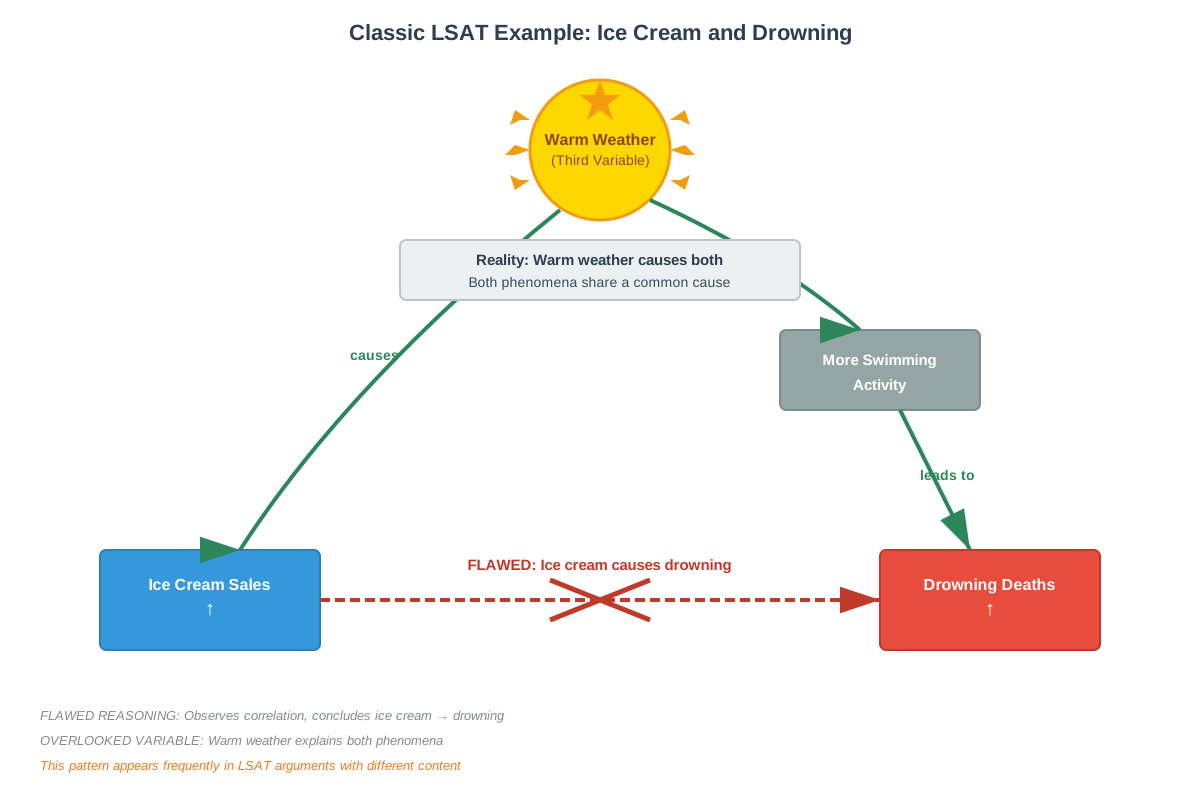
The third variable flaw represents one of the most frequently tested reasoning errors on the LSAT Logical Reasoning section. This flaw occurs when an argument observes a correlation between two phenomena and concludes that one causes the other, while failing to consider that both phenomena might be caused by a third, unmentioned variable. For example, if an argument notes that ice cream sales and drowning deaths both increase during summer months and concludes that ice cream consumption causes drowning, it commits the third variable flaw—the actual explanation is that warm weather (the third variable) causes both increased ice cream sales and more swimming activity.
Understanding the lsat third variable flaw is essential because it appears in multiple question types throughout the Logical Reasoning section, including Flaw questions, Weaken questions, Strengthen questions, and Assumption questions. The LSAT frequently tests whether students can recognize when an argument has jumped from correlation to causation without ruling out alternative explanations. This reasoning pattern reflects real-world critical thinking skills that law schools value: the ability to identify when evidence has been misinterpreted and when additional factors must be considered before drawing conclusions.
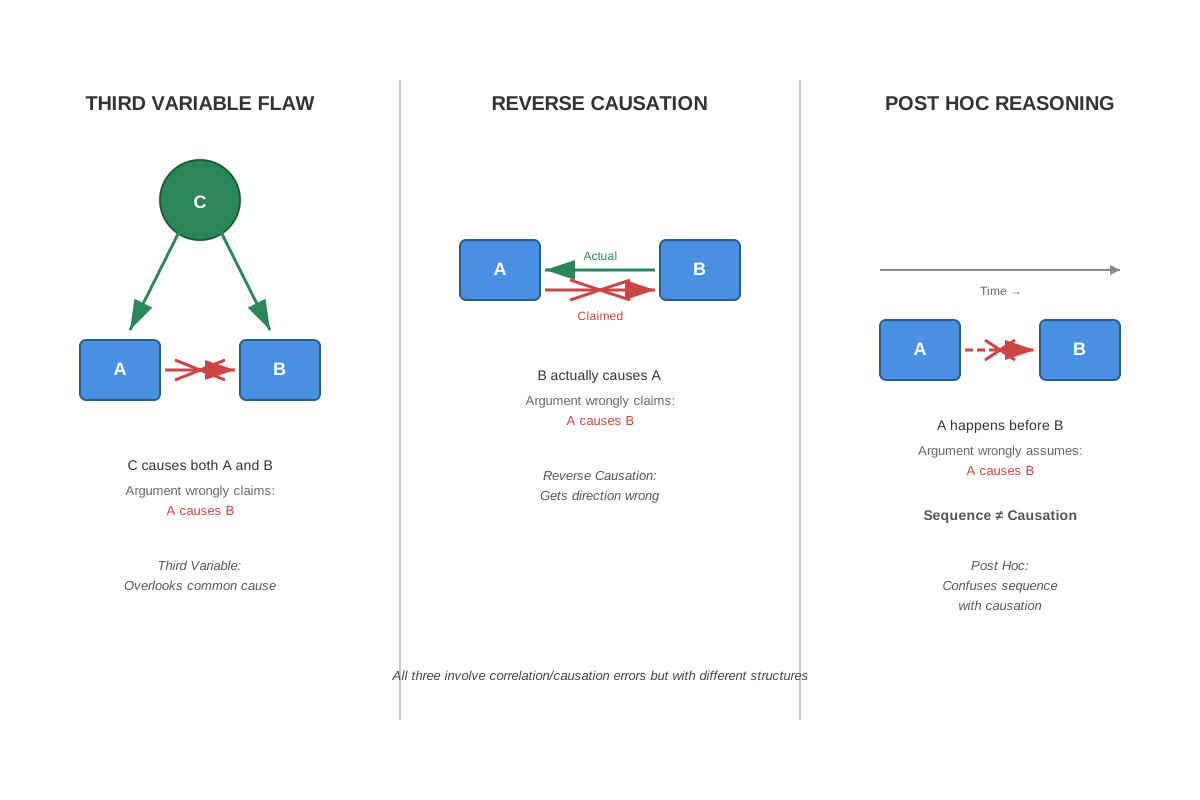
Within the broader landscape of logical reasoning, the third variable flaw belongs to a family of causal reasoning errors. It shares conceptual territory with other common flaws such as reverse causation (mistaking cause and effect), post hoc reasoning (assuming temporal sequence implies causation), and overlooking alternative explanations. Mastering the third variable flaw provides a foundation for understanding how the LSAT tests causal reasoning more generally and develops the analytical skills necessary for identifying gaps in argumentative logic across all flaw questions.
Learning Objectives
- [ ] Identify how Third variable flaw appears in LSAT questions
- [ ] Explain the reasoning pattern behind Third variable flaw
- [ ] Apply Third variable flaw to solve LSAT-style problems accurately
- [ ] Distinguish third variable flaws from other causal reasoning errors
- [ ] Recognize the specific language patterns that signal potential third variable flaws
- [ ] Evaluate answer choices that correctly describe the third variable flaw in technical language
Prerequisites
- Basic understanding of correlation versus causation: The third variable flaw fundamentally involves mistaking correlation for causation, so students must understand that two things occurring together does not necessarily mean one causes the other.
- Familiarity with argument structure: Students should be able to identify premises and conclusions in LSAT arguments, as recognizing the third variable flaw requires understanding what evidence is presented and what conclusion is drawn.
- Knowledge of conditional reasoning basics: While not directly conditional, understanding how evidence supports conclusions helps students recognize when that support is insufficient due to unconsidered alternatives.
Why This Topic Matters
The third variable flaw appears with remarkable frequency on the LSAT, making it one of the highest-yield topics for Logical Reasoning preparation. Statistical analysis of recent LSAT exams reveals that causal reasoning flaws—of which the third variable flaw is the most common variant—appear in approximately 15-20% of all Logical Reasoning questions. This translates to roughly 3-5 questions per exam that directly test this concept, not counting questions where understanding third variables helps eliminate incorrect answer choices.
Beyond exam performance, recognizing third variable flaws develops critical thinking skills essential for legal practice. Attorneys must constantly evaluate whether evidence truly supports claimed conclusions or whether alternative explanations exist. When a prosecutor argues that a defendant's presence at a crime scene proves guilt, defense attorneys must consider third variables—perhaps the defendant had legitimate reasons to be there. When corporate clients present data showing correlation between two business metrics, lawyers must ask whether a third factor explains both before advising on causation-based strategies.
On the LSAT, third variable flaws most commonly appear in:
- Flaw questions asking students to identify the reasoning error
- Weaken questions where the correct answer introduces a third variable
- Strengthen questions where the correct answer rules out third variables
- Assumption questions where the argument assumes no third variable exists
- Parallel Flaw questions requiring recognition of the same flawed pattern in different contexts
Core Concepts
The Basic Structure of Third Variable Flaw
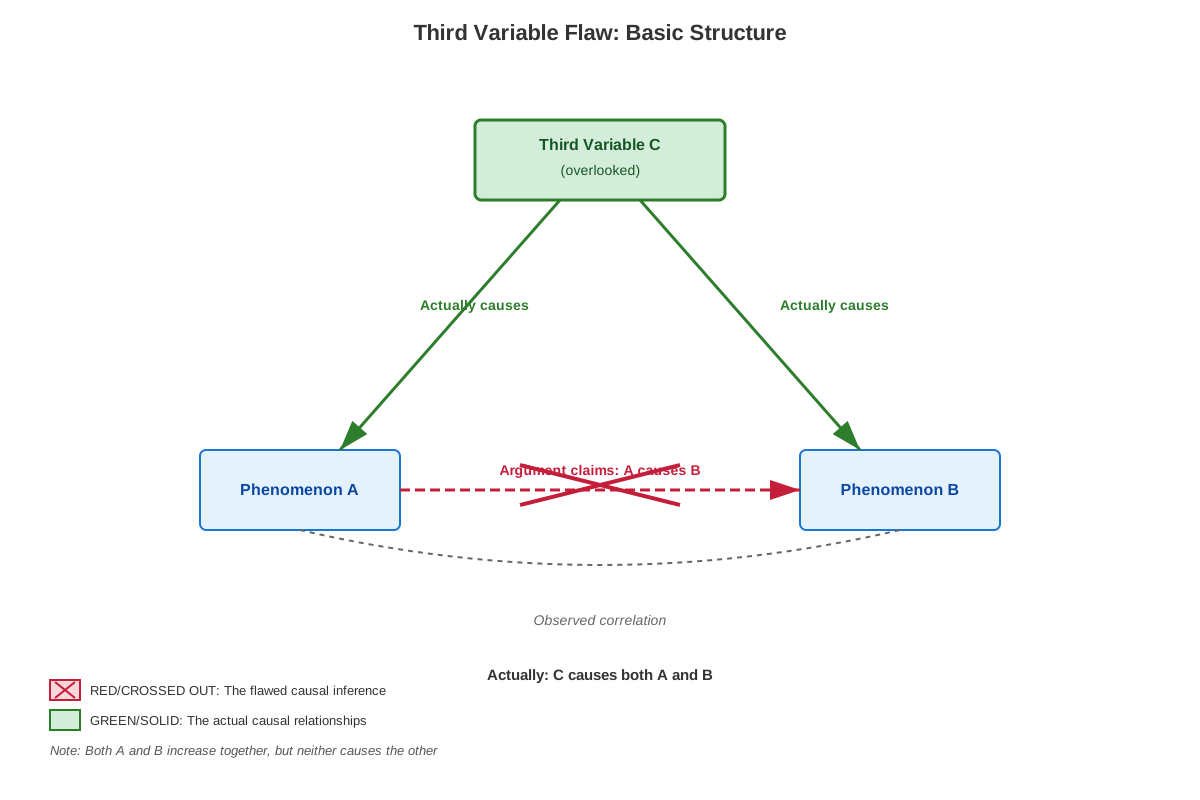
The third variable flaw follows a predictable pattern that appears consistently across LSAT questions. The argument structure typically includes:
- Observation of correlation: The argument presents evidence that two phenomena (A and B) occur together or vary together
- Causal conclusion: The argument concludes that A causes B (or B causes A)
- Missing consideration: The argument fails to consider that some third factor (C) might cause both A and B
This reasoning error is also called the "common cause fallacy" or "confounding variable error" in formal logic. The flaw lies not in observing the correlation—the correlation may be perfectly real—but in jumping to a causal conclusion without eliminating alternative explanations.
Distinguishing Correlation from Causation
Understanding the difference between correlation and causation is fundamental to recognizing third variable flaws. Correlation means two variables change together in a predictable pattern—when one increases, the other increases (positive correlation) or decreases (negative correlation). Causation means one variable directly produces changes in the other through some mechanism.
The LSAT exploits the common human tendency to assume causation from correlation. Consider this example:
| Observation | Flawed Conclusion | Third Variable Explanation |
|---|---|---|
| Cities with more hospitals have higher death rates | Hospitals cause deaths | Population size causes both more hospitals and more deaths |
| Students who take test prep courses score higher on average | Test prep courses cause higher scores | Motivation level causes both course enrollment and higher scores |
| Countries with more chocolate consumption have more Nobel Prize winners | Chocolate causes intellectual achievement | Wealth causes both chocolate consumption and educational investment |
The Mechanism of the Flaw
The third variable flaw succeeds as a reasoning error because the causal conclusion appears plausible on its surface. The argument provides genuine evidence (the correlation exists), making the conclusion seem supported. However, the evidence is insufficient to establish causation because multiple explanations remain consistent with the observed correlation:
- A causes B (the argument's conclusion)
- B causes A (reverse causation)
- C causes both A and B (third variable)
- The correlation is coincidental (no causal relationship)
The argument commits a flaw by selecting explanation #1 without ruling out explanations #2, #3, and #4. The LSAT most frequently tests whether students recognize that explanation #3 (third variable) has not been eliminated.
Identifying Third Variable Flaws in LSAT Arguments
Several linguistic markers signal potential third variable flaws in LSAT arguments:
Causal language in conclusions:
- "causes," "leads to," "results in," "produces," "brings about"
- "is responsible for," "explains why," "accounts for"
- "due to," "because of," "stems from"
Correlational language in premises:
- "associated with," "correlated with," "linked to"
- "occurs together with," "accompanies"
- "higher rates of X are found among those with Y"
- "increases/decreases along with"
When an argument uses correlational language in premises but causal language in conclusions, the third variable flaw should immediately come to mind as a possibility.
The Role of Mechanism in Causal Arguments
Strong causal arguments typically provide a mechanism—an explanation of how the cause produces the effect. Arguments vulnerable to the third variable flaw usually lack such mechanisms. For example:
Weak argument (vulnerable to third variable flaw): "Studies show that people who drink coffee regularly have lower rates of depression. Therefore, coffee consumption prevents depression."
Stronger argument (less vulnerable): "Studies show that people who drink coffee regularly have lower rates of depression. Researchers believe this occurs because caffeine increases dopamine production in the brain, and dopamine deficiency is associated with depression. Therefore, coffee consumption may help prevent depression."
The second argument remains imperfect, but by providing a mechanism, it makes the third variable explanation less likely (though still possible—perhaps people with certain genetic profiles both prefer coffee and have lower depression risk).
Common Third Variables in LSAT Arguments
The LSAT frequently employs certain categories of third variables:
Socioeconomic factors: Wealth, education level, and social class often serve as third variables explaining correlations between seemingly unrelated phenomena.
Demographic variables: Age, gender, geographic location, and cultural background frequently function as confounding factors.
Underlying traits: Motivation, intelligence, health consciousness, risk tolerance, and personality characteristics often cause multiple observable behaviors.
Environmental conditions: Weather, season, economic conditions, and technological availability can drive multiple correlated outcomes.
Selection effects: The process by which individuals end up in different groups may itself be caused by a third variable that also affects the outcome.
Concept Relationships
The third variable flaw connects to several other logical reasoning concepts in a hierarchical relationship:
Causal Reasoning (parent category) → includes → Third Variable Flaw + Reverse Causation + Post Hoc Reasoning
Within flaw questions specifically, the third variable flaw represents one type of insufficient evidence flaw, where the premises fail to adequately support the conclusion. This connects it to other insufficient evidence flaws like:
- Unrepresentative sample: The evidence comes from an atypical group
- Absence of evidence treated as evidence of absence: Lack of proof for X is treated as proof of not-X
- Overlooking alternatives: Failing to consider other possibilities (third variable is a specific instance of this)
The third variable flaw also relates to assumption questions because every argument with this flaw makes an implicit assumption: "No third variable explains both observed phenomena." When the LSAT asks for a necessary assumption, the correct answer often rules out a third variable. When it asks for a sufficient assumption, the correct answer might explicitly state that no confounding factors exist.
In strengthen and weaken questions, the relationship is direct:
- Strengthen → Rule out third variables → Makes causal conclusion more likely
- Weaken → Introduce plausible third variables → Makes causal conclusion less likely
Understanding this web of relationships allows students to recognize that mastering the third variable flaw provides tools for multiple question types, not just flaw identification questions.
High-Yield Facts
⭐ The third variable flaw occurs when an argument concludes causation from correlation without eliminating the possibility that a third factor causes both observed phenomena.
⭐ Arguments vulnerable to third variable flaws use correlational evidence (associated with, linked to, occurs together) but draw causal conclusions (causes, leads to, results in).
⭐ The most common third variables on the LSAT are socioeconomic factors, demographic variables, underlying personality traits, and selection effects.
⭐ In Flaw questions, correct answers describing third variable flaws often use language like "fails to consider that both phenomena might result from a common cause" or "overlooks the possibility that a third factor is responsible for both."
⭐ In Weaken questions, introducing a plausible third variable that could explain both phenomena significantly undermines causal arguments.
- The third variable flaw is distinct from reverse causation (mistaking which variable causes which) though both involve causal reasoning errors.
- Arguments that provide a mechanism explaining how A causes B are less vulnerable to third variable objections, though not immune.
- The correlation observed in arguments with third variable flaws is typically genuine—the flaw is in the interpretation, not the data.
- Third variable flaws can occur even when the argument acknowledges correlation explicitly; the flaw is in moving from correlation to causation.
- In Strengthen questions, ruling out third variables (showing no common cause exists) strengthens causal arguments more than simply showing stronger correlation.
- Temporal sequence (A occurs before B) does not eliminate third variable flaws; C might cause A first, then cause B later.
- The LSAT rarely requires students to identify the specific third variable; recognizing that the argument fails to eliminate this possibility is sufficient.
Quick check — test yourself on Third variable flaw so far.
Try Flashcards →Common Misconceptions
Misconception: If two things are correlated, there must be some causal relationship between them, even if we don't know which causes which.
Correction: Correlation can exist without any direct causal relationship between the correlated variables. A third variable might cause both, or the correlation might be coincidental. The third variable flaw specifically addresses cases where a common cause explains the correlation without either correlated variable causing the other.
Misconception: The third variable flaw only applies when the argument explicitly uses the word "causes."
Correction: The LSAT uses many causal terms beyond "causes," including "leads to," "results in," "produces," "explains," "is responsible for," "accounts for," and "brings about." Any language suggesting one thing produces or generates another indicates a causal claim vulnerable to third variable objections.
Misconception: If an argument mentions that other factors were controlled for or held constant, it cannot commit the third variable flaw.
Correction: Unless the argument specifically states that all potential third variables were eliminated or controlled for, the flaw remains. Controlling for some factors does not mean all confounding variables have been addressed. The LSAT often includes arguments that control for one or two variables while remaining vulnerable to other third variable explanations.
Misconception: The third variable must be something completely different from the two correlated phenomena.
Correction: Third variables can be closely related to the phenomena in question. For example, if an argument claims that exercise causes happiness based on correlation, the third variable might be "health consciousness"—a trait closely related to both exercise behavior and emotional well-being. The key is that it's a separate factor causing both, not that it's from an entirely different domain.
Misconception: In Weaken questions, the correct answer must prove that a third variable definitely exists and explains everything.
Correction: To weaken an argument with a third variable flaw, an answer choice need only introduce a plausible third variable that could explain the correlation. It does not need to prove this third variable is definitely the explanation. Raising reasonable doubt about the causal conclusion is sufficient to weaken the argument.
Misconception: If the argument provides any explanation for why A might cause B, it has avoided the third variable flaw.
Correction: Providing a speculative or theoretical mechanism does not eliminate the third variable flaw unless the argument also explains why a third variable explanation is unlikely. Simply offering a possible causal pathway does not rule out alternative explanations.
Worked Examples
Example 1: Classic Third Variable Flaw
Argument: "A recent study found that employees who work from home more than three days per week report higher job satisfaction than those who work primarily in the office. This demonstrates that working from home causes increased job satisfaction. Companies seeking to improve employee morale should therefore implement remote work policies."
Analysis:
Step 1 - Identify the conclusion: The argument concludes that working from home causes increased job satisfaction (causal claim).
Step 2 - Identify the evidence: The evidence is a correlation—employees who work from home more frequently report higher satisfaction.
Step 3 - Check for causal language shift: The evidence describes an association (who work from home "report higher" satisfaction), but the conclusion claims causation ("causes increased job satisfaction").
Step 4 - Consider third variable possibilities: Multiple third variables could explain this correlation:
- Autonomy/Trust: Employees allowed to work from home may have jobs requiring less supervision, and this autonomy (not the location itself) causes satisfaction
- Job type: Certain types of jobs (perhaps more creative or independent roles) both permit remote work and are inherently more satisfying
- Personality: People who prefer independence may both seek remote work arrangements and experience higher satisfaction regardless of location
- Selection effect: Employees who are already satisfied may be more likely to negotiate remote work privileges
Step 5 - Identify the flaw: The argument commits the third variable flaw by concluding that remote work causes satisfaction without ruling out the possibility that some third factor (like job autonomy, job type, or personality) causes both the ability to work remotely and higher satisfaction.
How this connects to learning objectives: This example demonstrates how to identify the third variable flaw (Objective 1), explains the reasoning pattern of moving from correlation to causation without eliminating alternatives (Objective 2), and shows how to analyze an LSAT-style argument (Objective 3).
Example 2: Third Variable in a Weaken Question
Argument: "Researchers observed that children who attend preschool programs score significantly higher on kindergarten readiness assessments than children who do not attend preschool. This evidence shows that preschool attendance improves children's academic preparation. Therefore, universal preschool programs would enhance educational outcomes for all children."
Question: Which of the following, if true, most weakens the argument?
Answer Choices:
(A) Some children who do not attend preschool score as high as children who do attend preschool.
(B) Kindergarten readiness assessments do not perfectly predict long-term academic success.
(C) Families who enroll children in preschool programs tend to have higher incomes and provide more educational resources at home than families who do not.
(D) Preschool programs vary widely in quality, with some providing little academic benefit.
(E) The cost of universal preschool programs would be substantial and require increased taxation.
Analysis:
Step 1 - Identify the argument's reasoning: The argument observes a correlation (preschool attendance associated with higher scores) and concludes causation (preschool causes better preparation).
Step 2 - Recognize vulnerability to third variable: This argument is vulnerable to the objection that some third factor causes both preschool attendance and higher scores.
Step 3 - Evaluate each answer:
(A) Shows variation within groups but doesn't challenge the causal claim—some overlap is expected even if causation exists. Weak weakener.
(B) Attacks the relevance of the assessment but doesn't challenge whether preschool causes higher scores on that assessment. Irrelevant to the causal claim.
(C) Introduces a third variable: Family income and home educational resources could cause both preschool enrollment (wealthier families can afford it) and higher readiness scores (more resources at home). This directly challenges the causal conclusion by offering an alternative explanation. Strong weakener—correct answer.
(D) Suggests preschool effects vary but doesn't challenge that preschool can cause improvement. Weak weakener.
(E) Addresses practical implementation but doesn't challenge the causal claim about preschool's effects. Irrelevant to the reasoning flaw.
Step 4 - Confirm the answer: Choice (C) weakens the argument by introducing a plausible third variable (family socioeconomic status and home environment) that could explain the observed correlation without preschool attendance itself causing the improvement.
How this connects to learning objectives: This example shows how third variable flaws appear in Weaken questions (Objective 1), demonstrates the application of third variable reasoning to eliminate wrong answers and select the correct one (Objective 3), and reinforces the pattern of correlation-to-causation reasoning (Objective 2).
Exam Strategy
Approaching Third Variable Flaw Questions
When encountering potential third variable flaw questions on the LSAT, follow this systematic approach:
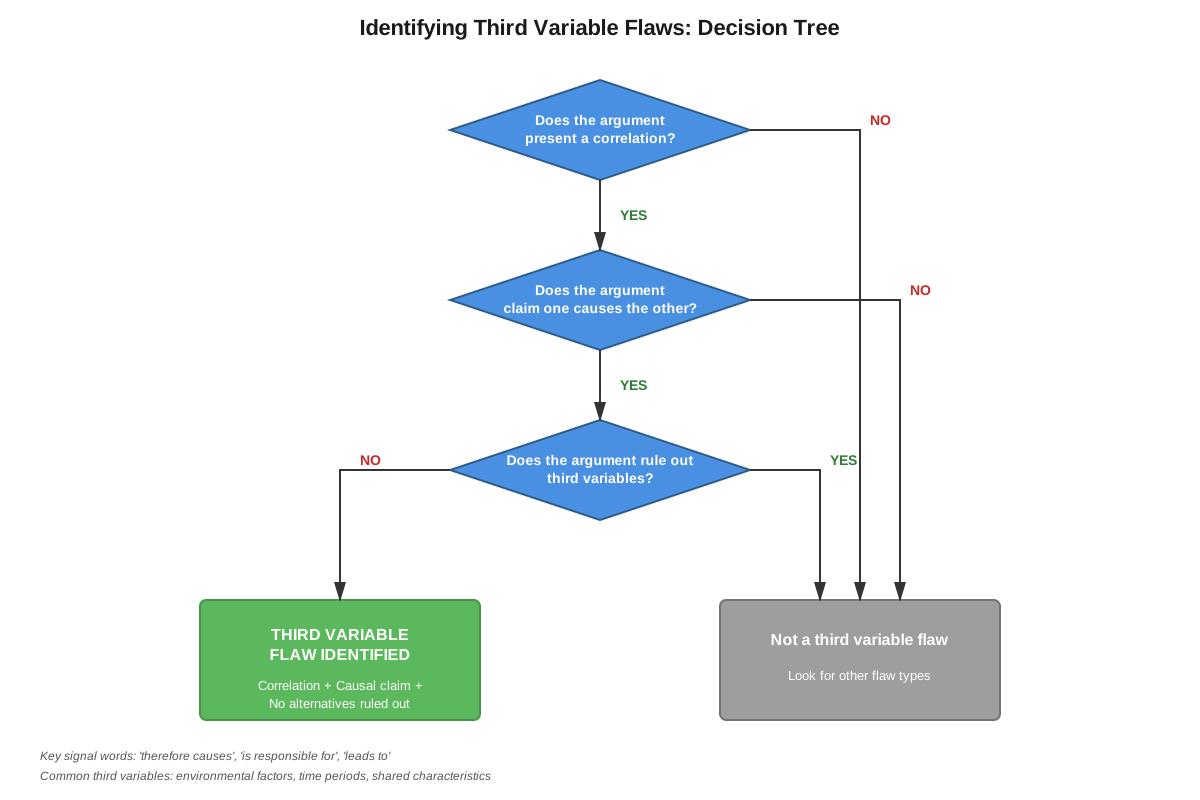
1. Identify causal conclusions quickly: Scan the conclusion for causal language (causes, leads to, results in, produces, explains, is responsible for). If present, immediately consider whether the evidence is merely correlational.
2. Check the evidence type: Look at what the premises actually establish. Do they show correlation, association, or co-occurrence? If the evidence is correlational but the conclusion is causal, the third variable flaw is likely present.
3. Generate potential third variables mentally: Before looking at answer choices, quickly brainstorm what third factors might explain both phenomena. Common categories include socioeconomic status, personality traits, selection effects, and environmental factors.
4. Match your prediction to answer choices: In Flaw questions, look for answers describing failure to consider common causes. In Weaken questions, look for answers introducing specific third variables. In Strengthen questions, look for answers ruling out third variables.
Trigger Words and Phrases
In the stimulus, watch for:
- "Studies show that X is associated with Y"
- "People who do X tend to also do Y"
- "X and Y occur together"
- "Higher rates of X are found among those with Y"
- Followed by: "Therefore, X causes Y" or "X is responsible for Y"
In answer choices for Flaw questions, look for:
- "fails to consider that both phenomena might result from a common cause"
- "overlooks the possibility that a third factor is responsible for both"
- "does not establish that the correlation is due to a causal relationship"
- "neglects the possibility that an alternative factor explains both"
- "presumes, without justification, that the correlation indicates causation"
In answer choices for Weaken questions, look for:
- Introduction of a specific factor that could cause both phenomena
- Information about selection effects or underlying differences between groups
- Evidence that a third variable varies along with both observed phenomena
In answer choices for Strengthen questions, look for:
- "No other factor is associated with both X and Y"
- "The relationship holds even when controlling for other variables"
- "Groups were identical except for the presence of X"
Process of Elimination Tips
Eliminate answers that:
- Describe reverse causation when the question asks about third variables (these are different flaws)
- Introduce factors that would affect only one of the two correlated phenomena (true third variables must relate to both)
- Merely restate the correlation without addressing the causal inference
- Attack the reliability of the evidence rather than the reasoning from evidence to conclusion
- Introduce irrelevant considerations about practical implementation or consequences
Keep answers that:
- Explicitly mention common causes, confounding factors, or alternative explanations
- Introduce specific variables that could plausibly cause both observed phenomena
- Address the gap between correlational evidence and causal conclusion
- Use language about "failing to rule out" or "overlooking the possibility"
Time Allocation Advice
Third variable flaw questions should not consume excessive time once the pattern is recognized. Allocate approximately:
- 15-20 seconds: Reading and understanding the argument
- 10-15 seconds: Identifying the correlation-to-causation structure and potential third variables
- 30-40 seconds: Evaluating answer choices
- Total: 55-75 seconds for straightforward third variable questions
If a question involves complex scientific or technical content, add 15-20 seconds for comprehension. However, the underlying logical structure remains the same regardless of content complexity.
Exam Tip: If you identify a correlation-to-causation argument structure, immediately predict "third variable flaw" before looking at answer choices. This prediction will help you move through answer choices more efficiently and avoid being distracted by sophisticated-sounding but incorrect alternatives.
Memory Techniques
The "ICE" Mnemonic
Remember the three key elements of third variable flaw arguments with ICE:
- Identify the correlation in the evidence
- Causal conclusion drawn without justification
- Eliminate third variables? (No—that's the flaw!)
The "Both-Caused-By" Visualization
Visualize third variable scenarios as a simple diagram:
        Third Variable (C)
           /        \
          ↓          ↓
    Phenomenon A  Phenomenon B
When you see correlation between A and B, mentally draw this diagram and ask: "What C could cause both?" This visual reminder helps prevent jumping to the conclusion that A causes B.
The "Coffee and Drowning" Anchor Example
Memorize one vivid example as an anchor for the concept: "Ice cream sales and drowning deaths are correlated, but ice cream doesn't cause drowning—warm weather causes both." This memorable example can serve as a mental reference point when evaluating whether an argument commits the third variable flaw.
The "SES" Reminder
When struggling to think of potential third variables, remember SES: Socioeconomic status, Environmental factors, and Selection effects. These three categories account for the majority of third variables in LSAT arguments.
The Causal Language List
Memorize this list of causal terms that signal vulnerability to third variable flaws:
- Causes
- Results in
- Explains
- Accounts for
- Triggers
- Engenders
The acronym CREATE helps remember that arguments using these terms to draw conclusions from correlational evidence "create" a logical flaw.
Summary
The third variable flaw represents a critical reasoning error that appears frequently throughout the LSAT Logical Reasoning section. This flaw occurs when an argument observes that two phenomena are correlated and concludes that one causes the other, without adequately considering that both phenomena might be caused by a third, unmentioned variable. Recognizing this flaw requires understanding the fundamental distinction between correlation and causation: while correlation describes two variables changing together, causation means one variable directly produces changes in the other. Arguments commit the third variable flaw by treating correlational evidence as sufficient to establish causation, failing to eliminate the possibility that some common cause explains both observed phenomena. On the LSAT, this flaw appears across multiple question types—Flaw questions ask students to identify it, Weaken questions reward introducing plausible third variables, Strengthen questions reward ruling them out, and Assumption questions test whether students recognize the implicit assumption that no third variable exists. Mastering the third variable flaw requires recognizing the linguistic markers (correlational language in premises, causal language in conclusions), understanding common categories of third variables (socioeconomic factors, personality traits, selection effects), and systematically applying this knowledge to eliminate incorrect answer choices and identify correct ones.
Key Takeaways
- The third variable flaw occurs when arguments conclude causation from correlation without eliminating the possibility that a third factor causes both observed phenomena
- Watch for arguments that use correlational language in premises (associated with, linked to, occurs together) but causal language in conclusions (causes, leads to, results in)
- Common third variables on the LSAT include socioeconomic status, personality traits, demographic factors, environmental conditions, and selection effects
- In Flaw questions, correct answers often state the argument "fails to consider that both phenomena might result from a common cause"
- In Weaken questions, introducing a plausible third variable significantly undermines causal arguments; in Strengthen questions, ruling out third variables supports them
- The correlation observed in these arguments is typically genuine—the flaw lies in interpreting correlation as causation, not in the data itself
- Recognizing third variable flaws quickly (within 15-20 seconds of reading an argument) allows efficient answer choice evaluation and better time management
Related Topics
Reverse Causation Flaw: While the third variable flaw involves a common cause explaining correlation, reverse causation involves mistaking which of two causally related variables is the cause and which is the effect. Mastering third variable flaws provides a foundation for understanding this related causal reasoning error.
Necessary vs. Sufficient Assumptions: Third variable flaws connect directly to assumption questions. The assumption that "no third variable exists" is necessary for causal arguments to succeed. Understanding third variables deepens comprehension of what assumptions causal arguments require.
Conditional Logic and Causation: While distinct, conditional reasoning and causal reasoning both involve relationships between phenomena. Understanding how third variables affect causal claims helps students avoid conflating correlation with conditional relationships.
Sampling and Representativeness: Third variables often arise from selection effects—the process determining which individuals end up in which group. This connects third variable reasoning to questions about whether samples are representative.
Strengthen and Weaken Question Strategies: Since introducing or eliminating third variables is a primary method for weakening or strengthening causal arguments, mastering this topic enables more sophisticated approaches to these high-frequency question types.
Practice CTA
Now that you understand the third variable flaw—its structure, how it appears on the LSAT, and strategies for identifying it—the next crucial step is application. Attempt the practice questions associated with this topic to reinforce your recognition of correlation-to-causation reasoning errors and build speed in evaluating answer choices. Use the flashcards to memorize key trigger phrases and common third variable categories. Remember that recognizing this single flaw type can help you correctly answer 3-5 questions on test day, making it one of the highest-yield topics in your LSAT preparation. Each practice question you complete strengthens your pattern recognition and brings you closer to automatic identification of this crucial reasoning error. Your investment in mastering this concept will pay dividends across multiple question types throughout the Logical Reasoning section.
Sign up free to keep reading
Create a free AnvayaPrep account to finish this LSAT guide on Third variable flaw — plus flashcards and practice questions.