Overview
Treating lack of evidence as evidence is one of the most frequently tested logical fallacies on the LSAT, appearing regularly in flaw questions throughout the Logical Reasoning sections. This reasoning error occurs when an argument concludes that something is true (or false) simply because there is no evidence proving the opposite. For example, arguing that ghosts must exist because no one has definitively proven they don't exist commits this fallacy. On the LSAT, recognizing this flaw is crucial because test-makers consistently craft arguments that make this exact mistake, and students must identify it among competing answer choices.
Understanding this flaw is essential for LSAT success because it appears in multiple question types beyond just flaw questions, including necessary assumption questions, sufficient assumption questions, and strengthen/weaken questions. The LSAT tests this concept because it reflects a fundamental principle of sound reasoning: the absence of evidence for a claim is not the same as evidence against that claim, and vice versa. This distinction is critical in legal reasoning, where the burden of proof matters significantly, making it particularly relevant to the skills law schools seek in prospective students.
This topic connects to broader Logical Reasoning concepts including burden of proof, sufficient versus necessary conditions, and the distinction between proving something false versus failing to prove it true. Mastering this flaw helps students recognize related errors in reasoning, such as appeals to ignorance and improper shifts in burden of proof. The ability to spot when an argument treats absence of evidence as if it were positive evidence for a conclusion is a cornerstone skill that will improve performance across all Logical Reasoning question types.
Learning Objectives
- [ ] Identify how Treating lack of evidence as evidence appears in LSAT questions
- [ ] Explain the reasoning pattern behind Treating lack of evidence as evidence
- [ ] Apply Treating lack of evidence as evidence to solve LSAT-style problems accurately
- [ ] Distinguish between legitimate uses of negative evidence and fallacious reasoning from absence of evidence
- [ ] Recognize variations of this flaw across different argument structures and contexts
- [ ] Predict correct answer choices that accurately describe this flaw in technical LSAT language
Prerequisites
- Basic argument structure: Understanding premises and conclusions is necessary to identify where the logical gap occurs in arguments committing this flaw
- Conditional reasoning fundamentals: Recognizing the difference between proving something true versus failing to prove it false requires understanding logical relationships
- Flaw question format: Familiarity with how flaw questions are asked and structured helps students focus on identifying the reasoning error rather than evaluating content
Why This Topic Matters
In real-world contexts, the fallacy of treating lack of evidence as evidence appears constantly in legal arguments, scientific debates, policy discussions, and everyday reasoning. Prosecutors must prove guilt; the absence of an alibi is not proof of presence at a crime scene. Scientists cannot conclude a hypothesis is true merely because experiments haven't disproven it. This reasoning pattern is so fundamental to critical thinking that the LSAT tests it extensively to assess whether students can distinguish between sound and unsound argumentation.
On the LSAT, this flaw appears in approximately 10-15% of all Logical Reasoning questions, making it one of the highest-yield topics to master. It most commonly appears in flaw questions (where students must identify the error), but also surfaces in necessary assumption questions (where the correct answer often addresses the gap between lack of evidence and positive conclusion), strengthen/weaken questions (where answer choices exploit this reasoning pattern), and parallel flaw questions (where students must match the flawed structure).
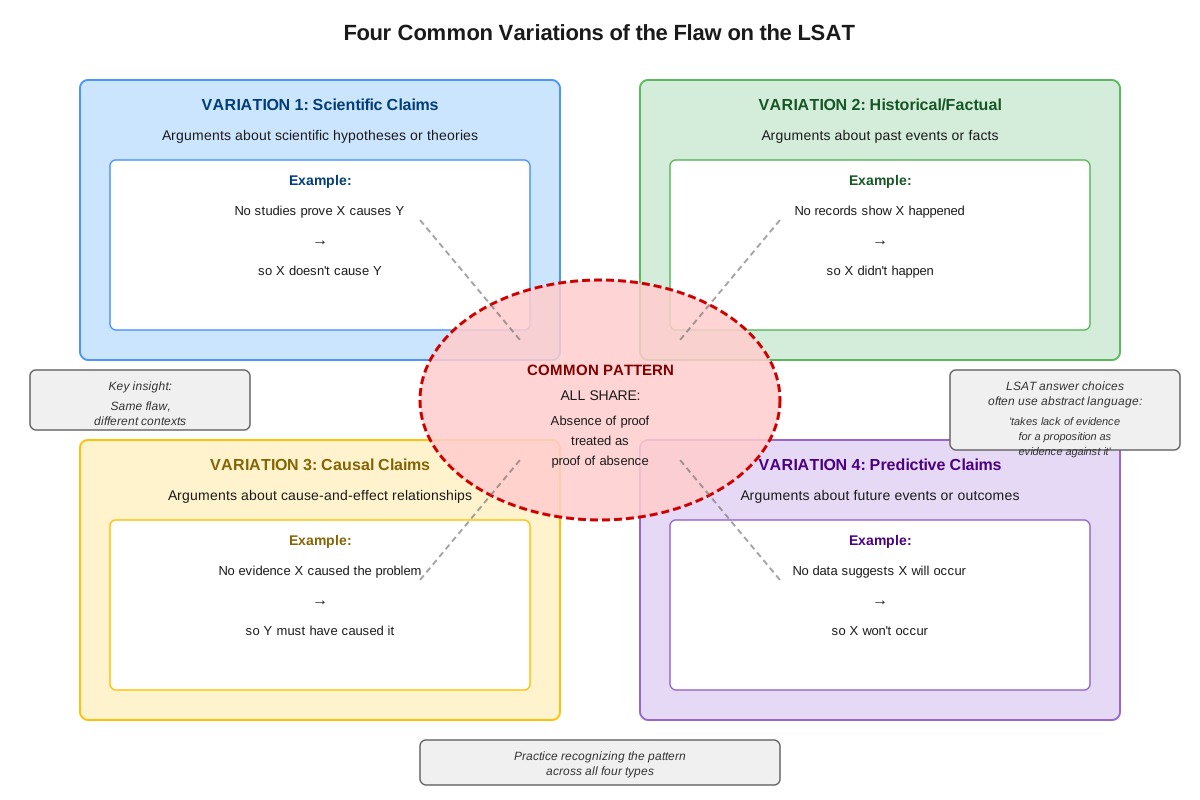
The LSAT presents this flaw in diverse contexts: archaeological arguments concluding ancient civilizations didn't have certain technologies because no artifacts have been found; medical arguments claiming treatments are safe because no studies have shown harm; historical arguments asserting events didn't occur because no records document them. The test-makers vary the subject matter extensively, but the underlying logical structure remains consistent, making pattern recognition the key to success.
Core Concepts
The Basic Structure of the Flaw
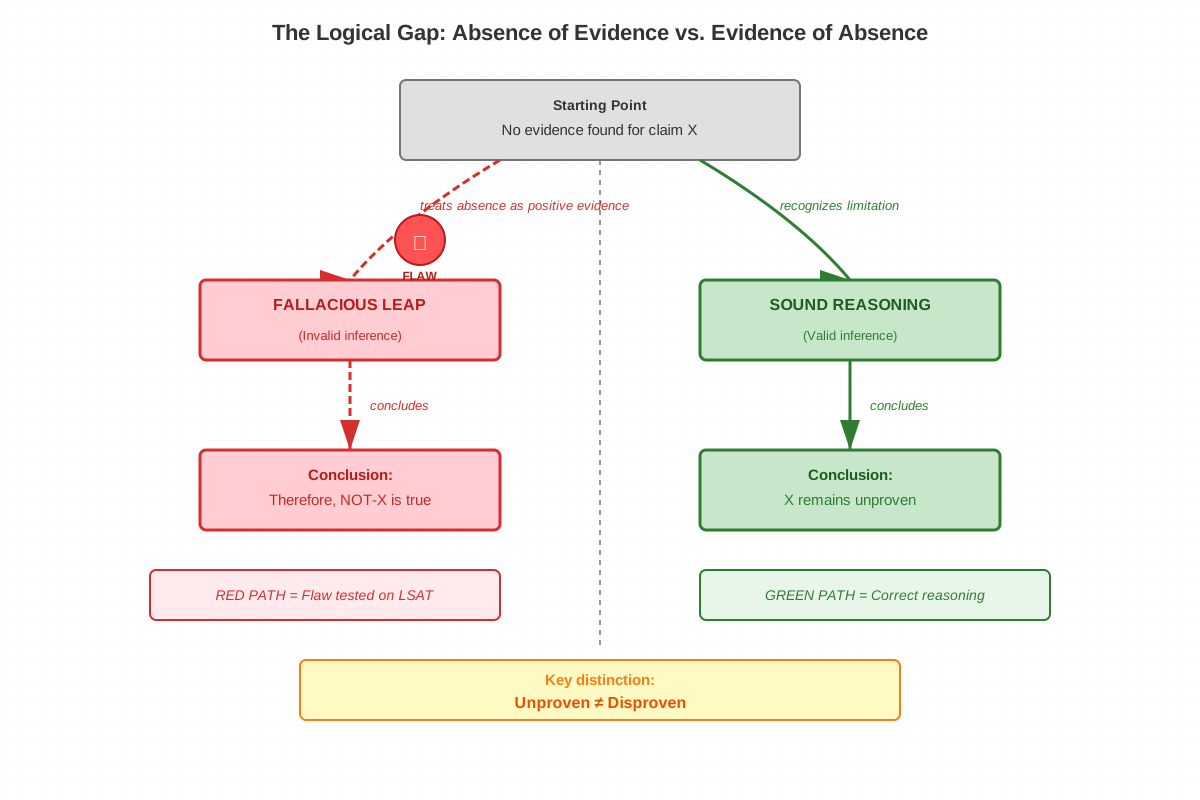
Treating lack of evidence as evidence (also called an appeal to ignorance or argumentum ad ignorantiam) occurs when an argument uses the absence of proof for one claim as if it constitutes proof for the opposite claim. The fundamental error involves confusing two distinct logical states:
- No evidence has been found for X (an epistemic claim about our current knowledge)
- Evidence exists against X (a claim about reality itself)
The fallacy treats statement 1 as if it were equivalent to statement 2, but these are logically distinct. Just because we haven't found evidence for something doesn't mean evidence against it exists, and just because we haven't proven something false doesn't mean it's true.
The Two Directional Forms
This flaw appears in two mirror-image forms on the LSAT:
| Direction | Structure | Example |
|---|---|---|
| Positive Conclusion | No evidence against X has been found → Therefore, X is true | "No study has proven this drug is harmful, so it must be safe." |
| Negative Conclusion | No evidence for X has been found → Therefore, X is false | "No evidence of ancient writing has been discovered, so this civilization must have been illiterate." |
Both forms commit the same fundamental error but reach opposite conclusions. LSAT questions test both directions with equal frequency, so students must recognize the pattern regardless of whether the conclusion is affirmative or negative.
The Burden of Proof Issue
Central to understanding this flaw is recognizing that burden of proof matters in logical argumentation. In sound reasoning, the party making a positive claim bears the burden of providing evidence for that claim. The absence of counter-evidence does not satisfy this burden.
Consider these scenarios:
- Flawed: "No one has proven my theory wrong, so it must be correct."
- Sound: "Multiple studies have confirmed my theory, and attempts to disprove it have failed, strengthening confidence in its validity."
The second example is sound because it provides positive evidence AND addresses counter-evidence. The first merely points to absence of counter-evidence, which doesn't constitute proof.
Distinguishing Legitimate Negative Evidence
Not all uses of "no evidence" are fallacious. The LSAT tests whether students can distinguish between:
Fallacious use: Using absence of evidence as the sole or primary basis for a conclusion
Legitimate use: Using absence of evidence as one factor among others, or in contexts where evidence would be expected if the claim were true
For example: "We searched the entire small room thoroughly with metal detectors. No metal was detected. Therefore, there is likely no metal in the room." This reasoning is sound because:
- A thorough search was conducted
- The search method would detect metal if present
- The conclusion is qualified ("likely")
- The context is constrained (small room, not an ocean)
Contrast with: "No one has ever proven that extraterrestrial life doesn't exist, so it must exist somewhere." This is fallacious because the absence of proof against something (in an essentially unsearchable domain) is treated as proof for it.
Common LSAT Contexts
The LSAT presents this flaw in several recurring contexts:
Archaeological/Historical: "No artifacts of type X have been found, so ancient people didn't use X"
- The flaw: Absence of discovered artifacts ≠ proof artifacts never existed
Scientific/Medical: "No research has demonstrated harm, so the practice is safe"
- The flaw: Absence of proof of harm ≠ proof of safety
Legal/Procedural: "No evidence of innocence has been presented, so the defendant is guilty"
- The flaw: Absence of exculpatory evidence ≠ proof of guilt
Observational: "No one has reported seeing X, so X didn't occur"
- The flaw: Absence of reports ≠ proof of non-occurrence
The Logical Gap
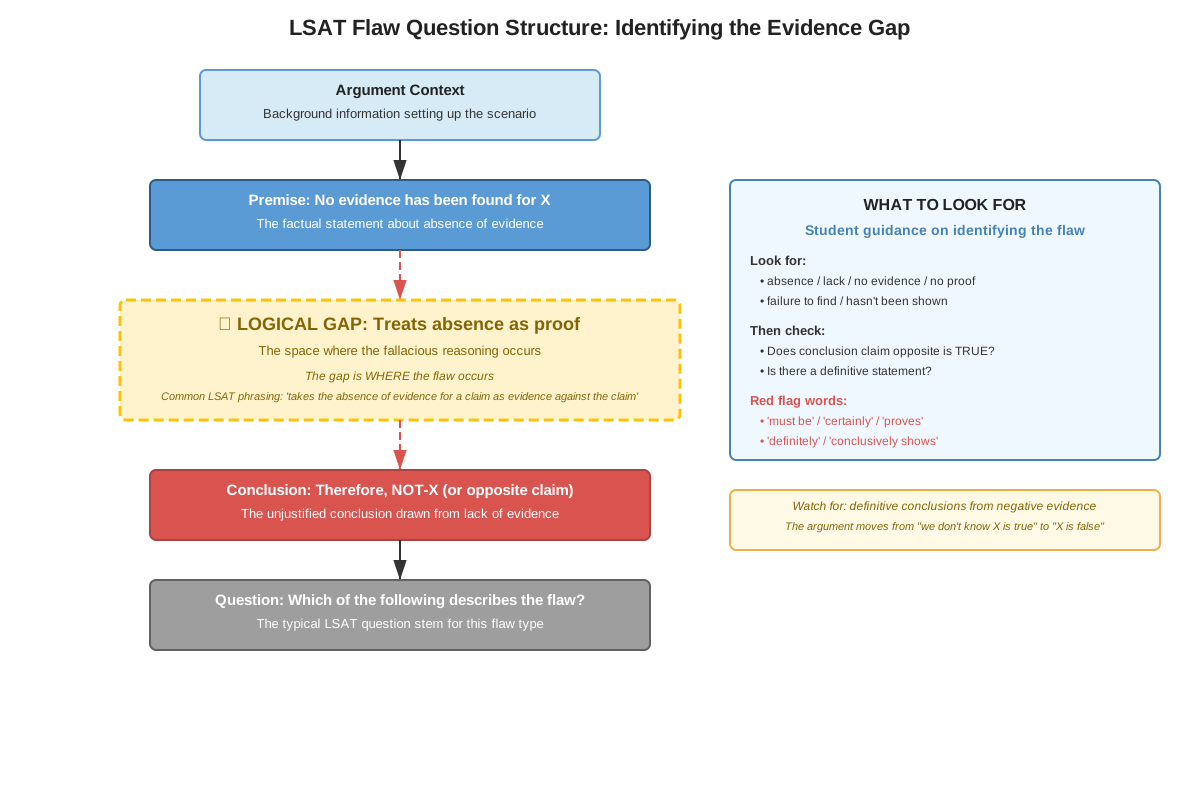
In arguments committing this flaw, there is always a logical gap between the premise and conclusion:
Premise: We lack evidence for/against X
Hidden assumption: If X were true/false, we would have evidence
Conclusion: Therefore, X is false/true
The argument fails because the hidden assumption is unwarranted. Many factors could explain the absence of evidence: insufficient searching, evidence degradation, limitations in detection methods, or simply that the search hasn't occurred yet. The argument treats one possible explanation (that X is false/true) as if it were the only explanation.
Recognition Patterns
On the LSAT, arguments committing this flaw typically include phrases like:
- "No evidence has been found that..."
- "There is no proof that..."
- "No one has demonstrated..."
- "It has never been shown that..."
- "No studies have established..."
- "The absence of... indicates..."
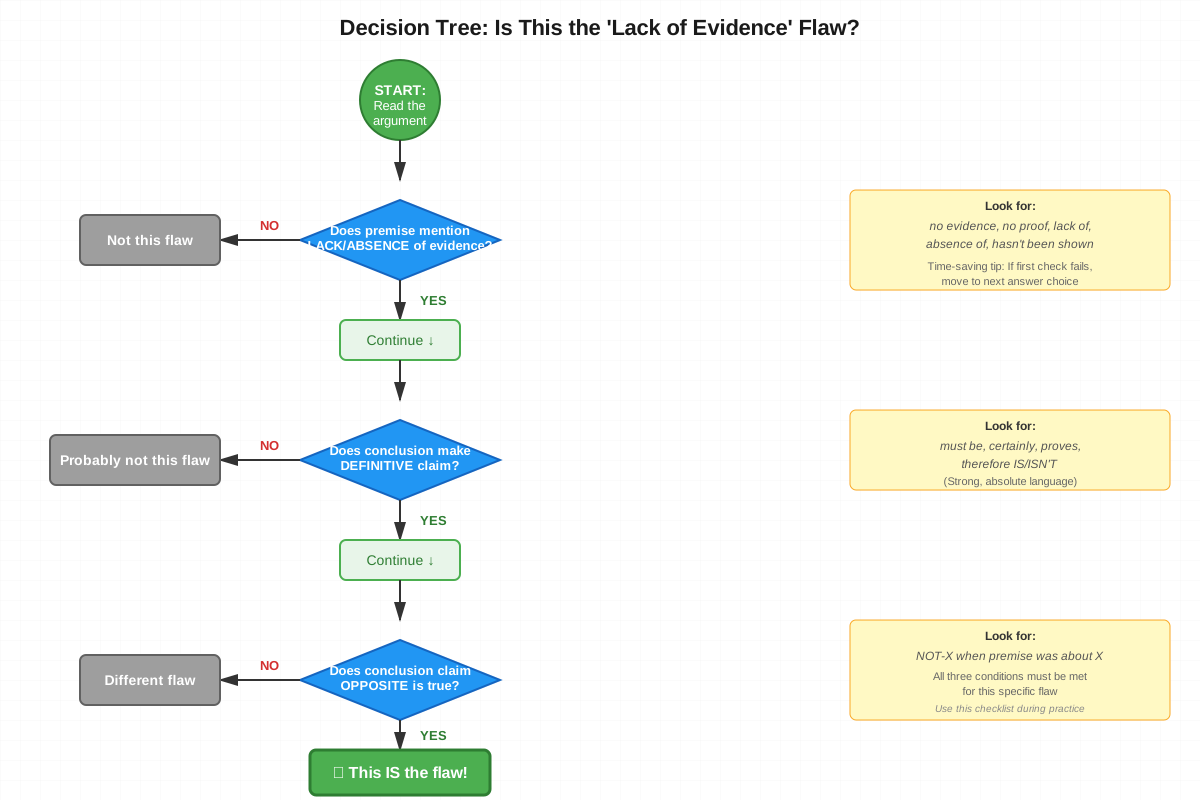
When these phrases appear in premises, and the conclusion makes a definitive claim in the opposite direction, the argument likely commits this flaw.
Concept Relationships
The concept of treating lack of evidence as evidence connects to several other logical reasoning principles. At its core, this flaw represents a misunderstanding of burden of proof → the party making a claim must provide positive evidence, not merely point to absence of counter-evidence. This connects directly to sufficient versus necessary conditions → the absence of evidence against X is not sufficient to prove X true, even though positive evidence for X is necessary to establish X.
This flaw also relates to hasty generalization in that both involve drawing conclusions from insufficient evidence, though hasty generalization involves weak positive evidence while this flaw involves absence of evidence. The relationship to conditional logic appears when students must recognize that "no evidence for X" does not trigger the contrapositive of "if X, then evidence exists."
The concept map flows as follows: Burden of Proof → determines who must provide evidence → Absence of Evidence → is not equivalent to → Evidence of Absence → which would require → Positive Evidence → to establish → Sound Conclusion. Understanding this chain helps students recognize why the flaw is indeed a flaw and not legitimate reasoning.
High-Yield Facts
⭐ Treating lack of evidence as evidence means concluding something is true (or false) based solely on the absence of proof for the opposite claim
⭐ This flaw appears in approximately 10-15% of all Logical Reasoning questions, making it one of the most frequently tested reasoning errors
⭐ The flaw works in both directions: concluding X is true because there's no evidence against it, OR concluding X is false because there's no evidence for it
⭐ Absence of evidence is not the same as evidence of absence—this distinction is the core of the flaw
⭐ Correct answer choices often use phrases like "takes the absence of evidence for a claim as evidence against that claim" or variations thereof
- The flaw is also known as "appeal to ignorance" or argumentum ad ignorantiam in formal logic
- Not all uses of "no evidence" are fallacious—legitimate uses occur when evidence would be expected if the claim were true and thorough searching has occurred
- This flaw often appears in archaeological, medical, historical, and scientific contexts on the LSAT
- The burden of proof lies with the party making a positive claim, not with those questioning it
- Arguments committing this flaw contain a logical gap between "we don't know" and "therefore we do know the opposite"
Quick check — test yourself on Treating lack of evidence as evidence so far.
Try Flashcards →Common Misconceptions
Misconception: Any argument that mentions "no evidence" commits this flaw → Correction: The flaw only occurs when absence of evidence is used as the primary or sole basis for a conclusion. Mentioning that no counter-evidence exists while also providing positive evidence is legitimate reasoning.
Misconception: This flaw only works in one direction (concluding something is false because there's no evidence for it) → Correction: The flaw works in both directions equally. Concluding something is true because there's no evidence against it is just as fallacious as concluding something is false because there's no evidence for it.
Misconception: If a thorough search has been conducted and no evidence found, concluding the thing doesn't exist is always fallacious → Correction: In constrained contexts where evidence would necessarily be found if the thing existed, this reasoning can be sound. The fallacy occurs when the absence of evidence is used in contexts where evidence might not exist even if the claim were true.
Misconception: This flaw is the same as "hasty generalization" → Correction: While both involve insufficient evidence, hasty generalization draws conclusions from weak positive evidence, while treating lack of evidence as evidence draws conclusions from the complete absence of evidence for one side of a claim.
Misconception: The correct answer will always use the exact phrase "treats lack of evidence as evidence" → Correction: LSAT answer choices vary their wording extensively. Correct answers might say "takes the absence of proof for X as proof against X," "treats failure to establish X as establishing not-X," or "confuses lack of evidence for a claim with evidence against that claim."
Worked Examples
Example 1: Archaeological Argument
Argument: "Archaeologists have excavated numerous sites from the ancient Minoan civilization, but they have never found any evidence of written records. Therefore, the Minoans must not have developed a writing system."
Analysis:
Step 1 - Identify the conclusion: "The Minoans must not have developed a writing system"
Step 2 - Identify the premise: "Archaeologists have never found any evidence of written records"
Step 3 - Identify the logical gap: The argument moves from "no evidence has been found" to "the thing didn't exist." This is the classic structure of treating lack of evidence as evidence.
Step 4 - Recognize why it's flawed: Multiple alternative explanations exist for the absence of evidence:
- Writing materials may have degraded over time
- Sites containing written records haven't been excavated yet
- Written records may have been rare and used only in specific contexts
- The writing system may not be recognized as such by archaeologists
The argument treats the absence of discovered evidence as if it were positive evidence that no writing system existed, which is fallacious.
Step 5 - Predict answer choice language: The correct answer will likely say something like "concludes that something did not occur merely because there is no evidence that it did occur" or "treats the failure to find evidence for a claim as evidence that the claim is false."
Connection to learning objectives: This example demonstrates how to identify the flaw (Objective 1), explains the reasoning pattern of moving from absence of evidence to a definitive conclusion (Objective 2), and shows the application process for LSAT-style problems (Objective 3).
Example 2: Medical Safety Argument
Argument: "The new pharmaceutical compound has been available for six months, and in that time, no studies have proven that it causes adverse side effects. We can therefore conclude that the compound is safe for long-term use."
Analysis:
Step 1 - Identify the conclusion: "The compound is safe for long-term use"
Step 2 - Identify the premise: "No studies have proven that it causes adverse side effects"
Step 3 - Identify the logical gap: The argument moves from "no proof of harm" to "proof of safety." This commits the flaw in the positive direction—concluding something is true (safe) because evidence against it (proof of harm) hasn't been found.
Step 4 - Recognize why it's flawed: The absence of studies proving harm is not equivalent to studies proving safety because:
- Six months may be insufficient time for long-term effects to manifest
- Studies may not have been conducted or published yet
- Adverse effects may be rare or difficult to detect
- The absence of proof of harm doesn't constitute proof of safety
Step 5 - Note the variation: This example shows the flaw working in the opposite direction from Example 1. Here, the absence of negative evidence is treated as positive evidence, rather than absence of positive evidence being treated as negative evidence.
Step 6 - Predict answer choice language: The correct answer might say "treats the absence of evidence that something is harmful as evidence that it is safe" or "takes the failure to prove a claim as proof of the opposite claim."
Connection to learning objectives: This example reinforces pattern recognition across different contexts (Objective 1), demonstrates the bidirectional nature of the flaw (Objective 4), and shows how to apply the concept when the conclusion is positive rather than negative (Objective 3).
Exam Strategy
When approaching flaw questions on the LSAT that involve treating lack of evidence as evidence, follow this systematic process:
Step 1 - Scan for trigger phrases: As you read the argument, watch for phrases like "no evidence has been found," "no proof exists," "has never been shown," or "absence of." These signal potential presence of this flaw.
Step 2 - Map the logical structure: Quickly identify whether the argument moves from:
- No evidence FOR X → Therefore X is FALSE, or
- No evidence AGAINST X → Therefore X is TRUE
Step 3 - Verify it's truly a flaw: Confirm that the absence of evidence is the primary or sole basis for the conclusion. If the argument also provides positive evidence, this particular flaw may not apply.
Step 4 - Pre-phrase the answer: Before looking at answer choices, mentally formulate how you would describe the flaw: "The argument treats the lack of evidence for X as if it were evidence against X."
Step 5 - Eliminate wrong answers: Use process of elimination:
- Eliminate answers describing flaws that aren't present
- Eliminate answers that describe the argument's content rather than its logical structure
- Eliminate answers that reverse the direction of the flaw
Exam Tip: Answer choices will rarely use the exact phrase "treats lack of evidence as evidence." Instead, look for variations like "takes absence of proof for X as proof against X," "confuses lack of evidence with evidence of lack," or "treats failure to establish X as establishing not-X."
Time allocation: Spend approximately 1 minute reading and analyzing the argument, and 30-45 seconds evaluating answer choices. If you've correctly identified the flaw, the right answer should match your pre-phrase closely.
Common trap answers for this flaw type include:
- Answers that describe circular reasoning (the argument doesn't assume its conclusion)
- Answers that describe sampling errors (the argument isn't generalizing from a sample)
- Answers that reverse the direction (saying the argument treats evidence as lack of evidence)
Memory Techniques
Primary Mnemonic - "ABSENCE":
- Absence of proof
- Burden not met
- Shift to opposite
- Evidence confused
- Not the same thing
- Conclusion unwarranted
- Explanations ignored
Visualization Strategy: Picture a courtroom where a prosecutor says, "The defendant hasn't proven his innocence, so he must be guilty." This reverses the burden of proof and treats lack of evidence (for innocence) as evidence (of guilt). This vivid image captures the essence of the flaw.
Directional Reminder - "Two-Way Street": Remember that this flaw travels both directions:
- No FOR → FALSE (no evidence supporting it, so it's not true)
- No AGAINST → TRUE (no evidence contradicting it, so it is true)
The "Absence ≠ Evidence" Equation: Mentally write: Absence of Evidence ≠ Evidence of Absence. This simple formula captures the core logical error.
Answer Choice Acronym - "TAPS": Correct answers often include these elements:
- Treats/Takes
- Absence/Lack
- Proof/Evidence
- Support/Establish (with "as" connecting to the opposite)
Summary
Treating lack of evidence as evidence is a fundamental logical flaw that appears frequently on the LSAT, particularly in flaw questions but also across other Logical Reasoning question types. The error occurs when an argument concludes that something is true (or false) based solely or primarily on the absence of evidence for the opposite claim. This confuses two distinct concepts: not having evidence for X (an epistemic state about our knowledge) with having evidence against X (a claim about reality). The flaw works bidirectionally—arguments can conclude something is false because no evidence supports it, or conclude something is true because no evidence contradicts it. Both forms are equally fallacious. Success on LSAT questions testing this concept requires recognizing the pattern across diverse contexts (archaeological, medical, scientific, historical), understanding why the reasoning is flawed (it ignores alternative explanations for the absence of evidence and improperly shifts the burden of proof), and matching the flaw to answer choices that may use varied language to describe the same logical error. Mastering this topic significantly improves performance on Logical Reasoning sections because it appears in 10-15% of questions and connects to broader concepts of burden of proof, sufficient evidence, and sound argumentation.
Key Takeaways
- Treating lack of evidence as evidence means using the absence of proof for one claim as if it constitutes proof for the opposite claim—this is a logical fallacy, not sound reasoning
- The flaw appears in two mirror-image forms: concluding X is false because there's no evidence for it, OR concluding X is true because there's no evidence against it
- This is one of the most frequently tested flaws on the LSAT, appearing in approximately 10-15% of Logical Reasoning questions
- The core error involves confusing "we don't have evidence" with "we have evidence for the opposite"—these are logically distinct states
- Correct answer choices use varied language but always describe the same pattern: taking absence of proof as proof of absence (or vice versa)
- Not all mentions of "no evidence" are fallacious—legitimate uses occur in constrained contexts where thorough searching has been done and evidence would be expected if the claim were true
- Recognizing trigger phrases like "no evidence has been found," "never been proven," and "absence of" helps quickly identify potential instances of this flaw
Related Topics
Burden of Proof Errors: Understanding how arguments improperly shift the burden of proof connects directly to this flaw, as treating lack of evidence as evidence often involves expecting one party to disprove a claim rather than requiring the claimant to prove it. Mastering the current topic provides the foundation for recognizing more subtle burden-shifting errors.
Necessary vs. Sufficient Assumptions: This flaw often appears in necessary assumption questions where the correct answer addresses the gap between "no evidence found" and "therefore false/true." Understanding this flaw helps identify what assumptions arguments require to be valid.
Conditional Logic Errors: The relationship between this flaw and conditional reasoning appears when students must recognize that "if X, then evidence" does not mean "if no evidence, then not X" without additional justification. This topic builds on the current understanding of evidentiary reasoning.
Strengthen and Weaken Questions: Arguments that commit this flaw can be strengthened by providing positive evidence or weakened by showing why absence of evidence is expected even if the claim were true. Mastering this flaw improves performance on these question types.
Practice CTA
Now that you understand the logical structure and recognition patterns for treating lack of evidence as evidence, it's time to reinforce your learning through active practice. Attempt the practice questions associated with this topic, focusing on identifying the flaw quickly and accurately predicting answer choice language before looking at the options. Use the flashcards to drill the key concepts, trigger phrases, and variations of this flaw until recognition becomes automatic. Remember: this flaw appears in 10-15% of Logical Reasoning questions, making it one of the highest-yield topics you can master. Every minute spent practicing this concept directly translates to points on test day. You've built the foundation—now solidify it through deliberate practice!
Sign up free to keep reading
Create a free AnvayaPrep account to finish this LSAT guide on Treating lack of evidence as evidence — plus flashcards and practice questions.