Overview
No statements represent one of the most fundamental and frequently tested components of formal logic and quantifiers on the LSAT. These statements express absolute negation—asserting that no members of one category belong to another category. Understanding how to properly interpret, diagram, and manipulate no statements is essential for success on Logical Reasoning questions, particularly those involving conditional reasoning, inference questions, and formal logic structures.
On the LSAT, no statements appear in various forms: "No A are B," "None of the A are B," "A are never B," and similar constructions. The ability to recognize these statements and understand their logical implications separates high-scoring test-takers from those who struggle with formal logic questions. These statements create absolute boundaries between categories, and recognizing these boundaries allows test-takers to make valid inferences while avoiding invalid ones. The LSAT frequently tests whether students can correctly identify what must be true, what could be true, and what cannot be true based on no statements.
The relationship between no statements and other logical reasoning concepts is foundational. No statements connect directly to conditional logic (they can be expressed as conditional statements), contrapositive reasoning, categorical logic, and quantifier relationships. Mastering no statements provides the building blocks for understanding more complex logical structures, including sufficient and necessary conditions, logical equivalences, and valid inference patterns. This topic serves as a gateway to advanced formal logic skills that appear throughout the Logical Reasoning and Analytical Reasoning sections of the LSAT.
Learning Objectives
- [ ] Identify how No statements appears in LSAT questions
- [ ] Explain the reasoning pattern behind No statements
- [ ] Apply No statements to solve LSAT-style problems accurately
- [ ] Convert no statements into equivalent conditional statement forms
- [ ] Recognize all linguistic variations of no statements in LSAT passages
- [ ] Determine valid and invalid inferences from no statements
- [ ] Combine no statements with other quantifiers to draw complex conclusions
Prerequisites
- Basic categorical logic: Understanding categories and class membership is essential because no statements describe relationships between entire categories
- Conditional statement structure: Familiarity with "if-then" statements helps because no statements can be expressed as conditional relationships
- Negation concepts: Knowing how logical negation works is necessary for understanding what no statements exclude
- Set theory basics: Understanding overlapping and non-overlapping sets provides the conceptual foundation for visualizing no statements
Why This Topic Matters
No statements appear with remarkable frequency on the LSAT, making them one of the highest-yield topics in formal logic. Research on LSAT question patterns indicates that approximately 15-20% of Logical Reasoning questions involve formal logic structures, and no statements appear in roughly 40% of those questions. This translates to 3-5 questions per LSAT exam that directly test or incorporate no statements—a significant portion of the test that can substantially impact overall scores.
In real-world applications, no statements represent categorical exclusions that appear in legal reasoning, policy analysis, and logical argumentation. Attorneys regularly encounter absolute prohibitions ("No evidence obtained illegally may be admitted"), categorical exclusions ("No person under 18 may enter into binding contracts"), and universal negations ("No testimony given under duress is admissible"). The ability to reason precisely with these statements is fundamental to legal practice and critical thinking.
On the LSAT, no statements commonly appear in several question types: Must Be True questions (where test-takers must identify valid inferences), Cannot Be True questions (where no statements directly establish impossibilities), Parallel Reasoning questions (where recognizing the logical structure of no statements is essential), and Formal Logic questions (where diagramming and manipulating no statements is required). They also appear frequently in stimulus passages that establish rules, constraints, or categorical relationships that form the basis for subsequent reasoning.
Core Concepts
Definition and Structure of No Statements
A no statement is a categorical proposition that asserts complete exclusion between two classes or categories. The standard form is "No A are B," which means that the set of A and the set of B have no members in common—they are completely disjoint. This represents the strongest form of negative categorical statement, expressing absolute rather than partial negation.
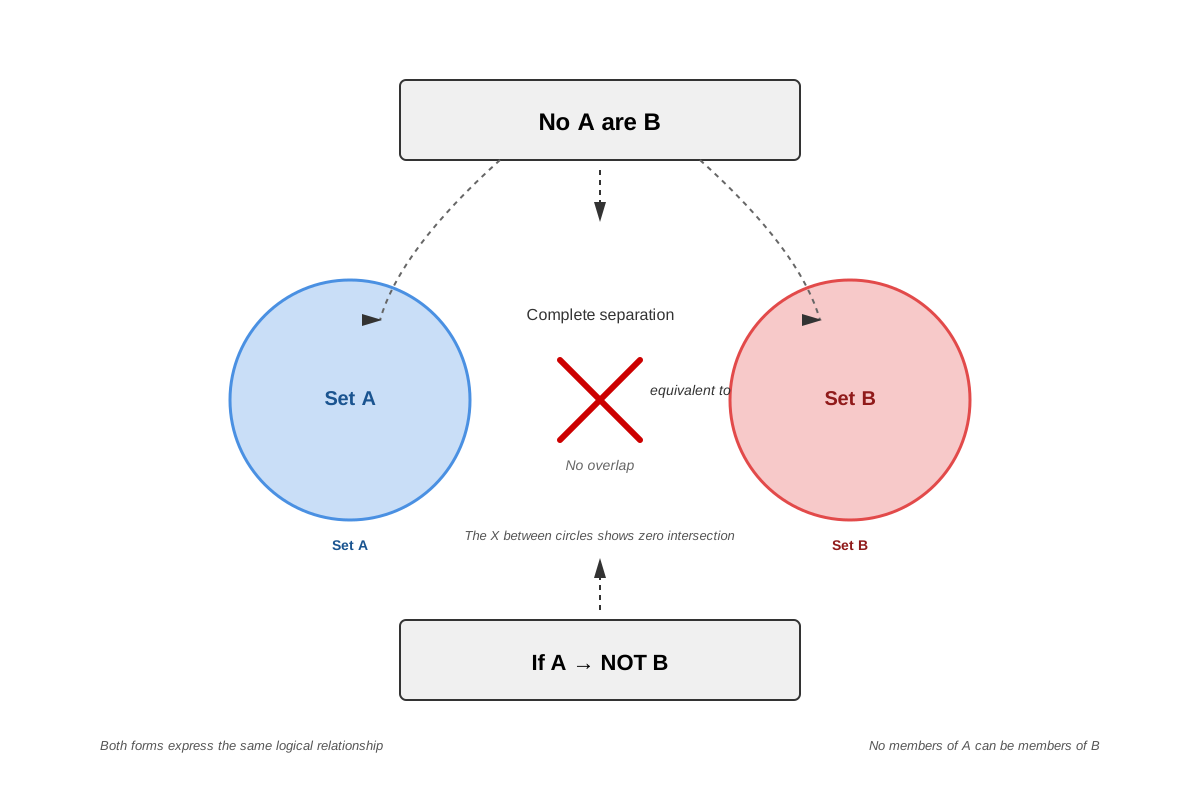
The logical structure of no statements involves two key components: the subject class (A) and the predicate class (B). The statement establishes that these two classes have zero overlap. In formal logic notation, this can be represented as: A ∩ B = ∅ (the intersection of A and B is the empty set). Understanding this set-theoretic interpretation helps visualize what no statements actually claim about the world.
Linguistic Variations
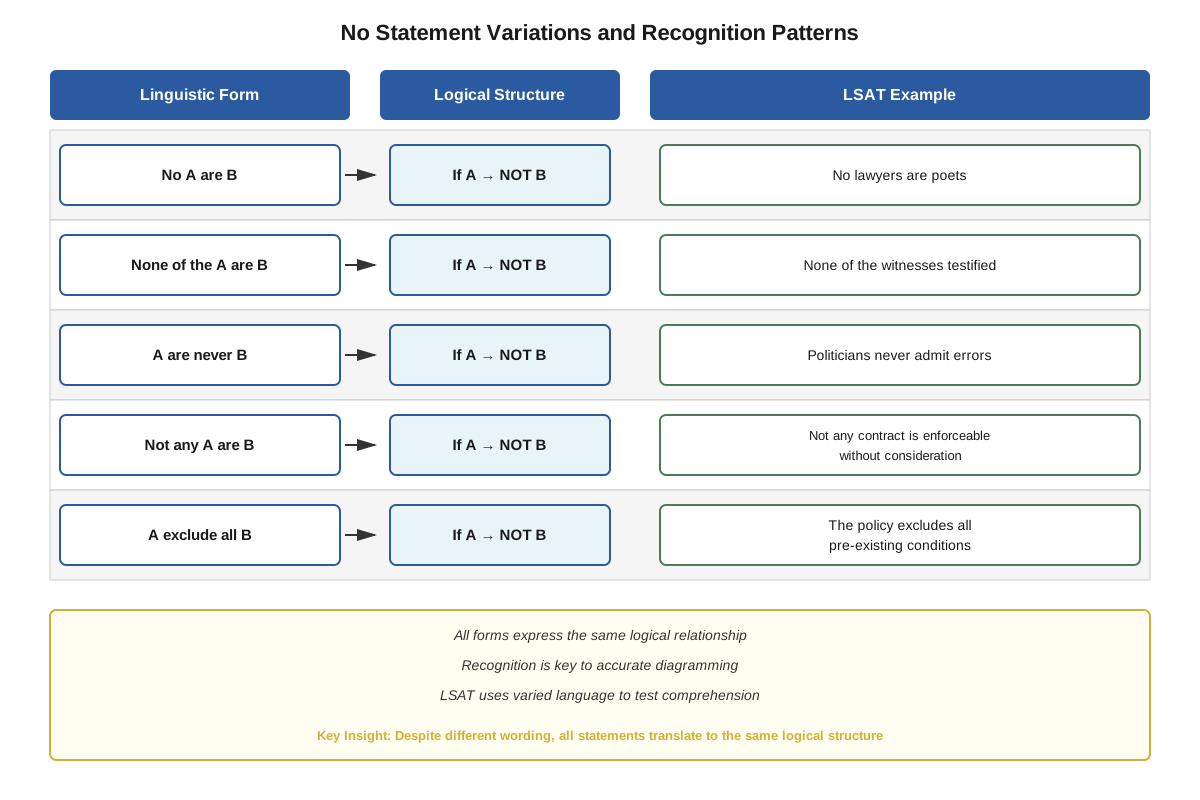
The LSAT presents no statements in numerous linguistic forms, and recognizing all variations is crucial for test success. Common formulations include:
- "No A are B" (standard form)
- "None of the A are B"
- "A are never B"
- "Not a single A is B"
- "There are no A that are B"
- "A are not B" (when context indicates universal negation)
- "Nothing that is A is B"
- "It is never the case that something is both A and B"
Each variation expresses the same logical relationship: complete exclusion between categories. Test-takers must train themselves to recognize these equivalent formulations instantly, as the LSAT deliberately varies language to test conceptual understanding rather than pattern recognition.
Conversion to Conditional Form
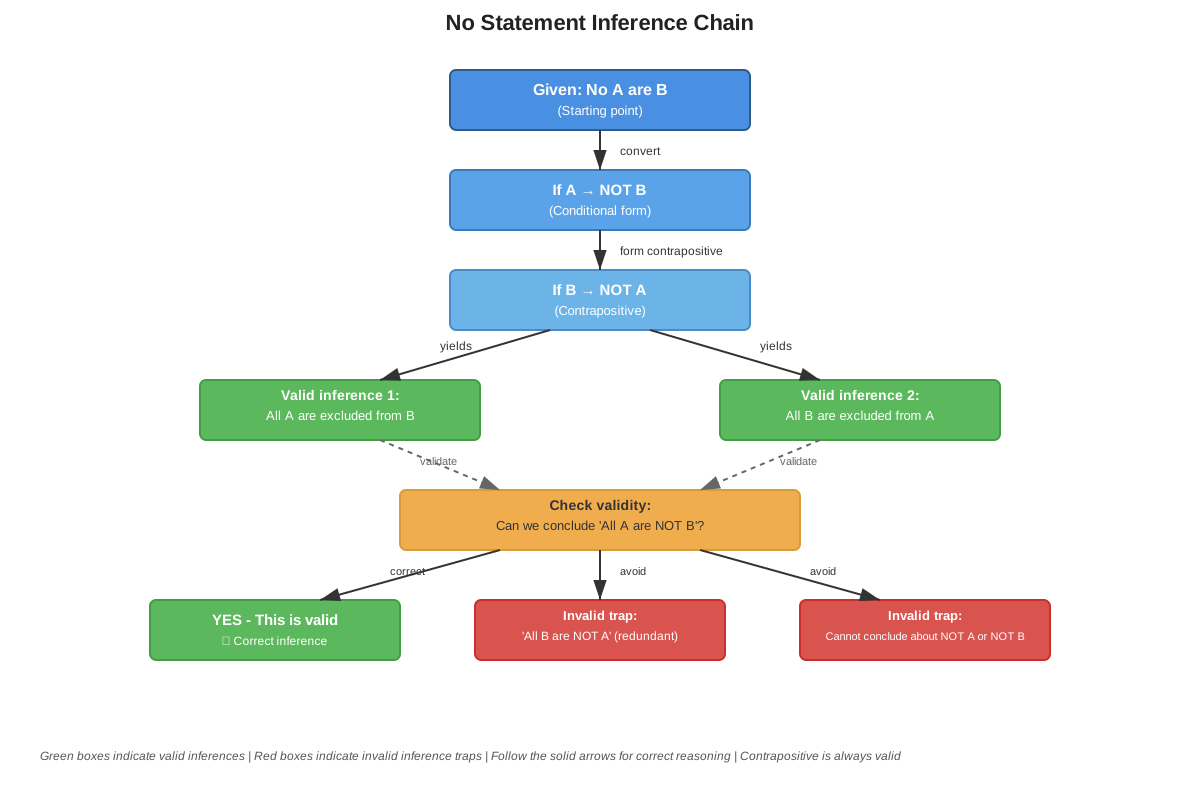
One of the most powerful techniques for working with no statements involves converting them into conditional statement form. The statement "No A are B" is logically equivalent to the conditional "If A, then not B" (A → ~B). This conversion is valid because if no members of category A belong to category B, then being an A is sufficient to guarantee not being a B.
This conditional equivalence unlocks powerful reasoning tools. Once converted to conditional form, no statements can be manipulated using contrapositive reasoning. The contrapositive of "If A, then not B" is "If B, then not A" (B → ~A). This means that "No A are B" is logically equivalent to "No B are A"—a property called symmetry or conversion. Unlike some categorical statements, no statements remain valid when the subject and predicate are reversed.
Logical Properties and Inferences
No statements possess several important logical properties that enable valid inferences:
Symmetry: "No A are B" is equivalent to "No B are A." The relationship of complete exclusion works in both directions.
Contraposition: When expressed conditionally (A → ~B), the contrapositive (B → ~A) is always valid and represents the same relationship from the opposite direction.
Partial inference: From "No A are B," we can validly infer "Some A are not B" (assuming A exists). This moves from a universal negative to a particular negative.
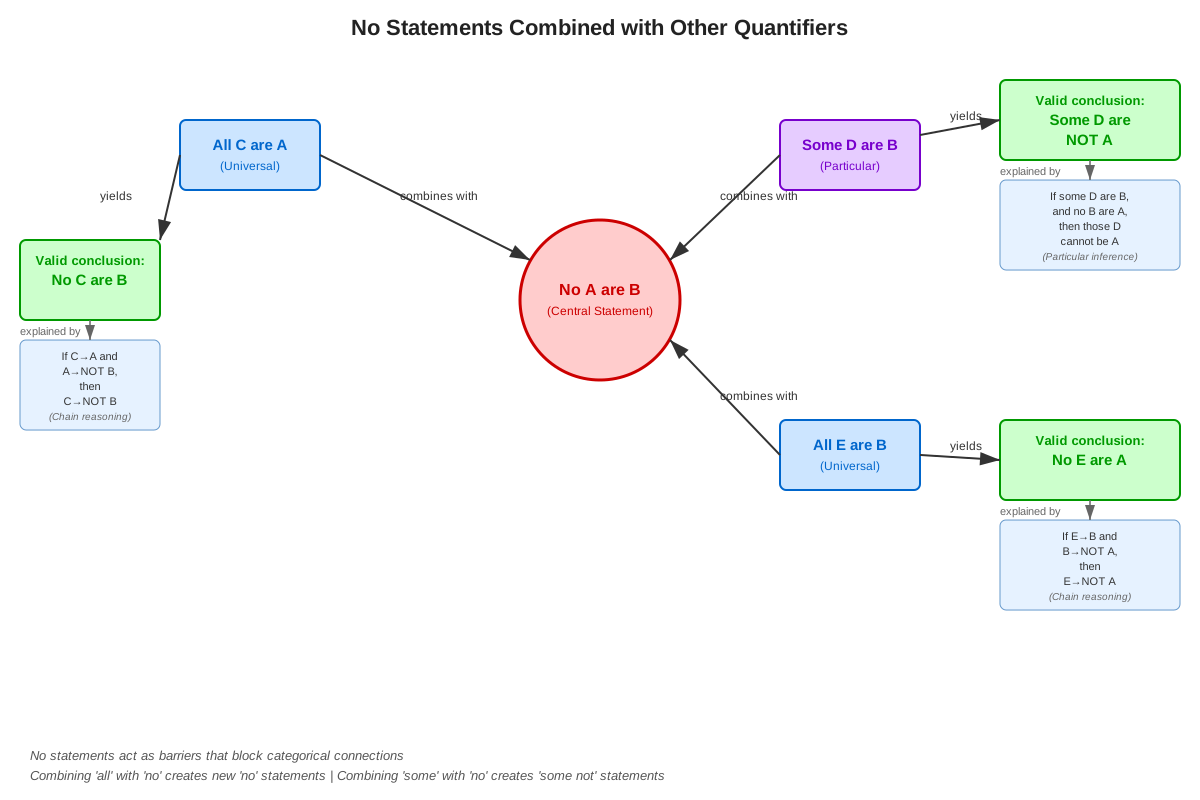
Combination with other quantifiers: No statements can be combined with other categorical statements to generate new inferences. For example:
- "No A are B" + "All C are A" → "No C are B"
- "No A are B" + "All C are B" → "No C are A"
Common Logical Fallacies
Understanding what no statements do NOT allow is equally important. Common invalid inferences include:
Illicit conversion with negation: "No A are B" does NOT mean "All A are not-B" in the sense of belonging to some specific category of non-B things. It only means A and B don't overlap.
Existential assumption: "No A are B" does not guarantee that A exists or that B exists. It only establishes that if they exist, they don't overlap.
Affirmative inference: From "No A are B," we cannot infer anything affirmative about what A or B actually are—only what they are not.
Diagramming Techniques
Visual representation of no statements aids comprehension and problem-solving. The most effective diagram shows two completely separate circles or sets:
[Circle A]     [Circle B]
   (no overlap)
This Venn diagram representation immediately shows the complete separation between categories. When combining multiple statements, these diagrams can be extended to show relationships among three or more categories, making complex inference patterns visible.
Relationship to Other Quantifiers
No statements occupy a specific position in the traditional square of opposition from classical logic:
| Statement Type | Form | Example |
|---|---|---|
| Universal Affirmative (A) | All A are B | All lawyers are professionals |
| Universal Negative (E) | No A are B | No lawyers are doctors |
| Particular Affirmative (I) | Some A are B | Some lawyers are politicians |
| Particular Negative (O) | Some A are not B | Some lawyers are not wealthy |
No statements (E-type) are contradictory to particular affirmative statements (I-type). If "No A are B" is true, then "Some A are B" must be false, and vice versa. This relationship frequently appears in LSAT questions that ask about what must be false or what contradicts a given statement.
Concept Relationships
The concepts within no statements form an interconnected logical system. The definition and structure of no statements provides the foundation → which enables conversion to conditional form → which unlocks contrapositive reasoning → which generates valid inferences. Understanding linguistic variations operates in parallel, allowing recognition of no statements regardless of surface form → which feeds into all other concepts by ensuring accurate identification.
The logical properties (symmetry, contraposition, partial inference) emerge directly from the fundamental structure of no statements and provide the rules for manipulation. These properties connect to combination with other quantifiers, enabling complex multi-step reasoning. Understanding common fallacies serves as a negative constraint, preventing invalid reasoning that might otherwise seem plausible.
Connections to prerequisite topics include: conditional logic (no statements convert to conditionals), negation (no statements express categorical negation), set theory (no statements describe disjoint sets), and categorical logic (no statements are one of four basic categorical forms). These connections mean that strengthening understanding in any related area reinforces comprehension of no statements.
Connections to related topics include: some statements (the contradictory opposite), all statements (which can be combined with no statements), conditional chains (which incorporate no statements as links), and formal logic games (which use no statements as constraints). Mastering no statements enables progression to these more complex topics.
High-Yield Facts
⭐ No statements are symmetric: "No A are B" is logically equivalent to "No B are A"—the order can be reversed without changing meaning.
⭐ Conditional conversion: "No A are B" converts to "If A, then not B" (A → ~B) and "If B, then not A" (B → ~A).
⭐ Contrapositive validity: The contrapositive of a no statement expressed conditionally is always valid and represents the same relationship.
⭐ Contradictory relationship: "No A are B" contradicts "Some A are B"—if one is true, the other must be false.
⭐ Combination rule: "No A are B" + "All C are A" validly yields "No C are B" through categorical syllogism.
- No statements express complete exclusion—zero overlap between categories, not merely partial separation.
- "No A are B" does not require that A or B actually exist; it's a conditional relationship about what would be true if they did exist.
- From "No A are B," we can infer "Some A are not B" only if we know that A exists (existential assumption).
- No statements cannot generate affirmative conclusions by themselves—they only establish what is not the case.
- Multiple no statements can be chained: "No A are B" + "No B are C" does NOT allow inference about the A-C relationship (unlike transitive relationships).
- "Not all A are B" is NOT equivalent to "No A are B"—the former allows some overlap while the latter prohibits any overlap.
- No statements in LSAT questions often appear disguised in complex sentence structures requiring careful parsing to identify.
- The negation of "No A are B" is "Some A are B" (at least one A is B), not "All A are B."
Quick check — test yourself on No statements so far.
Try Flashcards →Common Misconceptions
Misconception: "No A are B" means the same as "All A are not-B" in the sense that A belongs to some specific opposite category.
Correction: "No A are B" only establishes that A and B don't overlap; it doesn't place A into any particular alternative category. A could belong to many different categories that aren't B.
Misconception: If "No A are B," then "No B are C" allows us to conclude "No A are C."
Correction: No statements are not transitive. Complete exclusion between A-B and B-C tells us nothing definitive about the A-C relationship. A and C could overlap, be identical, or be completely separate.
Misconception: "No A are B" is the same as "Not all A are B."
Correction: These statements have vastly different logical strength. "Not all A are B" means at least one A is not B (but some A might be B). "No A are B" means zero A are B—complete exclusion. The LSAT frequently exploits this confusion.
Misconception: From "No A are B," we can infer that A and B are opposites or mutually exclusive categories in some meaningful sense.
Correction: No statements establish only non-overlap, not opposition. "No cats are furniture" doesn't make cats and furniture opposites; they're simply unrelated categories. Logical exclusion doesn't imply conceptual opposition.
Misconception: "No A are B" means that if something is not A, it could be B.
Correction: This confuses the statement with its contrapositive. "No A are B" means "If A, then not B" and "If B, then not A." It says nothing about what happens when something is not A—that thing could be B or not B.
Misconception: No statements can be weakened to "some not" statements but not strengthened.
Correction: While "No A are B" does imply "Some A are not B" (given existence), this is a one-way relationship. The reverse doesn't hold—"Some A are not B" doesn't imply "No A are B." Understanding this asymmetry is crucial for Must Be True questions.
Worked Examples
Example 1: Basic Inference Question
Stimulus: "No professional athletes are required to have college degrees. All members of the Olympic basketball team are professional athletes."
Question: Which of the following must be true?
Analysis:
Step 1: Identify the no statement: "No professional athletes are required to have college degrees."
- Convert to conditional: If professional athlete → not required to have college degree
- Contrapositive: If required to have college degree → not professional athlete
Step 2: Identify the all statement: "All members of the Olympic basketball team are professional athletes."
- Convert to conditional: If Olympic basketball team member → professional athlete
Step 3: Chain the conditionals:
- Olympic basketball team member → professional athlete → not required to have college degree
- Therefore: Olympic basketball team member → not required to have college degree
Step 4: Convert back to categorical form:
- "No members of the Olympic basketball team are required to have college degrees."
Answer: This must be true. The combination of the no statement with the all statement creates a valid categorical syllogism. The no statement excludes all professional athletes from the category of people required to have college degrees, and since all Olympic basketball team members are professional athletes, they too are excluded from that category.
Connection to Learning Objectives: This example demonstrates identifying no statements in LSAT questions, explaining the reasoning pattern (categorical syllogism with conditional conversion), and applying the logic to reach a valid conclusion.
Example 2: Complex Inference with Multiple Statements
Stimulus: "No vegetarian dishes at the restaurant contain meat. Some dishes that contain cheese are vegetarian dishes. All dishes containing meat are high in protein."
Question: If the statements above are true, which of the following must be false?
Analysis:
Step 1: Diagram the no statement:
- No vegetarian dishes contain meat
- Conditional form: If vegetarian dish → no meat
- Contrapositive: If contains meat → not vegetarian dish
Step 2: Analyze the some statement:
- Some dishes with cheese are vegetarian
- This tells us there's overlap between cheese dishes and vegetarian dishes
- Cannot make universal inferences from "some" statements alone
Step 3: Analyze the all statement:
- All meat dishes are high in protein
- If contains meat → high in protein
Step 4: Look for what must be false:
- From the no statement, we know vegetarian dishes and meat dishes are completely separate categories
- Therefore, "Some vegetarian dishes contain meat" must be false (contradicts the no statement)
- Also, "All vegetarian dishes contain meat" must be false (contradicts the no statement)
Step 5: Consider combinations:
- We cannot conclude that vegetarian dishes are NOT high in protein (they might be high in protein for other reasons)
- We cannot conclude that all cheese dishes are vegetarian (only some are)
- We CAN conclude that no vegetarian dishes contain meat (direct from the no statement)
Answer: Any statement claiming that vegetarian dishes contain meat must be false. The no statement establishes complete exclusion, making any claim of overlap impossible.
Connection to Learning Objectives: This example shows how to identify no statements in complex stimuli with multiple quantifiers, explain the reasoning pattern involving combinations of different statement types, and apply the logic to determine what must be false rather than what must be true.
Exam Strategy
When approaching LSAT questions involving no statements, follow this systematic process:
Step 1: Identify and mark no statements immediately. Circle or underline phrases like "no," "none," "never," "not a single," or "nothing." These are high-value logical anchors that constrain the entire problem.
Step 2: Convert to conditional form. Write "If A → ~B" next to "No A are B" statements. This conversion makes the logical structure explicit and enables contrapositive reasoning. Many students who struggle with no statements skip this crucial step.
Step 3: Write the contrapositive. From "If A → ~B," immediately write "If B → ~A." This doubles your logical information and often provides the key to solving the question.
Step 4: Look for combination opportunities. When no statements appear alongside all statements or other quantifiers, check whether they can be chained together. The pattern "All C are A" + "No A are B" → "No C are B" appears frequently.
Trigger words and phrases to watch for:
- "No," "none," "never," "not any," "not a single"
- "Nothing that is X is Y"
- "X are never Y"
- "It is never the case that"
- "There are no X that are Y"
- "X and Y are mutually exclusive" (implies no overlap)
Process-of-elimination tips:
- Eliminate answer choices that claim overlap between categories that a no statement separates
- Eliminate choices that reverse the logical direction without proper contrapositive reasoning
- Eliminate choices that treat "no" as equivalent to "not all"
- Keep choices that properly recognize symmetry (if no A are B, then no B are A)
- Keep choices that validly combine no statements with other quantifiers
Time allocation advice: No statement questions typically require 60-90 seconds. Spend 20-30 seconds identifying and converting statements, 20-30 seconds making inferences, and 20-30 seconds evaluating answer choices. If a question involves multiple no statements with complex combinations, allocate up to 2 minutes, but flag it for review if it's taking longer—these questions can become time traps.
Exam Tip: When you see a no statement in the stimulus, immediately check the answer choices for its contrapositive or symmetric form. The correct answer often restates the no statement in an equivalent but differently worded form.
Memory Techniques
Mnemonic for No Statement Properties - "SCCP":
- Symmetric: No A are B = No B are A
- Conditional: No A are B = If A then not B
- Contrapositive: If A then not B = If B then not A
- Partial: No A are B implies Some A are not B (with existence)
Visualization Strategy: Picture two circles that cannot touch. When you see a no statement, immediately visualize two separate bubbles with a force field between them. This mental image reinforces the complete exclusion and prevents errors where you might accidentally allow overlap.
Acronym for Linguistic Variations - "NNNNT":
- No A are B
- None of the A are B
- Never (A are never B)
- Not a single A is B
- There are no A that are B
Conversion Reminder - "NO means IF NOT": When you see NO, think IF NOT. "No A are B" becomes "If A, then NOT B." This simple phrase helps trigger the conditional conversion automatically.
Symmetry Reminder - "NO goes both ways": Unlike "all" statements (which don't convert), "no" statements work in both directions. The phrase "NO goes both ways" helps remember that you can flip the subject and predicate without changing the meaning.
Summary
No statements represent categorical propositions that establish complete exclusion between two classes, asserting that they have zero overlap. These statements appear frequently on the LSAT in various linguistic forms and serve as foundational elements of formal logic reasoning. The key to mastering no statements lies in recognizing their logical properties: symmetry (they work in both directions), convertibility to conditional form (enabling contrapositive reasoning), and combinability with other quantifiers (enabling complex inferences). Test-takers must distinguish no statements from weaker negative claims like "not all" and avoid common fallacies such as assuming transitivity or inferring affirmative conclusions. Success with no statements requires systematic identification, conversion to conditional form, application of contrapositive reasoning, and careful combination with other logical elements. The ability to work fluently with no statements unlocks a significant portion of LSAT Logical Reasoning questions and provides essential skills for more advanced formal logic topics.
Key Takeaways
- No statements establish complete exclusion between categories—zero overlap, not merely partial separation or majority exclusion
- Symmetry is automatic: "No A are B" always equals "No B are A," unlike all statements which don't convert
- Conditional conversion unlocks power: Transform "No A are B" into "If A → ~B" to enable contrapositive reasoning and logical chaining
- Combination with "all" statements is high-yield: The pattern "All C are A" + "No A are B" → "No C are B" appears frequently on the LSAT
- "No" and "not all" are completely different: Confusing these is one of the most common and costly errors on formal logic questions
- No statements contradict "some" statements: If "No A are B" is true, then "Some A are B" must be false, and vice versa
- Recognition of linguistic variations is essential: Train to identify no statements regardless of surface form—"never," "none," "not a single," etc.
Related Topics
Some Statements: The contradictory opposite of no statements, asserting that at least one member of category A belongs to category B. Mastering no statements provides the foundation for understanding the logical relationship between universal and particular propositions.
All Statements: Universal affirmative propositions that assert complete inclusion rather than exclusion. Understanding how all statements combine with no statements enables complex categorical syllogisms that appear frequently on the LSAT.
Conditional Logic Chains: Extended sequences of if-then statements that can incorporate no statements as links. Proficiency with no statements is prerequisite for handling multi-step conditional reasoning.
Formal Logic Games: Analytical Reasoning questions that use no statements as constraints in rule-based scenarios. The diagramming and inference skills developed with no statements transfer directly to logic games.
Contrapositive Reasoning: The logical operation of reversing and negating conditional statements. Since no statements convert to conditionals, contrapositive reasoning becomes a primary tool for generating inferences.
Square of Opposition: The classical logical framework showing relationships among all, no, some, and some-not statements. Understanding no statements within this framework provides comprehensive mastery of categorical logic.
Practice CTA
Now that you've mastered the core concepts of no statements, it's time to solidify your understanding through active practice. Attempt the practice questions to test your ability to identify, convert, and reason with no statements under timed conditions. Use the flashcards to drill recognition of linguistic variations and logical properties until they become automatic. Remember: formal logic skills improve dramatically with deliberate practice. Each question you work through strengthens the neural pathways that enable rapid, accurate reasoning on test day. The investment you make in practicing no statements will pay dividends across multiple question types throughout the Logical Reasoning section. You've built the foundation—now build the fluency that leads to a top score.
Sign up free to keep reading
Create a free AnvayaPrep account to finish this LSAT guide on No statements — plus flashcards and practice questions.