Overview
None plus all inference is a fundamental formal logic pattern that appears frequently on the LSAT Logical Reasoning section. This inference type combines two categorical statements—one stating that no members of group A are members of group B, and another stating that all members of group C are members of group A—to derive a valid conclusion about the relationship between groups C and B. Mastering this pattern enables test-takers to quickly identify valid deductions and eliminate invalid answer choices, making it an essential skill for achieving a competitive LSAT score.
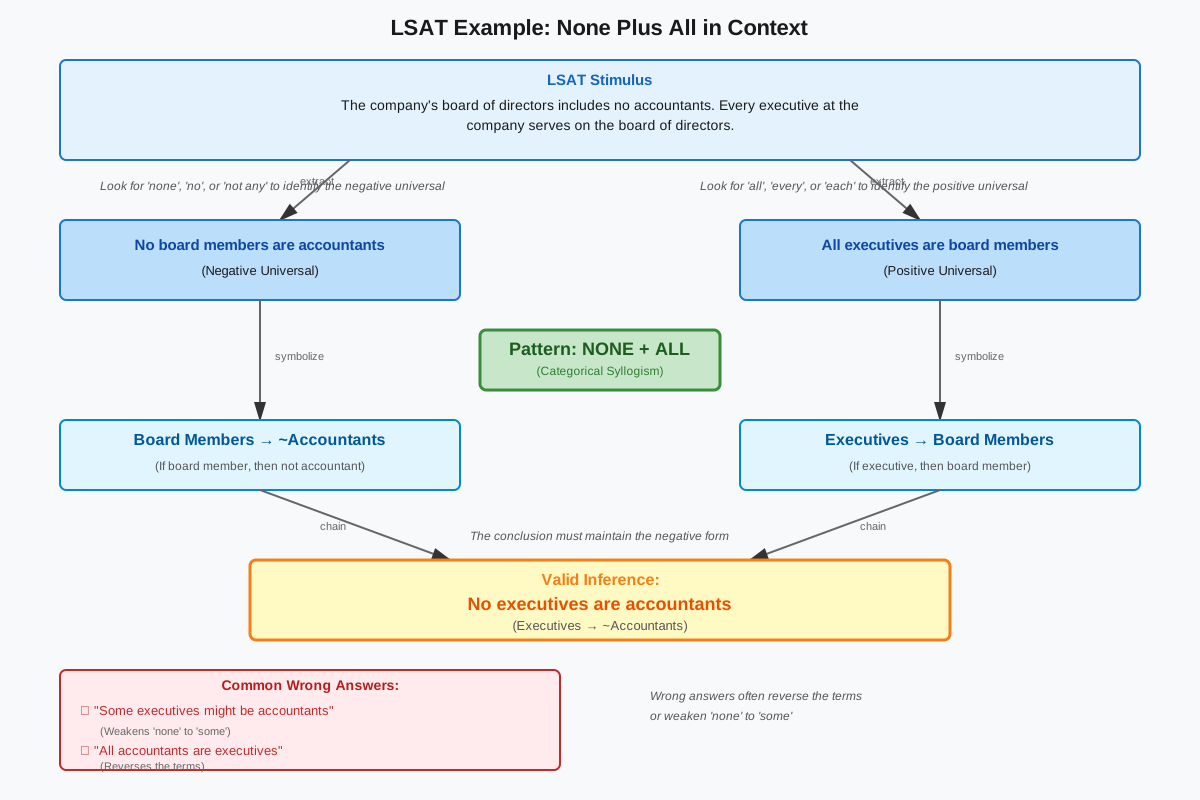
The LSAT none plus all inference pattern represents one of the most reliable and testable formal logic structures in the exam. When test-takers encounter statements like "None of the managers are accountants" combined with "All of the executives are managers," they must recognize that a valid conclusion follows: "None of the executives are accountants." This type of logical reasoning appears not only in explicit formal logic questions but also embedded within more complex argument structures, making it crucial for success across multiple question types including Must Be True, Inference, and Sufficient Assumption questions.
Understanding none plus all inference connects directly to broader competencies in formal logic and quantifiers. This pattern exemplifies how categorical statements interact through the rules of syllogistic reasoning, demonstrating the transitive properties of negative universal claims. Students who master this inference pattern develop stronger skills in diagramming arguments, recognizing valid deductive structures, and distinguishing between statements that must be true versus those that could be true. This foundational knowledge serves as a building block for more complex logical operations and enhances overall performance on the Logical Reasoning sections, which constitute approximately 50% of the scored LSAT.
Learning Objectives
- [ ] Identify how None plus all inference appears in LSAT questions
- [ ] Explain the reasoning pattern behind None plus all inference
- [ ] Apply None plus all inference to solve LSAT-style problems accurately
- [ ] Diagram none plus all inference patterns using standard formal logic notation
- [ ] Distinguish between valid and invalid variations of none plus all inference
- [ ] Recognize when additional premises are needed to complete a none plus all inference
- [ ] Combine none plus all inference with other formal logic patterns in complex arguments
Prerequisites
- Basic categorical logic: Understanding universal affirmative (all) and universal negative (none) statements is essential for recognizing the component parts of none plus all inference
- Conditional reasoning fundamentals: Familiarity with if-then statements and their contrapositives provides the logical foundation for understanding how categorical statements connect
- Set theory basics: Recognizing relationships between groups (subset, disjoint sets, intersection) enables visualization of how none plus all inference operates
- Formal logic notation: Ability to translate English statements into symbolic form (e.g., A → B, A → ~B) facilitates efficient diagramming and manipulation of logical statements
Why This Topic Matters
None plus all inference represents one of the highest-yield patterns for LSAT preparation because it appears with remarkable consistency across test administrations. Research on LSAT question patterns indicates that formal logic inferences, including none plus all patterns, appear in approximately 15-20% of Logical Reasoning questions. More importantly, these questions tend to be among the most efficiently solvable when students recognize the pattern, often requiring only 30-45 seconds to answer correctly compared to 90+ seconds for more complex argument-based questions.
In real-world applications, none plus all inference mirrors the categorical reasoning used in legal analysis, policy interpretation, and regulatory compliance. Attorneys regularly work with rules that exclude certain categories from specific classifications while simultaneously dealing with rules that place entities into those excluded categories. For example, understanding that "no felons may serve as jurors" combined with "all individuals convicted of embezzlement are felons" necessarily means "no individuals convicted of embezzlement may serve as jurors" represents practical legal reasoning that attorneys employ daily.
On the LSAT, none plus all inference appears most commonly in Must Be True questions, where test-takers must identify what necessarily follows from the given statements. It also appears in Inference questions, Sufficient Assumption questions (where the none plus all pattern completes an argument), and occasionally in Parallel Reasoning questions where the logical structure must be matched. The pattern may be presented explicitly with clear categorical language, or it may be embedded within more complex passages where test-takers must extract the relevant categorical statements before applying the inference rule. Questions may also test whether students can recognize when a none plus all inference is NOT valid due to reversed terms or missing premises.
Core Concepts
The Basic None Plus All Structure
The none plus all inference follows a specific logical structure that combines two categorical premises to yield a necessary conclusion. The pattern consists of:
- Premise 1 (None statement): None of the As are Bs (or equivalently: All As are not Bs)
- Premise 2 (All statement): All Cs are As
- Conclusion: None of the Cs are Bs (or equivalently: All Cs are not Bs)
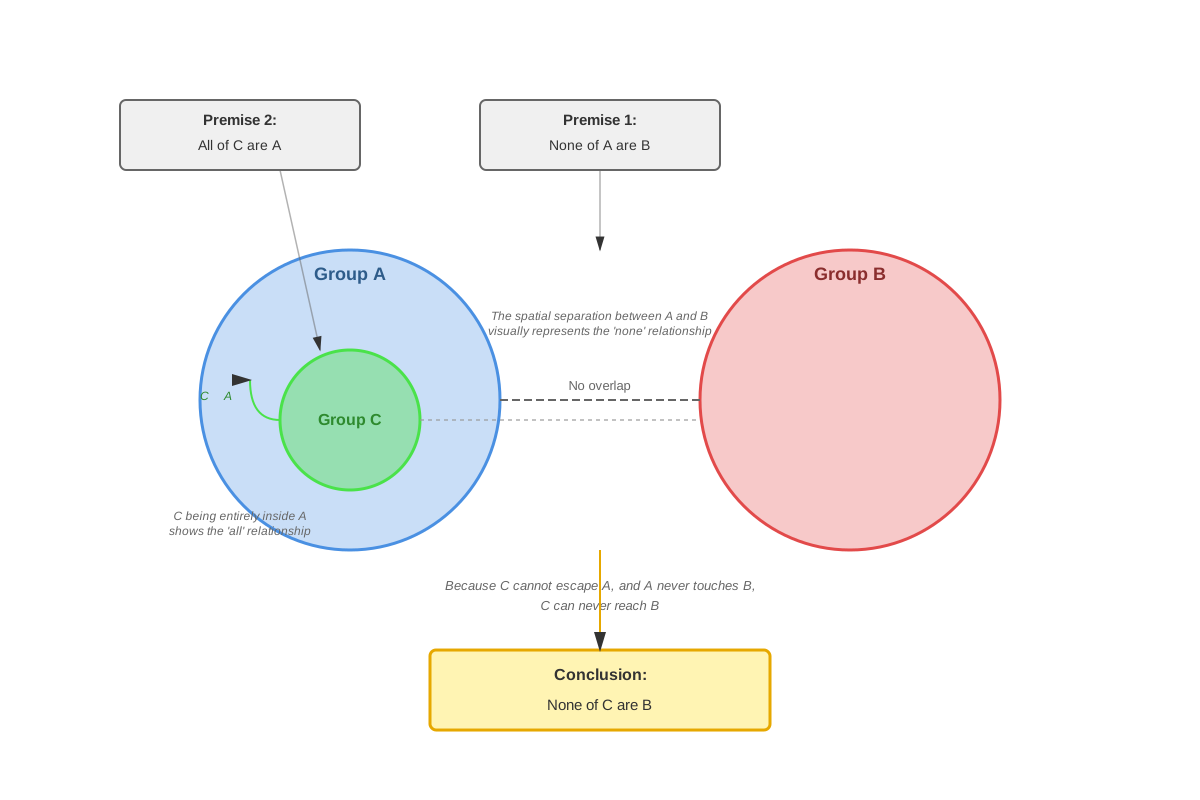
This structure works because the "all" statement places every member of group C inside group A, while the "none" statement establishes that groups A and B are completely separate (disjoint sets). Since every C is an A, and no A is a B, it necessarily follows that no C can be a B. The inference is deductively valid, meaning the conclusion must be true if the premises are true.
Formal Logic Notation
Understanding the symbolic representation enhances recognition speed and accuracy. The none plus all inference can be diagrammed as:
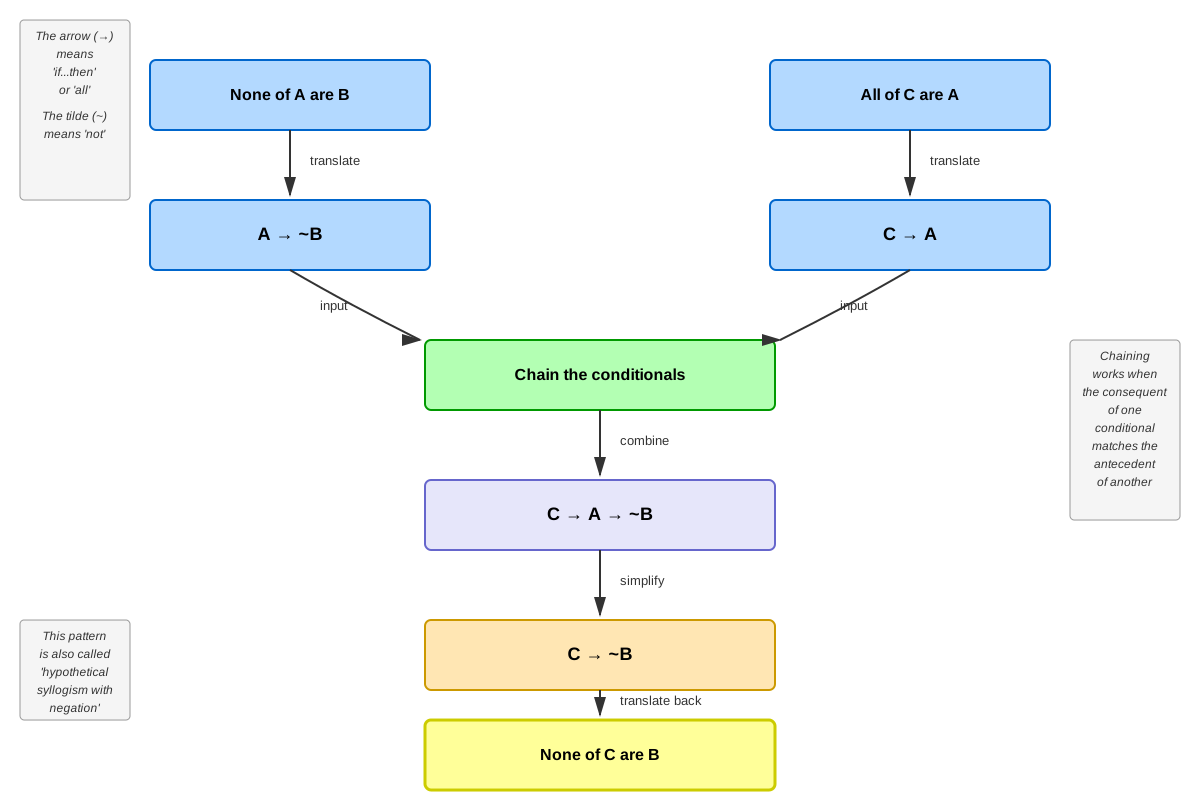
Premise 1: A → ~B  (If something is an A, then it is not a B)
Premise 2: C → A   (If something is a C, then it is an A)
Conclusion: C → ~B (If something is a C, then it is not a B)
This notation reveals that none plus all inference is actually a chain of conditional statements. The "none" statement (None of the As are Bs) translates to "If A, then not B," and the "all" statement (All Cs are As) translates to "If C, then A." Chaining these conditionals together through the shared term A produces the valid conclusion "If C, then not B," which translates back to "None of the Cs are Bs."
The Middle Term Connection
The validity of none plus all inference depends critically on the middle term—the category that appears in both premises but not in the conclusion. In the standard pattern, A serves as the middle term, connecting C to B through two separate relationships. The middle term must appear in the correct position in each premise:
- The middle term must be the subject of the "none" statement (None of the As are Bs)
- The middle term must be the predicate of the "all" statement (All Cs are As)
If the middle term appears in different positions, the inference may not be valid. For example, "None of the As are Bs" plus "All As are Cs" does NOT allow us to conclude anything definite about the relationship between C and B, because the terms are not properly connected.
Set Theory Visualization
Visualizing none plus all inference through set diagrams clarifies why the conclusion must follow:
- Draw circle A representing all members of category A
- Draw circle B completely separate from circle A (representing "None of the As are Bs")
- Draw circle C entirely inside circle A (representing "All Cs are As")
- Observe that circle C must also be completely separate from circle B
This visualization demonstrates that C and B cannot overlap because C is contained within A, and A and B do not overlap. The spatial relationship makes the logical necessity visually apparent.
Common Linguistic Variations
The LSAT presents none plus all inference using diverse language that may obscure the underlying pattern. Recognizing these variations is essential:
| Standard Form | LSAT Variations |
|---|---|
| None of the As are Bs | No A is a B; As are never Bs; As exclude all Bs; Not a single A is a B; As and Bs are mutually exclusive |
| All Cs are As | Every C is an A; Cs are always As; Only As can be Cs (contrapositive form); If C, then A; Being a C requires being an A |
| None of the Cs are Bs | No C is a B; Cs are never Bs; Cs cannot be Bs; It is impossible for a C to be a B |
Test-takers must mentally translate these variations into the standard none plus all structure to recognize the pattern quickly.
The Contrapositive Relationship
Understanding contrapositives enhances flexibility in recognizing none plus all patterns. The contrapositive of "All Cs are As" is "All non-As are non-Cs" (or "If not A, then not C"). This means none plus all inference can also be recognized in the form:
- None of the As are Bs
- All non-Bs are As (contrapositive form)
- Conclusion: All non-Bs are non-Cs, or equivalently, None of the Cs are Bs
Recognizing contrapositive forms prevents missing valid inferences when premises are stated in logically equivalent but syntactically different ways.
Invalid Variations and Common Traps
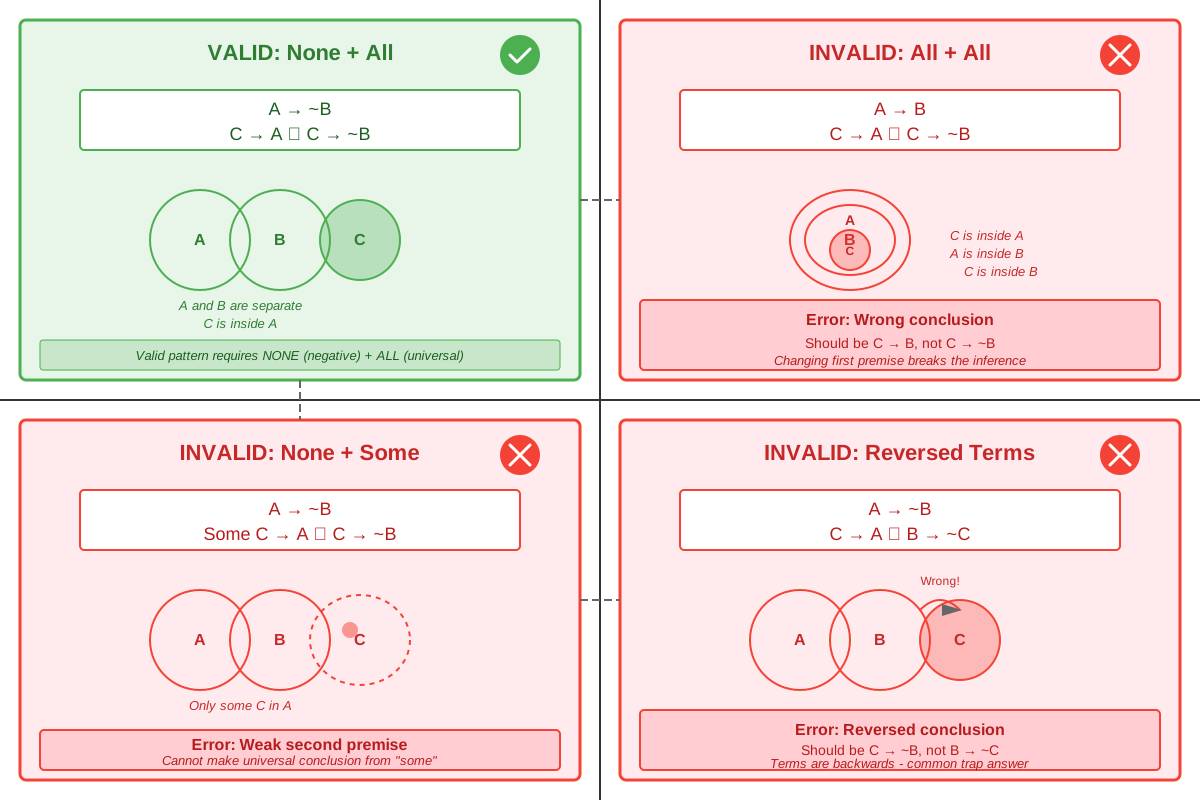
The LSAT frequently tests whether students can distinguish valid none plus all inferences from invalid variations. Common invalid patterns include:
Reversed middle term: "None of the Bs are As" plus "All Cs are As" does NOT yield a valid conclusion about C and B. The middle term A appears as the predicate in both statements, preventing proper connection.
Weakened quantifiers: "None of the As are Bs" plus "Some Cs are As" only allows the conclusion "Some Cs are not Bs," not "None of the Cs are Bs." The weakened quantifier "some" prevents the universal conclusion.
Reversed conclusion terms: From "None of the As are Bs" and "All Cs are As," we can conclude "None of the Cs are Bs," but we CANNOT conclude "None of the Bs are Cs" unless we have additional information. The conclusion terms must follow the proper order based on the premises.
Concept Relationships
None plus all inference connects fundamentally to conditional reasoning because categorical statements can be expressed as conditional statements. The "all" statement (All Cs are As) is equivalent to the conditional "If C, then A," and the "none" statement (None of the As are Bs) is equivalent to "If A, then not B." This connection means that none plus all inference is actually a specific application of conditional chaining, where two conditionals share a common term and can be linked together.
The relationship flows as follows: Categorical statements → can be translated into → Conditional statements → which can be combined through → Conditional chaining → producing → None plus all inference as a special case. This hierarchical relationship means that students who master conditional reasoning will find none plus all inference more intuitive, while students who master none plus all inference gain a foundation for understanding more complex conditional chains.
None plus all inference also connects to syllogistic reasoning, the classical logical system developed by Aristotle. Specifically, it represents the syllogistic form known as Celarent (No A is B; All C is A; therefore, No C is B). Understanding this connection to traditional logic helps students recognize that none plus all inference is not merely a test-taking trick but a fundamental valid argument form that has been recognized for millennia.
Within the broader category of formal logic and quantifiers, none plus all inference represents one of several standard patterns alongside "all plus all" inference (All As are Bs; All Cs are As; therefore All Cs are Bs) and "some plus all" inference (Some As are Bs; All Cs are As; therefore Some Cs are Bs). These patterns form a family of related inferences that differ based on the quantifiers used in the premises. Mastering none plus all inference provides a template for understanding these related patterns.
High-Yield Facts
⭐ None plus all inference requires exactly two premises: one "none" statement and one "all" statement with a shared middle term
⭐ The middle term must appear as the subject of the "none" statement and the predicate of the "all" statement for the inference to be valid
⭐ The conclusion of a valid none plus all inference is always a "none" statement (universal negative)
⭐ None plus all inference appears in approximately 15-20% of Logical Reasoning questions, making it one of the highest-yield patterns to master
⭐ The inference is deductively valid, meaning the conclusion must be true if the premises are true—there are no exceptions
- "None" statements can be expressed as "All... are not..." (e.g., "None of the As are Bs" = "All As are not Bs")
- The contrapositive of "All Cs are As" is "All non-As are non-Cs," which can also participate in none plus all inference
- Reversing the order of terms in the conclusion produces an invalid inference unless additional premises are provided
- None plus all inference works regardless of whether the categories refer to concrete objects, abstract concepts, or hypothetical entities
- The pattern can be extended to chains of three or more statements (e.g., None of the As are Bs; All Cs are As; All Ds are Cs; therefore None of the Ds are Bs)
- When the LSAT asks what "must be true," none plus all inference produces answers that must be true, not merely could be true
- The inference fails if either premise uses a weakened quantifier like "some," "most," or "many" instead of "all" or "none"
Quick check — test yourself on None plus all inference so far.
Try Flashcards →Common Misconceptions
Misconception: If none of the As are Bs and all Cs are As, then none of the Bs are Cs.
Correction: The valid conclusion is that none of the Cs are Bs, not that none of the Bs are Cs. The conclusion terms must follow the proper order based on how they appear in the premises. Reversing the conclusion terms produces a statement that might be true but does not necessarily follow from the premises.
Misconception: None plus all inference works with "most" instead of "all" (e.g., None of the As are Bs; Most Cs are As; therefore None of the Cs are Bs).
Correction: Weakening the "all" statement to "most" invalidates the inference. If most (but not all) Cs are As, then some Cs might not be As, and those Cs could potentially be Bs. The conclusion would need to be weakened to "Most Cs are not Bs," which is not a standard none plus all inference.
Misconception: The middle term can appear in any position in the premises as long as it appears in both.
Correction: The middle term must appear in specific positions for the inference to be valid. It must be the subject of the "none" statement and the predicate of the "all" statement. If the middle term appears as the predicate of both statements or the subject of both statements, the inference fails.
Misconception: None plus all inference only works with concrete, real-world categories.
Correction: The logical structure of none plus all inference is completely independent of the content of the categories. It works equally well with abstract concepts, hypothetical entities, or even nonsense terms. The validity depends solely on the logical form, not the meaning of the terms.
Misconception: If the premises are presented in reverse order (all statement first, then none statement), the inference doesn't work.
Correction: The order in which premises are presented is irrelevant to the validity of the inference. Whether the "none" statement comes first or second, as long as both premises are present with the proper structure, the conclusion follows validly.
Misconception: None plus all inference is the same as saying "if not B, then not C."
Correction: While the conclusion "None of the Cs are Bs" can be expressed as "If C, then not B," it is not equivalent to "If not B, then not C." The latter is the contrapositive of "If C, then B," which is different from "If C, then not B." This confusion of contrapositives is a common trap on the LSAT.
Worked Examples
Example 1: Classic None Plus All Pattern
Stimulus: No vegetarian eats meat. All members of the health club are vegetarians.
Question: Which one of the following must be true?
Answer Choices:
- (A) No members of the health club eat meat
- (B) No one who eats meat is a member of the health club
- (C) Some vegetarians are members of the health club
- (D) All vegetarians are members of the health club
- (E) Some people who eat meat are not vegetarians
Solution Process:
Step 1: Identify the categorical statements and translate them into standard form.
- Premise 1: "No vegetarian eats meat" = None of the vegetarians are meat-eaters
- Premise 2: "All members of the health club are vegetarians" = All health club members are vegetarians
Step 2: Recognize the none plus all pattern.
- We have a "none" statement with vegetarians as the subject
- We have an "all" statement with vegetarians as the predicate
- The middle term (vegetarians) appears in the correct positions
Step 3: Apply the inference rule.
- If none of the vegetarians are meat-eaters, and all health club members are vegetarians, then none of the health club members are meat-eaters
Step 4: Evaluate the answer choices.
- (A) "No members of the health club eat meat" - This matches our conclusion exactly. This must be true.
- (B) "No one who eats meat is a member of the health club" - This reverses the terms in the conclusion. While it happens to be logically equivalent to (A) through contrapositive, (A) is the more direct statement of the inference.
- (C) "Some vegetarians are members of the health club" - This could be true but doesn't must be true from the premises.
- (D) "All vegetarians are members of the health club" - This reverses the "all" statement and is not supported.
- (E) "Some people who eat meat are not vegetarians" - This is likely true in the real world but doesn't follow from the premises.
Answer: (A)
Connection to Learning Objectives: This example demonstrates identifying the none plus all pattern in standard LSAT format, explaining the reasoning through step-by-step analysis, and applying the inference to select the correct answer.
Example 2: Disguised Language and Contrapositive
Stimulus: Every student who received an A in the course attended all lectures. It is impossible for anyone who attended all lectures to have failed the final exam.
Question: If the statements above are true, which one of the following must also be true?
Answer Choices:
- (A) Every student who received an A passed the final exam
- (B) No student who failed the final exam received an A
- (C) Some students who attended all lectures received an A
- (D) Every student who passed the final exam attended all lectures
- (E) No student who received an A failed the final exam
Solution Process:
Step 1: Translate the statements into standard categorical form.
- Premise 1: "Every student who received an A attended all lectures" = All A-students are lecture-attenders
- Premise 2: "It is impossible for anyone who attended all lectures to have failed the final exam" = None of the lecture-attenders are final-exam-failers (or equivalently: All lecture-attenders are final-exam-passers)
Step 2: Identify the logical structure.
- We have "All A-students are lecture-attenders" (all statement)
- We have "None of the lecture-attenders are final-exam-failers" (none statement)
- The middle term is "lecture-attenders"
Step 3: Check the positioning of the middle term.
- In the none statement, we need the middle term as the subject: "None of the lecture-attenders are final-exam-failers" ✓
- In the all statement, we need the middle term as the predicate: "All A-students are lecture-attenders" ✓
- The structure is correct for none plus all inference
Step 4: Apply the inference.
- None of the lecture-attenders are final-exam-failers
- All A-students are lecture-attenders
- Therefore: None of the A-students are final-exam-failers
Step 5: Translate back to natural language.
- "None of the A-students are final-exam-failers" = "No student who received an A failed the final exam"
Step 6: Evaluate answer choices.
- (A) "Every student who received an A passed the final exam" - This is equivalent to our conclusion (if you didn't fail, you passed)
- (B) "No student who failed the final exam received an A" - This is the contrapositive of our conclusion and is also correct
- (C) "Some students who attended all lectures received an A" - Not supported
- (D) "Every student who passed the final exam attended all lectures" - This reverses the conditional and is invalid
- (E) "No student who received an A failed the final exam" - This directly states our conclusion
Answer: (E) is the most direct statement, though (A) and (B) are also logically equivalent
Connection to Learning Objectives: This example demonstrates recognizing none plus all inference when disguised with complex language, explaining the reasoning pattern through translation and diagramming, and distinguishing between the direct conclusion and its contrapositive.
Exam Strategy
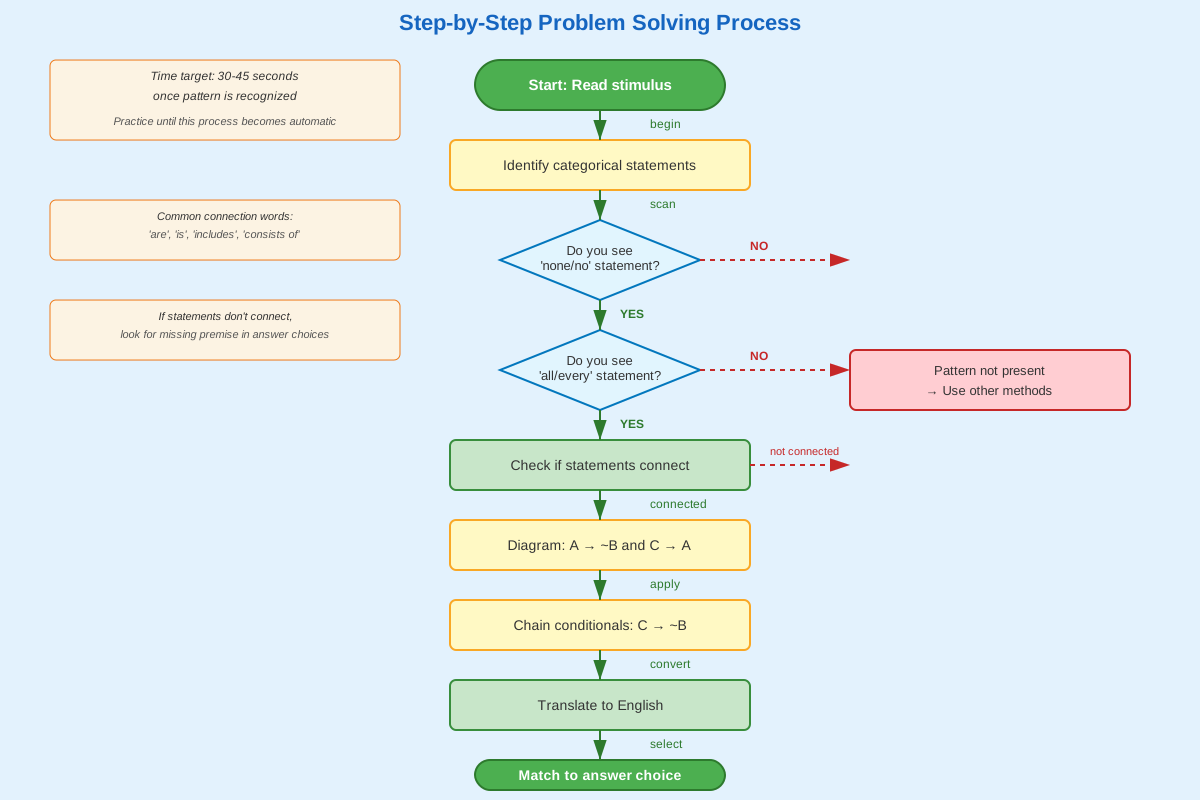
When approaching LSAT questions involving none plus all inference, implement a systematic recognition and application process. First, scan the stimulus for quantifier keywords that signal categorical statements: "all," "every," "none," "no," "never," and their equivalents. These trigger words indicate that formal logic may be at play. When you identify two categorical statements, immediately check whether one is a universal negative (none) and the other is a universal affirmative (all).
Diagramming strategy: Invest 10-15 seconds to diagram the statements using arrow notation. Write "A → ~B" for the none statement and "C → A" for the all statement. Visually inspect whether the statements share a common term that allows chaining. If they do, draw the conclusion "C → ~B" and translate it back to categorical form. This diagramming investment pays dividends in accuracy and speed.
Process of elimination approach: In Must Be True questions, eliminate answer choices that:
- Reverse the terms in the conclusion (watch for "None of the Bs are Cs" when the valid conclusion is "None of the Cs are Bs")
- Weaken the quantifier (changing "none" to "some" or "most")
- Introduce new terms not present in the premises
- State the contrapositive when a more direct answer is available (though contrapositives are logically valid, LSAT typically prefers the direct statement)
Time allocation: None plus all inference questions should be among your fastest solves. Allocate 45-60 seconds maximum for straightforward versions. If you find yourself spending more than 90 seconds, you may be overcomplicating the logic. Return to basic diagramming and check that you've correctly identified the middle term.
Trigger phrases for none plus all inference:
- "None of the X are Y" combined with "All Z are X"
- "X and Y are mutually exclusive" combined with "Every Z is an X"
- "No X is a Y" combined with "Z are always X"
- "It is impossible for an X to be a Y" combined with "All Z are X"
Red flags indicating invalid inference:
- Middle term appears in the same position in both statements
- One premise uses "some" or "most" instead of "all" or "none"
- Three or more categories with unclear relationships
- Conclusion reverses the order of terms without justification
Memory Techniques
Mnemonic for the pattern: "None Are Bad, All Children Are good, so No Children are Bad" - This captures the NAB + ACA → NCB structure while using memorable concrete terms.
Visual anchor: Picture three circles labeled A, B, and C. Imagine circle A and circle B as two separate islands that never touch (representing "none"). Then picture circle C as a small island completely inside island A. Since C is inside A, and A never touches B, C can never touch B either. This spatial metaphor makes the logical necessity intuitive.
The "Middle Term Bridge" technique: Remember that the middle term (A) acts as a bridge connecting C to B. The bridge must be properly constructed: one end must attach to the "none" statement as its subject, and the other end must attach to the "all" statement as its predicate. If the bridge is attached incorrectly, it collapses and the inference fails.
Acronym for checking validity: SNAP
- Subject of none statement = middle term?
- None statement present?
- All statement present?
- Predicate of all statement = middle term?
If all four SNAP elements are present, the inference is valid.
Quantifier hierarchy visualization: Imagine a strength scale from weakest to strongest: "some" < "most" < "all/none". None plus all inference requires the strongest quantifiers at both ends. If either quantifier is weaker, the conclusion must also be weakened. This hierarchy helps remember that substituting weaker quantifiers invalidates the standard inference.
Summary
None plus all inference represents a fundamental formal logic pattern that combines a universal negative statement (none of the As are Bs) with a universal affirmative statement (all Cs are As) to produce a necessary conclusion (none of the Cs are Bs). The validity of this inference depends on the proper positioning of the middle term, which must serve as the subject of the none statement and the predicate of the all statement. This pattern appears frequently on the LSAT in various linguistic disguises, requiring test-takers to recognize the underlying logical structure regardless of surface-level wording. Mastery involves three key competencies: rapid pattern recognition through trigger words and quantifiers, accurate diagramming using conditional notation, and systematic application of the inference rule to derive valid conclusions. The pattern connects to broader formal logic concepts including conditional reasoning, syllogistic logic, and set theory, making it a foundational skill that enhances performance across multiple question types. Students who internalize this pattern can solve related questions in 45-60 seconds with high accuracy, making it one of the highest-yield topics for LSAT preparation.
Key Takeaways
- None plus all inference combines "None of the As are Bs" with "All Cs are As" to conclude "None of the Cs are Bs"—this is a deductively valid pattern that appears in 15-20% of Logical Reasoning questions
- The middle term must appear as the subject of the none statement and the predicate of the all statement; incorrect positioning invalidates the inference
- Translate categorical statements into conditional notation (A → ~B and C → A) to visualize the logical chain and verify validity
- Watch for linguistic variations including "never," "mutually exclusive," "impossible," and "every" that disguise the standard none plus all structure
- Distinguish between the valid conclusion and its contrapositive—both are logically correct, but the LSAT typically expects the direct statement
- Weakening either quantifier from "all" or "none" to "some" or "most" invalidates the standard inference and requires a weakened conclusion
- Practice rapid recognition and diagramming to solve none plus all questions in under 60 seconds, maximizing time for more complex questions
Related Topics
All Plus All Inference: This parallel pattern combines two universal affirmative statements (All As are Bs; All Cs are As) to conclude that all Cs are Bs. Mastering none plus all inference provides the template for understanding this related pattern, which follows identical structural rules but with different quantifiers.
Some Plus All Inference: This variation combines an existential statement with a universal statement (Some As are Bs; All Cs are As) to conclude that some Cs are Bs. Understanding how weakened quantifiers affect conclusions builds on none plus all inference fundamentals.
Conditional Chains: None plus all inference is a specific application of conditional chaining, where multiple if-then statements are linked through shared terms. Mastering this topic enables progression to more complex multi-step conditional arguments.
Contrapositive Reasoning: Since categorical statements can be expressed as conditionals, understanding contrapositives enhances flexibility in recognizing none plus all patterns stated in logically equivalent forms.
Formal Logic Diagramming: Systematic diagramming techniques for all formal logic patterns, including none plus all inference, provide a comprehensive toolkit for solving the most challenging Logical Reasoning questions efficiently.
Practice CTA
Now that you've mastered the core concepts of none plus all inference, it's time to cement your understanding through active practice. Attempt the practice questions designed specifically for this topic, focusing on rapid pattern recognition and accurate application of the inference rule. Use the flashcards to drill the key distinctions between valid and invalid variations until recognition becomes automatic. Remember: none plus all inference is one of the highest-yield patterns on the LSAT—every minute invested in mastering this topic translates directly into points on test day. Challenge yourself to solve practice questions in under 60 seconds while maintaining perfect accuracy. Your systematic preparation now will pay dividends when you encounter these patterns under timed conditions on the actual exam.
Sign up free to keep reading
Create a free AnvayaPrep account to finish this LSAT guide on None plus all inference — plus flashcards and practice questions.