Overview
The distinction between numbers versus percentages represents one of the most frequently tested quantitative reasoning patterns in LSAT Logical Reasoning sections. This concept addresses a fundamental error in reasoning: confusing absolute quantities (raw numbers) with relative proportions (percentages, rates, or ratios). Test-makers exploit this confusion because it mirrors real-world argumentation flaws that lawyers must identify and counter in legal practice. When an argument shifts between discussing "how many" and "what proportion," it often commits a logical fallacy that weakens or invalidates its conclusion.
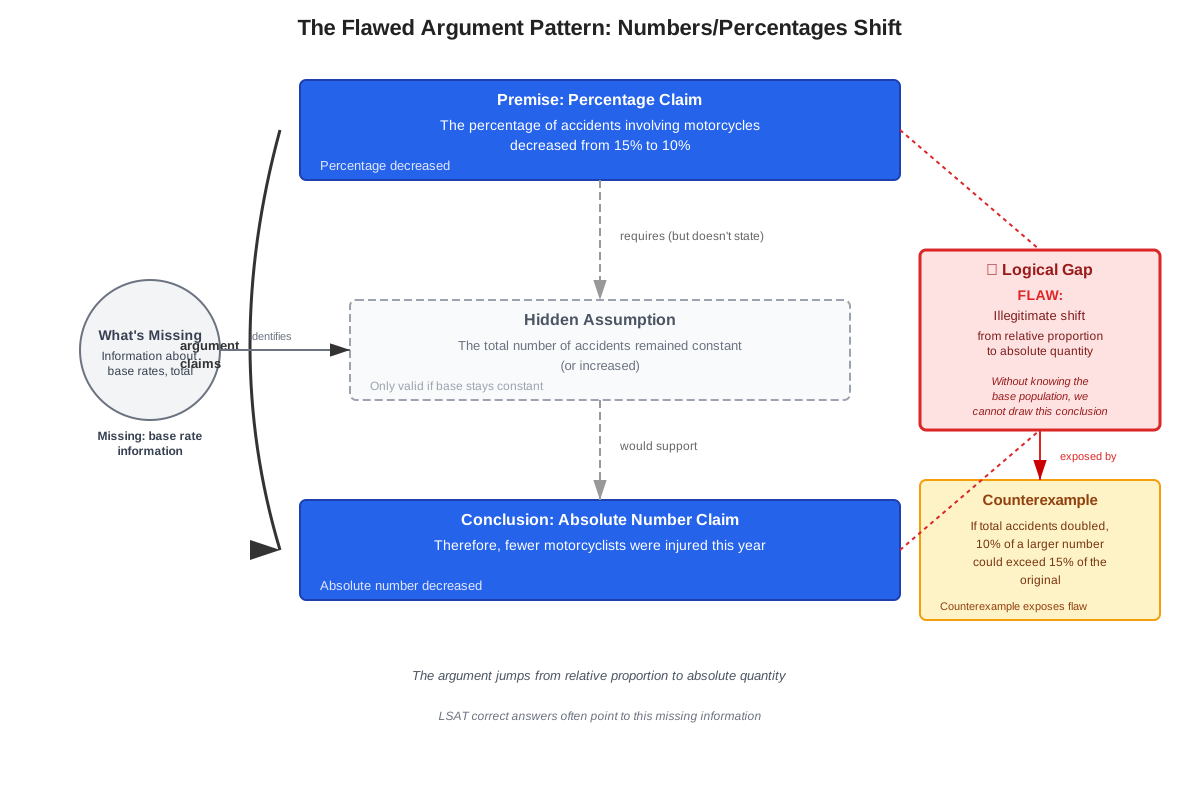
Understanding lsat numbers versus percentages is essential because this reasoning pattern appears across multiple question types, including Flaw, Weaken, Strengthen, Assumption, and Evaluate questions. The LSAT frequently presents arguments where evidence about percentages is used to draw conclusions about absolute numbers, or vice versa. For example, an argument might note that the percentage of traffic accidents involving motorcycles has decreased, then conclude that fewer motorcyclists are being injured—without considering that the total number of motorcycles on the road might have decreased even more dramatically. Recognizing this disconnect is crucial for identifying flawed reasoning and selecting correct answer choices.
This topic sits at the intersection of formal logic and quantifiers and practical reasoning skills. It requires understanding how quantifiers (all, some, most, few) relate to both absolute and relative measures, and how conclusions can be invalidated when these measures are conflated. Mastering this concept strengthens overall analytical abilities and prepares students to recognize similar patterns in other LSAT topics, including causal reasoning, sampling errors, and statistical arguments.
Learning Objectives
- [ ] Identify how Numbers versus percentages appears in LSAT questions
- [ ] Explain the reasoning pattern behind Numbers versus percentages
- [ ] Apply Numbers versus percentages to solve LSAT-style problems accurately
- [ ] Distinguish between absolute quantities and relative proportions in argument premises and conclusions
- [ ] Recognize when an argument illegitimately shifts between numerical and percentage-based claims
- [ ] Evaluate whether additional information about base rates or total populations would strengthen or weaken an argument
- [ ] Construct counterexamples that expose the flaw in arguments confusing numbers and percentages
Prerequisites
- Basic arithmetic and percentage calculations: Understanding how percentages relate to whole numbers is necessary to recognize when arguments conflate these measures
- Argument structure identification: Recognizing premises and conclusions allows students to spot where the shift between numbers and percentages occurs
- Quantifier logic fundamentals: Familiarity with terms like "most," "some," and "few" helps identify when these terms are being used to describe absolute versus relative quantities
- Causal reasoning basics: Many numbers versus percentages flaws appear in causal arguments where the evidence type doesn't match the conclusion type
Why This Topic Matters
In legal practice, attorneys must evaluate statistical evidence, demographic data, and quantitative claims that often involve the numbers versus percentages distinction. A prosecutor might argue that a particular neighborhood has seen a 50% increase in crime reports, but without knowing whether the population also increased by 75%, this percentage tells an incomplete story. Lawyers who cannot distinguish between these measures risk making flawed arguments or failing to identify weaknesses in opposing counsel's reasoning.
On the LSAT, this topic appears with remarkable frequency—approximately 10-15% of Logical Reasoning questions involve some form of numbers versus percentages reasoning. This pattern appears most commonly in Flaw questions (where students must identify the reasoning error), Weaken questions (where the correct answer often provides information about the missing measure), and Assumption questions (where the argument depends on an unstated relationship between numbers and percentages). The pattern also appears in Strengthen and Evaluate questions, making it one of the highest-yield topics for score improvement.
This reasoning pattern typically manifests in arguments about: comparative statistics between groups or time periods, survey results and polling data, risk assessment and probability claims, economic and business performance metrics, demographic trends and population studies, and success rates for programs or interventions. Recognizing the pattern quickly allows students to predict what information would be relevant and to eliminate answer choices that don't address the core flaw.
Core Concepts
The Fundamental Distinction
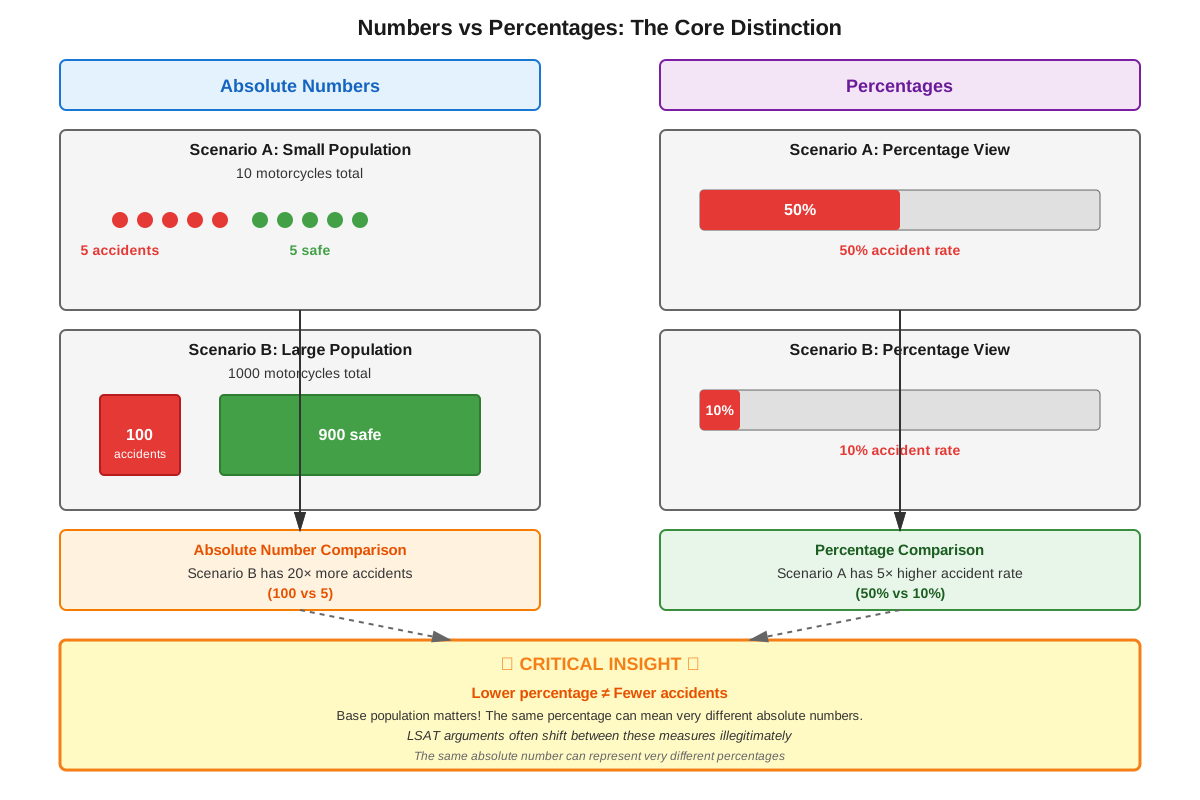
Numbers (also called absolute quantities, raw numbers, or counts) represent actual amounts: 100 people, 50 accidents, 1,000 applications. Percentages (also called relative proportions, rates, or ratios) represent relationships between quantities: 20% of applicants, a 15% increase, three times as many. The critical insight is that these measures can move in opposite directions or at different rates, creating logical gaps in arguments that treat them as equivalent.
Consider a simple example: If a company had 100 employees last year and 90 this year, the absolute number decreased by 10. However, if the industry average went from 200 employees to 150, this company's percentage of industry employment actually increased from 50% to 60%. An argument concluding that the company is "doing worse" based solely on the raw number decrease would be flawed without considering the relative position.
The Three Common Patterns
Pattern 1: Percentage Evidence → Number Conclusion
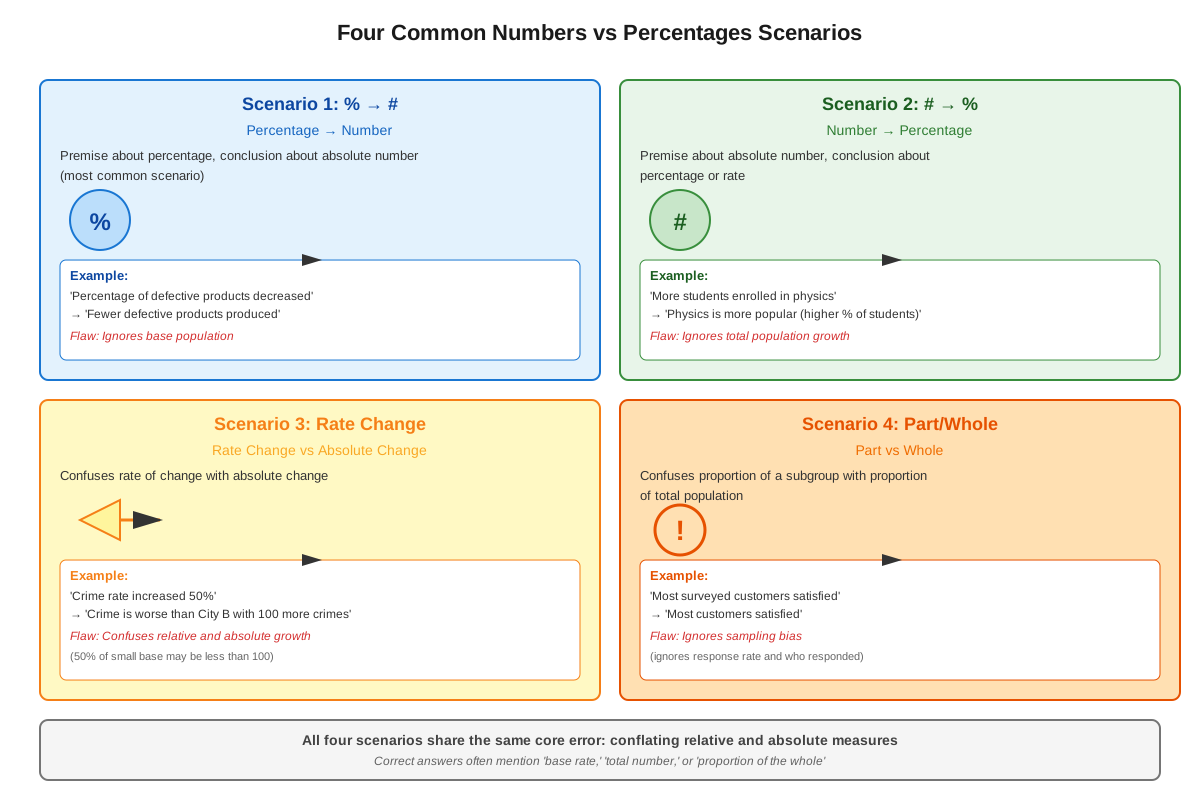
This pattern presents evidence about rates, proportions, or percentages, then draws a conclusion about absolute quantities. Example: "The percentage of students receiving financial aid has increased from 30% to 40%. Therefore, more students are receiving financial aid." This reasoning is flawed because if total enrollment decreased significantly, the absolute number receiving aid could have decreased despite the percentage increase.
Pattern 2: Number Evidence → Percentage Conclusion
This pattern presents evidence about absolute quantities, then draws a conclusion about rates or proportions. Example: "Our hospital treated 500 more patients this year than last year. Therefore, we are treating a greater proportion of the city's sick residents." This reasoning fails because if the city's population grew substantially, the hospital might actually be treating a smaller proportion despite the increased absolute number.
Pattern 3: Comparing Different Groups or Time Periods
This pattern compares percentages or numbers across different contexts without accounting for different base rates or population sizes. Example: "City A has 1,000 traffic accidents annually while City B has only 500. Therefore, City A has worse traffic safety." This ignores that City A might have ten times the population and vehicles, making its rate actually lower.
The Missing Link: Base Rates and Denominators
The key to understanding numbers versus percentages is recognizing that percentages require a base rate or denominator—the total population from which the percentage is calculated. When an argument shifts between numbers and percentages, it often fails to provide information about whether this base rate has changed or differs between comparison groups.
| Measure Type | What It Tells Us | What It Doesn't Tell Us | Requires Knowledge Of |
|---|---|---|---|
| Absolute Number | Actual quantity; concrete count | Proportion of total; relative significance | Nothing additional |
| Percentage | Relative proportion; rate | Actual quantity; absolute impact | Total population (denominator) |
| Both Together | Complete picture | N/A | Both measures |
Mathematical Relationship
The relationship can be expressed as:
Percentage = (Part / Whole) × 100
Absolute Number = (Percentage / 100) × Whole
This reveals why both measures can change independently: if the "Whole" (base rate) changes, the percentage and absolute number can move in different directions. A 50% increase in percentage doesn't mean a 50% increase in absolute numbers unless the base rate remained constant.
Context Dependency
The significance of numbers versus percentages often depends on context. In some scenarios, absolute numbers matter more (e.g., total lives saved by a medical intervention), while in others, percentages are more meaningful (e.g., success rate of a treatment). LSAT arguments often exploit this by using whichever measure supports their conclusion while ignoring the other measure that might undermine it.
Concept Relationships
The numbers versus percentages distinction connects directly to several other logical reasoning concepts. It represents a specific type of quantifier shift, where the scope of a claim changes without justification. Understanding formal logic and quantifiers provides the foundation for recognizing when "more" means "a greater number" versus "a greater proportion."
This concept also relates closely to sampling and representation errors. When an argument discusses percentages from a sample but draws conclusions about absolute numbers in a population (or vice versa), it combines the numbers versus percentages flaw with sampling issues. Similarly, causal reasoning frequently involves this pattern: an argument might claim that a policy caused crime to decrease (number claim) based on evidence that the crime rate fell (percentage claim), without considering population changes.
The relationship map flows as follows: Formal Logic and Quantifiers → establishes how to interpret "more," "less," "most," "few" → Numbers versus Percentages → applies these concepts to absolute versus relative measures → Statistical Reasoning → extends to more complex data interpretation → Causal Reasoning → uses these distinctions to evaluate cause-and-effect claims.
Understanding this topic also strengthens skills in necessary versus sufficient conditions because recognizing the flaw often requires identifying what additional information is necessary (but not provided) to make the argument valid. The missing information about base rates or total populations represents an unstated assumption that the argument requires.
High-Yield Facts
- ⭐ A percentage can increase while the absolute number decreases if the total population (denominator) decreases more dramatically
- ⭐ A percentage can decrease while the absolute number increases if the total population increases more dramatically
- ⭐ Comparing percentages between groups with different population sizes can be misleading without knowing the absolute numbers
- ⭐ The phrase "more likely" or "higher rate" indicates percentage/proportion, while "more cases" or "greater number" indicates absolute quantity
- ⭐ When an argument shifts from percentage evidence to number conclusion (or vice versa), look for answer choices that provide information about the base rate or total population
- An increase in both percentage and absolute number is possible but requires the total population to increase
- A decrease in both percentage and absolute number is possible but requires the total population to decrease
- Equal percentages across different groups can represent vastly different absolute numbers
- The same absolute change can represent different percentage changes depending on the starting value
- Arguments about "growth," "increase," or "decrease" are ambiguous without specifying whether they refer to absolute or relative measures
- Survey results typically provide percentages, but real-world impact often depends on absolute numbers
- Market share (percentage) and sales volume (numbers) can move independently based on overall market size changes
Quick check — test yourself on Numbers versus percentages so far.
Try Flashcards →Common Misconceptions
Misconception: If a percentage increases, the absolute number must also increase.
Correction: The absolute number can decrease if the total population (denominator) decreases more than proportionally. For example, if a company's market share increases from 20% to 30%, but the total market shrinks from 1,000 units to 500 units, the company's sales actually decreased from 200 to 150 units.
Misconception: Comparing percentages between groups always provides meaningful information.
Correction: Percentages can be misleading when comparing groups of vastly different sizes. A 10% increase in a population of 1,000,000 represents 100,000 people, while a 10% increase in a population of 100 represents only 10 people—the absolute impact differs dramatically.
Misconception: The argument is flawed only if the conclusion is definitely false.
Correction: The flaw exists when the conclusion doesn't necessarily follow from the premises, even if the conclusion might happen to be true. The reasoning pattern itself is invalid regardless of whether the conclusion is actually correct in a specific instance.
Misconception: Information about absolute numbers is always more important than percentages.
Correction: The relevant measure depends on context. For risk assessment, percentages (rates) are often more meaningful; for resource allocation, absolute numbers may matter more. The flaw is using one measure to draw conclusions about the other without justification.
Misconception: If both groups show the same percentage change, they experienced equivalent changes.
Correction: The same percentage change applied to different base numbers produces different absolute changes. A 50% increase from 100 is 50 additional units, while a 50% increase from 1,000 is 500 additional units.
Misconception: The numbers versus percentages flaw only appears in statistics-heavy arguments.
Correction: This pattern appears in everyday reasoning about any comparative claims, including business performance, social trends, health outcomes, and policy effectiveness. The flaw can be present even when specific numbers aren't explicitly stated.
Worked Examples
Example 1: Flaw Question
Stimulus: "Last year, 15% of the applications to Westside University were from international students. This year, that figure rose to 20%. Clearly, Westside is attracting more international students than it did last year."
Question: Which one of the following identifies the flaw in the reasoning above?
Analysis:
- Identify the evidence type: The premises provide percentages (15% and 20%)
- Identify the conclusion type: The conclusion claims "more international students" (absolute number)
- Recognize the pattern: Percentage evidence → Number conclusion
- Identify the gap: The argument assumes the total number of applications remained constant or increased
- Construct a counterexample: If total applications dropped from 10,000 to 5,000, international applications would have decreased from 1,500 to 1,000 despite the percentage increase
Correct answer pattern: "The argument overlooks the possibility that the total number of applications decreased" or "The argument fails to consider that a greater percentage of a smaller total might represent fewer actual students."
Connection to learning objectives: This example demonstrates how to identify the numbers versus percentages pattern (Objective 1), explain why the reasoning is flawed (Objective 2), and apply this understanding to eliminate wrong answers and select the correct one (Objective 3).
Example 2: Weaken Question
Stimulus: "Five years ago, 200 residents of Millbrook were diagnosed with diabetes. This year, 250 residents were diagnosed with diabetes. This increase demonstrates that Millbrook's diabetes prevention programs have been ineffective."
Question: Which one of the following, if true, most weakens the argument?
Analysis:
- Identify the evidence type: The premises provide absolute numbers (200 and 250)
- Identify the conclusion type: The conclusion is about program effectiveness, which relates to rates/proportions
- Recognize the pattern: Number evidence used to draw conclusion about effectiveness (which should consider rates)
- Identify what's missing: Information about the total population or the rate of diabetes in comparable communities
- Predict the answer: Information showing that the rate actually decreased, or that the increase is smaller than expected
Strong answer examples:
- "Millbrook's population increased by 60% over the past five years" (This would mean the rate actually decreased from 200/X to 250/1.6X)
- "Neighboring towns without prevention programs saw diabetes diagnoses increase by 80% over the same period" (This provides comparative rate information)
Weak answer examples:
- "The prevention programs cost less than anticipated" (Irrelevant to effectiveness)
- "Some residents were diagnosed with diabetes in other towns" (Doesn't address the rate versus number issue)
Connection to learning objectives: This example shows how to apply the numbers versus percentages framework to predict and evaluate answer choices in Weaken questions, demonstrating mastery of Objectives 2 and 3.
Exam Strategy
When approaching LSAT questions involving numbers versus percentages, follow this systematic process:
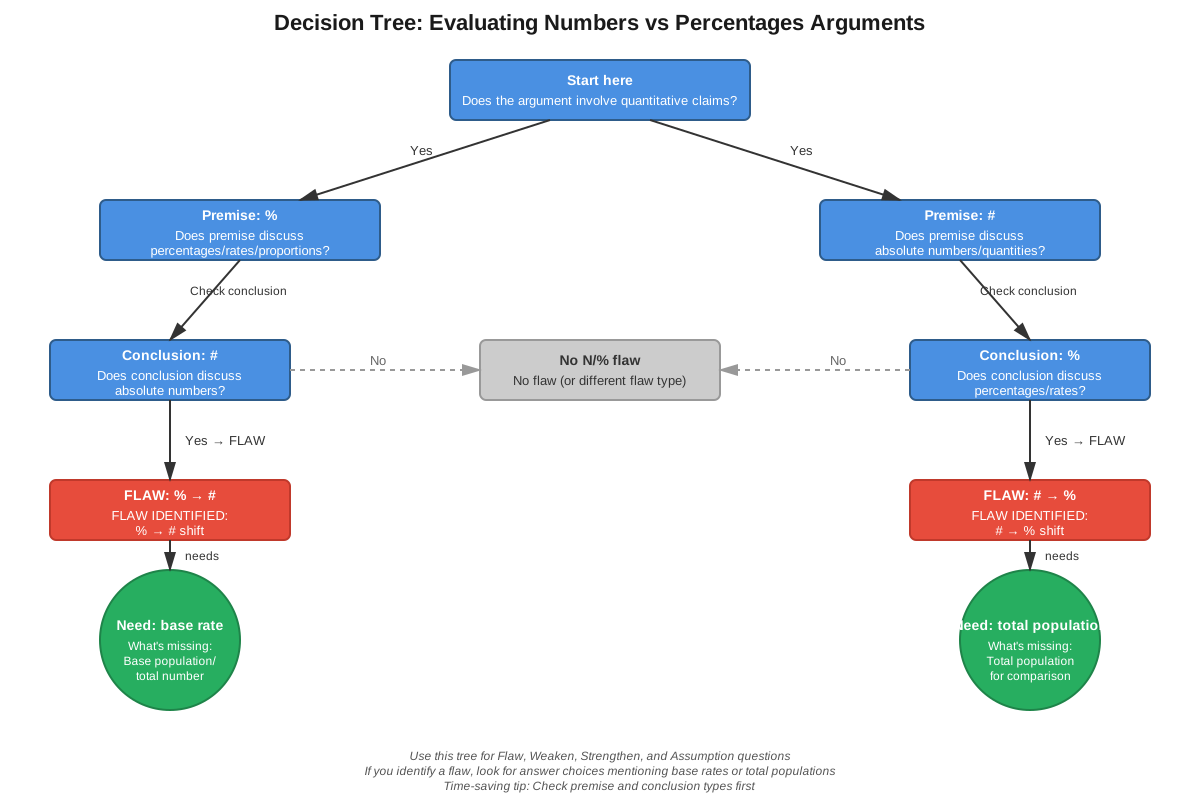
Step 1: Identify the measures in premises and conclusion (10 seconds)
- Underline or note whether each claim involves absolute numbers or percentages
- Watch for trigger words: "more/fewer" often indicates numbers, while "more/less likely," "higher/lower rate," or explicit percentages indicate proportions
- Be alert when the argument discusses "increases," "decreases," or "changes" without specifying the measure type
Step 2: Check for measure mismatch (5 seconds)
- If premises use one measure type and the conclusion uses another, you've likely found the flaw
- Even if both use the same measure type, check whether they're comparing different populations or time periods
Step 3: Identify the missing information (5 seconds)
- What would you need to know to make the argument valid?
- Usually: information about the base rate, total population, or denominator
- This prediction helps you quickly identify correct answers in Weaken, Strengthen, Assumption, and Evaluate questions
Step 4: Eliminate answer choices (20-30 seconds)
- Eliminate choices that don't address the numbers versus percentages gap
- Eliminate choices that provide the wrong measure type
- Eliminate choices that are irrelevant to the base rate or population size
Exam Tip: In Flaw questions, correct answers often use language like "fails to consider," "overlooks the possibility," or "takes for granted" followed by information about population changes or base rates.
Trigger phrases to watch for:
- "The percentage increased/decreased" followed by a conclusion about absolute quantities
- "More/fewer cases" followed by a conclusion about rates or likelihood
- "Market share," "proportion," or "rate" mixed with "total," "number," or "amount"
- Comparative claims between groups without mentioning whether the comparison is absolute or relative
- "Growth" or "decline" without specification of measure type
Time allocation: These questions should take 60-75 seconds once you recognize the pattern. Spend the extra 10-15 seconds confirming your answer because these questions have high accuracy rates for prepared students—they're essentially "giveaway" points once you master the pattern.
Memory Techniques
The "Pie Slice" Visualization: Imagine a pie representing the total population. A percentage is the size of your slice relative to the whole pie. Your slice can get bigger (larger percentage) even if the entire pie shrinks, resulting in less actual pie (smaller absolute amount). Visualize this whenever you see percentage evidence leading to number conclusions.
The "PAWN" Acronym:
- Percentage evidence?
- Absolute conclusion?
- What's the base rate?
- Need that information!
This helps you quickly identify the pattern and what's missing.
The "Two Questions" Method: Train yourself to automatically ask:
- "Is this about how many or what proportion?"
- "Has the total population changed?"
These two questions will identify nearly every numbers versus percentages issue on the LSAT.
The Counterexample Generator: Practice creating quick mental counterexamples. If an argument says "the percentage increased, so the number increased," immediately think: "But what if the total decreased dramatically?" This skill becomes automatic with practice and helps you understand why the reasoning is flawed.
Summary
The numbers versus percentages distinction represents a critical reasoning pattern that appears frequently throughout LSAT Logical Reasoning sections. This concept addresses the logical gap that occurs when arguments shift between absolute quantities (raw numbers) and relative proportions (percentages, rates, ratios) without justification. The fundamental insight is that these measures can move independently or even in opposite directions when the base rate or total population changes. A percentage can increase while the absolute number decreases if the denominator shrinks sufficiently, and vice versa. Recognizing this pattern requires identifying what type of measure appears in the premises versus the conclusion, then determining what additional information about base rates or population sizes would be necessary to make the argument valid. This pattern appears most commonly in Flaw, Weaken, Strengthen, and Assumption questions, making it one of the highest-yield topics for score improvement. Mastery requires the ability to quickly spot measure mismatches, predict what information is missing, and evaluate answer choices based on whether they address the core logical gap.
Key Takeaways
- Percentages and absolute numbers are distinct measures that can move independently when base rates change
- The most common flaw pattern uses percentage evidence to draw number conclusions, or vice versa
- Always identify whether premises and conclusions discuss absolute quantities or relative proportions
- The missing information typically involves the total population, base rate, or denominator
- Comparing percentages between different groups or time periods requires knowing whether population sizes differ
- Trigger phrases like "more likely" indicate percentages while "more cases" indicates absolute numbers
- This pattern appears in approximately 10-15% of Logical Reasoning questions across multiple question types
Related Topics
Statistical Reasoning and Surveys: Building on numbers versus percentages, this topic explores more complex statistical concepts including sampling methodology, margin of error, and representative samples. Mastering the current topic provides the foundation for understanding how survey percentages relate to actual population numbers.
Causal Reasoning: Many causal arguments involve numbers versus percentages flaws, such as claiming a policy caused crime to decrease (number) based on evidence that crime rates fell (percentage). Understanding this topic strengthens your ability to evaluate causal claims.
Necessary and Sufficient Assumptions: The numbers versus percentages pattern often appears in Assumption questions where the argument requires (but doesn't state) that base rates remained constant. This topic deepens your understanding of what makes assumptions necessary for arguments.
Comparative Reasoning: Arguments comparing two or more groups frequently involve numbers versus percentages issues. This related topic explores other ways comparisons can be flawed beyond the measure-type mismatch.
Practice CTA
Now that you understand the numbers versus percentages distinction, you're ready to apply this knowledge to actual LSAT questions. The practice questions and flashcards will reinforce your ability to quickly identify this pattern and select correct answers with confidence. Remember that this is one of the highest-yield topics on the LSAT—students who master this concept typically see immediate score improvements because these questions become reliably answerable once you recognize the pattern. Approach each practice question systematically: identify the measure types, spot any mismatch, determine what's missing, and eliminate wrong answers. With focused practice, you'll develop the automatic recognition that turns these questions into quick points on test day.
Sign up free to keep reading
Create a free AnvayaPrep account to finish this LSAT guide on Numbers versus percentages — plus flashcards and practice questions.