Overview
Quantified conditionals represent one of the most powerful and frequently tested concepts in LSAT Logical Reasoning. These statements combine conditional logic (if-then relationships) with quantifiers (words like "all," "some," "most," "none") to create complex logical structures that appear throughout the exam. Understanding quantified conditionals is essential because they form the backbone of many argument structures, assumption questions, strengthen/weaken questions, and formal logic puzzles that test-takers encounter.
The LSAT regularly presents arguments that hinge on the proper interpretation of quantified statements. A statement like "All lawyers who specialize in corporate law have studied contract theory" creates a conditional relationship that applies to an entire category. Misinterpreting the scope of such statements—confusing "all" with "some," or incorrectly negating a quantified conditional—leads directly to wrong answers. Mastery of this topic enables students to quickly diagram complex arguments, identify logical flaws, and eliminate incorrect answer choices with confidence.
Within the broader framework of formal logic and quantifiers, quantified conditionals serve as the bridge between basic conditional reasoning and more sophisticated logical structures. They build upon simple if-then statements by adding layers of quantification that specify how broadly a conditional relationship applies. This topic connects directly to sufficient and necessary conditions, contrapositive reasoning, and categorical logic—all high-yield areas for LSAT success. Students who master quantified conditionals gain a significant advantage in both speed and accuracy across multiple question types.
Learning Objectives
- [ ] Identify how quantified conditionals appears in LSAT questions
- [ ] Explain the reasoning pattern behind quantified conditionals
- [ ] Apply quantified conditionals to solve LSAT-style problems accurately
- [ ] Translate natural language statements containing quantifiers into formal logical notation
- [ ] Recognize and correct common errors in reasoning involving quantified conditionals
- [ ] Construct valid inferences from multiple quantified conditional statements
- [ ] Distinguish between different types of quantifiers and their logical implications
Prerequisites
- Basic conditional logic (if-then statements): Understanding sufficient and necessary conditions is fundamental because quantified conditionals extend these relationships to groups and categories
- Contrapositive reasoning: The ability to negate and reverse conditional statements is essential for working with quantified conditionals, as the contrapositive remains a primary inference tool
- Categorical relationships: Familiarity with how categories and groups relate logically provides the foundation for understanding how quantifiers modify conditional statements
- Logical operators (and, or, not): These basic operators combine with quantifiers to create complex logical structures that appear throughout LSAT questions
Why This Topic Matters
Quantified conditionals appear in approximately 30-40% of Logical Reasoning questions on the LSAT, making them one of the highest-yield topics for focused study. They surface most frequently in Necessary Assumption questions, Sufficient Assumption questions, Strengthen/Weaken questions, and Flaw questions. The LSAT tests quantified conditionals both explicitly (through formal logic structures) and implicitly (embedded within natural language arguments).
In real-world contexts, quantified conditionals represent how we reason about categories, make generalizations, and draw conclusions about groups. Legal reasoning—the core skill the LSAT assesses—constantly employs quantified conditionals: "All contracts require consideration," "Some evidence is inadmissible," "Most jurisdictions recognize this doctrine." Lawyers must precisely interpret the scope and implications of such statements, making this a directly relevant skill for legal practice.
On the exam, quantified conditionals typically appear in several forms: as premises in arguments that require assumption identification, as conclusions that need strengthening or weakening, as flawed reasoning patterns that must be identified, and as formal logic statements that require valid inferences. Questions may present quantified conditionals in straightforward logical language or disguise them within complex prose, testing whether students can extract the underlying logical structure. The ability to quickly recognize, diagram, and manipulate these statements separates high scorers from average performers.
Core Concepts
Understanding Quantifiers
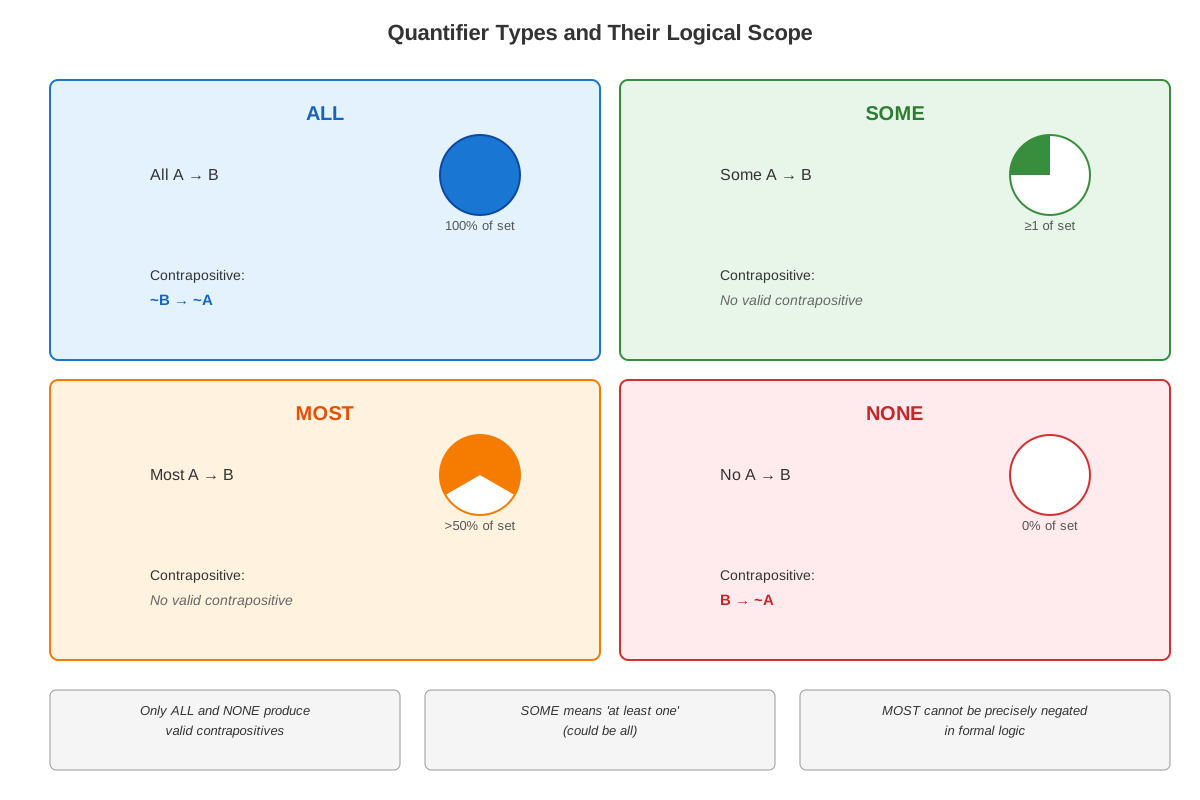
Quantifiers are words or phrases that specify the scope or extent to which a statement applies to members of a category. The four primary quantifiers on the LSAT are "all," "some," "most," and "none," each with distinct logical properties and implications.
"All" creates a universal affirmative statement, indicating that every member of one category belongs to another category. "All A are B" means that if something is A, then it must be B. This establishes a sufficient condition: being A is sufficient to guarantee being B. The contrapositive is equally important: "All A are B" means "All non-B are non-A."
"Some" indicates existence of at least one member that satisfies a condition. "Some A are B" means at least one thing is both A and B. Critically, "some" in formal logic means "at least one" and could include "all." The statement "some" provides minimal information and has limited inferential power—you cannot derive a contrapositive from a "some" statement.
"Most" indicates that more than half of a category satisfies a condition. "Most A are B" means that if you examined all members of category A, more than 50% would also be B. "Most" statements allow for specific inference patterns, particularly when combined with other "most" statements about overlapping categories.
"None" creates a universal negative statement. "No A are B" means that if something is A, it cannot be B, and vice versa. This is equivalent to "All A are non-B" and "All B are non-A," making it a powerful statement with strong inferential implications.
Structure of Quantified Conditionals
A quantified conditional combines a quantifier with a conditional relationship, creating statements like "All A are B" or "Most lawyers who work in corporate law have business degrees." The general structure follows this pattern:
[Quantifier] + [Category/Condition A] + [Relationship] + [Category/Condition B]The logical form can be represented using standard notation:
- All A → B (if A, then B)
- Some A ∧ B (at least one thing is both A and B)
- Most A → B (more than half of A are B)
- No A → ¬B (if A, then not B)
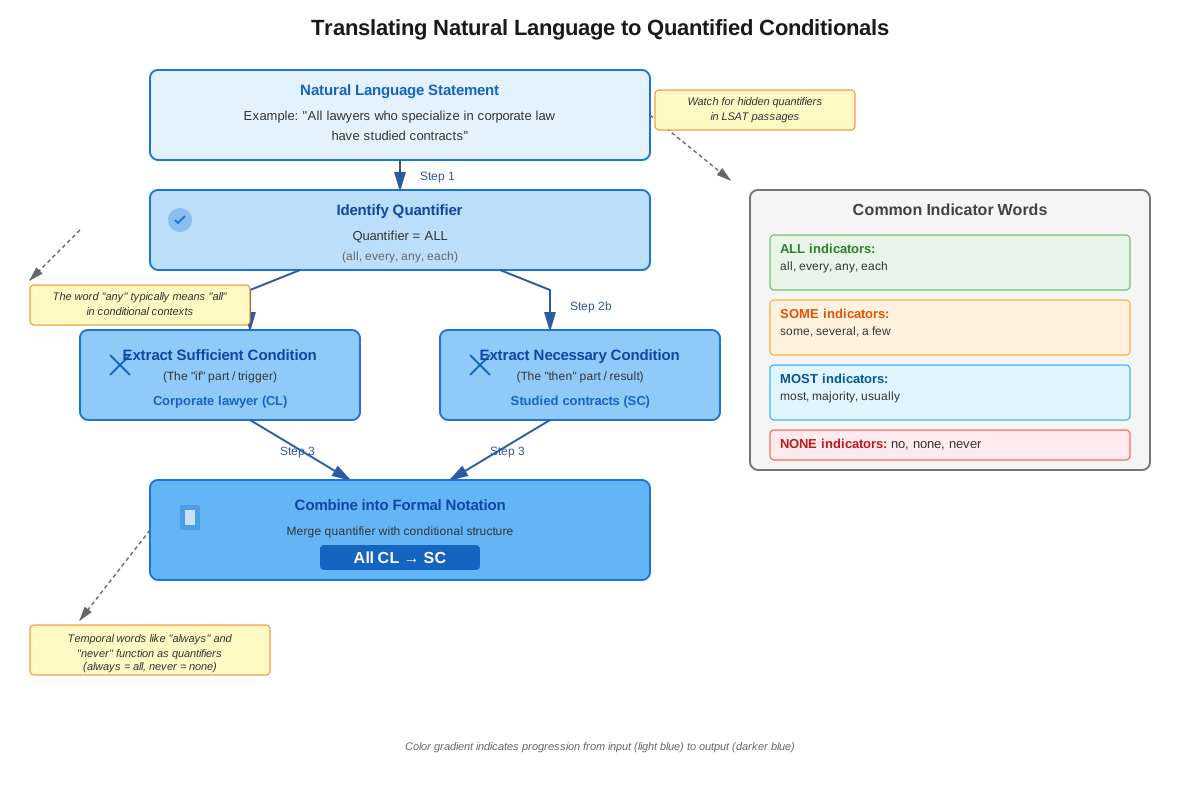
Understanding this structure allows test-takers to translate complex natural language into clear logical relationships. For example, "Every student who studies formal logic improves their LSAT score" becomes: All [students who study formal logic] → [improve LSAT score].
Inference Patterns with "All"
When working with "all" statements, several valid inference patterns emerge:
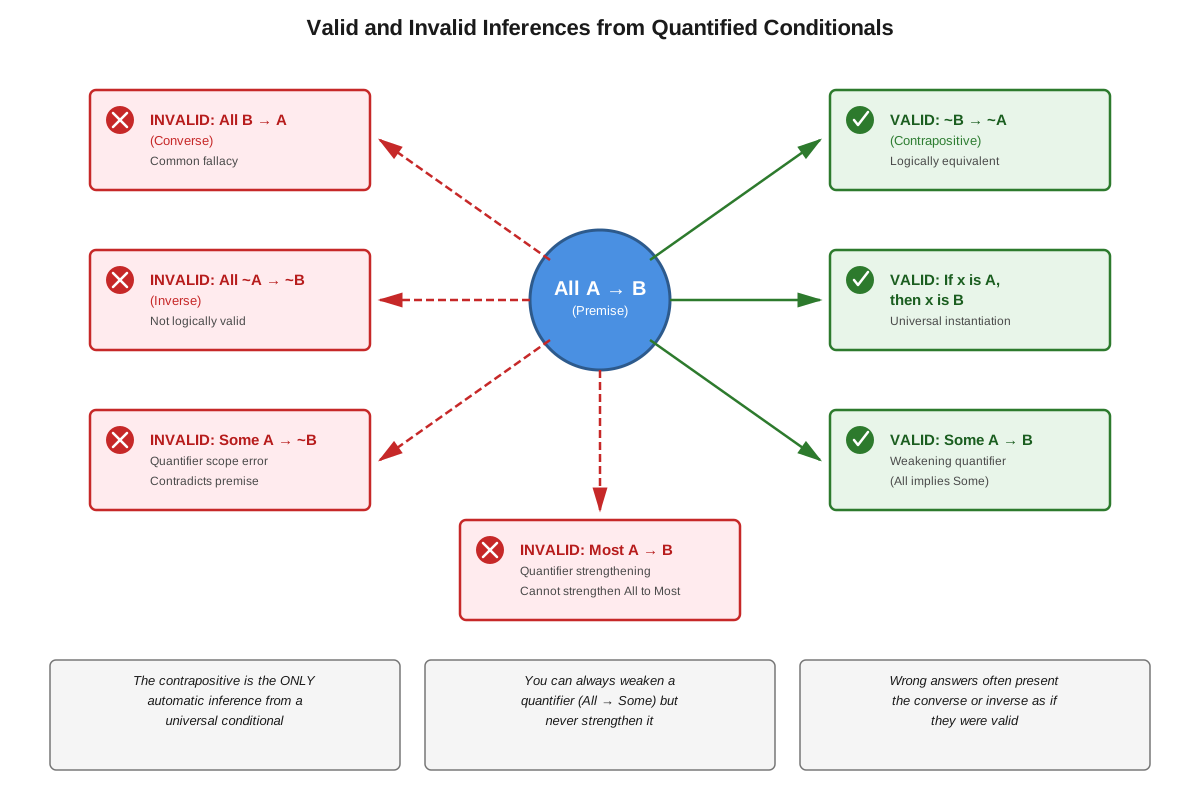
- Direct application: From "All A are B" and "X is A," you can conclude "X is B"
- Contrapositive: From "All A are B," you can conclude "All non-B are non-A"
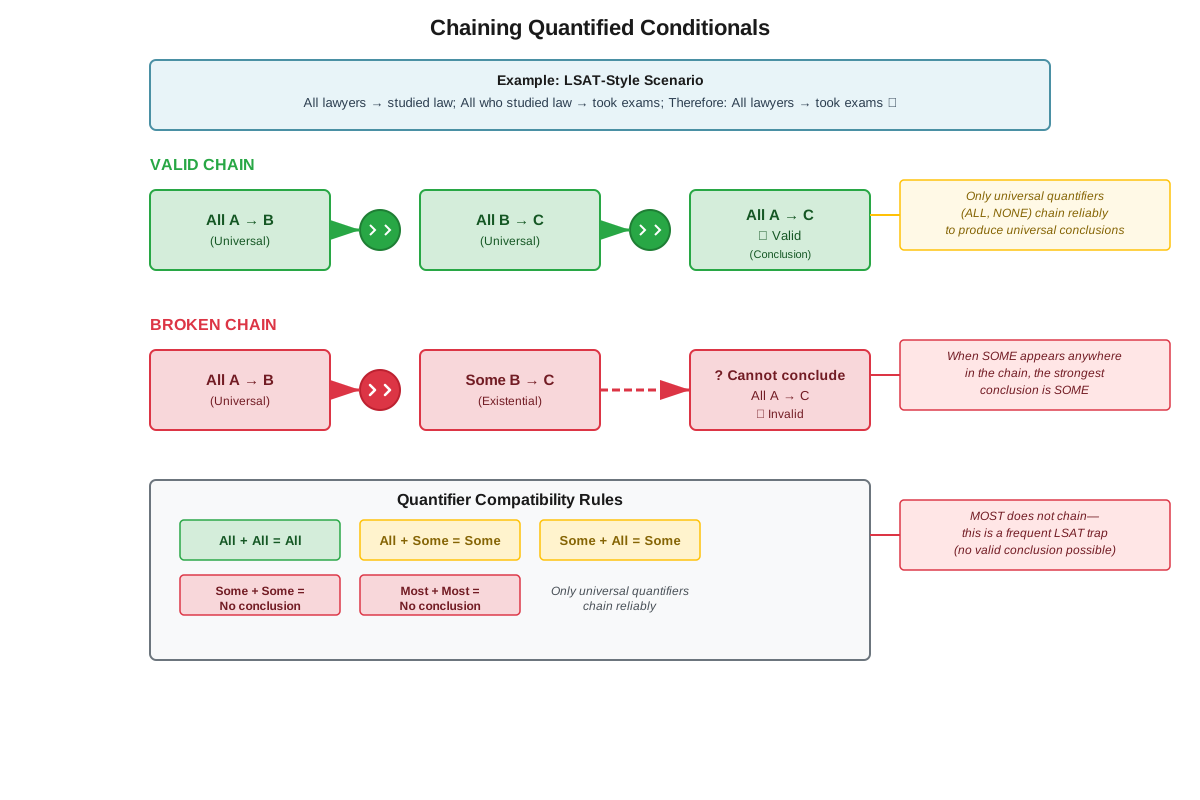
- Chain reasoning: From "All A are B" and "All B are C," you can conclude "All A are C"
Invalid inferences to avoid:
- Affirming the consequent: From "All A are B" and "X is B," you CANNOT conclude "X is A"
- Denying the antecedent: From "All A are B" and "X is not A," you CANNOT conclude "X is not B"
Inference Patterns with "Some"
"Some" statements have limited but important inferential properties:
- Symmetry: "Some A are B" is logically equivalent to "Some B are A"
- Existence: "Some A are B" guarantees at least one thing is both A and B
- Combination with "All": From "Some A are B" and "All B are C," you can conclude "Some A are C"
The key limitation: you cannot create a contrapositive from a "some" statement, and you cannot make universal claims based on "some" statements.
Inference Patterns with "Most"
"Most" statements enable unique inference patterns:
- Overlap principle: From "Most A are B" and "Most A are C," you can conclude "Some B are C" (because more than half of A are B, and more than half of A are C, there must be overlap)
- Chain with "All": From "Most A are B" and "All B are C," you can conclude "Most A are C"
- Contrapositive limitation: "Most A are B" does NOT mean "Most B are A" and does NOT mean "Most non-B are non-A"
Negating Quantified Conditionals
Understanding negation is crucial for identifying assumptions and evaluating arguments:
| Original Statement | Negation |
|---|---|
| All A are B | Some A are not B |
| Some A are B | No A are B |
| Most A are B | Most A are not B (or: It's not the case that most A are B) |
| No A are B | Some A are B |
The negation of "all" is NOT "none"—it's "some are not." This distinction appears frequently in Necessary Assumption questions, where the correct answer often negates a universal claim.
Translating Natural Language
The LSAT rarely presents quantified conditionals in pure logical form. Instead, they appear embedded in natural language with various indicator words:
"All" indicators: every, any, each, whenever, always, only (when used as "only B are A" = "All A are B")
"Some" indicators: a few, several, at least one, there exists
"Most" indicators: majority, more than half, usually, typically, generally
"None" indicators: never, not any, no, cannot
Recognizing these indicators allows rapid translation from prose to logical structure, a critical time-saving skill on the exam.
Concept Relationships
Quantified conditionals build directly upon basic conditional logic by adding quantification layers. Simple conditionals (A → B) become quantified conditionals (All A → B) when we specify that the relationship applies universally. This connection means that all rules for conditional reasoning—particularly contrapositive formation—apply to quantified conditionals with "all" and "none."
The relationship between different quantifiers creates a hierarchy of logical strength:
All → Most → Some → (existence)
None → Most are not → Some are not
"All" is the strongest positive claim, "none" is the strongest negative claim, and "some" is the weakest claim. Understanding this hierarchy helps in Strengthen/Weaken questions, where moving up the hierarchy strengthens an argument and moving down weakens it.
Quantified conditionals connect to categorical logic through the traditional square of opposition, where "all," "no," "some," and "some are not" statements have defined logical relationships. They also connect to formal logic puzzles and games, where quantified conditionals often establish the rules that govern the scenario.
Within argument structure, quantified conditionals typically function as premises that establish general principles, which are then applied to specific cases in the conclusion. Recognizing this pattern helps identify gaps in reasoning and necessary assumptions.
High-Yield Facts
⭐ "All A are B" is logically equivalent to "If A, then B" and has the contrapositive "If not B, then not A"
⭐ The negation of "All A are B" is "Some A are not B," NOT "No A are B"
⭐ "Some" means "at least one" and could include "all"—it's the minimum existence claim
⭐ From "Most A are B" and "Most A are C," you can validly infer "Some B are C"
⭐ "Only A are B" translates to "All B are A" (the conditional arrow points toward the term after "only")
- "Some A are B" is logically equivalent to "Some B are A" (symmetry property)
- You cannot create a valid contrapositive from a "some" statement
- "Most A are B" does NOT mean "Most B are A"—quantified conditionals with "most" are not reversible
- From "All A are B" and "All B are C," you can chain to conclude "All A are C"
- "No A are B" is equivalent to both "All A are non-B" and "All B are non-A"
- The statement "All A are B" allows for the possibility that some non-A are also B
- When an argument moves from "some" in the premises to "all" in the conclusion, there's a logical gap requiring an assumption
- "Unless" introduces a necessary condition and can be translated as "if not...then"
- Multiple "most" statements about the same category can be combined to draw limited inferences about overlap
Quick check — test yourself on Quantified conditionals so far.
Try Flashcards →Common Misconceptions
Misconception: "All A are B" means "All B are A" (reversing the conditional)
Correction: Quantified conditionals are directional. "All A are B" only tells you what's true about members of category A; it says nothing definitive about all members of category B. The valid reversal is the contrapositive: "All non-B are non-A."
Misconception: The negation of "All A are B" is "No A are B"
Correction: The negation of a universal affirmative is a particular negative. To negate "All A are B," you only need to show that at least one A is not B, which is expressed as "Some A are not B." This distinction is critical for Necessary Assumption questions.
Misconception: "Some A are B" means "Some A are not B" (interpreting "some" as "some but not all")
Correction: In formal logic, "some" means "at least one" and is compatible with "all." The statement "Some A are B" could be true even if every single A is B. When the LSAT means "some but not all," it will explicitly state that.
Misconception: "Most A are B" and "Most B are A" are equivalent
Correction: Unlike "some" statements, "most" statements are not symmetrical. "Most lawyers are hardworking" does NOT mean "Most hardworking people are lawyers." The first tells you about the composition of the lawyer category; the second would tell you about the composition of the hardworking people category—entirely different claims.
Misconception: From "All A are B" and "All C are B," you can conclude "All A are C"
Correction: This represents invalid reasoning (affirming the consequent). Just because two categories both lead to the same result doesn't mean they're equivalent to each other. Both dogs and cats are mammals, but that doesn't make all dogs cats. You can only chain conditionals when the consequent of one matches the antecedent of another.
Misconception: "Only A are B" means "All A are B"
Correction: "Only" introduces a necessary condition, not a sufficient one. "Only A are B" means "If B, then A" (or "All B are A"). It tells you that being A is necessary for being B, but not that being A is sufficient for being B. This translation error is one of the most common and costly mistakes on the LSAT.
Worked Examples
Example 1: Necessary Assumption Question
Argument: "All successful entrepreneurs have strong communication skills. Therefore, Maria, who recently launched a profitable startup, must have strong communication skills."
Question: Which of the following is an assumption required by the argument?
Analysis:
Step 1: Identify the quantified conditional in the premise
- Premise: All [successful entrepreneurs] → [strong communication skills]
Step 2: Identify what the conclusion claims
- Conclusion: Maria → [strong communication skills]
Step 3: Identify the logical gap
- The premise tells us what's true about successful entrepreneurs
- The conclusion applies this to Maria
- Gap: We need to establish that Maria is a successful entrepreneur
- The argument assumes: Maria is a successful entrepreneur
Step 4: Consider what would happen if we negated this assumption
- If Maria is NOT a successful entrepreneur, the premise doesn't apply to her
- The argument would fall apart
- This confirms it's a necessary assumption
Answer: The argument requires the assumption that Maria is a successful entrepreneur (or that launching a profitable startup makes one a successful entrepreneur).
Connection to learning objectives: This example demonstrates how quantified conditionals appear in LSAT questions (Objective 1), shows the reasoning pattern of applying a universal conditional to a specific case (Objective 2), and illustrates the gap-identification strategy for solving assumption questions (Objective 3).
Example 2: Flaw Question with Multiple Quantifiers
Argument: "Most doctors recommend regular exercise. Most people who exercise regularly have lower stress levels. Therefore, most doctors have lower stress levels."
Question: The reasoning in the argument is flawed because it:
Analysis:
Step 1: Diagram the quantified conditionals
- Premise 1: Most [doctors] → [recommend regular exercise]
- Premise 2: Most [people who exercise regularly] → [lower stress levels]
- Conclusion: Most [doctors] → [lower stress levels]
Step 2: Identify the logical gap
- Premise 1 tells us what doctors recommend, not what they do
- To connect Premise 1 to Premise 2, we'd need to know that doctors who recommend exercise actually exercise regularly themselves
- Even if we had that connection, Premise 2 is about "people who exercise regularly," not specifically about doctors
Step 3: Identify the flaw pattern
- The argument confuses recommending a behavior with engaging in that behavior
- The argument also attempts to chain "most" statements incorrectly
- Even if most doctors exercise regularly, and most people who exercise regularly have lower stress, we cannot conclude that most doctors have lower stress (the overlap might be smaller than "most")
Step 4: Formulate the flaw
- The argument fails to establish that doctors who recommend exercise actually exercise regularly themselves
- The argument improperly infers a "most" conclusion from premises that don't guarantee sufficient overlap
Answer: The argument is flawed because it assumes without justification that doctors who recommend regular exercise actually engage in regular exercise themselves, and it improperly combines "most" statements in a way that doesn't guarantee the conclusion.
Connection to learning objectives: This example shows how quantified conditionals with "most" appear in complex arguments (Objective 1), explains the specific reasoning error involving "most" statements (Objective 2), and demonstrates how to identify and articulate logical flaws involving quantifiers (Objectives 3 and 5).
Exam Strategy
When approaching LSAT questions involving quantified conditionals, follow this systematic process:
Step 1: Identify and extract quantifiers (5-10 seconds)
Scan the argument for quantifier words: all, every, some, most, none, never, always, usually. Circle or underline these terms to ensure you don't miss them in complex prose.
Step 2: Translate to logical notation (10-15 seconds)
Convert natural language into formal structure. Write out "All A → B" or "Most A → B" in the margin. This external representation prevents working memory overload and reduces errors.
Step 3: Check for valid inference patterns (10-15 seconds)
Ask: Can I chain these statements? Is there a contrapositive? Can I combine "most" statements? Actively look for what CAN be concluded before examining answer choices.
Step 4: Identify gaps and assumptions (10-15 seconds)
Look for mismatches between premises and conclusion. Does the conclusion use a different quantifier than the premises? Does it apply a general rule to a specific case without establishing that the case fits the category?
Exam Tip: When you see "all" in the premises but "some" or "most" in the conclusion, the argument is likely valid (moving from stronger to weaker claims). When you see "some" or "most" in premises but "all" in the conclusion, there's almost certainly a logical gap.
Trigger words to watch for:
- "Only": Immediately translate to identify what's sufficient and what's necessary. "Only A are B" = "All B → A"
- "Unless": Introduces a necessary condition. "A unless B" = "If not B, then A"
- "The only": Creates a necessary condition. "A is the only B" = "All B → A"
- "Requires," "needs," "must have": Indicate necessary conditions
- "Ensures," "guarantees," "is enough for": Indicate sufficient conditions
Process-of-elimination tips:
For Necessary Assumption questions: Negate each answer choice. The correct answer, when negated, will destroy the argument. Wrong answers, when negated, will leave the argument intact or only weaken it slightly.
For Sufficient Assumption questions: The correct answer will bridge the gap completely, often by providing a universal conditional that connects premise categories to conclusion categories.
For Flaw questions: Look for answer choices that describe quantifier errors: "treats a claim that something is usually true as though it were always true," "confuses a necessary condition with a sufficient condition," "overlooks the possibility that some members of the category lack the stated property."
Time allocation: Spend 15-20 seconds diagramming complex quantified conditionals. This upfront investment saves 30-45 seconds on the back end by making answer choice elimination faster and more accurate. For questions with multiple quantified conditionals, don't try to hold everything in working memory—write it out.
Memory Techniques
ASON Mnemonic for Negations:
- All → Some not
- Some → None
- Most → Most not (or "not most")
- None → Some
"ONLY Points Backward" Rule:
Visualize the word "only" as an arrow pointing backward to what comes before it. "Only lawyers can practice law" → the arrow points from "practice law" back to "lawyers," giving you "All [practice law] → [lawyers]."
The "Most Overlap" Visualization:
When you see two "most" statements about the same category, visualize two overlapping circles, each covering more than half of a larger circle. The overlap region must exist and represents "some." Draw this quickly in the margin to remember that "Most A are B" + "Most A are C" = "Some B are C."
Contrapositive Flip-and-Negate:
Create a physical gesture: flip your hand over (reverse the order) and make a negating motion (shake your head). This kinesthetic memory aid helps recall that contrapositives require both reversing AND negating.
The Quantifier Strength Ladder:
Visualize a ladder with rungs labeled from top to bottom: ALL → MOST → SOME → (nothing). Arguments can safely climb down the ladder (from stronger to weaker claims) but cannot climb up without additional support.
"SWAN" for Statement Types:
- Some: Symmetrical (Some A are B = Some B are A)
- Weak claim (minimum existence)
- All: Asymmetrical (All A are B ≠ All B are A)
- Negatable to contrapositive
Summary
Quantified conditionals combine quantifiers (all, some, most, none) with conditional relationships to create logical structures that appear throughout LSAT Logical Reasoning questions. Mastery requires understanding how each quantifier functions, what inferences each permits, and how to translate natural language into formal logical notation. The universal quantifier "all" creates the strongest positive claim and allows for contrapositive reasoning and chaining; "some" indicates minimal existence and has symmetry but limited inferential power; "most" enables specific overlap inferences when multiple "most" statements share a category; and "none" creates a universal negative equivalent to "all...not." Common errors include reversing conditionals, incorrectly negating universal claims, and improperly combining quantifiers. Success on LSAT questions requires systematic identification of quantifiers, translation to logical form, recognition of valid inference patterns, and identification of logical gaps between premises and conclusions. The ability to quickly diagram quantified conditionals and apply formal logic rules separates high scorers from average performers across multiple question types.
Key Takeaways
- Quantified conditionals combine quantifiers with conditional logic and appear in 30-40% of Logical Reasoning questions, making them essential for LSAT success
- "All A are B" functions as "If A, then B" with contrapositive "If not B, then not A," while its negation is "Some A are not B," not "No A are B"
- "Some" means "at least one," is symmetrical (Some A are B = Some B are A), and cannot be negated to form a contrapositive
- "Most" statements enable overlap inferences: "Most A are B" + "Most A are C" validly yields "Some B are C"
- Translation is critical—"only," "unless," and "the only" have specific logical meanings that differ from everyday usage and must be precisely converted to formal notation
- Valid inference patterns include chaining "all" statements, applying contrapositives, and combining "most" statements, while invalid patterns include reversing conditionals and affirming the consequent
- Systematic diagramming of quantified conditionals saves time and increases accuracy by externalizing complex logical relationships and preventing working memory overload
Related Topics
Conditional Logic and Contrapositives: Building directly on quantified conditionals, this topic explores advanced conditional reasoning, including complex conditional chains, bi-conditionals, and nested conditionals. Mastering quantified conditionals provides the foundation for these more sophisticated structures.
Categorical Logic and Syllogisms: This topic examines traditional Aristotelian logic, including the square of opposition and categorical syllogisms. Understanding quantified conditionals enables quick recognition of valid and invalid syllogistic forms.
Formal Logic Games: Many Logic Games involve rules expressed as quantified conditionals. The diagramming and inference skills developed through this topic transfer directly to game setup and deduction-making.
Argument Structure and Assumptions: Quantified conditionals frequently appear in argument premises and conclusions. Understanding their logical properties is essential for identifying gaps, necessary assumptions, and sufficient assumptions.
Strengthen and Weaken Questions: These question types often hinge on manipulating the strength of quantified claims—moving from "some" to "most" to "all" or vice versa. Mastery of quantifiers enables precise evaluation of how answer choices affect argument strength.
Practice CTA
Now that you've mastered the core concepts of quantified conditionals, it's time to cement your understanding through active practice. Attempt the practice questions designed specifically for this topic, focusing on applying the systematic approach outlined in the Exam Strategy section. Work through each question methodically: identify quantifiers, translate to logical notation, check for valid inferences, and identify gaps before examining answer choices. Use the flashcards to drill the high-yield facts until quantifier translation becomes automatic. Remember, the difference between understanding quantified conditionals conceptually and applying them flawlessly under timed conditions comes down to deliberate practice. Every question you work through builds the pattern recognition and logical intuition that will serve you on test day. You've built the foundation—now construct mastery through application.
Sign up free to keep reading
Create a free AnvayaPrep account to finish this LSAT guide on Quantified conditionals — plus flashcards and practice questions.