Overview
Inference from statistics represents one of the most frequently tested reasoning patterns on the LSAT Logical Reasoning section. This question type requires test-takers to draw valid conclusions from numerical data, percentages, rates, and statistical comparisons presented in stimulus passages. Unlike pure mathematical problems, these questions assess the ability to understand what statistical information does and does not support, making them fundamentally about logical reasoning rather than calculation.
The LSAT regularly presents arguments that cite surveys, studies, demographic data, or comparative statistics, then asks which conclusion must be true or is most strongly supported by the evidence. Success on these questions demands precision in distinguishing between what the numbers actually demonstrate versus what they might seem to suggest. Students must recognize the difference between absolute numbers and percentages, understand the implications of sample sizes, and avoid reading causation into correlation. These skills extend beyond statistics questions alone—they form the foundation for evaluating evidence quality throughout the Logical Reasoning section.
Within the broader landscape of logical reasoning, statistical inference questions connect directly to Must Be True questions, Strengthen/Weaken questions involving data, and Flaw questions that identify statistical reasoning errors. Mastering this topic enhances performance across multiple question types because statistical evidence appears in approximately 15-20% of all Logical Reasoning questions. The ability to parse statistical claims accurately separates high scorers from average performers, making this a high-yield area for focused study.
Learning Objectives
- [ ] Identify how Inference from statistics appears in LSAT questions
- [ ] Explain the reasoning pattern behind Inference from statistics
- [ ] Apply Inference from statistics to solve LSAT-style problems accurately
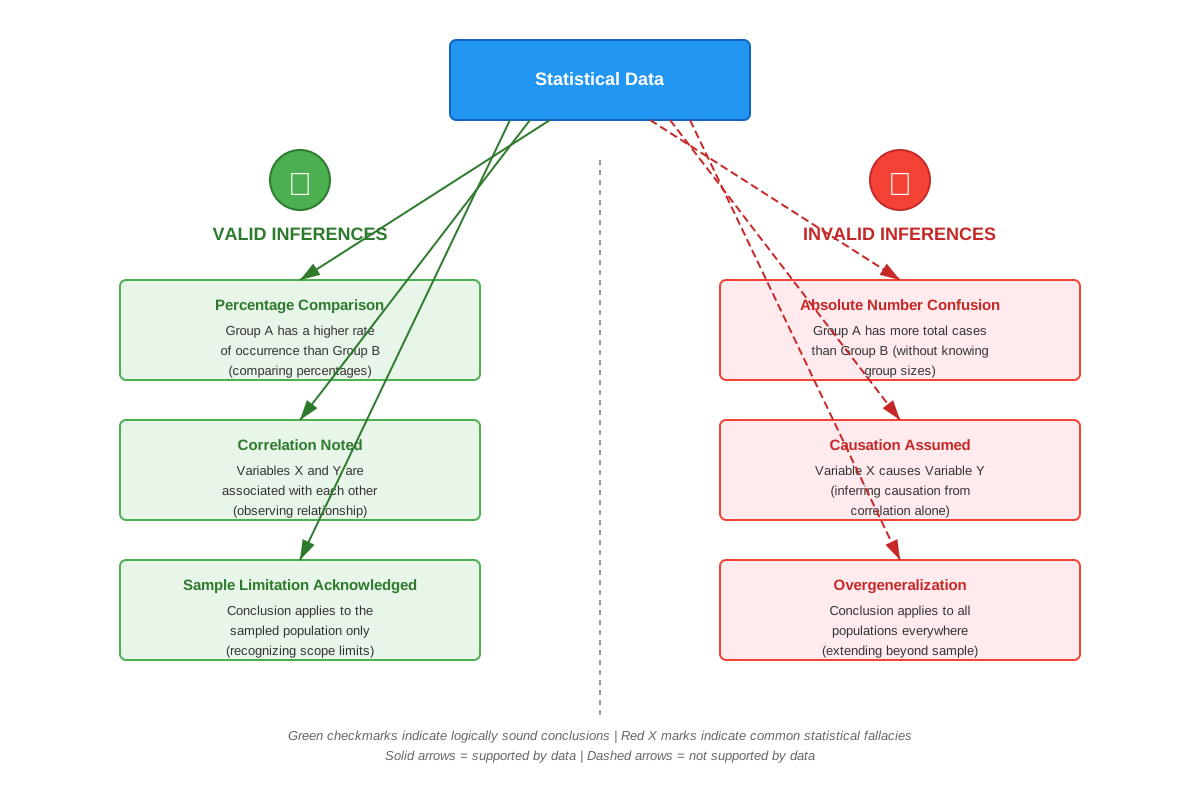
- [ ] Distinguish between valid and invalid statistical inferences in argument stimuli
- [ ] Recognize common statistical fallacies that appear in wrong answer choices
- [ ] Evaluate the scope and limitations of statistical evidence presented in passages
- [ ] Compare absolute numbers versus relative percentages to determine what conclusions follow
Prerequisites
- Basic understanding of percentages and proportions: Statistical inference questions assume familiarity with how percentages relate to whole populations and how to interpret comparative statements.
- Fundamental logical reasoning skills: Students must understand argument structure (premise-conclusion relationships) since statistical claims typically serve as evidence for broader conclusions.
- Must Be True question format: Many statistical inference questions use this format, requiring knowledge of how to identify what must follow from given information versus what might be true.
- Distinction between correlation and causation: Statistical questions frequently test whether students incorrectly assume that associated phenomena have a causal relationship.
Why This Topic Matters
Statistical reasoning pervades modern discourse—from medical studies and economic reports to political polling and social science research. The ability to evaluate statistical claims critically protects against manipulation and enables informed decision-making in professional and personal contexts. Lawyers, the target profession for LSAT-takers, regularly encounter statistical evidence in cases involving discrimination, product liability, medical malpractice, and regulatory compliance.
On the LSAT specifically, inference questions involving statistics appear in approximately 3-5 questions per test across both Logical Reasoning sections. These questions carry the same weight as any other question, but their predictable patterns make them particularly high-yield for preparation. Students who master statistical reasoning can often answer these questions more quickly and confidently than more abstract logical puzzles, creating time advantages for challenging questions elsewhere.
Statistical inference appears in several question formats: Must Be True questions asking what follows from survey data, Strengthen/Weaken questions where answer choices provide additional statistical information, Flaw questions identifying errors in statistical reasoning, and Parallel Reasoning questions requiring recognition of statistical argument structures. The topic also appears in Method of Reasoning questions that ask how statistical evidence functions within an argument. This versatility across question types makes statistical reasoning one of the most frequently tested logical patterns on the exam.
Core Concepts
Understanding Statistical Claims
LSAT inference from statistics questions present numerical information and require test-takers to determine what logically follows. The fundamental skill involves recognizing the precise scope of what the statistics demonstrate. A statistic about "most" members of a group (more than 50%) supports different conclusions than a statistic about "some" members (at least one) or "all" members (100%).
Statistical claims on the LSAT typically involve:
- Percentages or proportions of a population
- Absolute numbers or raw counts
- Rates of change or trends over time
- Comparative statements between groups
- Survey or study results with specified sample characteristics
The key principle: valid inferences must be supported by the specific statistical information provided, without adding assumptions about unstated factors.
Absolute Numbers vs. Percentages
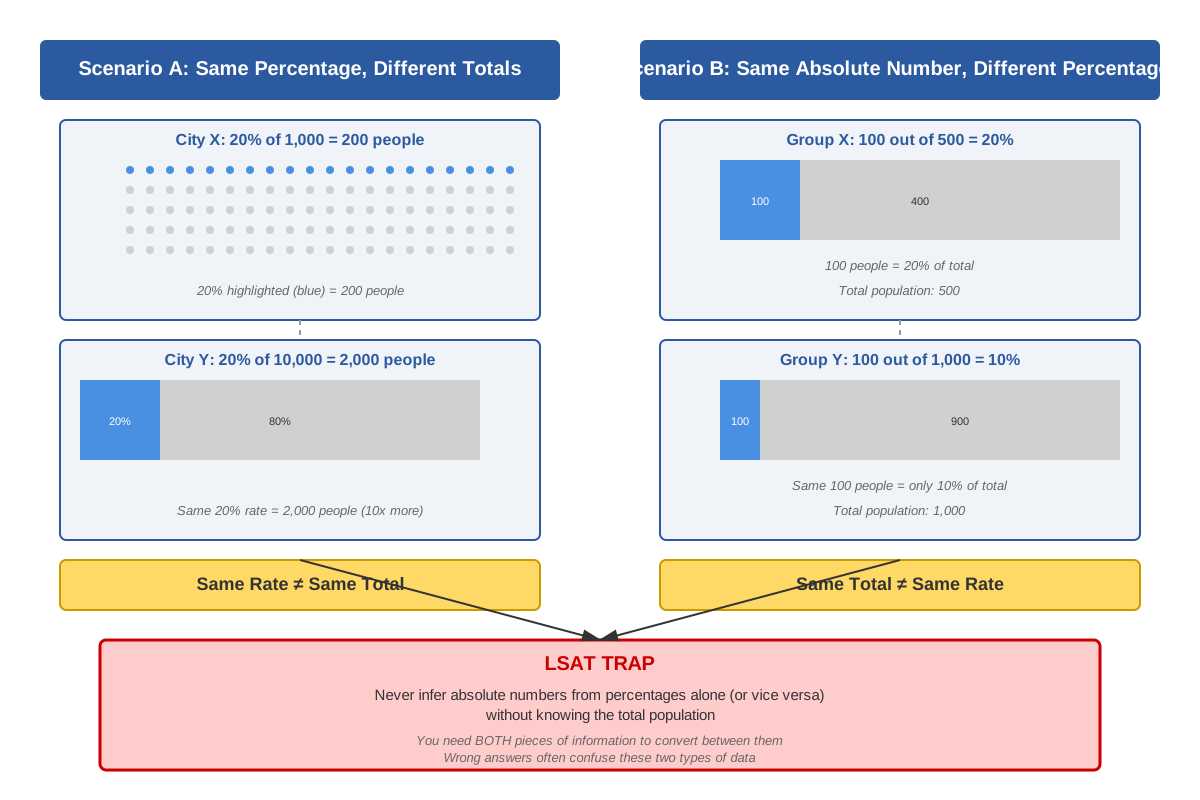
One of the most common patterns in statistical inference questions involves the relationship between absolute numbers and percentages. These represent fundamentally different types of information, and confusing them leads to invalid conclusions.
Absolute numbers tell us the actual count of items, people, or events. Percentages tell us the proportion relative to a total. Consider this example:
- City A: 100 traffic accidents (10% of all incidents)
- City B: 50 traffic accidents (50% of all incidents)
From this information, we can validly infer:
- City A had more traffic accidents in absolute terms (100 > 50)
- Traffic accidents represented a larger proportion of incidents in City B (50% > 10%)
- City A had more total incidents than City B (since 100 is only 10% of A's total, while 50 is 50% of B's total)
We cannot validly infer:
- City A is more dangerous for drivers (we don't know population, miles driven, or other relevant factors)
- City B should allocate more resources to traffic safety (resource allocation depends on many factors beyond percentage)
Sample Characteristics and Generalization
Statistical inferences depend critically on sample characteristics. The LSAT tests whether students recognize when conclusions about a sample can or cannot be extended to a broader population.
Valid generalization requires:
- The sample must be representative of the population
- The sample size must be adequate
- The conclusion must not extend beyond the population the sample represents
For example, if a survey samples only urban residents, conclusions cannot validly extend to rural populations. If a study examines behavior in one time period, conclusions about different time periods require additional assumptions.
Correlation vs. Causation
The LSAT frequently tests the distinction between correlation (two phenomena occurring together) and causation (one phenomenon causing another). Statistical evidence can demonstrate correlation but requires additional reasoning to establish causation.
When statistics show that X and Y occur together:
- Valid inference: X and Y are correlated/associated
- Invalid inference (without additional evidence): X causes Y, or Y causes X
Alternative explanations for correlation include:
- Reverse causation (Y causes X instead)
- Common cause (Z causes both X and Y)
- Coincidence (no causal relationship)
- Definitional relationship (X and Y measure related aspects of the same phenomenon)
Rates of Change and Trends
Statistical questions often present information about changes over time, requiring careful attention to what the rate of change indicates versus what it does not.
| Information Type | What It Shows | What It Doesn't Show |
|---|---|---|
| "Increased by 50%" | Relative change | Absolute magnitude of change |
| "Increased by 100 units" | Absolute change | Percentage change or final total |
| "Grew faster than Y" | Comparative rate | Whether X is larger than Y |
| "Declining for three years" | Direction of trend | Whether current level is high or low |
Scope Limitations
Every statistical claim has boundaries—the specific population, time period, and conditions to which it applies. Valid inferences must respect these boundaries.
Common scope limitations include:
- Population scope: Statistics about doctors don't support conclusions about all medical professionals
- Temporal scope: Data from 2020 doesn't necessarily indicate current conditions
- Geographic scope: National statistics may not apply to specific regions
- Conditional scope: Statistics about one scenario don't extend to different circumstances
Comparative Statistics
When statistics compare two or more groups, valid inferences must carefully track which group the conclusion addresses and what type of comparison the evidence supports.
Types of comparisons:
- Absolute comparison: Group A has more/fewer than Group B in raw numbers
- Relative comparison: Group A has a higher/lower percentage or rate than Group B
- Trend comparison: Group A is increasing/decreasing faster than Group B
- Proportional comparison: X represents a larger/smaller share of Group A than of Group B
Statistical Sufficiency
The LSAT tests whether students recognize when statistical information is sufficient to support a conclusion versus when additional information would be needed.
Sufficient information allows a definitive conclusion. Insufficient information means the conclusion might be true but doesn't necessarily follow from what's stated. Students must distinguish between:
- What must be true given the statistics
- What could be true but requires additional assumptions
- What cannot be true based on the statistics
Concept Relationships
The concepts within statistical inference form an interconnected logical framework. Understanding absolute numbers vs. percentages provides the foundation for analyzing comparative statistics, since comparisons may involve either absolute or relative measures. Both concepts connect to scope limitations because the type of number (absolute or percentage) determines what populations or scenarios the statistic describes.
Sample characteristics directly affects the validity of generalization, which in turn relates to scope limitations—a sample's characteristics define the scope of valid inferences. Meanwhile, correlation vs. causation represents a distinct reasoning pattern that applies when statistics show association between variables, requiring additional evidence to support causal claims.
The relationship map flows as follows:
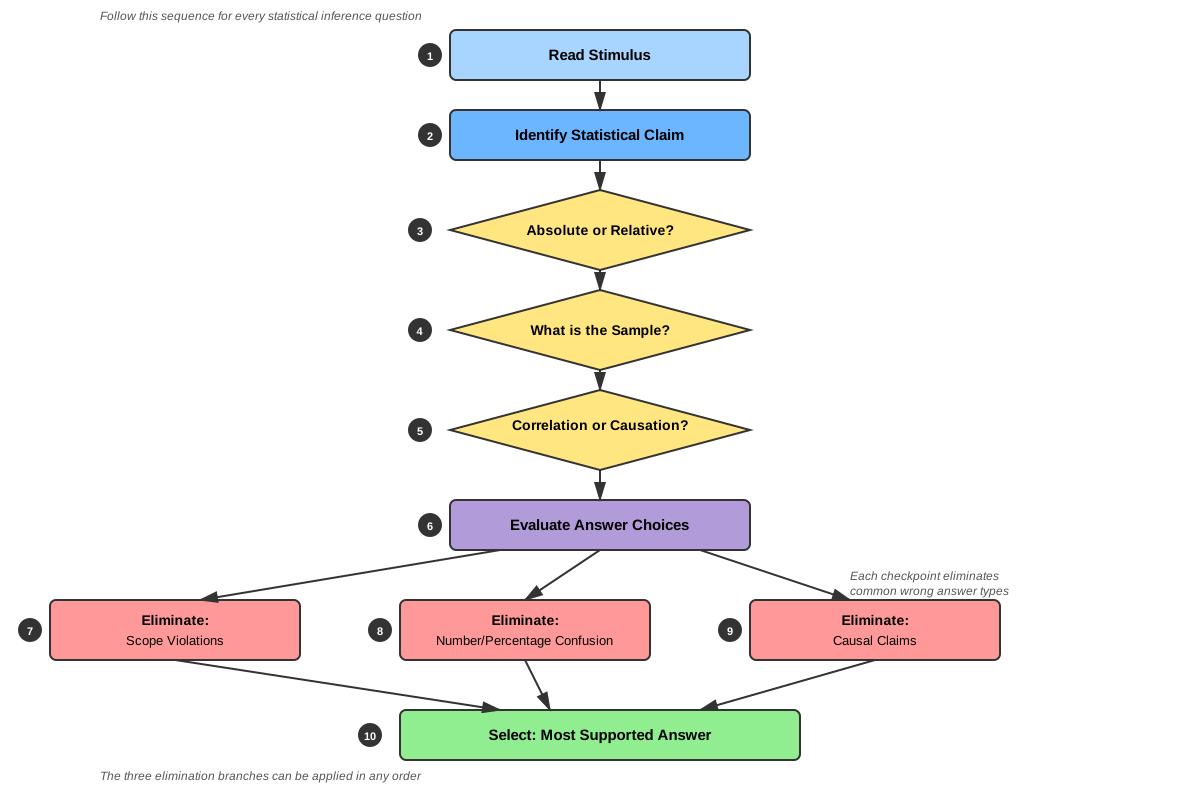
Statistical Claim → Identify type (absolute/percentage/rate) → Determine scope → Evaluate sample → Assess valid inferences → Distinguish correlation from causation (if applicable) → Select answer that stays within bounds of evidence
This topic connects to prerequisite knowledge of Must Be True questions by applying the same logical principle: the correct answer must be fully supported by the stimulus without requiring additional assumptions. It relates to argument structure because statistical claims typically serve as premises supporting broader conclusions, and students must evaluate whether the conclusion follows from the statistical evidence.
Statistical inference also connects forward to Strengthen/Weaken questions (where additional statistical evidence might support or undermine a conclusion), Flaw questions (where arguments make invalid statistical inferences), and Assumption questions (where unstated assumptions bridge gaps in statistical reasoning).
High-Yield Facts
⭐ A percentage increase/decrease does not indicate the absolute magnitude of change without knowing the base number
⭐ Statistics about a sample only support conclusions about populations the sample represents
⭐ Correlation between two variables does not establish that one causes the other
⭐ Comparing percentages across groups with different total sizes can be misleading about absolute numbers
⭐ A higher percentage does not necessarily mean a larger absolute number
- Statistics about "most" of a group (>50%) do not support conclusions about "all" members
- A rate of change tells us about relative growth/decline, not about current absolute levels
- Survey results depend on sample selection methods and may not generalize beyond the sample
- Statistics showing X is more common in Group A than Group B do not prove Group A membership causes X
- Temporal statistics (data from one time period) do not necessarily indicate current or future conditions
- Geographic statistics may not apply to different regions or locations
- Conditional statistics (data under specific circumstances) do not extend to different conditions
- The absence of statistical evidence for a claim is not statistical evidence against the claim
Quick check — test yourself on Inference from statistics so far.
Try Flashcards →Common Misconceptions
Misconception: If Group A has a higher percentage of X than Group B, then Group A has more instances of X in absolute terms.
Correction: Percentages represent proportions, not absolute quantities. A smaller group with a higher percentage may have fewer absolute instances than a larger group with a lower percentage. For example, 80% of 100 (80 instances) is less than 50% of 200 (100 instances).
Misconception: If two phenomena are statistically correlated, one must cause the other.
Correction: Correlation indicates association but not causation. The correlation could result from reverse causation, a common cause affecting both variables, coincidence, or a definitional relationship. Additional evidence beyond correlation is required to establish causation.
Misconception: Statistics about a sample automatically apply to any broader population.
Correction: Valid generalization requires that the sample be representative of the target population. A sample of college students doesn't support conclusions about all adults; a sample from one geographic region doesn't support conclusions about other regions.
Misconception: If X increased by 50% and Y increased by 25%, then X increased by more in absolute terms.
Correction: Percentage changes indicate relative growth, not absolute magnitude. If X started at 10 (increasing to 15) and Y started at 1000 (increasing to 1250), Y increased by far more in absolute terms despite the smaller percentage increase.
Misconception: A declining rate of increase means the absolute number is decreasing.
Correction: A declining rate of increase means growth is slowing, but the absolute number is still increasing. For example, if population grew by 10% last year and 5% this year, the population is still larger than before—it's just growing more slowly.
Misconception: Statistics showing X is common in Group A prove that being in Group A causes X.
Correction: Prevalence statistics show association but not causation. X might be common in Group A because membership in Group A causes X, because X causes membership in Group A, because some third factor causes both, or for other reasons.
Misconception: If most members of Group A have characteristic X, and most members of Group A also have characteristic Y, then most things with characteristic X have characteristic Y.
Correction: This reverses the logical relationship. Knowing that most A's are X doesn't tell us what proportion of X's are A. The groups might overlap completely, partially, or minimally depending on the relative sizes and distributions.
Worked Examples
Example 1: Absolute vs. Percentage Comparison
Stimulus: In Riverdale, 15% of all reported crimes are burglaries. In Lakeside, 8% of all reported crimes are burglaries. However, Lakeside reported 2,000 burglaries last year, while Riverdale reported 1,500 burglaries.
Question: Which of the following can be properly inferred from the information above?
Answer Choices:
(A) Riverdale has a higher crime rate than Lakeside
(B) Lakeside had more total reported crimes than Riverdale
(C) Burglary is a more serious problem in Riverdale than in Lakeside
(D) Lakeside residents are more likely to be burglary victims than Riverdale residents
(E) The percentage of crimes that are burglaries is declining in both cities
Analysis:
First, identify what the statistics tell us:
- Riverdale: 1,500 burglaries = 15% of total crimes
- Lakeside: 2,000 burglaries = 8% of total crimes
Calculate total crimes:
- Riverdale: 1,500 ÷ 0.15 = 10,000 total crimes
- Lakeside: 2,000 ÷ 0.08 = 25,000 total crimes
Now evaluate each answer:
(A) Crime rate requires knowing population size, which isn't provided. We know absolute crime numbers but cannot determine rates. Eliminate.
(B) Lakeside had 25,000 total reported crimes versus Riverdale's 10,000. This must be true based on the calculations above. Strong candidate.
(C) "More serious problem" is a value judgment that depends on factors beyond the statistics provided (population, resources, trends, etc.). Eliminate.
(D) Likelihood of victimization requires population data, which isn't provided. Eliminate.
(E) The stimulus provides no information about trends over time—only data from one year. Eliminate.
Correct Answer: (B)
Key Takeaway: This question tests the relationship between percentages and absolute numbers. The higher percentage in Riverdale doesn't mean more total crimes—in fact, Lakeside has more crimes in both absolute terms (burglaries) and total crimes. The valid inference requires calculating the implied totals from the percentage information.
Example 2: Sample Limitations and Scope
Stimulus: A survey of 500 physicians who specialize in sports medicine found that 78% recommend a particular brand of athletic shoe for patients recovering from foot injuries. The shoe manufacturer advertises: "Doctors recommend our shoes for injury recovery."
Question: The advertisement's claim is most vulnerable to criticism on which of the following grounds?
Answer Choices:
(A) It fails to indicate what percentage of all physicians recommend the shoes
(B) It does not specify how many physicians were surveyed
(C) It assumes that what helps recovery from injury also prevents injury
(D) It generalizes from sports medicine specialists to all doctors
(E) It does not indicate whether the physicians have financial relationships with the manufacturer
Analysis:
The survey sampled sports medicine specialists specifically. The advertisement claims "doctors recommend" without qualification, suggesting all or most doctors generally.
Evaluate each answer:
(A) The criticism about "all physicians" is relevant, but this answer doesn't identify the specific problem—that the sample was limited to specialists. Possible but not precise.
(B) The sample size (500) is actually stated in the stimulus. This isn't the vulnerability. Eliminate.
(C) The advertisement makes no claims about injury prevention, only recovery. Eliminate.
(D) This precisely identifies the scope problem: the survey sampled only sports medicine specialists, but the advertisement generalizes to "doctors" without qualification. This is an invalid generalization beyond the sample. Strong candidate.
(E) While financial relationships could be relevant to credibility, the stimulus provides no information suggesting this is the issue, and the question asks about the claim's vulnerability based on the given information. Eliminate.
Correct Answer: (D)
Key Takeaway: This question tests understanding of sample limitations and valid generalization. Statistics about a specialized subset (sports medicine physicians) don't support unqualified claims about the broader category (all doctors). The sample characteristics define the scope of valid inferences.
Exam Strategy
Identifying Statistical Inference Questions
Watch for these trigger phrases in stimuli:
- "A survey found that..."
- "X percent of..."
- "The rate of Y increased/decreased..."
- "More/fewer than..."
- "Studies show..."
- "Statistics indicate..."
- Comparative language with numbers or percentages
Systematic Approach
- Read carefully for exact numbers: Note whether information is presented as percentages, absolute numbers, rates, or comparisons. Write down key figures if helpful.
- Identify the scope: What population, time period, and conditions do the statistics describe? Mark scope limitations.
- Distinguish what's stated from what's implied: The LSAT tests whether you add unstated assumptions. Stick to what the numbers actually show.
- Check absolute vs. relative: When percentages appear, consider whether the question requires knowing absolute numbers. When absolute numbers appear, consider whether percentages matter.
- Evaluate answer choices systematically: Eliminate answers that:
- Extend beyond the stated scope
- Confuse absolute and relative measures
- Assume causation from correlation
- Require additional unstated information
- Reverse the logical relationship
Time Management
Statistical inference questions often reward careful reading more than complex reasoning. Allocate 1:15-1:30 for these questions—slightly more time than average to ensure precise understanding of the numbers, but they typically require less abstract reasoning than some other question types.
Process of Elimination Tips
Eliminate answers that:
- Use absolute language ("all," "none," "must") when statistics show only trends or majorities
- Discuss causation when the stimulus only establishes correlation
- Reference populations not covered by the sample
- Confuse percentage with absolute number
- Introduce new variables not mentioned in the stimulus
- Make value judgments ("better," "more important") based purely on numerical data
Keep answers that:
- Stay within the precise scope of the statistics
- Correctly distinguish between absolute and relative measures
- Acknowledge limitations of the data
- Use appropriately qualified language matching the strength of evidence
Memory Techniques
The PACS Framework
Remember PACS for analyzing statistical claims:
- Population: What group do the statistics describe?
- Absolute vs. relative: Are we dealing with raw numbers or percentages?
- Correlation vs. causation: Does association prove causation?
- Scope: What are the boundaries of valid inference?
The "Two Different Worlds" Visualization
Visualize percentages and absolute numbers as existing in "two different worlds." A percentage tells you about proportions within a world; an absolute number tells you about quantity. To compare across worlds, you need information about the size of each world (the total population or base number).
The Causation Checklist
Before accepting a causal claim from statistical evidence, mentally check:
- Could the causation run the opposite direction?
- Could a third factor cause both?
- Could this be coincidence?
- Is there additional evidence beyond correlation?
If you can't answer "no" to the first three and "yes" to the fourth, causation isn't established.
The Scope Boundary
Imagine drawing a circle around the exact population, time, and conditions the statistics describe. Valid inferences stay inside the circle; invalid inferences step outside it. When evaluating answers, ask: "Does this stay in the circle?"
Summary
Inference from statistics questions test the ability to draw valid conclusions from numerical data without adding unstated assumptions or extending beyond the evidence's scope. Success requires distinguishing absolute numbers from percentages, recognizing that correlation doesn't establish causation, respecting sample limitations, and understanding what comparative statistics do and don't demonstrate. The LSAT presents statistical evidence in various question types—Must Be True, Strengthen/Weaken, Flaw, and others—making this a high-yield topic that appears in 15-20% of Logical Reasoning questions. The key skill involves precision: identifying exactly what the numbers show versus what they might seem to suggest. Students must avoid common errors like confusing percentage increases with absolute growth, generalizing beyond representative samples, or assuming causation from association. By systematically analyzing the type of statistical information presented, its scope and limitations, and the logical relationship between evidence and conclusion, test-takers can consistently identify valid inferences and eliminate answers that overreach the data.
Key Takeaways
- Statistical inference questions reward precision: Valid conclusions must be fully supported by the specific numbers provided without adding assumptions about unstated factors
- Percentages and absolute numbers are fundamentally different: A higher percentage doesn't mean a larger absolute quantity, and vice versa; always identify which type of information you're working with
- Correlation never establishes causation alone: Statistical association between variables requires additional evidence to support causal claims
- Sample characteristics define the scope of valid generalization: Statistics about a sample only support conclusions about populations the sample represents
- Scope limitations are critical: Every statistical claim has boundaries (population, time, conditions) that valid inferences must respect
- Comparative statistics require careful tracking: Distinguish whether comparisons involve absolute numbers, percentages, rates of change, or proportional relationships
- The PACS framework (Population, Absolute vs. relative, Correlation vs. causation, Scope) provides a systematic approach to analyzing statistical claims and avoiding common errors
Related Topics
Necessary vs. Sufficient Conditions: Statistical evidence often relates to conditional reasoning, particularly when determining whether certain conditions are necessary or sufficient for outcomes. Mastering statistical inference enhances the ability to evaluate conditional claims.
Strengthen and Weaken Questions: Additional statistical evidence frequently appears in answer choices for these question types. Understanding statistical inference enables accurate evaluation of whether new data supports or undermines an argument.
Flaw Questions: Many flaw questions identify errors in statistical reasoning—confusing correlation with causation, generalizing from unrepresentative samples, or comparing incompatible statistics. Statistical inference mastery makes these flaws immediately recognizable.
Causal Reasoning: Statistical evidence often appears in arguments making causal claims. The relationship between statistical correlation and causal conclusions represents a crucial reasoning pattern throughout Logical Reasoning.
Argument Evaluation: Understanding what statistical evidence does and doesn't support enhances overall argument analysis skills, applicable across all Logical Reasoning question types.
Practice CTA
Now that you've mastered the core concepts of inference from statistics, it's time to apply these skills to LSAT-style practice questions. The patterns you've learned—distinguishing absolute from relative measures, respecting scope limitations, and avoiding causal assumptions—will become automatic through deliberate practice. Work through the practice questions methodically, using the PACS framework and elimination strategies. Review the flashcards to reinforce high-yield facts and common misconceptions. Statistical inference questions are among the most predictable on the LSAT—consistent practice with these patterns will build the confidence and accuracy that translate directly into points on test day. You've built the foundation; now strengthen it through application.
Sign up free to keep reading
Create a free AnvayaPrep account to finish this LSAT guide on Inference from statistics — plus flashcards and practice questions.