Overview
Inference with analogies represents a sophisticated reasoning pattern that appears frequently throughout the LSAT Logical Reasoning section. This question type requires test-takers to recognize structural similarities between two situations, scenarios, or arguments, and then draw valid conclusions based on those parallels. Unlike simple pattern recognition, LSAT inference with analogies demands that students identify the underlying logical structure shared between different contexts and apply that structure to reach a justified conclusion. The LSAT tests this skill because legal reasoning fundamentally relies on analogical thinking—attorneys and judges constantly draw parallels between past cases and current situations to determine how legal principles should apply.
The power of analogical reasoning lies in its ability to transfer knowledge from familiar domains to unfamiliar ones. When the LSAT presents an analogy, it establishes a relationship or pattern in one context and expects test-takers to recognize how that same relationship operates in a parallel context. Success requires identifying which elements correspond between the two scenarios and understanding what can legitimately be inferred from those correspondences. This goes beyond surface-level similarities; students must grasp the functional or structural equivalence between elements.
Within the broader landscape of Logical Reasoning, inference with analogies occupies a critical position. It connects to fundamental skills like identifying argument structure, recognizing patterns, and drawing valid conclusions from given information. Inference questions generally ask what must be true, what is most strongly supported, or what can be properly concluded from the stimulus. When analogies enter the picture, these questions test whether students can maintain logical rigor while translating patterns across different contexts. This topic also relates closely to parallel reasoning questions, though inference with analogies focuses more on drawing new conclusions rather than matching argument structures.
Learning Objectives
- [ ] Identify how Inference with analogies appears in LSAT questions
- [ ] Explain the reasoning pattern behind Inference with analogies
- [ ] Apply Inference with analogies to solve LSAT-style problems accurately
- [ ] Distinguish between valid and invalid analogical inferences
- [ ] Recognize the structural elements that must correspond for an analogy to support an inference
- [ ] Evaluate the strength of analogical reasoning based on the degree of relevant similarity
- [ ] Identify when surface similarities fail to support analogical inferences
Prerequisites
- Basic argument structure: Understanding premises and conclusions is essential because analogies transfer logical relationships between arguments
- Conditional reasoning fundamentals: Many analogies involve parallel conditional structures that must be recognized and applied
- Standard inference question types: Familiarity with "must be true" and "most strongly supported" question stems provides the foundation for analogy-based variants
- Pattern recognition skills: The ability to identify abstract patterns independent of specific content enables recognition of structural parallels
Why This Topic Matters
Analogical reasoning permeates legal practice and judicial decision-making. Attorneys argue cases by drawing parallels to precedents, and judges determine outcomes by identifying which past rulings most closely resemble current circumstances. The LSAT tests this skill because law schools seek students who can think analogically—transferring principles from one situation to another while maintaining logical precision. This cognitive ability proves essential not just for legal reasoning but for any field requiring principled decision-making across varied contexts.
On the LSAT, inference with analogies appears in approximately 10-15% of Logical Reasoning questions, making it a high-yield topic that significantly impacts overall scores. These questions typically appear as standard inference questions ("Which one of the following can be properly inferred...") where the stimulus establishes an analogy between two situations. They may also appear in more complex forms where multiple analogies interact or where the analogy is implicit rather than explicitly stated. The LSAT particularly favors analogies involving causal relationships, conditional structures, and proportional reasoning.
Common manifestations include: scenarios where a principle applied in one context must be extended to a parallel context; situations where a pattern of reasoning in one domain suggests a conclusion about a structurally similar domain; and arguments that establish a relationship between elements in one system and ask what must be true about corresponding elements in an analogous system. The test-makers design these questions to reward students who can abstract away from surface details and focus on underlying logical structure while penalizing those who rely on superficial similarities or make unwarranted inferential leaps.
Core Concepts
The Structure of Analogical Inference
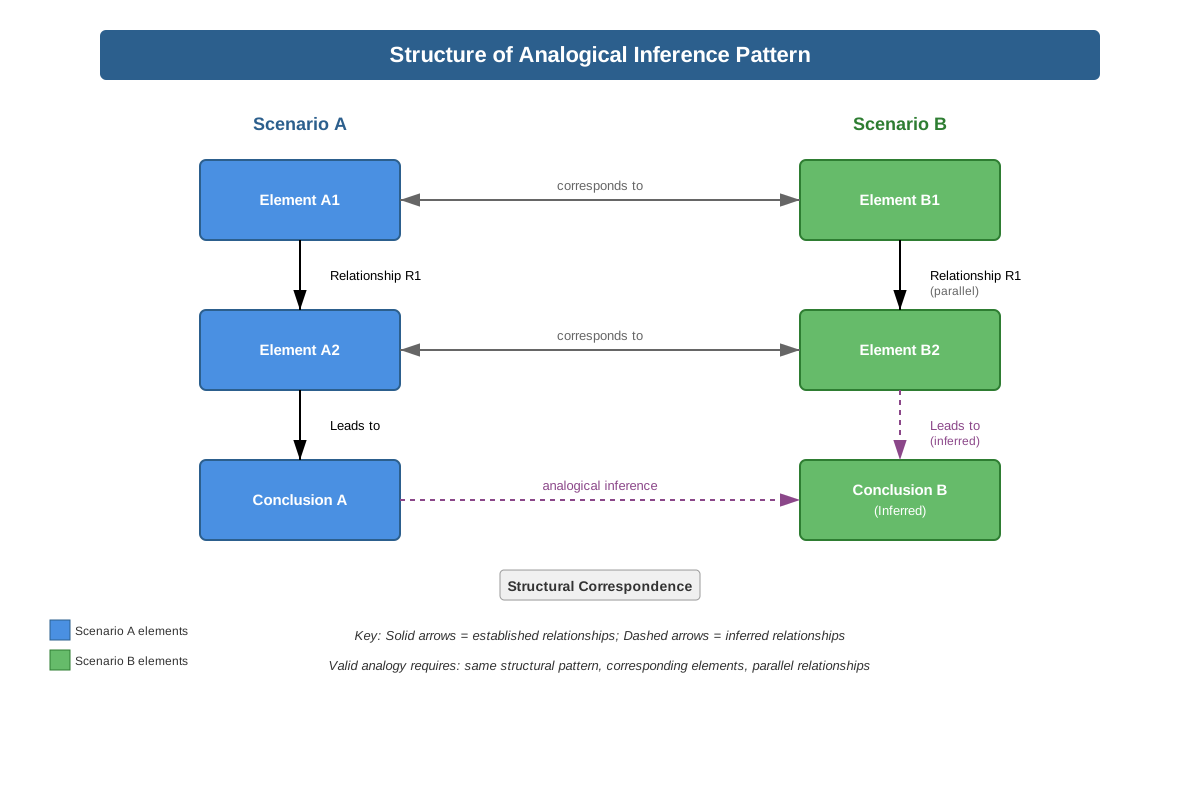
Inference with analogies operates through a fundamental logical pattern: if two situations share relevant structural features, and we know something about one situation, we can draw conclusions about the other. The key components include the source domain (the situation we know about), the target domain (the situation we're drawing conclusions about), and the mapping (the correspondence between elements in each domain). For an analogical inference to be valid on the LSAT, the mapped elements must play functionally equivalent roles in their respective contexts.
Consider this structure: Situation A has elements X, Y, and Z with a specific relationship. Situation B has elements X', Y', and Z' that correspond to X, Y, and Z respectively. If we know that in Situation A, when X and Y occur, Z follows, then we can infer that in Situation B, when X' and Y' occur, Z' will follow. The validity of this inference depends on whether the correspondence is genuine and whether the relationship that holds in Situation A is preserved in Situation B.
Identifying Corresponding Elements
The most critical skill in analogical inference involves correctly identifying which elements correspond between the two situations. The LSAT tests this by presenting scenarios where surface similarities might mislead students into mapping elements incorrectly. Corresponding elements must share functional roles, not merely superficial characteristics. For example, if the source domain discusses "the first step in a process," the corresponding element in the target domain must also be "the first step in a process," even if the specific content differs entirely.
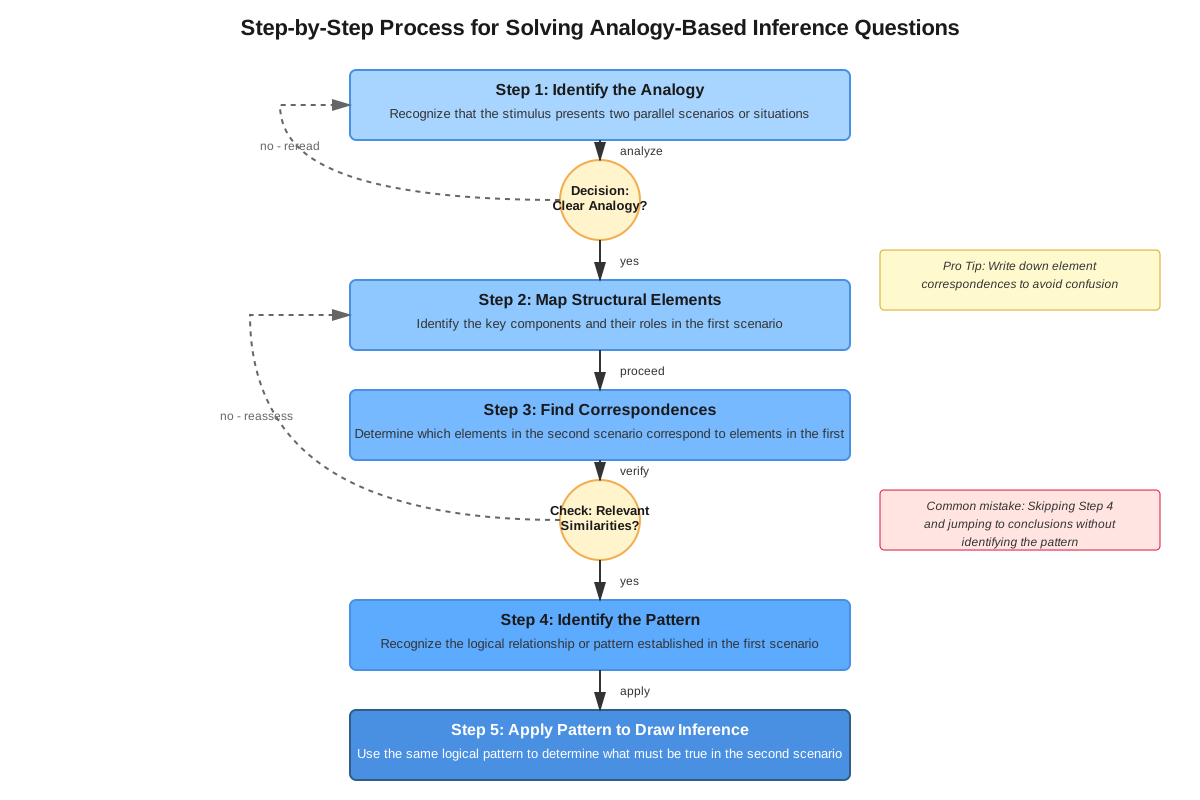
A systematic approach involves:
- Identifying all key elements in the source domain
- Determining the relationships between those elements
- Locating functionally equivalent elements in the target domain
- Verifying that the relationships between corresponding elements are preserved
- Drawing inferences based only on validated correspondences
Types of Analogical Relationships
| Relationship Type | Description | Example Structure |
|---|---|---|
| Causal | One element causes another in both domains | If A causes B in Domain 1, then A' causes B' in Domain 2 |
| Conditional | If-then relationships parallel each other | If X→Y in Domain 1, then X'→Y' in Domain 2 |
| Proportional | Quantitative relationships are preserved | If A is twice B in Domain 1, then A' is twice B' in Domain 2 |
| Sequential | Order or temporal relationships correspond | If X precedes Y in Domain 1, then X' precedes Y' in Domain 2 |
| Hierarchical | Structural relationships of superiority/subordination | If A contains B in Domain 1, then A' contains B' in Domain 2 |
Valid vs. Invalid Analogical Inferences
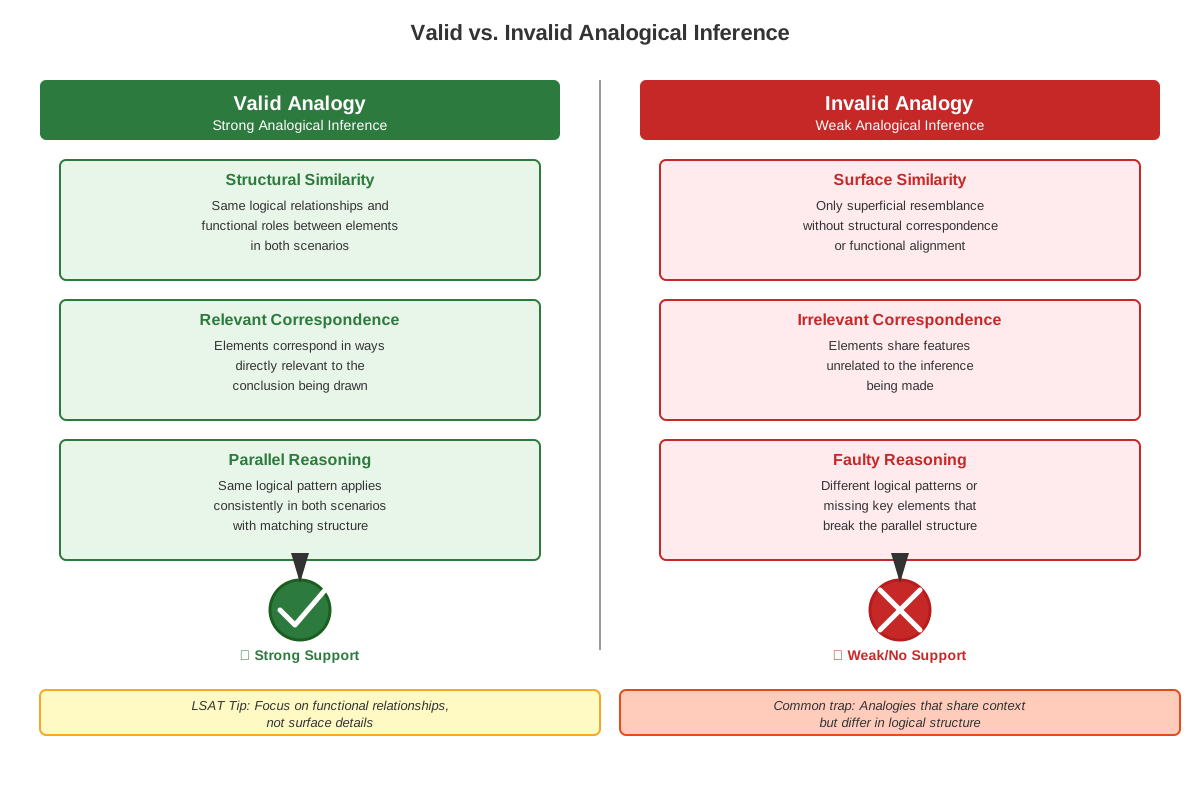
Not all analogies support valid inferences. The LSAT frequently includes answer choices that draw conclusions based on superficial similarities while ignoring structural differences. A valid analogical inference requires that:
- The mapped elements genuinely correspond in their functional roles
- The relationship being transferred is actually present in both domains
- No relevant disanalogies undermine the inference
- The conclusion stays within the scope of what the analogy supports
Invalid inferences typically fail because they assume correspondences that don't exist, transfer relationships that aren't actually parallel, or draw conclusions that go beyond what the structural similarity justifies. For instance, if two situations share some features but differ in a way that's relevant to the conclusion, the analogy doesn't support the inference.
Scope Limitations in Analogical Reasoning
Every analogy has limits. The LSAT tests whether students recognize that analogical inferences are only as strong as the relevant similarities between domains. When evaluating an inference based on analogy, consider:
- Breadth of correspondence: How many relevant features are shared?
- Depth of similarity: How fundamental are the shared features to the relationship in question?
- Presence of disanalogies: Are there relevant differences that weaken the inference?
- Specificity of conclusion: Does the inference claim more than the analogy supports?
Strong analogical inferences on the LSAT typically involve multiple points of correspondence, fundamental structural similarities, and conclusions that remain appropriately modest. Weak or invalid inferences often overreach, claiming more than the parallel structure justifies.
Implicit vs. Explicit Analogies
The LSAT presents analogies in varying degrees of explicitness. Explicit analogies use clear language like "similarly," "likewise," "just as," or "by analogy." These signal that analogical reasoning is at play and help students identify the source and target domains. Implicit analogies require more careful reading—the stimulus presents two situations without explicitly stating that they're analogous, and students must recognize the parallel structure independently.
Implicit analogies often appear in questions where the stimulus describes one scenario in detail, then briefly mentions another scenario with parallel features. The inference question then asks what must be true about the second scenario. Success requires recognizing that the detailed information about the first scenario can be transferred to the second based on their structural similarity.
Concept Relationships
The concepts within inference with analogies form an interconnected system. Identifying corresponding elements serves as the foundation for all analogical reasoning—without correct mapping, no valid inference is possible. This identification process leads directly to recognizing the type of analogical relationship present (causal, conditional, proportional, etc.), which determines what kinds of inferences are justified. Understanding relationship types enables evaluation of whether an inference is valid or invalid, as validity depends on whether the specific relationship being transferred actually holds in both domains.
Scope limitations interact with all other concepts by defining boundaries—even when correspondences are correctly identified and relationships properly recognized, inferences must remain within the scope that the analogy supports. The distinction between implicit and explicit analogies affects how students apply all other concepts; explicit analogies make the mapping more obvious, while implicit analogies require students to independently recognize the parallel structure before applying other analytical tools.
This topic connects to prerequisite knowledge of argument structure because analogies transfer logical relationships between arguments. Conditional reasoning frequently appears within analogies, as conditional structures in one domain correspond to conditional structures in another. The broader category of inference questions provides the question-type framework within which analogical reasoning operates—students must both recognize the analogy and apply standard inference-question skills to select answers that must be true or are most strongly supported.
Textual relationship map:
Identify Corresponding Elements → Determine Relationship Type → Evaluate Validity → Consider Scope Limitations → Draw Justified Inference
High-Yield Facts
⭐ Analogical inferences are only valid when the mapped elements play functionally equivalent roles in their respective contexts, not merely when they share superficial similarities.
⭐ The LSAT frequently includes wrong answers that draw conclusions based on surface-level resemblances while ignoring structural differences between the analogous situations.
⭐ When a stimulus establishes a causal relationship in one domain and presents an analogous domain, you can infer that the corresponding causal relationship holds in the second domain.
⭐ Conditional structures (if-then relationships) are among the most commonly tested analogical patterns—if X→Y in Domain 1, then X'→Y' in Domain 2.
⭐ Valid analogical inferences never extend beyond the scope of what the structural similarity supports; overreaching conclusions are typically incorrect.
- Proportional relationships transfer across analogies—if A is three times larger than B in one domain, the corresponding element A' is three times larger than B' in the analogous domain.
- Sequential or temporal relationships are preserved in valid analogies—if X precedes Y in the source domain, X' precedes Y' in the target domain.
- The strength of an analogical inference depends on the number and relevance of shared features between the domains.
- Disanalogies (relevant differences) weaken or invalidate analogical inferences even when some similarities exist.
- Implicit analogies require recognizing parallel structure without explicit signal words like "similarly" or "by analogy."
- Hierarchical relationships (containment, subordination, categorization) transfer across valid analogies just as other relationship types do.
- When multiple analogies appear in a single stimulus, track each correspondence separately to avoid conflating distinct parallel structures.
Quick check — test yourself on Inference with analogies so far.
Try Flashcards →Common Misconceptions
Misconception: If two situations share any similarities, conclusions about one automatically apply to the other.
Correction: Only relevant structural similarities support valid inferences. Surface-level resemblances or coincidental shared features don't justify analogical reasoning. The similarities must involve the functional roles of elements and the relationships between them.
Misconception: Analogical inferences are inherently weak or uncertain on the LSAT.
Correction: When the LSAT establishes a clear structural parallel between domains, analogical inferences can be just as strong as any other type of inference. The question stem determines the standard—"must be true" questions require inferences that follow with certainty from the analogy, while "most strongly supported" questions allow for somewhat less definitive conclusions.
Misconception: The corresponding elements in an analogy must be similar in content or subject matter.
Correction: Corresponding elements need only share functional or structural roles. An analogy might compare a biological system to an economic system, where "predators" correspond to "large corporations" and "prey" correspond to "small businesses." The content differs entirely, but the functional roles (dominant vs. subordinate entities in a competitive system) are parallel.
Misconception: If an analogy breaks down in one respect, it cannot support any inferences.
Correction: Analogies need not be perfect to support limited inferences. If two situations are analogous in relevant respects, valid inferences can be drawn about those specific aspects, even if the situations differ in other ways. The key is ensuring that the differences don't affect the particular relationship being transferred.
Misconception: Explicit signal words like "similarly" or "by analogy" always indicate that analogical reasoning is required.
Correction: While these words often signal analogies, they can also appear in other contexts. Conversely, many LSAT questions involve analogical reasoning without using explicit signal words. Students must recognize parallel structures based on logical analysis, not just keyword spotting.
Misconception: The source domain (the situation described first or in more detail) is always more important than the target domain.
Correction: Both domains are equally important for analogical reasoning. The source domain provides information that can be transferred, but the target domain is where the inference is drawn. Misunderstanding the target domain's structure will lead to incorrect inferences even if the source domain is perfectly understood.
Worked Examples
Example 1: Causal Analogy
Stimulus: "In northern ecosystems, the reintroduction of wolves led to a decrease in deer populations, which in turn allowed vegetation to recover, stabilizing riverbanks and reducing erosion. Similarly, in marine ecosystems, the reintroduction of sea otters has led to a decrease in sea urchin populations."
Question: Which one of the following can be properly inferred from the statements above?
Analysis:
First, identify the source domain: northern ecosystems with wolves, deer, and vegetation. The causal chain is: wolves → decreased deer → vegetation recovery → stabilized riverbanks.
Second, identify the target domain: marine ecosystems with sea otters and sea urchins. The established parallel is: sea otters correspond to wolves, and sea urchins correspond to deer.
Third, determine what the analogy supports inferring. The stimulus explicitly states that sea otter reintroduction decreased sea urchin populations (parallel to wolves decreasing deer). By analogy, we should expect the next step in the causal chain: something that sea urchins had been consuming or affecting should now recover, similar to how vegetation recovered when deer populations decreased.
Valid inference: "The reintroduction of sea otters has likely allowed kelp forests or other marine vegetation to recover." This follows the established causal pattern: predator reintroduction → decreased herbivore population → vegetation recovery.
Invalid inference: "The reintroduction of sea otters has stabilized riverbanks in coastal areas." This attempts to transfer a specific consequence (riverbank stabilization) that depends on the terrestrial context. While vegetation recovery might transfer analogically, the specific form that recovery takes (riverbank stabilization) is context-dependent and doesn't necessarily apply to marine ecosystems.
Learning objective connection: This example demonstrates how to identify corresponding elements (wolves/sea otters, deer/sea urchins) and apply the reasoning pattern (causal chain) to draw valid inferences while avoiding overreach.
Example 2: Conditional Analogy with Scope Limitations
Stimulus: "In corporate governance, if a board of directors lacks independent members, then conflicts of interest inevitably arise, compromising decision-making quality. University governance structures face similar challenges. Like corporate boards, university boards of trustees often include members with financial interests in university decisions."
Question: If the statements above are true, which one of the following must also be true?
Analysis:
First, identify the conditional structure in the source domain (corporate governance):
- If (lack of independent members) → then (conflicts of interest arise) → (compromised decision-making)
Second, identify the target domain (university governance) and the established parallel:
- University boards are analogous to corporate boards
- University board members with financial interests are analogous to non-independent corporate board members
Third, apply the conditional structure. The stimulus establishes that university boards "often include members with financial interests," which corresponds to "lacking independent members" in the corporate context. By analogy, the conditional relationship should transfer.
Valid inference: "University boards that include members with financial interests in university decisions face conflicts of interest that compromise decision-making quality." This directly applies the conditional relationship from the source domain to the target domain using the established correspondences.
Invalid inference: "All university boards lack independent members." This goes beyond what the analogy supports. The stimulus says university boards "often" include members with financial interests, not that all boards do or that they completely lack independent members. The inference overreaches by claiming more than the analogy justifies.
Invalid inference: "University governance is identical to corporate governance in all relevant respects." This misunderstands scope limitations. The analogy supports transferring the specific conditional relationship about independence and conflicts of interest, but doesn't establish that the domains are identical in all ways.
Learning objective connection: This example illustrates how conditional structures transfer across analogies while demonstrating the importance of scope limitations—valid inferences must stay within what the parallel structure actually supports.
Exam Strategy
When approaching LSAT questions involving inference with analogies, begin by reading the stimulus carefully to identify whether two distinct situations or domains are being presented. Look for explicit signal words like "similarly," "likewise," "just as," or "by analogy," but also remain alert for implicit analogies where parallel structures appear without explicit markers.
Trigger words and phrases to watch for:
- "Similarly," "likewise," "in the same way," "by analogy"
- "Just as... so too..."
- Parallel sentence structures describing different scenarios
- Phrases like "faces similar challenges" or "operates according to the same principle"
- Comparative language that establishes correspondences between elements
Step-by-step approach:
- Identify the domains: Clearly distinguish the source domain (usually described first or in more detail) from the target domain
- Map the elements: Determine which elements in the target domain correspond to which elements in the source domain based on functional roles
- Identify the relationship: Determine what type of relationship (causal, conditional, proportional, etc.) exists in the source domain
- Transfer carefully: Apply only the relationship that's established, without adding assumptions
- Check scope: Ensure your inference doesn't claim more than the analogy supports
Process-of-elimination tips:
- Eliminate answers that map elements incorrectly (e.g., treating non-corresponding elements as if they're parallel)
- Eliminate answers that transfer relationships not established in the stimulus
- Eliminate answers that rely on surface similarities while ignoring structural differences
- Eliminate answers that overreach beyond the scope of what the analogy supports
- Eliminate answers that introduce new information not inferable from the parallel structure
Time allocation advice: Spend adequate time on the initial mapping phase. Students often rush this step and misidentify correspondences, leading to incorrect answers despite solid reasoning thereafter. A typical inference-with-analogies question should take 1:20-1:40, with approximately 30-40 seconds devoted to carefully mapping elements before evaluating answer choices. This upfront investment prevents wasted time pursuing incorrect answers based on faulty mappings.
Exam Tip: When stuck between two answer choices, return to the mapping. Often, one answer correctly identifies corresponding elements while the other subtly misaligns them. The correct answer will preserve the functional roles of elements across domains.
Memory Techniques
MAPS - A mnemonic for the analogical inference process:
- Map the elements (identify correspondences)
- Analyze the relationship (determine what connects elements in source domain)
- Preserve the structure (transfer the relationship to target domain)
- Scope check (ensure inference doesn't overreach)
Visualization strategy: Picture analogies as two parallel bridges. Each bridge has the same structure (support beams, cables, deck), but different materials or settings. The structural elements correspond (beam to beam, cable to cable), and if you know something about how one bridge's structure functions, you can infer the same about the corresponding structure in the other bridge. This mental image reinforces that analogies depend on structural/functional parallels, not surface similarities.
The "Role-Not-Content" reminder: Create a mental sticky note that reads "ROLES = RELEVANT, CONTENT = COINCIDENTAL." This reminds you that corresponding elements must share functional roles, not merely content similarities. When mapping elements, repeatedly ask: "What role does this element play?" rather than "What is this element about?"
Acronym for relationship types - CCPSH:
- Causal
- Conditional
- Proportional
- Sequential
- Hierarchical
Remembering these five common relationship types helps you quickly categorize the relationship in the source domain, making it easier to transfer correctly to the target domain.
Summary
Inference with analogies represents a critical LSAT skill that tests the ability to recognize structural parallels between different situations and draw valid conclusions based on those parallels. Success requires identifying corresponding elements based on their functional roles rather than surface similarities, determining what type of relationship exists in the source domain, and carefully transferring that relationship to the target domain without overreaching. The LSAT tests this skill because analogical reasoning is fundamental to legal practice, where attorneys and judges constantly draw parallels between precedents and current cases. Valid analogical inferences depend on genuine structural correspondence, preservation of the relevant relationship, and conclusions that remain within the scope of what the analogy supports. Common pitfalls include mapping elements incorrectly, transferring relationships not actually established, relying on superficial similarities, and drawing conclusions that exceed what the parallel structure justifies. Mastery involves systematic analysis: identify domains, map elements by functional role, determine relationship type, transfer carefully, and verify scope limitations.
Key Takeaways
- Analogical inferences transfer logical relationships from a source domain to a structurally parallel target domain based on corresponding elements that share functional roles
- Valid correspondences depend on structural and functional equivalence, not surface-level content similarities
- The five most common relationship types in LSAT analogies are causal, conditional, proportional, sequential, and hierarchical
- Every analogical inference has scope limitations—conclusions must not claim more than the parallel structure supports
- Wrong answers typically fail by misidentifying correspondences, transferring unsupported relationships, or overreaching beyond the analogy's scope
- Both explicit analogies (with signal words) and implicit analogies (requiring recognition of parallel structure) appear regularly on the LSAT
- Systematic mapping of elements before evaluating answer choices prevents errors and saves time
Related Topics
Parallel Reasoning Questions: While inference with analogies focuses on drawing conclusions from parallel structures, parallel reasoning questions ask students to identify arguments with matching logical structures. Mastering analogical inference provides the foundation for recognizing structural parallels in parallel reasoning questions.
Principle Questions: Many principle questions involve applying a general rule from one context to a specific situation in another context, which requires analogical thinking. Understanding how to map elements and transfer relationships prepares students for principle application questions.
Strengthen and Weaken Questions with Analogies: Some strengthen/weaken questions present analogies and ask what would support or undermine the analogical reasoning. Mastering inference with analogies enables students to evaluate what makes analogical arguments stronger or weaker.
Flaw Questions Involving False Analogies: Understanding valid analogical inference helps students recognize when arguments commit the flaw of false analogy—treating situations as parallel when relevant differences undermine the comparison.
Practice CTA
Now that you've mastered the core concepts of inference with analogies, it's time to put your knowledge into action. Attempt the practice questions to test your ability to identify correspondences, transfer relationships, and draw valid inferences while avoiding common traps. The flashcards will help reinforce the key distinctions between valid and invalid analogical reasoning. Remember: analogical inference is a skill that improves dramatically with deliberate practice. Each question you work through strengthens your ability to recognize parallel structures and reason accurately across domains—a capability that will serve you throughout the LSAT and in legal reasoning beyond. You've built the foundation; now build the fluency through practice.
Sign up free to keep reading
Create a free AnvayaPrep account to finish this LSAT guide on Inference with analogies — plus flashcards and practice questions.