Overview
Inference with cause and effect represents one of the most frequently tested reasoning patterns on the LSAT Logical Reasoning section. This topic requires test-takers to understand how causal relationships are established, challenged, and manipulated within arguments. Unlike other inference questions that may focus on descriptive or correlational information, cause-and-effect inferences demand recognition of the specific logical structure that connects events, phenomena, or conditions through causal mechanisms. Mastering this topic is essential because the LSAT consistently presents arguments where understanding the direction, strength, and limitations of causal claims determines the correct answer.
The LSAT tests causal reasoning in multiple question types, including Must Be True questions, Most Strongly Supported questions, and even some Strengthen/Weaken questions that require inferential leaps about causal relationships. Test-makers deliberately craft passages that present causal claims with varying degrees of certainty, often embedding alternative explanations, temporal sequences, or correlational data that students must carefully distinguish from genuine causation. The ability to recognize when an argument establishes causation versus merely suggesting correlation, or when it confuses cause and effect, directly impacts performance on 15-20% of Logical Reasoning questions.
Within the broader landscape of LSAT Logical Reasoning, lsat inference with cause and effect connects intimately with argument structure analysis, conditional reasoning, and evidence evaluation. While conditional logic deals with sufficient and necessary conditions, causal reasoning addresses the mechanisms by which one event brings about another. Understanding this distinction—and recognizing when arguments conflate the two—forms a critical skill set that elevates performance across multiple question types and strengthens overall analytical reasoning abilities.
Learning Objectives
- [ ] Identify how Inference with cause and effect appears in LSAT questions
- [ ] Explain the reasoning pattern behind Inference with cause and effect
- [ ] Apply Inference with cause and effect to solve LSAT-style problems accurately
- [ ] Distinguish between causal claims and mere correlations in argument passages
- [ ] Recognize common causal reasoning flaws including reversed causation and third-cause scenarios
- [ ] Evaluate the strength of causal inferences based on the evidence provided
- [ ] Predict what additional information would strengthen or weaken causal claims
Prerequisites
- Basic argument structure: Understanding premises and conclusions is essential because causal claims typically appear as either evidence or conclusions that must be evaluated.
- Correlation versus causation distinction: Recognizing that two events occurring together does not necessarily mean one causes the other forms the foundation for sophisticated causal analysis.
- Conditional reasoning fundamentals: Causal relationships sometimes resemble but differ from conditional statements, and distinguishing these patterns prevents confusion.
- Inference question types: Familiarity with Must Be True and Most Strongly Supported questions provides the framework for understanding how causal inferences are tested.
Why This Topic Matters
Causal reasoning pervades not only standardized testing but also legal analysis, scientific research, policy evaluation, and everyday decision-making. Attorneys must establish causation in tort cases, determine whether actions led to specific outcomes, and evaluate whether proposed interventions will produce desired effects. The ability to rigorously analyze causal claims separates superficial thinking from the analytical precision required in legal practice.
On the LSAT specifically, causal reasoning appears in approximately 15-20% of Logical Reasoning questions across both sections. This translates to roughly 8-10 questions per test—a significant portion that can substantially impact overall scores. The topic appears most frequently in Must Be True questions (where students must identify what necessarily follows from causal premises), Strengthen/Weaken questions (where understanding causal mechanisms determines which answer choices affect argument validity), and Flaw questions (where recognizing causal reasoning errors is essential).
Common manifestations include passages describing scientific studies that establish correlations, policy arguments claiming certain actions will produce specific outcomes, historical analyses attributing events to particular causes, and comparative scenarios where differences in outcomes are attributed to differences in conditions. The LSAT particularly favors passages where multiple causal explanations compete, where temporal sequence might be confused with causation, or where the direction of causation remains ambiguous. Test-makers exploit these scenarios to create wrong answer choices that appeal to students who haven't mastered the nuances of causal inference.
Core Concepts
The Nature of Causal Claims
A causal claim asserts that one event, condition, or phenomenon (the cause) brings about, produces, or is responsible for another event, condition, or phenomenon (the effect). On the LSAT, causal language includes verbs and phrases such as "causes," "leads to," "produces," "results in," "brings about," "is responsible for," "contributes to," and "explains why." Recognizing these linguistic markers helps identify when an argument makes a causal assertion rather than merely describing a correlation or temporal sequence.
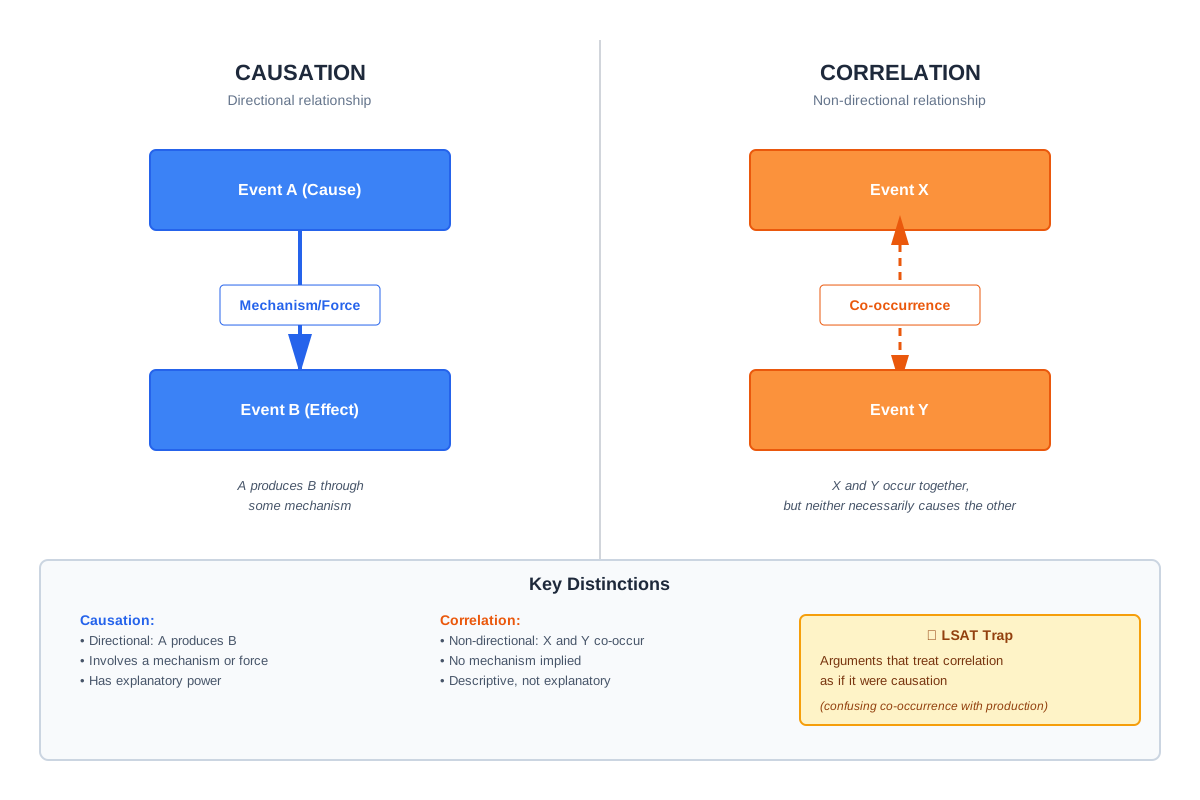
Causal relationships possess directionality: the cause precedes and produces the effect, not vice versa. This directionality creates vulnerability in arguments when the evidence presented could support reversed causation (where what appears to be the effect actually causes what appears to be the cause) or when a third factor might cause both observed phenomena. The LSAT frequently tests whether students recognize these alternative explanations.
Correlation Versus Causation
The most fundamental distinction in causal reasoning separates correlation (two things occurring together or varying together) from causation (one thing producing the other). When two variables correlate, they exhibit a statistical relationship: as one changes, the other tends to change in a predictable way. However, correlation alone never establishes causation because multiple explanations can account for the observed relationship.
Consider this structure: "Whenever A occurs, B also occurs." This statement establishes correlation but leaves causation undetermined. The relationship might reflect:
- A causes B
- B causes A (reversed causation)
- C causes both A and B (common cause)
- The correlation is coincidental
- A complex causal network involving multiple factors
LSAT passages often present correlational evidence while the conclusion asserts causation. Recognizing this gap between evidence and conclusion enables students to identify what the argument assumes and what would strengthen or weaken it.
Temporal Sequence and Causation
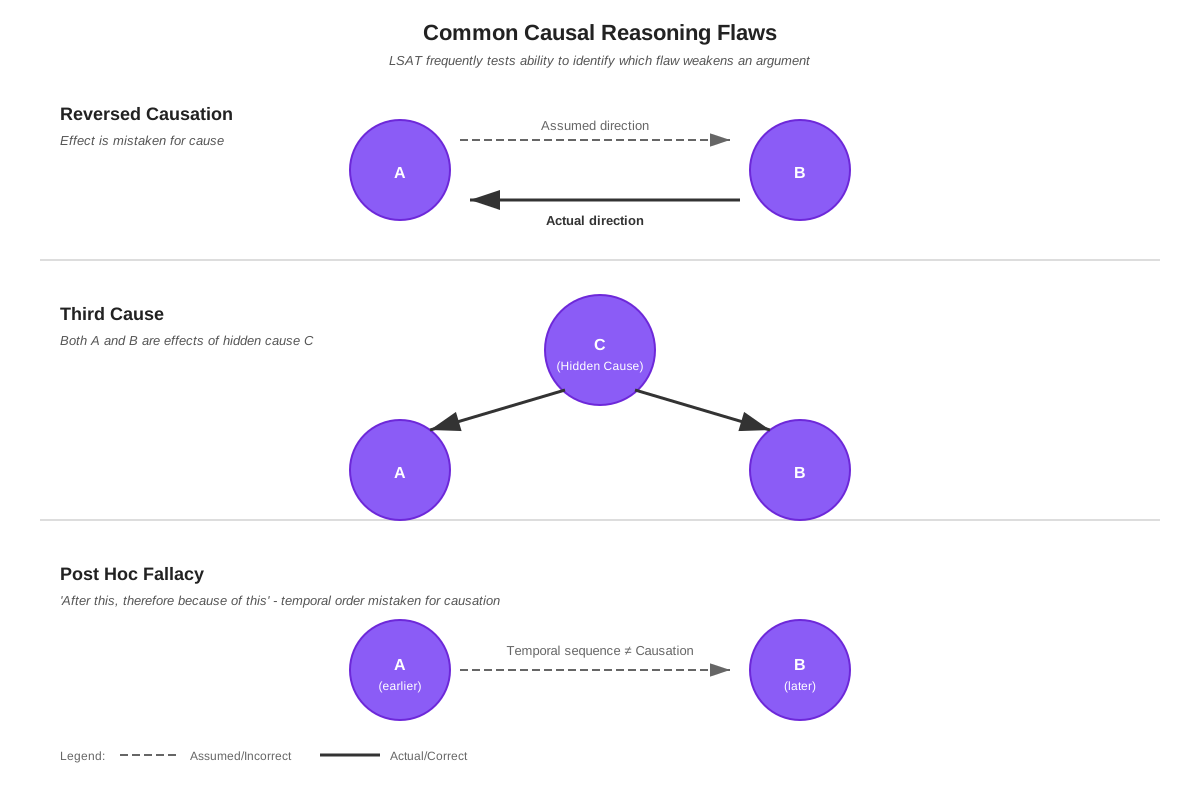
Temporal precedence—the cause occurring before the effect—represents a necessary but insufficient condition for causation. The LSAT exploits this by presenting arguments where event A precedes event B, and the argument concludes that A caused B. This reasoning pattern, sometimes called "post hoc ergo propter hoc" (after this, therefore because of this), commits a logical error when temporal sequence alone justifies the causal claim.
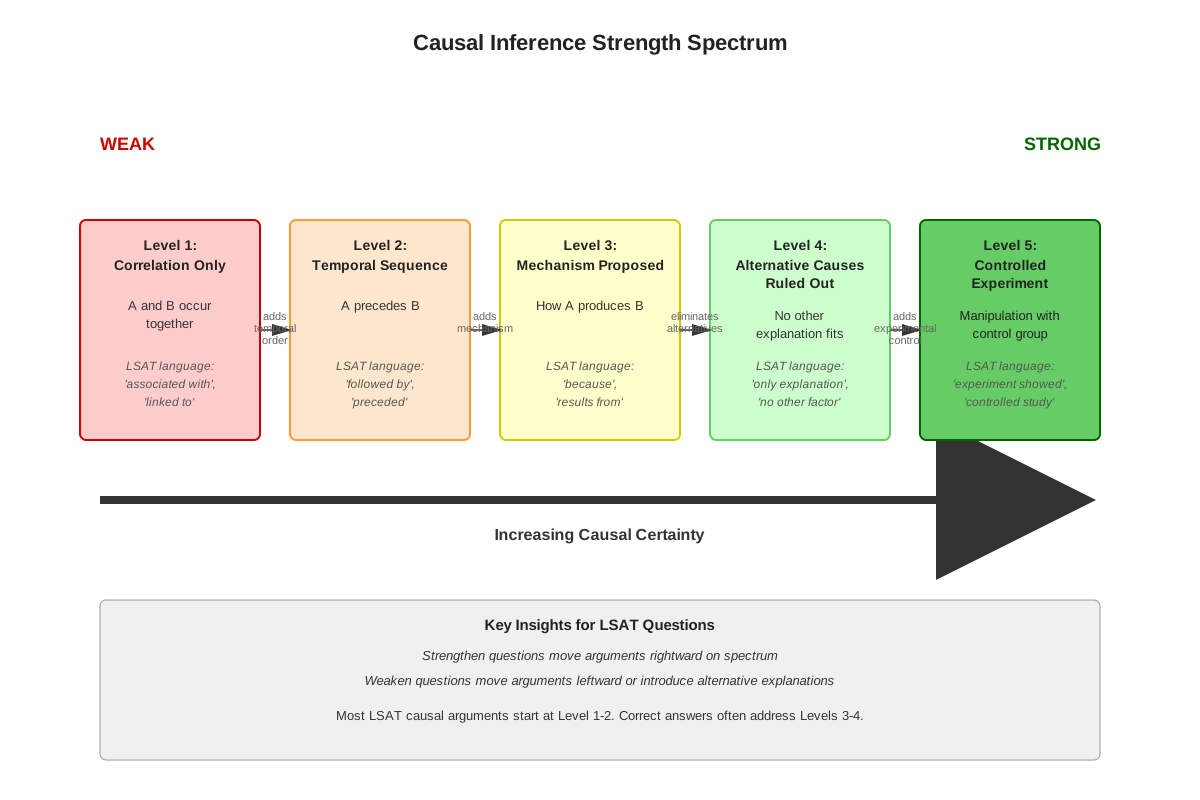
Valid causal reasoning requires more than temporal sequence: it demands a plausible mechanism connecting cause and effect, evidence ruling out alternative explanations, and often a pattern of regular occurrence rather than isolated instances. LSAT questions test whether students recognize when temporal information suffices for causal inference and when additional evidence is required.
Necessary and Sufficient Causes
Causal relationships vary in strength and type. A sufficient cause guarantees the effect: whenever the cause occurs, the effect must follow. A necessary cause is required for the effect: the effect cannot occur without this cause, though the cause alone might not produce the effect. Many causes are neither purely necessary nor purely sufficient but rather contributory factors that increase the likelihood of the effect.
| Cause Type | Definition | Example | LSAT Relevance |
|---|---|---|---|
| Sufficient | Cause guarantees effect | Decapitation causes death | Rare; most LSAT causes are contributory |
| Necessary | Effect requires cause | Oxygen necessary for fire | Tests understanding of what must be present |
| Contributory | Cause increases effect likelihood | Smoking contributes to cancer | Most common in LSAT passages |
| INUS | Insufficient but Necessary part of Unnecessary but Sufficient condition | Short circuit in presence of oxygen causes fire | Complex scenarios in difficult questions |
Understanding these distinctions helps evaluate answer choices that overstate or understate causal relationships. An argument might establish that X contributes to Y, but an answer choice might incorrectly claim that X is necessary for Y or that X alone suffices to produce Y.
Alternative Explanations and Causal Inference
Strong causal inferences require ruling out plausible alternative explanations. The LSAT tests this by presenting scenarios where multiple causal stories could account for the observed evidence. Three patterns appear repeatedly:
Reversed Causation: What appears to be the effect actually causes what appears to be the cause. Example: An argument claims that happiness causes success, but perhaps success causes happiness instead.
Common Cause (Third Factor): An unmentioned factor causes both observed phenomena. Example: An argument claims that coffee consumption causes heart disease based on correlation, but perhaps stress causes both increased coffee consumption and heart disease.
Coincidence or Confounding Variables: The observed relationship reflects chance, measurement error, or variables not accounted for in the analysis. Example: Ice cream sales correlate with drowning deaths, but both are caused by summer weather rather than ice cream causing drowning.
LSAT inference questions often require recognizing which of these alternatives the passage's evidence rules out and which remain viable. The correct answer to a Must Be True question must follow even when alternative explanations exist, while Strengthen/Weaken questions often hinge on information that makes alternatives more or less plausible.
Causal Mechanisms and Plausibility
Beyond establishing correlation and temporal precedence, strong causal arguments provide or assume a plausible mechanism—an explanation of how the cause produces the effect. The LSAT tests whether students recognize when a causal claim lacks a plausible mechanism or when evidence about mechanisms strengthens or weakens causal inferences.
For example, an argument might claim that meditation reduces blood pressure. Evidence showing that meditation decreases stress hormone levels, and that these hormones affect blood vessel constriction, provides a mechanism that strengthens the causal claim. Conversely, the absence of any plausible mechanism (or evidence contradicting proposed mechanisms) weakens causal arguments.
Causal Chains and Complex Causation
Many LSAT passages present causal chains where A causes B, which causes C, which causes D. Understanding these chains requires tracking multiple causal links and recognizing that breaking any link breaks the entire chain. Questions might ask what must be true if the chain holds, what would disrupt the chain, or what the chain implies about relationships between non-adjacent elements.
Complex causation also includes scenarios with multiple causes contributing to a single effect, single causes producing multiple effects, and feedback loops where effects influence their own causes. The LSAT tests whether students can navigate these complexities without losing track of what the evidence establishes versus what remains speculative.
Concept Relationships
The concepts within causal inference form an interconnected logical framework. Correlation versus causation serves as the foundation, establishing that observed relationships require further analysis before causal conclusions follow. This foundation supports understanding temporal sequence, which adds a necessary condition for causation but remains insufficient alone. Both correlation and temporal sequence lead to the central challenge of alternative explanations—reversed causation, common causes, and coincidence—which must be addressed before causal claims achieve validity.
Necessary and sufficient causes refine the analysis by specifying the strength and type of causal relationship, while causal mechanisms provide the explanatory bridge connecting cause to effect. These elements combine in causal chains and complex causation, where multiple concepts interact to create sophisticated reasoning scenarios.
This topic connects to prerequisite knowledge of argument structure by treating causal claims as conclusions that require evidential support. It extends conditional reasoning by showing how causal relationships differ from conditional relationships: "If A, then B" differs from "A causes B" because the former describes a logical or definitional relationship while the latter describes a productive relationship in the world. Understanding this distinction prevents conflating two important reasoning patterns.
The relationship map flows: Observed Correlation → Temporal Analysis → Alternative Explanation Evaluation → Mechanism Assessment → Causal Conclusion (with specified strength: necessary/sufficient/contributory). Each step represents a potential point where LSAT questions test understanding, and each step builds on previous concepts while enabling subsequent analysis.
High-Yield Facts
⭐ Correlation never establishes causation without additional evidence ruling out alternative explanations.
⭐ Temporal precedence (cause before effect) is necessary but not sufficient for establishing causation.
⭐ Three major alternatives to any causal claim: reversed causation, common cause, and coincidence.
⭐ Causal language includes: causes, leads to, produces, results in, brings about, is responsible for, contributes to, explains why.
⭐ Most LSAT causal relationships are contributory (increasing likelihood) rather than sufficient (guaranteeing outcome).
- Necessary causes must be present for the effect to occur, but their presence alone doesn't guarantee the effect.
- Sufficient causes guarantee the effect whenever they occur, but the effect might occur through other causes.
- Causal mechanisms explain how causes produce effects and strengthen causal arguments when present.
- Causal chains can be broken at any link, disrupting the entire sequence from initial cause to final effect.
- Evidence that the alleged cause sometimes occurs without the effect weakens claims of sufficient causation.
- Evidence that the effect sometimes occurs without the alleged cause weakens claims of necessary causation.
- Controlled experiments that manipulate the alleged cause while holding other factors constant provide stronger causal evidence than observational correlations.
- The strength of a causal inference depends on the quality and quantity of evidence, not merely on the confidence with which the conclusion is stated.
Quick check — test yourself on Inference with cause and effect so far.
Try Flashcards →Common Misconceptions
Misconception: If A and B correlate, and A occurs before B, then A must cause B.
Correction: Temporal precedence plus correlation suggests but doesn't establish causation. Alternative explanations (reversed causation, common cause, coincidence) must be ruled out through additional evidence or reasoning.
Misconception: Causal claims and conditional statements are interchangeable.
Correction: "If A, then B" describes a logical or definitional relationship where B follows necessarily from A, while "A causes B" describes a productive relationship where A brings about B in the world. Causation involves mechanisms and temporal processes that conditionals don't require.
Misconception: Finding any exception to a causal claim disproves it entirely.
Correction: Most causal relationships are contributory rather than sufficient. A contributory cause increases the likelihood of an effect without guaranteeing it, so exceptions don't disprove the causal relationship—they merely show it's not sufficient.
Misconception: The most recent event before an outcome must be its cause.
Correction: Temporal proximity doesn't establish causation. The most recent event might be coincidental, or it might be part of a longer causal chain where earlier events are more fundamentally responsible for the outcome.
Misconception: If an argument provides a mechanism explaining how A could cause B, the causal claim is proven.
Correction: A plausible mechanism strengthens a causal argument but doesn't prove causation. The mechanism must be supported by evidence, and alternative mechanisms producing the same effect must be considered.
Misconception: Causal inferences require certainty and cannot be drawn from probabilistic evidence.
Correction: LSAT inference questions ask what "must be true" or is "most strongly supported," but this refers to logical necessity given the premises, not empirical certainty. Probabilistic evidence can support causal inferences when properly qualified.
Misconception: Complex causal scenarios with multiple factors are too uncertain to support any inferences.
Correction: Even in complex scenarios, certain inferences follow necessarily. For example, if A and B together cause C, and C is absent, then at least one of A or B must be absent. The LSAT tests whether students can extract valid inferences from complex causal information.
Worked Examples
Example 1: Distinguishing Correlation from Causation
Passage: "A recent study found that students who eat breakfast regularly score higher on standardized tests than students who skip breakfast. The researchers concluded that eating breakfast improves test performance."
Question: Which of the following, if true, most weakens the researchers' conclusion?
Analysis Process:
- Identify the causal claim: The conclusion asserts that eating breakfast (cause) improves test performance (effect).
- Identify the evidence: The evidence establishes correlation—breakfast eaters score higher—and temporal precedence—breakfast occurs before tests.
- Recognize the gap: Correlation plus temporal sequence doesn't establish causation. Alternative explanations remain possible.
- Consider alternatives:
- Reversed causation: Could high test performance cause breakfast eating? Unlikely in this scenario.
- Common cause: Could a third factor cause both breakfast eating and high test scores? Very plausible—perhaps family socioeconomic status, parental involvement, or student conscientiousness causes both.
- Coincidence: Possible but less likely given the study's findings.
- Evaluate answer choices (hypothetical):
- (A) "Students from higher-income families are more likely both to eat breakfast regularly and to receive test preparation tutoring." → This presents a common cause (family income) that could explain both breakfast eating and test performance, weakening the causal claim. Strong weakener.
- (B) "Some students who skip breakfast still score well on tests." → This shows the cause isn't necessary, but doesn't address whether it's contributory. Weak weakener.
- (C) "The study included students from diverse geographic regions." → This addresses sample representativeness but doesn't challenge the causal inference. Irrelevant.
- (D) "Eating breakfast provides glucose that fuels brain function." → This provides a mechanism supporting the causal claim. Strengthener, not weakener.
Correct Answer: (A), because it introduces a common cause alternative explanation.
Connection to Learning Objectives: This example demonstrates identifying causal inference in LSAT questions, explaining the reasoning pattern (correlation to causation with insufficient evidence), and applying the framework to eliminate wrong answers and select the correct one.
Example 2: Necessary Versus Sufficient Causes
Passage: "Every successful technology startup in the past decade has had strong venture capital backing. Therefore, venture capital backing is essential for technology startup success."
Question: The argument's reasoning is most vulnerable to criticism on the grounds that it:
Analysis Process:
- Identify the causal claim: The conclusion asserts that venture capital backing is necessary (essential) for startup success.
- Examine the evidence: The evidence shows that all successful startups had venture capital backing—a correlation between success and VC backing.
- Evaluate the logical structure: The evidence shows: Success → VC backing (all successful startups had VC). The conclusion claims: Success requires VC backing (VC is necessary for success). This reasoning is valid IF the evidence is complete and accurate.
- Identify the vulnerability: The argument assumes that the observed pattern (all successful startups had VC) establishes necessity. However, this assumes:
- The sample is complete (no successful startups without VC were overlooked)
- Past patterns will continue (future success requires the same factors)
- Correlation indicates necessity rather than mere coincidence or common cause
- Recognize the flaw type: The argument confuses observed correlation with necessary causation. Just because all observed successes included VC backing doesn't prove VC backing is necessary—perhaps successful startups without VC backing exist but weren't included in the data, or perhaps VC backing correlates with success without causing it.
- Evaluate answer choices (hypothetical):
- (A) "Fails to consider that venture capital backing might be a result of startup success rather than a cause." → This describes reversed causation, but the temporal sequence (VC backing precedes success) makes this unlikely. Weak criticism.
- (B) "Assumes without justification that what is true of past startups will be true of future startups." → This identifies an assumption but doesn't address the core causal reasoning flaw. Moderate criticism.
- (C) "Overlooks the possibility that some successful startups without venture capital backing were not included in the data." → This directly challenges whether the evidence establishes necessity. Strong criticism.
- (D) "Treats a factor that may contribute to success as though it were the only factor." → This mischaracterizes the argument, which claims necessity, not exclusivity. Incorrect.
Correct Answer: (C), because it identifies how the evidence fails to establish that VC backing is necessary.
Connection to Learning Objectives: This example shows how to identify causal reasoning patterns (specifically claims about necessary causes), explain why the reasoning is flawed (insufficient evidence for necessity), and apply this understanding to select the answer that accurately describes the flaw.
Exam Strategy
Recognizing Causal Inference Questions
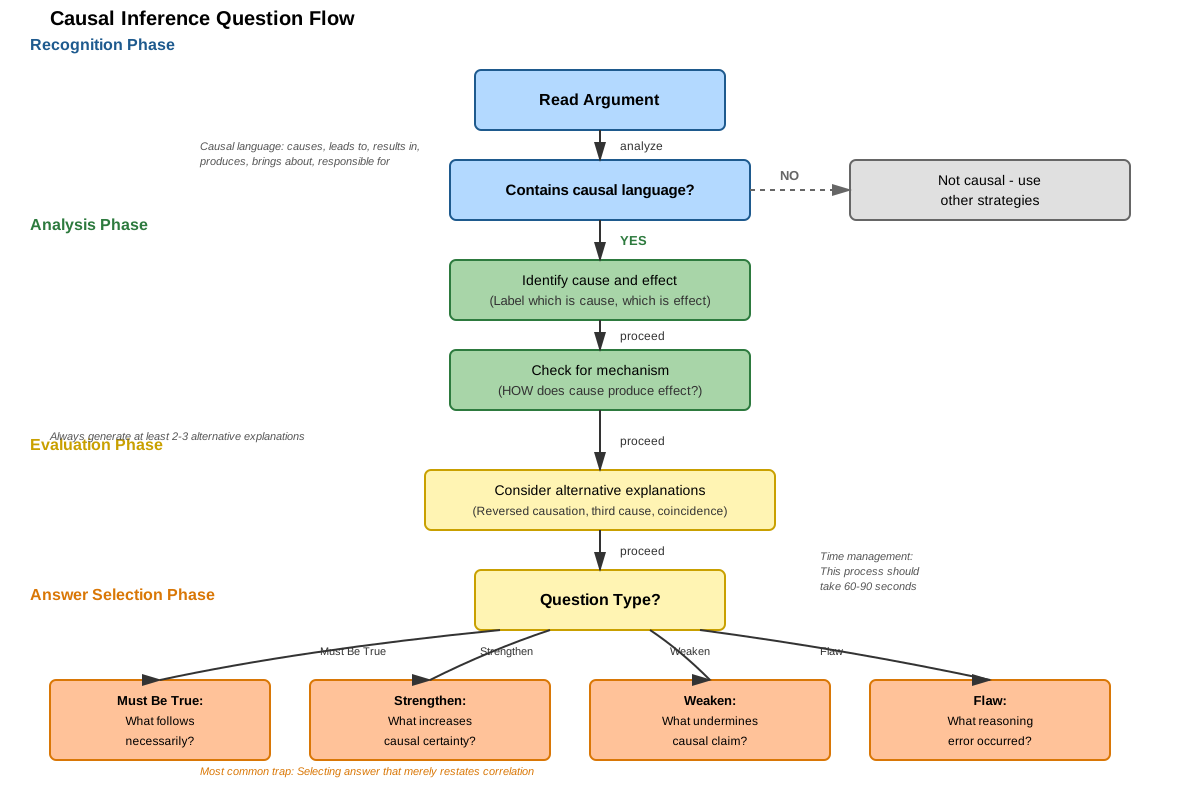
Watch for trigger language in both passages and questions. Passages containing "causes," "leads to," "results in," "produces," "explains why," "is responsible for," or "contributes to" likely involve causal reasoning. Questions asking what "must be true," what "can be properly inferred," what "most strengthens," or what "most weakens" often test causal inference when the passage contains causal claims.
Systematic Approach to Causal Inference Questions
- Identify the causal claim: Determine what the argument asserts causes what. Note the direction carefully.
- Assess the evidence: Does the passage provide correlation, temporal sequence, mechanism, or experimental manipulation? Each type of evidence has different inferential power.
- Consider alternatives: Before looking at answer choices, mentally generate alternative explanations: reversed causation, common cause, coincidence.
- Evaluate strength: Is the argument claiming necessary causation, sufficient causation, or contributory causation? Does the evidence support this strength of claim?
- Predict the answer: Based on the gap between evidence and conclusion, predict what type of answer will be correct (e.g., "something introducing a common cause alternative").
- Eliminate systematically: Remove answers that don't address the causal reasoning, that strengthen when you need weakening (or vice versa), or that address the wrong causal relationship.
Process of Elimination Tips
For Must Be True questions: Eliminate answers that:
- Go beyond what the causal evidence establishes (claiming certainty when only probability is supported)
- Reverse the direction of causation without justification
- Introduce causal claims not supported by the passage
- Confuse correlation with causation when the passage only establishes correlation
For Strengthen/Weaken questions: Eliminate answers that:
- Are irrelevant to the causal mechanism or alternative explanations
- Address a different causal relationship than the one in the conclusion
- Provide evidence about correlation when causation is at issue
- Strengthen when you need to weaken, or vice versa
Time Allocation
Causal inference questions typically require 60-90 seconds. Allocate:
- 20-30 seconds: Reading and identifying the causal claim and evidence
- 10-15 seconds: Considering alternative explanations
- 30-45 seconds: Evaluating answer choices
If a question involves complex causal chains or multiple causal relationships, allow up to 2 minutes. Don't rush the initial analysis—correctly identifying the causal structure prevents wasting time on wrong answer choices.
Common Traps
The Mechanism Trap: Answer choices that provide plausible mechanisms for the causal claim often appear in Weaken questions. Remember that providing a mechanism strengthens rather than weakens the argument.
The Partial Correlation Trap: Answer choices stating that the correlation isn't perfect (some causes occur without effects, or some effects without causes) appear in questions about contributory causation. These don't weaken contributory causal claims.
The Temporal Confusion Trap: Answer choices that establish temporal sequence when causation is at issue, or that challenge temporal sequence when the argument has already established it, distract from the real issue.
Memory Techniques
The CART Mnemonic for Alternative Explanations
Common cause
Alternative mechanism
Reversed causation
Temporal coincidence
When evaluating any causal claim, run through CART to identify what alternative explanations remain possible.
The "Three Questions" Framework
For any causal claim, ask:
- Does it happen? (Is there correlation?)
- Does it happen first? (Is there temporal precedence?)
- Does it make it happen? (Is there a mechanism and are alternatives ruled out?)
Only "yes" to all three establishes causation.
Visualization Strategy: The Causal Arrow
Mentally draw an arrow from cause to effect. Then visualize:
- A reverse arrow (reversed causation)
- A third factor with arrows pointing to both (common cause)
- A broken arrow (coincidence/no real connection)
- Multiple arrows converging (multiple causes)
- A chain of arrows (causal chain)
This visual representation helps track complex causal relationships and identify alternatives.
The "Necessary/Sufficient" Hand Trick
- Necessary: Make a fist (closed). The cause must be present (inside the fist) for the effect to occur. Without it, no effect.
- Sufficient: Open hand (giving). The cause gives/produces the effect automatically. Whenever present, effect follows.
- Contributory: Partially open hand. The cause helps but doesn't guarantee.
Physical gestures can reinforce conceptual distinctions during practice.
Summary
Inference with cause and effect represents a high-yield LSAT topic requiring students to distinguish genuine causal relationships from mere correlations, temporal sequences, or coincidences. The core challenge involves recognizing that correlation and temporal precedence, while necessary for causation, remain insufficient without additional evidence ruling out alternative explanations—particularly reversed causation, common causes, and coincidence. LSAT questions test whether students understand the difference between necessary causes (required for the effect), sufficient causes (guaranteeing the effect), and contributory causes (increasing the likelihood of the effect), and whether they can identify when arguments overstate the strength of causal claims. Success requires systematic analysis: identifying the causal claim, assessing the evidence type and strength, considering alternative explanations, and evaluating whether answer choices properly address the causal reasoning. Mastering this topic improves performance across multiple question types and strengthens overall analytical reasoning abilities essential for legal thinking.
Key Takeaways
- Correlation never proves causation—additional evidence ruling out alternatives (reversed causation, common cause, coincidence) is always required for valid causal inference.
- Temporal precedence is necessary but insufficient—the cause must occur before the effect, but temporal sequence alone doesn't establish that the earlier event produced the later one.
- Most LSAT causal relationships are contributory—they increase the likelihood of effects without guaranteeing them, so exceptions don't disprove the causal claim.
- Causal mechanisms strengthen arguments—explanations of how causes produce effects make causal claims more plausible and harder to challenge.
- Alternative explanations are the key to Strengthen/Weaken questions—answers that introduce or eliminate alternatives (especially common causes) most effectively affect causal arguments.
- Distinguish causal claims from conditional statements—"If A, then B" differs fundamentally from "A causes B" in logical structure and inferential implications.
- Systematic analysis prevents errors—following a consistent process (identify claim → assess evidence → consider alternatives → evaluate answers) improves accuracy and speed.
Related Topics
Correlation and Statistical Reasoning: Understanding how statistical relationships are established and interpreted deepens comprehension of when correlational evidence supports causal inferences and when it remains merely descriptive.
Conditional Logic and Sufficient/Necessary Conditions: While distinct from causal reasoning, conditional logic shares structural similarities that can clarify or confuse causal analysis, making explicit comparison valuable.
Argument Structure and Assumption Identification: Causal arguments often contain unstated assumptions about mechanisms or the absence of alternative explanations, connecting this topic to broader assumption-finding skills.
Strengthen and Weaken Questions: These question types frequently test causal reasoning by asking what information would make causal claims more or less plausible, providing additional practice with the concepts covered here.
Flaw Questions: Many logical flaws involve causal reasoning errors—confusing correlation with causation, assuming reversed causation, or overlooking common causes—making flaw recognition an extension of causal inference mastery.
Practice CTA
Now that you've mastered the conceptual framework for inference with cause and effect, it's time to apply these principles to actual LSAT questions. The practice questions and flashcards will reinforce your ability to quickly identify causal claims, evaluate evidence strength, consider alternative explanations, and select correct answers under timed conditions. Each practice question represents an opportunity to strengthen the neural pathways that make causal analysis automatic and accurate. Approach practice systematically, reviewing not just which answers are correct but why the reasoning process led to those answers. Your investment in deliberate practice with this high-yield topic will pay dividends across multiple question types and significantly impact your overall LSAT performance. Begin practicing now to transform conceptual understanding into test-day excellence.
Sign up free to keep reading
Create a free AnvayaPrep account to finish this LSAT guide on Inference with cause and effect — plus flashcards and practice questions.