Overview
Inference with no and all represents one of the most fundamental and frequently tested patterns in LSAT Logical Reasoning. This topic focuses on understanding how universal quantifiers ("all," "every," "any") and negative universal quantifiers ("no," "none") interact to create valid logical inferences. Mastering these inference patterns is essential because they form the backbone of formal logic and appear across multiple question types on the LSAT, including Must Be True questions, Cannot Be True questions, and Sufficient Assumption questions.
The LSAT tests the ability to recognize valid logical relationships between categorical statements. When statements use "all" or "no," they establish absolute relationships between groups or categories. Understanding how to chain these relationships together, recognize their contrapositives, and identify what must be true based on these statements is critical for success. These patterns appear not only in standalone inference questions but also embedded within more complex argument structures throughout the Logical Reasoning sections.
This topic connects directly to broader concepts in formal logic, including conditional reasoning, contrapositive formation, and categorical logic. While conditional statements (if-then) and categorical statements (all/no) are technically distinct logical forms, they share similar inference patterns that students must master. The ability to quickly and accurately process "all" and "no" statements provides the foundation for tackling more complex logical structures, making this a high-priority topic for any serious LSAT student.
Learning Objectives
- [ ] Identify how Inference with no and all appears in LSAT questions
- [ ] Explain the reasoning pattern behind Inference with no and all
- [ ] Apply Inference with no and all to solve LSAT-style problems accurately
- [ ] Translate categorical statements into standard logical form
- [ ] Construct valid inference chains using multiple "all" and "no" statements
- [ ] Recognize invalid inferences that violate the rules of categorical logic
- [ ] Distinguish between statements that must be true versus statements that could be true
Prerequisites
- Basic conditional reasoning: Understanding if-then statements provides the foundation for recognizing how "all" statements function as conditional relationships
- Contrapositive formation: The ability to form contrapositives is essential because "all" and "no" statements have contrapositives that generate additional valid inferences
- Categorical relationships: Familiarity with how groups and categories relate to one another helps in visualizing the logical relationships established by universal quantifiers
- Necessary versus sufficient conditions: Distinguishing these concepts is crucial for understanding the directional nature of "all" statements
Why This Topic Matters
In real-world contexts, categorical reasoning appears constantly in legal arguments, policy discussions, and analytical writing. Lawyers must understand how rules apply universally ("all contracts require consideration") and how exceptions work ("no contract formed under duress is enforceable"). The ability to draw valid conclusions from categorical premises is fundamental to legal reasoning and critical thinking in professional contexts.
On the LSAT, inference questions involving "all" and "no" statements appear with remarkable frequency. Approximately 15-20% of Logical Reasoning questions directly test categorical inference patterns, and these patterns appear embedded in arguments throughout both Logical Reasoning sections. Must Be True questions, which ask what can be validly concluded from the given statements, frequently present two or three categorical statements that must be combined to reach a conclusion. Additionally, Parallel Reasoning questions often test whether students can recognize equivalent logical structures involving universal quantifiers.
This topic appears in several distinct ways on the exam. Sometimes questions present explicit categorical statements using "all" and "no," requiring straightforward inference chains. Other times, the categorical relationships are disguised using equivalent language like "every," "any," "only," "none," or "never." The most challenging questions combine categorical statements with conditional statements or require students to recognize when an inference is invalid. Understanding these patterns enables students to move quickly and confidently through questions that might otherwise consume valuable time.
Core Concepts
Understanding "All" Statements
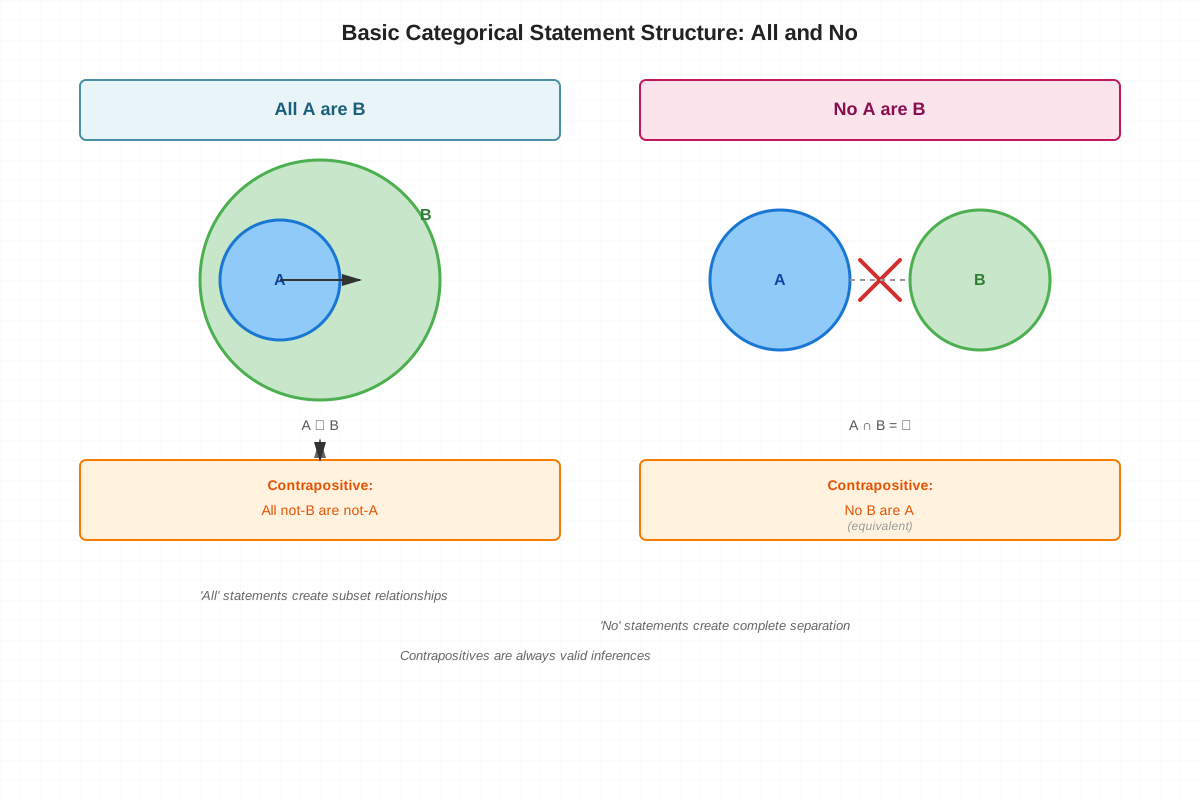
An "all" statement establishes a universal relationship where every member of one category is also a member of another category. The standard form is "All A are B," which means that if something is an A, then it must be a B. This creates a sufficient condition: being an A is sufficient to guarantee being a B.
The logical structure of "all" statements is directional and asymmetric. "All A are B" does NOT mean "All B are A." This is a critical distinction that the LSAT tests repeatedly. For example, "All lawyers are college graduates" does not allow us to conclude that "All college graduates are lawyers." The relationship flows in only one direction.
Contrapositive formation is essential for "all" statements. The contrapositive of "All A are B" is "All non-B are non-A" (or equivalently, "No non-B are A"). This contrapositive is logically equivalent to the original statement and represents a valid inference. Using our example, if "All lawyers are college graduates," then "All non-college-graduates are non-lawyers" (or "No non-college-graduates are lawyers").
Understanding "No" Statements
A "no" statement establishes a universal negative relationship where no member of one category is a member of another category. The standard form is "No A are B," which means that if something is an A, then it cannot be a B, and if something is a B, it cannot be an A.
Unlike "all" statements, "no" statements are symmetric and bidirectional. "No A are B" means exactly the same thing as "No B are A." This symmetry is unique to negative universal statements. For example, "No reptiles are mammals" conveys the same information as "No mammals are reptiles."
The contrapositive of a "no" statement is also important but less commonly tested. The contrapositive of "No A are B" is "No B are A," which is simply the symmetric version of the same statement. More usefully, "No A are B" can be understood as equivalent to "All A are non-B" and "All B are non-A."
Chaining Inferences
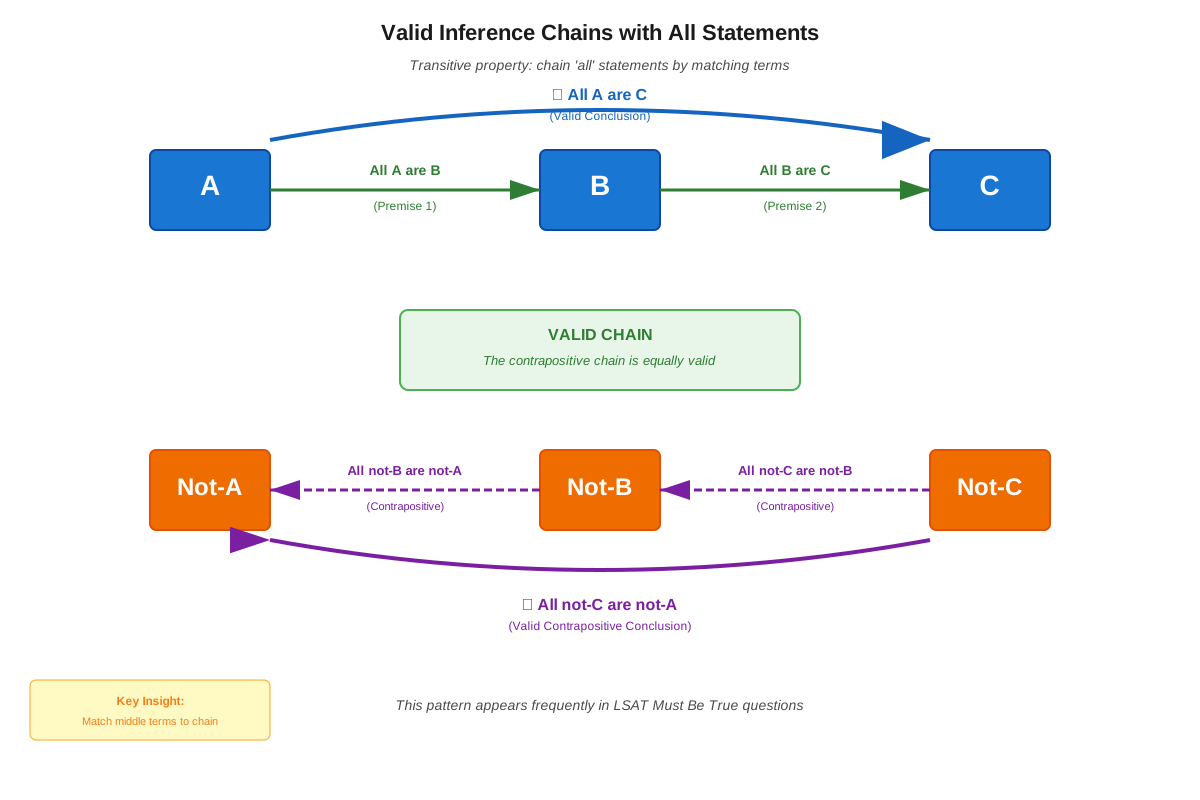
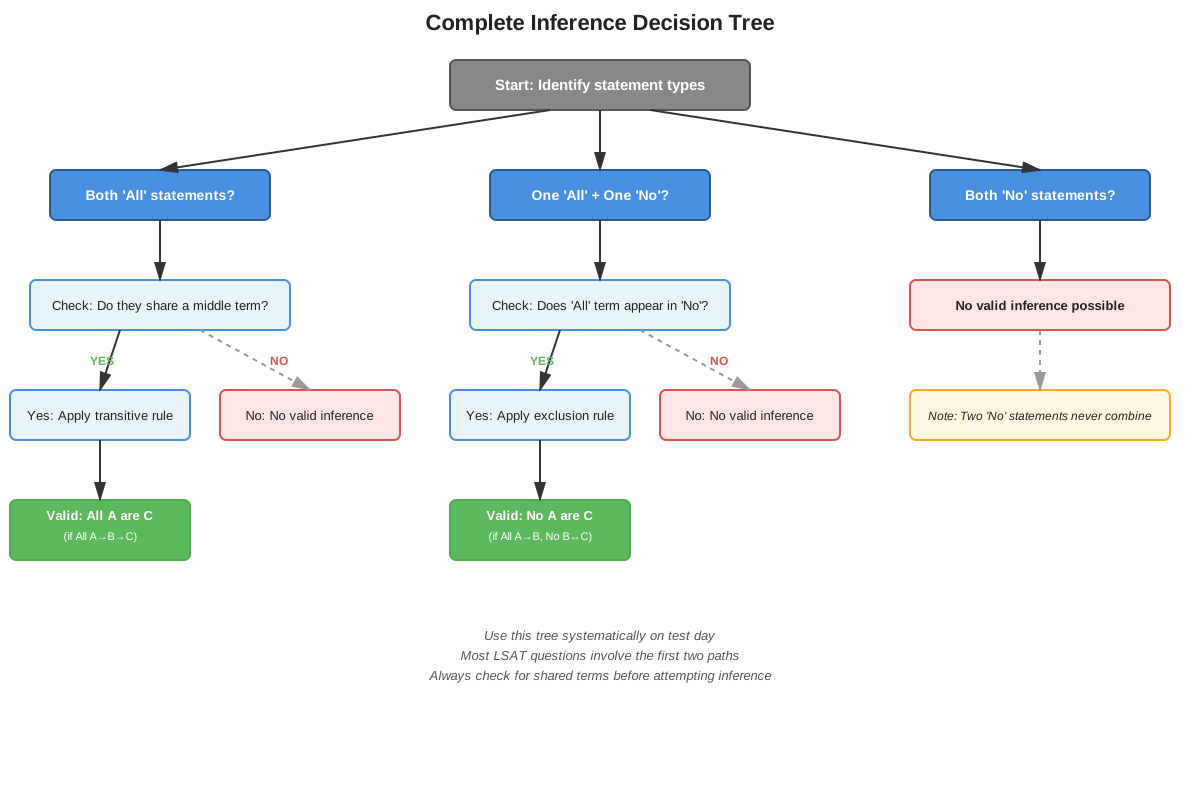
The most powerful application of categorical logic involves chaining multiple statements together to reach new conclusions. When the second category in one statement matches the first category in another statement, they can be combined.
The basic chaining pattern follows this structure:
- All A are B
- All B are C
- Therefore: All A are C
This creates a transitive chain where the middle term (B) connects the first term (A) to the final term (C). The LSAT frequently presents two or three statements that must be chained together to reach the credited answer.
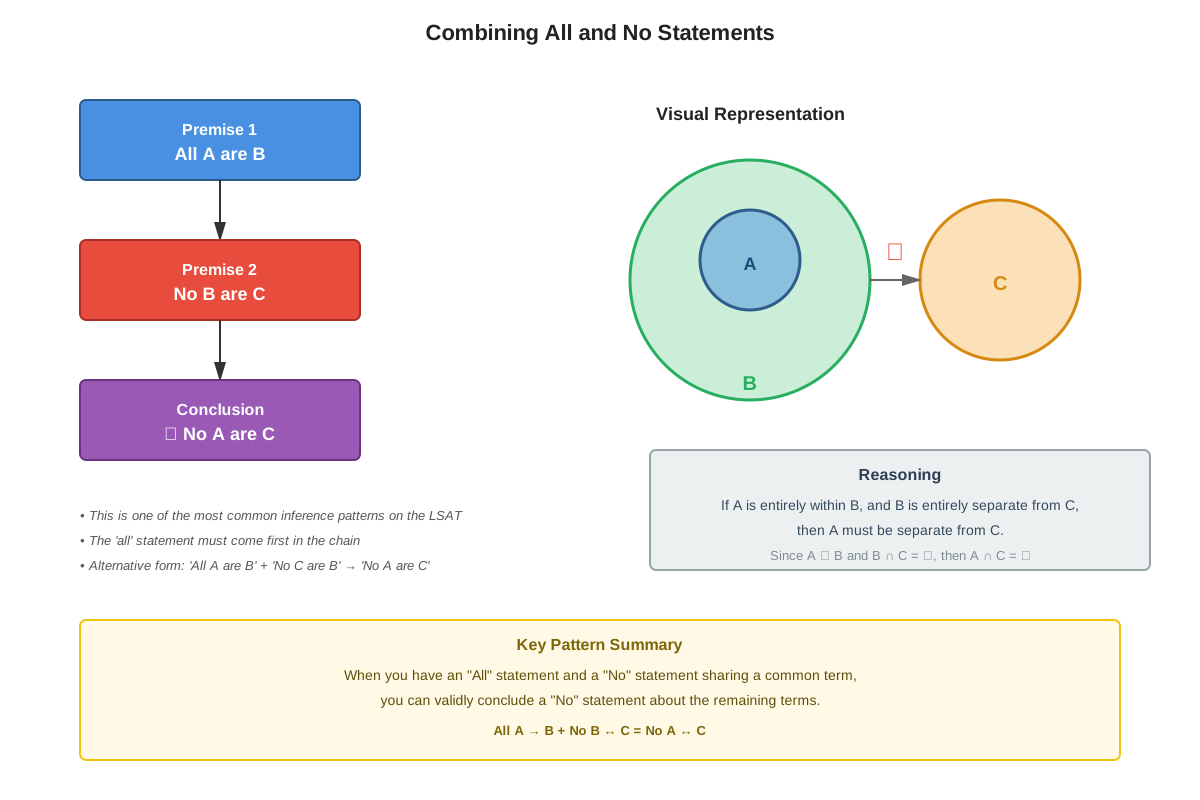
Chaining also works with "no" statements, but the pattern differs:
- All A are B
- No B are C
- Therefore: No A are C
When a "no" statement appears in a chain, it creates a negative conclusion. The key is identifying which categories connect and following the logical flow carefully.
Invalid Inference Patterns
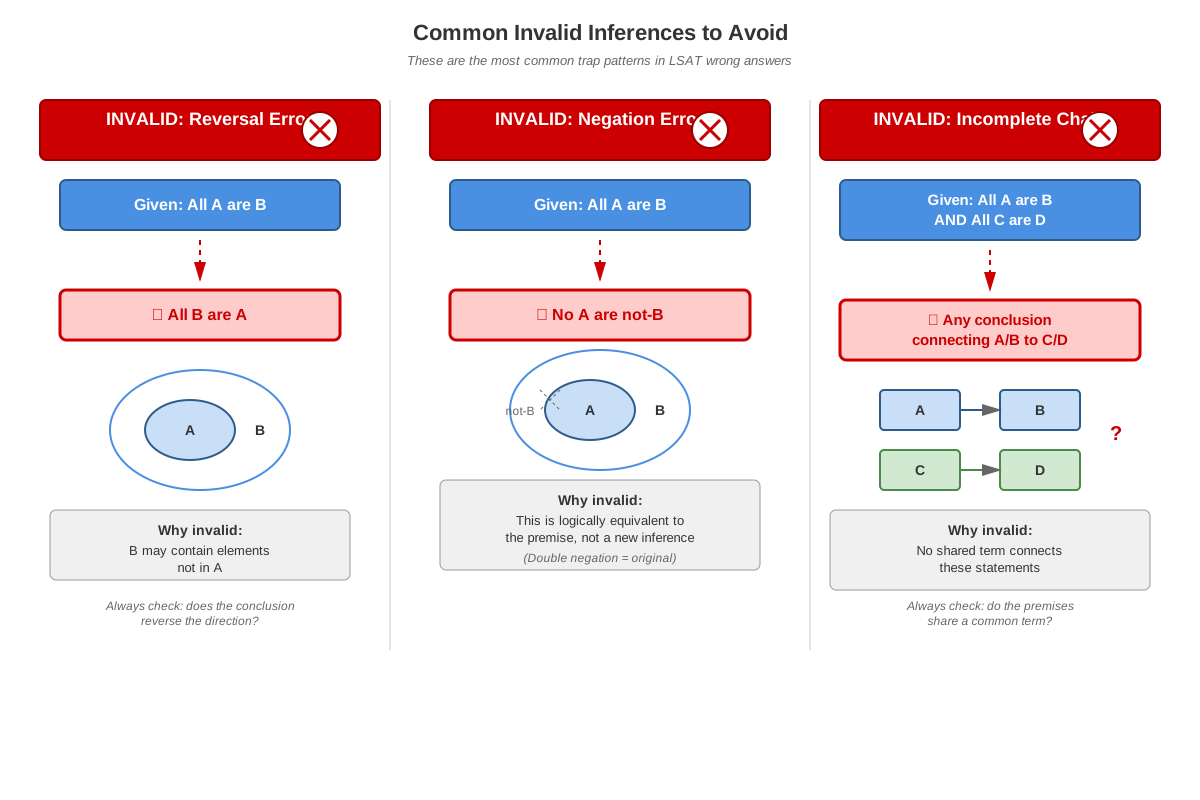
Understanding what does NOT follow from categorical statements is equally important. Several common invalid patterns appear repeatedly as trap answers on the LSAT.
Reversing an "all" statement is invalid. From "All A are B," we cannot conclude "All B are A." This reversal error is the most common trap in categorical reasoning questions.
Negating without forming the contrapositive is invalid. From "All A are B," we cannot conclude "All non-A are non-B." The valid contrapositive is "All non-B are non-A," which reverses AND negates.
Assuming existence is invalid. From "All A are B," we cannot conclude that any A actually exists. Categorical statements describe relationships but do not guarantee that the categories contain members.
Translating Equivalent Language
The LSAT disguises categorical statements using various linguistic forms. Recognizing these equivalents is essential for identifying the logical structure.
| Statement Form | Logical Equivalent | Example |
|---|---|---|
| All A are B | If A, then B | All doctors are professionals |
| Every A is B | If A, then B | Every student passed the exam |
| Any A is B | If A, then B | Any violation results in a penalty |
| Only B are A | If A, then B | Only members can vote |
| No A are B | If A, then not B | No children are eligible |
| None of the A are B | If A, then not B | None of the candidates won |
The "only" construction requires special attention because it reverses the expected order. "Only B are A" means "If A, then B," not "If B, then A." For example, "Only seniors can take the seminar" means "If you take the seminar, then you are a senior."
Combining Categorical and Conditional Logic
Advanced LSAT questions often combine categorical statements with conditional statements. Since "All A are B" can be translated as "If A, then B," these statements can be integrated into longer inference chains.
For example:
- All managers are employees (All M are E)
- If someone is an employee, they receive benefits (If E, then B)
- Therefore: All managers receive benefits (All M are B)
This integration allows for complex reasoning chains that test multiple logical skills simultaneously. The key is recognizing the underlying structure regardless of how the statements are presented.
Concept Relationships
The concepts within categorical inference form a tightly integrated system. "All" statements and "no" statements represent the two fundamental building blocks, with "all" establishing positive universal relationships and "no" establishing negative universal relationships. Both types of statements generate contrapositives, which provide additional valid inferences.
Chaining inferences builds upon individual categorical statements by connecting them through shared terms. This process requires understanding both "all" and "no" statements and recognizing when the conclusion of one statement can serve as the premise of another. The validity of chains depends on avoiding invalid inference patterns, particularly the reversal error and improper negation.
Translation skills connect natural language to logical form, enabling students to recognize categorical relationships regardless of how they are expressed. This translation ability feeds into all other aspects of categorical reasoning, as students must first identify the logical structure before applying inference rules.
The relationship map flows as follows:
Natural Language → Translation → Standard Form ("All A are B" or "No A are B") → Contrapositive Formation → Chaining with Other Statements → Valid Conclusion
This topic connects to prerequisite knowledge of conditional reasoning because "all" statements function as conditional relationships. The connection to contrapositive formation is direct and essential, as every categorical statement generates a contrapositive. Looking forward, mastery of categorical inference enables progression to formal logic games, sufficient assumption questions, and parallel reasoning questions, all of which rely heavily on these foundational patterns.
Quick check — test yourself on Inference with no and all so far.
Try Flashcards →High-Yield Facts
⭐ "All A are B" means if something is A, it must be B, but does NOT mean if something is B, it must be A
⭐ The contrapositive of "All A are B" is "All non-B are non-A" and is always valid
⭐ "No A are B" is symmetric: it means the same thing as "No B are A"
⭐ Categorical statements can be chained when the second term of one statement matches the first term of another
⭐ "Only B are A" translates to "If A, then B" (the order reverses)
- "All A are B" combined with "All B are C" yields "All A are C"
- "All A are B" combined with "No B are C" yields "No A are C"
- Reversing an "all" statement (concluding "All B are A" from "All A are B") is always invalid
- Categorical statements do not guarantee existence; "All unicorns are magical" can be true even if no unicorns exist
- "Every," "any," and "each" are equivalent to "all" in logical structure
- "None," "never," and "not any" are equivalent to "no" in logical structure
- The contrapositive of "No A are B" is "No B are A" (the symmetric version)
Common Misconceptions
Misconception: "All A are B" means the same thing as "All B are A"
Correction: "All" statements are directional and asymmetric. "All A are B" only tells us that every A is a B; it tells us nothing definitive about whether every B is an A. This reversal error is the most common trap in categorical reasoning.
Misconception: From "All A are B," we can conclude "Some B are A"
Correction: While this might be true in many real-world cases, it is not a logically necessary inference. Categorical statements do not guarantee existence, so we cannot conclude that any A actually exists to be among the B's.
Misconception: "No A are B" means "All A are not B" is different from "All B are not A"
Correction: "No A are B" is symmetric and means both "All A are not B" AND "All B are not A." Unlike "all" statements, "no" statements work in both directions equally.
Misconception: The contrapositive of "All A are B" is "All non-A are non-B"
Correction: The valid contrapositive is "All non-B are non-A." The contrapositive must both reverse AND negate the terms. Simply negating without reversing produces an invalid inference.
Misconception: "Only A are B" means "If A, then B"
Correction: "Only A are B" means "If B, then A." The word "only" creates a necessary condition for what follows it. "Only seniors can enroll" means "If you enroll, you must be a senior," not "If you're a senior, you must enroll."
Misconception: If "All A are B" and "All C are D," then we can conclude something about the relationship between A and C
Correction: Without a shared term connecting the statements, no valid inference can be drawn. Chaining requires that the second term of one statement matches the first term of another statement.
Worked Examples
Example 1: Basic Chaining with "All" Statements
Question: Given the following statements, what must be true?
- All philosophy majors are critical thinkers
- All critical thinkers are good writers
- Sarah is a philosophy major
Solution:
Step 1: Translate into standard form
- All P are C (All philosophy majors are critical thinkers)
- All C are W (All critical thinkers are good writers)
- Sarah is P (Sarah is a philosophy major)
Step 2: Identify the chaining opportunity
The second term of the first statement (C) matches the first term of the second statement (C), allowing us to chain them together.
Step 3: Create the chain
- All P are C
- All C are W
- Therefore: All P are W (All philosophy majors are good writers)
Step 4: Apply to Sarah
Since Sarah is P (a philosophy major), and all P are W (good writers), Sarah must be W (a good writer).
Conclusion: Sarah is a good writer. This must be true based on the given statements.
Connection to Learning Objectives: This example demonstrates how to identify categorical statements, chain them together using the standard inference pattern, and apply the conclusion to a specific case. It illustrates the core reasoning pattern behind inference with "all" statements.
Example 2: Combining "All" and "No" Statements
Question: Given the following statements, what can be validly concluded?
- All elected officials are public servants
- No public servants are permitted to accept gifts from lobbyists
- Maria is an elected official
Solution:
Step 1: Translate into standard form
- All E are P (All elected officials are public servants)
- No P are G (No public servants are permitted to accept gifts)
- Maria is E (Maria is an elected official)
Step 2: Identify the chaining opportunity
The second term of the first statement (P) matches the first term of the second statement (P), allowing us to chain them.
Step 3: Create the chain
- All E are P
- No P are G
- Therefore: No E are G (No elected officials are permitted to accept gifts from lobbyists)
Step 4: Apply to Maria
Since Maria is E (an elected official), and no E are G (permitted to accept gifts), Maria is not G (not permitted to accept gifts from lobbyists).
Step 5: Consider the contrapositive
We can also form the contrapositive of "No E are G," which is "No G are E." This means anyone permitted to accept gifts from lobbyists is not an elected official.
Conclusion: Maria is not permitted to accept gifts from lobbyists. Additionally, anyone who is permitted to accept such gifts cannot be an elected official.
Connection to Learning Objectives: This example shows how "no" statements function in inference chains and how they create negative conclusions. It demonstrates the application of categorical reasoning to reach must-be-true conclusions.
Exam Strategy
When approaching inference questions involving "all" and "no" statements on the LSAT, follow a systematic process to maximize accuracy and efficiency.
Trigger words to watch for: Look for "all," "every," "any," "each," "no," "none," "never," and "only." These words signal categorical relationships that can be chained together. Also watch for disguised forms like "the only," "whoever," "whatever," and "always."
Step-by-step approach:
- Identify all categorical statements in the stimulus
- Translate them into standard form (All A are B, No A are B)
- Look for shared terms that allow chaining
- Form any useful contrapositives
- Chain the statements together
- Predict what must be true before looking at answer choices
- Eliminate answers that go beyond what must be true
Exam Tip: Draw simple diagrams using arrows for "all" statements (A → B) and crossed-out arrows or prohibition symbols for "no" statements (A ⊥ B). Visual representation helps prevent reversal errors.
Process of elimination strategies: Eliminate answer choices that commit the reversal error (reversing an "all" statement), that assume existence when none is guaranteed, or that introduce new terms not connected to the given statements. Be especially suspicious of answers that use "some" or "most," as these typically cannot be proven from universal statements alone.
Time allocation: Categorical inference questions should take 60-90 seconds once the pattern is mastered. If a question takes longer, you may be overthinking it or missing a simple chain. Practice recognizing the patterns quickly so you can allocate more time to complex argument-based questions.
Common trap patterns: The LSAT frequently includes wrong answers that reverse "all" statements, confuse necessary and sufficient conditions, or make unwarranted existence claims. Always ask: "Does this MUST be true, or does it just COULD be true?"
Memory Techniques
Mnemonic for "All" statements: "All Arrows Are Directional" - Remember that "all" statements flow in one direction only, from the first term to the second term, like an arrow that cannot be reversed.
Mnemonic for Contrapositive: "Reverse And Negate" (RAN) - To form a valid contrapositive, you must both reverse the terms AND negate them. Doing only one produces an invalid inference.
Visualization for "No" statements: Picture a wall or barrier between the two categories. If "No A are B," imagine a solid wall preventing any A from being in the B category and vice versa. This symmetry helps remember that "no" statements work in both directions.
Acronym for chaining: "MATCH" - Middle terms Allow The CHain. To chain statements, the middle term (the second term of one statement and the first term of the next) must match.
Memory aid for "Only": "Only Reverses Order" - When you see "only," remember that it reverses the expected logical order. "Only B are A" means "If A, then B," not "If B, then A."
Visualization for invalid inferences: Picture a red X over reversed arrows. When you're tempted to reverse an "all" statement, visualize that red X to remind yourself it's invalid.
Summary
Inference with "all" and "no" statements forms a cornerstone of LSAT Logical Reasoning, testing the ability to recognize and apply categorical logic patterns. "All" statements establish directional relationships where every member of one category belongs to another, while "no" statements establish symmetric negative relationships where no member of one category belongs to another. Valid inferences can be drawn by chaining statements through shared terms and by forming contrapositives. The most critical skill is avoiding invalid inferences, particularly the reversal error where students incorrectly conclude "All B are A" from "All A are B." Success requires translating various linguistic forms into standard logical structure, recognizing when statements can be chained, and distinguishing between what must be true versus what merely could be true. Mastery of these patterns enables quick, confident responses to a significant portion of Logical Reasoning questions and provides the foundation for more advanced logical reasoning skills.
Key Takeaways
- "All A are B" is directional and does NOT mean "All B are A"; reversing is the most common error
- "No A are B" is symmetric and means the same as "No B are A"
- Statements can be chained when the second term of one matches the first term of another
- The contrapositive of "All A are B" is "All non-B are non-A" and is always valid
- "Only B are A" translates to "If A, then B" (the order reverses)
- Categorical statements do not guarantee existence; they describe relationships between categories
- Watch for disguised categorical language like "every," "any," "none," and "never"
Related Topics
Conditional Reasoning: Understanding if-then statements and their contrapositives provides parallel skills to categorical reasoning and often appears in combination with "all" and "no" statements.
Sufficient Assumption Questions: These questions often require identifying what categorical statement would complete an inference chain, making mastery of "all" and "no" patterns essential.
Formal Logic Games: Logic games frequently involve categorical rules that must be combined to reach conclusions, directly applying the inference patterns learned here.
Parallel Reasoning Questions: These questions test whether students can recognize equivalent logical structures, often involving categorical statements with "all" and "no."
Must Be True Questions: The most direct application of categorical inference, where students must identify what necessarily follows from given statements.
Mastering inference with "all" and "no" statements creates a strong foundation for all these related topics and significantly improves overall Logical Reasoning performance.
Practice CTA
Now that you understand the core patterns of categorical inference, it's time to solidify your mastery through practice. Attempt the practice questions designed specifically for this topic, focusing on identifying the logical structure quickly and avoiding common traps like the reversal error. Use the flashcards to drill the key patterns until they become automatic. Remember, categorical reasoning is a skill that improves dramatically with focused practice—each question you work through strengthens your ability to recognize these patterns instantly on test day. Your investment in mastering this high-yield topic will pay dividends across multiple question types throughout both Logical Reasoning sections.
Sign up free to keep reading
Create a free AnvayaPrep account to finish this LSAT guide on Inference with no and all — plus flashcards and practice questions.