Overview
Inference with percentages represents one of the most frequently tested quantitative reasoning patterns on the LSAT Logical Reasoning section. This topic challenges test-takers to draw valid conclusions from statistical information presented in percentage form, requiring careful attention to what the numbers actually represent versus what they might appear to suggest. The LSAT regularly includes passages that present percentage data about populations, surveys, trends, or comparative statistics, then asks students to identify which conclusion must be true, could be true, or is most strongly supported by the given information.
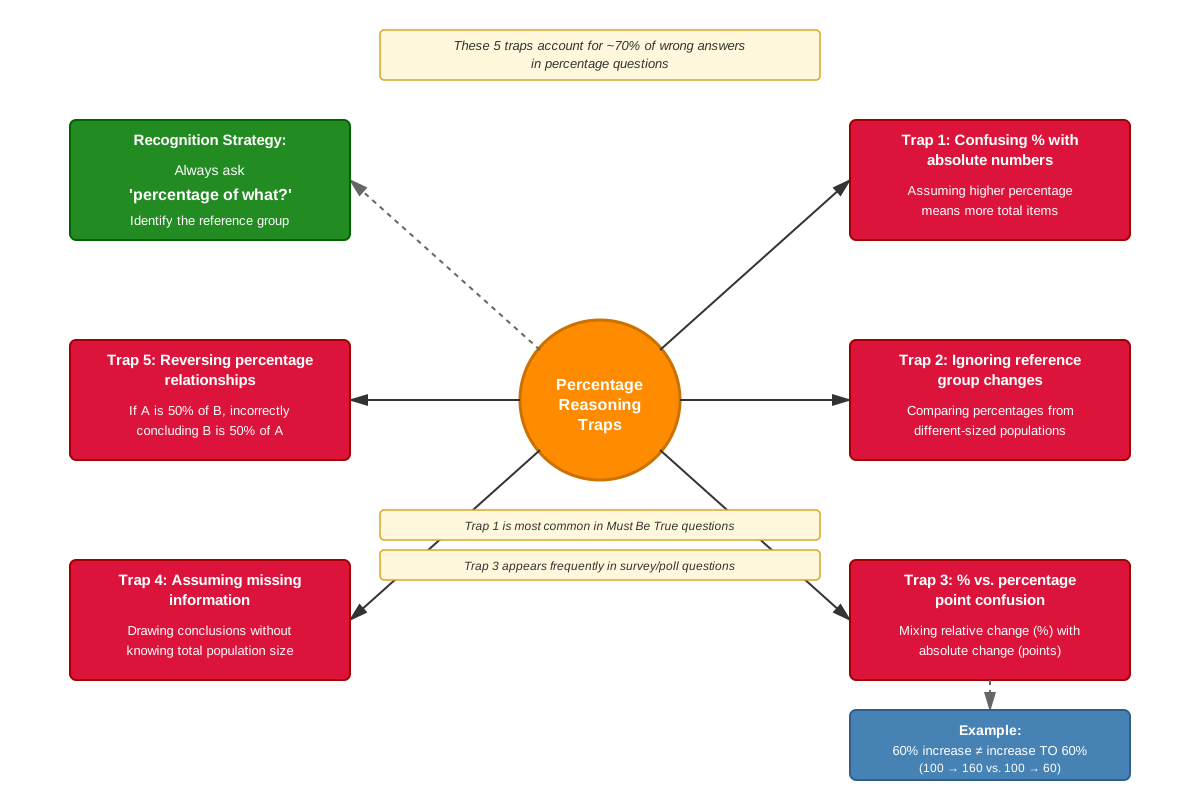
Mastering this topic is essential because percentage-based reasoning appears across multiple question types, including Must Be True questions, Most Strongly Supported questions, and even some Strengthen/Weaken questions where understanding the statistical foundation is crucial. The difficulty lies not in complex mathematics but in precise logical thinking: recognizing the difference between percentages and absolute numbers, understanding what reference group percentages describe, and avoiding the temptation to make unwarranted inferences that go beyond what the data actually establishes. Students who struggle with inference questions involving percentages often fall into predictable traps, such as confusing percentage increases with absolute increases or assuming that a higher percentage of a smaller group necessarily means more total members.
Within the broader landscape of Logical Reasoning, inference with percentages connects directly to fundamental skills in evidence evaluation, precise language interpretation, and the distinction between what is stated versus what is assumed. This topic reinforces the core LSAT principle that valid reasoning requires staying strictly within the bounds of given information while recognizing the logical implications that necessarily follow from that information.
Learning Objectives
- [ ] Identify how Inference with percentages appears in LSAT questions
- [ ] Explain the reasoning pattern behind Inference with percentages
- [ ] Apply Inference with percentages to solve LSAT-style problems accurately
- [ ] Distinguish between percentage values and absolute numerical values in logical arguments
- [ ] Recognize when insufficient information prevents drawing a valid inference about percentages
- [ ] Evaluate whether comparative percentage claims support conclusions about total quantities
- [ ] Identify common percentage-based reasoning errors in answer choices
Prerequisites
- Basic percentage concepts: Understanding what percentages represent (parts per hundred) is fundamental to interpreting statistical claims in stimulus passages.
- Proportional reasoning: The ability to recognize relationships between parts and wholes enables proper evaluation of percentage-based arguments.
- Must Be True question structure: Familiarity with inference question types provides the framework for applying percentage reasoning to actual LSAT questions.
- Distinction between necessary and sufficient conditions: This logical foundation helps determine what conclusions can and cannot be drawn from percentage data.
Why This Topic Matters
In real-world contexts, percentage-based reasoning appears constantly in policy debates, scientific research interpretation, business decisions, and legal arguments. Attorneys must evaluate statistical evidence in cases, assess survey data reliability, and identify when opposing counsel makes invalid inferences from numerical information. The ability to think precisely about percentages prevents costly errors in judgment and strengthens analytical credibility.
On the LSAT specifically, percentage-based inference questions appear in approximately 10-15% of Logical Reasoning questions across both sections, making this a high-yield topic that can significantly impact overall scores. These questions typically appear at medium to medium-high difficulty levels, serving as effective discriminators between average and high-scoring test-takers. The LSAT tests this concept because it directly measures the kind of precise analytical thinking required for legal reasoning.
Lsat inference with percentages questions commonly appear in several formats: stimulus passages presenting survey results with percentage breakdowns, comparative statistics about different time periods or populations, trend data showing percentage changes, and scenarios where percentage information about subgroups must be reconciled with information about the whole population. The test-makers deliberately craft answer choices that exploit common reasoning errors, making this topic particularly valuable for students aiming to avoid predictable traps.
Core Concepts
The Percentage-Absolute Number Distinction
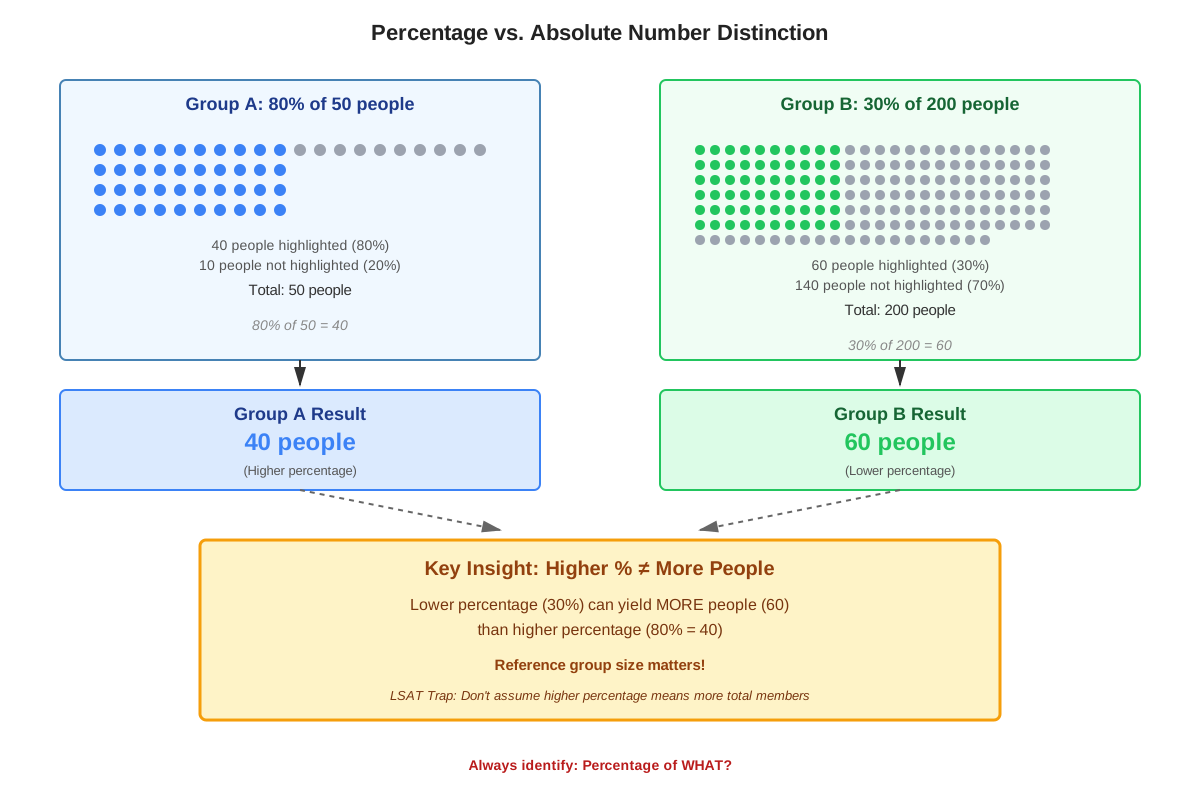
The most fundamental concept in inference with percentages involves recognizing that percentage values and absolute numerical values represent different types of information that cannot be directly equated. A percentage describes a proportion or ratio—a relationship between a part and its whole—while an absolute number describes a specific quantity. This distinction becomes critical when comparing groups of different sizes.
Consider this principle: If Group A has 80% of its members possessing a trait and Group B has 60% of its members possessing that same trait, we cannot conclude that Group A has more members with the trait in absolute terms unless we know the sizes of both groups. If Group A contains 10 members (8 with the trait) and Group B contains 100 members (60 with the trait), then Group B actually has more members with the trait despite having a lower percentage.
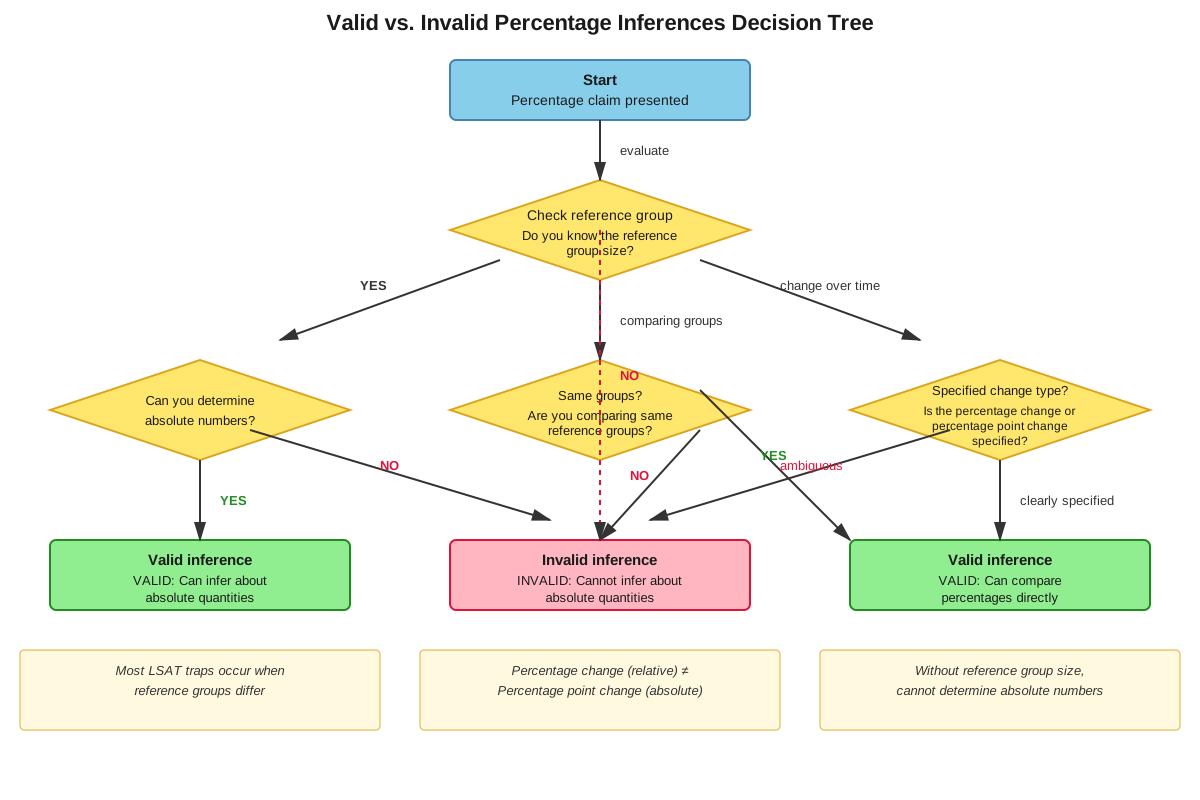
The LSAT exploits this distinction by presenting stimulus passages that provide percentage information while answer choices make claims about absolute numbers, or vice versa. Valid inferences require either having both types of information or carefully limiting conclusions to the type of information actually provided.
Reference Group Identification
Every percentage must be understood in relation to its reference group—the whole population or total from which the percentage is calculated. Misidentifying the reference group leads to invalid inferences. When a passage states "30% of doctors surveyed," the reference group is "doctors surveyed," not "all doctors" or "all medical professionals."
The LSAT frequently tests whether students can track shifting reference groups within a single passage. A stimulus might state: "Among voters who participated in the primary election, 45% supported Candidate X. Among all registered voters, 20% participated in the primary election." Here, the reference groups differ: the 45% refers to primary participants, while the 20% refers to all registered voters. Drawing conclusions about what percentage of all registered voters supported Candidate X requires combining these percentages correctly (45% of 20% = 9% of all registered voters).
Percentage Change vs. Percentage Point Change
A critical distinction that appears regularly involves the difference between a percentage change and a percentage point change. If a value increases from 20% to 30%, this represents:
- A 10 percentage point increase (30 - 20 = 10)
- A 50% increase relative to the original value (10/20 = 0.5 = 50%)
The LSAT tests whether students recognize which type of change is being described and which type of conclusion can be drawn. A passage might state that "support increased by 10 percentage points" while an incorrect answer choice claims "support increased by 10 percent," or vice versa. These represent fundamentally different claims.
Insufficient Information Recognition
Many percentage-based inference questions test the ability to recognize when insufficient information prevents drawing a definitive conclusion. This concept requires understanding what additional information would be necessary to support various inferences.
Common scenarios involving insufficient information include:
- Knowing percentages for subgroups but not their relative sizes
- Having percentage information for one time period but not another
- Possessing percentage data without knowing the total population size
- Understanding percentages for overlapping categories without knowing the degree of overlap
The correct answer in these cases often involves a carefully qualified statement that acknowledges the limits of what can be inferred, or it might be an answer choice stating that a particular conclusion cannot be determined from the given information.
Comparative Percentage Reasoning
When passages present percentage information about multiple groups, valid comparative reasoning requires careful attention to what comparisons the data actually supports. The LSAT frequently presents scenarios where:
| Given Information | Valid Inference | Invalid Inference |
|---|---|---|
| Group A: 70% have trait X; Group B: 40% have trait X | Higher proportion of Group A has trait X | Group A has more members with trait X |
| Last year: 30%; This year: 45% | Percentage increased by 15 points | Absolute number increased |
| 60% of Category 1 and 60% of Category 2 | Same proportion in each category | Categories have equal absolute numbers |
| 80% of those surveyed support policy | Most survey respondents support policy | Most of the total population supports policy |
Overlapping Categories and Percentages
Advanced percentage inference questions involve overlapping categories where individuals might belong to multiple groups simultaneously. If a passage states "60% of employees work remotely and 40% work in management," students cannot assume these are mutually exclusive categories. Some employees might be both remote workers and managers.
Valid inferences about overlapping categories require either explicit information about the overlap or careful logical reasoning about maximum and minimum possible overlaps. For instance, if 60% have trait A and 40% have trait B, the minimum overlap is 0% (if the groups are mutually exclusive) and the maximum overlap is 40% (the smaller group could be entirely contained within the larger group).
Percentage Distribution Across Categories
When a passage presents percentage breakdowns across multiple categories that should sum to 100%, this provides a complete distribution that enables certain inferences. If "among survey respondents, 35% strongly agreed, 40% somewhat agreed, 15% somewhat disagreed, and 10% strongly disagreed," the complete distribution allows inferences like "more respondents agreed than disagreed" (75% vs. 25%).
However, the LSAT tests whether students recognize when distributions are incomplete. If only some categories are mentioned, the remaining percentage is unaccounted for, limiting valid inferences about the complete picture.
Concept Relationships
The core concepts within inference with percentages build upon each other in a logical progression. Reference group identification serves as the foundation for all other concepts, since every percentage must be understood in relation to what it describes. This foundational understanding leads directly to the percentage-absolute number distinction, as recognizing the reference group clarifies what population the percentage describes and why this differs from absolute quantities.
The distinction between percentages and absolute numbers connects to comparative percentage reasoning, since valid comparisons require understanding whether we're comparing proportions (percentages) or quantities (absolute numbers). This comparison skill then extends to more complex scenarios involving overlapping categories, where multiple percentage values must be reconciled while accounting for potential overlap.
Insufficient information recognition represents a meta-concept that applies across all other concepts—it's the ability to recognize when any of the other reasoning patterns cannot be completed due to missing data. This connects back to prerequisite knowledge about necessary and sufficient conditions, as it requires understanding what information is necessary to support various conclusions.
The relationship map flows as follows:
Reference Group Identification → Percentage-Absolute Distinction → Comparative Reasoning → Overlapping Categories → Insufficient Information Recognition (which loops back to evaluate all previous steps)
Additionally, percentage change vs. percentage point change represents a specialized application of the percentage-absolute distinction, focusing specifically on how changes over time or between conditions should be interpreted.
High-Yield Facts
⭐ A higher percentage of a smaller group may represent fewer absolute members than a lower percentage of a larger group.
⭐ Percentages must always be interpreted relative to their specific reference group; changing the reference group changes the meaning.
⭐ Percentage point change and percentage change are different measures; a change from 20% to 30% is a 10 percentage point increase but a 50% increase.
⭐ Without knowing group sizes, percentage information alone cannot determine absolute numerical comparisons between groups.
⭐ When categories overlap, the sum of percentages across categories may exceed 100% of the total population.
- If 60% have trait A and 40% have trait B, the overlap could range from 0% (mutually exclusive) to 40% (complete containment of B within A).
- A percentage increase in one subgroup does not necessarily indicate a percentage increase in the total population.
- Survey percentages describe only the surveyed population, not necessarily the broader population from which the survey was drawn.
- Knowing the percentage of A that is B does not provide information about the percentage of B that is A without additional data.
- When a passage provides percentages for some but not all categories, the unmentioned categories prevent certain inferences about the complete distribution.
- A statement that "most" or "majority" means more than 50%, which is distinct from "plurality" (more than any other single category but not necessarily more than 50%).
- Percentage data from different time periods can only be compared if the reference groups remain consistent across those periods.
Quick check — test yourself on Inference with percentages so far.
Try Flashcards →Common Misconceptions
Misconception: If Group A has a higher percentage than Group B, then Group A has more members in absolute terms.
Correction: Percentages describe proportions, not quantities. A higher percentage of a smaller group may represent fewer actual members than a lower percentage of a larger group. Valid comparison of absolute numbers requires knowing both the percentages and the group sizes.
Misconception: If 60% of Category X belongs to Group A and 40% of Category Y belongs to Group A, then more of Category X belongs to Group A in absolute terms.
Correction: Without knowing the relative sizes of Category X and Category Y, no conclusion about absolute numbers can be drawn. If Category Y is much larger than Category X, it could have more members in Group A despite the lower percentage.
Misconception: When a value increases from 25% to 50%, this represents a 25% increase.
Correction: This represents a 25 percentage point increase, but a 100% increase in relative terms (the value doubled). The LSAT carefully distinguishes between these two types of change, and answer choices often exploit confusion between them.
Misconception: If 70% of surveyed individuals support a policy, then 70% of the total population supports that policy.
Correction: Survey results describe only the surveyed sample, not necessarily the broader population. The surveyed group might not be representative of the total population due to sampling methods, response rates, or other factors.
Misconception: If 80% of Group A has trait X and 60% of Group A has trait Y, then 140% of Group A has at least one of these traits.
Correction: Percentages of overlapping categories cannot simply be added. Some members might have both traits, so the actual percentage with at least one trait could range from 80% (if all Y members are also X members) to 100% (if the groups overlap minimally).
Misconception: Percentage information alone is sufficient to determine trends in absolute numbers over time.
Correction: A percentage can increase while absolute numbers decrease if the reference group (total population) is shrinking. For example, 30% of 1000 (300) is more than 40% of 500 (200), even though 40% is a higher percentage.
Worked Examples
Example 1: Comparing Percentages Across Different-Sized Groups
Stimulus: In City A, 15% of residents use public transportation daily. In City B, 8% of residents use public transportation daily. City A has a population of 200,000, while City B has a population of 500,000.
Question: Which of the following must be true based on the information above?
Answer Choices:
(A) More residents of City A use public transportation daily than residents of City B.
(B) City A has better public transportation infrastructure than City B.
(C) More residents of City B use public transportation daily than residents of City A.
(D) The percentage of residents using public transportation in City A is nearly double that in City B.
(E) Both cities have similar absolute numbers of daily public transportation users.
Solution Process:
Step 1: Identify what information is provided—percentages and total populations for both cities.
Step 2: Calculate absolute numbers:
- City A: 15% of 200,000 = 0.15 × 200,000 = 30,000 daily users
- City B: 8% of 500,000 = 0.08 × 500,000 = 40,000 daily users
Step 3: Evaluate each answer choice:
(A) Claims City A has more users in absolute terms. Our calculation shows City A has 30,000 while City B has 40,000, so this is false.
(B) Makes a claim about infrastructure quality, which is not addressed by the numerical data provided. This goes beyond what can be inferred.
(C) Claims City B has more users in absolute terms. Our calculation confirms this: 40,000 > 30,000. This must be true.
(D) Claims the percentage in City A is nearly double that in City B. While 15% is higher than 8%, it's not nearly double (double would be 16%). This is imprecise and not the best answer.
(E) Claims similar absolute numbers. The difference between 30,000 and 40,000 is substantial (10,000 users or a 33% difference), so this is false.
Correct Answer: (C)
Key Takeaway: This example demonstrates the critical percentage-absolute number distinction. Despite City A having a higher percentage, City B's larger population means it has more daily users in absolute terms. The LSAT tests whether students will be misled by the higher percentage into selecting answer (A).
Example 2: Insufficient Information About Overlapping Categories
Stimulus: A survey of 500 employees at a technology company found that 60% work on software development projects and 45% have management responsibilities. All surveyed employees work on at least one project or have management responsibilities.
Question: Based on the information above, which of the following could be true?
Answer Choices:
(A) Exactly 25% of employees both work on software development and have management responsibilities.
(B) No employees both work on software development and have management responsibilities.
(C) All employees with management responsibilities also work on software development.
(D) More than 300 employees work exclusively on software development without management responsibilities.
(E) Fewer than 100 employees have management responsibilities without working on software development.
Solution Process:
Step 1: Identify the reference group and percentages:
- Total surveyed: 500 employees
- Software development: 60% = 300 employees
- Management: 45% = 225 employees
- All employees fall into at least one category
Step 2: Determine the possible range of overlap. Since all employees must be in at least one category, we can use the principle that:
- Maximum overlap: 225 employees (all management employees also do software development)
- Minimum overlap: 300 + 225 - 500 = 25 employees (to avoid exceeding 500 total)
Step 3: Evaluate each answer choice:
(A) Claims exactly 25% (125 employees) overlap. This falls within the possible range (25 to 225), so this could be true.
(B) Claims no overlap. This would mean 300 + 225 = 525 employees, but only 500 were surveyed. This violates the constraint and cannot be true.
(C) Claims all 225 management employees also do software development (maximum overlap scenario). This is within the possible range and could be true.
(D) Claims more than 300 work exclusively on software development. If more than 300 work exclusively on software development, plus 225 have management responsibilities, this would exceed 500 total employees (even with no overlap). This cannot be true.
(E) Claims fewer than 100 have management responsibilities without software development. If the overlap is 126 or more, then 225 - 126 = 99 or fewer have management only. Since overlap can range up to 225, this could be true.
Correct Answers: (A), (C), and (E) could all be true, but the question asks which "could be true," so any of these would be acceptable. The question format would typically present only one correct answer, likely (C) as it represents a boundary case.
Key Takeaway: This example illustrates overlapping categories and the importance of recognizing when multiple scenarios are consistent with the given information. The LSAT tests whether students can identify the range of possibilities rather than assuming a single interpretation.
Exam Strategy
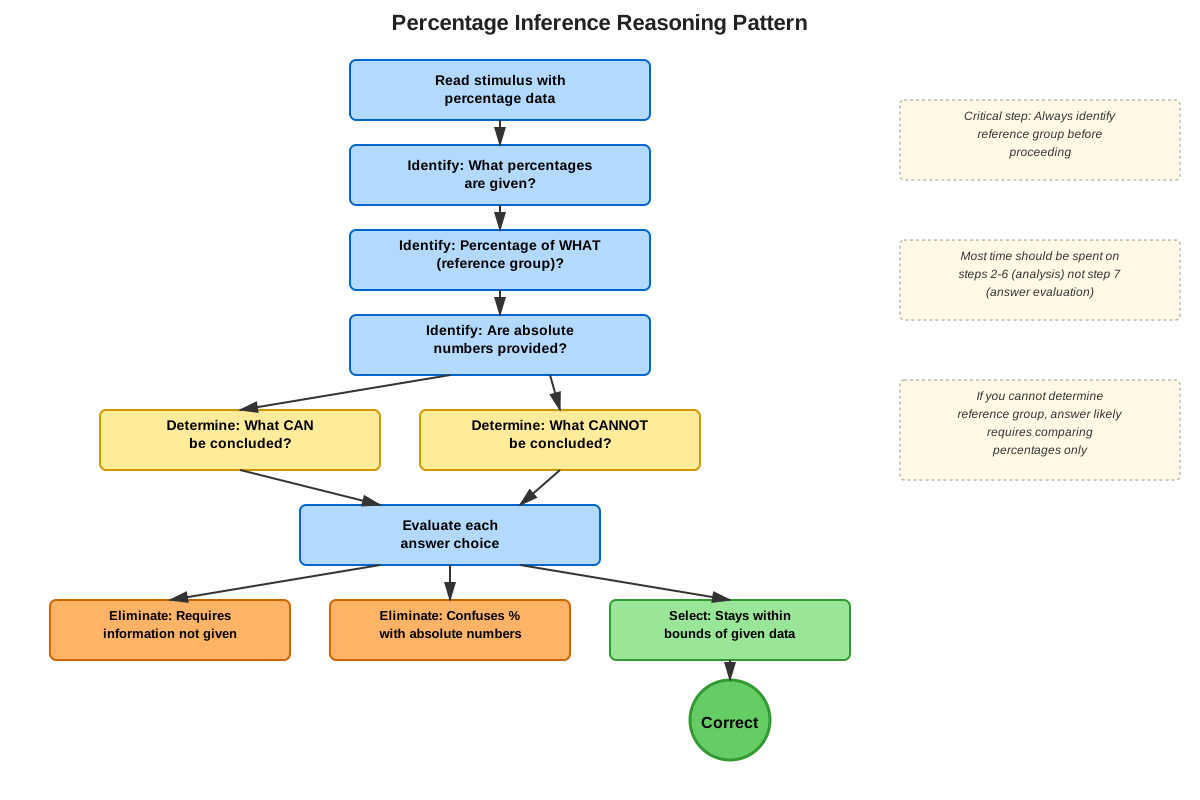
When approaching lsat inference with percentages questions, begin by identifying all percentage values and their reference groups. Underline or circle each percentage and note what population it describes. This prevents confusion when multiple percentages appear in a single stimulus.
Trigger words and phrases that signal percentage-based reasoning include: "percent," "percentage," "proportion," "ratio," "fraction," "most," "majority," "minority," "survey found," "of those surveyed," "among respondents," "increased by," "decreased by," "more than," "fewer than," and "compared to." When these appear, immediately activate careful quantitative reasoning.
For process of elimination, systematically eliminate answer choices that:
- Confuse percentages with absolute numbers
- Change the reference group without justification
- Assume information about group sizes when none is provided
- Confuse percentage change with percentage point change
- Make claims about populations beyond those described in the stimulus
- Assume categories are mutually exclusive when overlap is possible
Time allocation: Spend 15-20 seconds carefully reading the stimulus to identify all percentage information and reference groups. Spend 5-10 seconds on the question stem to understand what type of inference is required. Allocate 30-40 seconds to evaluate answer choices systematically. If a question requires calculation, perform it quickly but accurately—the LSAT rarely requires complex math, usually just basic multiplication or addition.
Exam Tip: When a stimulus provides percentages without absolute numbers, be immediately suspicious of answer choices that make claims about absolute quantities. Conversely, when absolute numbers are provided without percentages, be wary of answer choices making percentage claims.
Create a mental checklist for each question: (1) What percentages are given? (2) What are the reference groups? (3) Are absolute numbers provided? (4) What type of inference does the question ask for? (5) What information is missing that would be needed for certain conclusions?
Memory Techniques
Mnemonic for key principles: PRANG
- Percentages need reference groups
- Ratio vs. absolute distinction
- Add percentages only for mutually exclusive categories
- No assumptions about missing information
- Group size matters for absolute comparisons
Visualization strategy: Picture percentages as slices of differently-sized pies. A larger slice (higher percentage) of a small pie might contain less actual pie than a smaller slice (lower percentage) of a large pie. This mental image reinforces the percentage-absolute distinction.
Acronym for overlapping categories: MOMO (Minimum-Overlap, Maximum-Overlap)
- Minimum overlap = sum of percentages - 100% (if positive)
- Maximum overlap = smaller of the two percentages
Memory phrase: "Percentages describe proportions, not populations." Repeat this when evaluating answer choices to maintain focus on what percentages actually tell us.
Calculation shortcut: For percentage point vs. percentage change, remember "Points are simple subtraction; percent is relative to the original." If something goes from 20% to 30%, the point change is 30 - 20 = 10 points, but the percent change is 10/20 = 50%.
Summary
Inference with percentages represents a high-yield LSAT topic that tests precise quantitative reasoning within logical arguments. The fundamental principle underlying all percentage-based inference questions is that percentages describe proportions relative to specific reference groups, not absolute quantities. Valid inferences require careful attention to what information is provided versus what information would be necessary to support various conclusions. The most common reasoning patterns involve distinguishing percentages from absolute numbers, identifying reference groups, recognizing insufficient information, understanding overlapping categories, and differentiating percentage change from percentage point change. Success on these questions requires resisting intuitive but invalid inferences, such as assuming higher percentages always mean larger absolute numbers or that percentages from different reference groups can be directly compared. The LSAT deliberately crafts answer choices that exploit these common errors, making systematic evaluation essential. Students who master this topic gain a significant advantage, as percentage-based reasoning appears frequently across multiple question types and difficulty levels, serving as an effective discriminator between average and high-scoring test-takers.
Key Takeaways
- Percentages represent proportions relative to specific reference groups, not absolute quantities; always identify what population each percentage describes
- A higher percentage of a smaller group may represent fewer absolute members than a lower percentage of a larger group
- Percentage point change (simple subtraction) differs fundamentally from percentage change (relative to the original value)
- Without information about group sizes, percentage data alone cannot support conclusions about absolute numerical comparisons
- When categories can overlap, percentages cannot simply be added; the sum may exceed 100% of the total population
- Valid inferences must stay strictly within the bounds of provided information; recognize when insufficient data prevents drawing definitive conclusions
- Survey percentages describe only the surveyed sample, not necessarily the broader population from which the sample was drawn
Related Topics
Inference with Rates and Ratios: Building on percentage reasoning, this topic explores how rates (quantities per unit time) and ratios (relationships between quantities) function in logical arguments, requiring similar precision about reference points and the distinction between relative and absolute measures.
Causal Reasoning with Statistical Evidence: Mastering percentage-based inference provides the foundation for evaluating whether statistical correlations support causal claims, a frequent LSAT pattern that combines quantitative reasoning with causal logic.
Necessary vs. Sufficient Conditions in Quantitative Contexts: Understanding how percentages interact with conditional logic—such as when "most" (>50%) creates sufficient conditions or when percentage thresholds establish necessary conditions—extends both percentage reasoning and conditional logic skills.
Flaw Questions Involving Statistical Reasoning: Many flaw questions identify errors in percentage-based reasoning, making mastery of valid percentage inference essential for recognizing common statistical fallacies.
Practice CTA
Now that you've mastered the core concepts of inference with percentages, it's time to cement your understanding through active practice. Attempt the practice questions associated with this topic, focusing on applying the systematic approach outlined in the exam strategy section. Pay special attention to identifying reference groups and distinguishing percentages from absolute numbers in each question. Review the flashcards to reinforce high-yield facts and common misconceptions. Remember that percentage-based reasoning is a skill that improves dramatically with deliberate practice—each question you work through strengthens your ability to spot the reasoning patterns and avoid common traps. Your investment in mastering this high-yield topic will pay dividends across multiple questions on test day.
Sign up free to keep reading
Create a free AnvayaPrep account to finish this LSAT guide on Inference with percentages — plus flashcards and practice questions.