Overview
Inference with surveys represents a critical category within LSAT Logical Reasoning sections, appearing regularly in inference questions that test a student's ability to draw valid conclusions from survey data and polling information. Survey-based stimuli present unique challenges because they require test-takers to navigate between what the data actually shows versus what people commonly (but incorrectly) assume survey results demonstrate. These questions assess whether students can distinguish between correlation and causation, recognize sampling limitations, understand response rate implications, and avoid overextending conclusions beyond what the survey data legitimately supports.
The LSAT frequently uses survey scenarios because they mirror real-world reasoning patterns that lawyers encounter daily—evaluating evidence, assessing the strength of claims, and identifying logical gaps in arguments. Survey questions test multiple reasoning skills simultaneously: understanding statistical concepts, recognizing scope limitations, identifying necessary versus sufficient conditions, and detecting subtle shifts between what respondents say versus what they actually do or believe. Mastering LSAT inference with surveys requires developing a disciplined approach to reading survey data literally and resisting the temptation to import outside assumptions or common-sense inferences that aren't logically warranted by the stimulus.
Within the broader landscape of Logical Reasoning, inference questions with surveys connect to fundamental skills like identifying assumptions, recognizing flaws in reasoning, and understanding conditional logic. Survey questions often combine elements from multiple question types—they may require identifying what must be true (pure inference), what the data fails to establish (weaken/flaw), or what additional information would strengthen a conclusion (strengthen/assumption). This interconnectedness makes survey inference questions particularly valuable for developing comprehensive LSAT reasoning skills that transfer across question types.
Learning Objectives
- [ ] Identify how Inference with surveys appears in LSAT questions
- [ ] Explain the reasoning pattern behind Inference with surveys
- [ ] Apply Inference with surveys to solve LSAT-style problems accurately
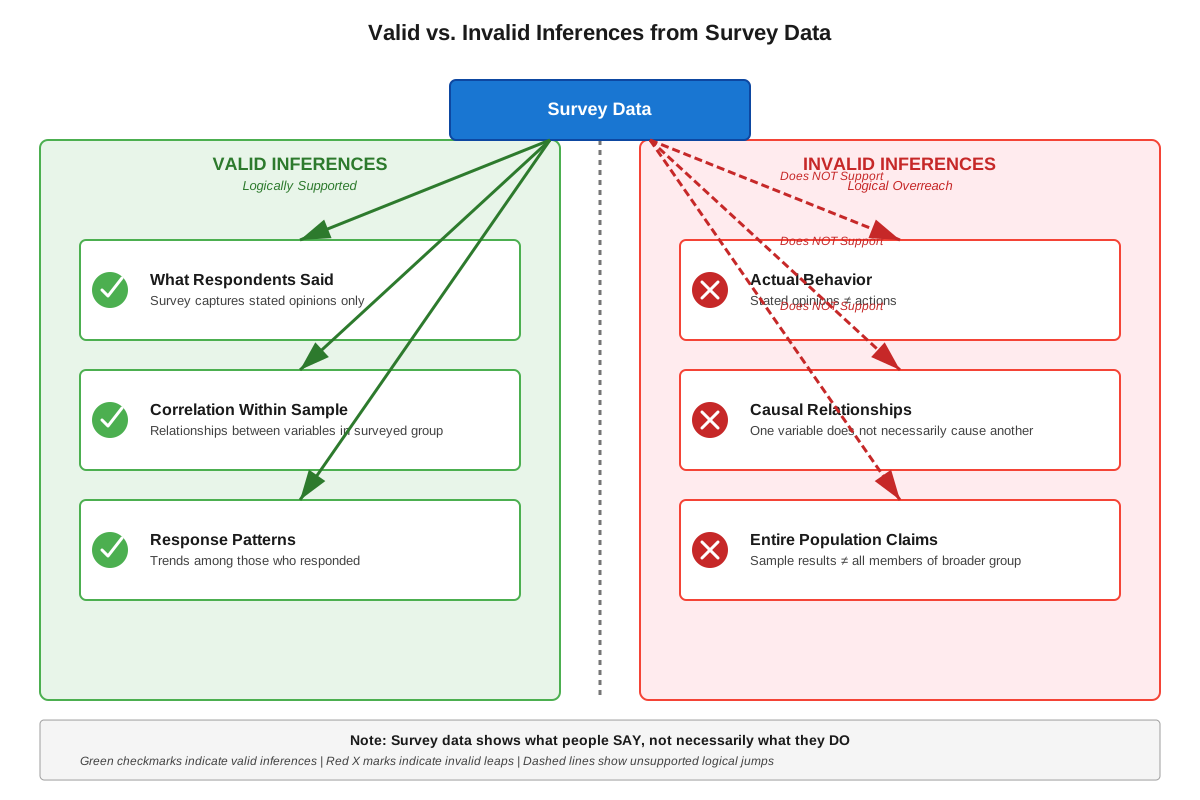
- [ ] Distinguish between valid and invalid inferences from survey data
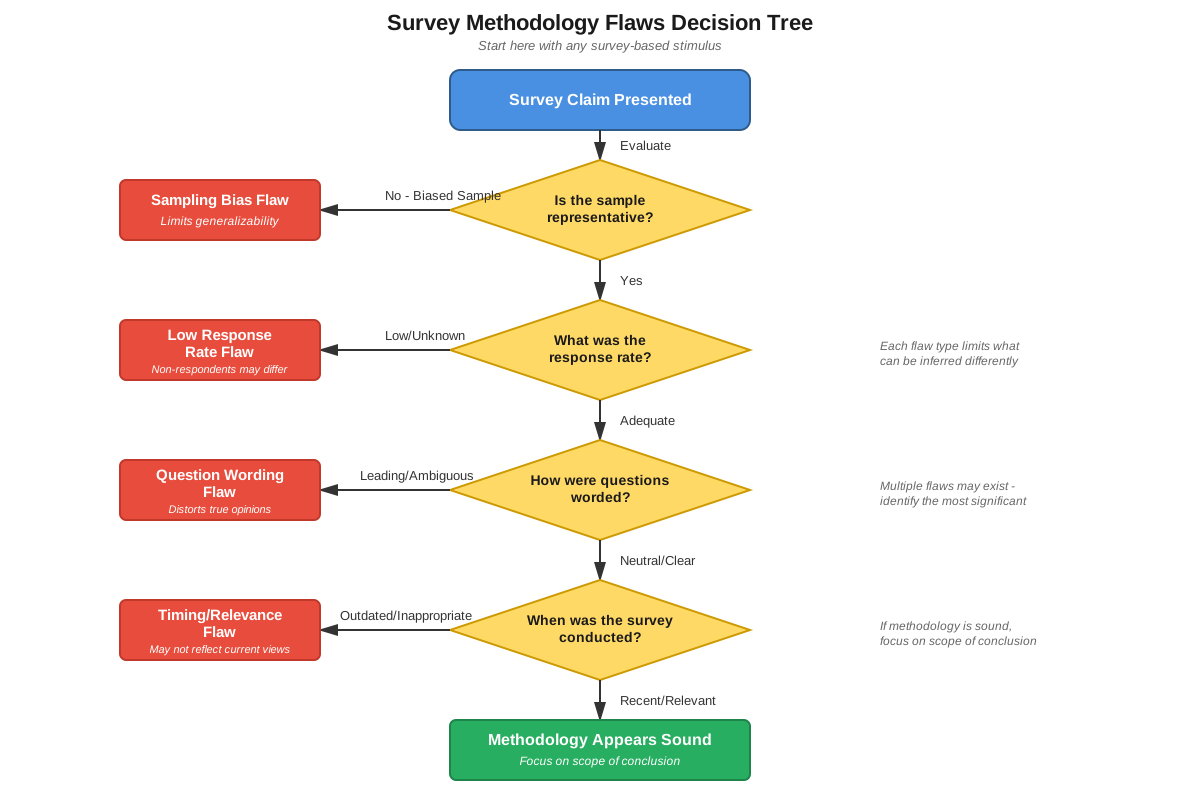
- [ ] Recognize common survey methodology flaws that limit inference scope
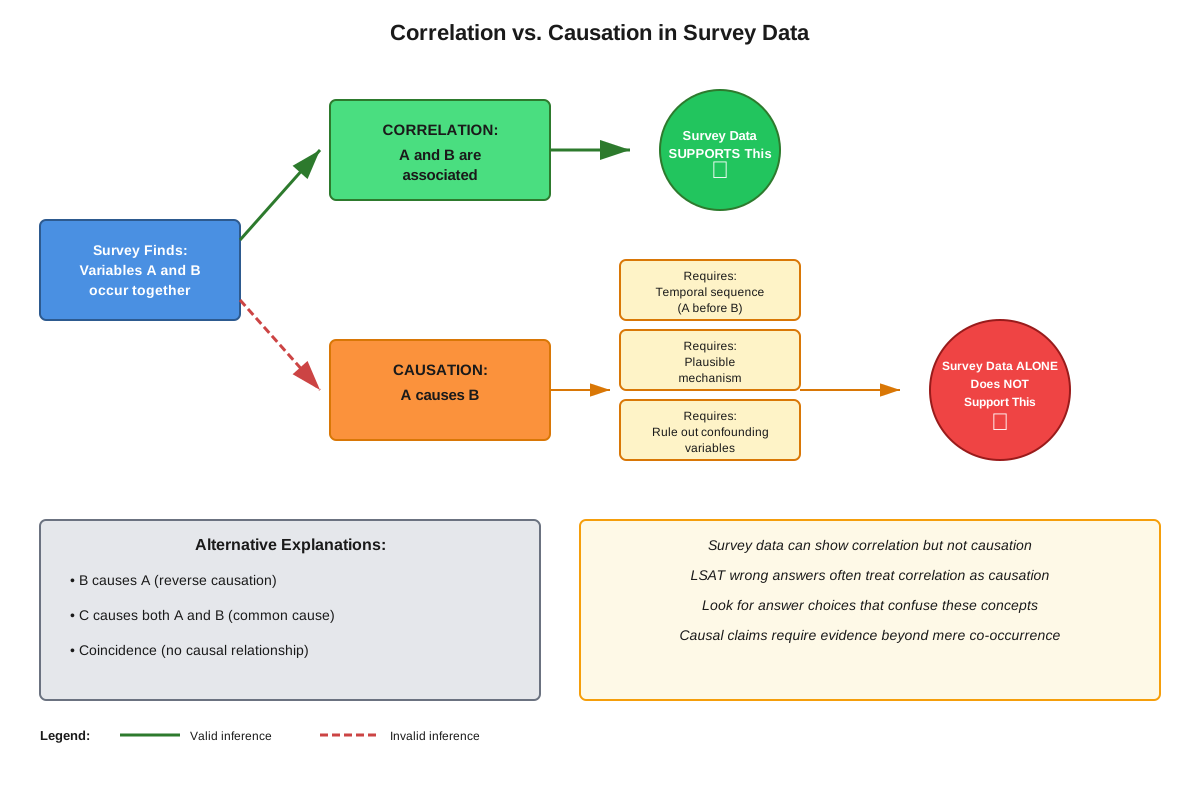
- [ ] Evaluate whether survey results support causal versus correlational claims
- [ ] Identify when survey response data conflicts with actual behavior or beliefs
Prerequisites
- Basic conditional logic: Understanding "if-then" relationships is essential because survey questions often involve conditional claims about what the data does or doesn't establish
- Distinction between necessary and sufficient conditions: Survey data may provide evidence for one type of condition but not the other, and recognizing this distinction prevents overextending conclusions
- Understanding of argument structure: Identifying premises and conclusions helps parse what the survey data actually shows versus what the stimulus claims it demonstrates
- Familiarity with scope limitations: Recognizing when evidence applies to a limited group versus a broader population is fundamental to avoiding overgeneralization errors
Why This Topic Matters
Survey-based reasoning appears throughout legal practice, from evaluating expert testimony to assessing public opinion evidence to analyzing statistical claims in litigation. Lawyers must constantly evaluate whether data supports the conclusions drawn from it, making survey inference questions highly relevant to the skills the LSAT aims to measure. The ability to critically analyze survey methodology, recognize sampling biases, and distinguish between what data shows versus what it suggests represents core analytical competencies for legal reasoning.
On the LSAT, survey-based questions appear in approximately 15-20% of Logical Reasoning sections, making them a high-frequency topic that significantly impacts overall scores. These questions appear across multiple question types, including Must Be True (pure inference), Most Strongly Supported, Flaw, Assumption, Strengthen, and Weaken questions. The versatility of survey stimuli means that mastering this topic provides returns across numerous question formats.
Survey questions typically appear in several common formats: (1) polls showing what percentage of respondents believe or prefer something, (2) studies comparing two groups with different characteristics or behaviors, (3) longitudinal surveys tracking changes over time, (4) surveys with low response rates or self-selected samples, and (5) surveys measuring stated preferences versus actual behavior. Each format presents characteristic inference traps that test-takers must learn to recognize and avoid.
Core Concepts
Understanding Survey Scope and Sampling
The foundation of valid survey inference lies in understanding sampling methodology and recognizing that survey results only directly support conclusions about the surveyed population. When a survey samples 500 residents of City X, the results tell us something definitive about those 500 people, something probable (with quantifiable confidence) about all City X residents if the sample was random and representative, but nothing certain about residents of other cities or populations with different characteristics.
The LSAT exploits common errors in extending survey conclusions beyond their legitimate scope. A survey of college students cannot support definitive claims about all adults. A survey of people who voluntarily responded to a magazine questionnaire cannot support claims about the general population because self-selected samples introduce systematic bias—people who choose to respond likely differ in relevant ways from those who don't.
Response rates critically affect what inferences surveys support. If 10,000 surveys were distributed and only 200 returned, the 2% response rate means we know something definitive about those 200 respondents, but we cannot validly infer that the broader population shares their views. The 9,800 non-respondents might hold systematically different opinions, and we have no data about them. The LSAT frequently presents low-response-rate scenarios where the stimulus or answer choices attempt to generalize from the responding minority to the entire surveyed population.
Stated Preferences Versus Actual Behavior
A critical distinction in survey reasoning involves recognizing that what people say they do, believe, or prefer may differ from their actual behavior or beliefs. Survey responses reflect self-reported data, which can be inaccurate due to social desirability bias (respondents answering in ways they perceive as socially acceptable), recall errors (people misremembering their past behavior), or intention-behavior gaps (people genuinely intending to act one way but actually acting differently).
When a survey shows that 70% of respondents say they recycle regularly, this establishes that 70% claim to recycle regularly—it does not establish that 70% actually do recycle regularly. The LSAT tests whether students recognize this distinction by presenting answer choices that shift from reported behavior to actual behavior, or vice versa. Valid inferences must maintain the same level of abstraction as the survey data: if the survey measured stated preferences, conclusions must be about stated preferences, not actual behavior.
Correlation Versus Causation in Survey Data
Survey data frequently reveals correlations—two variables that occur together or change together—but correlation alone never establishes causation. When a survey shows that people who exercise regularly report higher life satisfaction, this correlation supports several possible explanations: (1) exercise causes increased satisfaction, (2) higher satisfaction causes people to exercise more, (3) some third factor (like better health, more free time, or higher income) causes both exercise and satisfaction, or (4) the correlation is coincidental.
The LSAT tests whether students inappropriately infer causal relationships from correlational survey data. Valid inferences from correlational data must be phrased carefully: "People who exercise regularly tend to report higher satisfaction" is valid, while "Exercise increases life satisfaction" assumes a causal direction not established by correlation alone. Answer choices often present causal language ("causes," "leads to," "results in," "produces") that goes beyond what correlational survey data supports.
Comparative Claims and Survey Design
When surveys compare two groups, valid inferences depend on whether the comparison controls for relevant variables. If a survey shows that people who drink coffee daily score higher on memory tests than non-coffee drinkers, this comparison supports the conclusion that coffee drinkers scored higher in this sample. However, it does not establish that coffee improves memory unless the study controlled for other relevant factors (age, education, overall health, sleep quality, etc.) that might explain the difference.
The LSAT presents comparative survey scenarios where answer choices attempt to draw causal conclusions from simple correlational comparisons. Valid inferences must acknowledge alternative explanations: "Coffee drinkers in the survey scored higher on memory tests" is supported, while "Coffee improves memory" requires additional evidence ruling out confounding variables.
Temporal Relationships in Survey Data
Surveys conducted at different time points can show changes over time, but interpreting these changes requires careful attention to what specifically changed. If a survey shows that 60% of residents supported Policy X in 2020 and 40% supported it in 2022, this establishes that support decreased among surveyed residents. However, it does not necessarily establish that individual people changed their minds—the population composition might have changed (different people living in the area), or different people might have responded to each survey.
Longitudinal survey data supports conclusions about aggregate changes but not necessarily about individual-level changes unless the same individuals were surveyed both times. The LSAT tests whether students recognize this distinction by presenting answer choices that shift between population-level and individual-level claims.
Absolute Versus Relative Claims
Survey data often supports relative claims (comparisons between groups or time periods) but not absolute claims (definitive statements about magnitude or importance). If 65% of respondents prefer Brand A over Brand B, this establishes that more respondents prefer Brand A—it does not establish that Brand A is objectively better, that the preference is strong, or that people would actually purchase Brand A when making real buying decisions.
The distinction between "most respondents prefer X" (supported by 51%+ choosing X) and "respondents strongly prefer X" (requiring additional evidence about preference intensity) frequently appears in LSAT answer choices. Valid inferences must match the specificity and strength of the survey data.
Concept Relationships
The core concepts in survey inference questions form an interconnected web of reasoning principles. Sampling methodology determines the legitimate scope of conclusions, which in turn affects whether comparative claims can be extended beyond the surveyed population. The distinction between stated preferences and actual behavior connects to broader LSAT themes about evidence types and their limitations—similar to how witness testimony about intentions differs from evidence of actual actions.
Correlation versus causation represents a specific application of the general principle that evidence can support multiple explanations, connecting survey questions to assumption and flaw questions where identifying alternative explanations is crucial. This concept also links to comparative claims, since comparisons often reveal correlations that test-takers must avoid interpreting causally without additional evidence.
Temporal relationships in survey data connect to conditional logic concepts—just because X preceded Y doesn't mean X caused Y, similar to how affirming the consequent represents invalid conditional reasoning. The relationship flows: Survey Methodology → Determines Valid Scope → Limits Comparative Claims → Affects Correlation/Causation Inferences → Constrains Temporal Conclusions → All filtered through Stated vs. Actual Behavior distinction.
These survey-specific concepts build on prerequisite knowledge of argument structure (identifying what the evidence actually says versus what conclusions are drawn) and scope limitations (recognizing when evidence applies to a subset versus a whole). Mastering survey inference enables progression to more complex Logical Reasoning topics like evaluating statistical arguments, assessing scientific study designs, and analyzing expert testimony—all of which involve similar evidence evaluation principles.
Quick check — test yourself on Inference with surveys so far.
Try Flashcards →High-Yield Facts
⭐ Survey results definitively establish facts only about the actual respondents, not necessarily about the broader population or non-respondents
⭐ Low response rates severely limit the validity of generalizing survey results to the entire surveyed population
⭐ Correlation between two variables in survey data never, by itself, establishes that one causes the other
⭐ What survey respondents say they do, believe, or prefer may differ from their actual behavior or beliefs
⭐ Survey data showing that Group A has more of characteristic X than Group B does not establish that X causes the difference between groups
- Self-selected survey samples (voluntary respondents) cannot support valid inferences about populations that didn't choose to respond
- Surveys measuring stated preferences or intentions cannot support definitive conclusions about actual behavior or future actions
- Comparative survey data requires controlling for confounding variables before supporting causal conclusions
- Temporal correlation (X increased before Y increased) does not establish causal direction without additional evidence
- Survey results showing "most respondents" prefer something (51%) differ significantly from results showing "overwhelming majority" (requiring much higher percentages)
- Changes in aggregate survey results over time don't necessarily mean individual respondents changed their views—population composition may have changed
- Survey questions with leading language, ambiguous terms, or limited response options may not accurately capture respondents' true views
- Representative sampling requires that the sample mirrors the relevant characteristics of the target population
Common Misconceptions
Misconception: If a survey shows most respondents believe X, then X is probably true → Correction: Survey results establish what respondents believe, not whether those beliefs are accurate. Majority opinion doesn't determine factual truth—most people could share an incorrect belief.
Misconception: A survey with a large number of respondents (e.g., 5,000 people) automatically supports valid generalizations regardless of response rate → Correction: Absolute numbers matter less than response rate and sampling methodology. 5,000 respondents from a self-selected sample of 500,000 contacted (1% response rate) cannot support valid generalizations about the 495,000 non-respondents.
Misconception: If Survey A shows coffee drinkers are healthier and Survey B shows coffee drinkers exercise more, combining these surveys proves coffee causes better health → Correction: Even multiple correlational surveys don't establish causation. The combined data might suggest exercise (not coffee) causes better health, or that a third factor causes all three variables.
Misconception: Survey data showing a correlation between X and Y means that X probably causes Y, even if we can't be certain → Correction: Correlation provides zero evidence about causal direction. X could cause Y, Y could cause X, or Z could cause both. Without additional evidence ruling out alternatives, no causal direction is "more probable" than others.
Misconception: If a survey shows 60% of respondents prefer Brand A, this means Brand A is objectively better than alternatives → Correction: Preference data establishes subjective opinions, not objective quality. Preferences reflect respondent tastes, which may be based on factors unrelated to objective quality (familiarity, marketing, price, etc.).
Misconception: Longitudinal surveys showing that support for Policy X decreased from 70% to 50% establish that individual people changed their minds → Correction: Aggregate changes can result from population turnover rather than individual opinion changes. Different people may have responded to each survey, or population composition may have shifted.
Worked Examples
Example 1: Response Rate and Sampling
Stimulus: A consumer magazine mailed satisfaction surveys to 50,000 recent car buyers. Of the 2,000 surveys returned, 75% of respondents reported being "very satisfied" with their purchase. The magazine concluded that approximately 75% of recent car buyers are very satisfied with their purchases.
Question: Which of the following identifies a flaw in the magazine's reasoning?
Analysis Process:
- Identify the survey methodology: 50,000 surveys mailed, 2,000 returned = 4% response rate
- Determine what the data definitively establishes: 75% of the 2,000 respondents reported high satisfaction
- Identify the conclusion: The magazine generalizes this 75% figure to all recent car buyers
- Recognize the logical gap: The 48,000 non-respondents might have systematically different satisfaction levels
- Apply the core concept: Low response rates prevent valid generalization because self-selected respondents likely differ from non-respondents
Valid inference: 75% of survey respondents reported high satisfaction
Invalid inference: 75% of all recent car buyers are highly satisfied
Correct answer reasoning: The flaw is assuming that the 4% who chose to respond are representative of all car buyers. People who are very satisfied might be more motivated to return surveys, meaning the 75% figure likely overestimates overall satisfaction. The magazine treats a self-selected sample as though it were a representative random sample.
Connection to learning objectives: This example demonstrates how to identify survey methodology flaws (response rate issues) and distinguish between valid inferences (about respondents) and invalid inferences (about the broader population).
Example 2: Stated Preference Versus Behavior
Stimulus: A university survey asked 1,000 students whether they support increasing student activity fees to fund expanded recreational facilities. 68% of respondents indicated they would support such an increase. The university administration concluded that a referendum to increase fees would likely pass if put to a student vote.
Question: Which of the following, if true, most weakens the administration's conclusion?
Analysis Process:
- Identify what the survey measured: Stated support for fee increases in a survey context
- Identify the conclusion: The administration predicts actual voting behavior based on stated survey support
- Recognize the reasoning pattern: Inferring actual behavior from stated preferences
- Apply the core concept: Stated preferences may differ from actual behavior, especially when real consequences are involved
- Evaluate answer choices: Look for evidence that stated survey support doesn't predict actual voting behavior
Valid inference: 68% of surveyed students stated they support fee increases
Invalid inference: 68% of students will vote for fee increases in an actual referendum
Correct answer reasoning: The strongest weakener would establish that stated survey support doesn't translate to actual voting behavior—for example: "Previous university referendums on fee increases have consistently failed despite surveys showing majority support, as students who oppose increases vote at much higher rates than supporters." This answer reveals that the gap between stated preference and actual behavior is systematic and predictable in this context.
Alternative strong weakener: "Students responding to hypothetical survey questions about fee increases typically overestimate their willingness to pay more when faced with actual fee increase decisions." This directly addresses the stated-preference-versus-behavior gap.
Connection to learning objectives: This example illustrates how to recognize when survey data about stated preferences cannot support conclusions about actual behavior, and how to apply this reasoning pattern to weaken arguments that make this inferential leap.
Exam Strategy
When approaching LSAT questions involving surveys, implement a systematic reading strategy that focuses on methodology before conclusions. First, identify exactly what population was surveyed, how many responded, and what the response rate was. Circle or mentally note any indication of self-selection (voluntary response, magazine readers, website visitors) versus random sampling. These methodological details determine what inferences the data can legitimately support.
Trigger phrases that signal survey questions include: "poll," "survey," "questionnaire," "study," "respondents," "percentage of those surveyed," "X% reported that," "when asked," and "indicated that." When you encounter these phrases, immediately shift to survey-analysis mode, focusing on scope limitations and the stated-versus-actual distinction.
Read survey stimuli with extreme literalism. If the stimulus says "60% of respondents reported exercising regularly," mentally translate this to "60% of respondents said they exercise regularly" to maintain awareness that this is self-reported data. This translation helps prevent the automatic assumption that reported behavior equals actual behavior.
For process of elimination, systematically eliminate answer choices that:
- Extend conclusions beyond the surveyed population without justification
- Treat correlation as causation
- Confuse stated preferences with actual behavior
- Ignore response rate problems
- Make absolute claims when the survey only supports relative claims
- Assume non-respondents share respondents' characteristics
Time allocation: Survey questions typically require 60-90 seconds. Spend 20-30 seconds on careful stimulus reading (identifying methodology and scope), 10-15 seconds predicting the logical gap or valid inference, and 30-45 seconds evaluating answer choices. Don't rush the initial reading—methodological details are crucial and easy to miss when reading too quickly.
When stuck between two answer choices, return to the literal survey data. Ask: "Does the survey data actually establish this claim about these specific people?" The answer choice that stays closest to what the data literally shows, without importing assumptions or extending scope, is typically correct for inference questions.
Memory Techniques
SURVEY acronym for systematic analysis:
- Sample: Who was surveyed? Random or self-selected?
- Universe: What population can we generalize to?
- Response rate: What percentage responded?
- Verbal vs. actual: Does the survey measure stated preferences or observed behavior?
- Extension: Are conclusions extended beyond valid scope?
- Yield: What does the data actually establish versus what is claimed?
Visualization strategy: Picture survey data as a spotlight illuminating only a specific area. The spotlight (survey) shows you something definite about the illuminated area (respondents) but leaves everything outside the spotlight (non-respondents, other populations) in darkness. You cannot make definite claims about what's in the darkness based on what you see in the light.
The "Says vs. Does" mantra: When reading survey stimuli, mentally insert "says" or "reports" before any behavior or belief. "70% exercise regularly" becomes "70% say they exercise regularly." This simple insertion prevents the automatic assumption that stated preferences equal actual behavior.
Correlation causation reminder: "Together ≠ Therefore" — just because two things occur together doesn't mean one causes the other.
Summary
Inference with surveys represents a high-frequency LSAT topic that tests whether students can distinguish between valid and invalid conclusions drawn from survey data. Mastery requires understanding that survey results definitively establish facts only about actual respondents, not necessarily about non-respondents or broader populations. The critical reasoning patterns involve recognizing sampling limitations (especially response rate issues and self-selection bias), distinguishing between stated preferences and actual behavior, avoiding causal inferences from correlational data, and maintaining appropriate scope when drawing conclusions. Survey questions connect to broader Logical Reasoning skills including identifying assumptions, recognizing flaws, and evaluating evidence strength. Success requires reading survey stimuli with extreme literalism, focusing on methodology before conclusions, and systematically eliminating answer choices that overextend inferences beyond what the data legitimately supports. The ability to analyze survey evidence critically transfers directly to legal reasoning contexts where evaluating statistical claims and polling data is essential.
Key Takeaways
- Survey data definitively establishes facts about respondents but requires representative sampling and adequate response rates to support valid generalizations about broader populations
- Low response rates and self-selected samples create systematic bias that prevents valid generalization to non-respondents or the general population
- Correlation between variables in survey data never establishes causation without additional evidence ruling out alternative explanations and confounding variables
- Stated preferences, intentions, or self-reported behaviors measured in surveys may differ systematically from actual behavior or beliefs
- Valid inferences must maintain the same scope, specificity, and level of abstraction as the survey data—extending beyond these boundaries requires additional justification
- Survey methodology details (sampling method, response rate, question wording) determine what conclusions the data can legitimately support
- Reading survey stimuli literally and avoiding automatic assumptions about causation or behavior prevents the most common inference errors
Related Topics
Causal Reasoning: Survey inference questions frequently connect to causal reasoning topics, as students must recognize when survey data does and doesn't support causal claims. Mastering survey inference provides a foundation for understanding the evidence required to establish causation.
Sampling and Generalization: A deeper exploration of sampling methodology, including random versus stratified sampling, margin of error, and confidence intervals, builds on the foundational survey concepts covered here.
Flaw Questions with Statistical Evidence: Many flaw questions involve misuse of statistical or survey data. The reasoning patterns learned for survey inference transfer directly to identifying flaws in arguments that misuse quantitative evidence.
Strengthen and Weaken Questions with Studies: Survey inference skills enable more sophisticated analysis of strengthen/weaken questions involving scientific studies, polls, or experimental data, as these questions often test similar concepts about evidence scope and validity.
Necessary Assumption Questions: Survey-based necessary assumption questions often hinge on assumptions about sample representativeness or the relationship between stated and actual behavior—concepts central to survey inference mastery.
Practice CTA
Now that you've mastered the core concepts of inference with surveys, it's time to apply this knowledge to actual LSAT questions. The practice questions and flashcards will reinforce your ability to identify survey methodology flaws, distinguish valid from invalid inferences, and avoid common traps involving correlation, causation, and scope limitations. Consistent practice with these question types will develop the automatic recognition patterns that enable quick, accurate performance on test day. Remember: survey questions reward systematic analysis and literal reading—skills that improve dramatically with focused practice. Challenge yourself to articulate exactly why wrong answers fail and what makes correct answers valid. This metacognitive approach accelerates mastery and builds confidence for tackling even the most complex survey-based reasoning on the LSAT.
Sign up free to keep reading
Create a free AnvayaPrep account to finish this LSAT guide on Inference with surveys — plus flashcards and practice questions.