Overview
Soft must be true questions represent a critical category within LSAT logical reasoning that tests a student's ability to draw valid but flexible conclusions from given information. Unlike their "hard" counterparts that demand absolute certainty, soft must be true questions ask test-takers to identify what is most strongly supported, most likely true, or most reasonably inferred from the stimulus. These questions constitute a significant portion of inference questions on the LSAT and require a nuanced understanding of the difference between what must be true with absolute certainty versus what is strongly supported by the evidence presented.
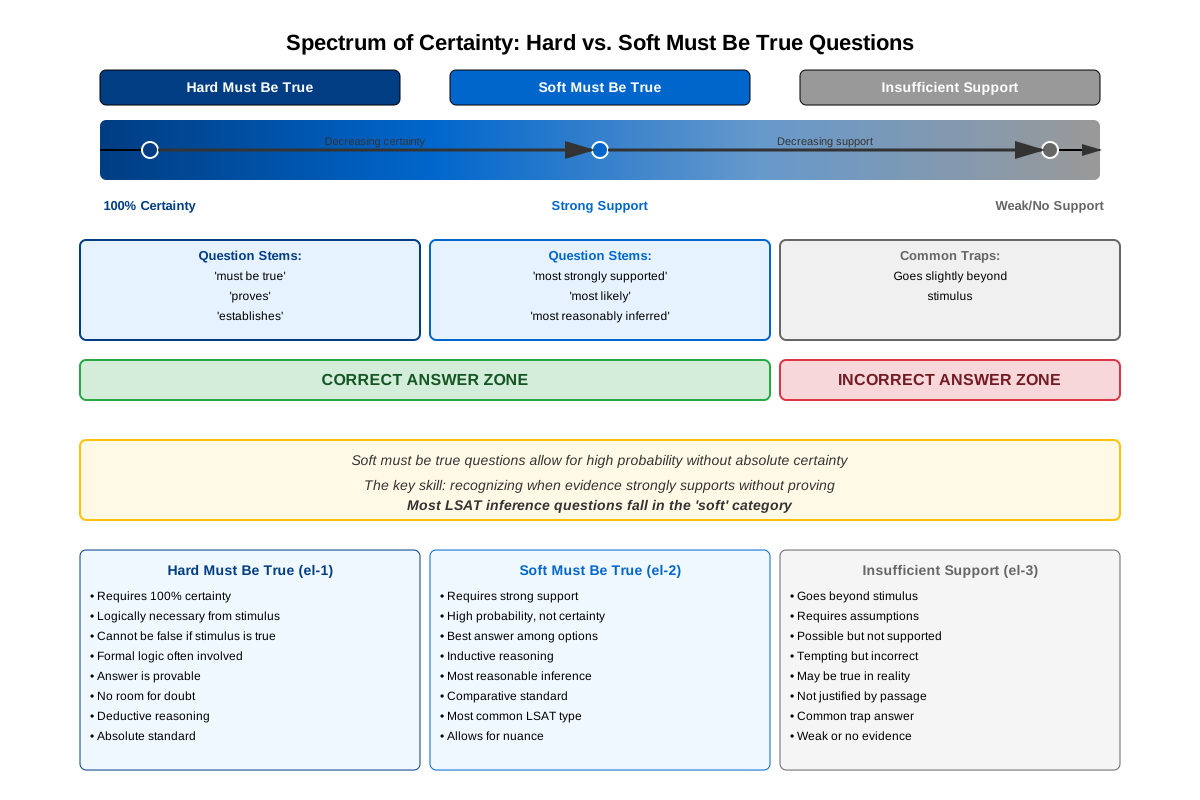
The distinction between "hard" and "soft" must be true questions is fundamental to LSAT success. While hard must be true questions demand answers that are logically necessary given the premises (where the correct answer is 100% certain), soft must be true questions allow for answers that are highly probable or strongly supported without being absolutely guaranteed. This subtle but crucial difference means that test-takers must calibrate their standards of proof appropriately—being neither too strict (eliminating correct answers that aren't absolutely certain) nor too lenient (accepting answers that go beyond what the stimulus supports).
Within the broader landscape of Logical Reasoning, soft must be true questions bridge the gap between pure deductive reasoning and the kind of evidence-based reasoning that appears in strengthen/weaken questions. They test whether students can recognize when premises provide strong support for a conclusion without necessarily proving it beyond all doubt. Mastering this question type builds essential skills for legal reasoning, where attorneys must frequently assess the strength of evidence and determine what conclusions are most reasonably drawn from available facts.
Learning Objectives
- [ ] Identify how soft must be true questions appears in LSAT questions by recognizing characteristic question stems and language
- [ ] Explain the reasoning pattern behind soft must be true questions and articulate the difference between absolute certainty and strong support
- [ ] Apply soft must be true questions to solve LSAT-style problems accurately by selecting answers that are most strongly supported
- [ ] Distinguish between soft must be true questions and hard must be true questions based on question stem language
- [ ] Evaluate answer choices by assessing the degree of support provided by the stimulus
- [ ] Recognize common trap answers that go slightly beyond what the stimulus supports
Prerequisites
- Basic conditional logic: Understanding if-then relationships is essential because soft must be true questions often involve drawing inferences from conditional statements, though without the absolute certainty required in formal logic.
- Argument structure recognition: Students must identify premises and conclusions to determine what follows from given information, as soft must be true questions require understanding what the stimulus actually states versus what it implies.
- Reading comprehension fundamentals: The ability to parse complex sentences and identify key information is necessary because these questions reward careful attention to exactly what is and isn't stated in the stimulus.
Why This Topic Matters
Soft must be true questions appear with remarkable frequency on the LSAT, typically comprising 15-20% of all Logical Reasoning questions across both scored sections. This translates to approximately 6-8 questions per test, making them one of the most common question types students will encounter. Unlike some specialized question types that appear only occasionally, soft must be true questions are virtually guaranteed to appear multiple times on every LSAT administration, making them a high-priority topic for focused study.
In legal practice, attorneys constantly engage in the type of reasoning tested by soft must be true questions. Lawyers must regularly assess what conclusions are most strongly supported by available evidence, even when absolute proof is unavailable. Whether evaluating witness testimony, analyzing documentary evidence, or constructing arguments from precedent, legal professionals must distinguish between what is certain, what is probable, and what is merely possible. The LSAT tests this skill directly through soft must be true questions.
These questions commonly appear in several formats: standalone inference questions where the stimulus presents only facts without an argument structure, questions following brief arguments where students must identify what the premises support, and questions embedded in longer passages requiring synthesis of multiple pieces of information. The stimuli often involve conditional statements, statistical information, comparative claims, or descriptive scenarios that allow for reasonable inferences without absolute certainty.
Core Concepts
Defining Soft Must Be True Questions
Soft must be true questions ask test-takers to identify answer choices that are strongly supported or made highly probable by the information in the stimulus, without requiring absolute logical certainty. The key distinguishing feature is the language used in question stems, which typically includes qualifiers such as "most strongly supported," "most likely," "most reasonable to conclude," or "most probable." This language signals that the correct answer need not be guaranteed by the premises but must have stronger support than any alternative answer choice.
The fundamental reasoning pattern involves assessing the degree of support that premises provide for potential conclusions. Rather than applying strict deductive logic where conclusions must follow with 100% certainty, students must evaluate which answer choice receives the most substantial backing from the stimulus. This requires understanding that multiple answers might be possible or even probable, but only one will be most strongly supported by the specific information provided.
Question Stem Recognition
Recognizing soft must be true questions begins with identifying characteristic question stem language. Common phrasings include:
- "Which one of the following is most strongly supported by the information above?"
- "If the statements above are true, which one of the following is most likely to be true?"
- "The statements above, if true, most strongly support which one of the following?"
- "Which one of the following can most reasonably be concluded from the information above?"
- "The information above most closely conforms to which one of the following?"
The presence of qualifiers like "most," "strongly," "likely," or "reasonably" distinguishes these from hard must be true questions, which use absolute language like "must be true," "proves," or "establishes conclusively." This distinction is critical because it determines the standard of proof required: soft questions accept strong probability while hard questions demand certainty.
The Spectrum of Support
Understanding soft must be true questions requires recognizing that support exists on a spectrum:
| Level of Support | Description | Question Type |
|---|---|---|
| Absolute certainty | Conclusion must be true if premises are true | Hard must be true |
| Strong support | Conclusion is highly probable given premises | Soft must be true |
| Moderate support | Conclusion is somewhat likely given premises | Too weak for correct answer |
| Weak support | Conclusion is merely possible given premises | Incorrect answer |
| No support | Conclusion doesn't follow from premises | Incorrect answer |
The correct answer to a soft must be true question falls in the "strong support" category—not absolutely certain, but more strongly supported than any alternative. Incorrect answers often fall into the "moderate support" or "weak support" categories, making them tempting but ultimately insufficient.
Inference Patterns in Soft Must Be True Questions
Several common inference patterns appear repeatedly in soft must be true questions:
- Comparative inferences: When the stimulus establishes relationships between items (X is larger than Y, Y is larger than Z), the correct answer often involves a comparison that follows from these relationships (X is larger than Z) without being explicitly stated.
- Statistical inferences: When the stimulus provides statistical information (most X are Y, some Y are Z), the correct answer typically involves a conclusion about probability or likelihood that follows from the statistics without overgeneralizing.
- Conditional inferences: When the stimulus presents conditional statements (if X then Y), the correct answer often involves applying these conditions to specific cases or combining multiple conditionals, though without the absolute certainty required in formal logic.
- Temporal inferences: When the stimulus describes events in sequence or provides information about timing, the correct answer may involve conclusions about what likely happened before, during, or after certain events.
- Causal inferences: When the stimulus suggests causal relationships or correlations, the correct answer often involves reasonable conclusions about likely causes or effects, though stopping short of proving causation definitively.
The Role of Modifiers and Qualifiers
Soft must be true questions reward careful attention to modifiers and qualifiers in both the stimulus and answer choices. Words like "some," "most," "many," "often," "typically," "usually," "probably," and "likely" create different levels of commitment. An answer choice that says "some X are Y" requires less support than one claiming "most X are Y," making it easier to support but also potentially too weak to be the best answer.
The correct answer often contains appropriate qualifiers that match the level of support provided by the stimulus. If the stimulus says "most scientists agree," an answer saying "some scientists agree" is supported but may be too weak, while "all scientists agree" goes beyond what's supported. The answer saying "the majority of scientists agree" or "it is likely that scientists agree" typically provides the best match.
Common Stimulus Structures
Soft must be true questions appear with various stimulus structures:
Fact-set stimuli present multiple related facts without an argument structure, requiring students to synthesize information and identify what follows. These often involve combining pieces of information to reach a conclusion that isn't explicitly stated but is strongly supported by the facts together.
Argument-based stimuli present a brief argument with premises and conclusion, then ask what else the premises support. The correct answer typically involves a different conclusion or additional implication that follows from the same premises.
Scenario-based stimuli describe a situation or set of circumstances, then ask what can be inferred about the scenario. These often test whether students can recognize what must or likely occurred given the described circumstances.
Concept Relationships
The concepts within soft must be true questions form an interconnected framework. Question stem recognition serves as the entry point, allowing students to identify that they're dealing with a soft rather than hard must be true question, which then determines the appropriate standard of proof. This recognition leads directly to understanding the spectrum of support, where students must calibrate their expectations for how strongly the stimulus must support the correct answer.
The spectrum of support concept connects to inference patterns, as different patterns (comparative, statistical, conditional, temporal, causal) provide different types and degrees of support for conclusions. Understanding these patterns helps students predict what kinds of inferences will be strongly supported versus those that go too far. The role of modifiers and qualifiers intersects with both the spectrum of support and inference patterns, as qualifiers determine where on the spectrum a particular answer choice falls.
All these concepts ultimately feed into the practical skill of evaluating answer choices against stimulus structures. Whether dealing with fact-set, argument-based, or scenario-based stimuli, students must apply their understanding of support levels, inference patterns, and qualifier usage to identify which answer is most strongly supported.
This topic connects to prerequisite knowledge of conditional logic by building on basic if-then reasoning while relaxing the requirement for absolute certainty. It relates to broader inference questions by representing one specific type within that category, distinguished by the "soft" standard of proof. The skills developed here also support success on strengthen/weaken questions, as both question types require assessing degrees of support rather than absolute proof.
High-Yield Facts
⭐ Soft must be true questions use qualifying language like "most strongly supported," "most likely," or "most reasonable" rather than absolute terms like "must be true" or "proves."
⭐ The correct answer to a soft must be true question doesn't need to be 100% certain—it only needs to be more strongly supported than the other answer choices.
⭐ Soft must be true questions typically comprise 15-20% of Logical Reasoning questions, making them one of the most common question types on the LSAT.
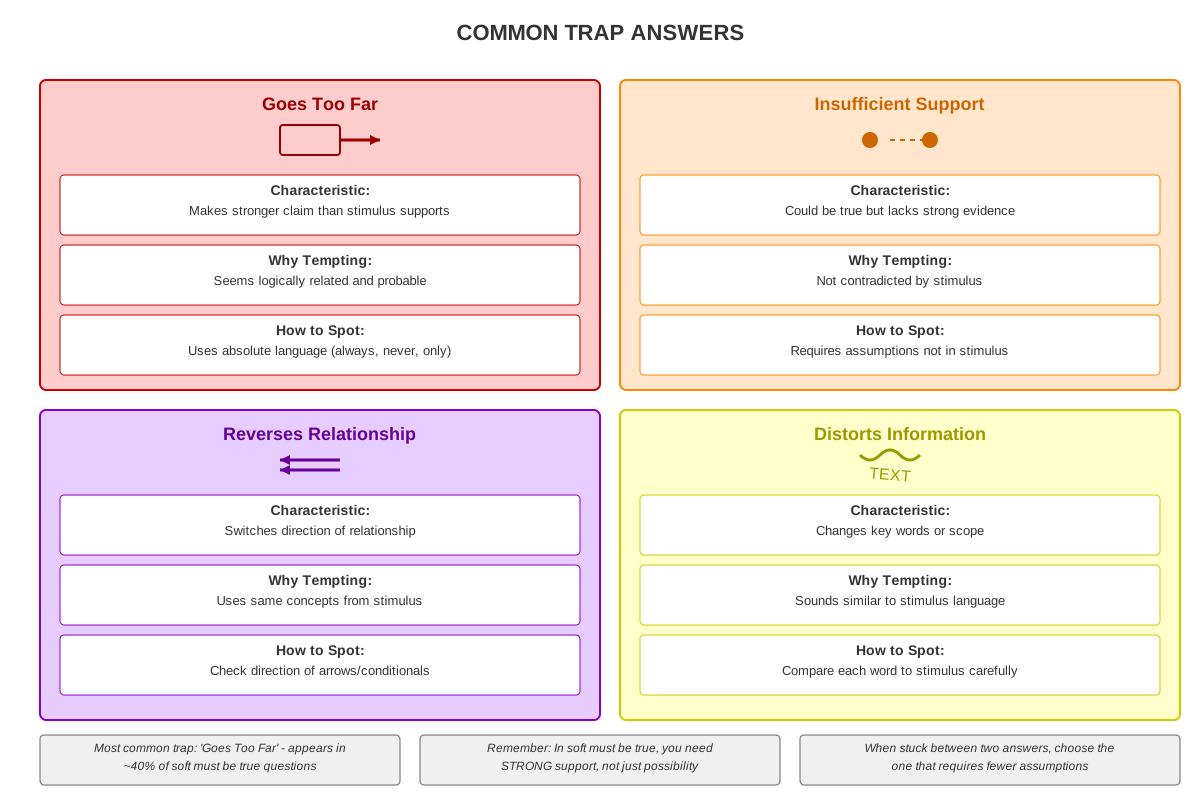
⭐ The most common trap answers go slightly beyond what the stimulus supports, making claims that are possible or even probable but not as strongly supported as the correct answer.
⭐ Paying attention to qualifiers like "some," "most," "many," "often," and "likely" in both stimulus and answer choices is essential for identifying the correct level of support.
- Soft must be true questions test the same inference skills used in legal reasoning, where attorneys must assess what conclusions are most strongly supported by available evidence.
- Comparative inferences (if X > Y and Y > Z, then X > Z) are among the most common inference patterns in soft must be true questions.
- The correct answer often contains appropriate hedging language that matches the level of certainty provided by the stimulus.
- Combining multiple pieces of information from the stimulus is frequently necessary to identify what is most strongly supported.
- Statistical information in the stimulus (e.g., "most X are Y") supports probabilistic conclusions but not absolute claims about individual cases.
- Temporal sequences in stimuli often support inferences about what likely happened before or after certain events without proving these inferences with certainty.
- Answer choices that merely restate information from the stimulus are rarely correct, as soft must be true questions reward inference rather than recognition.
Quick check — test yourself on Soft must be true questions so far.
Try Flashcards →Common Misconceptions
Misconception: Soft must be true questions require the same level of certainty as hard must be true questions, so the correct answer must be absolutely guaranteed by the premises.
Correction: Soft must be true questions explicitly allow for answers that are strongly supported without being absolutely certain. The qualifying language in question stems ("most strongly supported," "most likely") signals that probability rather than certainty is the standard. Students who apply too strict a standard often eliminate the correct answer because it isn't 100% guaranteed.
Misconception: If an answer choice is possible given the stimulus, it's a good answer for a soft must be true question.
Correction: Possibility is insufficient for soft must be true questions. Many answer choices might be possible, but only one will be most strongly supported by the stimulus. Students must distinguish between what could be true and what is most likely or most strongly supported based on the specific information provided.
Misconception: The correct answer will always introduce new information not explicitly stated in the stimulus.
Correction: While correct answers often involve inference beyond what's explicitly stated, they must still be supported by the stimulus. Some correct answers synthesize information from multiple sentences, while others apply general principles to specific cases. The key is strong support, not novelty. Answers that introduce information completely unconnected to the stimulus are incorrect.
Misconception: Longer, more detailed answer choices are more likely to be correct because they provide more information.
Correction: Length and detail don't correlate with correctness in soft must be true questions. In fact, longer answer choices often include additional claims that go beyond what the stimulus supports, making them incorrect despite containing some supported elements. The correct answer is the one most strongly supported, regardless of length.
Misconception: If the stimulus contains conditional statements, the correct answer must involve formal logical deductions from those conditionals.
Correction: While conditional statements often appear in soft must be true questions, the correct answer may involve probabilistic reasoning about the conditionals rather than strict logical deduction. For example, if the stimulus says "most X are Y" and "this is an X," the most strongly supported conclusion might be "this is probably Y," not "this must be Y."
Misconception: Statistical information in the stimulus (like "most" or "many") is too vague to support any specific conclusion.
Correction: Statistical information provides valuable support for probabilistic conclusions. If the stimulus states "most lawyers work long hours," this strongly supports the conclusion "it is likely that a randomly selected lawyer works long hours," even though it doesn't prove this with certainty. Students must learn to work with probabilistic support rather than dismissing it as insufficient.
Worked Examples
Example 1: Comparative Inference
Stimulus: "The Riverside Museum's collection contains more impressionist paintings than the Central Gallery's collection. The Central Gallery's collection contains more impressionist paintings than the Northside Museum's collection. The Northside Museum's collection contains at least fifteen impressionist paintings."
Question: Which one of the following is most strongly supported by the information above?
Answer Choices:
(A) The Riverside Museum's collection contains more than thirty impressionist paintings.
(B) The Central Gallery's collection contains exactly twenty impressionist paintings.
(C) The Riverside Museum's collection contains more impressionist paintings than the Northside Museum's collection.
(D) All three museums together contain fewer than one hundred impressionist paintings.
(E) The Riverside Museum has the largest overall art collection of the three museums.
Analysis:
First, identify this as a soft must be true question based on the question stem "most strongly supported." This means we need strong support, not absolute certainty.
Next, map out the relationships given:
- Riverside > Central (in impressionist paintings)
- Central > Northside (in impressionist paintings)
- Northside ≥ 15 (impressionist paintings)
Now evaluate each answer:
(A) We know Riverside > Central > Northside ≥ 15, so Riverside has more than 15, but we cannot determine if it has more than 30. This goes beyond what's supported. Incorrect.
(B) We have no information about exact numbers for Central Gallery. This is completely unsupported. Incorrect.
(C) Since Riverside > Central and Central > Northside, by transitivity, Riverside > Northside. This is strongly supported by combining the comparative relationships. Correct.
(D) We have no upper limit information. While possible, this isn't supported by the stimulus. Incorrect.
(E) The stimulus only discusses impressionist paintings, not overall collection size. This goes beyond the scope. Incorrect.
Answer: (C)
This example demonstrates the comparative inference pattern, where combining multiple comparative statements yields a conclusion not explicitly stated but strongly supported by the relationships given.
Example 2: Statistical and Conditional Inference
Stimulus: "Most professional athletes who endorse products have contracts requiring them to use those products publicly. Chen is a professional athlete who endorses running shoes manufactured by Swift Athletics. Chen was recently photographed wearing running shoes manufactured by a different company during her training sessions."
Question: If the statements above are true, which one of the following is most likely to be true?
Answer Choices:
(A) Chen violated the terms of her endorsement contract with Swift Athletics.
(B) Chen does not have a contract requiring her to wear Swift Athletics shoes publicly.
(C) Most professional athletes violate their endorsement contracts.
(D) Swift Athletics will terminate its endorsement contract with Chen.
(E) Chen prefers the other company's shoes to Swift Athletics shoes.
Analysis:
The question stem "most likely to be true" identifies this as a soft must be true question requiring strong support but not certainty.
Break down the stimulus:
- Most professional athletes who endorse products have contracts requiring public use
- Chen is a professional athlete who endorses Swift Athletics shoes
- Chen was photographed wearing a competitor's shoes during training
Evaluate each answer:
(A) This assumes Chen has a contract requiring public use AND that training sessions count as "public" use. While possible, we don't know if Chen is among the "most" who have such contracts, and we don't know if training sessions count as public. This goes slightly beyond what's supported. Incorrect.
(B) The stimulus tells us "most" athletes who endorse products have such contracts, but Chen might be in the minority who don't. However, the fact that she was photographed wearing competitor's shoes suggests she either doesn't have such a contract or is violating it. Of these possibilities, not having the contract is more likely than violating it (since violation would have serious consequences). This is reasonably supported. Possibly correct.
(C) The stimulus gives no information about how many athletes violate contracts. This is completely unsupported. Incorrect.
(D) We have no information about what Swift Athletics will do. This is speculation beyond the stimulus. Incorrect.
(E) While Chen wore competitor's shoes, this could be for many reasons (testing, sponsorship requirements, availability). Preference is not strongly supported. Incorrect.
Answer: (B)
This is a more challenging example because the correct answer requires recognizing that while "most" athletes have restrictive contracts, Chen's behavior suggests she likely doesn't fall into that majority. The answer is "most likely" rather than certain, which is appropriate for a soft must be true question.
Exam Strategy
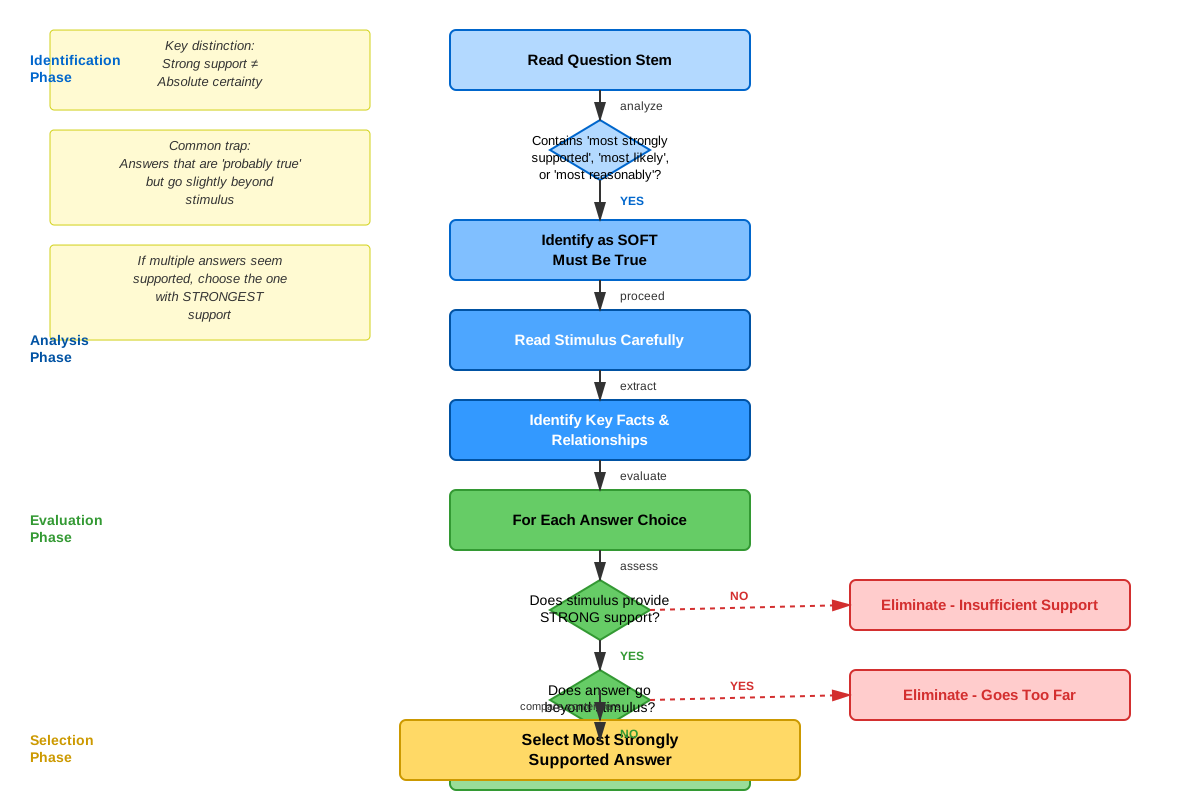
When approaching soft must be true questions on the LSAT, begin by carefully reading the question stem to confirm you're dealing with a soft rather than hard must be true question. Look for qualifying language like "most strongly supported," "most likely," or "most reasonable." This identification step is crucial because it sets your standard of proof—you're looking for strong support, not absolute certainty.
Exam Tip: If you find yourself thinking "this answer could be true, but I'm not 100% certain," that's often a sign you're on the right track with a soft must be true question. Don't eliminate answers that are highly probable just because they're not absolutely guaranteed.
Read the stimulus carefully, paying special attention to qualifiers (some, most, many, often, usually), comparative language (more than, less than, larger, smaller), and conditional statements (if-then relationships). These elements often form the basis for the inferences you'll need to make. Consider underlining or circling key qualifiers and relationships as you read.
Before looking at answer choices, briefly consider what kinds of inferences the stimulus supports. If it contains comparative statements, expect an answer involving a comparison not explicitly stated. If it includes statistical information, expect a probabilistic conclusion. This prediction step helps you recognize the correct answer more quickly and avoid traps.
When evaluating answer choices, use a two-pass approach. On the first pass, eliminate answers that are clearly unsupported or go beyond the scope of the stimulus. Look for answers that introduce completely new information, make claims about topics not discussed in the stimulus, or require assumptions not warranted by the information given. On the second pass, compare the remaining answers to identify which has the strongest support.
Trigger words and phrases to watch for:
In question stems:
- "Most strongly supported"
- "Most likely"
- "Most reasonable to conclude"
- "Most probable"
- "Best supported"
- "Most closely conforms"
In answer choices that often signal correct answers:
- "Probably"
- "Likely"
- "Some"
- "At least"
- "More than"
- "Less than"
In answer choices that often signal incorrect answers:
- "Must"
- "Definitely"
- "All"
- "None"
- "Only"
- "Exactly"
For process of elimination, be especially wary of answers that are "almost" supported but include one additional claim that goes slightly beyond the stimulus. These are the most common trap answers in soft must be true questions. Also eliminate answers that are merely possible but not strongly supported—remember that possibility is insufficient.
Time allocation for soft must be true questions should typically be 1:15 to 1:30 per question. These questions often require careful synthesis of information but shouldn't take as long as complex parallel reasoning or flaw questions. If you find yourself spending more than two minutes on a soft must be true question, make your best guess and move on, marking it for review if time permits.
Memory Techniques
SOFT Acronym for Approach:
- Stem check: Confirm it's a soft must be true question by identifying qualifying language
- Observe qualifiers: Note "some," "most," "many," and comparative terms in the stimulus
- Find relationships: Identify comparative, conditional, statistical, or temporal patterns
- Test support: Evaluate each answer for degree of support, not just possibility
The Support Spectrum Visualization: Picture a thermometer with "no support" at the bottom, "possible" in the lower third, "probable" in the middle, "strongly supported" in the upper third, and "certain" at the top. For soft must be true questions, you're looking for answers in the "strongly supported" zone—not quite at "certain" but well above "probable."
The "Most" Reminder: When you see "most" in a soft must be true question stem, remember it stands for "Most Obviously Supported Theory"—you're looking for the answer with the most obvious support, not necessarily absolute proof.
Comparative Chain Technique: For stimuli with multiple comparisons (A > B, B > C), visualize a chain or ladder with items arranged in order. This makes transitive relationships (A > C) immediately apparent.
Qualifier Matching: Remember that the correct answer's qualifiers should "match" the stimulus's level of certainty. If the stimulus says "most," look for answers with "likely" or "probably," not "all" or "must."
Summary
Soft must be true questions represent a critical LSAT question type that tests the ability to identify conclusions that are strongly supported by given information without requiring absolute certainty. Distinguished from hard must be true questions by qualifying language in question stems ("most strongly supported," "most likely"), these questions require calibrating one's standard of proof appropriately—accepting strong probability while rejecting mere possibility. Success depends on recognizing characteristic question stem language, understanding the spectrum of support from certainty to possibility, identifying common inference patterns (comparative, statistical, conditional, temporal, and causal), and paying careful attention to modifiers and qualifiers in both stimuli and answer choices. The most common trap answers go slightly beyond what the stimulus supports, making claims that are possible or even probable but not as strongly supported as the correct answer. Mastering soft must be true questions requires practice distinguishing between different levels of support and selecting answers that are most strongly backed by the specific information provided, even when they're not absolutely guaranteed.
Key Takeaways
- Soft must be true questions use qualifying language ("most strongly supported," "most likely") that signals a standard of strong probability rather than absolute certainty
- The correct answer must be more strongly supported than alternatives but doesn't need to be 100% guaranteed by the premises
- These questions appear 6-8 times per LSAT test, making them a high-priority topic for focused preparation
- Common inference patterns include comparative relationships, statistical reasoning, conditional applications, temporal sequences, and causal suggestions
- Trap answers typically go slightly beyond what the stimulus supports or are merely possible rather than strongly supported
- Careful attention to qualifiers ("some," "most," "many," "often," "likely") in both stimulus and answer choices is essential for success
- The skills tested by soft must be true questions—assessing degrees of support for conclusions—are fundamental to legal reasoning and practice
Related Topics
Hard Must Be True Questions: These require absolute certainty rather than strong support, demanding that correct answers be logically guaranteed by the premises. Mastering soft must be true questions provides a foundation for understanding the stricter standard required for hard must be true questions.
Strengthen and Weaken Questions: These also involve assessing degrees of support, but rather than identifying what is supported, students must identify what would increase or decrease support for a conclusion. The skills developed in soft must be true questions transfer directly to evaluating support in strengthen/weaken contexts.
Principle Questions: Some principle questions ask what principle is most strongly supported by a situation or argument, combining principle identification with the soft must be true reasoning pattern. Success with soft must be true questions enables better performance on these hybrid question types.
Parallel Reasoning Questions: Understanding inference patterns in soft must be true questions helps with recognizing similar reasoning structures in parallel reasoning questions, where matching the pattern of support is essential.
Practice CTA
Now that you've mastered the core concepts of soft must be true questions, it's time to put your knowledge into practice. Work through the practice questions to reinforce your understanding of question stem recognition, inference patterns, and answer evaluation strategies. Use the flashcards to drill key concepts like the spectrum of support and common trap answer patterns. Remember that soft must be true questions reward careful attention to exactly what the stimulus supports—not too strict in demanding certainty, but not too lenient in accepting mere possibility. With focused practice, you'll develop the calibrated judgment needed to consistently identify the most strongly supported answer. Your success on these high-frequency questions will significantly impact your overall Logical Reasoning score, so invest the time to master this essential skill!
Sign up free to keep reading
Create a free AnvayaPrep account to finish this LSAT guide on Soft must be true questions — plus flashcards and practice questions.