Overview
Textual support is a foundational principle in LSAT Logical Reasoning that governs how test-takers must justify their answer choices. Unlike many standardized tests that reward background knowledge or creative interpretation, the LSAT demands that every correct answer be directly supported by explicit information in the stimulus. This concept is particularly critical for inference questions, where students must identify what must be true based solely on the passage provided, without importing outside assumptions or making logical leaps beyond what the text explicitly states.
Understanding textual support transforms how students approach the entire Logical Reasoning section. The LSAT is fundamentally a reading comprehension test disguised as a logic test—success depends not on how clever or knowledgeable a student is, but on how carefully they can trace the connection between stimulus and answer choice. Every word in the stimulus exists for a reason, and the correct answer will always have a clear, demonstrable link to specific statements in the passage. Students who master this principle learn to distinguish between what could be true (speculation), what might be true (possibility), and what must be true given the information provided (proper inference).
The concept of LSAT textual support connects to virtually every question type in Logical Reasoning. Whether analyzing arguments, identifying assumptions, strengthening or weakening conclusions, or drawing inferences, the fundamental skill remains constant: anchoring reasoning to the text. This topic serves as the bedrock upon which all other logical reasoning skills are built, making it essential for achieving competitive scores on the LSAT.
Learning Objectives
- [ ] Identify how textual support appears in LSAT questions
- [ ] Explain the reasoning pattern behind textual support
- [ ] Apply textual support to solve LSAT-style problems accurately
- [ ] Distinguish between properly supported inferences and unsupported speculation
- [ ] Evaluate answer choices by tracing explicit connections to stimulus text
- [ ] Recognize common traps that violate textual support principles
- [ ] Demonstrate the ability to eliminate answer choices that introduce new information not present in the stimulus
Prerequisites
- Basic reading comprehension skills: The ability to understand written passages is essential because textual support requires precise interpretation of what is explicitly stated versus implied.
- Understanding of logical structure: Recognizing premises and conclusions helps identify which parts of the stimulus provide support for potential inferences.
- Familiarity with LSAT question formats: Knowing how inference questions are phrased allows students to recognize when textual support principles apply most directly.
- Concept of validity versus truth: Understanding that LSAT questions test logical relationships rather than real-world accuracy helps students focus on what the passage supports rather than external knowledge.
Why This Topic Matters
Textual support is not merely an academic concept—it reflects the core skill that law schools seek in prospective students: the ability to work strictly within established legal texts, precedents, and statutes without importing personal biases or unsupported interpretations. Legal reasoning demands that every claim be traceable to authoritative sources, making textual support training directly applicable to law school success and legal practice.
On the LSAT itself, textual support principles apply to approximately 60-70% of Logical Reasoning questions. While inference questions most explicitly test this skill (appearing 4-6 times per Logical Reasoning section), the principle underlies Must Be True questions, Most Strongly Supported questions, Main Point questions, and even some Assumption questions. A student who violates textual support principles will consistently select attractive wrong answers that "sound good" but lack proper grounding in the stimulus.
Common manifestations in exam passages include: questions asking what "can be properly inferred," what "the statements above most strongly support," what "must be true if the statements above are true," and what "follows logically from the information provided." Each of these phrasings signals that the correct answer requires explicit textual support rather than creative reasoning or outside knowledge.
Core Concepts
Definition of Textual Support
Textual support refers to the requirement that correct answers on the LSAT must be directly justified by explicit information contained in the stimulus passage. This means the connection between stimulus and answer must be demonstrable through direct quotation, logical necessity, or clear implication from stated facts. The LSAT operates under a "closed universe" principle: only information provided in the stimulus exists for purposes of answering the question.
This principle distinguishes the LSAT from tests of general knowledge or creative thinking. A student cannot rely on what they know about the real world, what seems plausible, or what might be true in most circumstances. Instead, they must ask: "Does the text explicitly state or logically require this conclusion?"
The Spectrum of Support
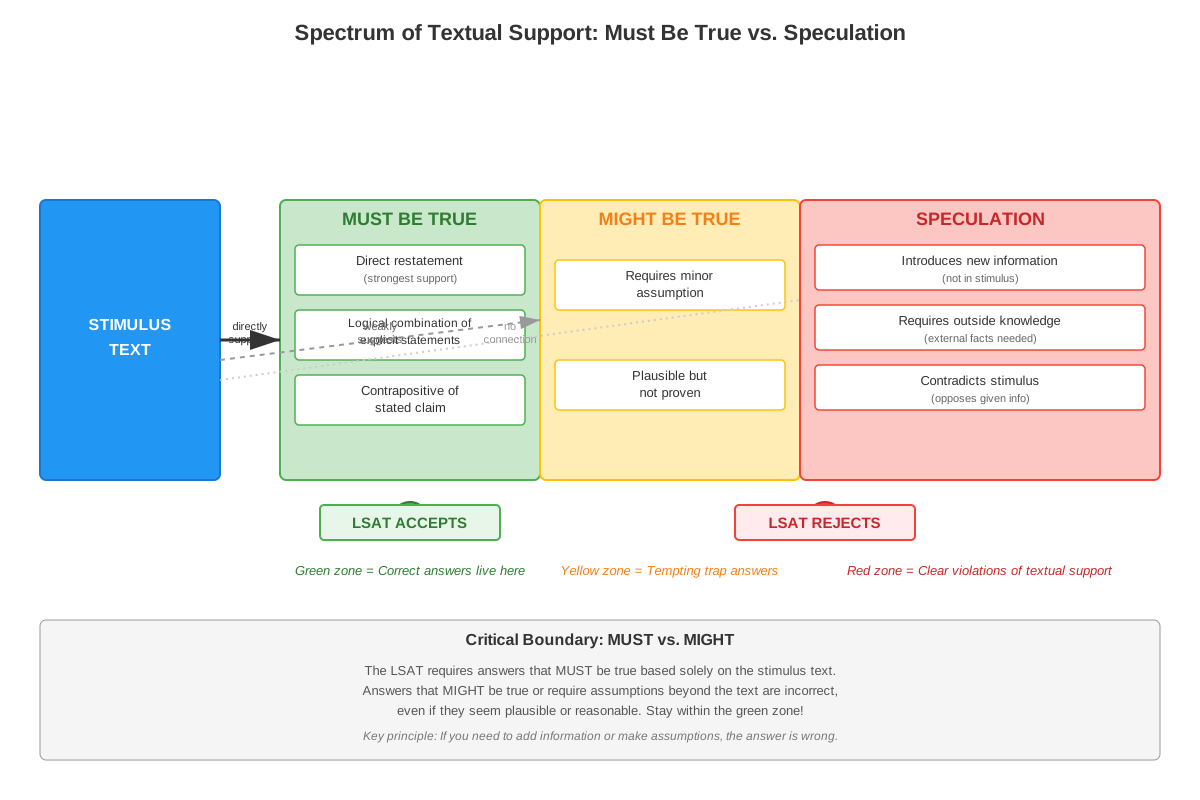
Not all inferences require the same degree of textual support. Understanding this spectrum is crucial for success:
| Support Level | Description | LSAT Application |
|---|---|---|
| Must Be True | Logically necessary given the premises; cannot be false if stimulus is true | Strongest inference questions; correct answer is guaranteed by the text |
| Most Strongly Supported | Highly probable given the information; best supported among options | Common inference question variant; allows slightly more interpretive flexibility |
| Could Be True | Possible but not required by the text | Generally incorrect on inference questions; represents speculation |
| Not Supported | Introduces new information or makes unjustified leaps | Always incorrect; violates textual support |
The LSAT most frequently tests the first two categories. Students must recognize that "most strongly supported" questions allow for slightly more inference than "must be true" questions, but both require clear textual grounding.
Direct Versus Indirect Support
Textual support can be direct (explicitly stated) or indirect (logically derived from stated information):
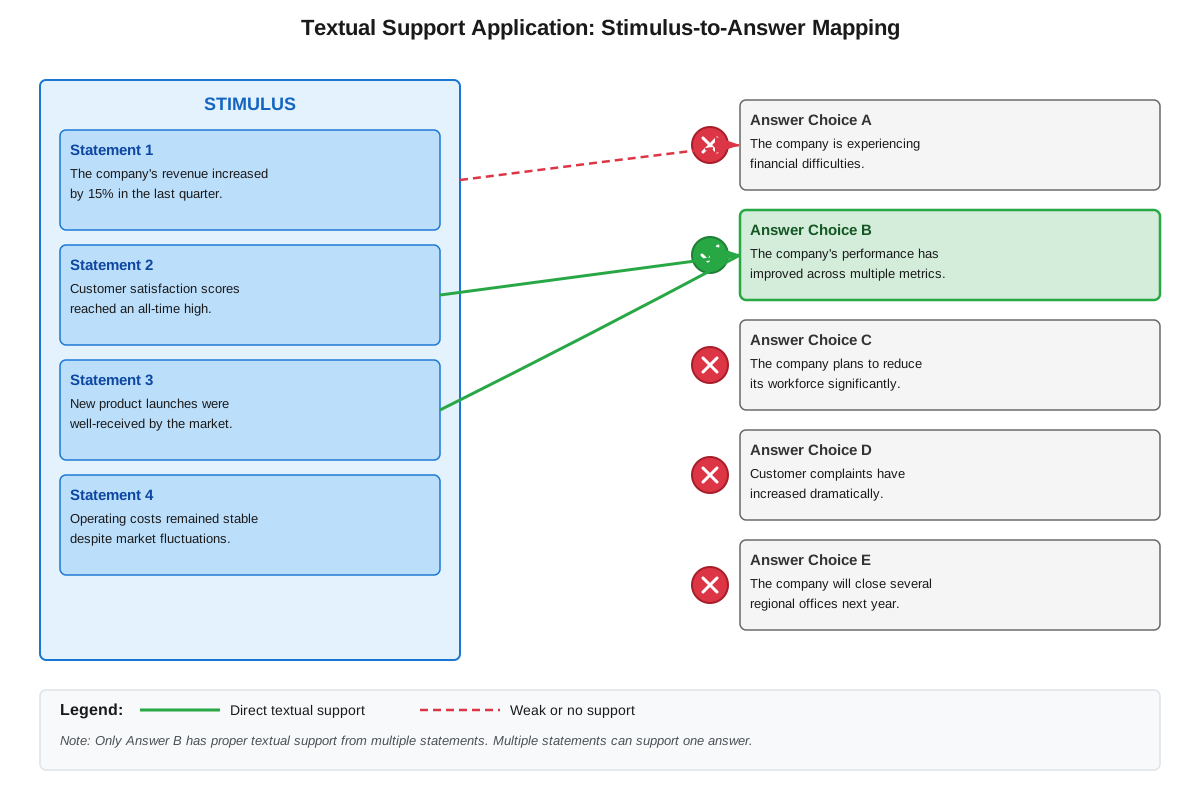
Direct support occurs when the stimulus contains language that directly corresponds to the answer choice. For example:
- Stimulus: "All members of the committee voted in favor of the proposal."
- Supported inference: "No committee member voted against the proposal."
Indirect support requires combining multiple statements or applying basic logical operations:
- Stimulus: "Every student who passed the exam studied for at least 10 hours. Maria passed the exam."
- Supported inference: "Maria studied for at least 10 hours."
Both types are valid, but indirect support requires more careful reasoning to ensure the logical connection is sound.
The Closed Universe Principle
The LSAT operates under what can be called the closed universe principle: for purposes of answering questions, only the information in the stimulus exists. This means:
- No outside knowledge: Even if something is true in the real world, it cannot be assumed unless stated in the stimulus
- No unstated possibilities: If the stimulus doesn't mention something, it cannot be assumed to exist
- No temporal assumptions: Events or facts from before or after the described situation cannot be imported
- No causal assumptions: Cause-and-effect relationships must be explicitly stated or clearly implied
This principle is particularly challenging for educated test-takers who naturally draw on their knowledge base. The LSAT deliberately includes answer choices that are factually true in the real world but unsupported by the specific stimulus.
Identifying Textual Support in Practice
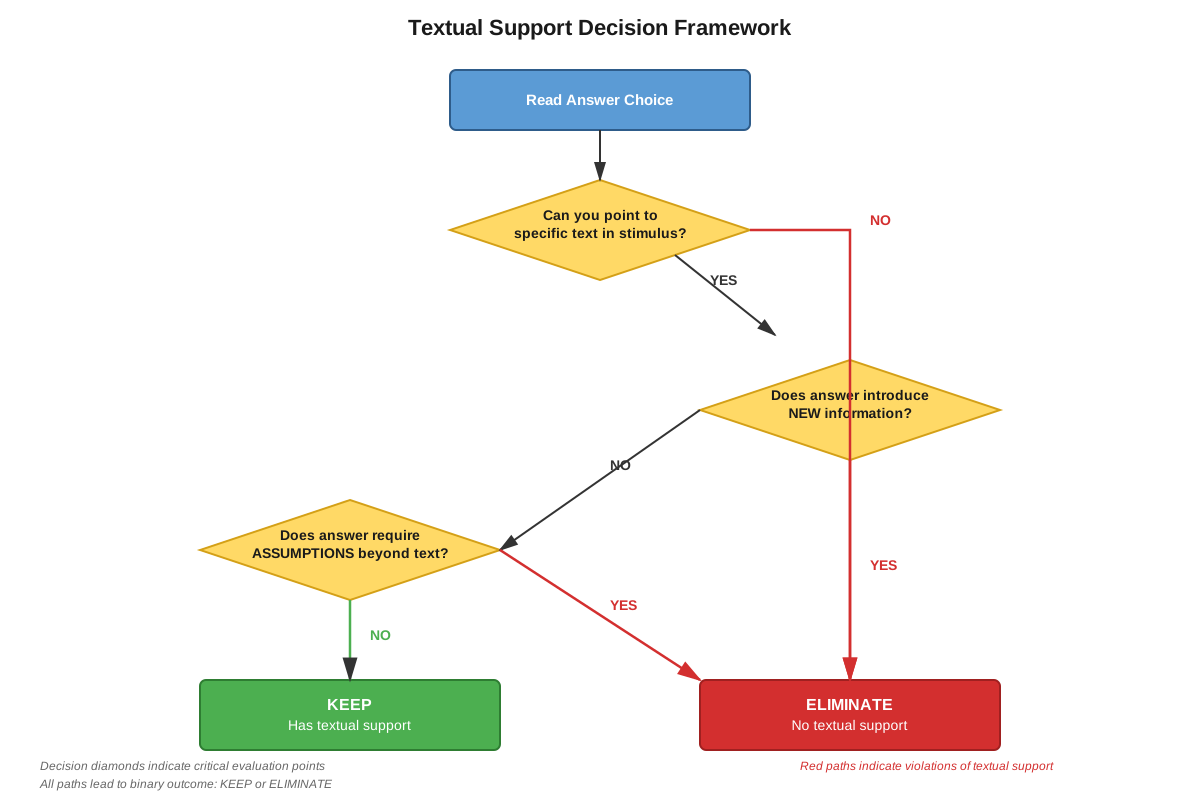
To determine whether an answer choice has proper textual support, apply this systematic process:
- Identify the claim: What exactly is the answer choice asserting?
- Locate relevant text: Which specific sentences or phrases in the stimulus relate to this claim?
- Trace the connection: Can you draw a direct line from stimulus to answer without adding information?
- Check for gaps: Are there any logical leaps that require assumptions not stated in the text?
- Verify necessity: For "must be true" questions, could the stimulus be true while the answer is false?
If any step reveals a gap, the answer choice lacks sufficient textual support.
Common Support Patterns
Certain logical patterns appear repeatedly in properly supported inferences:
Contrapositive relationships: If the stimulus states "All A are B," then "No non-B are A" is supported.
Quantifier inferences: If "most employees support the policy," then "at least some employees support the policy" is supported (but not "all employees support the policy").
Definitional inferences: If the stimulus defines a term and then applies it, inferences about that application are supported.
Temporal sequences: If events are described in sequence, inferences about their order are supported.
Comparative statements: If the stimulus establishes a comparison, inferences maintaining that relationship are supported.
Concept Relationships
Textual support serves as the foundation for all LSAT Logical Reasoning skills. The relationship flows as follows:
Textual Support → enables → Accurate Inference Drawing → which underlies → Assumption Identification (recognizing unstated premises) → which connects to → Argument Evaluation (strengthening/weakening)
Within inference questions specifically, textual support connects to:
- Conditional reasoning: Properly supported inferences often involve applying conditional statements
- Quantifier logic: Understanding "all," "some," "most," and "none" determines what can be properly inferred
- Formal logic: Translating statements into logical notation helps verify textual support
The concept also relates to prerequisite knowledge of logical structure: identifying premises helps locate the textual support for potential inferences, while understanding conclusions helps distinguish between what the argument claims and what can be independently inferred from the premises.
Textual support principles directly oppose common test-taking instincts like "reading between the lines" or "using common sense." Mastering this topic requires unlearning these habits and replacing them with rigorous textual analysis.
High-Yield Facts
⭐ The correct answer to an inference question must be true if the stimulus is true; it cannot possibly be false given the information provided.
⭐ Any answer choice that introduces new information not mentioned or implied in the stimulus violates textual support and is incorrect.
⭐ "Most strongly supported" questions allow slightly more interpretive flexibility than "must be true" questions, but both require clear textual grounding.
⭐ Real-world knowledge is irrelevant; even if an answer choice is factually accurate, it is wrong if not supported by the stimulus.
⭐ The LSAT rewards conservative inference-making; when in doubt, choose the answer that requires the smallest logical leap from the text.
- Textual support applies to approximately 60-70% of Logical Reasoning questions across different question types.
- Answer choices that use extreme language ("always," "never," "only") are often unsupported unless the stimulus uses equally extreme language.
- Properly supported inferences often involve combining two or more statements from the stimulus.
- The stimulus may contain irrelevant information; not every sentence will support the correct answer.
- Incorrect answer choices frequently appeal to common sense or general knowledge rather than textual support.
- Paraphrasing is common; the correct answer rarely uses identical language to the stimulus but maintains logical equivalence.
- Temporal and causal relationships must be explicitly stated in the stimulus to support inferences about timing or causation.
Quick check — test yourself on Textual support so far.
Try Flashcards →Common Misconceptions
Misconception: If an answer choice could be true based on the stimulus, it is correct.
Correction: "Could be true" is insufficient for most inference questions. The answer must be supported by the text, meaning it is either necessarily true (for "must be true" questions) or more strongly supported than other options (for "most strongly supported" questions). Mere possibility does not constitute textual support.
Misconception: Using real-world knowledge to fill gaps in the stimulus is acceptable if it makes the argument stronger.
Correction: The LSAT strictly prohibits importing outside knowledge. The stimulus creates a closed universe, and only information explicitly stated or logically derivable from stated information can be used. Even if something is universally true in reality, it cannot be assumed unless the stimulus establishes it.
Misconception: The correct answer will always use similar language to the stimulus.
Correction: The LSAT frequently paraphrases concepts, and correct answers often restate stimulus information using different vocabulary. What matters is logical equivalence, not verbal similarity. Conversely, wrong answers sometimes use language from the stimulus to create false familiarity.
Misconception: Longer, more detailed answer choices are more likely to be correct because they provide more information.
Correction: Length is irrelevant to correctness. In fact, longer answer choices often introduce additional unsupported claims, making them more likely to violate textual support principles. The correct answer may be the shortest option if it makes a simple, well-supported claim.
Misconception: If most of an answer choice is supported by the stimulus, it is correct even if one part is unsupported.
Correction: Every component of the correct answer must have textual support. An answer choice that is 90% supported but includes one unsupported claim is entirely incorrect. The LSAT tests precision, and partially supported answers are wrong answers.
Misconception: Inference questions test creativity and the ability to "read between the lines."
Correction: Inference questions test the ability to recognize what logically follows from stated information, not creative interpretation. "Reading between the lines" often leads to unsupported speculation. The LSAT rewards conservative, text-bound reasoning over imaginative leaps.
Worked Examples
Example 1: Must Be True Inference
Stimulus: "Every member of the city council who voted for the new zoning ordinance represents a district in the northern part of the city. Council member Rodriguez voted for the new zoning ordinance."
Question: Which one of the following must be true based on the information above?
Answer Choices:
(A) Rodriguez represents a district in the northern part of the city.
(B) Most city council members represent districts in the northern part of the city.
(C) The new zoning ordinance will primarily affect the northern part of the city.
(D) Council members representing southern districts opposed the new zoning ordinance.
(E) Rodriguez has consistently supported zoning changes in the past.
Analysis:
Let's apply textual support principles systematically:
(A) Rodriguez represents a district in the northern part of the city.
- The stimulus states: "Every member...who voted for the ordinance represents a district in the northern part"
- The stimulus also states: "Rodriguez voted for the ordinance"
- Logical structure: All X are Y; Rodriguez is X; therefore Rodriguez is Y
- This is a valid categorical syllogism with complete textual support
- This must be true given the stimulus
(B) Most city council members represent districts in the northern part of the city.
- The stimulus tells us about council members who voted for the ordinance, not about all council members
- We have no information about how many total council members exist or where they represent
- This introduces unsupported quantitative information
- Violates textual support—incorrect
(C) The new zoning ordinance will primarily affect the northern part of the city.
- The stimulus discusses who voted for the ordinance, not its effects
- This makes a causal/predictive claim with no textual basis
- Violates textual support—incorrect
(D) Council members representing southern districts opposed the new zoning ordinance.
- The stimulus only tells us about those who voted FOR the ordinance
- We have no information about who opposed it or about southern district representatives
- This assumes information not provided
- Violates textual support—incorrect
(E) Rodriguez has consistently supported zoning changes in the past.
- The stimulus only describes one vote by Rodriguez
- This makes a historical claim with no textual basis
- Violates textual support—incorrect
Correct Answer: (A)
This example demonstrates how proper textual support requires tracing a direct logical path from stimulus to answer. Only choice (A) follows necessarily from the given information.
Example 2: Most Strongly Supported Inference
Stimulus: "The city's new recycling program has been in effect for six months. During this period, the amount of waste sent to landfills has decreased by 15%. However, the recycling center reports that the volume of materials it processes has increased by only 8% compared to the previous six-month period."
Question: The statements above, if true, most strongly support which one of the following?
Answer Choices:
(A) The recycling program has been completely successful in achieving its goals.
(B) Some waste that previously went to landfills is now being disposed of through means other than the recycling center.
(C) Residents are generating less waste overall since the program began.
(D) The recycling center lacks the capacity to handle all recyclable materials.
(E) The 15% decrease in landfill waste is entirely due to the new recycling program.
Analysis:
This question asks for the most strongly supported inference, allowing slightly more interpretive flexibility than "must be true."
(A) The recycling program has been completely successful in achieving its goals.
- "Completely successful" is extreme language unsupported by the text
- We don't know what the program's goals were
- Unsupported—incorrect
(B) Some waste that previously went to landfills is now being disposed of through means other than the recycling center.
- Landfill waste decreased by 15%
- Recycling center processing increased by only 8%
- There's a gap: if recycling accounts for only 8% reduction, where did the other 7% go?
- This inference accounts for the discrepancy using only information provided
- Strongly supported by the text
(C) Residents are generating less waste overall since the program began.
- This could explain the discrepancy, but the stimulus provides no information about total waste generation
- This introduces a new explanation not grounded in the text
- Unsupported speculation—incorrect
(D) The recycling center lacks the capacity to handle all recyclable materials.
- This could explain why recycling increased by only 8%, but capacity is never mentioned
- This imports an assumption about why the numbers differ
- Unsupported—incorrect
(E) The 15% decrease in landfill waste is entirely due to the new recycling program.
- "Entirely" is too strong; other factors could contribute
- The stimulus doesn't establish exclusive causation
- Unsupported—incorrect
Correct Answer: (B)
This example shows how textual support works with "most strongly supported" questions: the correct answer explains or accounts for information in the stimulus without introducing unsupported assumptions. Choice (B) addresses the numerical discrepancy using only the facts provided.
Exam Strategy
Approaching Textual Support Questions
When facing inference questions or any question requiring textual support, follow this systematic approach:
- Read the stimulus carefully: Every word matters. Note qualifiers like "some," "most," "all," and "only."
- Identify the question type: "Must be true" requires stronger support than "most strongly supported."
- Predict before looking at answers: Ask yourself, "What can I definitely conclude from this information?"
- Evaluate each answer choice: For each option, ask "Where in the stimulus is this supported?"
- Eliminate aggressively: Remove any answer that introduces new information or requires assumptions.
Trigger Words and Phrases
Watch for these question stems that signal textual support is crucial:
- "Which one of the following can be properly inferred..."
- "The statements above, if true, most strongly support..."
- "Which one of the following must be true..."
- "The information above provides the most support for..."
- "Which one of the following follows logically..."
These phrases indicate that the correct answer must be grounded in the stimulus without importing outside information.
Red Flags in Answer Choices
Certain characteristics often indicate an answer choice violates textual support:
- New concepts: Terms or ideas not mentioned in the stimulus
- Extreme language: "Always," "never," "only," "completely" (unless the stimulus uses similar language)
- Causal claims: Suggesting X caused Y when the stimulus only shows correlation
- Temporal assumptions: Claims about past or future not addressed in the stimulus
- Quantifier shifts: Changing "some" to "most" or "most" to "all"
Exam Tip: The most common trap answers are those that "sound smart" or align with real-world knowledge but lack textual support. Always ask: "Can I point to specific text that requires this conclusion?"
Process of Elimination Strategy
For textual support questions, elimination is often more effective than selection:
- First pass: Eliminate answers that introduce completely new information
- Second pass: Eliminate answers that make unsupported logical leaps
- Third pass: Between remaining options, choose the one requiring the smallest inference from the text
Time Allocation
Textual support questions typically require 1-1.5 minutes:
- 30 seconds: Read and understand the stimulus
- 15 seconds: Process the question stem
- 30-45 seconds: Evaluate answer choices
If you find yourself spending more than 2 minutes, you may be overthinking. Return to the text and look for direct support rather than trying to construct complex logical chains.
Memory Techniques
The TRACE Acronym
Use TRACE to remember the textual support evaluation process:
- Text-bound: Does the answer stay within the stimulus?
- Required: Is this conclusion necessary given the information?
- Assumption-free: Does this avoid importing unstated premises?
- Connected: Can you draw a direct line from stimulus to answer?
- Explicit: Is the support clear and demonstrable?
The "Point and Prove" Technique
Visualize physically pointing to the relevant text in the stimulus that supports each component of an answer choice. If you cannot point to supporting text for any part of the answer, it violates textual support.
The Closed Box Visualization
Imagine the stimulus as a closed box containing all available information. The correct answer must be constructed entirely from materials inside the box. Any answer requiring materials from outside the box is incorrect.
The Conservative Inference Rule
Remember: "When in doubt, less is more." The LSAT rewards conservative inferences that stay close to the text. If an answer choice requires multiple inferential steps or creative interpretation, it is likely wrong.
Summary
Textual support is the fundamental principle governing correct answers in LSAT Logical Reasoning, particularly for inference questions. It requires that every correct answer be directly justified by explicit information in the stimulus, without importing outside knowledge, making unsupported assumptions, or taking unjustified logical leaps. The LSAT operates under a closed universe principle where only information stated or clearly implied in the stimulus can be used to evaluate answer choices. Success requires distinguishing between what must be true (logically necessary), what is most strongly supported (best justified among options), and what merely could be true (possible but unsupported). Students must learn to trace direct connections between stimulus and answer, eliminate choices that introduce new information, and resist the temptation to use real-world knowledge or creative interpretation. Mastering textual support transforms LSAT performance by providing a systematic method for evaluating answer choices and avoiding attractive traps that sound plausible but lack proper grounding in the text.
Key Takeaways
- Textual support requires that correct answers be directly justified by explicit stimulus information without importing outside knowledge or assumptions
- The LSAT operates under a closed universe principle: only information in the stimulus exists for purposes of answering questions
- "Must be true" questions require stronger support than "most strongly supported" questions, but both demand clear textual grounding
- Common wrong answers introduce new information, make unsupported logical leaps, or rely on real-world knowledge not present in the stimulus
- Systematic evaluation using the TRACE method (Text-bound, Required, Assumption-free, Connected, Explicit) helps identify properly supported answers
- Conservative inference-making is rewarded; when in doubt, choose the answer requiring the smallest logical leap from the text
- Approximately 60-70% of Logical Reasoning questions depend on proper application of textual support principles
Related Topics
Conditional Reasoning: Understanding "if-then" statements and their contrapositives is essential for recognizing properly supported inferences in many stimuli. Textual support principles determine which conditional inferences are valid.
Sufficient and Necessary Assumptions: These question types require identifying what must be true for an argument to work, which is the inverse of inference questions—instead of deriving what follows from premises, you identify what premises require.
Strengthen and Weaken Questions: These build on textual support by asking which additional information would increase or decrease support for a conclusion, requiring understanding of what constitutes proper support.
Formal Logic: Advanced inference questions often involve quantifiers (all, some, most, none) and their logical relationships, requiring precise understanding of what each quantifier supports.
Argument Structure: Identifying premises and conclusions helps locate the textual support for potential inferences and distinguishes between what the argument claims and what can be independently inferred.
Practice CTA
Now that you understand the principles of textual support, it's time to apply these concepts to actual LSAT questions. The practice questions and flashcards will help you internalize the distinction between properly supported inferences and attractive traps. Remember: every correct answer has a clear, demonstrable connection to the stimulus. As you practice, focus on tracing that connection explicitly rather than relying on intuition. With consistent application of textual support principles, you'll develop the disciplined reasoning skills that lead to top LSAT scores. Start practicing now to transform your understanding into exam-day performance!
Sign up free to keep reading
Create a free AnvayaPrep account to finish this LSAT guide on Textual support — plus flashcards and practice questions.