Overview
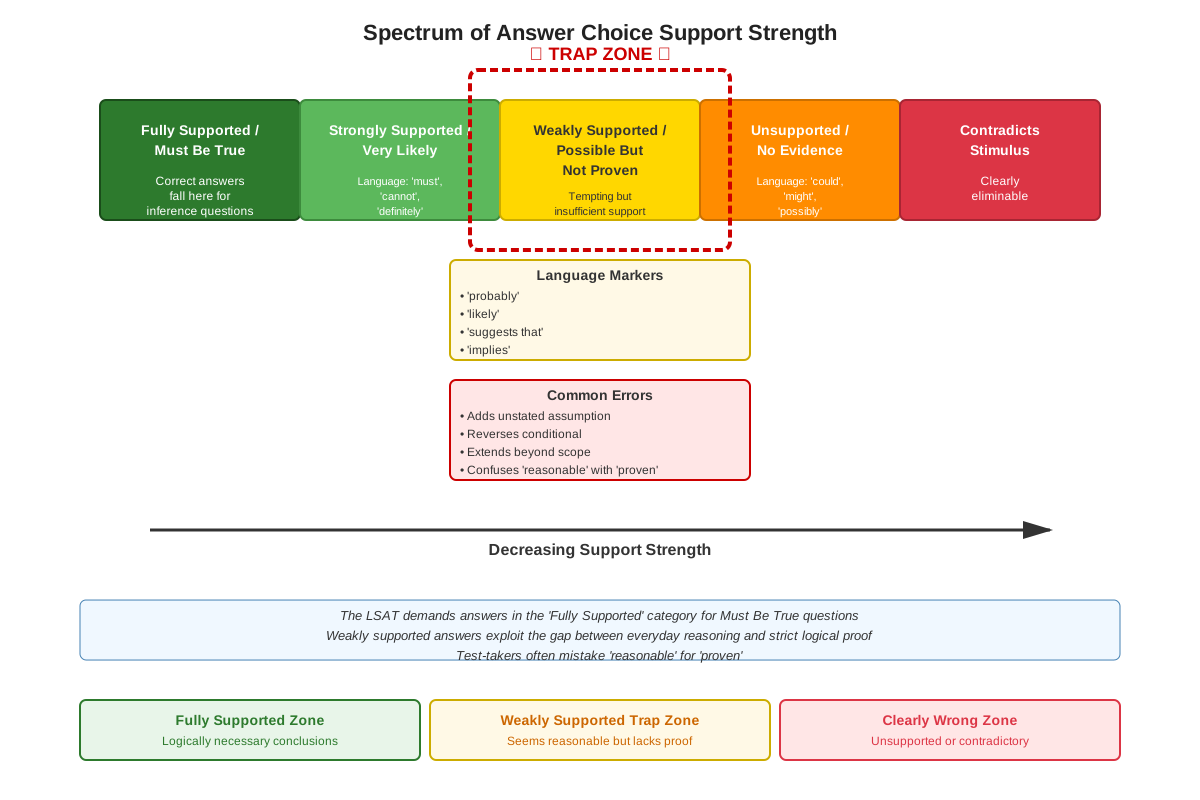
Weakly supported answer traps represent one of the most insidious and frequently encountered wrong answer types on LSAT Logical Reasoning sections, particularly within inference questions. These deceptive answer choices appear plausible at first glance because they relate to the stimulus content and often sound reasonable in everyday conversation. However, they fail the strict logical standard required by the LSAT: they extend beyond what the passage explicitly supports, introduce subtle assumptions, or make claims that are merely possible rather than necessarily true based on the given information.
Understanding and identifying lsat weakly supported answer traps is crucial for achieving a competitive score because these traps are deliberately designed to exploit natural reading tendencies. Test-takers often bring real-world knowledge, make reasonable but unwarranted inferences, or confuse "could be true" with "must be true." The LSAT rewards precision in logical thinking, and weakly supported answers punish those who make even small logical leaps beyond what the text strictly establishes. These traps appear across multiple question types—including Must Be True, Most Strongly Supported, Main Point, and even some Assumption questions—making them a high-frequency obstacle that demands systematic recognition strategies.
Within the broader landscape of Logical Reasoning, weakly supported answer traps connect directly to fundamental skills of textual analysis, conditional reasoning, and the distinction between sufficient and necessary conditions. They test whether students can maintain strict logical discipline when evaluating answer choices, resisting the temptation to "fill in gaps" with common sense or background knowledge. Mastering this topic strengthens overall performance by training students to read with surgical precision and evaluate each answer choice against an exacting standard of proof.
Learning Objectives
- [ ] Identify how weakly supported answer traps appear in LSAT questions
- [ ] Explain the reasoning pattern behind weakly supported answer traps
- [ ] Apply weakly supported answer traps recognition to solve LSAT-style problems accurately
- [ ] Distinguish between strongly supported inferences and weakly supported claims in answer choices
- [ ] Develop a systematic process for testing answer choice support against stimulus content
- [ ] Recognize the specific language patterns and qualifiers that signal weak support
- [ ] Evaluate the degree of logical connection between premises and answer choice claims
Prerequisites
- Basic conditional logic: Understanding "if-then" statements is essential because weakly supported answers often confuse necessary and sufficient conditions or reverse conditional relationships
- Distinction between facts and inferences: Students must recognize the difference between what is explicitly stated versus what can be concluded, as weakly supported answers blur this boundary
- Understanding of inference question types: Familiarity with Must Be True, Most Strongly Supported, and Main Point questions provides the context where these traps most frequently appear
- Concept of logical necessity versus possibility: Recognizing that the LSAT demands what must be true (not merely what could be true) underlies the ability to spot weak support
Why This Topic Matters
Weakly supported answer traps appear with remarkable frequency across LSAT administrations, affecting approximately 40-50% of inference-based questions. These traps are not limited to explicit "Must Be True" questions; they infiltrate Main Point questions (where the answer must be fully supported by the passage), Parallel Reasoning questions (where structural correspondence must be exact), and even some Strengthen/Weaken questions (where the connection between new information and conclusion must be tight). The LSAT test-makers invest considerable effort in crafting these distractors because they effectively separate students who read carefully from those who read casually.
In real-world applications, the skill of identifying weakly supported claims translates directly to legal practice, where attorneys must distinguish between what evidence actually proves versus what it merely suggests. Courts operate on standards of proof, and legal arguments fail when they rest on assumptions or logical leaps. Similarly, in academic research, policy analysis, and business decision-making, the ability to recognize when a conclusion outstrips its supporting evidence prevents costly errors in judgment.
On the LSAT specifically, these traps commonly appear in passages discussing scientific studies (where students might assume causation from correlation), conditional statements (where students reverse or negate incorrectly), comparative claims (where students assume absolute values from relative comparisons), and quantitative reasoning (where students confuse "some" with "most" or "all"). A single weakly supported answer trap can cost valuable points, and because these questions appear throughout both Logical Reasoning sections, mastering this skill yields compound benefits across the entire exam.
Core Concepts
Definition and Characteristics of Weakly Supported Answers
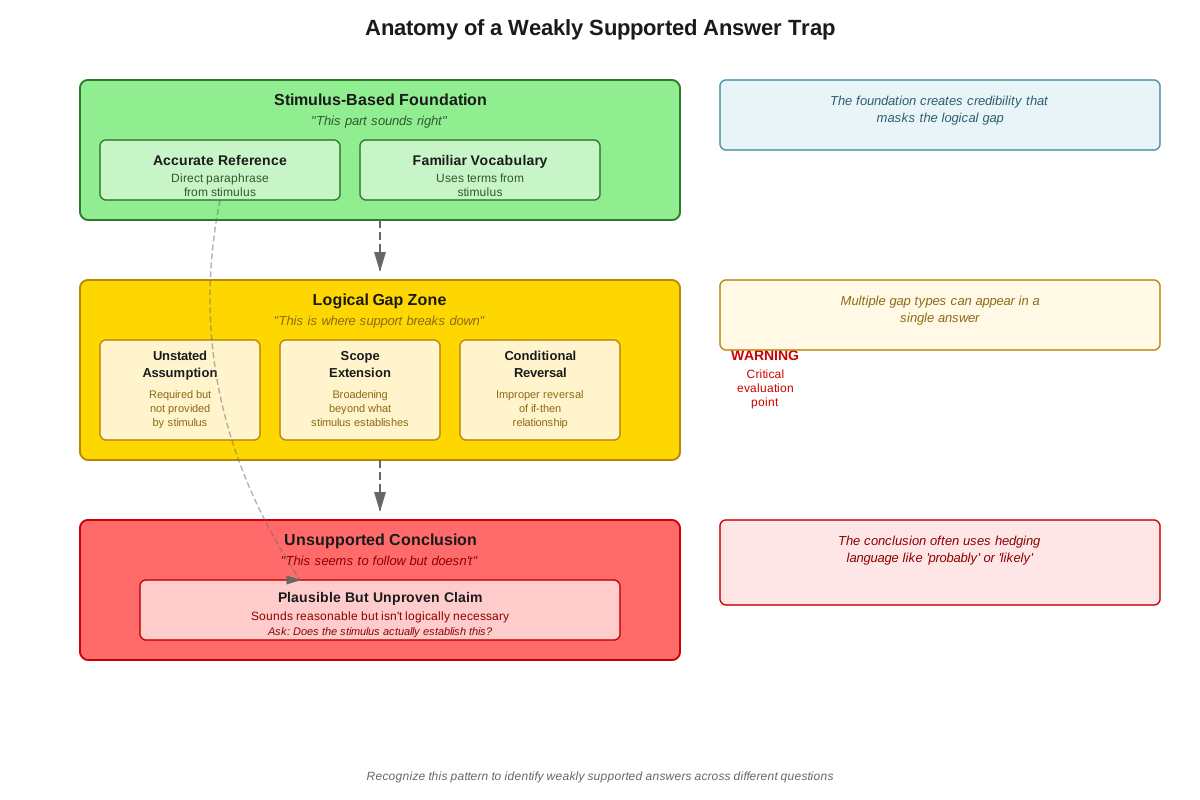
A weakly supported answer trap is an answer choice that makes a claim going beyond what the stimulus logically establishes, even though it may seem plausible, related to the topic, or consistent with common sense. The key characteristic distinguishing these traps from correct answers is the degree of logical support: while correct inference answers are fully justified by the stimulus (meaning they must be true if the stimulus is true), weakly supported answers require additional assumptions, make logical leaps, or introduce information not present in the passage.
These answer choices typically exhibit several identifying features:
- Scope expansion: The answer discusses a broader category, time frame, or population than the stimulus addresses
- Degree inflation: The answer uses stronger language (all, always, never, only) than the stimulus warrants
- Causal assumptions: The answer assumes causation when the stimulus only establishes correlation or temporal sequence
- Unwarranted generalizations: The answer extends a specific example to a universal principle
- Reversed or confused relationships: The answer switches the direction of a conditional or comparative relationship
The Logical Gap: What Makes Support "Weak"
Understanding weak support requires precision about what constitutes adequate logical support. On the LSAT, an answer is strongly supported when accepting the stimulus as true compels acceptance of the answer as true—there is no logical scenario where the stimulus is accurate but the answer is false. Weak support exists when a logical gap appears between stimulus and answer, requiring one or more bridging assumptions to connect them.
Consider this distinction:
| Strongly Supported | Weakly Supported |
|---|---|
| Follows necessarily from stated premises | Requires additional assumptions |
| No logical gap between stimulus and claim | Contains logical leaps |
| Uses language matching stimulus scope | Expands or shifts scope |
| Maintains conditional relationships | Reverses or confuses conditionals |
| Stays within established parameters | Introduces new elements |
The "weakness" in support manifests in several specific patterns:
- Insufficient evidence: The stimulus provides some evidence for the claim but not enough to establish it conclusively
- Mismatched scope: The answer addresses a different group, time, or context than the stimulus discusses
- Unjustified certainty: The answer expresses certainty when the stimulus only suggests possibility
- Assumed connections: The answer treats as established what the stimulus leaves uncertain
Common Manifestations in LSAT Questions
Scope Shifts
Scope shifts represent perhaps the most frequent form of weak support. The stimulus discusses a specific situation, group, or time period, but the answer choice broadens this to a general principle or different context. For example:
- Stimulus: "The new policy reduced traffic accidents in downtown areas by 15%"
- Weakly supported answer: "The new policy will reduce traffic accidents throughout the city"
The logical gap: downtown areas ≠ the entire city. The answer assumes the policy will have similar effects in different contexts without justification.
Degree Mismatches
These traps involve quantifier confusion or strength inflation. The stimulus uses moderate language ("some," "many," "often"), but the answer employs absolute terms ("all," "always," "never," "only"). Alternatively, the stimulus establishes a weak relationship, but the answer claims a strong one.
- Stimulus: "Most successful entrepreneurs have experienced failure"
- Weakly supported answer: "Experiencing failure is necessary for entrepreneurial success"
The logical gap: "most" does not establish necessity. Some successful entrepreneurs might never have experienced failure.
Causal Assumptions
The LSAT frequently tests whether students distinguish correlation from causation. A stimulus might present two events occurring together or in sequence, but a weakly supported answer assumes one caused the other without justification.
- Stimulus: "After the company implemented flexible work hours, employee satisfaction increased"
- Weakly supported answer: "Flexible work hours caused the increase in employee satisfaction"
The logical gap: temporal sequence (after) does not prove causation. Other factors might explain the satisfaction increase, or the relationship might be coincidental.
Conditional Confusion
Conditional logic errors create weak support when answers reverse sufficient and necessary conditions, negate incorrectly, or confuse "if" with "only if." These errors are particularly insidious because they maintain the same terms as the stimulus while fundamentally altering the logical relationship.
- Stimulus: "If a restaurant receives a health code violation, it must close temporarily"
- Weakly supported answer: "If a restaurant closes temporarily, it received a health code violation"
The logical gap: this illegally reverses the conditional. Many reasons besides health violations could cause temporary closure.
Unwarranted Generalizations
These traps extend a specific example to a universal principle or apply a limited finding to a broader population without justification.
- Stimulus: "In three studied cities, increased police presence correlated with reduced property crime"
- Weakly supported answer: "Increased police presence reduces property crime"
The logical gap: three cities do not establish a universal principle. The relationship might not hold in other contexts or might reflect confounding variables specific to those cities.
The Psychology Behind the Trap
Weakly supported answers succeed as traps because they exploit natural cognitive tendencies:
- Confirmation bias: Readers accept claims that align with their existing beliefs or common sense
- Gap-filling: The human brain automatically fills logical gaps, making incomplete arguments seem complete
- Familiarity bias: Answer choices using stimulus language feel correct even when the logic is flawed
- Satisficing: Under time pressure, test-takers accept "good enough" answers rather than demanding perfect support
- Real-world reasoning: Students apply everyday reasoning standards rather than strict logical standards
The LSAT deliberately designs these traps to feel right while being logically insufficient, testing whether students can maintain analytical discipline under pressure.
Concept Relationships
The concept of weakly supported answer traps connects to multiple foundational Logical Reasoning skills in a hierarchical relationship:
Conditional Logic → provides the framework for → Evaluating Logical Necessity → which enables → Distinguishing Strong from Weak Support → which is essential for → Identifying Weakly Supported Answer Traps
Similarly, understanding Scope and Degree → allows recognition of → Scope Shifts and Degree Mismatches → which are specific types of → Weakly Supported Answer Traps
The skill also relates laterally to other wrong answer types:
- Out of Scope answers are extreme cases of weakly supported answers where support is essentially zero
- Reverse Logic answers often involve weak support through conditional confusion
- Extreme answers represent weak support through degree inflation
Within inference questions specifically, the relationship map looks like this:
Stimulus Content → must fully justify → Correct Inference (strong support)
Stimulus Content → partially suggests but doesn't prove → Weakly Supported Trap (logical gap exists)
Stimulus Content → has no connection to → Out of Scope Trap (no support)
Understanding these relationships helps students develop a graduated scale of support evaluation rather than a binary correct/incorrect approach, enabling more nuanced answer choice analysis.
High-Yield Facts
⭐ Weakly supported answers contain logical gaps requiring additional assumptions to connect the stimulus to the conclusion
⭐ Scope shifts—where the answer addresses a broader or different context than the stimulus—represent the most common form of weak support
⭐ The LSAT demands what "must be true," not what "could be true" or "is likely true" based on the stimulus
⭐ Correlation does not establish causation; temporal sequence (A happened, then B happened) does not prove A caused B
⭐ Reversing a conditional statement (if A then B becomes if B then A) creates weak support unless the original statement was biconditional
- Quantifier confusion (treating "some" as "most" or "most" as "all") creates degree mismatches that weaken support
- Language matching between stimulus and answer choice does not guarantee strong support; the logical relationship matters more than vocabulary overlap
- Weakly supported answers often sound reasonable in everyday conversation but fail the strict logical standard required by the LSAT
- Generalizing from a specific example or limited sample to a universal principle requires explicit justification not present in weakly supported answers
- The presence of extreme language (all, always, never, only, must) in an answer choice demands equally strong support in the stimulus
- Weakly supported answers frequently exploit background knowledge or common sense that, while true in the real world, is not established by the stimulus
- Time pressure increases susceptibility to weakly supported traps because they require careful analysis to detect the logical gap
Quick check — test yourself on Weakly supported answer traps so far.
Try Flashcards →Common Misconceptions
Misconception: If an answer choice uses words from the stimulus, it must be well-supported.
Correction: Language matching is a superficial feature that test-makers deliberately use to make weakly supported answers attractive. The logical relationship between stimulus and answer matters far more than vocabulary overlap. An answer can use identical terms while completely distorting the logical structure.
Misconception: If an answer choice seems true based on common sense or real-world knowledge, it's correct.
Correction: The LSAT tests logical reasoning within the closed universe of the stimulus. An answer must be supported by the stimulus alone, regardless of whether it's true in reality. Bringing in outside knowledge is precisely what weakly supported traps exploit.
Misconception: "Most strongly supported" questions allow for some logical gaps or assumptions.
Correction: While "most strongly supported" uses comparative language, the correct answer still must have strong support from the stimulus—stronger than all other options. This phrasing doesn't license accepting answers with significant logical gaps; it simply acknowledges that inference strength can vary. The correct answer will still be tightly connected to the stimulus.
Misconception: If the stimulus discusses causation, any answer about causation is well-supported.
Correction: The stimulus must explicitly establish the causal relationship that the answer claims. If the stimulus only shows correlation, temporal sequence, or association, an answer asserting causation is weakly supported. The direction of causation also matters—the stimulus might support "A causes B" but not "B causes A."
Misconception: Longer, more detailed answer choices are more likely to be correct because they seem more thorough.
Correction: Length and detail are neutral factors. Weakly supported answers are often longer because they include additional claims beyond what the stimulus supports. The extra content creates the logical gap. Evaluate each claim within an answer choice separately for support.
Misconception: If an answer choice is possible given the stimulus, it's adequately supported.
Correction: Possibility is insufficient for LSAT inference questions. The correct answer must be necessary or highly probable based on the stimulus, not merely possible. Many weakly supported traps are technically possible but lack the strong logical connection required.
Misconception: Eliminating obviously wrong answers means the remaining answer must be correct, even if it seems weakly supported.
Correction: This "best of bad options" thinking leads to accepting weakly supported answers. If all answers seem problematic, re-read the stimulus and reconsider the answer choices. The LSAT always includes one answer with genuinely strong support; finding it requires careful analysis, not settling for the "least bad" option.
Worked Examples
Example 1: Scope Shift Trap
Stimulus: "A recent study of 500 college students found that those who took handwritten notes during lectures scored higher on conceptual questions than those who typed notes on laptops. The researchers controlled for prior academic performance and course difficulty."
Question: Which one of the following is most strongly supported by the information above?
Answer Choices:
(A) Handwriting notes causes better conceptual understanding than typing notes
(B) Students who handwrite notes will perform better in their careers than students who type notes
(C) In the study described, students who handwrote notes performed better on conceptual questions than students who typed notes
(D) All students should be required to handwrite rather than type their notes
(E) Typing notes on laptops impairs learning across all educational contexts
Analysis:
(A) is weakly supported due to a causal assumption. The stimulus establishes correlation (handwriters scored higher) but doesn't prove causation. Perhaps students who choose to handwrite differ in other ways that explain the performance difference. The word "causes" requires stronger evidence than correlation provides.
(B) is weakly supported through scope expansion (college lecture performance → career performance) and temporal extension (current behavior → future outcomes). The stimulus provides no information about career performance.
(C) is strongly supported—it precisely restates what the stimulus establishes without adding assumptions or expanding scope. It maintains the specific context (the study), the specific population (students in that study), and the specific finding (better performance on conceptual questions).
(D) is weakly supported through scope expansion (one study → universal policy) and unjustified prescription (descriptive finding → normative recommendation). The stimulus describes one study's findings but doesn't establish that all students in all contexts would benefit.
(E) is weakly supported through scope expansion (college lectures → all educational contexts) and degree inflation (one study's finding → universal impairment). The stimulus addresses one specific context and cannot support claims about "all educational contexts."
Correct Answer: (C)
Key Lesson: The correct answer stays tightly within the bounds of what the stimulus explicitly establishes, while weakly supported traps extend beyond those bounds through scope shifts, causal assumptions, or unjustified generalizations.
Example 2: Conditional Confusion Trap
Stimulus: "The city council will approve the new zoning ordinance only if the environmental impact study shows no significant harm to local wildlife. The environmental impact study has been completed and shows no significant harm to local wildlife."
Question: Which one of the following can be properly concluded from the information above?
Answer Choices:
(A) The city council will approve the new zoning ordinance
(B) The city council has met its necessary condition for approving the new zoning ordinance
(C) If the environmental impact study had shown significant harm, the city council would not have approved the ordinance
(D) The environmental impact study was the only factor the city council considered
(E) No significant harm to local wildlife will result from the new zoning ordinance
Analysis:
The stimulus establishes a conditional: Approve ordinance → No significant harm (using "only if" language, which introduces a necessary condition).
The stimulus also states: No significant harm (the necessary condition is satisfied).
(A) is weakly supported through conditional confusion. The stimulus establishes that "no significant harm" is necessary for approval, but necessary conditions don't guarantee outcomes. The council might require additional conditions beyond the environmental study. This answer illegally affirms the consequent (if A→B and B is true, concluding A is true—a logical fallacy).
(B) is strongly supported. The stimulus establishes "no significant harm" as a necessary condition for approval, and this condition has been met. The answer carefully states the council has met "its necessary condition" (singular), not that all conditions are met, avoiding the logical error in (A).
(C) is weakly supported through contrapositive confusion. While the contrapositive of the original statement would be "Significant harm → No approval," the answer uses conditional language ("would not have approved") that suggests certainty about a counterfactual scenario. The stimulus doesn't establish what the council would have done in alternative circumstances.
(D) is weakly supported through unwarranted assumption. The stimulus mentions one necessary condition but never states this is the "only factor" considered. Other requirements might exist.
(E) is weakly supported through scope shift and temporal confusion. The study shows no significant harm (presumably from current conditions or projections), but the answer makes a predictive claim about future results. Additionally, the study's findings don't guarantee future outcomes.
Correct Answer: (B)
Key Lesson: Conditional logic requires precision. Necessary conditions must be met but don't guarantee outcomes. Weakly supported answers exploit confusion between necessary and sufficient conditions or make unjustified inferences from conditional statements.
Exam Strategy
Systematic Approach to Avoiding Weakly Supported Traps
Step 1: Read the stimulus actively, identifying:
- The scope (who, what, when, where)
- The strength of claims (all, most, some, few)
- Conditional relationships (if-then, only if, unless)
- Evidence type (correlation, causation, example, principle)
Step 2: Predict the answer before reading choices. Ask: "What must be true based on this information?" This prediction serves as an anchor, making weakly supported traps more obvious.
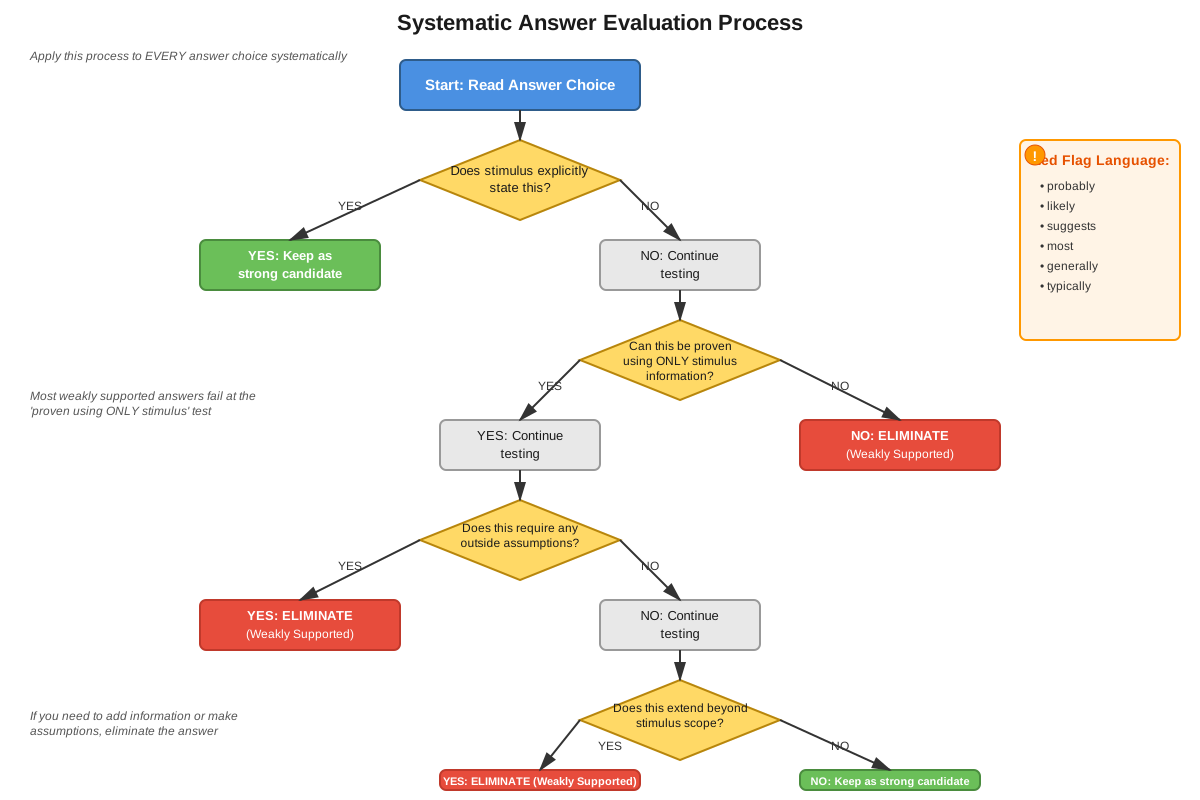
Step 3: Evaluate each answer choice using the "proof standard test":
- Can this be proven false while the stimulus remains true?
- Does this require any assumption beyond the stimulus?
- Does this match the scope, degree, and logical structure of the stimulus?
Step 4: Watch for trigger language that signals potential weak support:
High-Alert Trigger Words: - Causal language: "causes," "results in," "leads to," "produces," "is responsible for" - Absolute quantifiers: "all," "every," "always," "never," "only," "must" - Scope expansions: "in general," "typically," "usually," "everywhere," "everyone" - Temporal extensions: "will," "in the future," "permanently," "from now on"
Step 5: Apply the "reversal test" for conditional statements. If the stimulus says "If A, then B," and an answer says "If B, then A," it's weakly supported unless the original was biconditional.
Step 6: Use process of elimination strategically:
- First pass: Eliminate answers with obvious scope problems or extreme language unsupported by the stimulus
- Second pass: Eliminate answers requiring assumptions or making logical leaps
- Final evaluation: Choose the answer that stays closest to the stimulus language and logic
Time Management
Allocate approximately:
- 30-40 seconds: Reading and understanding the stimulus
- 10-15 seconds: Predicting the answer type
- 45-60 seconds: Evaluating answer choices
- 10-15 seconds: Final verification
If stuck between two answers, both likely have some support. Re-read the stimulus and identify which answer requires fewer assumptions or smaller logical leaps. The correct answer will have the tightest logical connection.
Red Flags During Answer Evaluation
Be immediately suspicious when an answer choice:
- Introduces new concepts not mentioned in the stimulus
- Uses stronger language than the stimulus supports
- Discusses a different group, time, or context than the stimulus
- Assumes causation when the stimulus only shows correlation
- Reverses or negates a conditional relationship
- Generalizes from a specific example without justification
Memory Techniques
The SCOPE Acronym
Use SCOPE to remember the five most common types of weak support:
- Scope shifts (broader or different context)
- Causal assumptions (correlation ≠ causation)
- Overstated claims (degree inflation)
- Premise reversal (conditional confusion)
- Extrapolation (unjustified generalization)
The "Proof Standard" Visualization
Imagine the stimulus as a spotlight illuminating a specific area. The correct answer stays within the illuminated zone. Weakly supported answers venture into the shadows, requiring you to make assumptions about what's there. If you can't "see" the answer clearly in the stimulus light, it's weakly supported.
The Three-Question Filter
Before selecting an answer, ask:
- "Says who?" – Does the stimulus actually make this claim, or am I assuming it?
- "Says when/where?" – Does this match the stimulus scope, or am I expanding it?
- "Says how strongly?" – Does the stimulus support this degree of certainty?
If you can't answer all three questions affirmatively using only stimulus content, the answer is weakly supported.
The Causation Checker
Remember: "After ≠ Because"
When you see temporal language (after, then, following, subsequently), don't automatically assume causation. The stimulus must explicitly establish the causal relationship, not just the sequence.
Summary
Weakly supported answer traps represent a critical challenge in LSAT Logical Reasoning, appearing frequently across inference questions and testing whether students can maintain strict logical discipline when evaluating answer choices. These traps succeed by appearing plausible—they relate to the stimulus topic, often use similar language, and may align with common sense or real-world knowledge. However, they fail the LSAT's exacting standard by containing logical gaps between stimulus and conclusion. The five primary manifestations are scope shifts (expanding context or population), causal assumptions (inferring causation from correlation), degree mismatches (using stronger language than justified), conditional confusion (reversing or misapplying if-then relationships), and unwarranted generalizations (extending specific examples to universal principles). Success requires reading stimuli with precision, identifying their exact scope and logical structure, and evaluating each answer choice against a "proof standard"—asking whether the stimulus fully justifies the claim without additional assumptions. Students must resist natural cognitive tendencies to fill logical gaps, apply background knowledge, or accept "good enough" answers under time pressure. Mastering weakly supported answer trap recognition strengthens overall Logical Reasoning performance by developing the analytical precision that distinguishes top scorers.
Key Takeaways
- Weakly supported answers contain logical gaps requiring assumptions beyond what the stimulus provides, even though they may seem plausible or relate to the topic
- The five most common patterns are scope shifts, causal assumptions, degree mismatches, conditional confusion, and unwarranted generalizations (remember: SCOPE)
- The LSAT demands what "must be true" based on the stimulus alone, not what "could be true" or aligns with common sense
- Correlation and temporal sequence do not establish causation without explicit evidence; "after" does not mean "because"
- Correct answers stay tightly within the stimulus scope, degree, and logical structure, while weakly supported traps venture beyond these boundaries
- Language matching between stimulus and answer is superficial; the logical relationship determines support strength
- Systematic evaluation using the "proof standard test" (Can this be proven false while the stimulus remains true?) identifies weak support reliably
Related Topics
Sufficient vs. Necessary Assumptions: Understanding the distinction between assumptions required for an argument to work (necessary) versus those that would guarantee the conclusion (sufficient) builds on weak support recognition by examining what's missing rather than what's present.
Strengthen and Weaken Questions: These question types require evaluating how new information affects argument support, directly applying the skill of assessing support strength developed through weakly supported trap recognition.
Flaw Questions: Many logical flaws involve the same patterns as weakly supported answers—scope shifts, causal assumptions, and conditional confusion—making this topic excellent preparation for identifying reasoning errors.
Parallel Reasoning: These questions demand precise matching of logical structure, requiring the same attention to scope, degree, and conditional relationships that identifies weakly supported answers.
Mastering weakly supported answer traps provides a foundation for these advanced topics by developing the core skill of evaluating logical connections with precision and rigor.
Practice CTA
Now that you understand how weakly supported answer traps function and how to identify them systematically, it's time to apply these concepts to actual LSAT questions. The practice questions and flashcards will reinforce your ability to spot scope shifts, causal assumptions, and other weak support patterns under timed conditions. Remember: recognizing these traps is a learnable skill that improves with deliberate practice. Each question you analyze strengthens your logical precision and builds the pattern recognition that leads to consistent high performance. Approach the practice materials with the systematic evaluation process outlined in this guide, and you'll develop the analytical discipline that distinguishes top scorers on test day.
Sign up free to keep reading
Create a free AnvayaPrep account to finish this LSAT guide on Weakly supported answer traps — plus flashcards and practice questions.