Overview
Appeal to principle is a fundamental reasoning pattern that appears frequently in LSAT Logical Reasoning sections, particularly within method, role, and structure questions. This pattern involves invoking a general rule, moral standard, or universal guideline to support a specific conclusion or to justify a particular action or judgment. When an argument appeals to principle, it moves from the abstract (a broad principle) to the concrete (a specific case), using the principle as the logical foundation for the conclusion.
Understanding how to identify and analyze appeals to principle is crucial for LSAT success because this reasoning structure appears across multiple question types, including Method of Reasoning questions (which ask how an argument proceeds), Role of Statement questions (which ask what function a particular claim serves), and Argument Structure questions (which require mapping the logical architecture of an argument). The LSAC frequently tests whether students can recognize when an arguer is grounding their position in a general principle rather than relying solely on empirical evidence, analogies, or other reasoning methods.
The lsat appeal to principle pattern connects to broader concepts in logical reasoning, including the distinction between general and specific claims, the application of rules to cases, and the evaluation of whether principles have been correctly applied. Mastering this topic enables students to quickly identify argument structures, predict correct answer choices, and eliminate distractors that mischaracterize how an argument actually proceeds. This skill is particularly valuable because appeals to principle often appear in complex arguments that combine multiple reasoning strategies, requiring students to parse which elements serve which functions.
Learning Objectives
- [ ] Identify how Appeal to principle appears in LSAT questions
- [ ] Explain the reasoning pattern behind Appeal to principle
- [ ] Apply Appeal to principle to solve LSAT-style problems accurately
- [ ] Distinguish appeals to principle from other reasoning patterns (such as appeals to authority, analogical reasoning, or causal arguments)
- [ ] Recognize when a principle is being established versus when it is being applied
- [ ] Evaluate whether a specific case genuinely falls under the scope of an invoked principle
Prerequisites
- Basic argument structure: Understanding premises and conclusions is essential because appeals to principle function as a specific type of premise that supports a conclusion through general rules.
- Conditional reasoning: Familiarity with if-then statements helps recognize how principles often take conditional form (e.g., "If X, then Y should follow").
- Distinction between general and specific claims: Recognizing the difference between universal statements and particular instances is necessary to identify when an argument moves from principle to application.
- Question stem interpretation: Knowing what different Logical Reasoning question types ask for enables proper identification of when principle-based reasoning is relevant to the answer.
Why This Topic Matters
Appeals to principle represent one of the most common reasoning structures in legal, ethical, and policy arguments—precisely the domains the LSAT emphasizes. Legal reasoning fundamentally involves applying general laws and precedents (principles) to specific cases, making this pattern central to the skills law schools seek in applicants. Understanding this reasoning structure prepares students not only for the LSAT but for the case-method analysis used throughout legal education.
On the LSAT, appeals to principle appear in approximately 15-20% of Logical Reasoning questions, making them high-yield content for score improvement. They most frequently appear in:
- Method of Reasoning questions: "The argument proceeds by..." or "The technique employed is..."
- Role of Statement questions: "The claim that [X] plays which role in the argument?"
- Principle questions: Both "Which principle justifies the reasoning?" and "Which principle is illustrated by the argument?"
- Parallel Reasoning questions: Where matching the principle-to-application structure is key
The pattern appears across diverse content areas—from ethical dilemmas to policy debates to scientific methodology—making it a versatile analytical tool. Students who can quickly spot appeals to principle gain significant time advantages, as they can immediately narrow answer choices to those that reference general rules or standards rather than other reasoning methods.
Core Concepts
The Basic Structure of Appeal to Principle
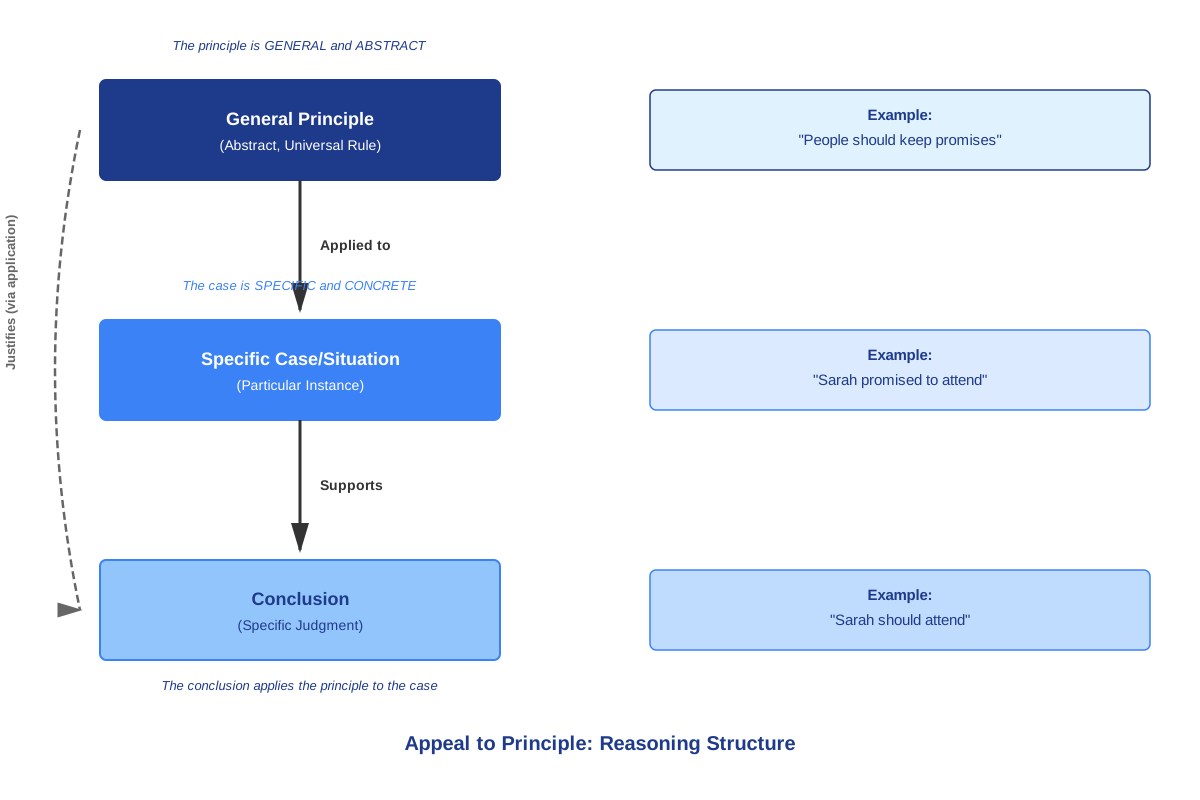
An appeal to principle follows a characteristic logical structure: the argument presents or assumes a general rule, standard, or guideline, then applies that principle to a specific situation to reach a conclusion. The principle serves as the warrant that bridges the specific facts of the case to the conclusion drawn.
The basic pattern can be represented as:
- General Principle: A universal or broadly applicable rule (e.g., "Actions that harm others without their consent are wrong")
- Specific Case: A particular situation or instance (e.g., "This policy would harm citizens without their consent")
- Conclusion: The application of the principle to the case (e.g., "Therefore, this policy is wrong")
The principle functions as a major premise in what resembles a syllogistic structure, though LSAT arguments often leave the principle implicit, requiring test-takers to identify the underlying principle that makes the argument work.
Explicit vs. Implicit Principles
Appeals to principle can be either explicit (stated directly in the argument) or implicit (assumed but not stated). Recognizing this distinction is crucial for different question types.
Explicit appeals directly state the principle being invoked:
"Any law that restricts freedom of expression should be rejected. The proposed ordinance restricts freedom of expression. Therefore, it should be rejected."
Here, the principle is clearly stated in the first sentence, and the argument transparently applies it to reach the conclusion.
Implicit appeals rely on unstated principles that the argument assumes:
"The proposed ordinance restricts freedom of expression, so it should be rejected."
This argument assumes the same principle as above but doesn't state it explicitly. Method of Reasoning questions often test whether students can recognize that an implicit principle is operating, while Principle questions may ask students to identify what principle would justify or support the reasoning.
Principles as Conditional Statements
Many principles take the form of conditional statements, establishing that if certain conditions are met, certain consequences should follow. Understanding this conditional structure helps identify appeals to principle and evaluate whether they've been correctly applied.
Common conditional principle structures include:
- "Whenever X occurs, Y should follow"
- "All instances of X merit treatment Y"
- "If something has property X, then it should be classified as Y"
- "Any action that produces result X is justified/unjustified"
For example: "Any policy that benefits the majority at the expense of a minority is unjust" establishes a conditional: IF [policy benefits majority at minority's expense] THEN [policy is unjust].
The Application Step
The critical move in an appeal to principle is the application step—demonstrating that the specific case falls within the scope of the general principle. This step requires showing that the particular situation possesses the relevant characteristics specified in the principle.
Strong applications clearly establish the connection:
"Mandatory retirement policies benefit the majority of workers by creating job openings, but they do so at the expense of older workers who wish to continue working. Since any policy that benefits the majority at the expense of a minority is unjust, mandatory retirement policies are unjust."
Weak or flawed applications may fail to establish that the case genuinely meets the principle's conditions, creating a logical gap that LSAT questions frequently exploit.
Types of Principles Invoked
LSAT arguments appeal to various categories of principles:
| Principle Type | Description | Example |
|---|---|---|
| Moral/Ethical | Standards of right and wrong conduct | "Deception is wrong when it harms others" |
| Legal | Rules about rights, obligations, and justice | "Citizens have a right to due process" |
| Practical/Prudential | Guidelines for effective action | "Policies should be judged by their consequences" |
| Epistemic | Standards for knowledge and belief | "Claims require evidence proportional to their extraordinariness" |
| Aesthetic | Standards for artistic or design judgment | "Good design prioritizes function over form" |
Recognizing the type of principle helps predict what kind of application will follow and what objections might arise.
Distinguishing Appeals to Principle from Other Reasoning Patterns
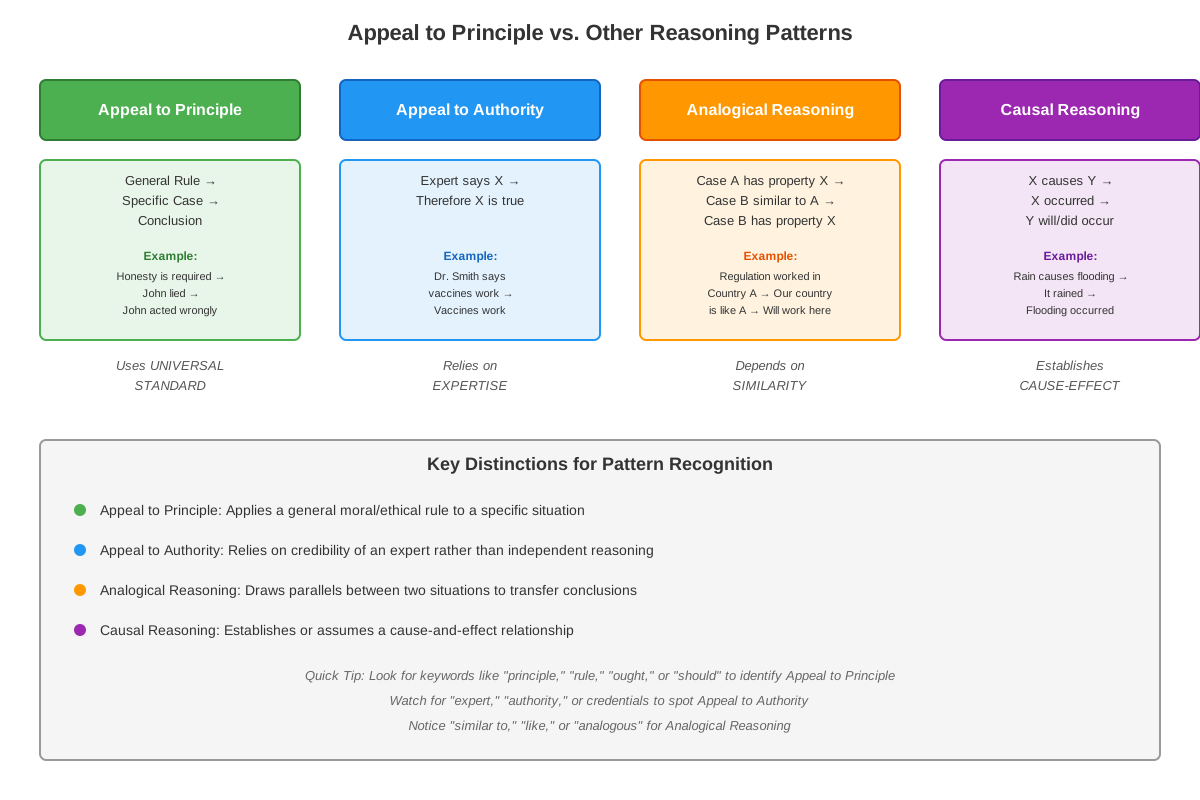
Appeals to principle must be distinguished from other common LSAT reasoning patterns:
Appeal to Principle vs. Appeal to Authority: An appeal to authority cites an expert's opinion as evidence ("Dr. Smith says X, therefore X"), while an appeal to principle invokes a general rule ("According to the principle that Y, X follows").
Appeal to Principle vs. Analogical Reasoning: Analogical reasoning argues that because two cases are similar, what's true of one is true of the other. Appeals to principle argue that a general rule applies to a specific case, not that two specific cases resemble each other.
Appeal to Principle vs. Causal Reasoning: Causal arguments establish that one event brings about another. Appeals to principle establish that a normative standard applies to a situation, determining what should be done or how something should be judged.
Concept Relationships
The concepts within appeals to principle form a hierarchical structure: General Principles (the broadest level) → Application Criteria (the conditions that must be met) → Specific Cases (particular instances) → Conclusions (judgments about those cases). Understanding this hierarchy helps identify where arguments might go wrong—typically either the principle itself is questionable, or the application step fails to establish that the case genuinely meets the principle's criteria.
Appeals to principle connect to conditional reasoning because principles often take conditional form, requiring students to identify sufficient and necessary conditions. They relate to assumption questions because implicit principles function as unstated assumptions that must hold for the argument to work. They connect to strengthen/weaken questions because showing that a case does or doesn't meet a principle's criteria can strengthen or weaken the argument's application.
The relationship map flows: Conditional Logic → enables recognition of → Principle Structure → which guides → Application Analysis → which determines → Conclusion Validity → which informs → Answer Selection in method, role, and structure questions.
High-Yield Facts
⭐ Appeals to principle invoke general rules or standards to support conclusions about specific cases—this is the defining characteristic that distinguishes them from other reasoning patterns.
⭐ Method of Reasoning questions frequently test whether students can identify that an argument "appeals to a general principle" or "applies a broad standard"—these phrases are common in correct answer choices.
⭐ The principle can be either explicitly stated or implicitly assumed—different question types test recognition of each form.
⭐ The application step must establish that the specific case meets the conditions specified in the principle—gaps in this step are common flaws.
⭐ Principles often take conditional form (if-then structure)—recognizing this helps identify both the principle and its proper application.
- Appeals to principle differ from appeals to authority, which cite expert opinion rather than general rules.
- Role of Statement questions may ask students to identify that a particular claim "states a principle that the argument applies" or "provides a general standard."
- Principles can be moral, legal, practical, epistemic, or aesthetic—the category doesn't change the basic reasoning structure.
- Multiple principles can operate in a single argument, requiring careful parsing of which principle supports which conclusion.
- Incorrect answer choices in Method questions often confuse appeals to principle with analogical reasoning or causal arguments.
Quick check — test yourself on Appeal to principle so far.
Try Flashcards →Common Misconceptions
Misconception: Any mention of a general statement constitutes an appeal to principle. → Correction: An appeal to principle specifically involves invoking a general rule or standard to justify a conclusion about a specific case. General statements that merely provide background information or context don't constitute appeals to principle unless they function as normative standards being applied.
Misconception: Appeals to principle are the same as appeals to authority. → Correction: Appeals to authority cite expert testimony or institutional positions as evidence, while appeals to principle invoke general rules or standards. "Dr. Jones says X" is an appeal to authority; "According to the principle that Y, X follows" is an appeal to principle, even if Dr. Jones stated the principle.
Misconception: If an argument contains a conditional statement, it must be appealing to principle. → Correction: Not all conditional reasoning involves appeals to principle. Conditional statements can describe causal relationships, make predictions, or establish logical connections without invoking normative standards. Appeals to principle specifically use general rules (which may be conditional) to justify judgments about cases.
Misconception: The principle must be explicitly stated to count as an appeal to principle. → Correction: Many appeals to principle rely on implicit, unstated principles. Method of Reasoning questions often have correct answers like "applies an unstated general principle" or "relies on an implicit standard."
Misconception: Identifying an appeal to principle means the argument is valid or strong. → Correction: Recognizing that an argument appeals to principle describes its structure, not its quality. The principle itself might be questionable, or the application might be flawed. Method and structure questions ask how an argument proceeds, not whether it succeeds.
Misconception: Appeals to principle only appear in ethical or moral arguments. → Correction: While moral principles are common, appeals to principle appear across all domains—scientific methodology, legal reasoning, policy analysis, aesthetic judgment, and practical decision-making all invoke general standards applied to specific cases.
Worked Examples
Example 1: Identifying an Appeal to Principle in a Method Question
Argument: "The city council's decision to close the community center was unjust. After all, any decision that disproportionately harms the most vulnerable members of the community without providing them alternative resources is unjust, and the closure of the community center does exactly that—it eliminates services that low-income families depend on without offering any alternatives."
Question: The argument proceeds by
(A) citing expert testimony to support a controversial claim
(B) drawing an analogy between the current situation and a past case
(C) applying a general principle to a specific case
(D) demonstrating that the opposing view leads to a contradiction
(E) providing statistical evidence for a causal relationship
Analysis:
Step 1: Identify the conclusion: "The city council's decision to close the community center was unjust."
Step 2: Identify the reasoning structure. The argument presents a general principle: "Any decision that disproportionately harms the most vulnerable members of the community without providing them alternative resources is unjust."
Step 3: Identify the application. The argument then shows that the specific case (closing the community center) meets the conditions specified in the principle: it harms vulnerable community members (low-income families) without providing alternatives.
Step 4: Recognize the pattern. This is a classic appeal to principle structure: General Rule → Specific Case meets conditions of rule → Conclusion follows from applying rule to case.
Step 5: Evaluate answer choices:
- (A) is incorrect—no expert is cited
- (B) is incorrect—no comparison to another case is made
- (C) is correct—this precisely describes the reasoning structure
- (D) is incorrect—no contradiction is demonstrated
- (E) is incorrect—no statistical evidence or causal relationship is established
Answer: (C)
Connection to Learning Objectives: This example demonstrates how to identify appeals to principle in Method of Reasoning questions and apply the recognition of this pattern to eliminate incorrect answers and select the correct characterization of the argument's structure.
Example 2: Distinguishing Explicit from Implicit Principles
Argument A: "The proposed surveillance program should be rejected. It would monitor citizens' communications without individualized suspicion of wrongdoing, and any program that monitors citizens without individualized suspicion violates fundamental privacy rights."
Argument B: "The proposed surveillance program should be rejected because it would monitor citizens' communications without individualized suspicion of wrongdoing."
Analysis:
Both arguments reach the same conclusion and cite the same specific fact (monitoring without individualized suspicion), but they differ in how explicitly they state the principle.
Argument A contains an explicit appeal to principle. The principle is directly stated: "any program that monitors citizens without individualized suspicion violates fundamental privacy rights." The argument's structure is transparent: it states the principle, shows the case meets the principle's conditions, and draws the conclusion.
Argument B contains an implicit appeal to principle. The same principle operates (that monitoring without individualized suspicion is wrong), but it's not stated—it's assumed. The argument expects readers to supply the principle that connects the premise (the program monitors without suspicion) to the conclusion (it should be rejected).
For a Method of Reasoning question about Argument A, the correct answer might say "applies an explicitly stated general principle." For Argument B, it might say "relies on an unstated assumption about privacy rights" or "applies an implicit standard."
For a Principle question asking "Which principle, if valid, would most justify the reasoning?" both arguments would be supported by the same principle, but only Argument B would need it supplied, since Argument A already states it.
Connection to Learning Objectives: This example illustrates the distinction between explicit and implicit principles and shows how this distinction affects different question types, demonstrating the ability to explain the reasoning pattern behind appeals to principle.
Exam Strategy
Trigger Words and Phrases
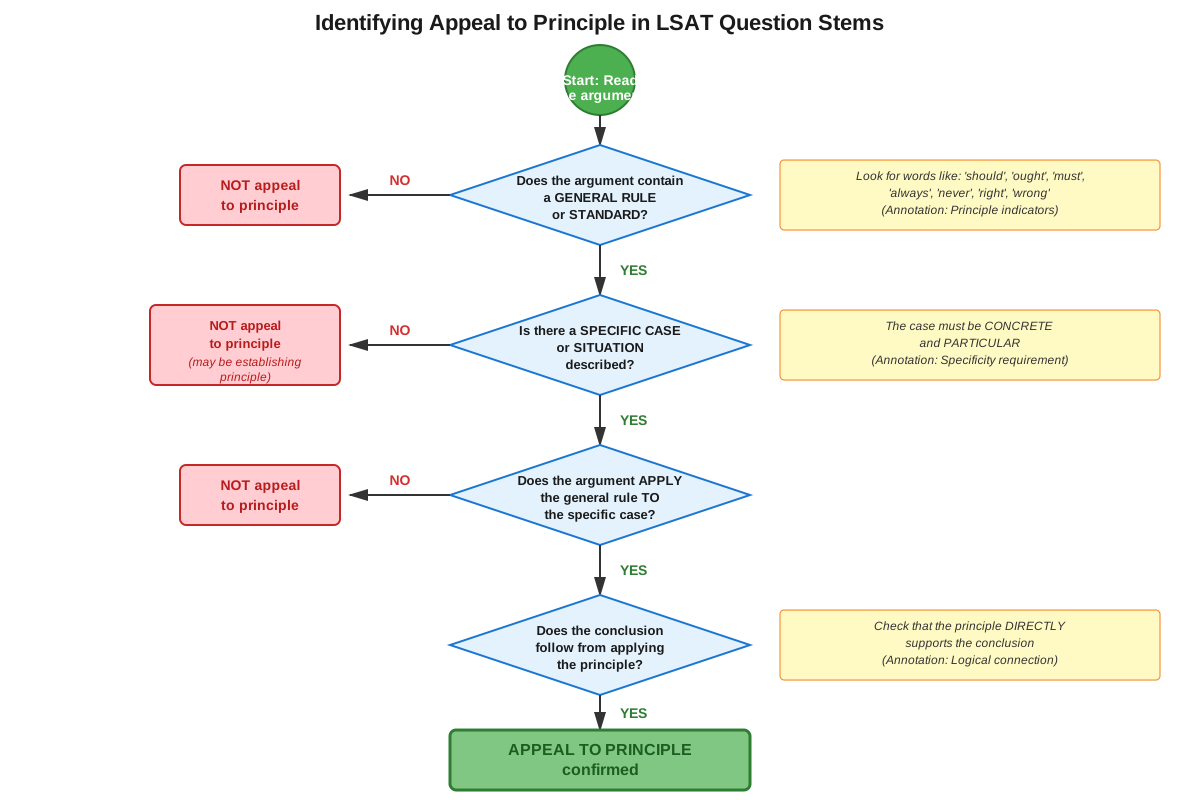
When reading LSAT arguments, watch for language that signals an appeal to principle:
- "Any [X] that [condition] should/must [consequence]"
- "All instances of [X] are [Y]"
- "Whenever [condition], then [consequence]"
- "It is a fundamental principle that..."
- "According to the standard that..."
- "Based on the rule that..."
- "The principle of [X] requires/demands/suggests..."
In answer choices for Method of Reasoning questions, look for:
- "appeals to a general principle"
- "applies a broad standard"
- "invokes a universal rule"
- "relies on a general guideline"
- "cites a widely accepted principle"
Approach Strategy
- Identify the conclusion first: Know what the argument is trying to establish.
- Look for general statements: Scan for universal claims, rules, or standards—these are candidate principles.
- Check for application: Determine whether the argument shows that a specific case meets the principle's conditions.
- Verify the pattern: Confirm that the reasoning moves from general (principle) to specific (case) rather than specific to specific (analogy) or cause to effect (causal reasoning).
- Match to question type: For Method questions, look for answer choices describing principle application. For Role questions, identify whether a statement is the principle itself or part of the application step.
Process of Elimination Tips
Eliminate answers that describe the wrong reasoning pattern:
- If the argument appeals to principle, eliminate answers mentioning analogy, authority, or causation
- If no expert is cited, eliminate "appeals to authority"
- If no comparison between cases is made, eliminate "draws an analogy"
Watch for scope mismatches:
- Answers that say "establishes a new principle" when the argument applies an existing one
- Answers that say "questions a principle" when the argument accepts and applies it
Be precise about explicit vs. implicit:
- If the principle is clearly stated, eliminate answers saying "relies on an unstated assumption" (unless they're asking about a different assumption)
- If the principle isn't stated, eliminate answers saying "explicitly invokes a principle"
Time Allocation
Appeals to principle questions typically require 60-90 seconds:
- 20-30 seconds: Read and understand the argument structure
- 15-20 seconds: Identify the principle and application
- 25-40 seconds: Evaluate answer choices using elimination
If you quickly recognize the appeal to principle pattern, you can often eliminate 3-4 answer choices immediately, leaving only 1-2 serious contenders.
Memory Techniques
The "GPS" Mnemonic
Remember GPS for the structure of appeals to principle:
- General principle (the rule or standard)
- Particular case (the specific situation)
- Specific conclusion (the judgment reached by applying the principle)
When you see an argument, check whether it follows the GPS route from general to particular to specific conclusion.
The "PRINCIPLE" Acronym
Premise that's general
Rule or standard stated/assumed
Invoked to justify
Normative judgment
Connecting general to
Individual case
Producing a
Logical conclusion about
Ethics, law, or policy
Visualization Strategy
Picture a pyramid structure:
- Top (broad): The general principle
- Middle (narrowing): The application criteria
- Bottom (specific): The particular case and conclusion
Arguments that appeal to principle move down the pyramid from broad to specific. This contrasts with analogical reasoning (which moves horizontally between two specific cases) and inductive reasoning (which moves up from specific instances to general conclusions).
The "Rule Book" Metaphor
Think of principles as rules in a rule book. An appeal to principle:
- Opens the rule book to a specific rule
- Checks whether the current situation matches the rule's conditions
- Applies the rule's consequence to the situation
This metaphor helps distinguish appeals to principle (consulting the rule book) from appeals to authority (asking an expert) or analogical reasoning (comparing to a previous game).
Summary
Appeals to principle represent a fundamental reasoning pattern in LSAT Logical Reasoning, particularly within method, role, and structure questions. This pattern involves invoking a general rule, standard, or guideline and applying it to a specific case to reach a conclusion. The principle functions as a bridge between the particular facts of a situation and the judgment or conclusion drawn about it. Principles may be explicitly stated or implicitly assumed, and they frequently take conditional form, establishing that when certain conditions are met, certain consequences should follow. Recognizing appeals to principle requires distinguishing them from other reasoning patterns such as appeals to authority, analogical reasoning, and causal arguments. The key identifying feature is the movement from a general normative standard to a specific application, following the structure: general principle → specific case meets principle's conditions → conclusion follows. Mastering this pattern enables rapid identification of argument structure, accurate prediction of correct answer choices in Method and Role questions, and efficient elimination of distractors that mischaracterize how arguments proceed. Success requires both recognizing the pattern and understanding the application step that connects principle to case.
Key Takeaways
- Appeals to principle invoke general rules or standards to support conclusions about specific cases—this is the defining structural feature that appears across multiple question types.
- The reasoning pattern follows GPS: General principle → Particular case → Specific conclusion, moving from broad standards to individual applications.
- Principles can be explicit (directly stated) or implicit (assumed but unstated), and different question types test recognition of each form.
- The critical application step must establish that the specific case genuinely meets the conditions specified in the principle—gaps here represent common argument flaws.
- Appeals to principle differ from appeals to authority, analogical reasoning, and causal arguments—recognizing these distinctions enables accurate answer selection in Method of Reasoning questions.
- Trigger phrases like "any X that Y should Z" and "according to the principle that" signal appeals to principle in both arguments and answer choices.
- This pattern appears in approximately 15-20% of Logical Reasoning questions, making it high-yield content for score improvement across Method, Role, Principle, and Parallel Reasoning question types.
Related Topics
Conditional Reasoning: Since principles often take conditional form, deepening understanding of sufficient and necessary conditions enhances the ability to analyze principle-based arguments and identify when applications are valid or flawed.
Necessary Assumption Questions: Implicit principles function as necessary assumptions, so mastering appeals to principle provides tools for identifying unstated premises that arguments require.
Strengthen and Weaken Questions: Understanding how principles apply to cases enables recognition of how additional information can strengthen (by confirming the case meets the principle's conditions) or weaken (by showing it doesn't) principle-based arguments.
Parallel Reasoning Questions: These questions often require matching the structure of appeals to principle, making this topic essential for identifying arguments with parallel logical architecture.
Principle Questions: Both "Which principle justifies the reasoning?" and "Which case illustrates the principle?" directly test understanding of appeals to principle, making this foundational knowledge for an entire question category.
Practice CTA
Now that you understand the structure and application of appeals to principle, it's time to cement your mastery through active practice. Work through the practice questions to test your ability to identify this reasoning pattern in various contexts and question types. Use the flashcards to reinforce the key distinctions and trigger phrases that signal appeals to principle. Remember: recognizing this pattern quickly and accurately will save you valuable time on test day and significantly improve your performance on Method, Role, and Structure questions. Each practice question you complete strengthens your pattern recognition and builds the automaticity that leads to top scores. You've learned the framework—now apply it!
Sign up free to keep reading
Create a free AnvayaPrep account to finish this LSAT guide on Appeal to principle — plus flashcards and practice questions.