Overview
Argument organization is a critical skill tested on the LSAT Logical Reasoning section, appearing in questions that ask test-takers to identify how an argument is structured, what role specific statements play, or what method of reasoning an author employs. These questions—collectively known as method, role, and structure questions—require students to step back from evaluating whether an argument is good or bad and instead focus on describing how the argument works. Rather than assessing truth or validity, students must recognize the architectural blueprint of reasoning: which parts serve as evidence, which parts are conclusions, how objections are handled, and what argumentative techniques the author deploys.
Understanding lsat argument organization is essential because these questions constitute approximately 10-15% of all Logical Reasoning questions on any given LSAT. Unlike assumption or strengthen/weaken questions that ask about content, argument organization questions test pure structural analysis—the ability to dissect reasoning into its component parts and label each piece accurately. This skill is foundational because recognizing argument structure improves performance across all logical reasoning question types. When students can quickly identify premises, conclusions, counterarguments, and supporting evidence, they process arguments more efficiently and avoid common traps in every question category.
The relationship between argument organization and other Logical Reasoning concepts is hierarchical and foundational. Before students can identify assumptions, strengthen arguments, or spot flaws, they must first understand what role each statement plays in the argument's architecture. Argument organization serves as the skeleton upon which all other logical reasoning skills are built. Mastering this topic enables students to approach complex arguments systematically, breaking down intimidating passages into manageable, labeled components that reveal the author's reasoning strategy.
Learning Objectives
- [ ] Identify how Argument organization appears in LSAT questions
- [ ] Explain the reasoning pattern behind Argument organization
- [ ] Apply Argument organization to solve LSAT-style problems accurately
- [ ] Distinguish between premises, conclusions, intermediate conclusions, and background information in complex arguments
- [ ] Recognize and categorize common argumentative techniques (analogy, counterexample, elimination, etc.)
- [ ] Analyze multi-layered arguments with nested reasoning structures
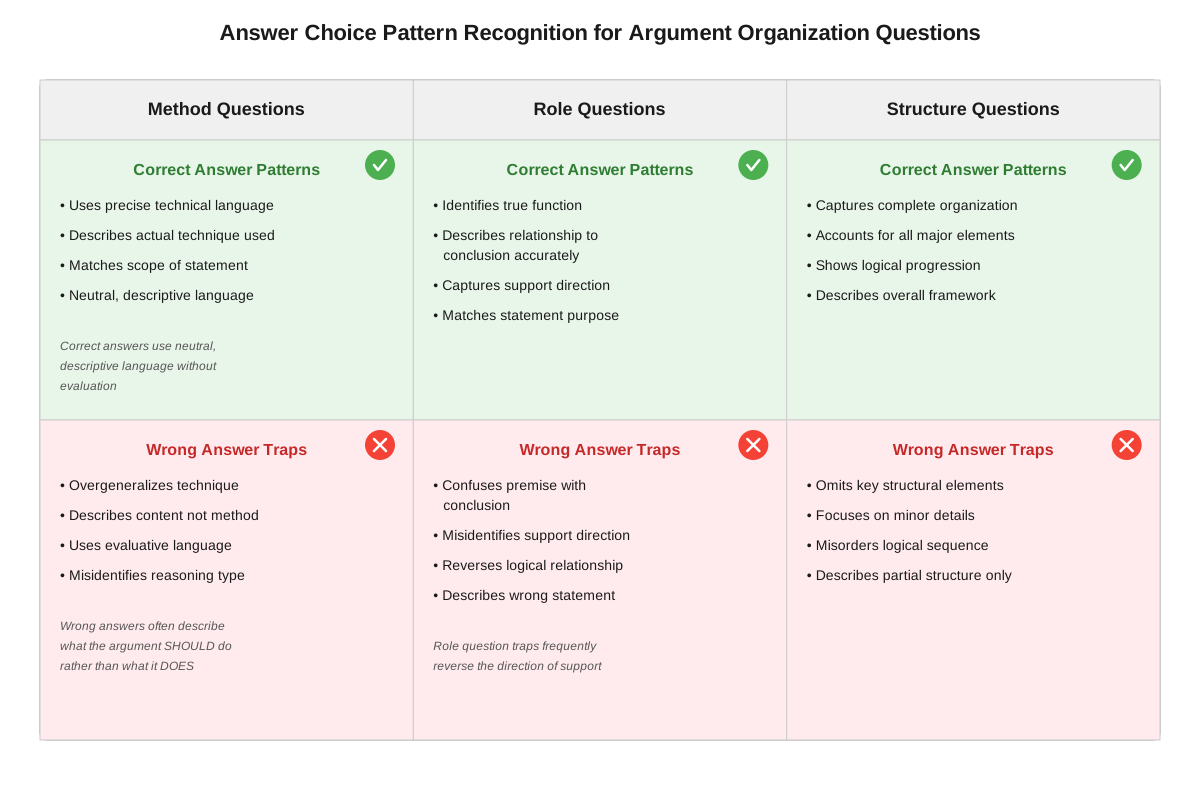
- [ ] Predict answer choice patterns for method, role, and structure questions
Prerequisites
- Basic argument structure: Understanding what constitutes a premise and conclusion is essential because argument organization builds on identifying these fundamental components
- Indicator words: Familiarity with conclusion indicators (therefore, thus, hence) and premise indicators (because, since, for) helps students quickly map argument structure
- Reading comprehension: The ability to parse complex sentences and identify main ideas enables students to distinguish between structural elements rather than getting lost in content
- Logical relationships: Understanding how statements support or oppose each other provides the foundation for recognizing how arguments are organized
Why This Topic Matters
In legal reasoning—the domain the LSAT prepares students for—understanding how arguments are constructed is as important as evaluating their merit. Lawyers must analyze opposing counsel's reasoning structure, identify where evidence fits in their own arguments, and recognize when a judge is offering a main holding versus supporting dicta. The skill of dissecting argument organization translates directly to case analysis, legal writing, and oral advocacy.
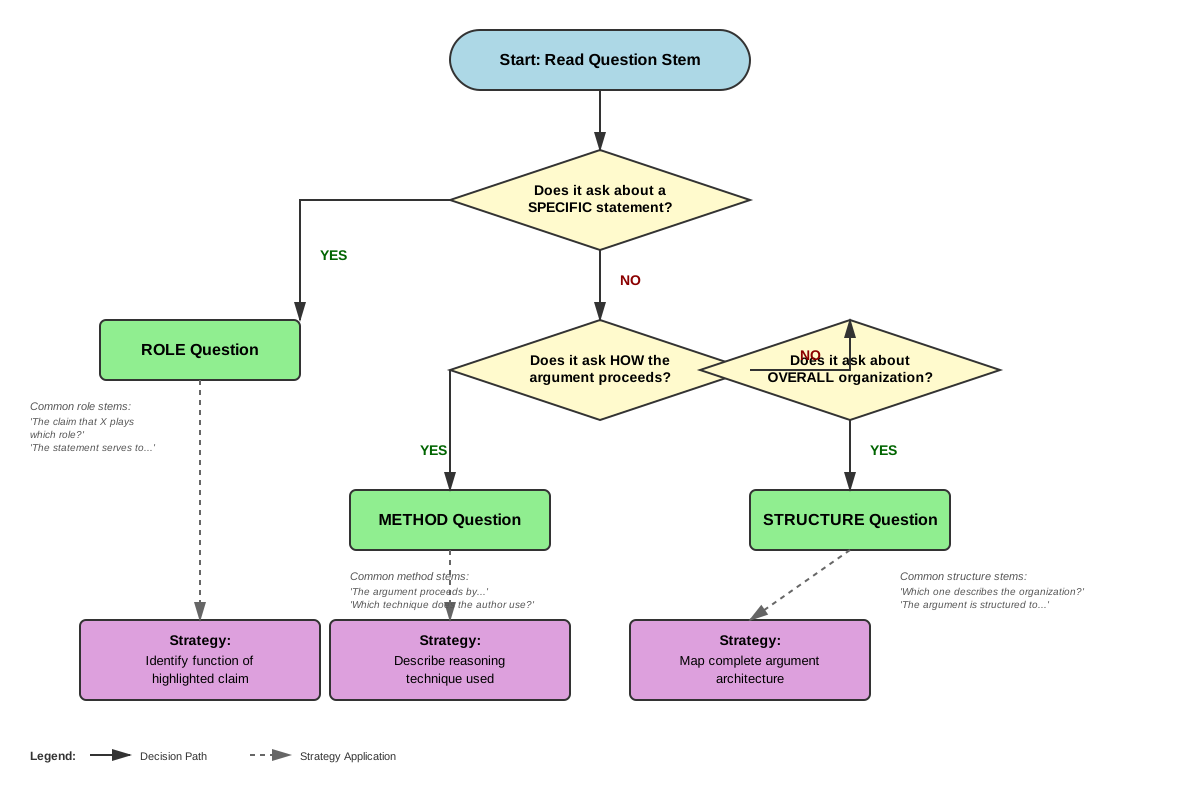
On the LSAT, argument organization questions appear in three primary forms: Method of Reasoning questions (asking "how does the author argue?"), Role of a Statement questions (asking "what function does this claim serve?"), and Argument Structure questions (asking "which describes the argument's organization?"). These questions typically appear 3-5 times per Logical Reasoning section, making them high-yield for score improvement. Because they test pure structure rather than content knowledge, they're among the most learnable question types—students who master the patterns can achieve near-perfect accuracy.
Common manifestations include: arguments that present a main conclusion supported by sub-conclusions; arguments that raise and refute objections; arguments that use analogies or parallel cases; arguments that eliminate alternative explanations; and arguments that present a general principle and apply it to a specific case. The LSAT frequently tests whether students can distinguish between an author's own position and positions the author describes or opposes, making structural awareness crucial for avoiding trap answers.
Core Concepts
The Anatomy of LSAT Arguments
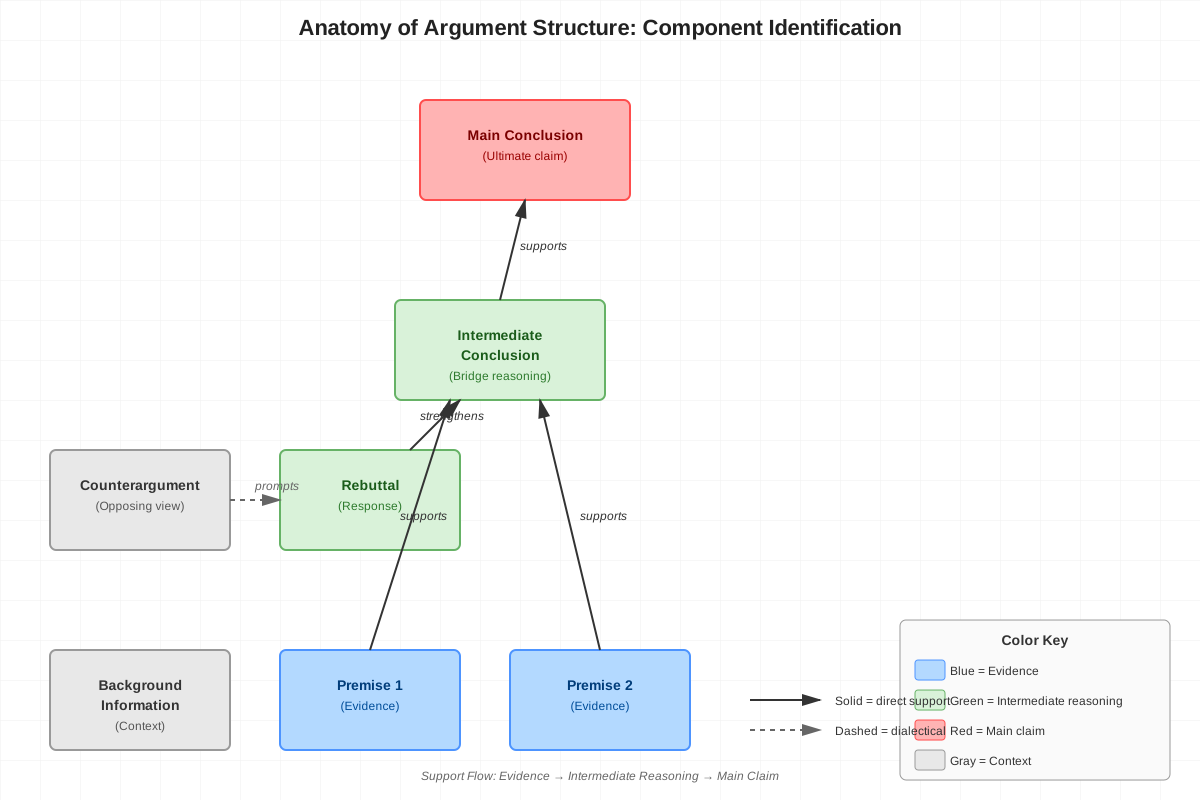
Every LSAT argument in Logical Reasoning consists of structural components that work together to advance a point. The conclusion represents the author's main claim—what they're trying to convince you to believe. Premises are the reasons, evidence, or facts offered in support of that conclusion. Many arguments also contain intermediate conclusions (also called sub-conclusions), which are claims supported by some premises and then used to support the main conclusion. Additionally, arguments may include background information that provides context without directly supporting the conclusion, counterarguments that present opposing views, and concessions where the author acknowledges limitations.
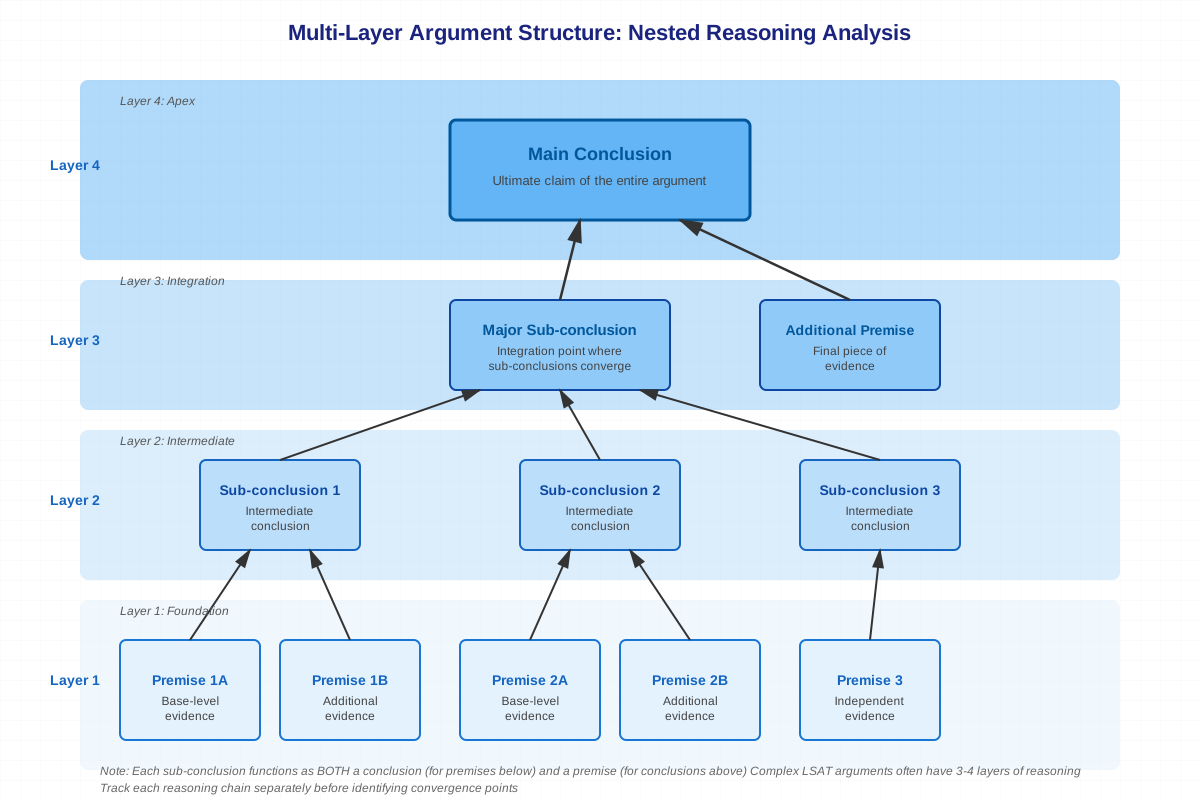
The key to mastering argument organization is recognizing that the same sentence can play different roles depending on its relationship to other statements. A claim might be a conclusion relative to one set of premises but a premise relative to a higher-level conclusion. This hierarchical structure is what makes LSAT arguments sophisticated and what these questions test.
Method of Reasoning Questions
Method of Reasoning questions ask students to describe the argumentative technique or strategy the author employs. These questions use stems like "Which one of the following describes the technique of reasoning used above?" or "The argument proceeds by..." The answer choices describe processes, not content—they explain how the author argues, not what the author argues.
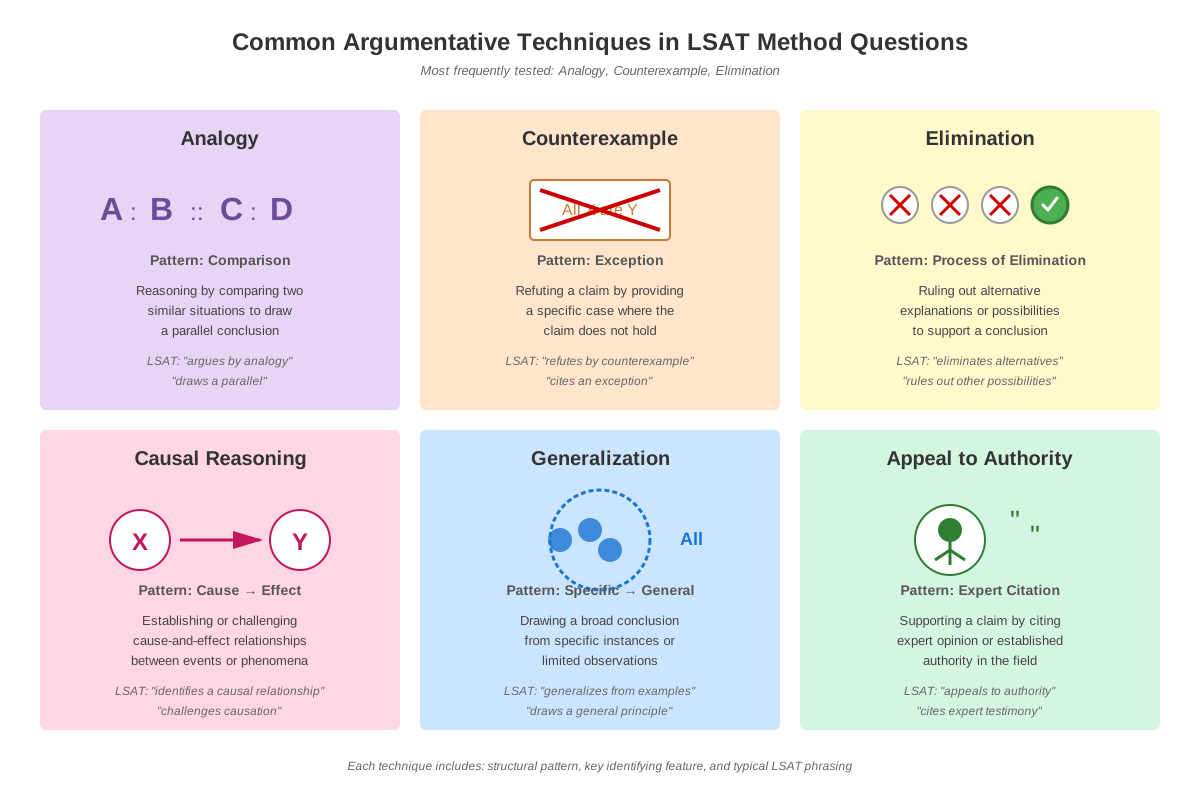
Common methods tested include:
- Arguing by analogy: Drawing a parallel between two situations and inferring that what's true of one is true of the other
- Arguing by counterexample: Refuting a general claim by providing a specific instance where it doesn't hold
- Arguing by elimination: Ruling out alternative explanations to support the remaining option
- Arguing from authority: Citing expert opinion or authoritative sources as evidence
- Arguing from general principle to specific case: Applying a broad rule to a particular situation
- Arguing from specific cases to general principle: Inferring a general rule from particular examples
- Presenting a problem and solution: Identifying an issue and proposing a remedy
- Raising and refuting an objection: Anticipating a counterargument and explaining why it fails
Role of a Statement Questions
Role of a Statement questions highlight a specific claim in the argument and ask what function it serves. Question stems include "The claim that X plays which one of the following roles in the argument?" or "The statement that Y is used to..." These questions test whether students can identify whether a statement is a main conclusion, intermediate conclusion, premise, background, counterargument, or illustration.
The critical skill is tracing logical relationships: What does this statement support? What supports this statement? If a statement supports the main conclusion directly, it's a premise. If it's supported by other statements and then supports the main conclusion, it's an intermediate conclusion. If it presents a view the author opposes, it's a counterargument or opposing position.
Argument Structure Questions
Argument Structure questions ask for a description of the argument's overall organization. Stems include "Which one of the following most accurately describes the organization of the argument?" or "The argument is structured to lead to which conclusion?" Answer choices provide architectural blueprints: "presents a generalization and provides supporting evidence," "describes a problem, considers two solutions, and advocates for one," or "states a position, acknowledges an objection, and provides a rebuttal."
These questions require students to identify the major structural moves in sequence. The answer must capture both the components present and their order. A common pattern is: Background → Problem → Solution → Support for solution. Another is: Opposing view → Author's position → Evidence for author's position → Refutation of opposing view.
Identifying Structural Indicators
Certain words and phrases signal structural relationships:
| Function | Indicator Words |
|---|---|
| Main Conclusion | therefore, thus, hence, so, consequently, it follows that |
| Premise | because, since, for, given that, as indicated by |
| Intermediate Conclusion | this suggests that, this shows that, from this we can see |
| Counterargument | some argue that, it might be objected that, critics claim |
| Refutation | however, but, yet, nevertheless, on the contrary |
| Evidence/Example | for instance, for example, specifically, in particular |
| Background | historically, traditionally, currently, it is known that |
However, the LSAT often omits these indicators to increase difficulty, requiring students to infer relationships from context and logical flow.
Complex Argument Structures
Advanced LSAT arguments feature nested reasoning where multiple layers of support exist. A typical complex structure might be:
- Background context (sets the stage)
- Opposing position (view the author will challenge)
- Evidence against opposing position (undermines the opposing view)
- Intermediate conclusion (preliminary claim based on that evidence)
- Additional premise (new supporting fact)
- Main conclusion (the author's ultimate point, supported by the intermediate conclusion and additional premise)
Recognizing these layers prevents students from confusing intermediate conclusions with main conclusions—a common trap in both Role and Method questions.
Argumentative Techniques in Detail
Analogy arguments compare two situations and argue that because they're similar in relevant ways, what's true of one should be true of the other. The structure is: Situation A has properties X, Y, Z and outcome Q. Situation B has properties X, Y, Z. Therefore, Situation B will have outcome Q.
Elimination arguments list possible explanations or options, rule out all but one, and conclude the remaining option must be correct. The structure is: Either P, Q, or R. Not P (evidence). Not Q (evidence). Therefore, R.
Principle application arguments state a general rule and apply it to a specific case. The structure is: General principle (if X, then Y). Specific case (this situation has X). Therefore, this situation has Y.
Counterexample arguments challenge a universal claim by providing a single instance where it fails. The structure is: Claim states "All X are Y." Here's an X that isn't Y. Therefore, the claim is false.
Concept Relationships
The concepts within argument organization form a hierarchical system. At the foundation lies basic structural identification—recognizing premises and conclusions. This enables role identification, where students can label what function each statement serves. Role identification, in turn, supports method recognition, as understanding what role each part plays reveals the overall argumentative technique. Finally, structure description synthesizes all these elements into a comprehensive blueprint of how the argument operates.
Argument organization connects to prerequisite knowledge of indicator words by using those signals as initial clues, but then goes deeper by requiring students to infer relationships even when indicators are absent. It relates to assumption questions because recognizing argument structure helps identify gaps between premises and conclusions where assumptions hide. It connects to strengthen/weaken questions because understanding which statements are premises versus conclusions clarifies what needs support or challenge.
The relationship map flows as follows:
Indicator Words → Identify Premises/Conclusions → Determine Statement Roles → Recognize Argumentative Method → Describe Overall Structure → Apply to All LR Question Types
Each skill builds on the previous, creating a cascade of competencies that enhance overall Logical Reasoning performance.
Quick check — test yourself on Argument organization so far.
Try Flashcards →High-Yield Facts
⭐ Method of Reasoning questions ask HOW the author argues, not WHETHER the argument is good or bad—focus on process, not evaluation
⭐ Role questions require tracing logical relationships: what supports this statement, and what does this statement support?
⭐ The main conclusion is the statement that everything else in the argument works to support; it's not necessarily the last sentence
⭐ Intermediate conclusions are both supported by premises AND used to support the main conclusion—they serve dual roles
⭐ Background information provides context but doesn't directly support the conclusion; it's descriptive rather than argumentative
- Counterarguments present views the author opposes; they're not the author's position
- Analogies argue that similar situations should have similar outcomes based on relevant shared properties
- Elimination arguments rule out alternatives to support the remaining option
- Concessions acknowledge limitations or opposing points without abandoning the main conclusion
⭐ Answer choices for structure questions must match both the components present AND their sequence
- "Arguing by counterexample" means refuting a general claim with a specific instance where it fails
- When a question asks about "the technique of reasoning," look for answer choices describing processes (comparing, eliminating, applying) rather than content
- Principle application arguments move from general rules to specific cases, while generalization arguments move from specific cases to general rules
⭐ The most common trap in Role questions is confusing intermediate conclusions with main conclusions
- Evidence and examples illustrate or support claims but aren't themselves claims requiring support
Common Misconceptions
Misconception: The conclusion is always the last sentence of the argument.
Correction: Conclusions can appear anywhere—beginning, middle, or end. The conclusion is identified by its logical role (what everything else supports), not its position. Many LSAT arguments place the conclusion first, then provide supporting premises.
Misconception: Every statement in an argument is either a premise or a conclusion.
Correction: Arguments contain multiple types of statements: premises, conclusions, intermediate conclusions, background information, counterarguments, concessions, examples, and illustrations. Recognizing these distinctions is crucial for Role questions.
Misconception: Method of Reasoning questions require evaluating whether the argument is strong or weak.
Correction: Method questions are purely descriptive—they ask you to identify the argumentative technique used, regardless of whether that technique is employed well. An argument can use analogy poorly, but if it uses analogy, that's the correct answer to a Method question.
Misconception: If a statement is true, it must be the conclusion.
Correction: Truth is irrelevant to structural role. A true statement can be a premise, background information, or even a counterargument the author opposes. Role is determined by logical function, not truth value.
Misconception: Intermediate conclusions are less important than main conclusions.
Correction: Intermediate conclusions are critical structural elements that often appear in answer choices. They're the "stepping stones" in complex reasoning, and recognizing them prevents confusion between what directly supports the main conclusion versus what supports supporting claims.
Misconception: Structure questions can be answered by skimming for keywords.
Correction: While indicator words help, many LSAT arguments deliberately omit them. Structure must be inferred from logical relationships, context, and the flow of reasoning. Students must actively reconstruct the argument's architecture, not just spot signal words.
Worked Examples
Example 1: Method of Reasoning Question
Argument: "Some people claim that the new traffic law will reduce accidents. However, a similar law was implemented in a neighboring city, and accident rates there actually increased. Therefore, we should not expect the new traffic law to reduce accidents here."
Question: The argument proceeds by
Analysis:
Let's identify the structural components:
- Opposing position: "Some people claim that the new traffic law will reduce accidents"
- Evidence: "A similar law was implemented in a neighboring city, and accident rates there actually increased"
- Conclusion: "We should not expect the new traffic law to reduce accidents here"
Now let's identify the method: The argument presents what others believe, then provides evidence from a comparable situation that contradicts that belief, and uses that evidence to challenge the original claim. Specifically, it's using a parallel case (the neighboring city) to cast doubt on a prediction.
The method is: arguing by analogy (drawing a parallel between two situations) combined with citing a counterexample (showing that in a similar case, the expected outcome didn't occur).
Correct answer pattern: "Challenging a claim by citing a case in which a similar measure produced an outcome contrary to that predicted"
Connection to learning objectives: This demonstrates how to identify argumentative technique (Method of Reasoning) by first mapping the argument's structure, then recognizing the logical strategy employed.
Example 2: Role of a Statement Question
Argument: "Urban gardens provide numerous benefits to communities. They increase access to fresh produce, which improves nutrition. Better nutrition leads to improved public health outcomes. Additionally, urban gardens create green spaces that enhance mental well-being. Therefore, cities should invest in urban garden programs."
Question: The statement "Better nutrition leads to improved public health outcomes" plays which role in the argument?
Analysis:
Let's map the logical relationships:
- "Urban gardens provide numerous benefits" = Background/context
- "They increase access to fresh produce" = Premise 1
- "which improves nutrition" = Intermediate conclusion 1 (supported by Premise 1)
- "Better nutrition leads to improved public health outcomes" = Intermediate conclusion 2 (supported by Intermediate conclusion 1)
- "Additionally, urban gardens create green spaces that enhance mental well-being" = Premise 2
- "Therefore, cities should invest in urban garden programs" = Main conclusion
The statement in question is supported by the claim that urban gardens improve nutrition, AND it supports the main conclusion that cities should invest in these programs. This dual role—being both supported and supporting—identifies it as an intermediate conclusion.
Correct answer pattern: "It is a conclusion supported by one claim and used to support the argument's main conclusion"
Connection to learning objectives: This demonstrates how to trace logical relationships to determine statement role, distinguishing intermediate conclusions from both premises and main conclusions.
Exam Strategy
When approaching argument organization questions, follow this systematic process:
Step 1: Identify the question type. Look for stems containing "method of reasoning," "technique," "role," "function," or "organization/structure." This determines whether you're describing the overall technique, a specific statement's function, or the argument's blueprint.
Step 2: Map the argument before reading answer choices. Quickly label each sentence: P (premise), C (conclusion), IC (intermediate conclusion), B (background), CA (counterargument). Draw arrows showing what supports what. This prevents answer choices from confusing you.
Step 3: For Method questions, identify the argumentative technique. Ask: Is the author comparing situations (analogy)? Ruling out alternatives (elimination)? Providing a specific case that contradicts a general claim (counterexample)? Applying a general rule to a specific situation (principle application)?
Step 4: For Role questions, trace relationships for the highlighted statement. Ask: What supports this statement? What does this statement support? If it's supported by nothing and supports the main point, it's a premise. If it's supported by something and supports the main point, it's an intermediate conclusion. If everything supports it, it's the main conclusion.
Step 5: For Structure questions, identify the sequence of major moves. Note the order: Does the argument start with background, then present a problem, then offer a solution? Does it state a position, acknowledge an objection, then refute it?
Exam Tip: Wrong answers in Method questions often describe what the argument should do rather than what it actually does. Stay descriptive, not prescriptive.
Trigger words to watch for:
- "The argument proceeds by..." = Method question
- "The claim that X plays which role..." = Role question
- "Which describes the organization..." = Structure question
- "The technique of reasoning" = Method question
- "Functions in the argument to" = Role question
Process of elimination strategies:
- Eliminate answer choices that mention content not present in the argument
- Eliminate answer choices that reverse the logical direction (e.g., saying the argument moves from specific to general when it actually moves from general to specific)
- Eliminate answer choices that mislabel components (e.g., calling a premise a conclusion)
- For Role questions, eliminate answers that describe functions the statement doesn't perform (e.g., if it doesn't refute anything, eliminate "refutes an objection")
Time allocation: Spend 15-20 seconds mapping the argument structure before reading answer choices. This upfront investment saves time by making answer evaluation faster and more accurate. These questions should take 60-75 seconds total—slightly less than assumption or flaw questions because they're more mechanical once you've mapped the structure.
Memory Techniques
PRIME - For remembering statement types:
- Premise (supports conclusion)
- Refutation (challenges opposing view)
- Intermediate conclusion (supported and supports)
- Main conclusion (ultimate point)
- Evidence/Example (illustrates claims)
CAP-E - For common argumentative methods:
- Counterexample (refutes general claim with specific instance)
- Analogy (parallel situations should have parallel outcomes)
- Principle application (general rule → specific case)
- Elimination (rule out alternatives)
Visualization strategy: Picture arguments as buildings. The main conclusion is the roof—everything supports it. Premises are the foundation—they support but aren't supported. Intermediate conclusions are middle floors—they rest on the foundation and support the roof. Background is the surrounding landscape—it provides context but isn't part of the structure.
The Support Test: For any statement, ask "What supports this?" and "What does this support?" Draw arrows. If arrows only point away from it (it only supports), it's a premise. If arrows only point toward it (it's only supported), it's the main conclusion. If arrows point both ways, it's an intermediate conclusion.
Method Matching: Create a mental library of method patterns:
- Analogy = "Situation A is like Situation B, so..."
- Elimination = "It could be X, Y, or Z. Not X. Not Y. So Z."
- Counterexample = "They say all X are Y. But here's an X that isn't Y."
- Principle application = "Rule: If P, then Q. This case has P. So Q."
Summary
Argument organization is the foundational skill for analyzing how LSAT arguments are constructed, tested through Method of Reasoning, Role of a Statement, and Argument Structure questions. Success requires moving beyond content evaluation to structural analysis—identifying whether statements function as premises, conclusions, intermediate conclusions, background, or counterarguments, and recognizing the argumentative techniques authors employ. The key competencies include tracing logical relationships (what supports what), distinguishing between main and intermediate conclusions, recognizing common methods (analogy, elimination, counterexample, principle application), and matching argument blueprints to structural descriptions. These questions are highly learnable because they test pattern recognition rather than content knowledge. By systematically mapping arguments before evaluating answer choices, students can achieve consistent accuracy. Mastering argument organization enhances performance across all Logical Reasoning question types because structural awareness accelerates argument processing and reveals logical relationships that other question types exploit.
Key Takeaways
- Argument organization questions test structure, not evaluation—describe how the argument works, not whether it's good
- The main conclusion is identified by logical role (what everything supports), not position in the passage
- Intermediate conclusions are both supported by premises AND support the main conclusion—they're critical structural elements
- Method of Reasoning questions require identifying argumentative techniques: analogy, elimination, counterexample, principle application
- Role questions demand tracing relationships: what supports this statement, and what does this statement support?
- Map argument structure before reading answer choices to avoid confusion and increase accuracy
- Common methods include arguing by analogy (parallel situations), elimination (ruling out alternatives), and counterexample (specific instance refuting general claim)
Related Topics
Assumption Questions: Understanding argument structure reveals gaps between premises and conclusions where assumptions hide. Recognizing what role statements play helps identify what's missing.
Strengthen/Weaken Questions: Knowing which statements are premises versus conclusions clarifies what needs support or challenge. Structural awareness shows where arguments are vulnerable.
Flaw Questions: Many flaws involve structural problems—treating intermediate conclusions as sufficient support, confusing correlation with causation in causal arguments, or drawing analogies between relevantly dissimilar situations.
Parallel Reasoning Questions: These require matching argument structures, making structural mapping essential. The same skills used for organization questions apply directly to finding parallel patterns.
Main Point Questions: These are essentially Role questions asking which statement is the main conclusion. Mastering role identification makes Main Point questions straightforward.
Practice CTA
Now that you understand how arguments are organized and how the LSAT tests this knowledge, it's time to apply these skills. Work through the practice questions to reinforce your ability to identify methods, determine roles, and describe structures. Use the flashcards to drill common argumentative techniques and structural patterns until recognition becomes automatic. Remember: argument organization questions are among the most learnable on the LSAT—consistent practice with structural mapping will build the pattern recognition that leads to consistent accuracy. Each practice question strengthens your ability to dissect complex reasoning quickly and confidently. You've got this!
Sign up free to keep reading
Create a free AnvayaPrep account to finish this LSAT guide on Argument organization — plus flashcards and practice questions.