Overview
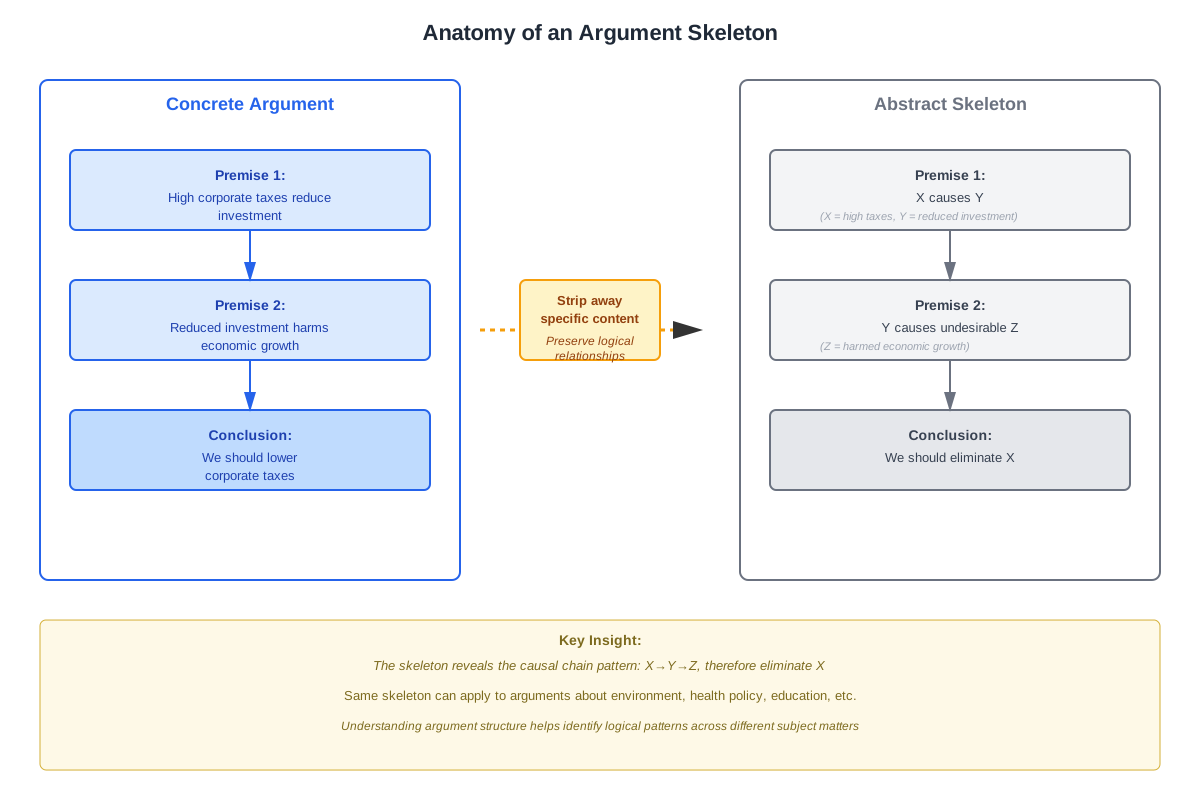
An argument skeleton is the abstract logical structure that underlies an argument, stripped of its specific content and reduced to its essential reasoning pattern. When analyzing LSAT arguments, recognizing the skeleton means identifying the fundamental relationship between premises and conclusion—the "bones" of the argument without the "flesh" of particular subject matter. This concept is foundational for method, role, and structure questions on the LSAT, which ask test-takers to describe how an argument proceeds, what function a particular statement serves, or how two arguments relate to each other structurally.
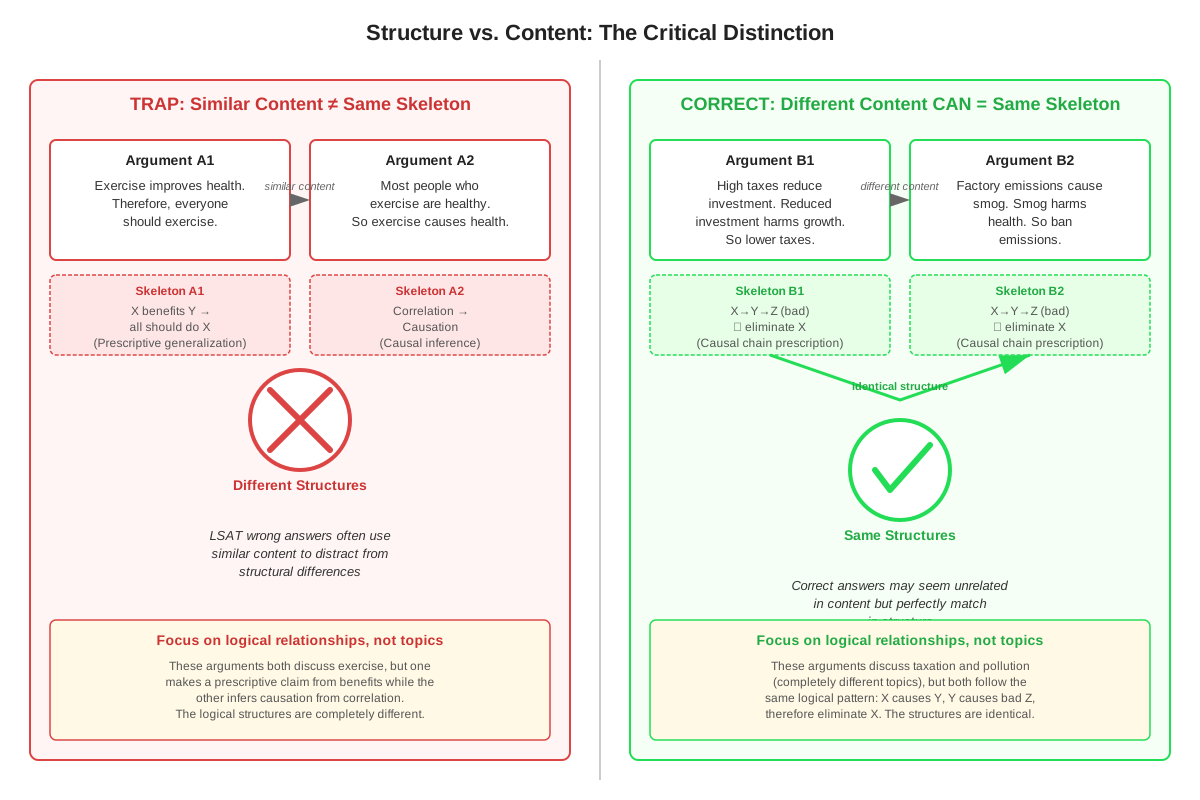
Understanding argument skeletons transforms how students approach logical reasoning questions. Rather than getting lost in complex content about economics, biology, or philosophy, students who master this skill can quickly identify that two seemingly different arguments share identical logical structures. For instance, an argument about corporate taxation and another about environmental regulation might both follow the pattern: "X causes problem Y; therefore, we should eliminate X." Recognizing this shared skeleton allows test-takers to predict answer choices, eliminate wrong options efficiently, and understand why certain reasoning moves are valid or flawed.
The LSAT argument skeleton concept connects intimately with other logical reasoning skills. It builds upon basic argument analysis (identifying premises and conclusions) while serving as the foundation for parallel reasoning questions, method of reasoning questions, and role-of-a-statement questions. Mastering argument skeletons also enhances performance on flaw questions, strengthen/weaken questions, and assumption questions because understanding structure reveals where arguments are vulnerable or what they take for granted. This topic represents a crucial bridge between elementary argument identification and advanced logical analysis.
Learning Objectives
- [ ] Identify how Argument skeleton appears in LSAT questions
- [ ] Explain the reasoning pattern behind Argument skeleton
- [ ] Apply Argument skeleton to solve LSAT-style problems accurately
- [ ] Abstract specific arguments into their underlying logical structures
- [ ] Match arguments with identical skeletons despite different content
- [ ] Distinguish between structural similarities and superficial content similarities
- [ ] Evaluate whether two arguments employ the same method of reasoning
Prerequisites
- Basic argument structure: Understanding premises, conclusions, and inference indicators is essential because argument skeletons are abstractions of these fundamental components
- Conditional reasoning: Familiarity with if-then statements helps recognize skeletal patterns involving sufficient and necessary conditions
- Argument components: Knowing the difference between evidence, claims, assumptions, and counterexamples enables proper structural analysis
- Logical indicators: Recognizing words like "therefore," "because," "however," and "thus" helps identify the skeleton's framework
Why This Topic Matters
Argument skeleton questions appear with remarkable frequency on the LSAT, making this a high-yield topic for score improvement. Approximately 15-20% of Logical Reasoning questions directly test the ability to recognize argument structure, including Method of Reasoning questions (which ask "how" an argument proceeds), Role questions (which ask what function a statement serves), and Parallel Reasoning questions (which require matching argument skeletons). Additionally, understanding argument structure indirectly benefits performance on nearly every other question type, as structural awareness reveals logical vulnerabilities and reasoning patterns.
In real-world applications, the ability to recognize argument skeletons is invaluable for legal practice, policy analysis, and critical thinking. Lawyers must identify when opposing counsel uses flawed reasoning patterns, regardless of the case's specific facts. Policy analysts need to recognize when different proposals employ similar logical structures with different outcomes. Academics across disciplines benefit from seeing how arguments in one field mirror those in another, facilitating interdisciplinary insight and preventing the repetition of logical errors.
On the LSAT, argument skeleton questions typically appear in several formats: "The argument proceeds by..." questions that describe the method of reasoning; "The claim that X plays which role..." questions that identify a statement's structural function; "Which of the following is most similar in reasoning..." questions that require parallel structure matching; and "The argument employs which technique..." questions that name specific argumentative strategies. These questions reward students who can think abstractly about logical form rather than getting distracted by content.
Core Concepts
Defining Argument Skeleton
The lsat argument skeleton represents the logical form of an argument when all specific content is removed and replaced with abstract placeholders. Think of it as the architectural blueprint of reasoning—the load-bearing structure that remains when decorative details are stripped away. For example, the argument "All dogs are mammals; Fido is a dog; therefore, Fido is a mammal" has the skeleton: "All X are Y; Z is X; therefore, Z is Y." This skeletal form reveals the argument's validity independent of whether we're discussing dogs, planets, or political systems.
Creating an argument skeleton involves several steps:
- Identify the conclusion and all premises
- Determine the logical relationships between statements (causal, conditional, analogical, etc.)
- Replace specific terms with variables (X, Y, Z) or generic placeholders
- Preserve the logical connectors (all, some, if-then, because, therefore)
- Maintain the argument's structural moves (appeals to authority, analogies, counterexamples, etc.)
The skeleton must capture not just what the argument says, but how it reasons—the method by which premises are supposed to support the conclusion.
Common Skeletal Patterns
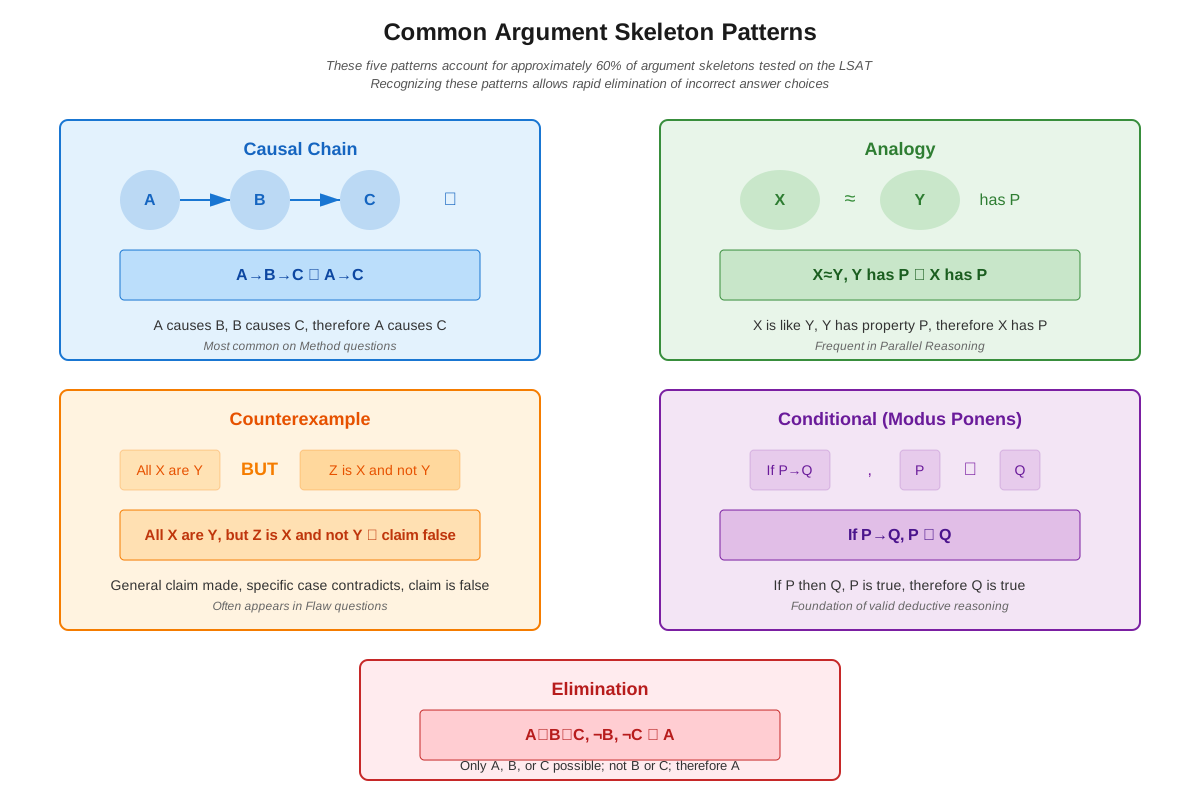
Several argument skeletons appear repeatedly on the LSAT. Recognizing these patterns accelerates question analysis:
| Skeletal Pattern | Structure | Example |
|---|---|---|
| Modus Ponens | If X, then Y; X; therefore Y | If it rains, streets are wet; it rained; so streets are wet |
| Modus Tollens | If X, then Y; not Y; therefore not X | If qualified, hired; not hired; so not qualified |
| Causal Reasoning | X correlates with Y; therefore X causes Y | Crime dropped when police increased; so more police reduced crime |
| Analogy | X is like Y in respects A, B, C; X has property D; so Y has D | Mars resembles Earth in atmosphere and temperature; Earth has life; so Mars might have life |
| Elimination | Either X or Y; not X; therefore Y | The cause is genetic or environmental; not genetic; so environmental |
| Appeal to Authority | Expert says X; therefore X is true | Scientists agree climate is changing; so climate is changing |
| Counterexample | Theory claims all X are Y; here's an X that isn't Y; so theory is false | Theory says all swans are white; black swans exist; so theory is wrong |
Structural Roles of Statements
Within an argument skeleton, different statements serve distinct structural functions. Role questions specifically test the ability to identify these functions:
Main Conclusion: The primary claim the argument seeks to establish. This is the "destination" of the reasoning. Identified by conclusion indicators (therefore, thus, so, consequently) or by asking "What is the author trying to prove?"
Intermediate Conclusion: A claim supported by some premises and used to support the main conclusion. This serves as both a conclusion (from earlier premises) and a premise (for the final conclusion). Example: "The law is unjust [intermediate conclusion from previous evidence]; therefore, we should change it [main conclusion]."
Premise/Evidence: Facts, data, or claims offered as support. These are the "starting points" of reasoning, often introduced by premise indicators (because, since, given that, for).
Background Information: Context that frames the argument without directly supporting the conclusion. This sets the stage but doesn't function as evidence.
Counterargument/Opposing View: A position the author disagrees with, often introduced to be refuted. Example: "Some claim X, but this is wrong because..."
Concession: A point the author acknowledges as true, even though it might seem to weaken their position. Often introduced by "although," "admittedly," or "granted."
Illustration/Example: Specific instances that clarify or demonstrate a general claim without serving as primary evidence.
Method of Reasoning
Method of reasoning questions ask students to describe the argumentative technique or strategy employed. These questions test skeleton recognition by requiring abstract descriptions of how arguments proceed. Common methods include:
Establishing a general principle and applying it to a specific case: The argument states a rule, then shows how a particular situation falls under that rule. Skeleton: "All X should do Y; Z is an X; therefore Z should do Y."
Presenting a problem and proposing a solution: The argument identifies an undesirable situation and recommends an action to address it. Skeleton: "Situation S is problematic; action A would eliminate S; therefore, we should do A."
Arguing by analogy: The argument claims two situations are similar in relevant respects, so what's true of one is likely true of the other. Skeleton: "X and Y share properties A, B, C; X has property D; therefore Y probably has D."
Challenging a position by providing a counterexample: The argument refutes a universal claim by showing an instance where it doesn't hold. Skeleton: "Theory claims all X are Y; here's an X that isn't Y; therefore theory is false."
Drawing a conclusion based on absence of evidence: The argument infers something is false or unlikely because no evidence supports it. Skeleton: "No evidence exists for X; therefore, X is probably false."
Reasoning from effect to cause: The argument observes an outcome and infers what produced it. Skeleton: "Y occurred; X typically causes Y; therefore, X probably caused this instance of Y."
Parallel Reasoning
Parallel reasoning questions require finding an argument with an identical skeleton to the original. These questions test whether students can abstract structure from content. The correct answer must match:
- Logical form: Same pattern of inference (deductive vs. inductive, conditional vs. causal, etc.)
- Structural moves: Same argumentative techniques (analogy, elimination, counterexample, etc.)
- Validity status: If the original is valid, the parallel must be valid; if flawed, the parallel must have the same flaw
- Quantifier structure: "All," "some," "most," "none" must correspond appropriately
Parallel reasoning does NOT require matching:
- Subject matter or content
- Conclusion truth value
- Premise plausibility
- Argument length or complexity
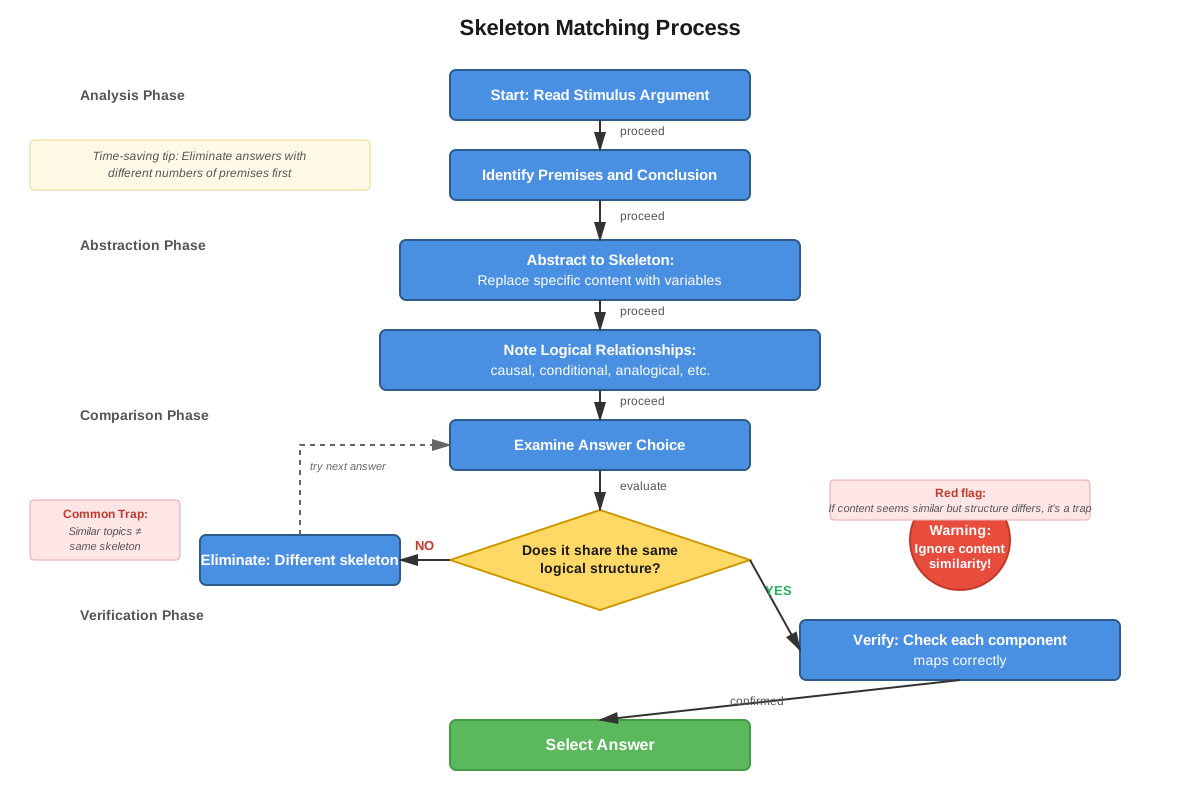
The key strategy is to skeleton the original argument first, then skeleton each answer choice, looking for structural identity rather than content similarity.
Structural Indicators and Transitions
Certain words and phrases signal structural relationships within argument skeletons:
Conclusion indicators: therefore, thus, so, hence, consequently, it follows that, which means that, accordingly
Premise indicators: because, since, for, given that, as, in that, owing to, for the reason that
Contrast/Counterargument indicators: but, however, yet, nevertheless, on the other hand, although, even though, despite
Support/Continuation indicators: moreover, furthermore, additionally, in addition, also, besides
Illustration indicators: for example, for instance, such as, to illustrate, specifically
Concession indicators: admittedly, granted, to be sure, certainly, of course
Recognizing these indicators helps map the argument skeleton by revealing how pieces fit together structurally.
Concept Relationships
The argument skeleton concept serves as a central hub connecting multiple logical reasoning skills. At the foundational level, basic argument structure (identifying premises and conclusions) provides the raw material that skeletons abstract. Without recognizing what claims an argument makes and how they relate, creating a skeleton is impossible.
Moving upward in complexity, argument skeletons directly enable parallel reasoning questions, which are essentially skeleton-matching exercises. The relationship flows: Argument Structure → Argument Skeleton → Parallel Reasoning. Similarly, method of reasoning questions ask students to describe skeletons in abstract terms, making skeleton recognition a prerequisite skill.
Laterally, argument skeletons connect to conditional reasoning because many skeletal patterns involve if-then structures (modus ponens, modus tollens, contrapositive reasoning). Understanding conditional logic helps recognize these specific skeleton types. The relationship is bidirectional: conditional reasoning skills improve skeleton recognition, and skeleton awareness helps identify conditional patterns.
Argument skeletons also illuminate logical flaws. Many flaws are skeletal—they appear across different content areas with the same structural error. For example, "correlation implies causation" is a skeletal flaw that appears whether discussing economics, health, or education. Recognizing the skeleton helps identify the flaw regardless of subject matter.
Finally, skeletons connect to assumption questions because an argument's structure reveals what must be true for premises to support the conclusion. The skeleton shows the logical "gap" that assumptions must bridge. The relationship: Argument Skeleton → Identifies Structural Gap → Reveals Required Assumption.
Quick check — test yourself on Argument skeleton so far.
Try Flashcards →High-Yield Facts
⭐ Argument skeletons abstract logical form from specific content, replacing particular terms with variables while preserving logical relationships.
⭐ Two arguments share the same skeleton if and only if they have identical logical structure, regardless of subject matter.
⭐ Method of reasoning questions ask for abstract descriptions of how arguments proceed, requiring skeleton recognition.
⭐ Role questions test the ability to identify what structural function a statement serves within the argument skeleton.
⭐ Parallel reasoning questions require matching argument skeletons, not matching content or subject matter.
- Skeletal patterns include modus ponens, modus tollens, causal reasoning, analogy, elimination, and counterexample structures.
- Intermediate conclusions serve dual roles: conclusions from earlier premises and premises for later conclusions.
- Valid argument skeletons must be matched with valid parallels; flawed skeletons must be matched with identically flawed parallels.
- Quantifier structure (all, some, most, none) must correspond between parallel arguments.
- Background information and illustrations are not part of the core argument skeleton, though they may appear in the passage.
- Concessions acknowledge opposing points without undermining the main argument's structure.
- Structural indicators (therefore, because, however) reveal how skeleton components connect.
- The same skeletal flaw can appear across wildly different content areas, making skeleton recognition valuable for flaw questions.
- Creating a skeleton involves identifying logical relationships (causal, conditional, analogical) between statements, not just listing claims.
- Argument skeletons can be simple (one premise, one conclusion) or complex (multiple premises, intermediate conclusions, counterarguments).
Common Misconceptions
Misconception: Arguments with similar subject matter have the same skeleton.
Correction: Argument skeletons depend on logical structure, not content. Two arguments about taxation could have completely different skeletons (one analogical, one causal), while arguments about taxation and biology could share identical skeletons.
Misconception: Parallel reasoning answers must reach similar conclusions to the original argument.
Correction: Parallel reasoning requires identical logical structure, not similar conclusions. An argument concluding "we should increase taxes" could parallel one concluding "we should reduce pollution" if both use the same reasoning pattern.
Misconception: Longer arguments have more complex skeletons than shorter ones.
Correction: Argument length doesn't determine skeletal complexity. A long argument might simply elaborate on a simple skeleton with examples and background, while a short argument might employ a complex multi-step inference.
Misconception: The skeleton includes all statements in the passage.
Correction: Skeletons capture only the logical core—premises, conclusions, and their relationships. Background information, rhetorical flourishes, and tangential remarks aren't part of the skeleton.
Misconception: If two arguments are both flawed, they must have the same skeleton.
Correction: Arguments can be flawed in different ways with different skeletons. One might commit a causal fallacy while another commits an appeal to inappropriate authority—both flawed, but structurally distinct.
Misconception: Method of reasoning questions ask what the argument is about.
Correction: Method questions ask how the argument reasons, not what it discusses. The correct answer describes the logical technique or strategy, not the subject matter.
Misconception: Role questions ask whether a statement is true or false.
Correction: Role questions ask what function a statement serves in the argument's structure (premise, conclusion, counterargument, etc.), not whether the statement is factually accurate.
Misconception: Identifying the skeleton means memorizing formal logic notation.
Correction: While formal logic can represent skeletons, LSAT questions don't require symbolic notation. Understanding structural relationships conceptually is sufficient.
Worked Examples
Example 1: Identifying Argument Skeleton and Method
Passage: "Recent studies show that cities with more bike lanes have lower rates of traffic congestion. City planners should therefore invest in expanding bike lane infrastructure to reduce traffic problems."
Question: The argument proceeds by:
Step 1 - Identify Components:
- Premise: Cities with more bike lanes have lower traffic congestion (correlation)
- Conclusion: City planners should expand bike lanes (recommendation)
- Implicit assumption: The correlation indicates causation (bike lanes reduce congestion)
Step 2 - Abstract the Skeleton:
- X correlates with Y
- Therefore, we should implement X to achieve Y
Step 3 - Identify the Method:
The argument observes a correlation and recommends action based on an assumed causal relationship. It presents a problem (traffic congestion) and proposes a solution (bike lanes) based on correlational evidence.
Step 4 - Evaluate Answer Choices (hypothetical):
- (A) "Establishing a general principle and applying it to a specific case" - INCORRECT: No general principle is stated
- (B) "Drawing a causal conclusion from correlational evidence and recommending action based on that conclusion" - CORRECT: Matches the skeleton
- (C) "Arguing by analogy between two similar situations" - INCORRECT: No analogy is present
- (D) "Refuting an opposing view by providing a counterexample" - INCORRECT: No opposing view is addressed
Connection to Learning Objectives: This example demonstrates how to identify the argument skeleton (correlation-to-causation-to-recommendation) and explain the reasoning pattern (inferring causation from correlation to justify a policy).
Example 2: Parallel Reasoning
Original Argument: "All effective teachers inspire curiosity in their students. Professor Martinez inspires curiosity in her students. Therefore, Professor Martinez is an effective teacher."
Step 1 - Identify the Flaw in the Skeleton:
- Premise 1: All X have property Y (All effective teachers inspire curiosity)
- Premise 2: Z has property Y (Martinez inspires curiosity)
- Conclusion: Z is X (Martinez is an effective teacher)
This commits the fallacy of affirming the consequent. The structure is: "If X, then Y; Y; therefore X"—which is invalid because Y could result from causes other than X.
Step 2 - Skeleton Each Answer Choice:
(A) "All professional athletes train daily. Jordan trains daily. Therefore, Jordan is a professional athlete."
- Skeleton: All X have Y; Z has Y; therefore Z is X
- Flaw: Affirming the consequent (identical to original)
- CORRECT - Perfect parallel
(B) "All professional athletes train daily. Jordan is a professional athlete. Therefore, Jordan trains daily."
- Skeleton: All X have Y; Z is X; therefore Z has Y
- Flaw: None—this is valid (modus ponens)
- INCORRECT - Different skeleton
(C) "Some professional athletes train daily. Jordan trains daily. Therefore, Jordan might be a professional athlete."
- Skeleton: Some X have Y; Z has Y; therefore Z might be X
- Flaw: Weak inference, but not the same flaw
- INCORRECT - Different quantifier structure
(D) "No professional athletes avoid training. Jordan doesn't avoid training. Therefore, Jordan is a professional athlete."
- Skeleton: No X are Y; Z is not Y; therefore Z is X
- Flaw: Affirming the consequent with negative terms
- INCORRECT - Similar flaw but different logical form
Step 3 - Verify the Match:
Answer (A) has identical skeleton, identical flaw, and identical logical form. The content differs (teachers vs. athletes, curiosity vs. training), but the structure is perfectly parallel.
Connection to Learning Objectives: This example shows how to apply argument skeleton analysis to solve parallel reasoning questions by abstracting structure, identifying flaws, and matching logical form rather than content.
Exam Strategy
Approaching Skeleton Questions
When encountering method, role, or parallel reasoning questions, follow this systematic approach:
For Method of Reasoning Questions:
- Read the argument and identify the conclusion first
- Map how premises connect to the conclusion (causal? conditional? analogical?)
- Note any special techniques (counterexample, elimination, appeal to authority)
- Predict the answer in your own words before reading choices
- Eliminate answers that describe content rather than method
- Choose the answer that describes the logical technique, not the subject matter
For Role Questions:
- Locate the referenced statement in the passage
- Determine what comes before it (what supports it?) and after it (what does it support?)
- Identify whether it's a premise, conclusion, intermediate conclusion, counterargument, or concession
- Eliminate answers that misidentify the statement's structural function
- Verify your answer by checking whether removing the statement would affect the argument's logic
For Parallel Reasoning Questions:
- Skeleton the original argument completely before reading answer choices
- Note the logical form (deductive/inductive), validity (valid/flawed), and specific pattern
- Skeleton each answer choice systematically
- Eliminate choices with different logical forms first
- Among remaining choices, eliminate those with different validity status
- Verify the final answer matches quantifier structure and specific reasoning moves
Trigger Words and Phrases
Watch for these phrases that signal skeleton questions:
- "The argument proceeds by..." → Method of reasoning
- "The claim that [X] plays which one of the following roles..." → Role question
- "Which one of the following is most similar in reasoning..." → Parallel reasoning
- "The argument employs which technique..." → Method of reasoning
- "The statement that [X] figures in the argument in which way..." → Role question
- "The pattern of reasoning in the argument above is most similar to..." → Parallel reasoning
Process of Elimination Tips
For Method Questions:
- Eliminate answers that describe what the argument concludes rather than how it reasons
- Eliminate answers that mention specific content from the passage (names, subjects, particular facts)
- Eliminate answers describing techniques not present in the argument
- Keep answers that abstractly describe the logical moves made
For Role Questions:
- Eliminate answers that contradict the statement's position (if the statement supports the conclusion, eliminate answers saying it opposes it)
- Eliminate answers that misidentify what the statement supports or is supported by
- Keep answers that accurately trace the statement's logical connections
For Parallel Reasoning:
- Eliminate answers with different logical forms first (if original is deductive, eliminate inductive answers)
- Eliminate answers with different validity status (if original is flawed, eliminate valid answers)
- Eliminate answers with different quantifier structures (if original uses "all," eliminate answers using "some")
- Among remaining answers, eliminate those with different specific reasoning patterns
Time Allocation
Argument skeleton questions typically require more time than average Logical Reasoning questions because they demand abstract analysis. Allocate:
- Method of Reasoning: 1:30-2:00 minutes (skeleton the argument, predict, evaluate choices)
- Role Questions: 1:00-1:30 minutes (locate statement, trace connections, evaluate choices)
- Parallel Reasoning: 2:00-2:30 minutes (skeleton original, skeleton each choice, verify match)
If a parallel reasoning question is taking longer than 2:30, skeleton the original carefully, eliminate obviously wrong answers, and make an educated guess among remaining choices rather than spending 3+ minutes.
Memory Techniques
The SKELETON Acronym
Use SKELETON to remember the steps for analyzing argument structure:
- Spot the conclusion first
- Key premises—identify them
- Evaluate logical relationships (causal, conditional, analogical)
- Label special techniques (counterexample, elimination, etc.)
- Eliminate specific content, keep logical form
- Trace how premises connect to conclusion
- Outline the abstract pattern
- Note quantifiers and their scope
The "X, Y, Z" Visualization
When creating skeletons, consistently use:
- X for the first major concept
- Y for the second major concept
- Z for specific instances or examples
Visualize the argument as a simple equation: "All X are Y; Z is X; therefore Z is Y." This consistent variable assignment makes pattern recognition faster.
The "Blueprint" Metaphor
Remember that an argument skeleton is like an architectural blueprint. Just as blueprints show structure without decoration, skeletons show logical form without content. When you see a blueprint for a house, you don't care if it's brick or wood—you care about the structural design. Similarly, when analyzing argument skeletons, ignore the "building materials" (specific content) and focus on the "structural design" (logical form).
Common Patterns Mnemonic: "MACE"
Remember the most common skeletal patterns with MACE:
- Modus ponens/tollens (conditional reasoning)
- Analogy (similarity reasoning)
- Causal (correlation to causation)
- Elimination (either/or reasoning)
These four patterns account for the majority of LSAT argument skeletons.
Summary
Argument skeleton analysis is the practice of abstracting logical structure from specific content, revealing the underlying reasoning pattern that connects premises to conclusions. This skill is essential for method of reasoning questions (which ask how arguments proceed), role questions (which ask what function statements serve), and parallel reasoning questions (which require matching logical structures). Mastering argument skeletons requires recognizing that logical form is independent of subject matter—two arguments about completely different topics can share identical skeletons if they employ the same reasoning pattern. The key to success is systematically identifying conclusions, premises, and their relationships, then replacing specific terms with variables while preserving logical connectors and quantifiers. Common skeletal patterns include conditional reasoning (modus ponens and tollens), causal reasoning, analogical reasoning, and elimination reasoning. Students must distinguish between structural similarities (which matter for skeleton questions) and content similarities (which are irrelevant). By focusing on how arguments reason rather than what they discuss, test-takers can efficiently eliminate wrong answers and identify correct ones across all skeleton-related question types.
Key Takeaways
- Argument skeletons are abstract logical structures independent of specific content—focus on form, not subject matter
- Method of reasoning questions require describing how arguments proceed, not what they conclude or discuss
- Role questions test the ability to identify what structural function a statement serves within the argument's logical framework
- Parallel reasoning requires matching logical structure exactly, including validity status, quantifier structure, and specific reasoning patterns
- Common skeletal patterns (MACE: Modus ponens/tollens, Analogy, Causal, Elimination) appear repeatedly across different content areas
- Systematic skeletonization—identifying conclusion, premises, relationships, and abstracting to variables—is the key to accuracy and efficiency
- Structural indicators (therefore, because, however) reveal how skeleton components connect and should guide your analysis
Related Topics
Parallel Reasoning Questions: Building directly on argument skeleton skills, these questions require finding arguments with identical logical structures. Mastering skeletons makes parallel reasoning questions significantly more manageable.
Flaw Questions: Many logical flaws are skeletal—they appear across different content with the same structural error. Understanding skeletons helps recognize flaws like "correlation implies causation" or "affirming the consequent" regardless of subject matter.
Assumption Questions: An argument's skeleton reveals the logical gaps that assumptions must fill. The structure shows what must be true for premises to support the conclusion, making skeleton analysis valuable for identifying necessary and sufficient assumptions.
Formal Logic: For students seeking deeper understanding, formal logic provides symbolic notation systems for representing argument skeletons with precision. While not required for the LSAT, formal logic training can enhance skeletal analysis skills.
Conditional Reasoning: Many argument skeletons involve if-then structures. Advanced study of conditional logic, including contrapositives, sufficient/necessary conditions, and conditional chains, deepens skeleton recognition abilities.
Practice CTA
Now that you understand argument skeletons and their central role in LSAT Logical Reasoning, it's time to apply these concepts to real questions. Work through the practice problems focusing on identifying skeletal patterns, abstracting structure from content, and matching logical forms. Use the flashcards to reinforce common skeletal patterns and structural indicators. Remember: every argument has a skeleton, and with practice, you'll recognize patterns instantly. The more you practice abstracting structure, the faster and more accurate you'll become. These skills will serve you not just on test day, but throughout law school and your legal career. Start practicing now—your improved score awaits!
Sign up free to keep reading
Create a free AnvayaPrep account to finish this LSAT guide on Argument skeleton — plus flashcards and practice questions.