Overview
The challenge and response structure is one of the most frequently tested argumentative patterns in LSAT Logical Reasoning sections. This structure appears when an argument presents an initial position or claim, followed by a challenge or objection to that position, and then concludes with a response that addresses the challenge. Understanding this pattern is crucial because it forms the backbone of approximately 15-20% of method, role, and structure questions on the LSAT, and recognizing it quickly can save valuable time during the exam while improving accuracy.
In the context of logical reasoning, the challenge and response structure represents a sophisticated form of argumentation where authors anticipate objections and address them preemptively. This dialectical approach mirrors real-world legal reasoning, where attorneys must anticipate counterarguments and respond effectively. On the LSAT, test-makers use this structure to assess whether students can identify the function of different parts of an argument, understand how objections relate to main conclusions, and recognize how responses strengthen or defend original positions.
Mastering the lsat challenge and response structure connects directly to broader Logical Reasoning skills, including identifying argument components, understanding the flow of reasoning, and recognizing how different statements support or oppose each other. This topic serves as a foundation for more complex question types, including Method of Reasoning questions (which ask how an argument proceeds), Role questions (which ask what function a specific statement serves), and Structure questions (which ask about the overall organization of an argument). Students who excel at identifying challenge and response patterns develop a significant advantage in quickly parsing complex arguments and eliminating incorrect answer choices.
Learning Objectives
- [ ] Identify how Challenge and response structure appears in LSAT questions
- [ ] Explain the reasoning pattern behind Challenge and response structure
- [ ] Apply Challenge and response structure to solve LSAT-style problems accurately
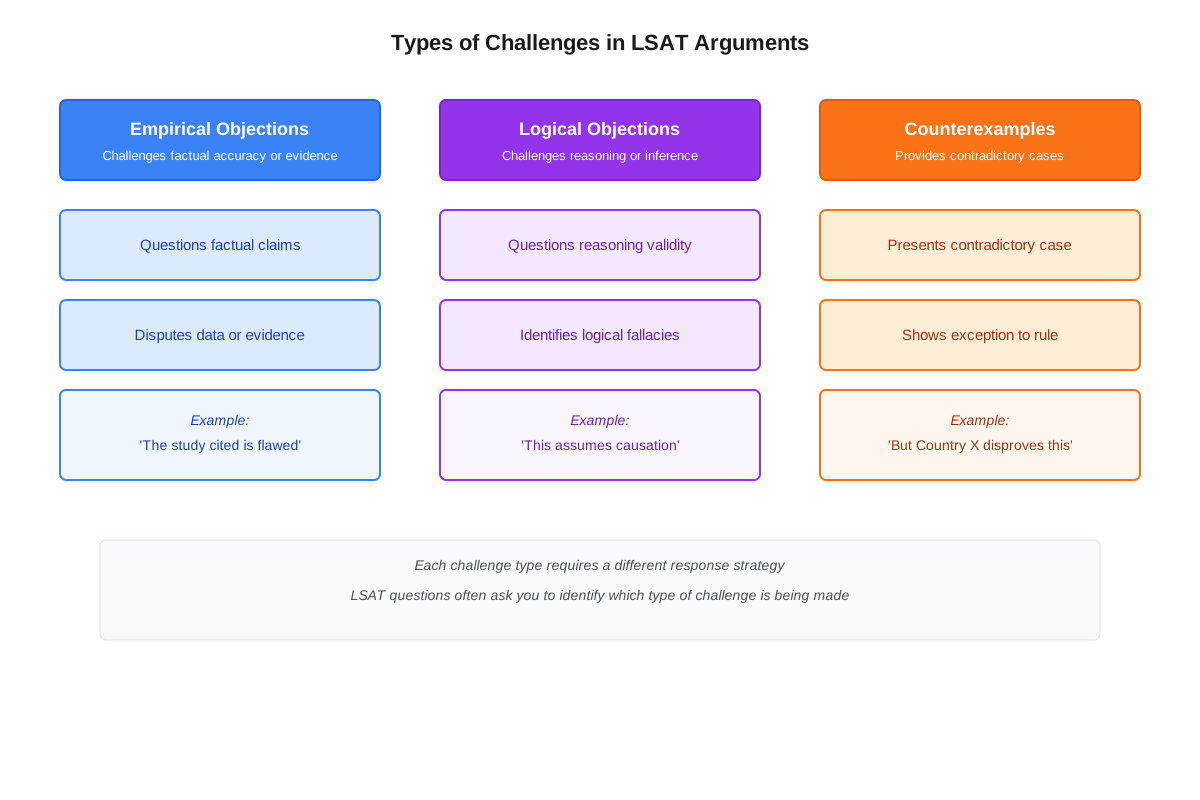
- [ ] Distinguish between different types of challenges (empirical objections, logical objections, counterexamples)
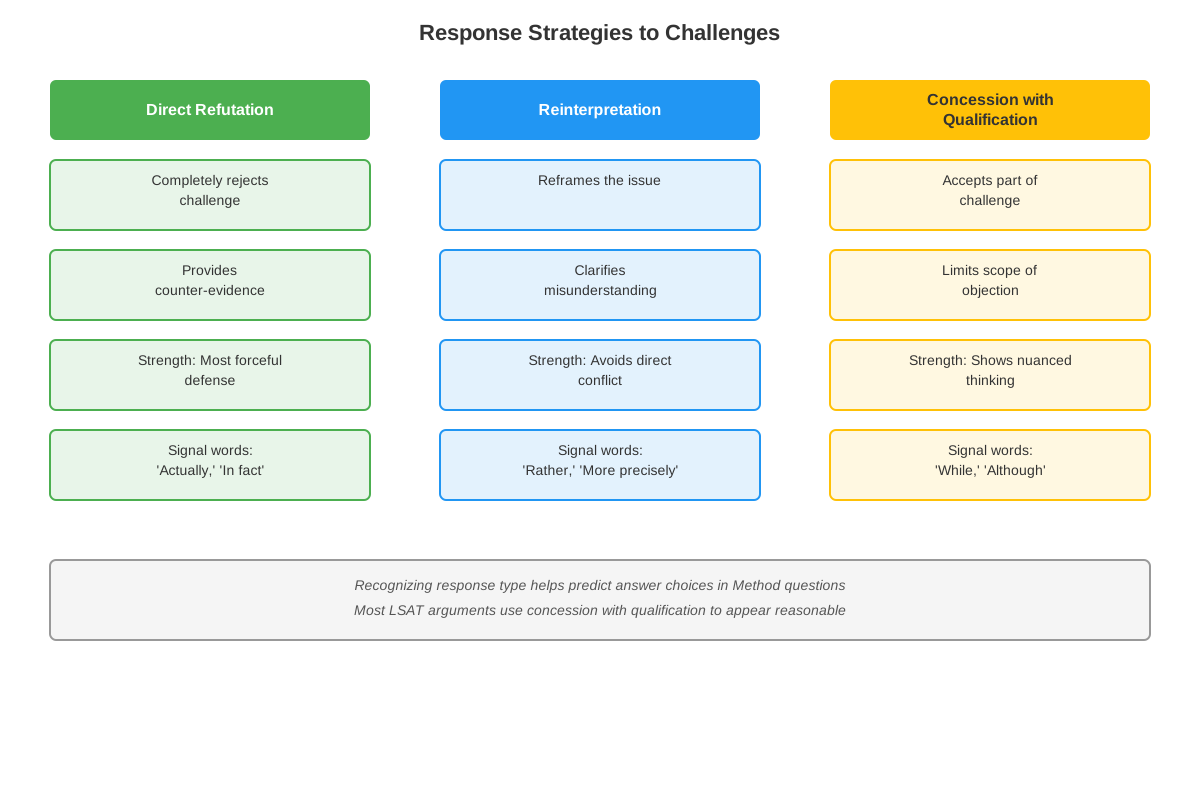
- [ ] Recognize the various ways responses can address challenges (direct refutation, reinterpretation, concession with qualification)
- [ ] Predict answer choices based on the structural role of statements within challenge and response arguments
Prerequisites
- Basic argument structure: Understanding premises, conclusions, and how they connect is essential because challenge and response structures build upon these fundamental components
- Indicator words and phrases: Familiarity with conclusion indicators ("therefore," "thus") and premise indicators ("because," "since") helps identify where challenges and responses begin and end
- Argument components: Recognizing the difference between main conclusions, intermediate conclusions, and supporting evidence enables proper identification of what is being challenged and what constitutes the response
- Reading comprehension skills: The ability to parse complex sentences and identify relationships between ideas is necessary for tracking the flow from initial claim through challenge to response
Why This Topic Matters
The challenge and response structure appears in real-world contexts constantly, particularly in legal, academic, and policy debates. Attorneys routinely present arguments while anticipating opposing counsel's objections, scientists address potential criticisms of their research methodologies, and policymakers defend proposals against predicted concerns. Understanding this structure develops critical thinking skills that extend far beyond standardized testing into professional and academic success.
On the LSAT specifically, challenge and response structures appear in approximately 3-5 questions per Logical Reasoning section, making them one of the highest-yield patterns to master. These questions typically appear as Method of Reasoning questions (asking "how does the argument proceed?"), Role questions (asking "what function does statement X serve?"), or Structure questions (asking about the organization of the argument). The LSAT Law School Admission Council data indicates that students who correctly identify challenge and response structures score an average of 2-3 points higher on Logical Reasoning sections compared to those who struggle with this pattern.
Common manifestations in exam passages include: arguments that present a theory, acknowledge a potential objection, then explain why the objection doesn't undermine the theory; arguments that describe a common belief, present evidence against it, then address why people might still hold the belief; and arguments that propose a solution, anticipate a criticism of the solution, then modify or defend the solution against that criticism. The structure may be explicit (with clear indicator words like "however," "one might object," "in response") or implicit (requiring careful reading to identify the dialectical pattern).
Core Concepts
The Basic Three-Part Structure
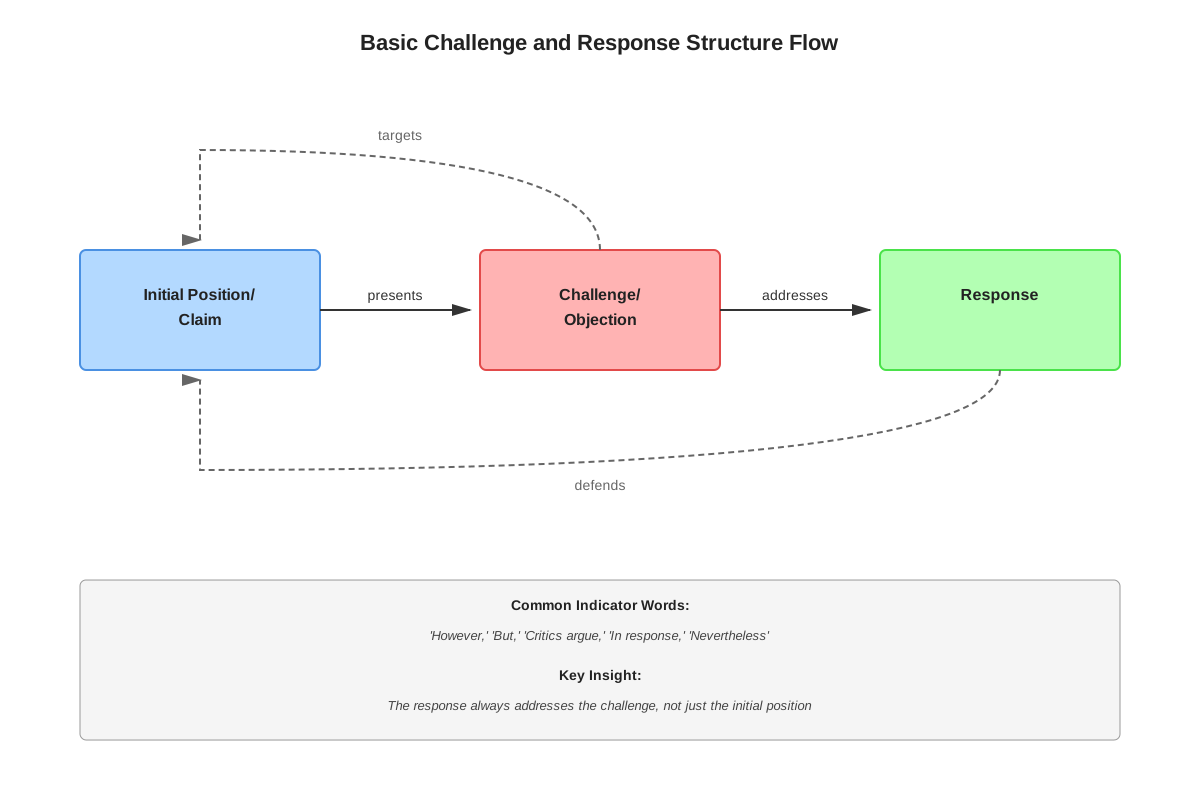
The challenge and response structure consists of three essential components that appear in sequence. First, the initial position presents a claim, theory, proposal, or argument that the author either supports or describes. This position establishes what will be challenged. Second, the challenge introduces an objection, counterargument, criticism, or potential problem with the initial position. This challenge may come from an external source (another person, group, or theory) or may be raised hypothetically by the author. Third, the response addresses the challenge by refuting it, qualifying it, reinterpreting the initial position, or explaining why the challenge doesn't ultimately undermine the main argument.
The key to identifying this structure lies in recognizing the dialectical movement: the argument doesn't simply present evidence for a conclusion but instead engages with opposition. This engagement distinguishes challenge and response structures from simple premise-conclusion arguments. The response component is particularly important because it typically contains or supports the author's main conclusion, making it the most critical part for understanding the argument's ultimate position.
Types of Challenges
Challenges in LSAT arguments fall into several categories, each requiring different types of responses. Empirical challenges question the factual basis of the initial position, suggesting that the evidence doesn't support the claim or that contradictory evidence exists. For example, if an argument claims a policy reduced crime, an empirical challenge might note that crime statistics don't show a significant decrease.
Logical challenges question whether the conclusion follows from the premises, even if the premises are true. These challenges identify gaps in reasoning, unstated assumptions, or alternative explanations. For instance, if an argument concludes that a new teaching method caused improved test scores, a logical challenge might suggest other factors (more study time, easier tests) could explain the improvement.
Counterexamples present specific cases that seem to contradict the initial position's general claim. If an argument states "all successful companies prioritize innovation," a counterexample might cite a successful company that focuses on efficiency rather than innovation.
Practical objections raise concerns about feasibility, cost, unintended consequences, or implementation difficulties. These are common when the initial position proposes a policy or solution.
Types of Responses
Responses vary in how they address challenges, and recognizing the response type helps predict correct answers. Direct refutation argues that the challenge is simply wrong, often by providing counter-evidence or exposing flaws in the challenge's reasoning. This is the strongest type of response, completely dismissing the challenge's validity.
Reinterpretation accepts the challenge's factual basis but argues it doesn't actually conflict with the initial position when properly understood. The response might clarify what the initial position really meant, showing the challenge was based on a misunderstanding.
Concession with qualification acknowledges the challenge has some merit but argues it doesn't undermine the main conclusion because the conclusion is more limited than the challenge assumes, or because the challenge applies only in specific circumstances. This response often includes phrases like "while it's true that..." or "although X may occur in some cases..."
Outweighing accepts the challenge but argues that other considerations are more important or that the benefits of the initial position outweigh the problems raised by the challenge.
Structural Indicators
Certain words and phrases signal transitions between the three components of challenge and response structures. Challenge indicators include: "however," "but," "one might object that," "critics argue," "a potential problem is," "it might seem that," "some believe," and "an alternative explanation." These phrases signal that what follows will oppose or question what came before.
Response indicators include: "in response," "nevertheless," "yet," "despite this," "this objection fails because," "actually," "in fact," "closer examination reveals," and "however" (when it appears after a challenge to introduce the response). Recognizing these indicators helps track the argument's flow and identify which component each statement belongs to.
Relationship to Argument Structure
| Component | Function | Typical Location | Relationship to Conclusion |
|---|---|---|---|
| Initial Position | Establishes the claim to be defended | Beginning of argument | May be the conclusion or may support it |
| Challenge | Raises objection or problem | Middle of argument | Opposes the conclusion or initial position |
| Response | Addresses the challenge | End of argument | Usually contains or directly supports the main conclusion |
The response typically represents the author's ultimate position, making it crucial for identifying the main conclusion. However, sometimes the initial position is the main conclusion, and the challenge-response sequence serves to defend it against objections.
Concept Relationships
The challenge and response structure builds directly upon fundamental argument analysis skills. Understanding basic argument structure (premises supporting conclusions) enables recognition of the initial position component. The challenge component requires understanding counterarguments and objections, which are themselves types of arguments opposing the initial position. The response component often employs strengthening techniques from other Logical Reasoning question types, as it must bolster the initial position against the challenge.
Within the challenge and response structure itself, the three components form a logical progression: Initial Position → generates → Challenge → prompts → Response. The challenge depends on the initial position (you cannot object to something that hasn't been stated), and the response depends on both the initial position and the specific challenge (the response must address what was actually challenged, not some other issue).
This structure connects to Method of Reasoning questions because these questions often ask students to describe how an argument proceeds, and "presents a position, considers an objection, then responds to that objection" is a common correct answer pattern. It connects to Role questions because students must identify whether a particular statement functions as the initial position, the challenge, or the response. It also relates to Strengthen/Weaken questions because understanding what is being challenged helps identify what would strengthen or weaken the argument.
The challenge and response structure also relates to assumption questions because the response often relies on unstated assumptions about why the challenge fails. Identifying these assumptions requires understanding both what the challenge claims and how the response addresses it.
High-Yield Facts
⭐ The response component typically contains or directly supports the author's main conclusion, making it the most important part for understanding the argument's ultimate position.
⭐ Challenge indicators like "however," "but," and "one might object" signal a shift from the initial position to the challenge, helping you track the argument's structure quickly.
⭐ Not all objections are challenges in the technical sense—a challenge must be addressed by a response; if an objection is simply stated without being answered, it's not part of a challenge and response structure.
⭐ The initial position may be a view the author opposes—sometimes authors present others' positions, raise challenges to them, and use those challenges to support their own contrary conclusion.
⭐ Responses don't always completely refute challenges—concession with qualification is a valid response type where the author acknowledges the challenge has some merit but argues it doesn't undermine the main point.
- Challenge and response structures often appear in arguments about 150-200 words long, making them common in longer LSAT Logical Reasoning stimuli.
- The challenge may be implicit rather than explicitly stated, requiring you to infer that a particular statement functions as an objection to what came before.
- Multiple challenges and responses can appear in a single argument, creating a more complex dialectical structure.
- The response may introduce new evidence or may simply reinterpret existing information to show the challenge doesn't apply.
- Understanding the specific type of challenge (empirical, logical, counterexample, practical) helps predict what type of response would be effective and what answer choices will be correct.
- In Method of Reasoning questions, incorrect answers often misidentify which component is which (calling the challenge the main conclusion, for example).
- The phrase "in fact" often signals a response that provides counter-evidence to a challenge.
- Challenge and response structures are particularly common in arguments about scientific theories, policy proposals, and explanations of phenomena.
Quick check — test yourself on Challenge and response structure so far.
Try Flashcards →Common Misconceptions
Misconception: Every argument that contains the word "however" or "but" is a challenge and response structure. → Correction: These words can signal various relationships, including simple contrasts or additional considerations. A true challenge and response structure requires all three components: an initial position, a challenge to that position, and a response addressing the challenge. A "however" might simply introduce a contrasting piece of evidence without creating a full challenge-response pattern.
Misconception: The challenge always comes from someone other than the author. → Correction: Authors frequently raise challenges themselves, either to anticipate objections or to consider alternative explanations before explaining why they don't undermine the main argument. Phrases like "one might think" or "it might seem that" often introduce author-generated challenges.
Misconception: The initial position is always the author's main conclusion. → Correction: Sometimes the initial position is a view the author opposes. The author presents this view, challenges it, and uses that challenge to support a contrary conclusion. The response component more reliably indicates the author's ultimate position.
Misconception: A response must completely refute the challenge to be effective. → Correction: Many effective responses acknowledge the challenge has some validity but argue it doesn't undermine the main conclusion. Concession with qualification is a legitimate response strategy where the author accepts part of the challenge while maintaining the core argument.
Misconception: If an argument mentions an objection, it must address that objection. → Correction: Some arguments present objections without responding to them, particularly when the author is describing a debate or presenting multiple viewpoints. A true challenge and response structure requires the response component; merely mentioning an objection doesn't create this structure.
Misconception: The three components always appear in strict order (position, then challenge, then response). → Correction: While this is the most common pattern, variations exist. Sometimes the response appears before the challenge is fully articulated, or the initial position is restated after the response. The logical relationship matters more than the strict sequence.
Misconception: Longer arguments are more likely to contain challenge and response structures. → Correction: While these structures do require sufficient space to develop all three components, length alone doesn't determine structure. Some long arguments simply present multiple premises without any dialectical engagement, while some relatively concise arguments efficiently present position-challenge-response patterns.
Worked Examples
Example 1: Scientific Theory Argument
Stimulus: "Recent studies suggest that moderate coffee consumption may reduce the risk of certain diseases. However, critics point out that these studies are merely correlational and cannot establish causation—coffee drinkers might engage in other healthy behaviors that actually account for the reduced disease risk. Yet this objection overlooks the fact that the most rigorous studies controlled for lifestyle factors such as diet and exercise, and the correlation between coffee consumption and reduced disease risk persisted even after these adjustments."
Analysis:
Initial Position: "Recent studies suggest that moderate coffee consumption may reduce the risk of certain diseases." This establishes the claim that will be challenged.
Challenge: "However, critics point out that these studies are merely correlational and cannot establish causation—coffee drinkers might engage in other healthy behaviors that actually account for the reduced disease risk." The word "however" signals the challenge, which is a logical objection questioning whether the evidence (correlation) supports the conclusion (coffee reduces disease risk). The challenge suggests an alternative explanation (other healthy behaviors).
Response: "Yet this objection overlooks the fact that the most rigorous studies controlled for lifestyle factors such as diet and exercise, and the correlation between coffee consumption and reduced disease risk persisted even after these adjustments." The word "yet" signals the response, which directly refutes the challenge by providing additional information about the studies' methodology. The response argues that the alternative explanation (other healthy behaviors) was already ruled out by proper experimental controls.
Question Application: If asked "The argument proceeds by," the correct answer would be something like "presenting a claim, considering an objection based on alternative explanations, then providing evidence that the objection has been addressed." If asked about the role of the statement beginning with "However," the correct answer would identify it as an objection or challenge that the argument subsequently addresses.
Example 2: Policy Proposal Argument
Stimulus: "City planners propose converting underutilized parking lots into green spaces to improve urban quality of life. Some business owners worry this will reduce available parking and hurt retail sales. This concern, while understandable, fails to account for evidence from similar cities where such conversions actually increased foot traffic and sales by making downtown areas more attractive destinations. Moreover, the proposal specifically targets lots that current usage data shows are rarely more than 30% full, ensuring adequate parking remains available."
Analysis:
Initial Position: "City planners propose converting underutilized parking lots into green spaces to improve urban quality of life." This is the proposal that will be challenged.
Challenge: "Some business owners worry this will reduce available parking and hurt retail sales." This is a practical objection raising concerns about negative consequences of the proposal.
Response: The response has two parts. First, "This concern, while understandable, fails to account for evidence from similar cities where such conversions actually increased foot traffic and sales by making downtown areas more attractive destinations." This is a concession with qualification followed by counter-evidence—the response acknowledges the concern but provides empirical evidence that the feared consequence doesn't actually occur. Second, "Moreover, the proposal specifically targets lots that current usage data shows are rarely more than 30% full, ensuring adequate parking remains available." This provides additional evidence that directly addresses the parking availability concern.
Question Application: If asked "The argument responds to the business owners' concern by," the correct answer would describe the two-part response: providing evidence from comparable situations and clarifying that the proposal is limited in scope. If asked about the function of "Some business owners worry," the correct answer would identify it as an objection or concern that the argument addresses. Notice how this example demonstrates that responses can have multiple components, each addressing different aspects of the challenge.
Exam Strategy
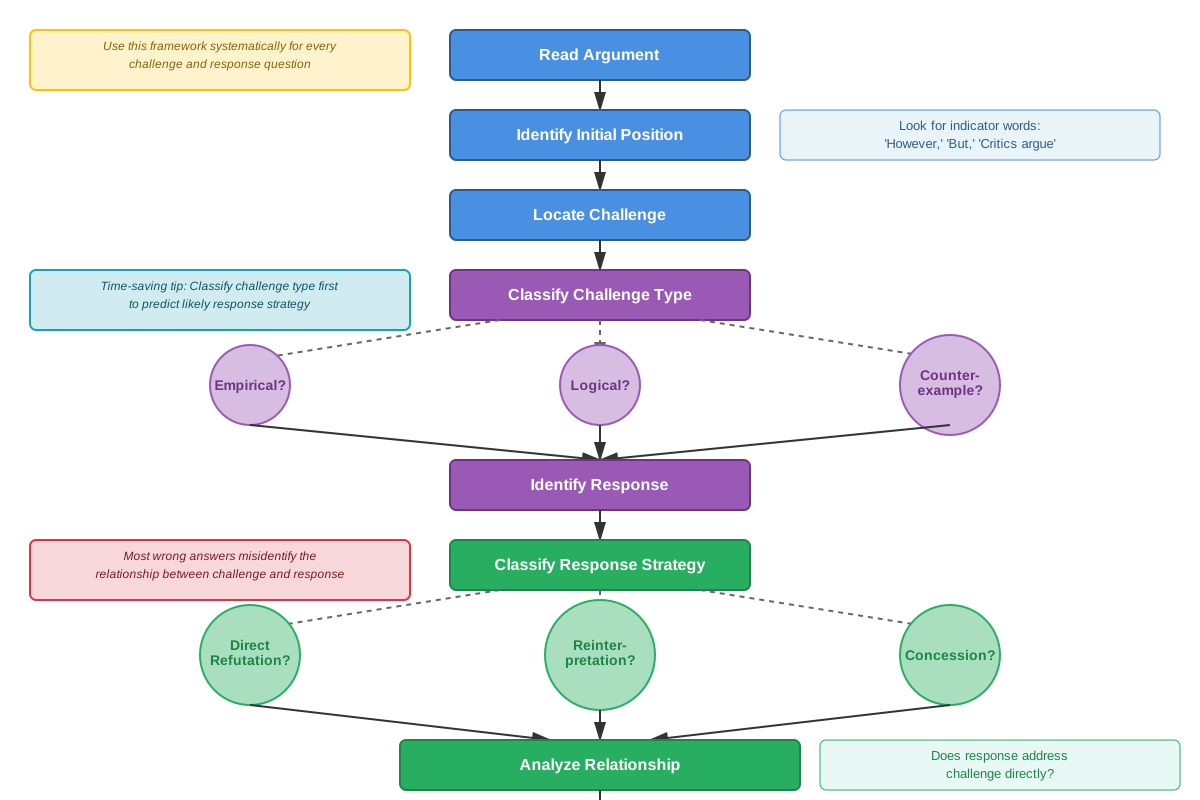
When approaching method, role, and structure questions involving challenge and response patterns, begin by quickly mapping the argument's components. As you read, mark or mentally note where the initial position ends, where the challenge begins (watch for indicator words), and where the response starts. This structural roadmap prevents confusion about which statement serves which function.
Trigger words to watch for: "However," "but," "yet," "nevertheless," "critics argue," "one might object," "some believe," "an alternative explanation," "it might seem," "in response," "this objection fails," "actually," "in fact," and "despite this concern." When you see these phrases, immediately identify whether they're introducing a challenge or a response.
For Method of Reasoning questions, predict the answer before looking at choices. If you've identified a challenge and response structure, the correct answer will describe this pattern, often using language like "presents a position, considers an objection, then responds by..." Eliminate answers that misidentify components (calling the challenge the main conclusion) or that describe structures not present in the argument (such as "uses an analogy" when no analogy appears).
For Role questions, first identify which component the specified statement belongs to, then predict its function. If it's the challenge, the correct answer will describe it as an objection, criticism, or alternative view that the argument addresses. If it's the response, the correct answer will describe it as addressing, refuting, or qualifying the challenge. Eliminate answers that describe functions the statement doesn't serve.
Time allocation: Spend 15-20 seconds identifying the structure before attempting to answer the question. This upfront investment saves time by preventing the need to reread the stimulus. Challenge and response questions are typically medium difficulty, so aim to complete them in 1:15-1:30 total.
Process of elimination tips: Eliminate answers that describe components not present in the argument. If there's no analogy, eliminate "uses an analogy." If there's no appeal to authority, eliminate "cites expert opinion." For challenge and response structures specifically, eliminate answers that fail to mention the dialectical nature of the argument—correct answers for these structures almost always reference the challenge-response pattern explicitly or implicitly.
Watch for wrong answer traps: Answers that accurately describe one component but claim it's the main conclusion when it's actually the challenge or initial position. Answers that describe the argument as simply presenting evidence for a conclusion without mentioning the challenge-response pattern. Answers that reverse the order or relationship of components.
Memory Techniques
PCR Acronym: Remember Position-Challenge-Response as the three components. Think of PCR like the medical test (polymerase chain reaction)—just as PCR testing involves a sequence of steps, challenge and response arguments involve a sequence of components.
The Debate Visualization: Picture a formal debate. The first speaker presents a position (initial position), the second speaker raises objections (challenge), and the first speaker responds (response). This mental image helps remember both the sequence and the adversarial nature of the structure.
Indicator Word Categories: Group indicator words into two categories using the acronym HOBO for challenge indicators: However, One might object, But, Others argue. For response indicators, use YIDA: Yet, In fact, Despite this, Actually.
The Three-Act Play: Think of challenge and response structures as a three-act play: Act 1 establishes the situation (initial position), Act 2 introduces conflict (challenge), Act 3 resolves the conflict (response). This narrative framework makes the structure memorable and helps you anticipate what comes next.
The Shield Metaphor: Visualize the initial position as something valuable that needs protection, the challenge as an attack on it, and the response as a shield defending against the attack. This metaphor emphasizes that the response's purpose is to protect the initial position from the challenge.
Summary
The challenge and response structure is a fundamental argumentative pattern in LSAT Logical Reasoning that consists of three components: an initial position that presents a claim or proposal, a challenge that raises an objection or problem with that position, and a response that addresses the challenge to defend or qualify the initial position. This structure appears frequently in Method of Reasoning, Role, and Structure questions, making it one of the highest-yield patterns to master. Success requires recognizing indicator words that signal transitions between components, understanding different types of challenges (empirical, logical, counterexamples, practical) and responses (direct refutation, reinterpretation, concession with qualification, outweighing), and accurately identifying which component each statement belongs to. The response typically contains or supports the author's main conclusion, making it the most critical component for understanding the argument's ultimate position. Students who quickly identify this structure gain significant advantages in both speed and accuracy on LSAT Logical Reasoning sections.
Key Takeaways
- Challenge and response structures consist of three essential components: initial position, challenge, and response, appearing in that logical sequence
- The response component typically contains or directly supports the author's main conclusion, making it crucial for understanding the argument's ultimate position
- Indicator words like "however," "but," "one might object" signal challenges, while "yet," "in fact," "nevertheless" signal responses
- Challenges can be empirical (questioning evidence), logical (questioning reasoning), counterexamples (presenting contradictory cases), or practical (raising implementation concerns)
- Responses don't always completely refute challenges—concession with qualification is a valid strategy where the author acknowledges some merit in the challenge while maintaining the core argument
- Quickly mapping the three components as you read prevents confusion and saves time on Method, Role, and Structure questions
- The initial position isn't always the author's view—sometimes authors present others' positions, challenge them, and use those challenges to support contrary conclusions
Related Topics
Method of Reasoning Questions: These questions ask how an argument proceeds or what technique it employs. Mastering challenge and response structures provides a framework for answering these questions when arguments follow this pattern, as correct answers often describe the dialectical progression from position through challenge to response.
Role Questions: These questions ask what function a specific statement serves in an argument. Understanding challenge and response structures enables quick identification of whether a statement is the initial position, the challenge, or the response, leading directly to correct answers.
Strengthen and Weaken Questions: The challenge component often suggests what would weaken the initial position, while the response suggests what would strengthen it. Understanding this structure helps predict what additional evidence would support or undermine the argument.
Assumption Questions: Responses often rely on unstated assumptions about why challenges fail. Identifying these assumptions requires understanding both the challenge and the response, making challenge and response structure knowledge valuable for assumption questions.
Parallel Reasoning Questions: Some parallel reasoning questions require matching not just the logical structure but also the argumentative structure. Recognizing challenge and response patterns helps identify when answer choices match or fail to match this structural element.
Practice CTA
Now that you understand the challenge and response structure, it's time to apply this knowledge to actual LSAT questions. The practice questions and flashcards will help solidify your ability to quickly identify this pattern and use it to answer Method, Role, and Structure questions accurately. Remember, recognizing this structure becomes faster and more automatic with practice—each question you work through strengthens your pattern recognition skills. Challenge yourself to identify all three components in each practice argument, and you'll find that what initially seemed complex becomes second nature. Your investment in mastering this high-yield topic will pay dividends throughout the Logical Reasoning sections of your LSAT.
Sign up free to keep reading
Create a free AnvayaPrep account to finish this LSAT guide on Challenge and response structure — plus flashcards and practice questions.