Overview
Distinguishing method from flaw represents a critical analytical skill tested throughout the LSAT's Logical Reasoning sections. This competency requires test-takers to differentiate between describing how an argument proceeds (its method or structure) versus identifying what's wrong with that argument (its logical flaw). While these two question types may appear similar at first glance, they demand fundamentally different analytical approaches and lead to distinctly different answer choices.
The LSAT frequently tests whether students can recognize this distinction because it reflects essential legal reasoning skills. Attorneys must be able to both describe the structure of opposing counsel's arguments and identify weaknesses in those arguments—two separate but complementary abilities. Method questions ask students to characterize argumentative techniques neutrally, without judgment about validity. Flaw questions, conversely, require identifying specific logical errors that undermine an argument's soundness. Confusing these two question types leads to systematic errors that can significantly impact test scores.
Within the broader category of Method, Role, and Structure Questions, distinguishing method from flaw serves as a foundational skill that enhances performance across multiple question types. Mastering this distinction improves accuracy on Method of Reasoning questions, Flaw questions, and even strengthens performance on Parallel Reasoning and Evaluate questions. This topic sits at the intersection of structural analysis and critical evaluation, making it one of the highest-yield areas for focused study in LSAT preparation.
Learning Objectives
- [ ] Identify how Distinguishing method from flaw appears in LSAT questions
- [ ] Explain the reasoning pattern behind Distinguishing method from flaw
- [ ] Apply Distinguishing method from flaw to solve LSAT-style problems accurately
- [ ] Distinguish between neutral descriptive language and evaluative critical language in answer choices
- [ ] Recognize common question stem patterns that signal method versus flaw questions
- [ ] Evaluate answer choices by matching them to the appropriate analytical framework (descriptive vs. critical)
Prerequisites
- Basic argument structure: Understanding premises, conclusions, and how they connect is essential because both method and flaw questions require identifying these components before analysis can proceed.
- Common logical fallacies: Familiarity with standard reasoning errors (ad hominem, circular reasoning, false dichotomy, etc.) provides the vocabulary needed to recognize flaws when they appear.
- Conditional reasoning: Many arguments use if-then logic, and recognizing valid versus invalid conditional inferences is crucial for both describing methods and identifying flaws.
- Evidence evaluation: Understanding what constitutes strong versus weak support helps distinguish between describing how evidence is used (method) and critiquing whether it's used appropriately (flaw).
Why This Topic Matters
In legal practice, attorneys must constantly perform dual analyses of arguments: first understanding the structure and technique of reasoning, then evaluating its logical soundness. Law school professors expect entering students to seamlessly shift between these analytical modes, making this skill directly relevant to legal education success beyond the LSAT itself.
On the LSAT, lsat distinguishing method from flaw appears with remarkable frequency. Method of Reasoning questions typically constitute 2-4 questions per Logical Reasoning section, while Flaw questions represent 4-6 questions per section. Combined, these question types account for approximately 25-35% of all Logical Reasoning questions. More importantly, students who confuse these question types often select answers that are factually accurate but categorically wrong—describing a method when asked for a flaw, or vice versa. This confusion represents one of the most common and costly error patterns in LSAT preparation.
This topic appears in several distinct formats on the exam:
- Direct Method questions: "The argument proceeds by..." or "Which one of the following describes the technique of reasoning used?"
- Direct Flaw questions: "The reasoning is flawed because..." or "The argument is vulnerable to criticism on the grounds that..."
- Hybrid questions: Occasionally, questions ask students to identify both the method AND evaluate whether it's problematic
- Parallel Reasoning questions: These implicitly test method recognition by requiring students to match argumentative structures
- Evaluate questions: Understanding method helps identify what additional information would strengthen or weaken an argument
Core Concepts
The Fundamental Distinction: Description vs. Evaluation
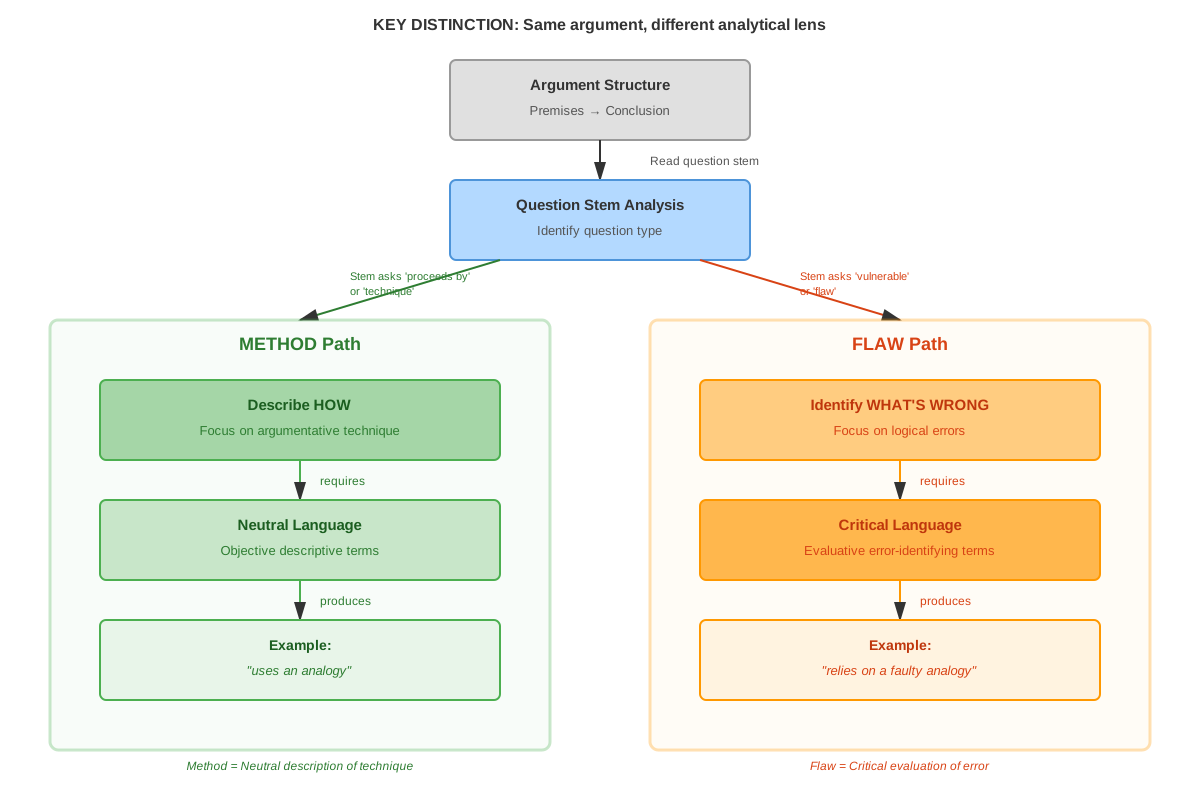
The core difference between method and flaw analysis lies in the analytical stance taken toward an argument. Method questions require a neutral, descriptive approach—characterizing what the argument does without judging whether it does so effectively. Flaw questions demand a critical, evaluative stance—identifying why the argument fails to establish its conclusion adequately.
Consider this analogy: A method question asks you to describe a chess player's strategy ("The player sacrificed a knight to expose the opponent's king"), while a flaw question asks you to identify why that strategy failed ("The player overlooked that sacrificing the knight left their own queen vulnerable"). Both require understanding what happened, but only the flaw question requires evaluating the quality of the reasoning.
Method Questions: Neutral Structural Analysis
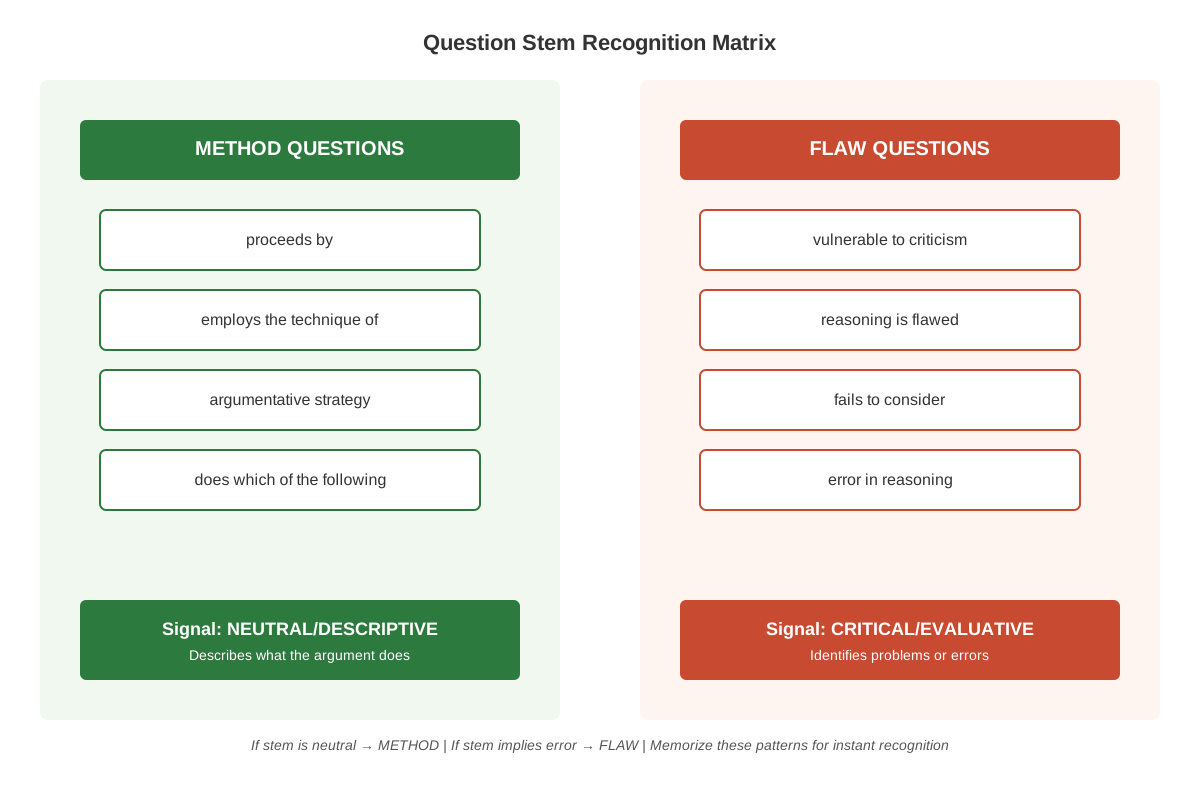
Method of Reasoning questions ask test-takers to describe the argumentative technique or structure an author employs. These questions use stems like:
- "The argument proceeds by..."
- "Which one of the following describes the technique of reasoning used above?"
- "The argument employs which one of the following argumentative strategies?"
- "The reasoning above conforms most closely to which one of the following principles?"
Correct answers to method questions use neutral, descriptive language that accurately characterizes the argument's structure without suggesting the reasoning is flawed. Common method descriptions include:
- Presenting a counterexample to refute a general claim
- Drawing an analogy between two situations
- Appealing to expert authority to support a conclusion
- Citing statistical evidence to establish a trend
- Eliminating alternative explanations to support a hypothesis
- Generalizing from a specific case to a broader principle
- Questioning the relevance of an opponent's evidence
Notice that none of these descriptions inherently criticize the argument—they simply describe what the argument does.
Flaw Questions: Critical Evaluation
Flaw questions require identifying a specific logical error that undermines an argument's validity. These questions use stems like:
- "The reasoning in the argument is flawed because..."
- "The argument is vulnerable to criticism on the grounds that it..."
- "A questionable aspect of the reasoning above is that it..."
- "The argument is most susceptible to criticism on which one of the following grounds?"
Correct answers to flaw questions use evaluative, critical language that identifies a specific reasoning error. Common flaw descriptions include:
- Assumes without justification that correlation implies causation
- Treats a necessary condition as if it were sufficient
- Relies on the testimony of sources whose expertise is questionable
- Overlooks the possibility that the stated factors are not the only relevant ones
- Fails to consider that the evidence cited might be unrepresentative
- Takes for granted that what is true of the parts is true of the whole
- Confuses a claim's popularity with its truth
Each of these descriptions identifies a specific logical problem that weakens the argument's reasoning.
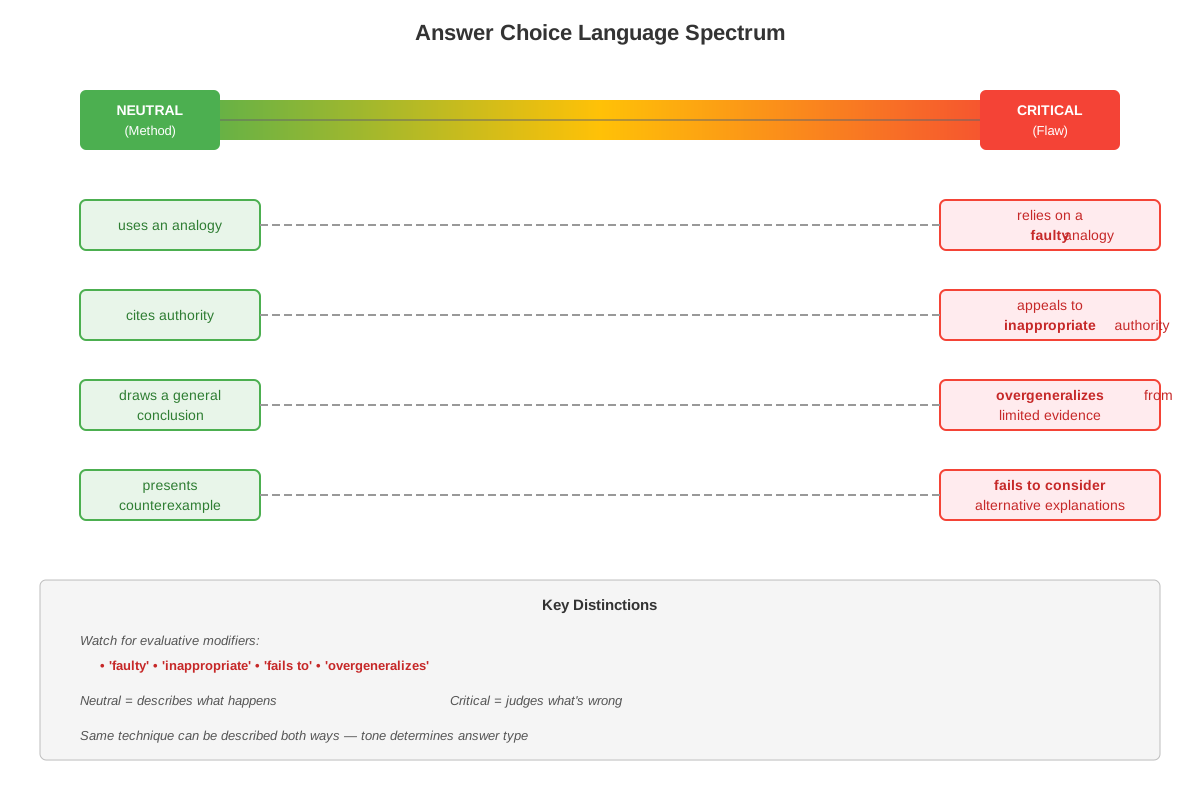
The Language Distinction: Key Linguistic Markers
| Method Language (Neutral) | Flaw Language (Critical) |
|---|---|
| "presents evidence that..." | "fails to consider evidence that..." |
| "draws an analogy between..." | "relies on a questionable analogy between..." |
| "cites the opinion of..." | "inappropriately appeals to authority by..." |
| "generalizes from..." | "overgeneralizes from..." |
| "eliminates alternatives by..." | "overlooks alternative explanations such as..." |
| "supports the conclusion by..." | "provides insufficient support for..." |
| "argues that..." | "assumes without warrant that..." |
The linguistic shift from neutral description to critical evaluation is the most reliable indicator of whether an answer choice addresses method or flaw.
The Same Technique Can Be Both Method and Flaw
A crucial insight for LSAT success: the same argumentative technique can be described neutrally (method) or criticized (flaw) depending on the question asked. Consider an argument that uses an analogy:
- Method description: "The argument proceeds by drawing an analogy between two situations and inferring that what is true of one is likely true of the other."
- Flaw description: "The argument relies on an analogy between two situations that may not be relevantly similar in the respect at issue."
Both statements might accurately describe the same argument, but only one is correct for any given question. The question stem determines which analytical framework to apply.
Common Method Types Tested on the LSAT
- Counterexample method: Refuting a universal claim by providing a single instance where it doesn't hold
- Analogical reasoning: Drawing parallels between two situations to infer similar outcomes
- Elimination method: Ruling out alternatives to support a remaining hypothesis
- Appeal to authority: Citing expert opinion or testimony
- Causal reasoning: Arguing that one factor produces or influences another
- Generalization: Moving from specific instances to broader principles
- Reductio ad absurdum: Showing a position leads to absurd consequences
- Challenging relevance: Questioning whether evidence actually supports a claim
Common Flaw Types Tested on the LSAT
- Correlation-causation confusion: Treating correlation as proof of causation
- Necessary-sufficient confusion: Treating necessary conditions as sufficient or vice versa
- Unrepresentative sample: Generalizing from atypical cases
- Overlooking alternatives: Failing to consider other explanations or possibilities
- Circular reasoning: Using the conclusion as support for itself
- Equivocation: Using a term with shifting meanings
- Ad hominem: Attacking the person rather than the argument
- False dichotomy: Presenting limited options as if they're exhaustive
- Composition/division: Confusing properties of parts with properties of wholes
- Questionable authority: Relying on sources lacking relevant expertise
Concept Relationships
The relationship between method and flaw analysis forms a hierarchical structure: method identification → serves as foundation for → flaw detection. One cannot identify a flaw without first understanding the method employed. For example, recognizing that an argument uses analogical reasoning (method) enables identifying whether the analogy is relevantly similar (potential flaw).
This topic connects to prerequisite knowledge through several pathways:
- Argument structure → enables → method identification: Understanding premises and conclusions allows recognition of how they connect
- Logical fallacies → provide vocabulary for → flaw identification: Knowing standard error types helps match arguments to flaw categories
- Conditional reasoning → appears within → both method and flaw questions: Valid conditional inferences can be described as methods; invalid ones are flaws
Within the broader category of Method, Role, and Structure Questions, this topic relates to:
- Role questions: Understanding method helps identify what function a statement serves in an argument
- Parallel Reasoning: Method recognition is essential for matching argumentative structures
- Evaluate questions: Knowing the method reveals what additional information would test the argument's strength
The progression flows: Identify structure → Describe method → Evaluate validity → Recognize flaws. Each step builds on the previous, creating an integrated analytical framework.
High-Yield Facts
⭐ Method questions require neutral, descriptive language; flaw questions require critical, evaluative language.
⭐ The same argumentative technique can be correctly described as either a method or a flaw depending on the question stem.
⭐ Method question stems typically include "proceeds by," "technique of reasoning," or "argumentative strategy."
⭐ Flaw question stems typically include "vulnerable to criticism," "reasoning is flawed," or "questionable aspect."
⭐ Correct method answers describe what the argument does; correct flaw answers explain why what it does is problematic.
- Method questions never suggest the argument is logically deficient; flaw questions always identify a logical weakness.
- Words like "fails," "overlooks," "assumes without justification," and "ignores" signal flaw language, not method language.
- An answer choice can be factually accurate about what an argument does but still be wrong if it uses evaluative language for a method question.
- Approximately 25-35% of Logical Reasoning questions test method or flaw recognition, making this distinction high-yield.
- The most common error is selecting a flaw answer for a method question because the argument is indeed flawed—but the question asks only for description, not evaluation.
- Method answers often begin with present-tense verbs: "presents," "draws," "cites," "argues," "supports."
- Flaw answers often include negative constructions: "fails to," "neglects," "overlooks," "ignores," "assumes without warrant."
- Some arguments use valid methods but still contain flaws in other aspects (e.g., using valid analogical reasoning but with a poor analogy).
- Reading the question stem carefully before analyzing the argument prevents applying the wrong analytical framework.
- Practice identifying whether each answer choice uses neutral or evaluative language as a quick elimination strategy.
Quick check — test yourself on Distinguishing method from flaw so far.
Try Flashcards →Common Misconceptions
Misconception: If an argument is flawed, method questions should identify that flaw.
Correction: Method questions require neutral description regardless of whether the argument is flawed. Even deeply flawed arguments have methods that can be described without criticism. The question stem determines whether to describe or critique.
Misconception: Flaw answers must use technical terminology like "ad hominem" or "false dichotomy."
Correction: While LSAT flaw answers sometimes use formal fallacy names, they more commonly describe flaws in plain language. "The argument attacks the character of the person making the claim rather than addressing the claim itself" is just as valid as "commits an ad hominem fallacy."
Misconception: If an answer choice accurately describes something the argument does, it must be correct for a method question.
Correction: Accuracy is necessary but insufficient. The answer must also use appropriately neutral language. An answer stating "fails to provide sufficient evidence" might accurately describe the argument but uses evaluative language inappropriate for a method question.
Misconception: Method and flaw questions test completely different skills with no overlap.
Correction: These question types test complementary skills along a continuum. Both require identifying argumentative structure; they differ only in whether that structure is described neutrally or evaluated critically. Strong performance on one type enhances performance on the other.
Misconception: All arguments that use analogies are flawed because analogies are inherently weak reasoning.
Correction: Analogical reasoning is a legitimate argumentative method. Whether a specific analogy is flawed depends on whether the compared situations are relevantly similar. Method questions describe the use of analogy neutrally; flaw questions critique specific analogies only when they're genuinely problematic.
Misconception: Longer, more complex answer choices are more likely to be correct for method questions.
Correction: Answer length correlates poorly with correctness. The LSAT deliberately includes verbose wrong answers and concise correct answers. Focus on whether the language is appropriately neutral or evaluative, not on length or complexity.
Worked Examples
Example 1: Distinguishing Method from Flaw
Argument: "Recent studies show that countries with higher chocolate consumption have more Nobel Prize winners per capita. Therefore, eating chocolate must enhance cognitive function and increase the likelihood of achieving scientific excellence."
Method Question: "The argument proceeds by which one of the following methods?"
Analysis: First, identify what the argument actually does without evaluating whether it's valid. The argument observes a correlation (chocolate consumption and Nobel Prizes) and infers a causal relationship (chocolate causes enhanced cognition).
Correct Method Answer: "Drawing a causal inference from a statistical correlation between two phenomena."
This answer neutrally describes what the argument does. It doesn't suggest this is problematic—it simply characterizes the argumentative technique.
Incorrect Method Answer: "Inappropriately inferring causation from mere correlation without ruling out alternative explanations."
While this accurately identifies the argument's flaw, it uses evaluative language ("inappropriately," "mere correlation," "without ruling out") that's inappropriate for a method question.
Flaw Question: "The reasoning in the argument is most vulnerable to criticism on the grounds that it..."
Analysis: Now we evaluate the argument critically. The argument commits the classic correlation-causation fallacy. The correlation between chocolate consumption and Nobel Prizes could be explained by confounding variables (e.g., national wealth enabling both chocolate purchases and research funding) rather than chocolate directly causing cognitive enhancement.
Correct Flaw Answer: "Treats a correlation between two phenomena as sufficient to establish that one causes the other, without considering alternative explanations for the correlation."
This answer identifies the specific logical error using appropriately critical language.
Incorrect Flaw Answer: "Draws a causal inference from a statistical correlation."
While factually accurate, this uses neutral method language rather than identifying why this is problematic. It describes what the argument does without explaining the flaw.
Example 2: Complex Argument Analysis
Argument: "City Council Member: The mayor claims our proposed traffic reduction plan won't work because a similar plan failed in Springfield. But Springfield's plan failed only because they didn't enforce parking restrictions. Since our plan includes strict enforcement mechanisms, the mayor's objection is unfounded."
Method Question: "The council member responds to the mayor's objection by..."
Analysis: The council member identifies a disanalogy between the two situations (Springfield lacked enforcement; the current plan includes it) to argue that the mayor's analogical reasoning doesn't apply. This is a method of responding to an argument by challenging the relevance of a comparison.
Correct Method Answer: "Pointing out a relevant difference between the two situations being compared that undermines the force of the comparison."
This neutrally describes the argumentative technique without suggesting whether it's successful.
Incorrect Method Answer: "Presenting a counterexample that refutes a universal generalization."
This describes a different method entirely. The council member doesn't present a counterexample; they challenge an analogy's relevance.
Flaw Question: "The council member's reasoning is questionable because it..."
Analysis: The council member assumes that enforcement was the only relevant difference between Springfield and the current city. Other factors (city size, public transportation availability, road infrastructure) might also explain Springfield's failure and could affect the current plan. The argument overlooks alternative explanations for the disanalogy.
Correct Flaw Answer: "Assumes without justification that the cited difference between the two situations is the only relevant difference."
This identifies the specific logical gap using appropriately critical language.
Incorrect Flaw Answer: "Relies on a comparison between two situations to support its conclusion."
This is neutral method language, not flaw identification. Using comparisons isn't inherently flawed; the flaw lies in how this specific comparison is used.
Exam Strategy
Pre-Reading the Question Stem
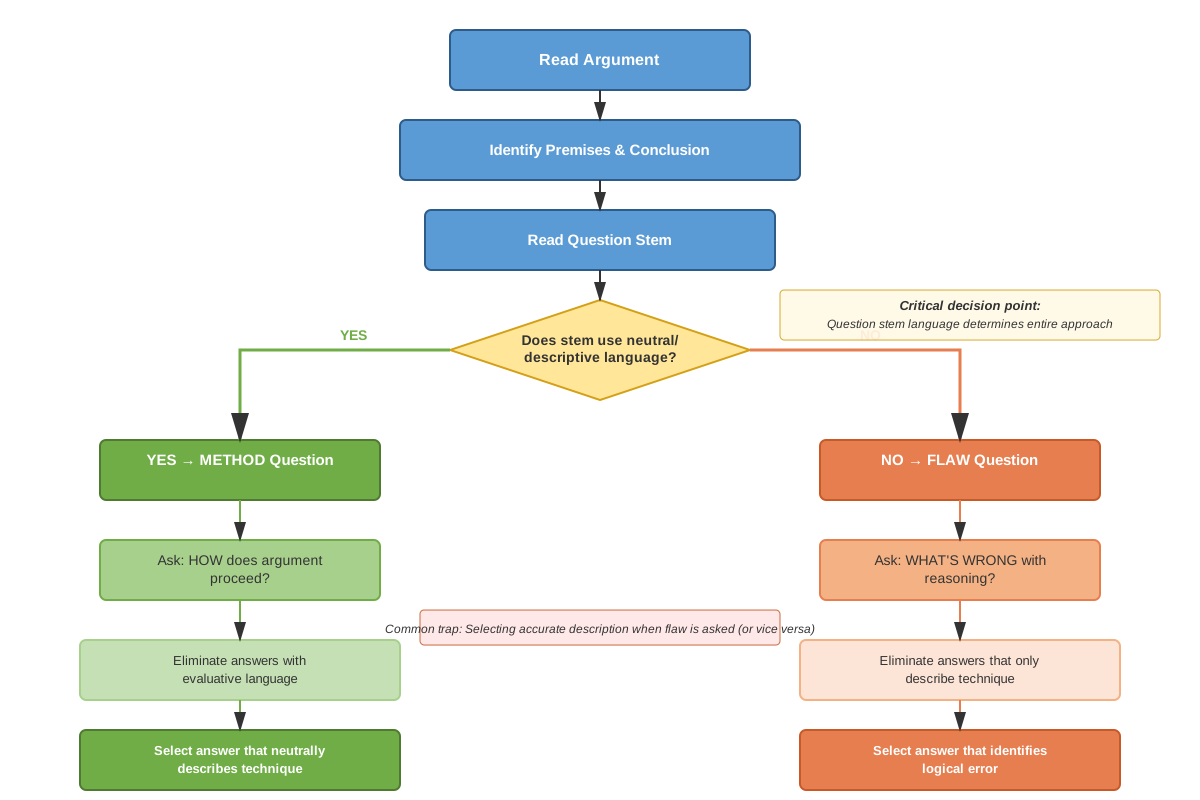
Always read the question stem before analyzing the argument. This determines which analytical framework to apply. If the stem asks "proceeds by" or "technique of reasoning," activate neutral descriptive mode. If it asks "vulnerable to criticism" or "reasoning is flawed," activate critical evaluative mode. This prevents wasting time analyzing the argument from the wrong perspective.
Trigger Words for Method Questions
Watch for these phrases that signal method questions:
- "proceeds by"
- "technique of reasoning"
- "argumentative strategy"
- "method of argumentation"
- "does which one of the following"
- "employs which one of the following"
When you see these triggers, remind yourself: describe, don't critique.
Trigger Words for Flaw Questions
Watch for these phrases that signal flaw questions:
- "vulnerable to criticism"
- "reasoning is flawed"
- "questionable aspect"
- "most susceptible to criticism"
- "error in reasoning"
- "reasoning is weak"
When you see these triggers, remind yourself: identify the logical error.
Answer Choice Evaluation Strategy
For method questions, eliminate any answer choice containing:
- "fails to"
- "neglects"
- "overlooks"
- "ignores"
- "assumes without justification"
- "inappropriately"
- "questionable"
- "insufficient"
These words signal evaluative language inappropriate for method questions.
For flaw questions, eliminate any answer choice that:
- Merely describes what the argument does without identifying a problem
- Uses entirely neutral language with no critical evaluation
- Accurately describes the method but doesn't explain why it's problematic
The Two-Pass Approach
- First pass: Quickly eliminate answers with the wrong type of language (evaluative for method questions; neutral for flaw questions)
- Second pass: Among remaining answers, identify which most accurately describes the argument's method or flaw
This two-pass approach typically eliminates 3-4 answer choices quickly, leaving a manageable comparison.
Time Allocation
Method and flaw questions typically require 60-90 seconds each:
- 15-20 seconds: Read and understand the question stem
- 20-30 seconds: Analyze the argument structure
- 25-40 seconds: Evaluate answer choices
Don't spend excessive time on these questions. If you've correctly identified the method or flaw, the right answer should be recognizable within the time frame. If you're stuck after 90 seconds, make your best guess and move on.
Common Trap Answers
The LSAT frequently includes trap answers that:
- Accurately describe the argument but use the wrong type of language
- Describe a method or flaw that's common but doesn't appear in this specific argument
- Use technical terminology impressively but inaccurately
- Describe something tangentially related but not the primary method or flaw
Always verify that your selected answer directly addresses what the argument actually does (method) or what's actually wrong with it (flaw).
Memory Techniques
The "Describe vs. Diagnose" Mnemonic
Method = Describe (both have 'D')
Flaw = Diagnose (both identify problems)
When you see a question, ask: "Am I describing or diagnosing?" This immediately activates the correct analytical framework.
The Language Litmus Test
Create a mental "word wall" separating neutral from evaluative language:
NEUTRAL WALL | EVALUATIVE WALL
- presents | - fails to present
- draws | - inappropriately draws
- cites | - relies on questionable
- argues | - assumes without warrant
- supports | - provides insufficient support
Visualize answer choices hitting one wall or the other. Method questions need answers from the neutral wall; flaw questions need answers from the evaluative wall.
The "Same Argument, Different Lens" Visualization
Picture yourself wearing two different pairs of glasses:
- Blue glasses (method): You see only structure and technique, like an architect viewing a building's design
- Red glasses (flaw): You see cracks and weaknesses, like an inspector identifying structural problems
The question stem tells you which glasses to wear. The argument doesn't change—only your analytical perspective.
The PEACE Acronym for Method Questions
Presents (evidence, examples, counterexamples)
Eliminates (alternatives, objections)
Analogizes (draws comparisons)
Cites (authority, statistics)
Extrapolates (generalizes, infers)
Most method answers describe one of these five basic techniques.
The FAUCET Acronym for Common Flaws
Fails to consider alternatives
Assumes without justification
Uses unrepresentative samples
Confuses correlation with causation
Equivocates on key terms
Treats necessary as sufficient (or vice versa)
These six flaws appear in approximately 70% of flaw questions.
Summary
Distinguishing method from flaw represents a fundamental analytical skill that separates high-scoring LSAT test-takers from average performers. The core distinction lies in analytical stance: method questions demand neutral, descriptive characterization of argumentative techniques, while flaw questions require critical evaluation identifying logical errors. The same argument can be accurately described using either framework, but the question stem determines which is appropriate. Success requires recognizing linguistic markers—neutral language for methods ("presents," "draws," "cites") versus evaluative language for flaws ("fails to," "overlooks," "assumes without justification"). This distinction appears in 25-35% of Logical Reasoning questions, making it one of the highest-yield topics for focused study. Mastery requires practice shifting between descriptive and evaluative modes, reading question stems carefully before analyzing arguments, and eliminating answer choices based on language type before evaluating accuracy.
Key Takeaways
- Method questions ask "what does the argument do?" while flaw questions ask "what's wrong with what it does?"—this fundamental distinction drives all analysis
- Always read the question stem first to determine whether to describe neutrally or critique critically before analyzing the argument
- The same argumentative technique can be both a valid method to describe and a flaw to identify depending on the question asked
- Language type (neutral vs. evaluative) is often more important than factual accuracy when eliminating wrong answers
- Method and flaw questions together constitute approximately 25-35% of Logical Reasoning questions, making this distinction essential for score improvement
- Trigger words in question stems reliably signal which analytical framework to apply: "proceeds by" signals method; "vulnerable to criticism" signals flaw
- Practice shifting between descriptive and evaluative modes until the transition becomes automatic based on question stem recognition
Related Topics
Parallel Reasoning Questions: These questions require matching argumentative structures, which depends heavily on accurate method identification. Mastering method recognition enables faster, more accurate parallel reasoning performance.
Evaluate the Argument Questions: Understanding an argument's method reveals what additional information would strengthen or weaken it. Method recognition is the foundation for identifying relevant evaluation criteria.
Role of a Statement Questions: These questions ask what function a particular sentence serves in an argument. Recognizing overall argumentative method helps identify how individual components contribute to that method.
Strengthen and Weaken Questions: Identifying an argument's method and potential flaws reveals what evidence would support or undermine it. This topic provides the analytical foundation for all argument evaluation questions.
Principle Questions: Many principle questions require recognizing the method of reasoning in an argument and matching it to an abstract principle. Method recognition skills transfer directly to principle identification.
Practice CTA
Now that you understand the crucial distinction between method and flaw analysis, it's time to cement this knowledge through active practice. The concepts covered here appear in approximately one-quarter of all Logical Reasoning questions—making this one of the highest-yield topics for practice investment. Attempt the practice questions associated with this topic, focusing on identifying question type before analyzing arguments. Create flashcards for the linguistic markers that distinguish method from flaw language. With deliberate practice, the shift between descriptive and evaluative modes will become automatic, significantly improving both speed and accuracy on test day. Your ability to distinguish method from flaw is a learnable skill that directly translates to points on the LSAT—invest the practice time now to reap the scoring benefits later.
Sign up free to keep reading
Create a free AnvayaPrep account to finish this LSAT guide on Distinguishing method from flaw — plus flashcards and practice questions.