Overview
Role of a statement questions represent a critical question type within the LSAT's Logical Reasoning sections, appearing consistently across multiple test administrations. These questions ask test-takers to identify the specific function that a particular claim, sentence, or piece of evidence plays within an argument's overall structure. Unlike questions that ask what an author concludes or what evidence supports a conclusion, role questions require students to step back and analyze the argumentative architecture itself—to understand not just what is being said, but why it appears where it does and how it contributes to the argument's logical flow.
Mastering lsat role of a statement questions is essential because they test a fundamental skill that underlies all logical reasoning: the ability to deconstruct arguments into their component parts and understand how those parts interact. When facing these questions, students must recognize whether a statement functions as a main conclusion, an intermediate conclusion, a premise supporting the main point, background information, an opposing viewpoint being refuted, or one of several other possible roles. This analytical skill directly translates to improved performance across all logical reasoning question types, as understanding argumentative structure is foundational to evaluating arguments, identifying flaws, strengthening or weakening reasoning, and making inferences.
Within the broader category of method, role, and structure questions, role questions occupy a unique position. While method questions ask how an argument proceeds and structure questions examine the overall organization, role questions zoom in on individual components. Together, these question types form a comprehensive toolkit for argument analysis. Students who excel at role questions develop a sophisticated understanding of argumentative discourse that enhances their ability to navigate complex reasoning passages, making this topic a high-leverage investment of study time with returns that extend far beyond this specific question type.
Learning Objectives
- [ ] Identify how Role of a statement questions appears in LSAT questions
- [ ] Explain the reasoning pattern behind Role of a statement questions
- [ ] Apply Role of a statement questions to solve LSAT-style problems accurately
- [ ] Distinguish between different statement roles (main conclusion, intermediate conclusion, premise, counterpoint, background information)
- [ ] Recognize common question stem formulations that signal role questions
- [ ] Evaluate answer choices by matching them precisely to the statement's actual function within the argument
- [ ] Analyze complex arguments with multiple layers to determine the hierarchical relationship between statements
Prerequisites
- Basic argument structure: Understanding the distinction between premises and conclusions is fundamental, as role questions require identifying which category a statement belongs to and its specific function within that category.
- Indicator words and phrases: Familiarity with conclusion indicators (therefore, thus, hence) and premise indicators (because, since, for) helps quickly identify statement functions, though role questions often test cases where these indicators are absent.
- Reading comprehension skills: The ability to parse complex sentences and understand their literal meaning is necessary before analyzing their argumentative function.
- Logical relationships: Recognizing how statements support, oppose, or qualify each other provides the foundation for understanding why a particular statement appears in an argument.
Why This Topic Matters
Role of a statement questions appear with remarkable consistency on the LSAT, typically comprising 2-4 questions per Logical Reasoning section, which translates to approximately 4-8 questions per complete test. Given that each Logical Reasoning section contains roughly 25-26 questions, role questions represent approximately 8-15% of the Logical Reasoning score—a significant portion that can meaningfully impact overall performance. These questions are considered medium difficulty, meaning they effectively separate high scorers from average performers, making them crucial for students targeting competitive score ranges.
Beyond their direct point value, role questions develop transferable analytical skills that enhance performance across the entire LSAT. The ability to identify statement functions improves performance on flaw questions (by recognizing what role flawed reasoning plays), assumption questions (by understanding what premises need support), and parallel reasoning questions (by matching argumentative structures). Legal education and practice heavily emphasize argument analysis, making role questions particularly relevant to the skills law schools seek to identify.
In real-world applications, the analytical framework developed through role questions translates directly to legal reasoning. Attorneys must constantly identify whether a particular piece of evidence serves as direct support for their case, addresses a counterargument, provides necessary background, or establishes an intermediate point leading to their ultimate conclusion. Judges analyzing legal briefs perform similar functions, determining what role each citation and argument plays in the overall case structure. This practical relevance makes role questions not merely a test-taking exercise but a genuine assessment of skills central to legal practice.
Core Concepts
Defining Role of a Statement Questions
Role of a statement questions ask test-takers to identify the specific function that a highlighted or referenced statement performs within an argument's logical structure. These questions present a complete argument, then ask about one particular claim within that argument. The correct answer describes what that claim does in the argument—not whether it's true, not what supports it, but rather its functional purpose in the argumentative framework.
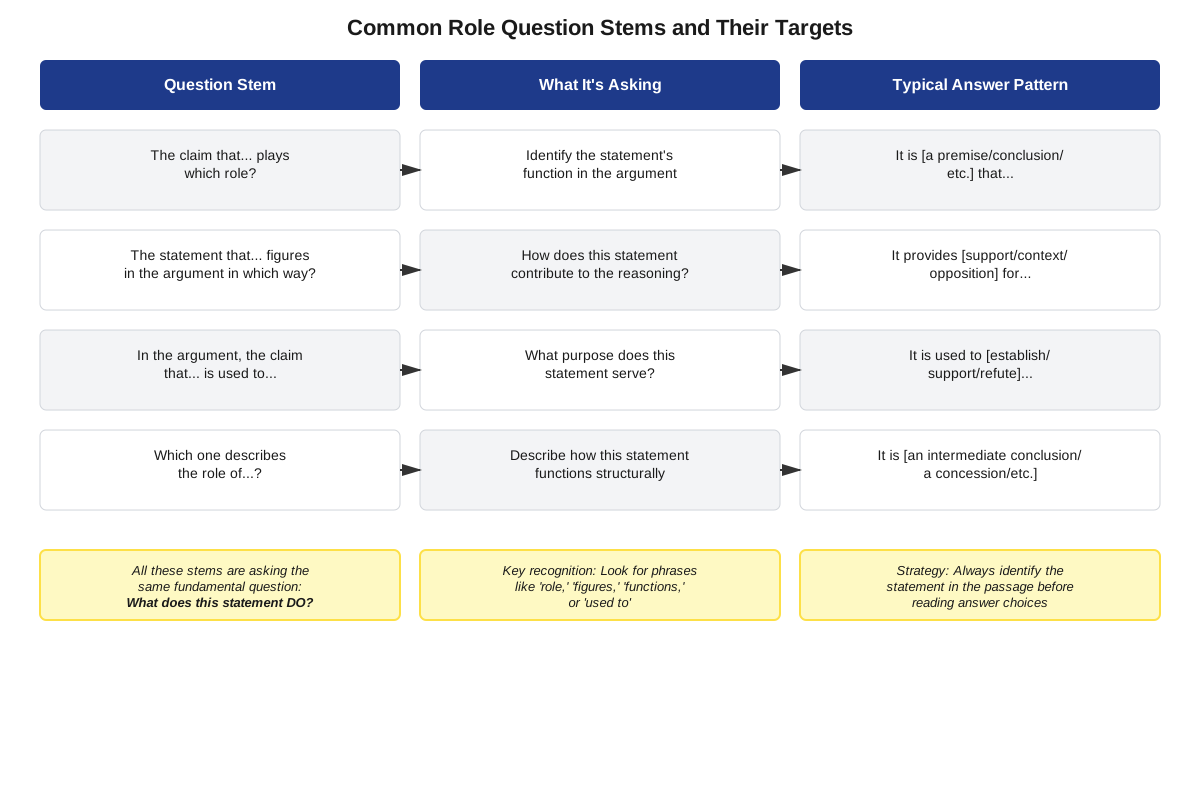
The question stems for role questions follow recognizable patterns, typically including phrases such as:
- "The claim that [statement] plays which one of the following roles in the argument?"
- "The statement that [statement] figures in the argument in which one of the following ways?"
- "In the argument, the observation that [statement] serves to..."
- "Which one of the following most accurately describes the role played in the argument by the claim that [statement]?"
These stems signal that students must analyze argumentative function rather than content, shifting from asking "what does this mean?" to "what does this accomplish?"
The Anatomy of Argument Structure
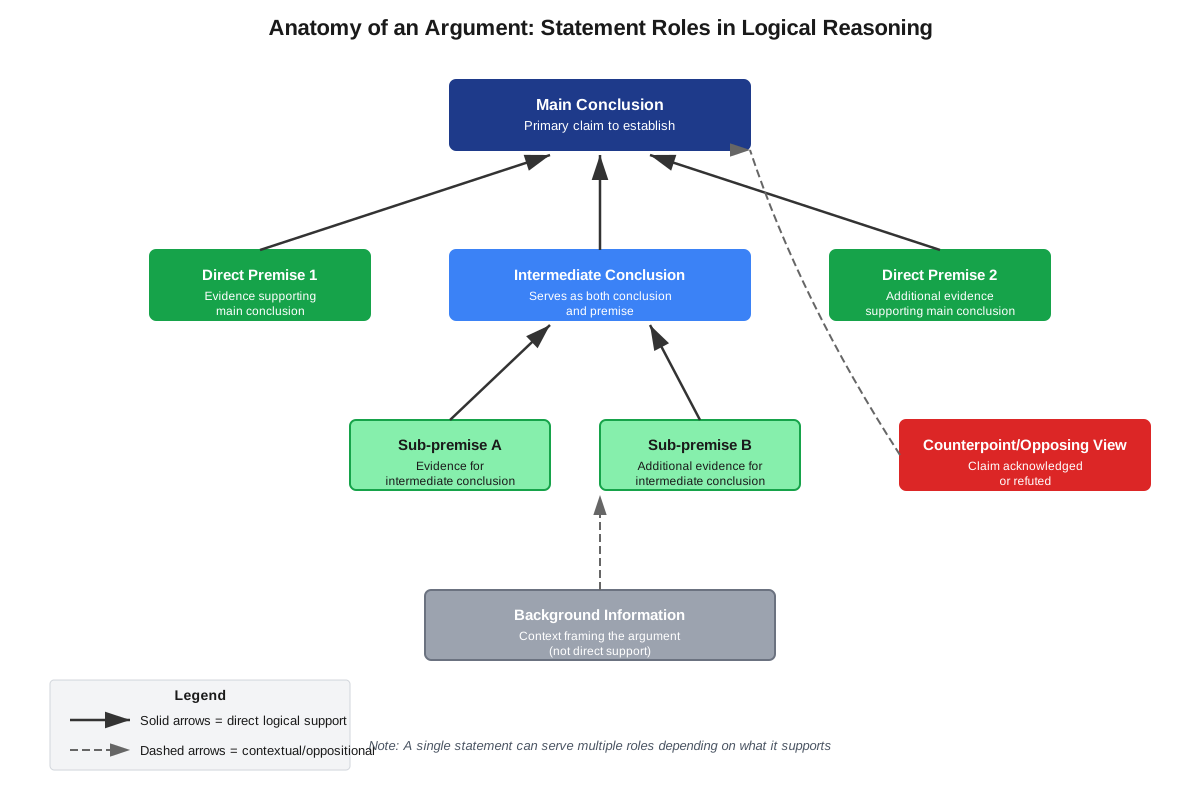
To identify statement roles accurately, students must understand the hierarchical nature of arguments. Arguments consist of multiple layers, each serving distinct functions:
Main Conclusion: The ultimate point the argument seeks to establish—the final destination of the reasoning chain. Every argument has exactly one main conclusion, though it may appear anywhere in the passage (beginning, middle, or end). The main conclusion is what the author most wants the reader to accept.
Intermediate Conclusion: A claim that serves dual purposes—it's supported by some premises and simultaneously supports the main conclusion. Intermediate conclusions function as stepping stones in complex arguments, breaking the reasoning into manageable stages. Not all arguments contain intermediate conclusions, but their presence creates the multi-layered structure that role questions often test.
Premise: Evidence, facts, or reasons offered in direct support of a conclusion (either main or intermediate). Premises are the foundational building blocks of arguments, providing the justification for accepting conclusions. They may be factual claims, expert testimony, statistical data, or logical principles.
Background Information: Context-setting statements that don't directly support the conclusion but help readers understand the situation or issue. Background information frames the discussion without functioning as evidence.
Counterpoint/Opposing View: A position contrary to the author's conclusion, typically introduced to be refuted or acknowledged. These statements represent what others believe or what might seem true initially, but which the argument ultimately rejects or qualifies.
Concession: An acknowledgment that something contrary to the main conclusion is true or has merit, often followed by a "but" or "however" that pivots back to the author's position. Concessions strengthen arguments by demonstrating the author has considered alternative perspectives.
The Functional Relationship Model
Understanding how statements relate to each other functionally is crucial for role questions. Consider this relationship hierarchy:
Background Information
        ↓
Counterpoint/Opposing View
        ↓
Premise 1 + Premise 2
        ↓
Intermediate Conclusion
        ↓
Additional Premise
        ↓
Main Conclusion
Each level supports or leads to the next, creating a logical flow. Role questions test whether students can identify where in this hierarchy a particular statement belongs and what specific function it performs at that level.
Common Statement Roles in Detail
| Role Type | Function | Typical Indicators | Example Context |
|---|---|---|---|
| Main Conclusion | Ultimate claim to be established | "Therefore," "thus," "consequently" (or no indicator) | "We should implement the new policy" |
| Intermediate Conclusion | Supported by some premises, supports main conclusion | "This shows that," "it follows that" | "The current system is inefficient" (supporting ultimate policy recommendation) |
| Direct Premise | Provides immediate support for conclusion | "Because," "since," "given that" | "Studies show 40% cost reduction" |
| Background | Sets context without arguing | Often at passage beginning | "The company has operated for 50 years" |
| Counterpoint | Opposes author's view | "Some argue," "critics claim" | "Opponents say the cost is prohibitive" |
| Rebuttal to Counterpoint | Refutes opposing view | "However," "but," "yet" | "But the long-term savings outweigh initial costs" |
Identifying Statement Roles: The Systematic Approach
To determine a statement's role accurately, follow this systematic process:
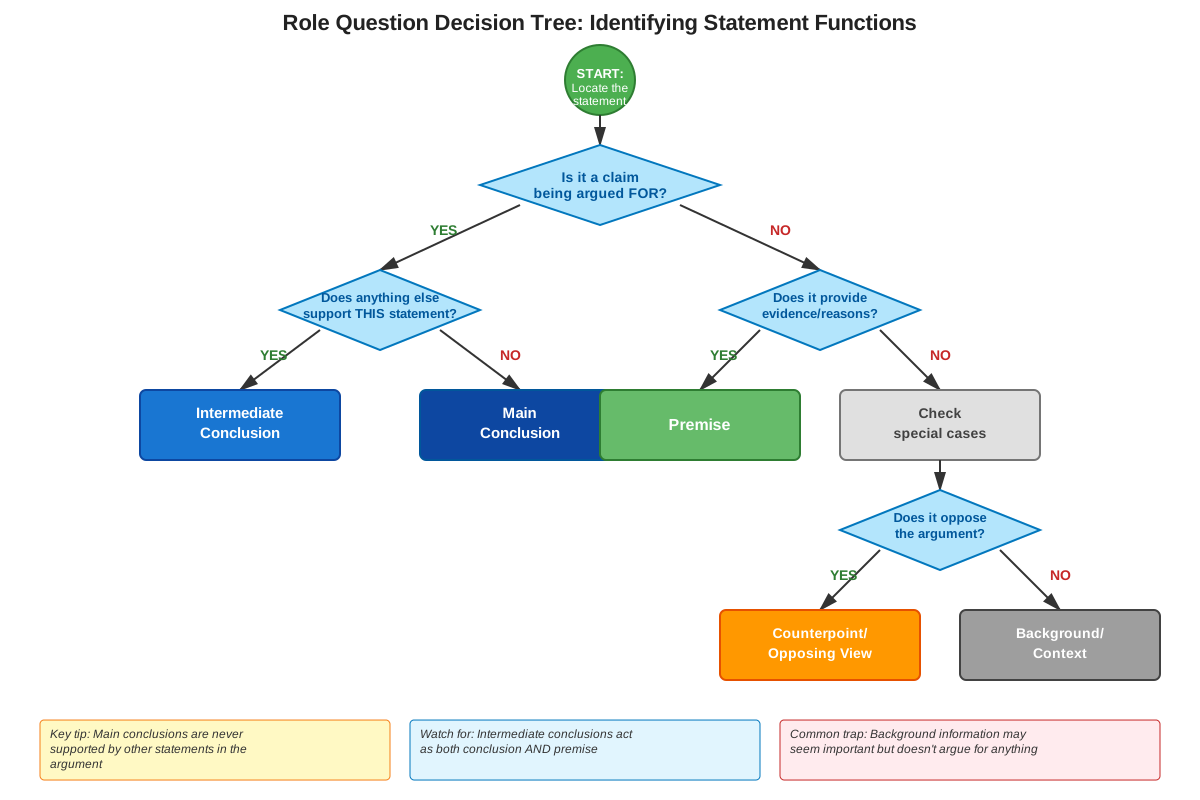
- Identify the main conclusion first: Before analyzing any individual statement's role, determine what the argument's ultimate point is. Ask: "What is the author most trying to convince me of?" This provides the reference point for all other statements.
- Trace support relationships: For the statement in question, ask: "Does anything in the argument support this claim?" If yes, it's likely a conclusion of some type. Then ask: "Does this claim support anything else?" If yes, it's an intermediate conclusion; if no, it's the main conclusion.
- Check for opposition: Ask: "Does this statement contradict or oppose the main conclusion?" If yes, it's likely a counterpoint or opposing view that the argument addresses.
- Evaluate evidential function: If the statement supports the conclusion without itself being supported by other claims in the argument, it functions as a premise.
- Consider contextual function: If the statement neither supports the conclusion nor is supported by other claims, it likely provides background information or context.
The Role of Context and Argument Flow
Statement roles cannot be determined in isolation—context is paramount. The same sentence could play different roles in different arguments. For example, "Electric vehicles produce zero emissions" could function as:
- A main conclusion in an argument about environmental benefits
- A premise supporting a conclusion about air quality improvement
- An intermediate conclusion in an argument ultimately recommending policy changes
- A counterpoint if the argument goes on to discuss lifecycle emissions
The statement's role depends entirely on how it relates to surrounding claims and what the argument's ultimate purpose is.
Concept Relationships
The concepts within role of a statement questions form an interconnected system where understanding one element enhances comprehension of others. The relationship begins with argument structure identification → which enables → distinguishing between conclusion types (main vs. intermediate) → which facilitates → recognizing support relationships → which allows → accurate role determination.
Main conclusions and intermediate conclusions exist in a hierarchical relationship: intermediate conclusions always support main conclusions, never the reverse. This one-directional flow creates a logical chain that students can trace. Premises connect to both conclusion types, but the nature of the connection differs—premises supporting intermediate conclusions create the first tier of reasoning, while premises supporting main conclusions may bypass intermediate steps entirely.
Background information and counterpoints relate to the core argument structure differently than premises and conclusions. While premises and conclusions form the argument's logical skeleton, background and counterpoints provide context and acknowledge complexity. Understanding this distinction prevents students from mistakenly identifying contextual statements as evidential ones.
The connection to prerequisite knowledge is direct: basic argument structure (premises and conclusions) provides the foundation, while role questions add sophistication by introducing intermediate conclusions, counterpoints, and functional distinctions. This topic also connects forward to method questions (which ask how arguments proceed using these structural elements) and structure questions (which examine overall organizational patterns built from individual statement roles).
High-Yield Facts
⭐ Role questions always ask about function, never about truth or validity—the correct answer describes what the statement does in the argument, not whether it's accurate or well-supported.
⭐ The main conclusion is the statement that everything else in the argument works to support—it's the ultimate destination of the reasoning, regardless of where it appears in the passage.
⭐ Intermediate conclusions are both supported and supporting—they receive support from premises and provide support to the main conclusion, functioning as logical bridges.
⭐ Question stems typically include phrases like "plays which role," "figures in the argument," or "serves to"—these phrases signal that functional analysis is required.
⭐ A statement can only play one role in a given argument—while the same sentence might play different roles in different arguments, within any single argument, each statement has exactly one function.
- Premises are never supported by other statements within the argument—they're the foundational claims that provide support without receiving it.
- Background information appears frequently at the beginning of arguments but can appear anywhere—its defining characteristic is that it provides context without directly supporting the conclusion.
- Counterpoints are typically introduced with phrases like "some argue," "critics claim," or "it might seem that"—these signal opposing views the argument will address.
- The correct answer to a role question must be precisely accurate—answers that are partially correct or describe related but distinct functions are incorrect.
- Role questions often test complex arguments with multiple layers—simple two-premise, one-conclusion arguments rarely appear in role questions because they offer limited analytical challenge.
- Concessions differ from counterpoints in that the author accepts them as true while still maintaining the main conclusion—counterpoints are typically rejected or refuted.
- The physical location of a statement in the passage doesn't determine its role—main conclusions can appear first, last, or in the middle of arguments.
Quick check — test yourself on Role of a statement questions so far.
Try Flashcards →Common Misconceptions
Misconception: The main conclusion always appears at the end of the argument. → Correction: Main conclusions can appear anywhere in an argument—beginning, middle, or end. The conclusion's position is determined by rhetorical choice, not logical necessity. Students must identify the main conclusion by its function (what everything else supports) rather than its location.
Misconception: If a statement is supported by evidence, it must be the main conclusion. → Correction: Both main conclusions and intermediate conclusions receive support from premises. The distinguishing feature is that intermediate conclusions also provide support to something else (the main conclusion), while main conclusions are the final destination of support. Students must check whether the supported statement itself supports anything further.
Misconception: Premises always come before conclusions in the passage. → Correction: Arguments frequently present conclusions first, then provide supporting premises. The logical relationship (premise supports conclusion) is independent of the order of presentation. Indicator words and support relationships, not position, determine which statements are premises.
Misconception: Every statement in an argument must be either a premise or a conclusion. → Correction: Arguments contain multiple statement types including background information, counterpoints, concessions, and rhetorical questions that serve functions other than direct logical support. Recognizing these additional roles is essential for role questions, which often test precisely these non-standard elements.
Misconception: The correct answer to a role question should describe what the statement means. → Correction: Role questions ask about function, not content. The correct answer describes what the statement does in the argument's structure—whether it supports, opposes, contextualizes, or concludes—not what it says or means. Students must shift from content analysis to functional analysis.
Misconception: If a statement seems important or interesting, it must be the main conclusion. → Correction: Importance and interest are subjective and don't determine logical function. Background information can be fascinating, and premises can be striking, but these qualities don't make them conclusions. Only the support relationships within the argument determine statement roles.
Misconception: Intermediate conclusions are less important than main conclusions. → Correction: While intermediate conclusions are logically subordinate to main conclusions, they're equally important to the argument's structure and are frequently the focus of role questions precisely because they perform dual functions. Understanding intermediate conclusions is often the key to distinguishing high scorers from average performers.
Worked Examples
Example 1: Multi-Layered Argument
Argument: "Urban gardens have become increasingly popular in major cities over the past decade. Studies show that neighborhoods with community gardens experience 25% less crime than comparable neighborhoods without them. This reduction in crime leads to increased property values in these areas. Therefore, city governments should invest in creating more community garden spaces, as doing so will generate economic benefits that exceed the initial investment costs."
Question: The claim that neighborhoods with community gardens experience 25% less crime than comparable neighborhoods without them plays which one of the following roles in the argument?
Analysis:
Step 1: Identify the main conclusion. The word "therefore" signals that "city governments should invest in creating more community garden spaces" is likely the main conclusion. Everything else should support this claim.
Step 2: Examine the statement in question. "Studies show that neighborhoods with community gardens experience 25% less crime" is presented as factual evidence.
Step 3: Trace support relationships. Does anything support this crime reduction claim? No—it's presented as an established fact from studies. Does this claim support anything else? Yes—it directly supports the next sentence about property values increasing.
Step 4: Determine the role. The crime reduction claim is supported by nothing in the argument (making it premise-like) but supports the property value claim (making it conclusion-like). This dual function identifies it as an intermediate conclusion.
Step 5: Verify the logical chain:
- Premise: Crime reduction occurs (from studies)
- Intermediate Conclusion: Property values increase (supported by crime reduction)
- Main Conclusion: Cities should invest (supported by economic benefits from property values)
Correct Answer: "It is an intermediate conclusion that supports the argument's main conclusion by establishing a link between community gardens and economic benefits."
Key Takeaway: The statement functions as a bridge between the factual observation (crime reduction) and the ultimate recommendation (government investment). Its dual nature—being presented as fact while supporting further reasoning—makes it an intermediate conclusion rather than a simple premise.
Example 2: Counterpoint and Rebuttal
Argument: "Some educators argue that standardized testing provides an objective measure of student achievement across different schools and districts. However, this view overlooks the significant cultural and socioeconomic biases embedded in many standardized tests. Research demonstrates that test performance correlates more strongly with family income than with actual academic ability. Given these biases, schools should reduce their reliance on standardized testing and develop more holistic assessment methods."
Question: The statement that some educators argue standardized testing provides an objective measure of student achievement plays which one of the following roles in the argument?
Analysis:
Step 1: Identify the main conclusion. The final sentence beginning with "Given these biases" presents the recommendation that schools should reduce reliance on standardized testing—this is what the argument works toward establishing.
Step 2: Examine the statement in question. "Some educators argue that standardized testing provides an objective measure" is explicitly attributed to others ("some educators argue"), not presented as the author's view.
Step 3: Check for opposition. Does this statement align with or oppose the main conclusion? It opposes it—the statement supports standardized testing while the conclusion recommends reducing reliance on it.
Step 4: Observe what follows. The word "However" immediately following this statement signals a contrast, and the author proceeds to refute this view by pointing out biases.
Step 5: Determine the role. The statement presents an opposing viewpoint that the argument subsequently refutes. It's not the author's position but rather a counterpoint introduced to be challenged.
Correct Answer: "It presents a position that the argument opposes and subsequently refutes through evidence about cultural and socioeconomic biases."
Key Takeaway: Attribution phrases like "some argue" or "critics claim" signal counterpoints rather than the author's own premises. These statements play the crucial role of acknowledging alternative perspectives before demonstrating why the author's conclusion is superior. Recognizing this pattern prevents students from mistakenly identifying opposing views as the argument's own position.
Exam Strategy
Approaching Role Questions Systematically
When encountering a role question on the LSAT, implement this strategic approach:
First Pass—Identify the Main Conclusion: Before even looking at the specific statement in question, determine the argument's main conclusion. This provides the reference point for all other statements. Ask: "What is the author's ultimate point?" Circle or mentally note this conclusion.
Second Pass—Locate the Statement: Find the exact statement the question asks about. Read it carefully in context, noting what comes immediately before and after it.
Third Pass—Apply the Support Test: Ask two critical questions: (1) "Is this statement supported by anything else in the argument?" and (2) "Does this statement support anything else in the argument?" The answers create a decision tree:
- Supported by nothing, supports something → Premise
- Supported by something, supports nothing → Main conclusion
- Supported by something, supports something else → Intermediate conclusion
- Supported by nothing, supports nothing → Background or counterpoint
Fourth Pass—Check for Opposition: If the support test doesn't clearly identify the role, ask: "Does this statement contradict or oppose the main conclusion?" If yes, it's likely a counterpoint or opposing view.
Trigger Words and Phrases
Certain words and phrases in question stems reliably signal role questions:
- "plays which one of the following roles"
- "figures in the argument in which way"
- "serves to"
- "functions in the argument to"
- "the role played by"
- "most accurately describes the role"
When these phrases appear, immediately shift to functional analysis mode rather than content evaluation mode.
Within arguments themselves, watch for these indicators of specific roles:
Counterpoint indicators: "some argue," "critics claim," "it might seem," "one might think," "opponents contend"
Intermediate conclusion indicators: "this shows that," "this means that," "it follows that," "this suggests"
Concession indicators: "admittedly," "granted," "while it's true that," "although"
Process of Elimination Strategy
Role questions lend themselves particularly well to systematic elimination:
- Eliminate answers describing the wrong conclusion level: If the statement clearly isn't the main conclusion, eliminate any answer calling it "the argument's main conclusion" or "the overall point."
- Eliminate answers describing support relationships backwards: If the statement supports X, eliminate answers saying "X supports this statement."
- Eliminate answers that describe content rather than function: Answers that summarize what the statement says rather than what it does are incorrect.
- Eliminate answers that are partially but not fully accurate: Role answers must be precisely correct—if an answer correctly identifies that something is a conclusion but incorrectly specifies which conclusion, it's wrong.
- Verify the remaining answer against the argument: The correct answer should map perfectly onto the statement's actual function when you trace through the argument's logic.
Time Allocation
Role questions typically require 60-90 seconds—slightly more than average for Logical Reasoning questions. The additional time investment is justified because:
- These questions require careful structural analysis rather than quick pattern recognition
- Tracing support relationships accurately takes time
- The arguments in role questions are often intentionally complex with multiple layers
However, avoid spending more than 90 seconds. If you're struggling, use the elimination strategy aggressively and make your best guess rather than getting bogged down.
Exam Tip: If you're stuck between two answers, return to the main conclusion and trace the logical chain forward. The correct answer will fit seamlessly into this chain, while the incorrect answer will create a logical inconsistency or mismatch.
Memory Techniques
The SCIP Mnemonic
Remember the four primary statement roles with SCIP:
- Supporting (Premises—provide support without receiving it)
- Concluding (Main conclusion—receives support without providing it)
- Intermediate (Intermediate conclusions—both receive and provide support)
- Positioning (Background and counterpoints—provide context or opposition)
The Two-Question Test
Memorize these two diagnostic questions that unlock most role questions:
- "Is it supported?" (If no → premise or background; if yes → some type of conclusion)
- "Does it support?" (If no → main conclusion or background; if yes → intermediate conclusion or premise)
The combination of answers determines the role:
- No + Yes = Premise
- Yes + No = Main Conclusion
- Yes + Yes = Intermediate Conclusion
- No + No = Background or Counterpoint
Visualization: The Argument Pyramid
Visualize arguments as pyramids:
         [Main Conclusion]
              /    \
    [Intermediate] [Intermediate]
         /  \          /  \
    [Premise] [Premise] [Premise] [Premise]
The base consists of premises (foundational support), intermediate conclusions form the middle tier (supported and supporting), and the main conclusion sits at the apex (supported by everything below). Background information and counterpoints exist outside this pyramid, providing context or opposition.
The "Therefore Test"
To identify whether a statement is a conclusion (main or intermediate), try inserting "therefore" before it. If the argument makes sense with "therefore" added, the statement is likely a conclusion. If it sounds awkward or illogical, it's probably a premise or background information.
Summary
Role of a statement questions assess the ability to identify the specific function that individual claims perform within an argument's logical structure. These questions require students to move beyond understanding what an argument says to analyzing how it works—determining whether statements serve as main conclusions, intermediate conclusions, premises, background information, counterpoints, or other functional elements. Success depends on systematically identifying the main conclusion first, then tracing support relationships to determine how the statement in question relates to that conclusion and to other statements in the argument. The key distinction lies between statements that provide support (premises), statements that receive support (conclusions), statements that do both (intermediate conclusions), and statements that provide context or opposition (background and counterpoints). Mastering role questions develops analytical skills that enhance performance across all Logical Reasoning question types, as understanding argumentative structure is foundational to evaluating, strengthening, weakening, and drawing inferences from arguments. The systematic approach—identify the main conclusion, apply the support test, check for opposition, and verify through elimination—provides a reliable method for accurately determining statement roles even in complex, multi-layered arguments.
Key Takeaways
- Role questions ask about function (what a statement does) rather than content (what it says) or validity (whether it's true)—always analyze structural relationships, not substantive claims
- The main conclusion is identified by what it receives (support from everything else) not by where it appears—location in the passage is irrelevant to logical function
- Intermediate conclusions perform dual functions, both receiving support from premises and providing support to the main conclusion—recognizing this bridge function is essential for distinguishing them from simple premises or main conclusions
- The two-question support test ("Is it supported?" and "Does it support?") provides a systematic method for determining most statement roles through the combination of answers
- Counterpoints and opposing views are introduced to be refuted or acknowledged, not as the author's own position—attribution phrases like "some argue" or "critics claim" signal these opposing perspectives
- Correct answers must be precisely accurate in describing both the type of role and the specific relationships—partially correct answers that misidentify the conclusion level or support direction are wrong
- Mastering role questions develops transferable skills in argument analysis that enhance performance across all Logical Reasoning question types and directly translate to legal reasoning skills
Related Topics
Method of Reasoning Questions: These questions ask how an argument proceeds or what argumentative technique it employs, building on the structural understanding developed through role questions. While role questions focus on individual statement functions, method questions examine the overall argumentative strategy, making role analysis a prerequisite skill.
Argument Structure Questions: These questions ask about the overall organization and flow of arguments, requiring students to understand how multiple statement roles combine to create complete argumentative frameworks. Mastering role questions provides the component-level analysis necessary for structure questions.
Flaw Questions: Identifying logical flaws requires understanding what role each statement plays—recognizing whether a flaw occurs in the premises, in the connection between premises and conclusion, or in treating an intermediate conclusion as sufficient support. Role analysis enhances flaw identification.
Assumption Questions: These questions ask what unstated premises are necessary for an argument to work, requiring clear understanding of what role existing statements play and what gaps exist in the logical chain. Role questions develop the structural awareness necessary for assumption identification.
Parallel Reasoning Questions: These questions require matching the structure of one argument to another, which depends on identifying what role each statement plays in both arguments. The functional analysis developed through role questions directly enables parallel reasoning success.
Practice CTA
Now that you've mastered the conceptual framework for role of a statement questions, it's time to put your knowledge into practice. Attempt the practice questions designed specifically for this topic, focusing on applying the systematic approach outlined in this guide. As you work through problems, consciously implement the two-question support test and trace logical relationships rather than relying on intuition. Review the flashcards to reinforce the distinctions between different statement roles and to internalize the trigger words that signal specific functions. Remember that role questions reward careful, methodical analysis—the time you invest in systematic practice now will translate directly to points on test day. Each practice question you complete strengthens your ability to deconstruct arguments and identify functional relationships, skills that will serve you throughout the LSAT and in legal reasoning beyond. You've built the foundation; now construct mastery through deliberate practice.
Sign up free to keep reading
Create a free AnvayaPrep account to finish this LSAT guide on Role of a statement questions — plus flashcards and practice questions.