Overview
The evidence conclusion relationship is a foundational concept in LSAT Logical Reasoning that appears across multiple question types, particularly in method, role, and structure questions. Understanding this relationship means recognizing how premises (evidence) support or fail to support the conclusion in an argument. On the LSAT, test-makers frequently ask students to identify what role a particular statement plays in an argument, describe the method of reasoning used, or analyze the structural relationship between different parts of an argument. Mastery of evidence-conclusion relationships enables students to dissect arguments systematically, identify logical gaps, and select correct answers with confidence.
The LSAT evidence conclusion relationship forms the backbone of argument analysis throughout the Logical Reasoning section. Every argument presented on the LSAT contains evidence (facts, data, observations, or premises) and typically a conclusion (the claim the author wants you to accept). The relationship between these components determines the argument's strength, validity, and structure. Questions testing this relationship ask students to step back from evaluating whether an argument is good or bad and instead focus on describing how the argument operates—what each piece does and how the pieces fit together.
This topic connects intimately with other Logical Reasoning concepts including argument structure, assumption identification, and strengthening/weakening questions. While those question types ask you to evaluate or modify arguments, method, role, and structure questions ask you to describe and analyze the architecture of reasoning itself. Students who master evidence-conclusion relationships develop a meta-cognitive skill that improves performance across all Logical Reasoning question types, as they can quickly identify the moving parts of any argument before applying specific question-type strategies.
Learning Objectives
- [ ] Identify how Evidence conclusion relationship appears in LSAT questions
- [ ] Explain the reasoning pattern behind Evidence conclusion relationship
- [ ] Apply Evidence conclusion relationship to solve LSAT-style problems accurately
- [ ] Distinguish between main conclusions, intermediate conclusions, and evidence in complex arguments
- [ ] Recognize indicator words that signal evidence-conclusion relationships
- [ ] Evaluate the structural role of counterexamples, concessions, and background information in arguments
- [ ] Diagram argument structures to visualize evidence-conclusion relationships
Prerequisites
- Basic argument structure: Understanding what constitutes a premise and conclusion is essential because evidence-conclusion relationship questions build on this foundation by asking about how these components interact.
- Indicator words: Familiarity with conclusion indicators (therefore, thus, hence) and premise indicators (because, since, for) helps students quickly identify argument components.
- Reading comprehension skills: The ability to parse complex sentences and identify main ideas enables students to distinguish between evidence and conclusions in dense passages.
- Logical connectives: Understanding how "if-then" statements, "and," "or," and "not" function helps students trace how evidence connects to conclusions.
Why This Topic Matters
Evidence-conclusion relationship questions appear with high frequency on the LSAT, typically comprising 15-20% of all Logical Reasoning questions across both sections. These questions test a fundamental skill that law schools value: the ability to analyze how arguments are constructed rather than simply accepting or rejecting them. Legal reasoning requires constant analysis of how evidence supports claims, how precedents relate to current cases, and how different parts of legal arguments function together. Students who excel at identifying evidence-conclusion relationships demonstrate the analytical precision necessary for legal study.
In real-world legal practice, attorneys must constantly articulate how evidence supports their claims, identify the role of specific facts in opposing arguments, and structure their own reasoning clearly. A prosecutor explaining how forensic evidence supports a guilty verdict, a defense attorney showing how witness testimony serves as background rather than proof, or a judge describing the reasoning method in a precedent case—all rely on the same skills tested in evidence-conclusion relationship questions.
On the LSAT, these questions appear in several formats: Role of a Statement questions ask what function a specific claim plays in the argument; Method of Reasoning questions ask how the argument proceeds from evidence to conclusion; Argument Structure questions ask about the overall organization or parallel structure of reasoning. Common question stems include "The claim that X plays which of the following roles in the argument?" or "The argument proceeds by..." or "Which one of the following most accurately describes the organization of the argument?" Understanding evidence-conclusion relationships is the key skill for all these question types.
Core Concepts
Evidence and Conclusions Defined
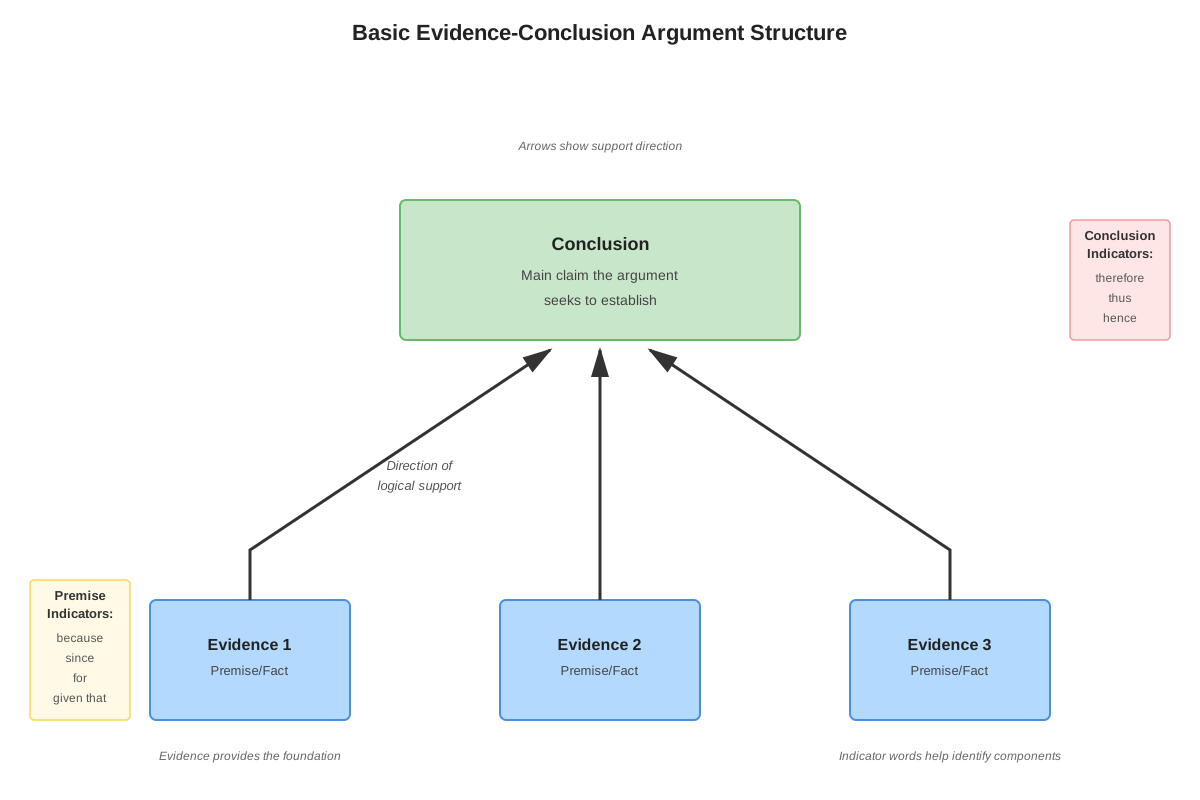
Evidence (also called premises, reasons, or support) consists of the facts, data, observations, or claims that an argument presents as support for its conclusion. Evidence represents what the argument takes as given or established. On the LSAT, evidence can include statistical data, expert testimony, historical facts, hypothetical scenarios, analogies, or general principles. The critical feature of evidence is its functional role: it provides the foundation upon which the conclusion rests.
A conclusion is the claim that the argument wants the reader to accept based on the evidence provided. The conclusion represents the argument's destination—where the reasoning is trying to go. In LSAT arguments, conclusions can be recommendations, predictions, explanations, evaluations, or factual claims. Importantly, conclusions are not necessarily at the end of an argument; they can appear at the beginning, middle, or end of a passage.
Identifying Conclusions vs. Evidence
The most reliable method for distinguishing conclusions from evidence involves the "because" test: try inserting "because" between statements. The statement that makes sense after "because" is evidence; the statement before it is the conclusion. For example: "The company will succeed [conclusion] because it has strong leadership [evidence]." This test works because evidence provides reasons for believing the conclusion.
Conclusion indicators signal that a conclusion follows: therefore, thus, hence, so, consequently, it follows that, which shows that, which means that, accordingly. Evidence indicators signal that evidence follows: because, since, for, given that, as, in that, owing to, for the reason that, as indicated by. However, not all arguments use indicator words, so students must also rely on logical relationships and context.
Types of Evidence-Conclusion Relationships
| Relationship Type | Description | Example Structure |
|---|---|---|
| Direct Support | Evidence directly supports the conclusion without intermediate steps | Evidence → Conclusion |
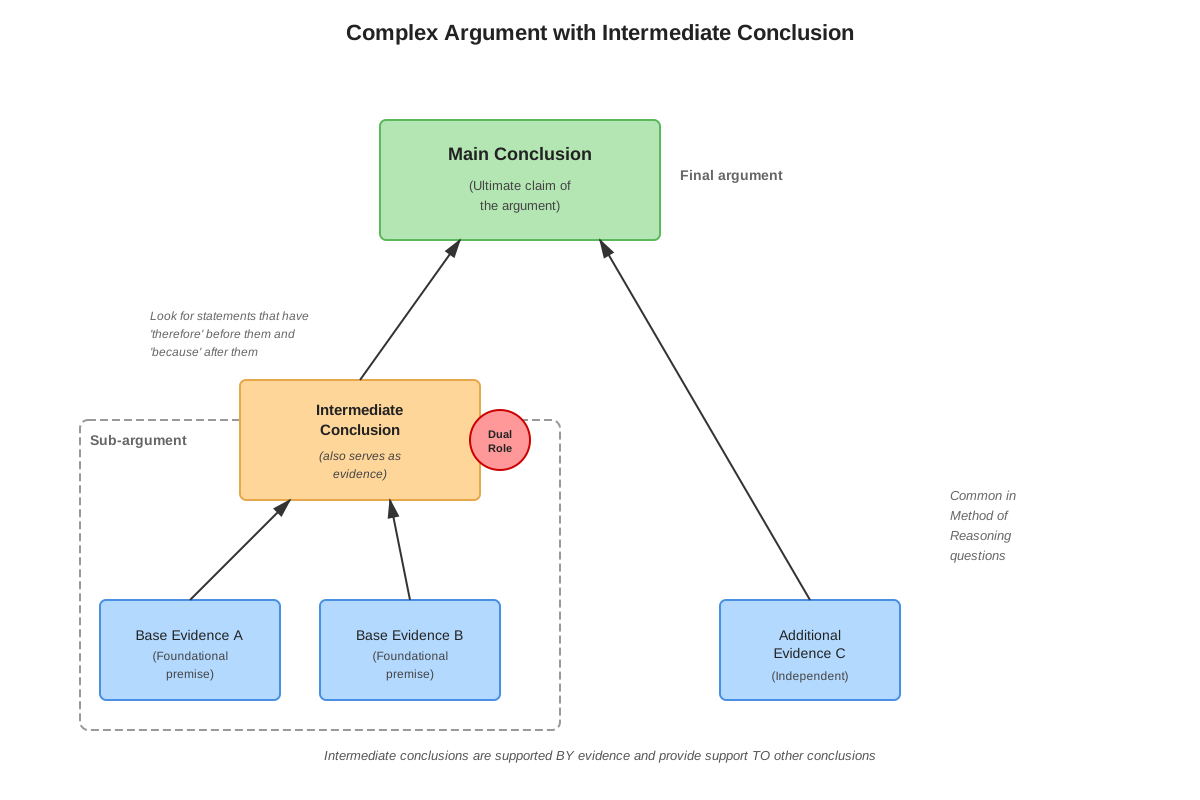
| Intermediate Conclusion | Evidence supports a sub-conclusion, which then supports the main conclusion | Evidence → Intermediate Conclusion → Main Conclusion |
| Independent Support | Multiple pieces of evidence each independently support the conclusion | Evidence A → Conclusion; Evidence B → Conclusion |
| Dependent Support | Multiple pieces of evidence work together to support the conclusion | Evidence A + Evidence B → Conclusion |
| Counterexample | Evidence that appears to contradict the conclusion but is then addressed | Counterexample → Response → Conclusion |
Intermediate Conclusions
Intermediate conclusions (also called subsidiary conclusions or sub-conclusions) function as both conclusions and evidence. They are conclusions because they are supported by other premises, but they also serve as evidence because they support the main conclusion. Recognizing intermediate conclusions is crucial for understanding complex arguments. For example: "Sales increased last quarter [evidence]. Therefore, the marketing campaign was effective [intermediate conclusion]. So we should expand the campaign [main conclusion]." The middle statement is concluded from the first and supports the last.
Special Structural Elements
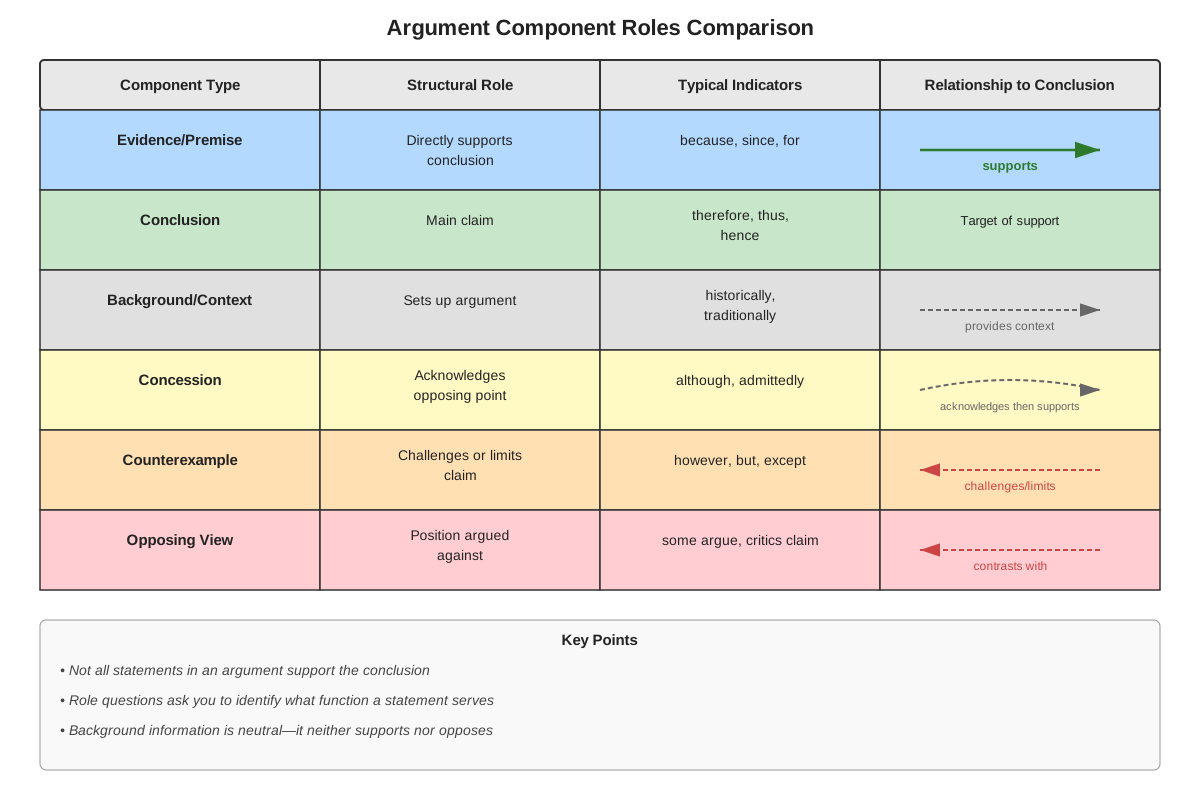
Background information provides context but does not directly support the conclusion. It sets the stage for the argument without functioning as evidence. For example: "The company was founded in 1995 [background]. Last year, profits doubled [evidence]. Therefore, the company is thriving [conclusion]."
Concessions acknowledge opposing viewpoints or potential objections before presenting the main argument. They often begin with "although," "while," "admittedly," or "granted." For example: "Although some critics disagree [concession], the policy has been successful [conclusion] because crime rates have dropped [evidence]."
Counterexamples present cases that seem to contradict the conclusion but are then explained away or shown to be consistent with it. They test the argument's limits and often strengthen it by addressing potential objections.
Method of Reasoning Patterns
Arguments employ various reasoning methods, and LSAT questions frequently ask students to identify which method an argument uses:
- Generalization: Drawing a general conclusion from specific examples
- Analogy: Arguing that because two things are similar in some ways, they are similar in another way
- Causal reasoning: Claiming that one thing causes another
- Elimination: Ruling out alternatives to support a conclusion
- Appeal to authority: Using expert opinion as evidence
- Principle application: Applying a general rule to a specific case
- Reductio ad absurdum: Showing that a position leads to absurd consequences
Structural Roles in Arguments
Different statements play different structural roles:
- Main conclusion: The primary claim the argument defends
- Intermediate conclusion: A claim supported by some evidence and supporting the main conclusion
- Evidence/Premise: Support for a conclusion
- Background: Context-setting information
- Concession: Acknowledgment of opposing views
- Counterexample: Apparent contradiction addressed by the argument
- Illustration: Example clarifying a point without serving as evidence
- Hypothesis: Tentative explanation considered by the argument
- Prediction: Forecast of future events based on current evidence
Concept Relationships
The evidence-conclusion relationship forms the core of argument analysis, which connects to virtually every other Logical Reasoning concept. Assumption questions require understanding evidence-conclusion relationships because assumptions are unstated premises that bridge gaps between evidence and conclusions. If you cannot identify what the evidence is and what the conclusion is, you cannot identify what's missing between them.
Strengthen and weaken questions build directly on evidence-conclusion relationships. To strengthen an argument, you add evidence that makes the conclusion more likely; to weaken it, you add evidence that makes the conclusion less likely. Both require first understanding the existing relationship between evidence and conclusion.
Flaw questions often involve identifying problems in how evidence relates to the conclusion—perhaps the evidence is insufficient, irrelevant, or misinterpreted. Understanding the intended evidence-conclusion relationship allows you to spot where it breaks down.
The relationship map flows as follows: Basic argument structure (identifying premises and conclusions) → Evidence-conclusion relationships (understanding how premises support conclusions and what roles different statements play) → Assumption identification (finding gaps in the relationship) → Argument evaluation (strengthening, weakening, and identifying flaws) → Advanced reasoning (parallel reasoning, principle questions, and complex argument analysis).
Within the topic itself, concepts build progressively: First, students must distinguish evidence from conclusions using indicator words and logical tests. Second, they must recognize intermediate conclusions that serve dual roles. Third, they must identify special structural elements like background, concessions, and counterexamples. Fourth, they must describe methods of reasoning. Finally, they must analyze complex arguments with multiple layers of support and various structural components working together.
High-Yield Facts
⭐ Evidence provides reasons for accepting the conclusion; the conclusion is what the argument wants you to believe based on that evidence.
⭐ Intermediate conclusions are supported by evidence and support the main conclusion, functioning as both conclusion and premise.
⭐ Conclusion indicators include: therefore, thus, hence, so, consequently, it follows that, which shows that.
⭐ Evidence indicators include: because, since, for, given that, as, in that, owing to.
⭐ Background information provides context but does not directly support the conclusion.
- Concessions acknowledge opposing views and typically begin with "although," "while," or "admittedly."
- The "because test" helps distinguish evidence from conclusions: the statement that makes sense after "because" is evidence.
- Not all arguments use indicator words; logical relationships and context are equally important for identifying structure.
- Counterexamples present apparent contradictions that the argument then addresses or explains.
- Method of reasoning questions ask how the argument proceeds, not whether it succeeds.
- Role of a statement questions require identifying what function a specific claim plays in the argument's structure.
- Multiple pieces of evidence can support a conclusion independently (each alone is sufficient) or dependently (they work together).
- Illustrations and examples that clarify a point without providing evidential support do not function as premises.
- The main conclusion is not always the last statement; it can appear anywhere in the argument.
- Arguments can have multiple conclusions at different levels (main and intermediate).
Quick check — test yourself on Evidence conclusion relationship so far.
Try Flashcards →Common Misconceptions
Misconception: The conclusion is always the last sentence in an argument.
Correction: Conclusions can appear anywhere—beginning, middle, or end. The conclusion's position depends on rhetorical style, not logical structure. Use indicator words and logical relationships, not position, to identify conclusions.
Misconception: Every statement in an argument is either evidence or a conclusion.
Correction: Arguments contain various structural elements including background information, concessions, counterexamples, illustrations, and context-setting statements that serve neither as evidence nor conclusions. These elements play important roles but function differently from premises and conclusions.
Misconception: Intermediate conclusions are less important than main conclusions.
Correction: Intermediate conclusions are crucial to argument structure and frequently appear in LSAT questions. They represent key logical steps and often contain the argument's most vulnerable points. Questions specifically ask about their role, making them high-yield for test preparation.
Misconception: If a statement comes after "because," it must be the main conclusion.
Correction: "Because" introduces evidence, not conclusions. The statement after "because" supports the statement before it. This is the opposite of conclusion indicators like "therefore," which introduce conclusions.
Misconception: Method of reasoning questions ask whether the argument is good or bad.
Correction: Method of reasoning questions are purely descriptive, asking how the argument proceeds, not whether it succeeds. The correct answer describes the argumentative strategy used, regardless of whether that strategy is effective. Evaluative judgments are irrelevant to these questions.
Misconception: All evidence directly supports the main conclusion.
Correction: In complex arguments, evidence often supports intermediate conclusions, which then support the main conclusion. Evidence can also support the argument indirectly by refuting counterexamples or establishing background conditions necessary for the conclusion.
Misconception: Longer statements are more likely to be conclusions than shorter ones.
Correction: Length has no relationship to logical function. A conclusion can be a brief phrase while evidence can be multiple sentences. Focus on logical relationships and indicator words, not statement length.
Worked Examples
Example 1: Identifying Roles in a Complex Argument
Argument: "Although some economists predicted a recession, the economy has remained stable. Consumer spending increased by 3% last quarter, and unemployment rates have declined. This shows that consumer confidence is high. Therefore, the Federal Reserve should not raise interest rates, as doing so would unnecessarily slow economic growth."
Question: The claim that consumer confidence is high plays which of the following roles in the argument?
Step 1 - Identify the main conclusion: The main conclusion is "the Federal Reserve should not raise interest rates." This is signaled by "therefore" and represents the argument's ultimate recommendation.
Step 2 - Identify the evidence for the main conclusion: The argument states that raising rates "would unnecessarily slow economic growth." This assumes that growth should not be slowed, and the reason it would be unnecessary is that consumer confidence is high.
Step 3 - Trace the support for "consumer confidence is high": This claim is supported by two pieces of evidence: consumer spending increased (3%) and unemployment declined. The phrase "this shows that" indicates that consumer confidence is a conclusion drawn from these facts.
Step 4 - Determine the role: "Consumer confidence is high" is an intermediate conclusion. It is concluded from the spending and unemployment data, and it supports the main conclusion about interest rates. It functions as both a conclusion (from the economic data) and a premise (for the policy recommendation).
Step 5 - Identify other structural elements: "Although some economists predicted a recession" is a concession that acknowledges an opposing view but does not support the argument's conclusion. "The economy has remained stable" is background information setting context.
Answer: The claim that consumer confidence is high is an intermediate conclusion, supported by evidence about consumer spending and unemployment, which in turn supports the main conclusion about interest rate policy.
Example 2: Describing Method of Reasoning
Argument: "The new traffic law reduced accidents at intersections by 40% in City A. City B has similar traffic patterns, population density, and road infrastructure to City A. Therefore, implementing the same traffic law in City B will likely reduce accidents there as well."
Question: The argument proceeds by which of the following methods?
Step 1 - Identify the conclusion: "Implementing the same traffic law in City B will likely reduce accidents there as well." This is the prediction the argument makes.
Step 2 - Identify the evidence: The law reduced accidents in City A (40%), and City B is similar to City A in relevant ways (traffic patterns, population density, road infrastructure).
Step 3 - Analyze the reasoning pattern: The argument observes that something worked in one case (City A) and argues it will work in another case (City B) because the two cases are similar. This is reasoning by analogy.
Step 4 - Describe the method precisely: The argument establishes that two situations share relevant characteristics, notes an outcome in one situation, and predicts the same outcome in the other situation based on their similarity.
Step 5 - Eliminate alternative methods: This is not generalization (not drawing a general rule from multiple examples), not causal reasoning (not explaining why the law works), not elimination (not ruling out alternatives), and not principle application (not applying a general rule to a specific case).
Answer: The argument proceeds by drawing an analogy between two similar cities and predicting that a policy successful in one will be successful in the other based on their relevant similarities.
Exam Strategy
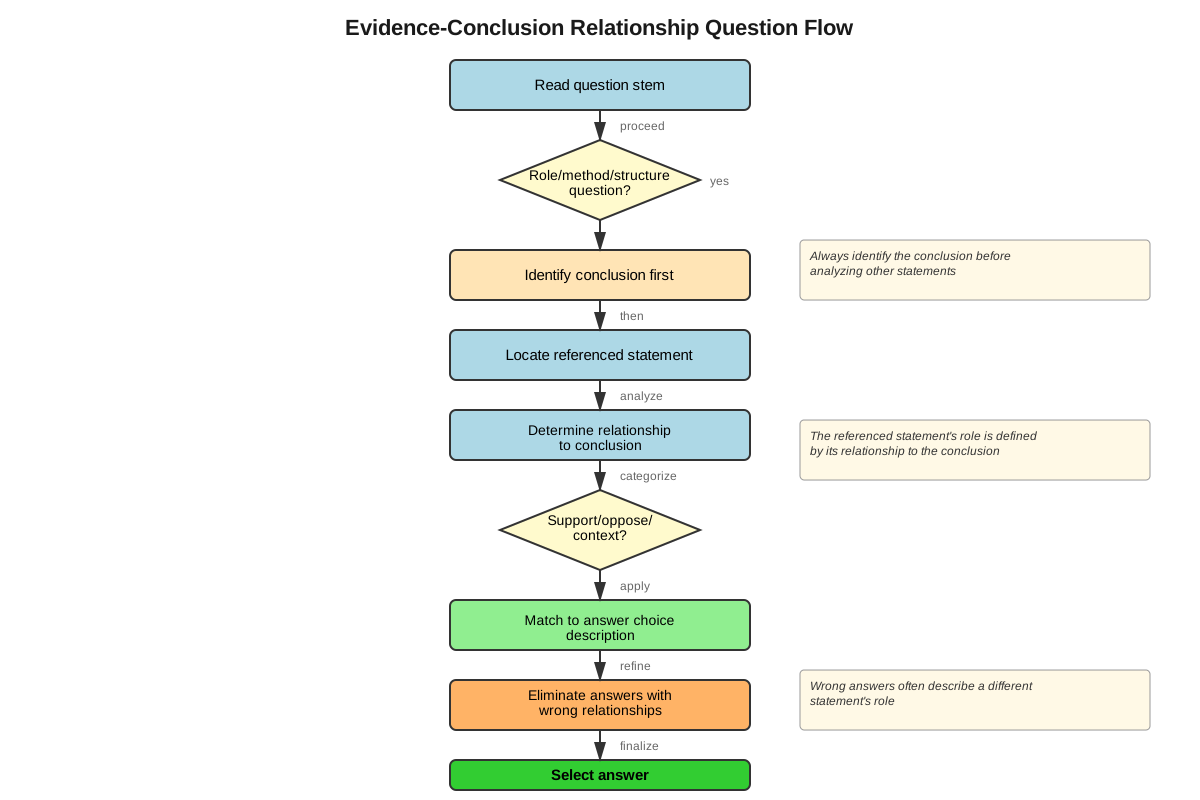
When approaching method, role, and structure questions on the LSAT, begin by reading the question stem first to know what you're looking for. If the question asks about the role of a specific statement, locate that statement in the passage and bracket it before reading. If it asks about the method of reasoning, prepare to identify the overall argumentative strategy.
Trigger phrases for role questions include: "plays which of the following roles," "functions in the argument to," "serves which one of the following purposes," "is used to." When you see these, your task is to determine whether the statement is the main conclusion, an intermediate conclusion, evidence, background, a concession, a counterexample, or another structural element.
Trigger phrases for method questions include: "proceeds by," "employs which of the following techniques," "argues by," "the argument does which of the following." These questions require identifying the reasoning pattern: analogy, generalization, causal reasoning, elimination, authority, principle application, or reductio ad absurdum.
Trigger phrases for structure questions include: "most accurately describes the organization," "structured to," "the relationship between X and Y is that." These questions ask about how different parts of the argument relate to each other.
Exam Tip: Always identify the main conclusion first, even if the question doesn't ask about it directly. Knowing the main conclusion provides an anchor point for understanding what role other statements play.
For process of elimination, incorrect answers to role questions often misidentify the logical function of a statement. Common wrong answer patterns include: confusing evidence with conclusion, confusing intermediate conclusion with main conclusion, claiming a statement is background when it actually supports the conclusion, or claiming a concession supports the conclusion when it actually opposes it.
For method questions, wrong answers often describe methods the argument doesn't use or describe the method too vaguely or too specifically. The correct answer must accurately capture what the argument does without being so general that it could describe any argument or so specific that it includes details not present in the reasoning.
Time allocation: Spend 15-20 seconds identifying the argument's structure before looking at answer choices. This upfront investment prevents confusion and speeds up answer choice evaluation. Method, role, and structure questions should take 60-90 seconds total, as they don't require external knowledge—only careful analysis of the argument's structure.
Diagramming strategy: For complex arguments, quickly diagram the structure using arrows: Evidence → Intermediate Conclusion → Main Conclusion. Mark concessions with "C:" and background with "B:". This visual representation clarifies relationships and prevents confusion about what supports what.
Memory Techniques
CITE - Mnemonic for identifying conclusions:
- Check for indicator words (therefore, thus, hence)
- Insert "because" to test relationships
- Think about what the author wants you to believe
- Eliminate background and concessions
PRIME - Mnemonic for evidence indicators:
- Premise indicators: because, since
- Reason markers: for, as
- In that, given that
- Motivated by, owing to
- Evidence signals: as indicated by
The Support Chain Visualization: Picture evidence as the foundation of a building, intermediate conclusions as middle floors, and the main conclusion as the roof. Each level must be supported by what's below it. This mental image helps identify what supports what and prevents confusion about argument structure.
The "Because Test" Mantra: When uncertain whether a statement is evidence or conclusion, mentally insert "because" between statements. Repeat: "The statement after 'because' is always evidence; the statement before it is what that evidence supports."
Method Acronym - GACE PAR:
- Generalization
- Analogy
- Causal reasoning
- Elimination
- Principle application
- Authority
- Reductio ad absurdum
Role Categories - MICE BC:
- Main conclusion
- Intermediate conclusion
- Concession
- Evidence
- Background
- Counterexample
Summary
The evidence-conclusion relationship represents the fundamental structure of arguments tested throughout LSAT Logical Reasoning. Mastering this relationship requires distinguishing between evidence (premises that provide support) and conclusions (claims the argument wants you to accept), recognizing intermediate conclusions that serve dual functions, and identifying special structural elements like background information, concessions, and counterexamples. Method, role, and structure questions specifically test this understanding by asking students to describe how arguments are built rather than evaluate whether they succeed. Success on these questions depends on using indicator words, applying logical tests like the "because test," and carefully tracing support relationships from evidence through intermediate conclusions to main conclusions. Students must recognize that arguments employ various reasoning methods—analogy, generalization, causal reasoning, elimination, and others—and that different statements play different structural roles. The ability to analyze evidence-conclusion relationships forms the foundation for all argument-based questions on the LSAT and reflects the analytical skills essential for legal reasoning.
Key Takeaways
- Evidence provides reasons for accepting the conclusion; identify the conclusion first to understand what role other statements play
- Intermediate conclusions are both supported by evidence and support the main conclusion, making them crucial to argument structure
- Use indicator words (therefore, because, since) and the "because test" to distinguish evidence from conclusions
- Background information, concessions, and counterexamples serve structural roles distinct from evidence and conclusions
- Method of reasoning questions ask how the argument proceeds (analogy, generalization, causal reasoning, etc.), not whether it succeeds
- Role questions require identifying whether a statement is the main conclusion, intermediate conclusion, evidence, or another structural element
- The conclusion's position in the passage is irrelevant; focus on logical relationships, not physical location
Related Topics
Assumption Questions: Understanding evidence-conclusion relationships enables identification of unstated premises that bridge gaps between evidence and conclusions. Mastering this topic provides the foundation for recognizing what arguments take for granted.
Strengthen and Weaken Questions: These questions require understanding the existing evidence-conclusion relationship before adding information that makes the conclusion more or less likely. The skills developed here transfer directly to evaluation questions.
Parallel Reasoning Questions: These questions ask students to identify arguments with the same structure as the original, requiring precise understanding of evidence-conclusion relationships and reasoning methods.
Flaw Questions: Many logical flaws involve problems in how evidence relates to conclusions—insufficient evidence, irrelevant evidence, or misinterpreted evidence. Understanding proper evidence-conclusion relationships helps identify when these relationships break down.
Principle Questions: These questions often require identifying the general principle underlying a specific argument's evidence-conclusion relationship, then applying that principle to new situations.
Practice CTA
Now that you understand evidence-conclusion relationships, you're ready to apply these concepts to actual LSAT questions. The practice questions and flashcards will reinforce your ability to identify argument structure, recognize reasoning methods, and determine the roles different statements play. Each practice question you complete strengthens your pattern recognition and speeds up your analysis. Remember: these skills improve dramatically with deliberate practice. Approach each practice question by first identifying the conclusion, then tracing the evidence that supports it, and finally analyzing any intermediate conclusions or special structural elements. Your investment in mastering this foundational topic will pay dividends across every Logical Reasoning question type. Start practicing now to transform your understanding into test-day performance.
Sign up free to keep reading
Create a free AnvayaPrep account to finish this LSAT guide on Evidence conclusion relationship — plus flashcards and practice questions.