Overview
Identifying argument strategy is a critical skill tested extensively in the LSAT's Logical Reasoning sections. This topic falls under the broader category of method, role, and structure questions, which ask test-takers to analyze how an argument functions rather than what it concludes. When the LSAT asks you to identify an argument's strategy, you must recognize the specific reasoning pattern the author employs—whether they're using analogy, presenting counterexamples, appealing to authority, or employing one of many other argumentative techniques. These questions don't require you to evaluate whether the argument is good or bad; instead, they demand that you accurately describe the argumentative moves the author makes.
Mastering this skill is essential because method questions appear with high frequency on every LSAT administration, typically comprising 10-15% of all Logical Reasoning questions. Unlike assumption or strengthen/weaken questions that focus on content gaps, argument strategy questions test your meta-cognitive ability to step back from an argument's substance and observe its structural mechanics. This analytical distance—the capacity to see arguments as constructed objects with identifiable parts and patterns—represents a sophisticated form of critical thinking that law schools value highly.
Within the broader landscape of logical reasoning, identifying argument strategy connects intimately with other question types. Understanding how arguments are constructed helps you recognize their vulnerabilities (for flaw questions), identify what they take for granted (for assumption questions), and predict what would strengthen or weaken them. The skill of pattern recognition you develop here becomes foundational for virtually every other Logical Reasoning question type, making this topic a high-leverage investment of your study time.
Learning Objectives
- [ ] Identify how identifying argument strategy appears in LSAT questions
- [ ] Explain the reasoning pattern behind identifying argument strategy
- [ ] Apply identifying argument strategy to solve LSAT-style problems accurately
- [ ] Distinguish between different common argumentative strategies (analogy, counterexample, appeal to authority, etc.)
- [ ] Recognize the difference between describing argument content versus argument method
- [ ] Eliminate incorrect answer choices that confuse strategy with conclusion or evidence
- [ ] Map argument components to their strategic functions within 60-90 seconds per question
Prerequisites
- Basic argument structure: Understanding premises, conclusions, and how they connect is essential because you must identify these components before describing how they function strategically
- Indicator words: Familiarity with conclusion indicators ("therefore," "thus") and premise indicators ("because," "since") helps you quickly parse argument structure before analyzing strategy
- Logical relationships: Recognizing support relationships, causal claims, and conditional statements enables you to accurately describe the reasoning patterns authors employ
- Question stem recognition: Knowing how to identify different Logical Reasoning question types ensures you apply the appropriate analytical approach
Why This Topic Matters
In legal practice, attorneys must constantly analyze not just what opposing counsel argues, but how they argue—identifying the rhetorical moves, logical structures, and persuasive techniques deployed. Law schools seek students who can perform this meta-level analysis, making argument strategy questions a direct assessment of lawyerly thinking. Beyond law, this skill enhances critical reading across disciplines, enabling you to recognize when someone argues by analogy versus empirical evidence, or when they're refuting a position versus proposing an alternative.
On the LSAT, method, role, and structure questions appear in approximately 4-6 questions per Logical Reasoning section, meaning you'll encounter 8-12 such questions on test day. Argument strategy questions specifically—those asking "the argument proceeds by" or "the author's argument employs which technique"—constitute roughly half of this category. These questions carry the same weight as any other Logical Reasoning question, making them worth 2-3% of your total LSAT score collectively.
These questions appear with distinctive question stems that explicitly ask about argumentative technique: "The argument proceeds by doing which one of the following?" or "Which one of the following most accurately describes the method of reasoning used?" or "The claim that [specific statement] figures in the argument in which one of the following ways?" The LSAT tests this skill because it requires precise analytical reading—you must understand the argument well enough to abstract its strategy while avoiding the trap of simply restating its content.
Core Concepts
What Argument Strategy Questions Ask
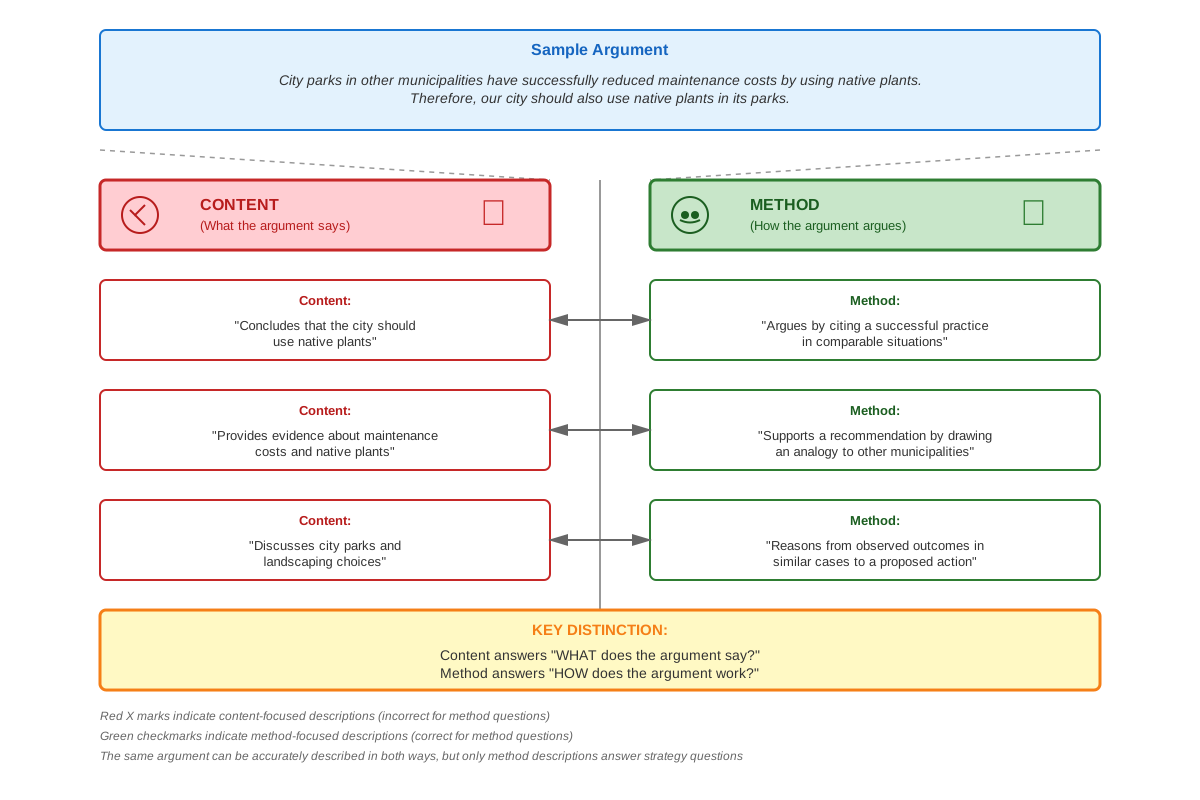
LSAT identifying argument strategy questions require you to describe the argumentative technique or reasoning pattern an author uses, not the argument's content or conclusion. The fundamental challenge is maintaining the distinction between what an argument says and how it says it. When an argument states "Most doctors recommend this treatment, so it's probably effective," the content concerns medical recommendations and treatment efficacy, but the strategy is an appeal to authority. Strategy questions demand you recognize this pattern abstractly.
These questions appear with characteristic stems:
- "The argument proceeds by..."
- "The method of reasoning employed is..."
- "The argument uses which technique..."
- "The role played by [claim] is..."
- "The argument does which of the following..."
The correct answer will describe the argumentative moves in general, abstract terms that could apply to many different arguments using the same strategy.
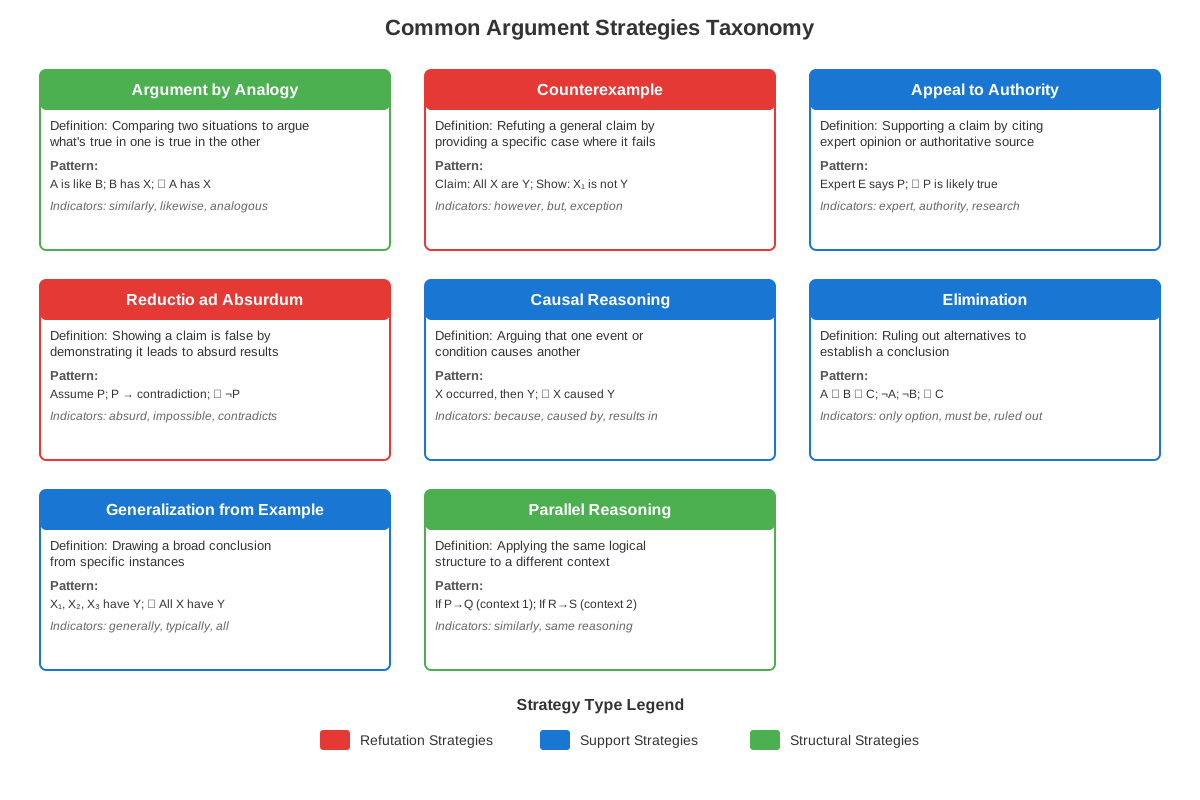
Common Argumentative Strategies
Understanding the most frequently tested strategies is crucial for rapid pattern recognition:
| Strategy | Description | Example Pattern |
|---|---|---|
| Analogy | Draws parallel between two situations to support conclusion | "Just as X has property Y, so too does Z have property Y" |
| Counterexample | Refutes a general claim by providing a specific instance that contradicts it | "The claim that all A are B is false because this A is not B" |
| Appeal to Authority | Supports conclusion by citing expert opinion or authoritative source | "Experts say X, therefore X is likely true" |
| Causal Reasoning | Argues that one phenomenon causes another | "X occurred, then Y occurred, so X caused Y" |
| Elimination | Rules out alternatives to establish conclusion | "It must be A because it cannot be B, C, or D" |
| Generalization | Moves from specific instances to general principle | "These five cases all show X, so X is generally true" |
| Reductio ad Absurdum | Shows a position leads to absurd consequences, therefore rejecting it | "If we accept X, then absurd Y follows, so we must reject X" |
| Presenting Alternative Explanation | Offers different account of evidence to challenge opponent's conclusion | "The evidence could be explained by Z instead of the claimed Y" |
Distinguishing Strategy from Content
The most critical skill in these questions is abstracting from specific content to general pattern. Consider this argument: "The new highway reduced commute times in Springfield by 30%. A similar highway would likely reduce commute times in Riverside by a comparable amount."
Content description (incorrect): "The argument claims that a highway in Riverside would reduce commute times based on what happened in Springfield."
Strategy description (correct): "The argument proceeds by drawing an analogy between two similar situations and inferring that what occurred in one will occur in the other."
Notice how the strategy description uses no specific content words (highway, Springfield, Riverside, commute times) but instead describes the logical structure in terms applicable to any analogical argument. This abstraction is precisely what the LSAT tests.
The Role of Argument Components
Some strategy questions ask specifically about the role a particular claim plays within the argument. These questions require you to identify whether a statement functions as:
- Main conclusion: The primary claim the argument seeks to establish
- Intermediate conclusion: A claim supported by some premises and used to support the main conclusion
- Premise/Evidence: A claim offered as support without itself being supported
- Background/Context: Information that frames the argument without directly supporting the conclusion
- Opposing position: A view the argument challenges or refutes
- Concession: A point the author grants before arguing for their position despite it
Understanding these functional roles allows you to map arguments structurally and recognize how authors deploy different components strategically.
Method of Reasoning Patterns
Beyond individual strategies, recognize these broader reasoning patterns:
Constructive vs. Critical: Some arguments build a positive case for a conclusion (constructive), while others attack an opposing view (critical). Critical arguments might refute by counterexample, show internal inconsistency, or demonstrate that a position leads to unacceptable consequences.
Deductive vs. Inductive: Though the LSAT rarely uses these terms explicitly, recognizing whether an argument claims certainty (deductive pattern) or probability (inductive pattern) helps you eliminate answer choices that mischaracterize the argument's strength.
Direct vs. Indirect: Direct arguments support their conclusion with straightforward evidence. Indirect arguments (like reductio ad absurdum) establish their conclusion by eliminating alternatives or showing that denying the conclusion leads to problems.
Analyzing Complex Arguments
Many LSAT arguments employ multiple strategies in combination. A sophisticated argument might:
- Present an opposing view
- Offer a counterexample to refute it
- Propose an alternative explanation
- Support that explanation with an analogy
When facing such arguments, identify the primary strategy—the main logical move that establishes the conclusion—while noting subsidiary techniques. The correct answer will typically describe the primary strategy, though it may acknowledge the overall structure.
Concept Relationships
The concepts within argument strategy form a hierarchical relationship: Basic argument structure (premises and conclusions) provides the foundation → Functional roles (how components relate) build upon this → Specific strategies (analogy, counterexample, etc.) represent particular patterns of these relationships → Complex reasoning patterns combine multiple strategies.
This topic connects backward to prerequisite knowledge of argument structure—you cannot identify how an argument proceeds without first recognizing its components. It connects forward to flaw questions (recognizing flawed strategies), parallel reasoning questions (matching strategies across arguments), and assumption questions (understanding what strategies take for granted).
The relationship map: Argument Structure → Component Identification → Functional Role Analysis → Strategy Pattern Recognition → Application to Question Types. Each level depends on mastery of the previous, making this a cumulative skill that improves with practice across question types.
Quick check — test yourself on Identifying argument strategy so far.
Try Flashcards →High-Yield Facts
⭐ Correct answers describe strategy in abstract, general terms that avoid specific content from the argument
⭐ The most common strategies tested are: analogy, counterexample, appeal to authority, elimination of alternatives, and presenting alternative explanations
⭐ Strategy questions ask "how" an argument proceeds, not "what" it concludes or whether it's valid
⭐ When a question asks about the role of a specific claim, identify whether it's a premise, conclusion, intermediate conclusion, or opposing view
⭐ Incorrect answers often describe the argument's content rather than its method, or describe a strategy the argument doesn't actually use
- Arguments that cite expert opinion or studies employ appeal to authority strategy
- Counterexamples refute universal claims by providing a single contradictory instance
- Analogical arguments assume relevant similarity between the compared situations
- Elimination arguments establish a conclusion by ruling out all alternatives
- Reductio ad absurdum shows a position leads to absurd or unacceptable consequences
- Causal arguments infer that one event or condition produces another
- Some arguments present alternative explanations to challenge an opponent's causal reasoning
- Generalizations move from specific observed instances to broader principles
- The primary strategy is the main logical move supporting the conclusion, even if subsidiary techniques appear
- Role questions require identifying the functional purpose of a specific statement within the argument's structure
Common Misconceptions
Misconception: Strategy questions ask whether the argument is good or bad → Correction: These questions are purely descriptive, asking you to identify the technique used, not evaluate its effectiveness. Save evaluation for flaw, strengthen, and weaken questions.
Misconception: The correct answer should include specific content from the argument → Correction: Correct answers describe strategy abstractly. If an answer choice mentions specific subjects from the passage (like "highways" or "doctors"), it's likely describing content rather than method and is probably wrong.
Misconception: If an argument mentions an expert, the strategy must be appeal to authority → Correction: Consider how the expert opinion functions. If it's merely background information or one piece of evidence among many, the primary strategy might be something else entirely.
Misconception: Complex arguments with multiple parts don't have a single identifiable strategy → Correction: Even complex arguments have a primary logical move that establishes the conclusion. Identify the main strategy while noting subsidiary techniques, and match your analysis to answer choices that capture the primary method.
Misconception: Role questions and strategy questions are fundamentally different → Correction: Role questions are a subset of strategy questions, focusing on how a specific component functions within the overall argumentative strategy. The same analytical skills apply to both.
Worked Examples
Example 1: Identifying Analogical Reasoning
Argument: "The city of Brookfield installed speed cameras at major intersections and saw traffic accidents decrease by 40% within six months. Riverside has similar traffic patterns and demographics to Brookfield. Therefore, installing speed cameras in Riverside would likely produce a comparable reduction in accidents."
Question: The argument proceeds by which of the following methods?
Analysis:
- Identify the conclusion: Installing speed cameras in Riverside would likely reduce accidents comparably
- Identify the premises: Brookfield saw 40% reduction; Riverside is similar to Brookfield
- Recognize the logical move: The argument draws a parallel between two cities and infers that what worked in one will work in the other
- Abstract the strategy: This is reasoning by analogy—using one case to predict outcomes in a similar case
Correct Answer Pattern: "Drawing a parallel between two similar situations and inferring that what occurred in one will likely occur in the other"
Why Wrong Answers Fail:
- "Citing statistical evidence to support a causal claim" - This describes content (statistics) rather than the analogical method
- "Appealing to expert opinion about traffic safety" - No experts are mentioned; this confuses content
- "Establishing that speed cameras reduce accidents in all cities" - The argument makes a specific prediction about Riverside, not a universal claim
Example 2: Identifying Counterexample Strategy
Argument: "Political commentator: Some claim that all successful politicians must compromise their principles. But Senator Williams maintained her core principles throughout her career and achieved significant legislative success. This shows the claim is false."
Question: The commentator's argument proceeds by
Analysis:
- Identify the structure:
- Opposing view: All successful politicians must compromise principles
- Evidence: Senator Williams succeeded without compromising
- Conclusion: The opposing view is false
- Recognize the logical move: The argument refutes a universal claim ("all successful politicians") by providing a single instance that contradicts it
- Abstract the strategy: This is refutation by counterexample—showing a general claim is false by demonstrating one case where it doesn't hold
Correct Answer Pattern: "Refuting a general claim by providing an example that contradicts it"
Why Wrong Answers Fail:
- "Supporting a conclusion with an appeal to authority" - Senator Williams isn't cited as an authority; she's an example
- "Drawing an analogy between two political figures" - No comparison between two figures occurs
- "Showing that a claim leads to an absurd consequence" - The argument doesn't trace logical consequences; it provides a counterexample
Exam Strategy
Approaching Strategy Questions Systematically
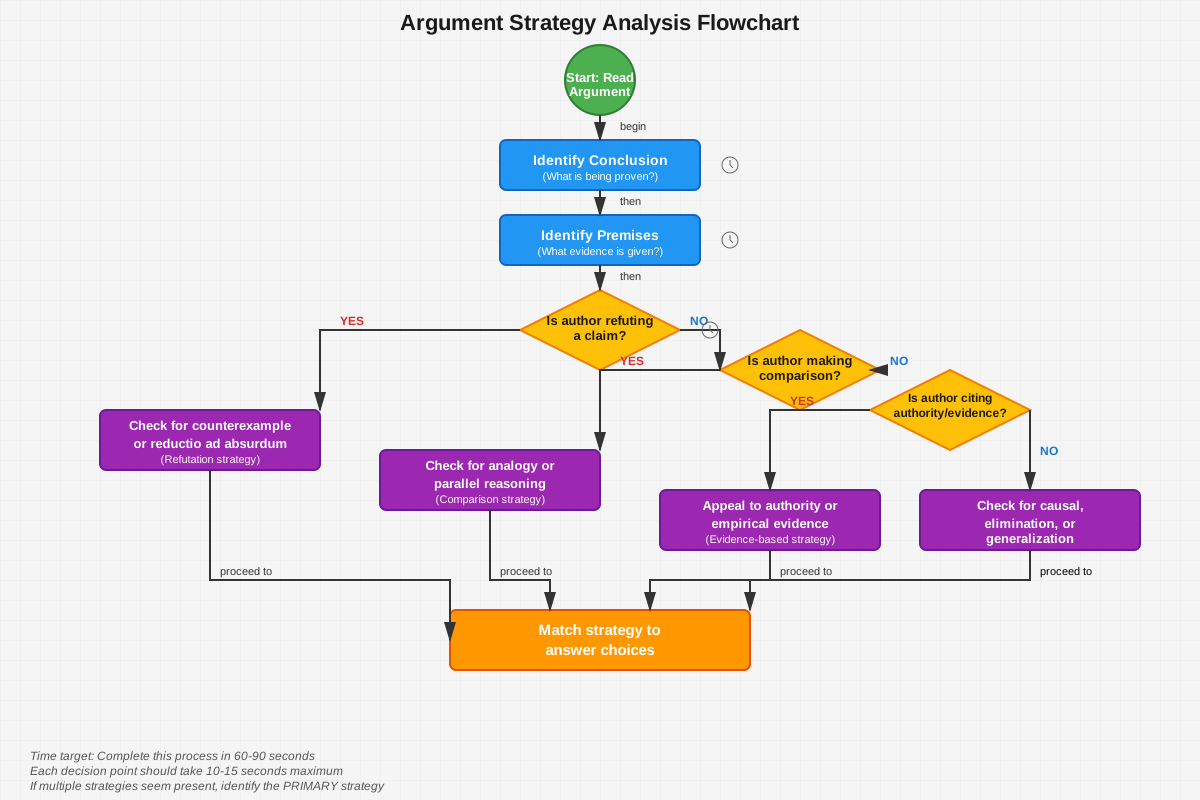
- Read the question stem first to confirm you're dealing with a strategy question (look for "proceeds by," "method of reasoning," "role played by")
- Identify argument components quickly: What's the conclusion? What are the premises? Is there an opposing view?
- Describe the strategy to yourself in abstract terms before looking at answers
- Eliminate answers that describe content rather than method, or that describe strategies not present in the argument
- Match your abstract description to the answer choice that captures the same pattern
Trigger Words and Phrases
Watch for these question stem indicators:
- "proceeds by"
- "method of reasoning"
- "technique of argumentation"
- "role played by"
- "functions in the argument to"
- "does which of the following"
In answer choices, correct answers often use these abstract terms:
- "drawing an analogy"
- "providing a counterexample"
- "citing authority"
- "eliminating alternatives"
- "presenting an alternative explanation"
- "showing that a claim leads to"
- "generalizing from"
Process of Elimination Tips
Eliminate answers that:
- Include specific content words from the passage (proper nouns, technical terms)
- Describe strategies not present in the argument (if there's no analogy, eliminate "drawing an analogy")
- Confuse premises with conclusions or misidentify the argument's structure
- Evaluate the argument's quality rather than describing its method
- Are too narrow (missing the primary strategy) or too broad (describing all arguments generally)
Exam Tip: If you're stuck between two answers, check whether each describes something that actually happens in the argument. The wrong answer often describes a plausible strategy that simply isn't present in this particular argument.
Time Allocation
Spend 60-90 seconds on strategy questions:
- 15-20 seconds: Read and understand the argument
- 10-15 seconds: Identify the strategy abstractly
- 30-45 seconds: Evaluate answer choices
- 5-10 seconds: Confirm your selection
These questions reward careful initial analysis. Investing time upfront to correctly identify the strategy pays off in rapid answer choice elimination.
Memory Techniques
PACE Acronym for Common Strategies
Parallel (Analogy)
Authority (Appeal to experts)
Counter (Counterexample)
Eliminate (Ruling out alternatives)
These four strategies appear most frequently on the LSAT. When you identify one of these patterns, you can quickly predict the correct answer's language.
The "Content vs. Method" Mantra
Before selecting an answer, ask: "Does this describe WHAT the argument says or HOW it argues?" Repeat this distinction until it becomes automatic. Content = wrong; Method = potentially correct.
Visualization Strategy
Picture arguments as machines with moving parts. The strategy is the type of machine (pulley system, lever, gear assembly), not what the machine produces. This metaphor helps maintain the crucial distinction between method and content.
Role Question Mnemonic: "PICO"
Premise (supporting evidence)
Intermediate conclusion (supported and supporting)
Conclusion (main point)
Opposing view (position challenged)
When a question asks about a claim's role, run through PICO to classify it correctly.
Summary
Identifying argument strategy is a high-frequency LSAT skill that requires recognizing how arguments function rather than what they conclude. The key to mastering these questions lies in abstracting from specific content to general patterns—describing arguments in terms of analogy, counterexample, appeal to authority, elimination, and other common strategies. Success demands distinguishing between content (what the argument discusses) and method (how it reasons), a distinction that separates correct answers from attractive traps. Strategy questions connect to virtually all other Logical Reasoning question types, making this skill foundational for LSAT success. By systematically identifying argument components, recognizing common patterns, and eliminating answers that describe content rather than method, test-takers can consistently answer these questions correctly within the time constraints. The most tested strategies—analogy, counterexample, appeal to authority, elimination, and alternative explanation—should become second nature through practice, enabling rapid pattern recognition on test day.
Key Takeaways
- Strategy questions ask HOW an argument proceeds, not WHAT it concludes or whether it's valid
- Correct answers describe argumentative techniques in abstract, general terms without specific content
- The most frequently tested strategies are analogy, counterexample, appeal to authority, elimination of alternatives, and presenting alternative explanations
- Distinguish between describing an argument's method (correct approach) and restating its content (common trap)
- Role questions ask about the function of specific claims within the argument's structure (premise, conclusion, opposing view, etc.)
- Systematic analysis—identifying components, abstracting strategy, eliminating content-based answers—leads to consistent accuracy
- This skill connects to and enhances performance on flaw, parallel reasoning, and assumption questions
Related Topics
Parallel Reasoning Questions: Once you can identify an argument's strategy, parallel reasoning questions ask you to find another argument using the same strategy—a direct application of pattern recognition skills developed here.
Flaw Questions: Many flaws involve misapplying argumentative strategies (weak analogies, inappropriate appeals to authority, hasty generalizations). Understanding strategies enables you to recognize their flawed execution.
Assumption Questions: Different strategies depend on different assumptions. Analogical arguments assume relevant similarity; appeals to authority assume the authority is reliable. Recognizing strategy helps predict assumptions.
Argument Structure Questions: These questions ask you to identify the overall organization of an argument, building directly on your ability to recognize how components function strategically.
Practice CTA
Now that you understand how to identify argument strategies, it's time to cement this knowledge through application. Work through the practice questions systematically, applying the PACE framework and content-versus-method distinction to each problem. Use the flashcards to drill common strategies until pattern recognition becomes automatic. Remember: this skill improves dramatically with deliberate practice. Each question you analyze strengthens your ability to abstract from content to method, building the meta-cognitive awareness that distinguishes top LSAT performers. You're developing a skill that will serve you throughout law school and legal practice—the ability to see not just what arguments say, but how they work.
Sign up free to keep reading
Create a free AnvayaPrep account to finish this LSAT guide on Identifying argument strategy — plus flashcards and practice questions.