Overview
The opposing viewpoint structure is one of the most frequently tested argument patterns in LSAT Logical Reasoning sections. This structure appears when an author presents someone else's position, claim, or reasoning—often to disagree with it, refute it, or provide an alternative perspective. Understanding this pattern is crucial because approximately 15-20% of Logical Reasoning questions involve identifying, analyzing, or evaluating how authors use opposing viewpoints to build their arguments.
In the context of method, role, and structure questions, recognizing opposing viewpoint structure allows test-takers to accurately describe what an author is doing rhetorically, identify the function of specific statements within an argument, and understand how different parts of a passage relate to one another. The LSAT frequently asks students to identify which statement represents the opposing view, determine how the author responds to that view, or explain the role that the opposing viewpoint plays in the overall argument structure.
Mastering opposing viewpoint structure connects directly to broader Logical Reasoning skills including argument analysis, critical reading, and understanding rhetorical strategies. This pattern appears not only in dedicated structure questions but also influences how students should approach assumption questions, strengthen/weaken questions, and parallel reasoning questions. The ability to quickly distinguish between an author's own position and the viewpoint they're opposing is fundamental to achieving accuracy and speed on test day.
Learning Objectives
- [ ] Identify how opposing viewpoint structure appears in LSAT questions
- [ ] Explain the reasoning pattern behind opposing viewpoint structure
- [ ] Apply opposing viewpoint structure to solve LSAT-style problems accurately
- [ ] Distinguish between the author's position and the opposing viewpoint in complex arguments
- [ ] Recognize common linguistic markers that signal opposing viewpoint structure
- [ ] Evaluate how authors use opposing viewpoints to strengthen their own conclusions
- [ ] Predict question types most likely to test opposing viewpoint structure
Prerequisites
- Basic argument structure: Understanding premises, conclusions, and how they connect is essential because opposing viewpoint structure builds upon these fundamental components
- Indicator words and transitions: Familiarity with words like "however," "but," "although," and "critics argue" helps identify when an opposing view is being introduced
- Distinction between claims and evidence: Recognizing the difference between what someone claims and what supports that claim is necessary to understand how opposing viewpoints function within arguments
- Reading comprehension fundamentals: The ability to track multiple perspectives within a single passage is required to separate the author's view from others' positions
Why This Topic Matters
In legal reasoning, professional writing, and academic discourse, authors routinely engage with opposing viewpoints to demonstrate the strength of their own positions. The LSAT tests this skill because lawyers must constantly anticipate counterarguments, understand opposing counsel's reasoning, and construct persuasive responses. Recognizing opposing viewpoint structure trains students to think critically about how arguments are constructed and defended in real-world contexts.
On the LSAT, opposing viewpoint structure appears in approximately 3-5 questions per Logical Reasoning section, making it one of the highest-yield patterns to master. This structure most commonly appears in Method of Reasoning questions (asking "how does the author respond to X?"), Role questions (asking "what function does statement Y serve?"), and Structure questions (asking "which describes the argument's organization?"). Additionally, understanding this pattern improves performance on Strengthen, Weaken, and Assumption questions where the opposing viewpoint may be implicit.
The lsat opposing viewpoint structure typically manifests in several recognizable forms: an author may present a critic's objection before refuting it, introduce a commonly held belief before challenging it, acknowledge a potential counterargument before explaining why it fails, or contrast their position with an alternative theory. Questions testing this structure often ask students to identify which statement represents the opposing view, describe the relationship between different claims, or explain the argumentative strategy the author employs.
Core Concepts
The Basic Pattern of Opposing Viewpoint Structure
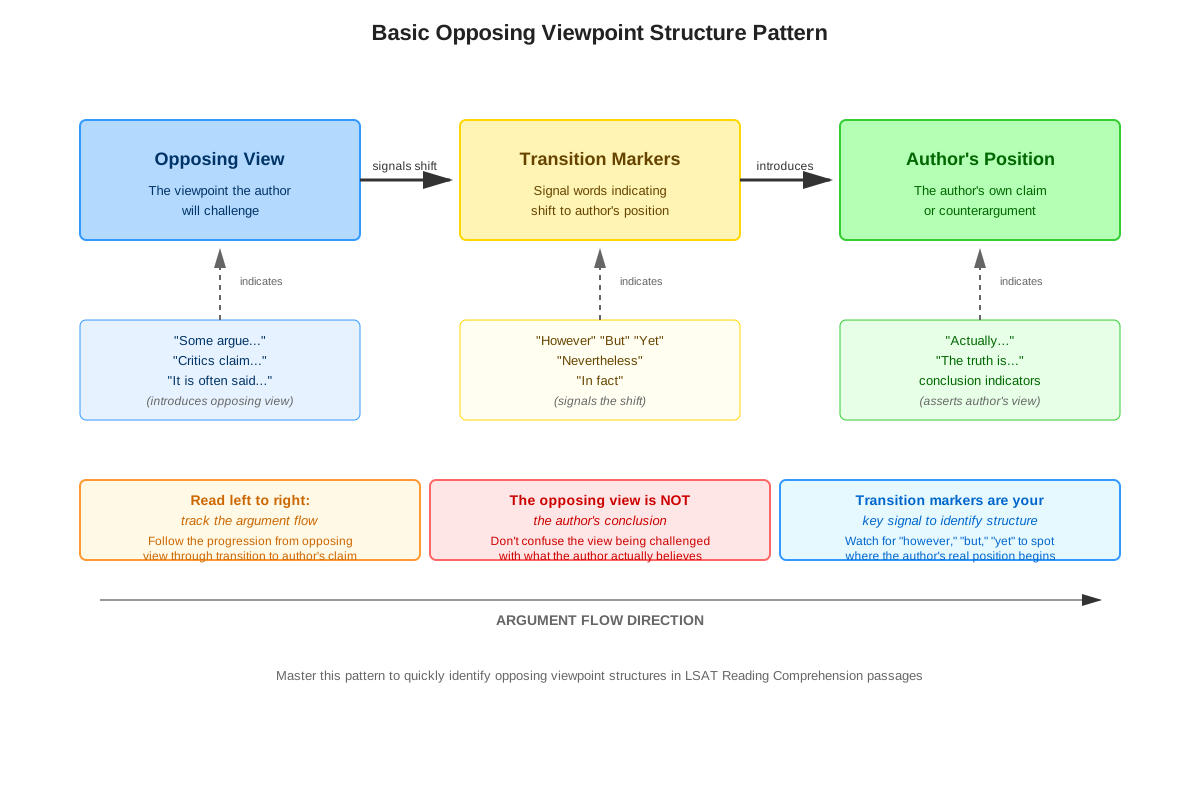
The opposing viewpoint structure follows a predictable pattern that appears throughout LSAT Logical Reasoning passages. At its core, this structure involves an author presenting someone else's position, claim, or reasoning—typically followed by the author's own response, critique, or alternative perspective. The basic template looks like this:
- Introduction of the opposing view: The author presents another person's, group's, or theory's position
- The author's response: The author disagrees, qualifies, refutes, or provides an alternative to that opposing view
- Support for the author's position: Evidence, reasoning, or examples that justify the author's stance
This structure serves multiple rhetorical purposes: it demonstrates that the author has considered alternative perspectives, it allows the author to preemptively address potential objections, and it creates a framework for the author to position their own view as superior or more nuanced than the opposing position.
Linguistic Markers and Signal Phrases
Recognizing opposing viewpoint structure depends heavily on identifying specific linguistic markers that signal when an opposing view is being introduced or when the author is transitioning to their own position. Common phrases that introduce opposing viewpoints include:
- "Critics argue that..."
- "Some believe that..."
- "It has been suggested that..."
- "According to [person/group]..."
- "The traditional view holds that..."
- "Opponents claim that..."
- "One might object that..."
Conversely, phrases that signal the author's response to the opposing view include:
- "However..."
- "But this view is mistaken because..."
- "Yet..."
- "Nevertheless..."
- "This objection fails to consider..."
- "On the contrary..."
- "In fact..."
Understanding these markers allows test-takers to quickly map the structure of an argument and identify which statements belong to which perspective.
Types of Opposing Viewpoint Relationships
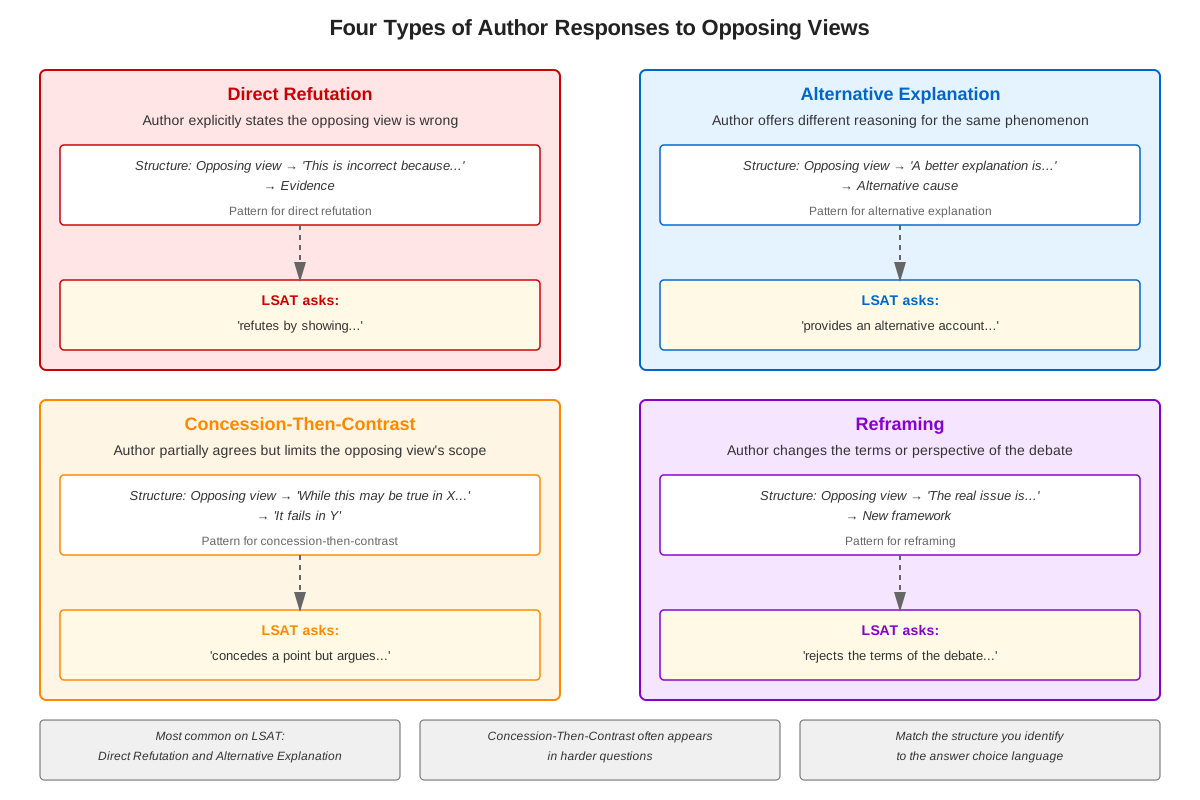
Not all opposing viewpoint structures function identically. The LSAT employs several distinct relationship types:
| Relationship Type | Description | Example Structure |
|---|---|---|
| Direct Refutation | Author presents opposing view and explicitly argues it is wrong | "Critics say X. But X is false because Y." |
| Qualification | Author presents opposing view and adds nuance or limitations | "Some argue X. While X is partially correct, it overlooks Y." |
| Alternative Explanation | Author presents one explanation and offers a different one | "Theory X explains phenomenon Z. However, theory Y provides a better explanation." |
| Concession and Rebuttal | Author acknowledges validity of opposing view but argues their position is stronger | "Admittedly, X has merit. Nevertheless, Y is more compelling because..." |
| Preemptive Counterargument | Author anticipates an objection and addresses it before it's raised | "One might object that X. But this objection fails because Y." |
Each type requires slightly different analytical approaches, but all share the fundamental pattern of presenting multiple perspectives within a single argument.
The Role of Opposing Viewpoints in Argument Structure
Opposing viewpoints serve specific structural functions within LSAT arguments. Understanding these functions is essential for answering Role and Method questions correctly:
- Establishing context: The opposing view may represent conventional wisdom or background information that frames the author's contribution
- Creating contrast: By presenting an alternative position, the author highlights what makes their own view distinctive or superior
- Demonstrating thoroughness: Acknowledging opposing views shows the author has considered multiple perspectives
- Setting up the conclusion: The opposing view often serves as a foil that the author's conclusion directly contradicts or refines
When a question asks about the role of a particular statement, determining whether that statement represents the author's view or an opposing view is often the key to selecting the correct answer.
Identifying the Author's Position vs. Opposing Views
A critical skill in handling opposing viewpoint structure is distinguishing between what the author believes and what the author is reporting that others believe. The LSAT deliberately creates passages where this distinction is subtle or where multiple viewpoints appear in quick succession.
Key strategies for maintaining this distinction include:
- Track attribution carefully: Note who is making each claim (the author, critics, proponents of a theory, etc.)
- Identify the main conclusion: The author's own position typically aligns with or directly supports the main conclusion
- Follow the logical flow: Statements that appear after "however," "but," or "yet" typically represent the author's own view when they follow an opposing viewpoint
- Consider the tone: Authors often use neutral or skeptical language when presenting opposing views, but more assertive language for their own positions
Common Question Formats Testing This Structure
The lsat opposing viewpoint structure appears in several question formats, each requiring specific recognition skills:
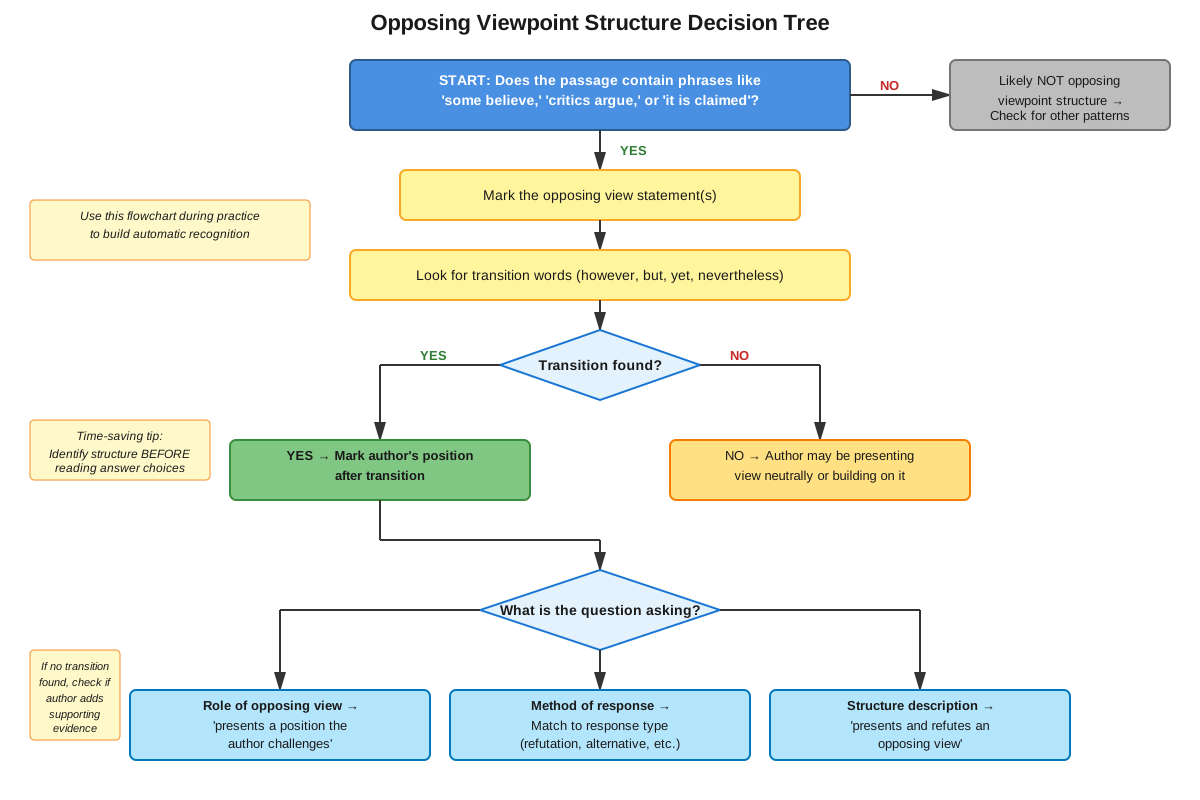
Method of Reasoning questions ask how the author makes their argument, with correct answers often describing the opposing viewpoint structure explicitly (e.g., "presents a view and then argues against it" or "introduces an objection and then responds to it").
Role questions ask what function a specific statement serves, requiring students to identify whether that statement is the opposing view, the author's response, evidence for either position, or the main conclusion.
Structure questions ask for a description of the argument's overall organization, with correct answers often outlining the opposing viewpoint pattern (e.g., "describes a theory, presents evidence against it, and proposes an alternative").
Point at Issue questions require identifying what two speakers disagree about, which depends on accurately understanding each speaker's position.
Concept Relationships
The opposing viewpoint structure concept connects to multiple aspects of LSAT Logical Reasoning. At the foundational level, it builds upon basic argument structure (premises and conclusions) by adding a layer of complexity—arguments now contain multiple perspectives that must be tracked simultaneously. The ability to identify indicator words and transitions directly enables recognition of opposing viewpoint structure, as these linguistic markers signal when perspectives shift.
Within the topic itself, the relationships flow as follows: Linguistic markers → signal the presence of → opposing viewpoint structure → which manifests in → specific relationship types (refutation, qualification, etc.) → which serve → structural functions within arguments → which are tested through → specific question formats.
This structure also connects forward to more advanced Logical Reasoning skills. Understanding opposing viewpoint structure improves performance on Assumption questions because the author's response to an opposing view often relies on unstated assumptions. It enhances Strengthen/Weaken question performance because evidence that undermines an opposing view strengthens the author's position. It aids Parallel Reasoning questions because matching argument structures requires recognizing when both arguments employ opposing viewpoint patterns.
The relationship to method, role, and structure questions is particularly direct: these question types explicitly test whether students can identify and describe the opposing viewpoint structure. Mastering this pattern provides a framework for answering approximately 30-40% of all method, role, and structure questions accurately.
High-Yield Facts
⭐ Opposing viewpoint structure appears in 15-20% of all Logical Reasoning questions, making it one of the highest-yield patterns to master.
⭐ The author's main conclusion typically opposes or qualifies the opposing viewpoint, not supports it—if you're unsure which view is the author's, identify the conclusion first.
⭐ Phrases like "critics argue," "some believe," and "it has been suggested" almost always introduce opposing viewpoints, not the author's own position.
⭐ Statements appearing after "however," "but," or "yet" typically represent the author's response to a previously stated opposing view.
⭐ Method of Reasoning questions testing opposing viewpoint structure often include answer choices with phrases like "presents a view and argues against it" or "introduces an objection and responds to it."
- The opposing viewpoint may appear at the beginning, middle, or end of an argument, though it most commonly appears early to set up the author's response.
- Authors may present opposing viewpoints using neutral language without explicitly labeling them as "wrong" or "mistaken" until the response.
- Multiple opposing viewpoints can appear in a single argument, requiring careful tracking of which perspective each statement represents.
- The opposing viewpoint itself may contain premises and a conclusion, creating a nested argument structure within the larger passage.
- Role questions about opposing viewpoint structure often have incorrect answer choices that reverse the roles (claiming the author's view is the opposing view or vice versa).
- Recognizing opposing viewpoint structure can help eliminate wrong answers on Main Point questions by identifying which conclusion is actually the author's.
- The strength of the author's response to an opposing view often depends on unstated assumptions, making these arguments vulnerable to Assumption and Weaken questions.
Quick check — test yourself on Opposing viewpoint structure so far.
Try Flashcards →Common Misconceptions
Misconception: Any statement that disagrees with something is an opposing viewpoint structure.
Correction: Opposing viewpoint structure specifically involves the author presenting someone else's view before responding to it. Simple disagreement between two speakers or a single author arguing against a claim without attributing it to others doesn't constitute this structure.
Misconception: The opposing viewpoint always appears at the beginning of the argument.
Correction: While opposing viewpoints frequently appear early to set up the author's response, they can appear anywhere in the argument. Authors may state their position first, then address a potential objection, or even end with an opposing view they've already refuted.
Misconception: If the author acknowledges any merit in an opposing view, they must partially agree with it.
Correction: Authors often concede minor points or acknowledge limited validity in opposing views as a rhetorical strategy before arguing that their own position is nevertheless superior overall. This "concession and rebuttal" pattern doesn't indicate genuine agreement.
Misconception: The opposing viewpoint is always explicitly labeled as wrong or mistaken.
Correction: Authors may present opposing viewpoints neutrally and respond with subtle disagreement, alternative explanations, or qualifications rather than direct refutation. The response may be implicit in the evidence provided rather than explicitly stated.
Misconception: In Role questions, the opposing viewpoint is always "a position the author disagrees with."
Correction: While this is often true, the correct answer may be more specific, such as "an objection the author anticipates and addresses," "a view the author qualifies," or "a theory the author offers an alternative to." The precise relationship matters.
Misconception: Every argument contains an opposing viewpoint structure.
Correction: Many LSAT arguments present only the author's position with supporting evidence, without engaging with alternative views. Recognizing when this structure is absent is as important as recognizing when it's present.
Worked Examples
Example 1: Method of Reasoning Question
Passage: "Some economists argue that raising the minimum wage reduces employment because businesses cannot afford to hire as many workers at higher wages. However, recent studies of cities that raised their minimum wages show no significant decrease in employment. This suggests that the economists' prediction does not account for increased worker productivity and reduced turnover that result from higher wages."
Question: The author's argument proceeds by
(A) accepting the economists' conclusion but disputing their reasoning
(B) presenting evidence that contradicts a prediction and offering an alternative explanation
(C) demonstrating that the economists' argument contains a logical fallacy
(D) providing an analogy that supports the economists' position
(E) questioning the reliability of the studies cited
Analysis:
First, identify the opposing viewpoint structure. The phrase "Some economists argue" signals an opposing viewpoint. The economists' position is: raising minimum wage → reduces employment (because businesses can't afford as many workers).
Next, identify the author's response. The word "However" signals the transition to the author's perspective. The author presents evidence (studies showing no employment decrease) that contradicts the economists' prediction.
Then, identify the author's explanation. The author doesn't just contradict the economists; they offer an alternative explanation for why the prediction fails: increased productivity and reduced turnover offset the higher wage costs.
Now evaluate the answer choices:
(A) is incorrect because the author doesn't accept the economists' conclusion—the author argues employment doesn't decrease.
(B) correctly describes the structure: evidence contradicts prediction + alternative explanation provided.
(C) is incorrect because the author doesn't identify a logical fallacy in the economists' reasoning.
(D) is incorrect because no analogy appears, and the author opposes rather than supports the economists.
(E) is incorrect because the author uses the studies as reliable evidence, not questions them.
Correct Answer: (B)
This example demonstrates how recognizing opposing viewpoint structure allows you to map the argument's organization and match it to the correct answer choice description.
Example 2: Role Question
Passage: "Critics of the new traffic management system claim it will increase congestion by reducing the number of available lanes. But the system actually improves traffic flow by optimizing signal timing across the entire network. The critics focus narrowly on individual intersections rather than considering the system-wide effects."
Question: The claim that the new system will increase congestion serves which function in the argument?
(A) It is the main conclusion the author defends
(B) It is a position the author argues against
(C) It provides evidence for the author's conclusion
(D) It is an assumption underlying the author's reasoning
(E) It is a concession the author makes before qualifying it
Analysis:
First, identify who makes the claim in question. "Critics of the new traffic management system claim" clearly attributes this claim to critics, not the author.
Next, determine the author's response. The word "But" signals the author's contrasting position. The author argues the system "actually improves traffic flow," directly contradicting the critics' claim about increased congestion.
Then, identify the function. The critics' claim is presented so the author can argue against it—this is classic opposing viewpoint structure where the opposing view is introduced and then refuted.
Now evaluate the answer choices:
(A) is incorrect because this is the critics' conclusion, not the author's.
(B) correctly identifies this as a position the author argues against.
(C) is incorrect because the claim doesn't support the author's conclusion; it opposes it.
(D) is incorrect because this is an explicit claim, not an unstated assumption.
(E) is incorrect because the author doesn't concede any validity to this claim; the author directly contradicts it.
Correct Answer: (B)
This example shows how Role questions test whether you can distinguish between the author's position and opposing viewpoints, and accurately describe the function each statement serves.
Exam Strategy
When approaching LSAT questions involving opposing viewpoint structure, employ a systematic process to maximize accuracy and efficiency:
Step 1: Identify attribution markers. As you read, immediately note phrases like "critics argue," "some believe," "opponents claim," or "according to X." These signal that an opposing viewpoint is being introduced. Mark these in your mental map or with notation if you're working on paper.
Step 2: Track perspective shifts. Watch for transition words like "however," "but," "yet," "nevertheless," and "on the contrary." These typically signal the author's response to the opposing view. The statement following these transitions usually represents the author's own position.
Step 3: Identify the main conclusion. The author's main conclusion almost always aligns with the author's own view, not the opposing viewpoint. If you're uncertain which perspective belongs to the author, finding the main conclusion clarifies this immediately.
Step 4: Map the structure. Quickly outline the argument's organization: Opposing view → Author's response → Support. This map helps you answer Method, Role, and Structure questions efficiently.
Exam Tip: If a question asks about "the author's argument" or "the author's reasoning," eliminate any answer choices that describe the opposing viewpoint. Many wrong answers deliberately confuse the author's position with the opposing view.
Trigger words for opposing viewpoint structure include: critics, opponents, some people, traditionally, commonly believed, it has been suggested, one might object, proponents of X argue, according to, the conventional view.
Trigger words for the author's response include: however, but, yet, nevertheless, on the contrary, in fact, actually, this view is mistaken, this objection fails, a better explanation.
Process-of-elimination strategy: On Method and Role questions, immediately eliminate answer choices that:
- Reverse the roles (claiming the opposing view is the author's position)
- Describe argumentative moves that don't appear in the passage
- Use extreme language ("proves," "definitively establishes") when the author's response is more measured
Time allocation: Opposing viewpoint structure questions should take approximately 1:15-1:30 minutes. The structure is usually straightforward once you identify it, so if you're spending more than 1:45, you may be overcomplicating the analysis. Trust your initial identification of which view belongs to whom.
Common trap answers: Watch for answer choices that accurately describe the opposing viewpoint but incorrectly attribute it to the author, or that accurately describe the author's position but mischaracterize its role in the argument.
Memory Techniques
The "HOWEVER" mnemonic helps remember the typical opposing viewpoint structure:
- Hear the opposing view first
- Opponent's position is stated
- Watch for transition words
- Evaluate the author's response
- Verify which view is which
- Examine the support provided
- Recognize the pattern for future questions
Visualization strategy: Picture opposing viewpoint structure as a tennis match. The opposing view serves the ball (makes a claim), and the author returns it (responds with their own position). This mental image helps you track which "player" (perspective) is making each move.
The "CRITIC" acronym for identifying opposing viewpoints:
- Critics argue
- Reportedly
- It has been suggested
- Traditionally believed
- In the view of
- Commonly held that
The "BUT" acronym for identifying the author's response:
- But
- Unlike that view
- Though/Nevertheless
Color-coding technique: When practicing, use one color to mark opposing viewpoints and another for the author's response. This visual distinction reinforces the pattern recognition that becomes automatic with practice.
Summary
Opposing viewpoint structure is a fundamental pattern in LSAT Logical Reasoning where an author presents someone else's position before responding with their own perspective. This structure appears in 15-20% of Logical Reasoning questions and is explicitly tested in Method, Role, and Structure questions. Mastering this pattern requires recognizing linguistic markers that signal opposing viewpoints ("critics argue," "some believe") and transitions to the author's response ("however," "but," "yet"). The structure serves multiple rhetorical functions: establishing context, creating contrast, demonstrating thoroughness, and setting up the author's conclusion. Success depends on accurately distinguishing between the author's position and the opposing view, understanding the specific relationship between them (refutation, qualification, alternative explanation, etc.), and matching this structure to answer choice descriptions. The ability to quickly map opposing viewpoint structure improves performance across multiple question types and is essential for achieving high scores on the LSAT Logical Reasoning section.
Key Takeaways
- Opposing viewpoint structure involves an author presenting someone else's position before responding with their own view—recognizing this pattern is essential for 15-20% of Logical Reasoning questions
- Linguistic markers like "critics argue" and "some believe" signal opposing viewpoints, while "however" and "but" signal the author's response—tracking these transitions is the key to mapping argument structure
- The author's main conclusion almost always aligns with the author's own position, not the opposing viewpoint—identify the conclusion to clarify which perspective belongs to whom
- Method, Role, and Structure questions explicitly test whether you can identify and describe opposing viewpoint structure—correct answers often include phrases like "presents a view and argues against it"
- Common trap answers reverse the roles or mischaracterize the relationship between perspectives—always verify which view belongs to the author before selecting an answer
- Multiple relationship types exist (refutation, qualification, alternative explanation, concession and rebuttal)—understanding these nuances improves accuracy on complex passages
- Mastering opposing viewpoint structure improves performance on Assumption, Strengthen, Weaken, and Parallel Reasoning questions—this pattern connects to multiple question types beyond just structure questions
Related Topics
Argument Structure and Components: Understanding how premises support conclusions provides the foundation for recognizing when multiple perspectives appear within a single argument. Mastering opposing viewpoint structure enables deeper analysis of complex argument architectures.
Method of Reasoning Questions: These questions explicitly ask how authors construct their arguments. Opposing viewpoint structure is one of the most common patterns tested, making this topic essential preparation for method questions.
Role and Function Questions: These questions ask what purpose specific statements serve within arguments. Recognizing opposing viewpoint structure allows accurate identification of whether statements represent the author's view, opposing views, or support for either position.
Assumption Questions: Authors' responses to opposing viewpoints often rely on unstated assumptions. Understanding the opposing viewpoint structure helps identify gaps in reasoning that assumption questions target.
Parallel Reasoning Questions: Matching argument structures requires recognizing when both arguments employ opposing viewpoint patterns. This topic provides a framework for identifying structural similarities.
Practice CTA
Now that you understand opposing viewpoint structure, it's time to apply this knowledge to actual LSAT questions. Work through the practice questions and flashcards to reinforce your ability to identify this pattern quickly and accurately. Focus on tracking attribution markers and transition words as you read, and practice mapping the structure before looking at answer choices. With deliberate practice, recognizing opposing viewpoint structure will become automatic, giving you a significant advantage on test day. Remember: this pattern appears in approximately 1 in 5 Logical Reasoning questions—mastering it will directly improve your score. Start practicing now to build the pattern recognition skills that separate high scorers from the rest.
Sign up free to keep reading
Create a free AnvayaPrep account to finish this LSAT guide on Opposing viewpoint structure — plus flashcards and practice questions.