Overview
The premise conclusion relationship forms the backbone of every argument encountered on the LSAT Logical Reasoning section. Understanding how premises support conclusions is not merely a foundational skill—it is the lens through which all argument-based questions must be viewed. When the LSAT asks about the role a statement plays, the method of reasoning an argument employs, or the structure of an argument, the test is fundamentally assessing whether test-takers can accurately map the relationships between the building blocks of reasoning. This topic represents the intersection of reading comprehension and logical analysis, requiring students to move beyond simply understanding what an argument says to grasping how it functions mechanically.
Method, role, and structure questions explicitly test the ability to identify and articulate premise conclusion relationships. These question types ask test-takers to describe what a particular statement does within an argument, how an argument proceeds from evidence to conclusion, or what role a claim plays in the overall reasoning. Unlike assumption or strengthen/weaken questions that ask about argument content, these questions focus on argument architecture. Mastering this topic enables students to see arguments as transparent structures rather than opaque blocks of text, transforming confusion into clarity.
The premise conclusion relationship connects to virtually every other concept in logical reasoning. Identifying conclusions is prerequisite to finding assumptions, evaluating evidence requires understanding what that evidence is meant to support, and recognizing flaws depends on seeing how premises fail to adequately support their conclusions. This topic serves as the foundation upon which all advanced logical reasoning skills are built, making it one of the highest-yield areas of study for LSAT preparation.
Learning Objectives
- [ ] Identify how premise conclusion relationship appears in LSAT questions
- [ ] Explain the reasoning pattern behind premise conclusion relationship
- [ ] Apply premise conclusion relationship to solve LSAT-style problems accurately
- [ ] Distinguish between main conclusions, subsidiary conclusions, and premises in complex arguments
- [ ] Recognize and categorize different types of premise-conclusion indicators in argument text
- [ ] Diagram multi-layered arguments showing the flow of support from premises through intermediate conclusions to main conclusions
Prerequisites
- Basic argument structure: Understanding that arguments consist of claims meant to persuade is essential because premise-conclusion relationships exist only within argumentative contexts.
- Reading comprehension fundamentals: The ability to parse complex sentences and identify main ideas enables students to locate conclusions even when they appear in unexpected positions.
- Logical vocabulary: Familiarity with terms like "claim," "evidence," "support," and "inference" provides the language needed to discuss how arguments function.
- Conditional reasoning basics: Many arguments use conditional structures where premises establish conditions that lead to conclusions, making this background helpful for understanding support relationships.
Why This Topic Matters
In legal reasoning, professional writing, and everyday decision-making, the ability to distinguish between what someone is trying to prove and what evidence they offer matters enormously. Lawyers must identify the central claim in opposing counsel's argument to effectively rebut it. Policy analysts must trace how data points support recommendations. Even casual debates require participants to recognize when someone has shifted from providing evidence to stating their position. The lsat premise conclusion relationship skill translates directly to these real-world applications.
On the LSAT itself, premise-conclusion relationships appear with remarkable frequency. Approximately 15-20% of Logical Reasoning questions are explicitly method, role, and structure questions that directly test this skill. However, the true importance extends far beyond this percentage—virtually every Logical Reasoning question requires identifying the conclusion as a first step. Strengthen questions ask what would support the conclusion; weaken questions ask what would undermine it; assumption questions ask what must be true for premises to support the conclusion. Without accurately identifying premise-conclusion relationships, students cannot effectively approach any argument-based question type.
These relationships appear in LSAT passages through various structural patterns. Sometimes conclusions appear first, followed by supporting premises. Other times, premises build progressively toward a conclusion stated at the end. Complex arguments may contain intermediate conclusions that serve as premises for further reasoning. The LSAT deliberately varies these patterns to test whether students truly understand the functional relationships rather than relying on positional cues. Questions may ask "Which one of the following most accurately describes the role played in the argument by the claim that..." or "The argument proceeds by..." or "The statement that X serves which one of the following functions in the argument?" Each formulation tests the same core skill: recognizing how pieces of an argument relate to one another.
Core Concepts
Defining Premises and Conclusions
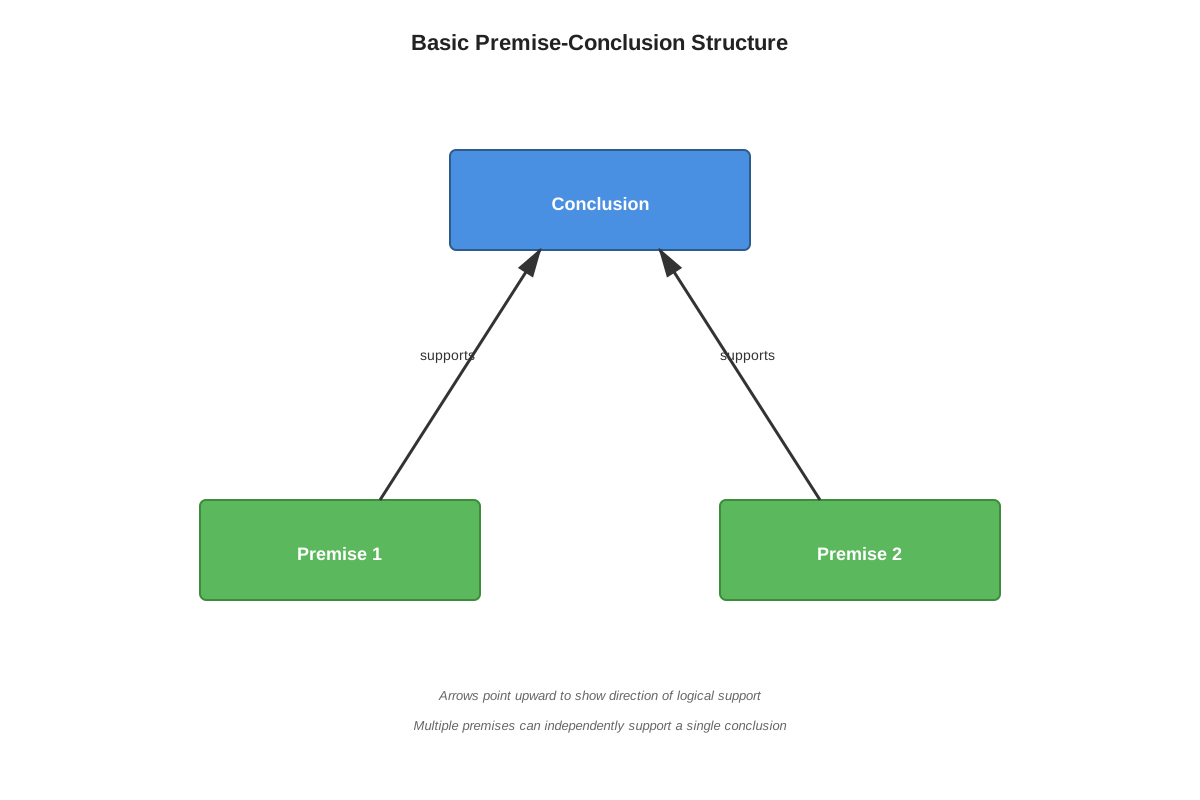
A premise is a statement offered as evidence or a reason to believe something else. It represents the support structure of an argument—the foundation upon which the argument rests. Premises can be facts, observations, expert testimony, statistical data, examples, or any other claim presented as a reason for accepting the conclusion. Crucially, premises are not necessarily true; they are simply presented as if they were true for the purpose of supporting the conclusion.
A conclusion is the statement that the argument is trying to establish or prove. It represents the destination of the argument—the claim that all the premises are working together to support. The conclusion is what the author wants the audience to believe after considering the evidence. In LSAT arguments, the conclusion is the answer to the question "What is this argument trying to convince me of?"
The relationship between premises and conclusions is one of logical support: premises provide reasons to accept the conclusion. This relationship is directional—premises support conclusions, not the other way around. Understanding this directionality is essential for mapping argument structure accurately.
Indicator Words and Phrases
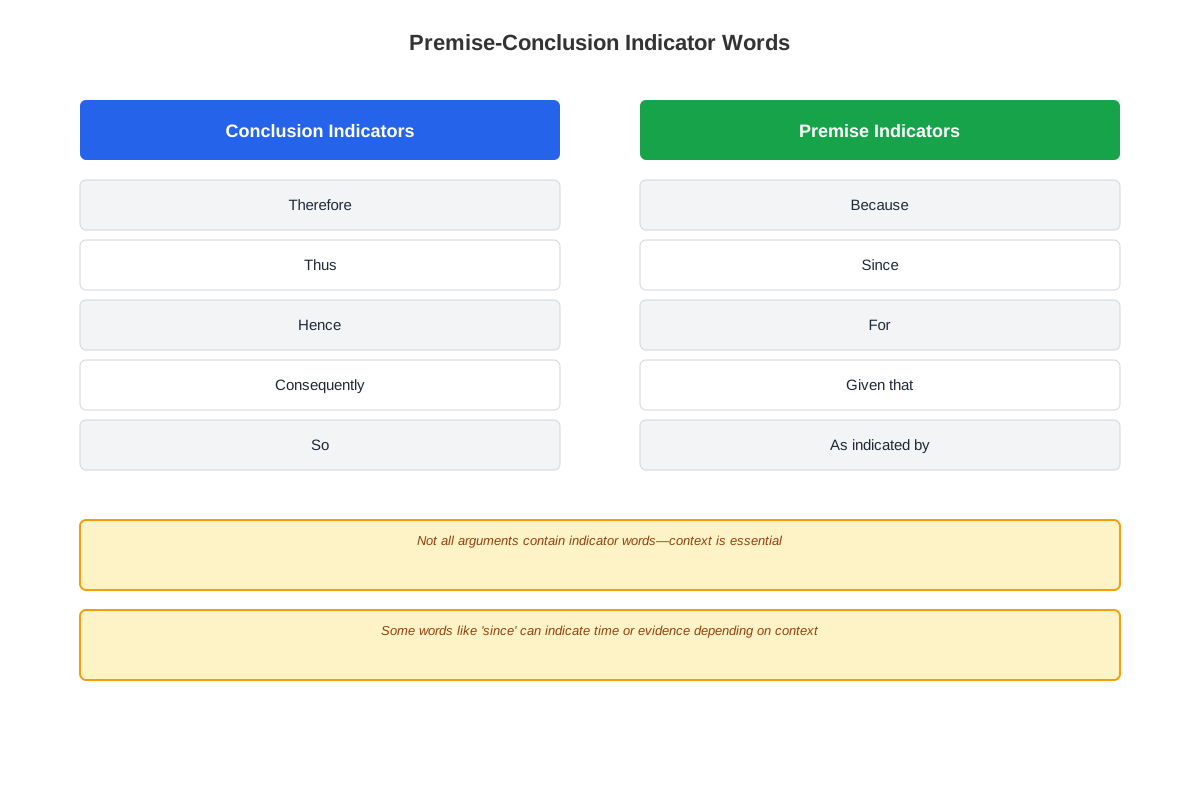
The LSAT frequently uses indicator words to signal premise-conclusion relationships. Recognizing these linguistic markers dramatically improves the speed and accuracy of argument analysis.
Conclusion indicators signal that what follows is the main point:
- Therefore
- Thus
- Hence
- Consequently
- So
- It follows that
- We can conclude that
- This shows that
- This demonstrates that
- This proves that
Premise indicators signal that what follows is evidence or support:
- Because
- Since
- For
- Given that
- As indicated by
- For the reason that
- In light of
- Seeing that
- Owing to
However, the LSAT deliberately includes arguments without indicator words to test deeper understanding. Students must be able to identify premise-conclusion relationships based on logical function rather than relying solely on linguistic cues.
Types of Support Relationships
Not all premise-conclusion relationships function identically. Understanding the different types of support helps in analyzing argument structure:
| Support Type | Description | Example Structure |
|---|---|---|
| Direct Support | Premises directly support the main conclusion without intermediate steps | Premise 1 + Premise 2 → Conclusion |
| Convergent Support | Multiple independent premises each provide separate support for the same conclusion | Premise 1 → Conclusion ← Premise 2 |
| Linked Support | Premises must work together to support the conclusion; neither works alone | (Premise 1 + Premise 2) → Conclusion |
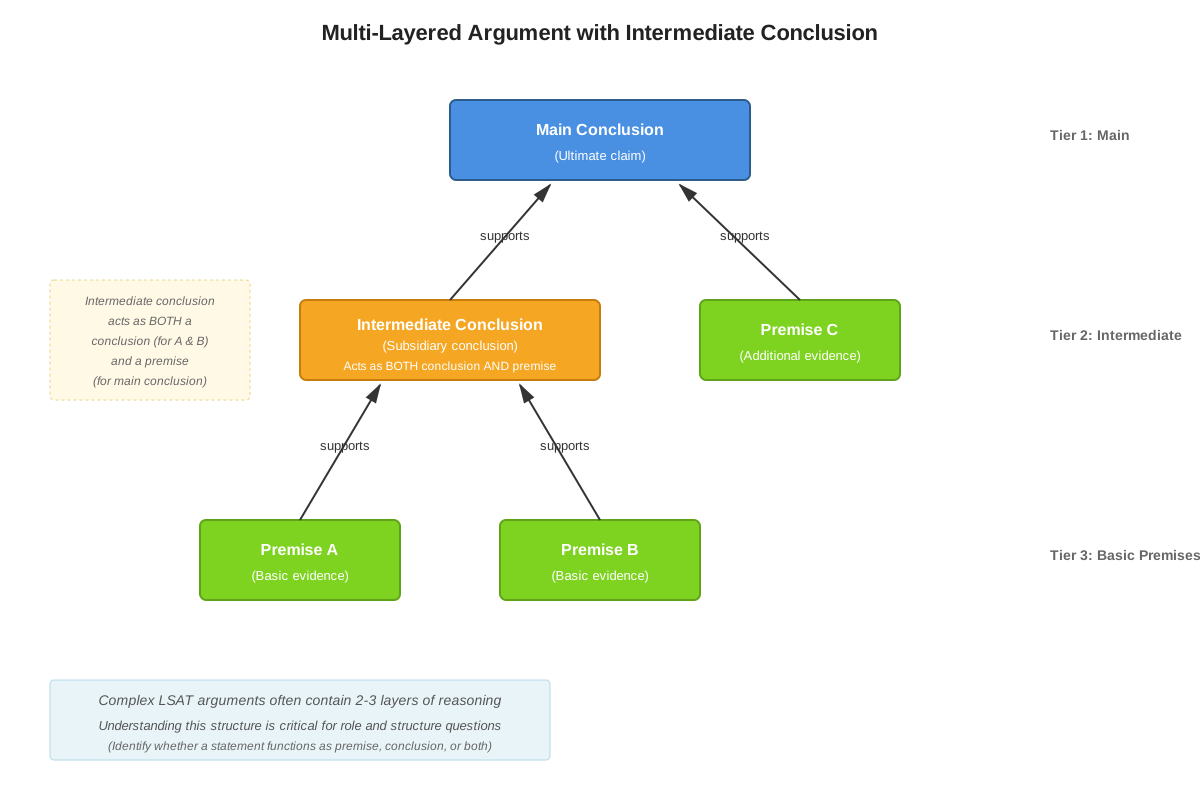
| Serial Support | Premises support intermediate conclusions, which then support the main conclusion | Premise → Sub-conclusion → Main Conclusion |
Serial support structures are particularly important for LSAT questions because they create complexity. A statement might function as both a conclusion (supported by earlier premises) and a premise (supporting a later conclusion). These intermediate or subsidiary conclusions are frequent subjects of role questions.
Identifying the Main Conclusion
Several strategies help identify the main conclusion when it is not explicitly marked:
- The "Why?" Test: Ask "why?" after each statement. If the argument provides an answer, that statement is likely the conclusion. Premises answer "why?" questions; conclusions prompt them.
- The "Therefore" Test: Try inserting "therefore" before different statements. The statement that makes the most sense following "therefore" is likely the conclusion.
- The Support Direction Test: Determine which statements support which others. The statement that is supported by others but does not itself support anything else is the main conclusion.
- The Author's Purpose Test: Ask what the author is trying to convince the reader to believe. This belief is the conclusion.
- The Removal Test: Consider removing each statement. The statement whose removal would eliminate the argument's purpose is likely the conclusion.
Context and Background Statements
Not every statement in an LSAT argument is either a premise or a conclusion. Some statements provide context, background information, or opposing viewpoints. These statements set the stage for the argument but do not directly support the conclusion.
For example: "Many people believe that X. However, this view is mistaken because Y." The first sentence provides context about a common belief but is neither a premise nor the conclusion. The second sentence contains both the conclusion ("this view is mistaken") and a premise indicator ("because") introducing support.
Distinguishing context from premises is crucial for role questions, which may ask about statements that describe opposing positions, provide background, or introduce the topic without contributing to the logical support structure.
Argument Mapping
Argument mapping is the process of visually representing premise-conclusion relationships. While students cannot draw on the LSAT, mentally mapping arguments dramatically improves comprehension.
A simple argument map uses arrows to show support:
- Premise 1
- Premise 2
- ↓
- Conclusion
A complex argument with serial support might map as:
- Premise A
- ↓
- Intermediate Conclusion B (also serves as premise)
- Premise C
- ↓
- Main Conclusion D
Creating mental maps forces students to actively analyze relationships rather than passively reading, leading to better retention and more accurate answers.
Role Question Mechanics
When the LSAT asks about the role a statement plays, it is testing whether students understand that statement's function within the premise-conclusion relationship. Common roles include:
- Main conclusion: The primary claim the argument establishes
- Intermediate conclusion: A claim supported by some premises and used to support the main conclusion
- Direct premise: Evidence offered in support of a conclusion
- Background information: Context that frames the argument without providing logical support
- Opposing position: A view the argument contradicts or refutes
- Concession: A point the author acknowledges before arguing for a different conclusion
- Illustration: An example that clarifies but does not prove the conclusion
- Hypothesis: A tentative explanation the argument evaluates
Understanding these distinct roles enables students to match argument components to answer choices accurately.
Concept Relationships
The concepts within premise-conclusion relationships form an interconnected system. Indicator words serve as signposts pointing to the functional relationships between premises and conclusions. These functional relationships can be categorized into support types (direct, convergent, linked, serial), which determine how the argument's logical structure should be mapped. Argument mapping makes visible the relationships that indicator words suggest and support types describe.
Context statements and background information relate to premises and conclusions by contrast—they are the elements that are NOT part of the logical support structure, making their identification crucial for avoiding confusion. Role identification synthesizes all these concepts by requiring students to categorize each statement according to its function within the overall structure.
The flow of mastery proceeds: Indicator words → Premise/conclusion identification → Support type recognition → Argument mapping → Role categorization. Each step builds on the previous one, creating a comprehensive understanding of argument architecture.
This topic connects to prerequisite knowledge of basic argument structure by adding precision and detail to the general understanding that arguments contain claims and support. It extends to related topics like assumption identification (which requires knowing what the premises are and what they're meant to support), strengthen/weaken questions (which require identifying the conclusion to know what to strengthen or weaken), and flaw identification (which requires understanding how premises fail to adequately support conclusions).
Quick check — test yourself on Premise conclusion relationship so far.
Try Flashcards →High-Yield Facts
⭐ The conclusion is not always at the end of an argument; it can appear at the beginning, middle, or end, and must be identified by function rather than position.
⭐ Indicator words are helpful but not always present; approximately 30-40% of LSAT arguments lack explicit conclusion indicators.
⭐ A statement can serve as both a conclusion and a premise in arguments with serial support structures; these intermediate conclusions are frequently tested in role questions.
⭐ The main conclusion is the statement that all other premises ultimately support; it is supported by other statements but does not itself support anything else.
⭐ Context and background statements are neither premises nor conclusions; they provide framing information without contributing to logical support.
- Premise indicators include "because," "since," "for," "given that," and "as indicated by."
- Conclusion indicators include "therefore," "thus," "hence," "consequently," and "so."
- Convergent support occurs when multiple independent premises each separately support the conclusion.
- Linked support occurs when premises must work together to support the conclusion; neither premise alone provides support.
- The "why?" test helps identify conclusions: if the argument answers "why?" about a statement, that statement is likely the conclusion.
- Role questions ask about the function of a statement within the argument's logical structure.
- Method questions ask how the argument proceeds from premises to conclusion.
- Structure questions ask about the overall organization of the argument's components.
- Opposing positions are often introduced before the author's actual conclusion to set up a contrast.
- Illustrations and examples typically support conclusions but are not themselves the main point being argued.
Common Misconceptions
Misconception: The conclusion is always the last sentence of an argument.
Correction: Conclusions can appear anywhere in an argument. The LSAT deliberately varies conclusion placement to test whether students identify conclusions by logical function rather than position. Approximately 40% of LSAT arguments place the conclusion in the first sentence, and many place it in the middle.
Misconception: Every sentence in an argument is either a premise or a conclusion.
Correction: Arguments often contain context statements, background information, opposing viewpoints, and other elements that are neither premises nor conclusions. These statements frame the argument or provide contrast but do not participate in the logical support relationship.
Misconception: Indicator words always reliably mark premises and conclusions.
Correction: While indicator words are helpful, they can be misleading. The word "since" usually indicates a premise, but in "since 1990" it indicates time. The phrase "it follows that" usually indicates a conclusion, but the argument's actual main conclusion might appear elsewhere. Students must verify logical function rather than relying solely on indicators.
Misconception: Premises are true statements and conclusions are opinions.
Correction: The premise-conclusion distinction is about logical function, not truth or objectivity. Premises are statements offered as support, regardless of whether they are actually true. Conclusions are statements being supported, regardless of whether they are factual claims or value judgments. An argument can have false premises and a true conclusion, or vice versa.
Misconception: A statement cannot be both a premise and a conclusion.
Correction: In arguments with serial or layered support, intermediate conclusions are supported by earlier premises and then serve as premises supporting the main conclusion. These dual-function statements are common in complex LSAT arguments and are frequently the subject of role questions.
Misconception: Longer arguments always have more premises.
Correction: Length does not determine the number of premises. A long argument might contain extensive background information, detailed examples, or elaborate phrasing of a single premise. Conversely, a short argument might contain multiple distinct premises. Students must identify logical components rather than counting sentences.
Misconception: The strongest-sounding statement is the conclusion.
Correction: Conclusions are not necessarily the most emphatic or confident-sounding statements. Sometimes premises are stated more forcefully than conclusions. The conclusion is determined by what the argument is trying to establish, not by the tone or certainty with which statements are expressed.
Worked Examples
Example 1: Identifying Roles in a Complex Argument
Argument: "Urban planners have long assumed that mixed-use development reduces automobile dependence. However, recent studies show that residents of mixed-use neighborhoods drive just as frequently as residents of single-use neighborhoods. This finding suggests that proximity to services is less important than previously thought. Therefore, urban planners should reconsider their emphasis on mixed-use development."
Question: The claim that residents of mixed-use neighborhoods drive just as frequently as residents of single-use neighborhoods plays which of the following roles in the argument?
Analysis:
Step 1: Identify the main conclusion using the "therefore" test. The statement "urban planners should reconsider their emphasis on mixed-use development" follows "therefore," marking it as the main conclusion.
Step 2: Identify premises that directly support the main conclusion. The statement "proximity to services is less important than previously thought" supports the main conclusion—if proximity matters less, then mixed-use development (which emphasizes proximity) deserves reconsideration.
Step 3: Determine what supports the intermediate conclusion. The statement "residents of mixed-use neighborhoods drive just as frequently as residents of single-use neighborhoods" is presented as evidence from "recent studies." This evidence supports the claim about proximity being less important.
Step 4: Map the argument structure:
- Background: "Urban planners have long assumed that mixed-use development reduces automobile dependence"
- Premise: "Recent studies show that residents of mixed-use neighborhoods drive just as frequently as residents of single-use neighborhoods"
- Intermediate Conclusion: "This finding suggests that proximity to services is less important than previously thought"
- Main Conclusion: "Therefore, urban planners should reconsider their emphasis on mixed-use development"
Step 5: Identify the role of the target statement. The claim about driving frequency is a premise that supports an intermediate conclusion, which in turn supports the main conclusion. It is evidence from studies, not itself a conclusion.
Answer: The statement serves as a premise supporting an intermediate conclusion that proximity to services is less important than previously thought, which in turn supports the main conclusion that urban planners should reconsider mixed-use development.
Connection to Learning Objectives: This example demonstrates how to identify premise-conclusion relationships in complex arguments with serial support structures, directly addressing the objective to distinguish between main conclusions, subsidiary conclusions, and premises.
Example 2: Method of Reasoning
Argument: "Every successful technology company has invested heavily in research and development. TechCorp has invested heavily in research and development. Therefore, TechCorp will be a successful technology company."
Question: The argument proceeds by:
Analysis:
Step 1: Identify the conclusion. "TechCorp will be a successful technology company" is the conclusion, marked by "therefore."
Step 2: Identify the premises.
- Premise 1: "Every successful technology company has invested heavily in research and development"
- Premise 2: "TechCorp has invested heavily in research and development"
Step 3: Analyze how the premises relate to the conclusion. The first premise establishes a characteristic of all successful tech companies (heavy R&D investment). The second premise states that TechCorp has this characteristic. The conclusion infers that TechCorp will be successful.
Step 4: Identify the reasoning pattern. This argument treats a necessary condition (R&D investment is necessary for success—all successful companies have it) as if it were a sufficient condition (having R&D investment is enough for success). This is a conditional reasoning error, but the question asks about method, not validity.
Step 5: Describe the method. The argument identifies a characteristic shared by all members of a category, notes that a particular entity has that characteristic, and concludes that the entity belongs to the category.
Answer: The argument proceeds by identifying a characteristic common to all members of a successful category and inferring that an entity with that characteristic will belong to that category.
Connection to Learning Objectives: This example shows how to explain the reasoning pattern behind premise-conclusion relationships, specifically how premises are structured to support (even if inadequately) a conclusion, addressing the objective to explain reasoning patterns.
Exam Strategy
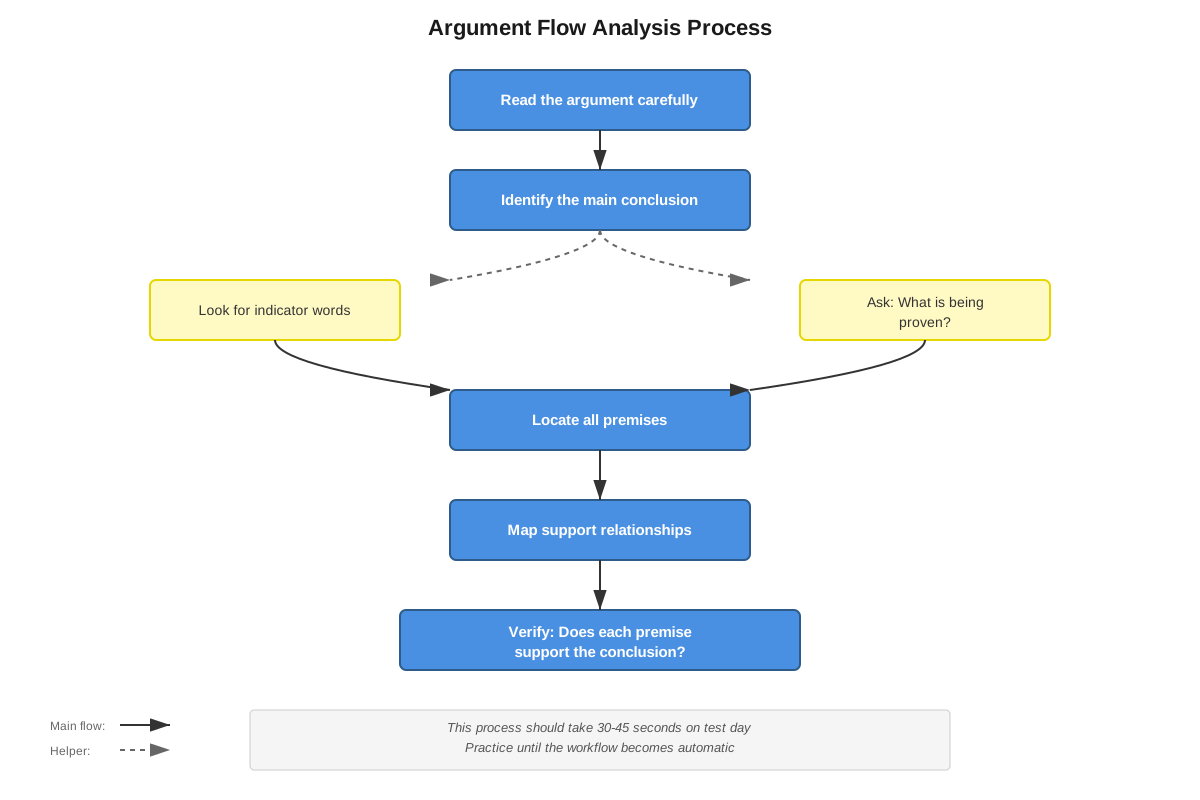
When approaching method, role, and structure questions on the LSAT, follow this systematic process:
Step 1: Identify the Question Type
Trigger phrases include:
- "The claim that X plays which of the following roles..."
- "The argument proceeds by..."
- "Which one of the following most accurately describes the technique of reasoning..."
- "The statement that X figures in the argument in which of the following ways..."
Step 2: Read for Structure, Not Content
Focus on how statements relate to each other rather than whether you agree with them. Ask: "What is this statement doing in the argument?" not "Is this statement true?"
Step 3: Locate the Main Conclusion First
Use indicator words, the "why?" test, and the "therefore" test. Circle or mentally mark the conclusion before analyzing other components. Approximately 60% of errors on these questions stem from misidentifying the conclusion.
Step 4: Map the Support Structure
Mentally trace arrows from premises to conclusions. Identify which statements support which others. Note any intermediate conclusions that serve dual functions.
Step 5: Categorize Each Statement
Label each component: main conclusion, intermediate conclusion, direct premise, background, opposing view, etc. For role questions, focus especially on the target statement mentioned in the question.
Step 6: Predict the Answer
Before looking at answer choices, articulate in your own words what role the statement plays or how the argument proceeds. This prevents answer choices from confusing your analysis.
Step 7: Eliminate Using Structural Mismatches
Wrong answers often:
- Confuse premises with conclusions
- Describe a statement as supporting something it doesn't actually support
- Claim a statement is the main conclusion when it's actually intermediate
- Describe reasoning patterns not present in the argument
Time Allocation: Spend 1:00-1:15 on these questions. They require careful analysis but should not consume excessive time. If stuck, eliminate answers that clearly misidentify the conclusion and guess from remaining choices.
Exam Tip: When answer choices describe roles, test each by substituting it into the sentence "This statement functions as [answer choice]." The correct answer will accurately complete this sentence.
Common Trap Patterns:
- Answer choices that describe what the argument should do rather than what it actually does
- Choices that accurately describe one part of the argument but not the specific statement asked about
- Choices using technical-sounding language that doesn't match the actual logical structure
Memory Techniques
PICS Mnemonic for Argument Components:
- Premises: Provide support
- Intermediate conclusions: In-between, both supported and supporting
- Conclusion: Claim being established
- Support: Flows from premises to conclusion
Indicator Word Acronym - "BEST" for conclusion indicators:
- Because of this (therefore)
- Evidently (thus)
- So
- This shows that
Indicator Word Acronym - "FABS" for premise indicators:
- For
- As indicated by
- Because
- Since
Visualization Strategy: Picture arguments as buildings. Premises are the foundation and supporting pillars. The conclusion is the roof. Intermediate conclusions are floors between the foundation and roof. Context statements are the surrounding landscape—visible but not part of the structure itself.
The Arrow Technique: When reading arguments, mentally draw arrows from supporting statements to supported statements. The statement with arrows pointing to it but no arrows pointing away is the main conclusion.
Role Question Mantra: "What does this statement DO, not what does it SAY." This reminds students to focus on function rather than content.
Summary
The premise conclusion relationship represents the fundamental architecture of logical reasoning on the LSAT. Premises are statements offered as support; conclusions are statements being supported. This relationship is directional and functional, not positional or content-based. Indicator words like "because" (premise) and "therefore" (conclusion) often signal these relationships, but students must be able to identify them through logical analysis when indicators are absent. Arguments can have simple structures with premises directly supporting conclusions, or complex structures with intermediate conclusions that are both supported by earlier premises and support later conclusions. Method, role, and structure questions explicitly test the ability to identify and articulate these relationships, asking what function a statement serves or how an argument proceeds from evidence to conclusion. Success requires distinguishing between main conclusions, subsidiary conclusions, premises, and non-argumentative elements like background information and opposing viewpoints. The key to mastery is analyzing arguments structurally—mapping the flow of support from premises through any intermediate conclusions to the main conclusion—rather than focusing solely on content. This skill underlies virtually every Logical Reasoning question type, making it one of the highest-yield areas for LSAT preparation.
Key Takeaways
- Premises provide support; conclusions receive support; this directional relationship defines argument structure
- The main conclusion is identified by function (what all premises ultimately support) not position (where it appears in the text)
- Indicator words are helpful but not always present; develop the ability to identify relationships through logical analysis
- Intermediate conclusions serve dual functions: they are supported by some premises and support the main conclusion
- Context, background, and opposing viewpoints are neither premises nor conclusions; they frame arguments without providing logical support
- Method, role, and structure questions test whether you understand what statements do within arguments, not whether you agree with them
- Always identify the main conclusion first before analyzing other components; most errors stem from misidentifying what the argument is trying to prove
Related Topics
Assumption Questions: Once premise-conclusion relationships are identified, assumption questions ask what unstated premises are necessary for the stated premises to support the conclusion. Mastering premise-conclusion relationships is prerequisite to finding assumptions.
Strengthen and Weaken Questions: These questions require identifying the conclusion (what to strengthen or weaken) and understanding how premises support it (what kind of additional evidence would help or hurt that support). The premise-conclusion relationship determines what information is relevant.
Flaw Questions: Identifying logical flaws requires understanding how premises are supposed to support conclusions and recognizing when that support is inadequate. The premise-conclusion relationship provides the framework for evaluating argument quality.
Parallel Reasoning Questions: These questions ask students to identify arguments with the same logical structure. Matching structures requires mapping premise-conclusion relationships in both the original argument and answer choices.
Argument Completion Questions: These questions present premises and ask what conclusion follows. Success requires understanding how different types of premises support different types of conclusions.
Practice CTA
Now that you understand how premises and conclusions relate to form argument structures, it's time to apply this knowledge. Work through the practice questions to test your ability to identify roles, describe methods, and analyze structures. Each practice problem reinforces the skills covered in this guide, building the automaticity needed for test-day success. The flashcards will help cement key concepts like indicator words and support types. Remember: premise-conclusion relationships are not just tested directly in method, role, and structure questions—they underlie every single Logical Reasoning question on the LSAT. Mastering this topic now will pay dividends across the entire section. You've built the foundation; now practice building arguments on it!
Sign up free to keep reading
Create a free AnvayaPrep account to finish this LSAT guide on Premise conclusion relationship — plus flashcards and practice questions.