Overview
The problem solution structure is one of the most frequently tested argument patterns in LSAT Logical Reasoning sections. This structure appears when an author identifies a problem, challenge, or undesirable situation and then proposes one or more solutions to address it. Understanding this pattern is crucial because it forms the backbone of numerous question types, particularly method, role, and structure questions, where test-takers must identify how different parts of an argument function together.
On the LSAT, recognizing the problem solution structure allows students to quickly map the logical architecture of complex passages. When an argument follows this pattern, the problem typically appears first (though not always), establishing what needs to be fixed or addressed. The solution follows, presenting a course of action, policy recommendation, or strategy designed to resolve the identified issue. Between these two components, authors may include evidence about why the problem exists, consequences of inaction, or reasons why the proposed solution will be effective. Mastering this structure enables test-takers to anticipate how questions will target different components of the argument and to identify which statements play which roles.
This topic connects directly to broader LSAT problem solution structure analysis skills that appear across multiple question types. Beyond method and structure questions, problem solution arguments frequently appear in strengthen/weaken questions, assumption questions, and flaw questions. The ability to dissect these arguments into their constituent parts—identifying the problem statement, the proposed solution, and any supporting or connecting reasoning—provides a systematic approach to tackling some of the most challenging questions on the exam. This structural awareness also helps students avoid common traps where answer choices mischaracterize the role of specific statements or confuse problems with solutions.
Learning Objectives
- [ ] Identify how Problem solution structure appears in LSAT questions
- [ ] Explain the reasoning pattern behind Problem solution structure
- [ ] Apply Problem solution structure to solve LSAT-style problems accurately
- [ ] Distinguish between problem statements and solution proposals in complex arguments
- [ ] Recognize variations of problem solution structure, including multiple solutions or nested problems
- [ ] Evaluate answer choices that describe the functional role of problem and solution components
- [ ] Predict common question types that target problem solution structures
Prerequisites
- Basic argument structure: Understanding premises and conclusions is essential because problem solution arguments are a specialized type of argument where the conclusion typically advocates for the solution.
- Argument mapping skills: The ability to identify different components of an argument helps students separate problem descriptions from solution proposals and supporting evidence.
- Familiarity with method questions: Since problem solution structure most commonly appears in method and structure questions, students should understand what these question types ask.
- Reading comprehension fundamentals: Identifying problem solution structures requires careful reading to distinguish descriptive statements about problems from prescriptive statements about solutions.
Why This Topic Matters
Problem solution structure represents one of the most practical and universally applicable reasoning patterns tested on the LSAT. In real-world contexts, this pattern dominates policy debates, business proposals, medical treatment plans, legal arguments, and everyday decision-making. Attorneys regularly encounter this structure when analyzing case strategies, proposing settlements, or arguing for specific remedies. The ability to identify problems accurately and evaluate proposed solutions critically is fundamental to legal reasoning.
On the LSAT, problem solution structures appear in approximately 15-20% of Logical Reasoning questions across all question types. They are particularly prevalent in method of reasoning questions (appearing in roughly 30-40% of such questions) and structure questions. The LSAT tests this pattern because it requires multiple analytical skills simultaneously: identifying the function of different statements, understanding causal reasoning (since solutions must address causes or effects of problems), and recognizing prescriptive versus descriptive claims.
Common manifestations include: passages where an author describes a societal issue and recommends policy changes; arguments presenting a business challenge and proposing a strategic response; discussions of scientific problems with proposed research directions; and debates about institutional failures with suggested reforms. The LSAT frequently tests whether students can distinguish the problem from its causes, separate the solution from evidence supporting it, and identify which statements serve which functions within the overall argument structure.
Core Concepts
Defining Problem Solution Structure
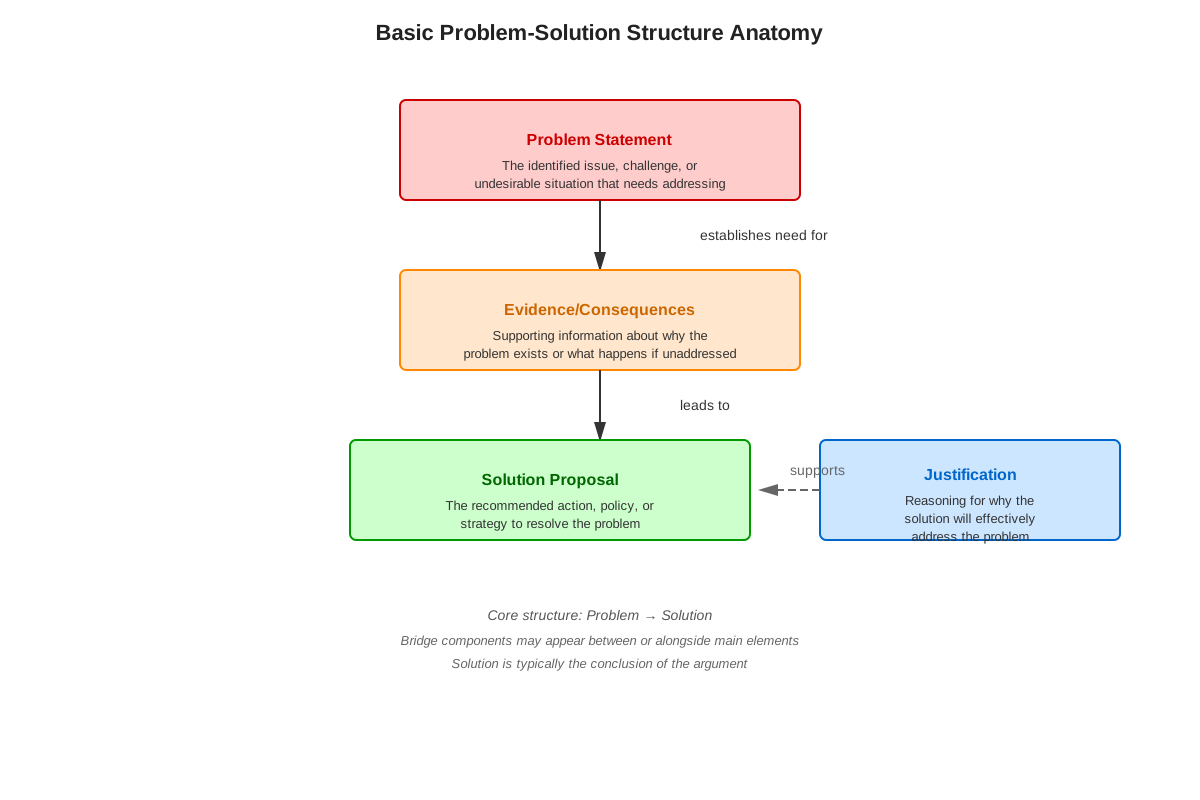
Problem solution structure is an argument pattern in which an author first identifies an undesirable situation, challenge, obstacle, or negative condition (the problem), and then proposes one or more courses of action, policies, strategies, or interventions designed to address, resolve, or mitigate that problem (the solution). This structure is fundamentally prescriptive—it moves from describing what is wrong to recommending what should be done.
The problem component typically includes:
- A description of the undesirable current state
- Evidence demonstrating the problem's existence or severity
- Explanation of causes or contributing factors
- Consequences of leaving the problem unaddressed
The solution component typically includes:
- A specific proposal or recommendation
- A mechanism explaining how the solution addresses the problem
- Evidence or reasoning supporting the solution's effectiveness
- Sometimes, acknowledgment of potential objections or limitations
Structural Variations
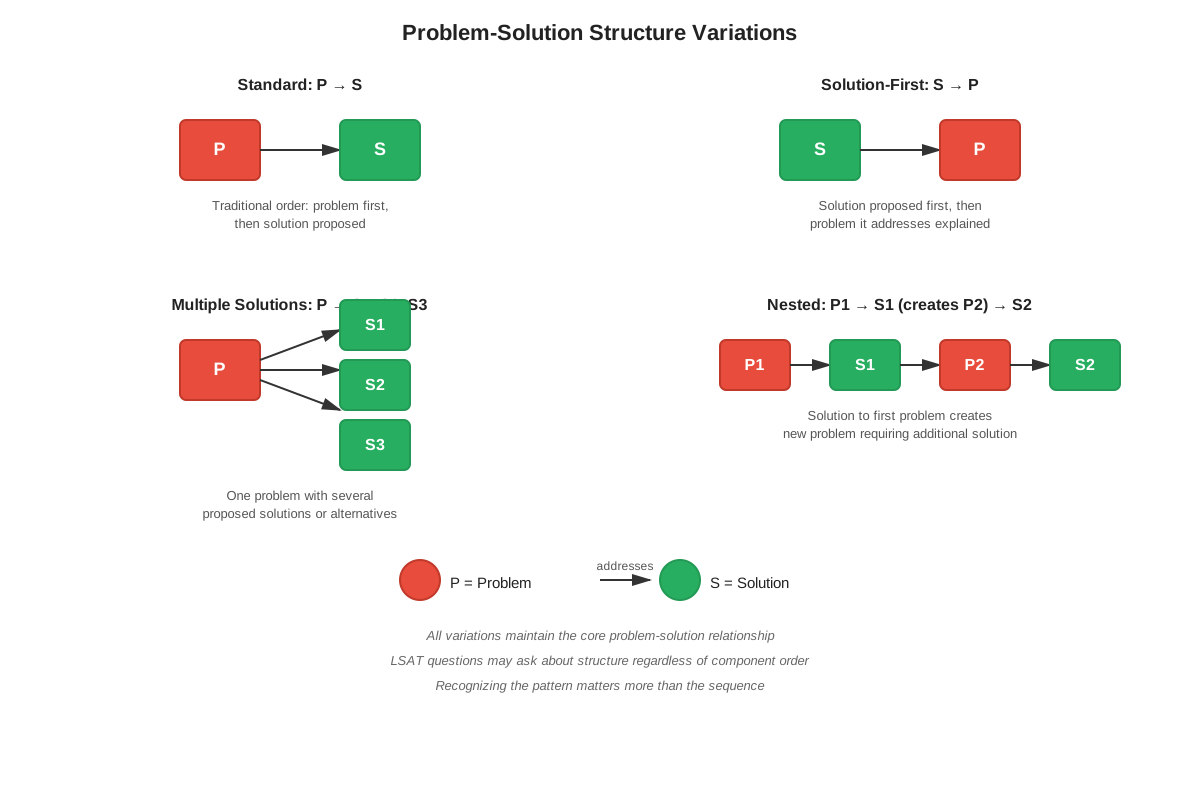
Problem solution arguments do not always follow a simple linear pattern. Understanding common variations is essential for LSAT success:
Standard Linear Structure: Problem → Solution
Example: "Traffic congestion has increased commute times by 40%. The city should expand public transportation."
Solution-First Structure: Solution → Problem it addresses
Example: "We should implement remote work policies. This would reduce the severe traffic congestion that has increased commute times by 40%."
Multiple Solutions Structure: Problem → Solution A → Solution B
Example: "Traffic congestion has worsened. We could expand public transit or implement congestion pricing."
Nested Problems Structure: Problem A → Solution A (which creates) → Problem B → Solution B
Example: "Traffic is terrible. We expanded highways, but this induced more driving. Now we must invest in rail."
Problem-Cause-Solution Structure: Problem → Cause Analysis → Solution targeting cause
Example: "Traffic has worsened. This stems from inadequate public transit. We should expand bus routes."
Identifying Problem Statements
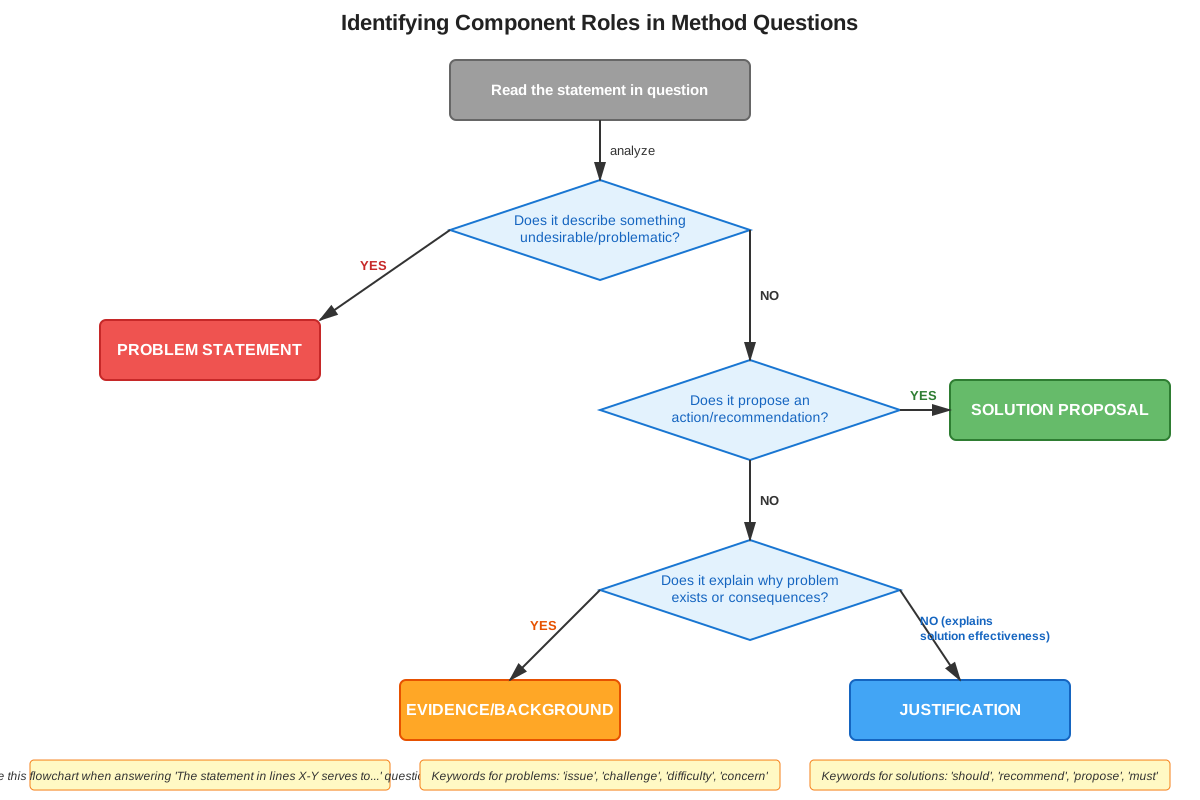
Problem statements on the LSAT often contain specific linguistic markers:
| Marker Type | Examples | Function |
|---|---|---|
| Negative evaluations | "unfortunately," "problematic," "concerning" | Signal undesirability |
| Deficit language | "lack of," "insufficient," "inadequate" | Indicate what's missing |
| Negative trends | "declining," "worsening," "deteriorating" | Show negative direction |
| Consequence indicators | "resulting in," "leading to," "causing" | Connect problem to effects |
| Contrast markers | "however," "but," "yet" | Highlight gap between ideal and actual |
The problem need not be explicitly labeled as such. Sometimes the problem is implied through description of negative consequences or unmet needs. Test-takers must recognize that any description of an undesirable state that the author wants to change constitutes the problem component.
Identifying Solution Statements
Solution statements typically exhibit prescriptive language indicating what should be done:
Modal verbs of obligation or recommendation:
- "should," "must," "ought to"
- "needs to," "has to," "is necessary"
- "would be advisable," "it is imperative"
Explicit recommendation language:
- "I recommend," "I propose," "I suggest"
- "The best approach is," "The solution is"
- "We should adopt," "It is essential to implement"
Conditional constructions suggesting courses of action:
- "If we want to solve X, we must do Y"
- "To address this problem, we should..."
- "The way to fix this is..."
Solutions are prescriptive claims about future action, distinguishing them from descriptive claims about current or past states. This distinction is crucial for structure questions that ask about the role of specific statements.
The Logical Connection Between Problem and Solution
The strength of a problem solution argument depends on the logical connection between the identified problem and the proposed solution. The LSAT frequently tests whether students recognize that:
- The solution must address the actual problem: A solution targeting symptom X doesn't address problem Y
- The solution must be feasible: Practical constraints matter
- The solution must be sufficient: It should actually resolve or significantly mitigate the problem
- The solution may require assumptions: Unstated premises often connect problem to solution
For example, if the problem is "decreased voter turnout" and the solution is "implement online voting," the argument assumes that inconvenience (not apathy or other factors) causes low turnout, and that online voting would be secure and accessible.
Supporting Elements in Problem Solution Arguments
Beyond the core problem and solution, these arguments often include:
Evidence for the problem's existence:
- Statistics demonstrating severity
- Expert testimony confirming the issue
- Historical comparisons showing decline
Causal analysis:
- Explanation of what causes the problem
- Identification of contributing factors
- Analysis of why previous solutions failed
Evidence for the solution's effectiveness:
- Precedents where similar solutions worked
- Expert recommendations
- Logical explanation of mechanism
- Pilot program results
Acknowledgment of objections:
- Potential costs or drawbacks
- Alternative solutions considered and rejected
- Limitations of the proposed solution
Understanding these supporting elements helps students identify the role of specific statements in method and structure questions.
Common Question Types Targeting This Structure
Method of Reasoning Questions: "The argument proceeds by..."
- Correct answers often describe identifying a problem and proposing a solution
- May describe the relationship between problem description and solution proposal
Role Questions: "The claim that X plays which role..."
- Test whether students can identify if a statement describes the problem, proposes the solution, or provides supporting evidence
Structure Questions: "Which one of the following most accurately describes the organization of the argument?"
- Require mapping the entire problem solution structure
- Often include distractors that reverse the order or mischaracterize components
Main Point Questions: In problem solution arguments, the main point is typically the solution proposal, not the problem description
Assumption Questions: Often target the gap between problem and solution, asking what must be true for the solution to address the problem
Concept Relationships
The problem solution structure connects to multiple aspects of LSAT Logical Reasoning. At its foundation, this structure represents a specialized type of argument structure where the conclusion is prescriptive (advocating action) rather than descriptive (making a factual claim). This prescriptive nature links problem solution arguments to normative reasoning—arguments about what should be done rather than what is.
The relationship flows as follows: Argument Structure → Problem Solution Structure → Method/Role/Structure Questions. Understanding general argument structure (premises supporting conclusions) enables recognition of problem solution patterns, which in turn allows accurate answering of questions about how arguments proceed or what role statements play.
Problem solution structure also connects intimately with causal reasoning. Problems often involve undesirable effects, and solutions propose interventions to address causes. This creates the relationship: Problem (Effect) → Causal Analysis → Solution (Intervention on Cause). Many strengthen/weaken questions targeting problem solution arguments actually test causal reasoning—whether the solution will produce the intended effect.
Additionally, problem solution arguments frequently involve assumption identification. The gap between problem and solution requires bridging assumptions: Problem Statement → Unstated Assumptions → Solution Proposal. These assumptions might concern feasibility, effectiveness, or whether the solution actually addresses the problem's root cause.
Finally, problem solution structure relates to evaluation questions and flaw questions. Common flaws include proposing solutions that don't address the actual problem, ignoring alternative solutions, or failing to consider negative consequences. This creates: Problem Solution Structure → Potential Logical Flaws → Evaluation/Flaw Questions.
High-Yield Facts
⭐ Problem solution structure consists of two core components: an identification of an undesirable situation (problem) and a proposal for addressing it (solution).
⭐ The solution component is typically the conclusion of a problem solution argument, making it the main point the author wants to establish.
⭐ Problem statements are descriptive (describing what is), while solution statements are prescriptive (recommending what should be).
⭐ Method questions about problem solution arguments often have correct answers stating the argument "identifies a problem and proposes a solution to address it."
⭐ The order can vary: problems don't always come before solutions in the passage, though they logically precede solutions in the reasoning structure.
- Problem solution arguments require assumptions connecting the problem to the solution's effectiveness.
- Supporting evidence in these arguments may describe the problem's severity, explain its causes, or demonstrate the solution's feasibility.
- Multiple solutions may be proposed, with the author sometimes comparing their relative merits.
- Nested problem solution structures occur when a proposed solution creates a new problem requiring another solution.
- Causal reasoning often underlies problem solution arguments, as solutions typically intervene on causes of problems.
- The strength of these arguments depends on whether the solution actually addresses the identified problem's root cause.
- Common flaws include proposing solutions that address symptoms rather than causes, or that create worse problems than they solve.
- Structure questions may ask students to identify which paragraph or sentence presents the problem versus the solution.
Quick check — test yourself on Problem solution structure so far.
Try Flashcards →Common Misconceptions
Misconception: The problem always appears before the solution in the passage text.
Correction: While problems often appear first, authors sometimes present solutions first and then explain what problem they address. The logical structure (problem → solution) differs from textual order. Students must identify functional roles, not just sequential position.
Misconception: Any negative statement in an argument represents the problem component.
Correction: Not all negative statements describe the problem the author wants to solve. Some negative statements might describe consequences of the problem, objections to solutions, or limitations of proposals. The problem is specifically the undesirable situation the author's solution aims to address.
Misconception: Evidence supporting the solution's effectiveness is itself part of the solution.
Correction: The solution is the proposed course of action, while evidence for its effectiveness is supporting material. For example, "We should implement policy X" is the solution, while "Policy X worked in other cities" is evidence supporting that solution, not part of the solution itself.
Misconception: Problem solution arguments always propose only one solution.
Correction: Arguments may present multiple solutions, compare alternative approaches, or propose a multi-part solution with several components. Students must recognize all solution elements and understand how they relate to each other.
Misconception: The main point of a problem solution argument is identifying the problem.
Correction: The main point is typically the solution proposal—what the author wants the audience to do or accept. The problem description provides context and motivation, but the conclusion is prescriptive, advocating for the solution.
Misconception: If an argument mentions a problem and a solution, it must be a problem solution structure.
Correction: Some arguments mention problems and solutions without having a problem solution structure. For example, an argument might describe how a past solution failed (using problem solution as evidence) while making a different point. The structure requires that proposing the solution be the argument's primary purpose.
Worked Examples
Example 1: Standard Method Question
Passage: "Urban noise pollution has reached levels that significantly impair residents' quality of life, causing sleep disruption and increased stress. Studies show that 65% of city dwellers report being bothered by traffic noise. To address this serious problem, the city council should implement strict noise ordinances limiting vehicle noise levels and establish quiet zones in residential areas. Similar policies in European cities have successfully reduced noise complaints by 40%."
Question: The argument proceeds by which of the following methods?
Answer Choices:
(A) Presenting a hypothesis and describing an experiment that would test it
(B) Identifying a problem and proposing a solution supported by evidence
(C) Describing a general principle and applying it to a specific case
(D) Challenging an opposing view by presenting counterevidence
(E) Drawing an analogy between two similar situations
Analysis:
Step 1: Identify the problem component
The problem is clearly stated in the first two sentences: "Urban noise pollution has reached levels that significantly impair residents' quality of life, causing sleep disruption and increased stress." The statistic about 65% of city dwellers being bothered provides evidence for the problem's existence and severity.
Step 2: Identify the solution component
The solution appears in the third sentence: "the city council should implement strict noise ordinances limiting vehicle noise levels and establish quiet zones in residential areas." The prescriptive language ("should implement") signals this is the proposed solution.
Step 3: Identify supporting elements
The final sentence provides evidence supporting the solution's likely effectiveness: "Similar policies in European cities have successfully reduced noise complaints by 40%." This is precedent-based evidence.
Step 4: Map the overall structure
Problem (noise pollution impairs quality of life) → Evidence for problem (statistics) → Solution (implement noise ordinances) → Evidence for solution (European precedent)
Step 5: Evaluate answer choices
(A) Incorrect - No hypothesis or experiment is mentioned
(B) CORRECT - This precisely describes the structure: identifying a problem (noise pollution) and proposing a solution (noise ordinances) supported by evidence (European precedent)
(C) Incorrect - No general principle is stated or applied
(D) Incorrect - No opposing view is challenged
(E) Incorrect - While European cities are mentioned, the argument doesn't proceed by analogy; it uses precedent as evidence
Key Takeaway: This exemplifies the standard problem solution structure. The correct answer directly names both components and notes the supporting evidence, which is typical of method questions targeting this pattern.
Example 2: Role Question with Complex Structure
Passage: "The proposed highway expansion would reduce commute times by an average of 15 minutes. However, traffic engineers have documented that highway expansions consistently lead to increased driving within three years, a phenomenon called induced demand. This increased driving ultimately returns congestion to previous levels while generating more air pollution. Therefore, rather than expanding highways, the city should invest in rail infrastructure, which does not suffer from induced demand and provides environmental benefits."
Question: The statement that highway expansions consistently lead to increased driving plays which one of the following roles in the argument?
Answer Choices:
(A) It is the main conclusion of the argument
(B) It describes a problem that the argument's proposed solution is designed to address
(C) It provides evidence that a proposed solution would be ineffective
(D) It presents an alternative solution to the problem described
(E) It acknowledges a potential objection to the argument's conclusion
Analysis:
Step 1: Identify the argument's conclusion
The conclusion is signaled by "Therefore": "the city should invest in rail infrastructure." This is the solution being advocated.
Step 2: Identify what problem this solution addresses
The problem isn't simply traffic congestion—it's that highway expansion (an alternative solution) doesn't actually solve congestion due to induced demand and creates additional problems (air pollution).
Step 3: Analyze the target statement's function
"Highway expansions consistently lead to increased driving" explains why highway expansion (mentioned in the first sentence as a potential solution) would be ineffective. This is evidence against an alternative solution, supporting the author's preferred solution (rail infrastructure).
Step 4: Understand the nested structure
This argument has a complex structure:
- Implicit problem: Traffic congestion
- Rejected solution: Highway expansion (mentioned first)
- Evidence against rejected solution: Induced demand phenomenon
- Preferred solution: Rail infrastructure
Step 5: Evaluate answer choices
(A) Incorrect - The conclusion is about investing in rail, not about induced demand
(B) Incorrect - Induced demand itself isn't the problem to be solved; it's evidence that highway expansion won't solve the congestion problem
(C) CORRECT - The statement provides evidence that highway expansion (a proposed solution) would be ineffective, thereby supporting the alternative solution (rail)
(D) Incorrect - This describes a problem with a solution, not an alternative solution
(E) Incorrect - This isn't acknowledging an objection; it's providing evidence against an alternative
Key Takeaway: In complex problem solution arguments, statements may serve to reject alternative solutions rather than directly support the preferred solution. Understanding this function requires recognizing the nested structure where one potential solution is evaluated and rejected before the preferred solution is proposed.
Exam Strategy
Approaching Problem Solution Questions
Step 1: Quickly scan for prescriptive language
Before reading carefully, scan for "should," "must," "ought to," "recommend," or "propose." These signal solution components and help you anticipate the structure.
Step 2: Identify the conclusion first
In problem solution arguments, the conclusion is typically the solution proposal. Finding this first provides an anchor for understanding the rest of the argument.
Step 3: Work backward to find the problem
Once you've identified the solution, ask: "What problem does this solve?" The problem description should logically connect to what the solution addresses.
Step 4: Map supporting elements
Identify which statements provide evidence for the problem's existence, explain its causes, or support the solution's effectiveness. Don't confuse these with the core problem or solution components.
Trigger Words and Phrases
Problem indicators:
- "Unfortunately," "problematic," "concerning," "troubling"
- "Lack of," "insufficient," "inadequate," "shortage"
- "Declining," "worsening," "deteriorating," "failing"
- "Challenge," "obstacle," "difficulty," "issue"
Solution indicators:
- "Should," "must," "ought to," "need to"
- "Recommend," "propose," "suggest," "advocate"
- "Solution," "remedy," "fix," "address"
- "To solve this," "the way to address," "in order to fix"
Evidence indicators:
- "Studies show," "research indicates," "evidence suggests"
- "For example," "in fact," "specifically"
- "Similar cases," "precedent," "has been successful"
Process of Elimination Tips
For Method Questions:
- Eliminate answers describing structures not present (e.g., "presents an analogy" when no analogy exists)
- Eliminate answers that reverse the order of reasoning
- Eliminate answers that describe only one component (problem OR solution) when both are present
- Keep answers that accurately name both problem and solution components
For Role Questions:
- Eliminate answers that confuse problem with solution or vice versa
- Eliminate answers that confuse evidence with the claim it supports
- Eliminate answers describing functions not present in the argument
- Keep answers that accurately describe the statement's function in supporting the conclusion
For Structure Questions:
- Eliminate answers that misorder the components
- Eliminate answers that omit major components
- Eliminate answers that add components not present
- Keep answers that accurately map all major elements in their functional (not necessarily textual) order
Time Allocation
Problem solution structure questions typically require 1:15-1:30 minutes:
- 30-40 seconds: Initial read and structure identification
- 20-30 seconds: Analyzing the specific question and target statement
- 25-30 seconds: Evaluating answer choices
If you can quickly identify the problem and solution components, you can move faster. If the structure is nested or complex, allocate extra time for mapping relationships.
Exam Tip: When you identify a problem solution structure, immediately note "P:" and "S:" in the margin next to the relevant sentences. This physical marking helps you quickly reference components when answering questions and prevents confusion about which statement serves which function.
Memory Techniques
The PS-MAP Acronym
Problem: What's wrong?
Solution: What should be done?
Mechanism: How does the solution address the problem?
Assumptions: What must be true for this to work?
Precedent/Proof: What evidence supports effectiveness?
Use PS-MAP to systematically analyze any problem solution argument, ensuring you identify all key components.
The "Doctor's Visit" Analogy
Think of problem solution arguments like a doctor's visit:
- Symptoms = Problem description
- Diagnosis = Causal analysis (why the problem exists)
- Prescription = Solution proposal
- Prognosis = Evidence the solution will work
- Side effects = Potential drawbacks or limitations
This analogy helps you remember that solutions should address causes (diagnosis), not just symptoms, and that good arguments consider both effectiveness and potential negative consequences.
Visual Structure Mapping
When reading, mentally visualize or quickly sketch:
[PROBLEM] → [SOLUTION]
    ↑            ↑
Evidence    Evidence
This simple visual reminds you that both problem and solution typically have supporting evidence, and that the solution should logically flow from the problem.
The "Should Test"
To distinguish problems from solutions, apply the "should test":
- Can you put "should" or "must" before it? → Likely a solution
- Does it describe what IS (not what should be)? → Likely a problem or evidence
This quick test helps you categorize statements when the structure isn't immediately obvious.
Summary
Problem solution structure represents a fundamental reasoning pattern on the LSAT where arguments identify an undesirable situation and propose a course of action to address it. This structure appears most frequently in method, role, and structure questions, but understanding it benefits performance across all Logical Reasoning question types. The core components are the problem (descriptive, identifying what's wrong) and the solution (prescriptive, recommending what should be done), though arguments often include supporting evidence for both components, causal analysis, and acknowledgment of limitations. Successful identification requires recognizing prescriptive language marking solutions, understanding that textual order may differ from logical structure, and distinguishing core components from supporting evidence. The LSAT tests this pattern because it requires multiple analytical skills: identifying statement functions, understanding causal relationships, recognizing assumptions bridging problems to solutions, and evaluating whether proposed solutions actually address identified problems. Mastery involves quickly mapping argument structure, accurately categorizing each statement's role, and applying this understanding to eliminate incorrect answer choices that mischaracterize components or their relationships.
Key Takeaways
- Problem solution structure consists of identifying an undesirable situation (problem) and proposing action to address it (solution), with the solution typically serving as the argument's conclusion
- Problems are descriptive statements about what is wrong; solutions are prescriptive statements about what should be done
- Textual order may differ from logical structure—solutions sometimes appear before problems in the passage
- Method questions targeting this structure typically have correct answers stating the argument "identifies a problem and proposes a solution"
- Role questions test whether students can distinguish problem descriptions from solution proposals and both from supporting evidence
- Strong problem solution arguments require logical connections between problem and solution, often involving unstated assumptions about feasibility and effectiveness
- Common variations include multiple solutions, nested problems, and solution-first presentations that require careful analysis to map correctly
Related Topics
Causal Reasoning: Problem solution arguments frequently involve causal analysis, as problems often describe undesirable effects and solutions propose interventions on causes. Mastering causal reasoning enhances ability to evaluate whether solutions will actually address problems.
Assumption Questions: The gap between problem and solution typically requires bridging assumptions about feasibility, effectiveness, or whether the solution addresses root causes. Understanding problem solution structure provides a framework for identifying these assumptions.
Strengthen/Weaken Questions: Many strengthen and weaken questions target problem solution arguments, asking for evidence that the solution will or won't work. Recognizing the structure helps identify what would strengthen or weaken the connection between problem and solution.
Flaw Questions: Common flaws in problem solution arguments include addressing symptoms rather than causes, ignoring alternative solutions, or proposing solutions that create worse problems. Understanding the structure enables recognition of these specific flaws.
Main Point Questions: In problem solution arguments, the main point is typically the solution proposal, not the problem description. This structural understanding helps students avoid selecting problem descriptions as main points.
Practice CTA
Now that you understand problem solution structure, you're ready to apply this knowledge to actual LSAT questions. The practice questions and flashcards will reinforce your ability to quickly identify this pattern, distinguish problems from solutions, and accurately answer method, role, and structure questions. Remember that recognizing this structure becomes faster with practice—each question you analyze strengthens your pattern recognition skills. Approach the practice materials systematically, using the PS-MAP framework and the strategies outlined above. Your investment in mastering this high-yield topic will pay dividends across multiple question types on test day. You've got this!
Sign up free to keep reading
Create a free AnvayaPrep account to finish this LSAT guide on Problem solution structure — plus flashcards and practice questions.