Overview
Role of a premise questions represent a critical category within LSAT Logical Reasoning sections, falling under the broader umbrella of method, role, and structure questions. These questions ask test-takers to identify the specific function that a particular statement plays within an argument's logical framework. Unlike questions that ask you to evaluate whether an argument is strong or weak, role questions focus purely on understanding the architecture of reasoning—how different components work together to build a conclusion.
Mastering LSAT role of a premise questions is essential because they appear with consistent frequency on every LSAT administration, typically comprising 2-4 questions per test. These questions assess your ability to deconstruct arguments into their constituent parts and recognize how each element contributes to the overall reasoning structure. This skill is fundamental not only for role questions themselves but also for virtually every other Logical Reasoning question type, as understanding argument structure underlies the ability to identify assumptions, strengthen or weaken arguments, and evaluate logical flaws.
The relationship between role of a premise questions and other Logical Reasoning concepts is foundational. Before you can identify what's wrong with an argument (flaw questions), what would make it stronger (strengthen questions), or what it assumes (assumption questions), you must first understand what role each statement plays. Is a particular sentence providing evidence for the conclusion, or is it the conclusion itself? Is it an intermediate conclusion that serves as both a conclusion from earlier premises and a premise for the main conclusion? Is it background information, an opposing viewpoint, or a principle being applied? Role questions directly test this analytical skill, making them a cornerstone of LSAT logical reasoning mastery.
Learning Objectives
- [ ] Identify how Role of a premise appears in LSAT questions
- [ ] Explain the reasoning pattern behind Role of a premise
- [ ] Apply Role of a premise to solve LSAT-style problems accurately
- [ ] Distinguish between main conclusions, intermediate conclusions, premises, and background information within complex arguments
- [ ] Recognize common language patterns that signal different argumentative roles
- [ ] Evaluate answer choices by matching functional descriptions to actual statement roles
- [ ] Analyze multi-layered arguments where statements serve multiple functions simultaneously
Prerequisites
- Basic argument structure: Understanding the distinction between premises (evidence) and conclusions (claims supported by evidence) is fundamental, as role questions specifically test the ability to identify these components.
- Indicator words: Familiarity with conclusion indicators (therefore, thus, hence) and premise indicators (because, since, for) helps quickly identify statement functions.
- Reading comprehension: The ability to parse complex sentences and identify main ideas versus supporting details is necessary for determining what role each statement plays.
- Logical relationships: Understanding how statements can support, oppose, or contextualize each other provides the foundation for recognizing their roles in arguments.
Why This Topic Matters
Role of a premise questions matter because they test the most fundamental skill in logical reasoning: understanding how arguments are constructed. In legal practice, attorneys must constantly analyze the structure of arguments—identifying which statements are claims, which are evidence, and how they relate. This same analytical skill applies to business decision-making, academic research, and any field requiring critical thinking.
On the LSAT specifically, role questions appear in approximately 10-15% of Logical Reasoning questions, making them a high-yield topic for score improvement. They typically appear as questions asking "Which one of the following most accurately describes the role played in the argument by the claim that..." or "The statement that X serves which one of the following functions in the argument?" These questions are considered medium difficulty because while the concept is straightforward, the execution requires careful reading and precise understanding of logical relationships.
Role questions commonly appear in passages containing complex, multi-layered arguments where a single statement might seem to serve multiple functions. The LSAT frequently tests your ability to distinguish between a statement that IS the conclusion versus one that SUPPORTS the conclusion, or between background information and actual premises. Additionally, these questions often feature arguments with intermediate conclusions—statements that are supported by some premises while simultaneously supporting the main conclusion—making precise role identification crucial.
Core Concepts
Understanding Argumentative Roles
Every statement in an LSAT argument serves a specific role of a premise or other function within the logical structure. The primary roles include:
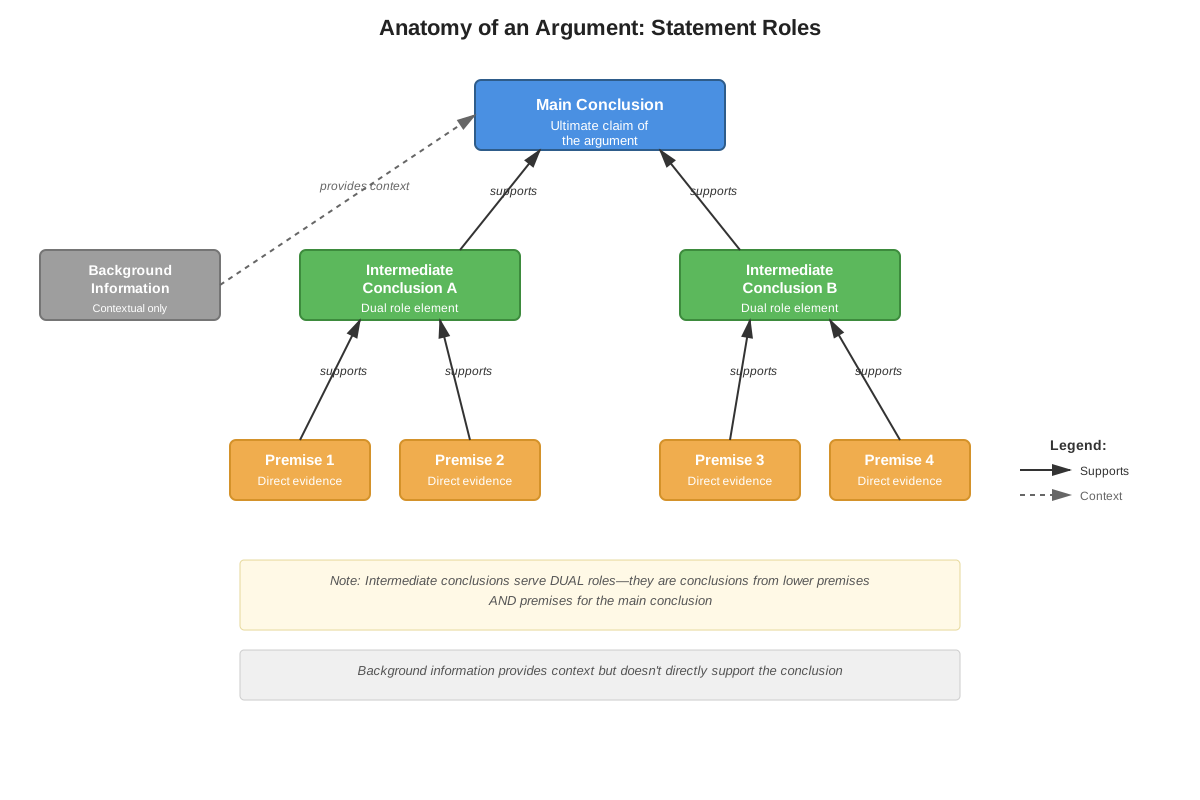
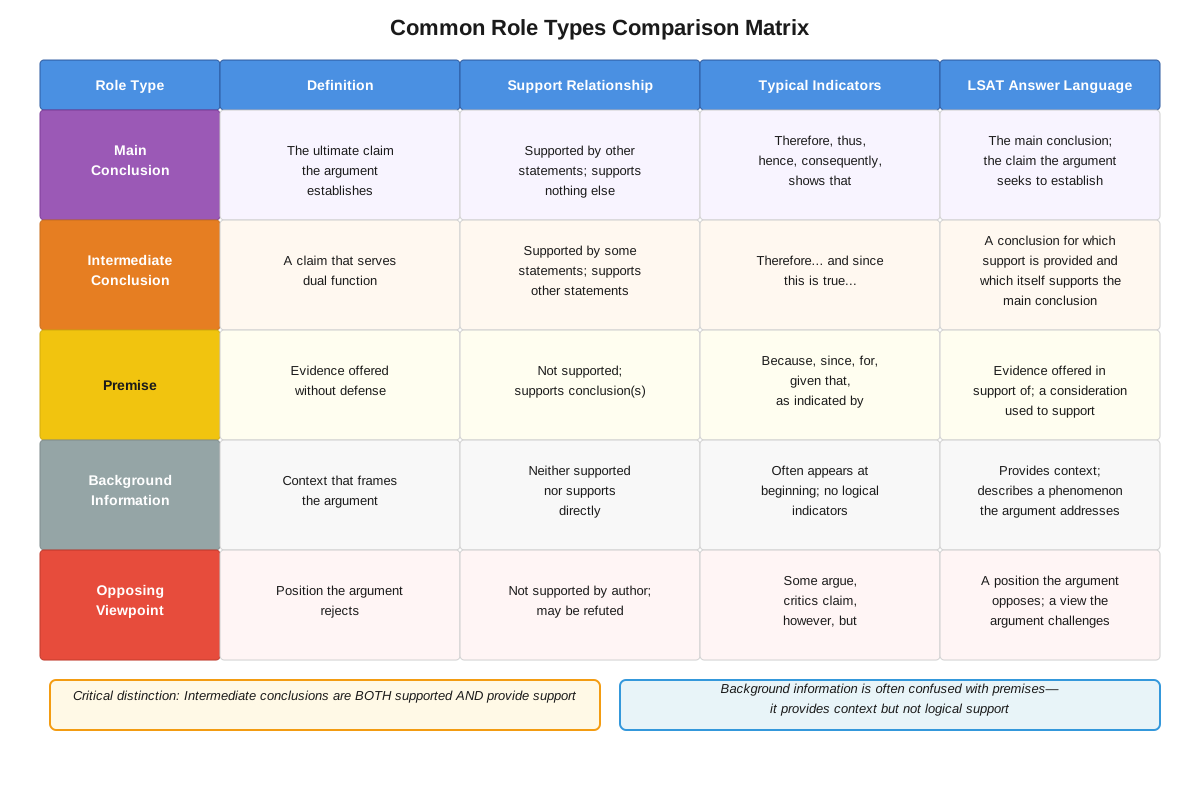
Main Conclusion: The primary claim the argument seeks to establish. This is what the author ultimately wants you to believe. It is supported by all other premises but does not itself support anything else in the argument.
Premise (Evidence): A statement offered as support for a conclusion. Premises provide reasons, facts, data, or observations that make the conclusion more believable or justified.
Intermediate Conclusion (Sub-conclusion): A statement that functions as both a conclusion (supported by some premises) and a premise (supporting the main conclusion). These create layered arguments and are frequently tested on the LSAT.
Background Information (Context): Statements that provide setting, definitions, or context but do not directly support the conclusion. These help readers understand the argument but aren't part of the logical chain.
Opposing Viewpoint: A position the author disagrees with, often introduced to be refuted. These statements represent what others believe, not what the author is arguing.
Concession: A point the author acknowledges as true, often to appear reasonable, before presenting a contrasting main point.
Identifying Statement Roles
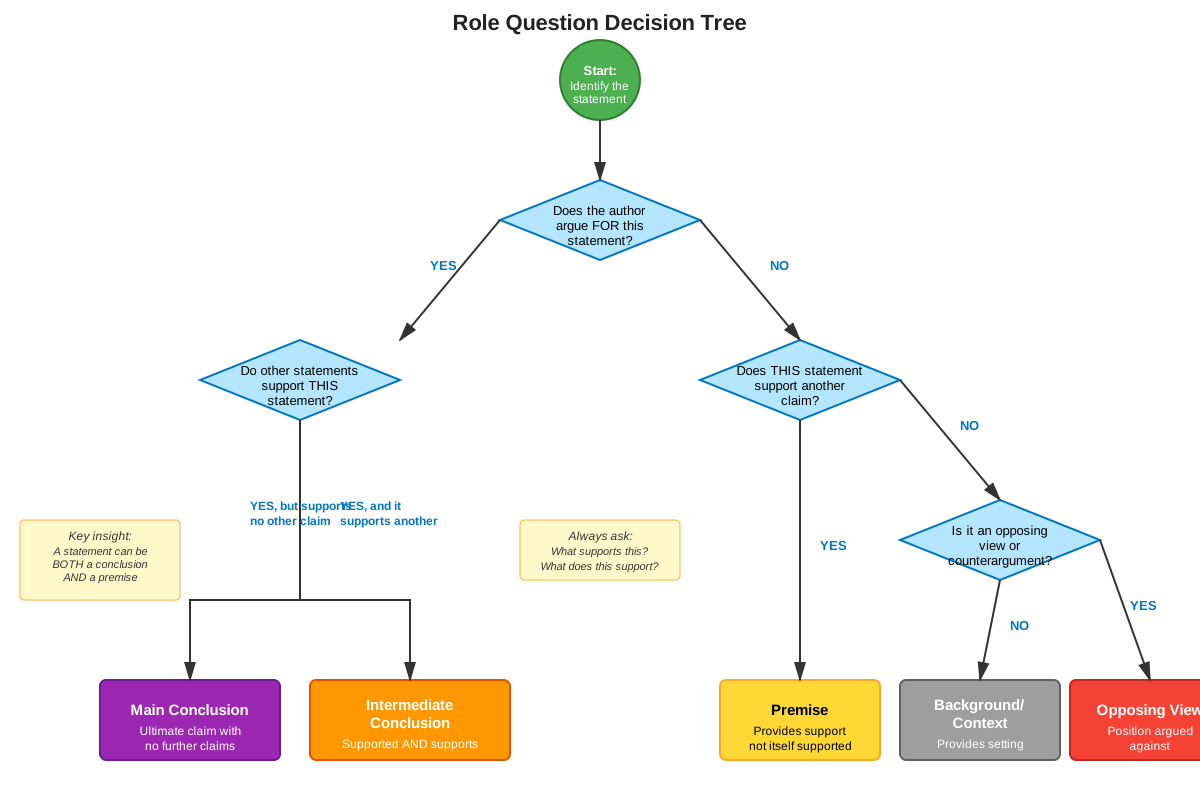
To determine a statement's role, apply this systematic approach:
- Locate the main conclusion first: Ask "What is the author's primary claim?" Look for conclusion indicators or identify the statement that everything else supports.
- Identify what supports the conclusion: Any statement that provides a reason to believe the conclusion is a premise.
- Check for intermediate conclusions: If a statement is supported by evidence BUT also supports the main conclusion, it's an intermediate conclusion.
- Distinguish support from context: Background information describes a situation but doesn't argue for the conclusion.
- Recognize opposing views: Statements introduced with "some believe," "critics argue," or "it might seem" often represent positions the author will challenge.
Common Role Patterns
| Role Type | Function | Typical Indicators | Example |
|---|---|---|---|
| Main Conclusion | Ultimate claim | Therefore, thus, consequently, clearly | "Therefore, the policy should be changed." |
| Premise | Direct support | Because, since, given that, for | "Since crime rates have fallen, the program works." |
| Intermediate Conclusion | Both supported and supporting | This shows/means/indicates that | "This means costs will rise, so we should act now." |
| Background | Contextual information | Historically, currently, in general | "The company was founded in 1990." |
| Opposing View | Position to be refuted | Some argue, critics claim, it appears | "Critics claim the law is ineffective." |
| Concession | Acknowledged limitation | Although, admittedly, granted | "Although costs are high, benefits outweigh them." |
The Intermediate Conclusion Challenge
Intermediate conclusions represent the most challenging aspect of role questions. Consider this structure:
- Premise 1: "Studies show exercise improves mood."
- Intermediate Conclusion: "Therefore, exercise benefits mental health."
- Premise 2: "Mental health improvements increase productivity."
- Main Conclusion: "Thus, companies should provide gym memberships."
The statement "exercise benefits mental health" is supported by the study premise, making it a conclusion. However, it also serves as a premise supporting the main conclusion about gym memberships. Recognizing these dual-function statements is crucial for LSAT success.
Functional vs. Content Analysis
Role questions require functional analysis, not content evaluation. You're not assessing whether a statement is true or whether the argument is strong. Instead, you're identifying what job the statement performs in the argument's architecture. A false statement can still serve as a premise if the author uses it as evidence. A weak argument can still have a clearly identifiable conclusion.
Signal Words and Phrases
While not foolproof, certain words frequently signal specific roles:
Conclusion indicators: therefore, thus, hence, consequently, so, accordingly, clearly, shows that, demonstrates that, proves that
Premise indicators: because, since, for, given that, as, due to, in light of, considering that, for the reason that
Contrast indicators (often preceding opposing views or concessions): however, but, yet, although, even though, despite, nevertheless
Intermediate conclusion indicators: this shows, this means, this suggests, this indicates, from this we can see
Concept Relationships
The concepts within role of a premise questions form a hierarchical structure. At the foundation lies the basic premise-conclusion relationship: premises support conclusions. This fundamental relationship expands into more complex structures when intermediate conclusions are introduced, creating chains where Statement A supports Statement B, which in turn supports Statement C.
Background information relates to the core argument structure by providing necessary context without participating in the logical support chain. Understanding this distinction prevents misidentifying contextual statements as premises. Similarly, opposing viewpoints connect to the argument structure by representing positions the author argues against, often serving as a foil that makes the author's actual position clearer by contrast.
The relationship map flows as follows:
Background/Context → sets the stage for → Premises → provide support for → Intermediate Conclusions → which serve as premises for → Main Conclusion
Meanwhile, Opposing Viewpoints → are introduced to be → Refuted by Premises → which support → Main Conclusion
This topic connects to prerequisite knowledge of basic argument structure by building upon the simple premise-conclusion model and adding layers of complexity. It relates to other Logical Reasoning question types by providing the foundational skill needed for assumption questions (identifying gaps between premises and conclusions), flaw questions (recognizing where the support breaks down), and strengthen/weaken questions (understanding what would affect the premise-conclusion relationship).
High-Yield Facts
⭐ The main conclusion is the statement that is supported by other statements but does not itself support anything else in the argument.
⭐ Intermediate conclusions are both supported by premises AND support the main conclusion—they serve a dual function.
⭐ Background information provides context but does not offer logical support for the conclusion.
⭐ A statement's role is determined by its function in the argument, not by whether it's true or false.
⭐ Opposing viewpoints represent positions the author disagrees with, not the author's own position.
- Premise indicators (because, since, for) often precede statements that provide evidence, but their absence doesn't mean a statement isn't a premise.
- Conclusion indicators (therefore, thus, hence) often precede main conclusions, but can also precede intermediate conclusions.
- A single argument can contain multiple premises that independently support the conclusion.
- Concessions acknowledge a point against the author's position but are followed by stronger points supporting the main conclusion.
- The question stem will typically quote or paraphrase a specific statement and ask about its role—always locate that exact statement in the passage before analyzing answer choices.
Quick check — test yourself on Role of a premise so far.
Try Flashcards →Common Misconceptions
Misconception: The conclusion is always the last sentence of the argument.
Correction: Conclusions can appear anywhere in an argument—beginning, middle, or end. The conclusion's position is determined by logical function, not physical location. Always identify the conclusion by asking what the author is ultimately trying to prove.
Misconception: Every statement in an argument must be either a premise or a conclusion.
Correction: Arguments contain various types of statements including background information, opposing viewpoints, concessions, and rhetorical questions that serve functions other than direct logical support. Not every sentence participates in the premise-conclusion chain.
Misconception: If a statement is supported by evidence, it must be the main conclusion.
Correction: Intermediate conclusions are also supported by evidence but differ from main conclusions because they themselves support something else. A statement can be a conclusion relative to what comes before it while serving as a premise for what comes after.
Misconception: Premises must be factual or true statements.
Correction: A premise is any statement the author uses as evidence, regardless of its truth value. The author might base an argument on false or questionable premises—the role is determined by function, not accuracy.
Misconception: Role questions ask you to evaluate whether the argument is good or bad.
Correction: Role questions are purely descriptive, asking you to identify what function a statement serves, not whether it serves that function well. You're analyzing structure, not quality.
Misconception: Background information and premises are the same thing because both provide information.
Correction: Background information describes a situation or provides context without arguing for the conclusion. Premises specifically offer reasons to believe the conclusion is true. Background sets the stage; premises build the case.
Worked Examples
Example 1: Identifying an Intermediate Conclusion
Argument: "Recent studies have shown that regular meditation reduces stress hormones in the bloodstream. This demonstrates that meditation has measurable physiological benefits. Given that physiological benefits typically translate to improved overall health, employers should offer meditation classes to their employees."
Question: The claim that meditation has measurable physiological benefits plays which role in the argument?
Step 1 - Identify the main conclusion: The main conclusion is "employers should offer meditation classes to their employees." This is what the author ultimately wants to convince us of. The word "should" signals a recommendation, and everything else in the argument builds toward supporting this claim.
Step 2 - Identify the premises: The first sentence ("Recent studies have shown...") is a premise providing evidence. The phrase "Given that physiological benefits typically translate to improved overall health" is also a premise.
Step 3 - Analyze the target statement: "This demonstrates that meditation has measurable physiological benefits" is supported by the studies mentioned in the previous sentence (making it a conclusion from that evidence). However, this statement also serves as evidence for the main conclusion about employers offering classes (making it a premise for the main conclusion).
Step 4 - Determine the role: This is an intermediate conclusion—it's both supported by evidence and provides support for the main conclusion.
Answer: The statement serves as an intermediate conclusion, supported by evidence about stress hormones and used to support the recommendation that employers offer meditation classes.
Connection to Learning Objectives: This example demonstrates how to identify role of a premise by systematically analyzing the logical structure and recognizing the dual function of intermediate conclusions.
Example 2: Distinguishing Background from Premises
Argument: "The city's public transportation system was established in 1952 and currently serves 200,000 daily riders. Because ridership has increased 15% over the past five years while funding has remained flat, the system faces a significant budget shortfall. Since budget shortfalls inevitably lead to service cuts, the city must increase transportation funding to maintain current service levels."
Question: The statement that the transportation system was established in 1952 and serves 200,000 daily riders plays which role in the argument?
Step 1 - Identify the main conclusion: "The city must increase transportation funding to maintain current service levels" is the main conclusion—the author's ultimate recommendation.
Step 2 - Identify the supporting premises: "Ridership has increased 15% over the past five years while funding has remained flat" provides evidence for the budget shortfall. "Budget shortfalls inevitably lead to service cuts" provides a general principle supporting the need for increased funding.
Step 3 - Analyze the target statement: The information about when the system was established and how many riders it serves provides context about the transportation system but doesn't directly argue for why funding should increase. This information helps readers understand what's being discussed but doesn't participate in the logical chain leading to the conclusion.
Step 4 - Determine the role: This is background information—it provides context without offering logical support for the conclusion.
Answer: The statement provides background information about the transportation system, establishing context for the argument but not directly supporting the conclusion about funding needs.
Connection to Learning Objectives: This example illustrates the critical distinction between contextual information and actual premises, showing how to apply role analysis to avoid confusing description with argumentation.
Exam Strategy
When approaching LSAT role of a premise questions, follow this systematic process:
Step 1 - Read the question stem first: Role questions will explicitly ask about a specific statement's function. Identify exactly which statement you need to analyze before reading the argument. This focuses your attention and prevents confusion.
Step 2 - Locate the statement in the passage: Find the exact sentence or claim mentioned in the question stem. Underline or bracket it to keep your focus clear.
Step 3 - Identify the main conclusion: Before analyzing the target statement's role, determine what the argument's main conclusion is. Ask yourself: "What is the author ultimately trying to prove?" This provides the reference point for understanding all other roles.
Step 4 - Trace logical relationships: Determine what supports the target statement (if anything) and what the target statement supports (if anything). This reveals whether it's a premise, conclusion, intermediate conclusion, or something else.
Step 5 - Watch for trigger words in answer choices:
- "Provides support for" or "offers evidence for" → premise function
- "Is supported by" or "is a conclusion drawn from" → conclusion function
- "Is both supported by and provides support for" → intermediate conclusion
- "Provides context" or "describes a situation" → background information
- "Is a position the argument opposes" → opposing viewpoint
Exam Tip: Wrong answer choices often describe the role of a different statement in the argument. After eliminating obviously wrong answers, check whether remaining choices actually describe other statements in the passage.
Time allocation: Spend approximately 1:15-1:30 on role questions. They require careful reading but shouldn't demand extensive analysis once you understand the structure. If you're spending more than 90 seconds, you may be overthinking—role questions test recognition, not complex reasoning.
Process of elimination strategies:
- Eliminate answers that describe the wrong direction of support (e.g., saying a premise is supported by the conclusion)
- Eliminate answers that describe roles not present in the argument (e.g., "opposing viewpoint" when no opposing view is mentioned)
- Eliminate answers that use extreme language not justified by the passage (e.g., "proves conclusively" when the statement only "suggests")
Common trap patterns:
- Answer choices that accurately describe the main conclusion when you're asked about a premise
- Answer choices that describe what a statement SHOULD do rather than what it DOES do
- Answer choices that evaluate the statement's truth or strength rather than its function
Memory Techniques
PICS Mnemonic for the four primary roles:
- Premise: Provides support
- Intermediate conclusion: Is supported AND supports
- Conclusion: Claim that's supported
- Supporting context: Sets the scene
The Building Metaphor: Think of arguments as buildings:
- Background = the land/location (context for everything)
- Premises = the foundation (what everything rests on)
- Intermediate conclusions = the floors (supported by foundation, supporting the roof)
- Main conclusion = the roof (the ultimate point, supported by everything below)
The "Two-Question Test" for intermediate conclusions:
- Is this statement supported by evidence? (If yes, it's some type of conclusion)
- Does this statement support something else? (If yes, it's also a premise)
If both answers are "yes," you've found an intermediate conclusion.
Directional Arrows Visualization: When reading arguments, mentally draw arrows:
- Premises → point toward what they support
- Conclusions ← have arrows pointing at them
- Intermediate conclusions have arrows both pointing at them AND pointing away from them
The "Therefore Test": To identify conclusions, try inserting "therefore" before statements. If it sounds natural and logical, that statement is likely a conclusion. If it sounds awkward, it's probably a premise or background.
Summary
Role of a premise questions test the fundamental skill of understanding argument structure by asking test-takers to identify the specific function a statement serves within logical reasoning. Success requires distinguishing between main conclusions (the ultimate claim), premises (supporting evidence), intermediate conclusions (statements that are both supported and supporting), background information (context without logical support), and opposing viewpoints (positions the author argues against). The key to mastering these questions lies in systematic analysis: first identifying the main conclusion, then tracing logical relationships to determine what supports what, and finally matching the target statement's actual function to the answer choice that accurately describes that role. Unlike questions that evaluate argument quality, role questions are purely structural—they assess whether you can deconstruct an argument into its component parts and recognize how those parts work together, regardless of whether the argument is strong or weak, true or false.
Key Takeaways
- Role questions test your ability to identify what function a statement serves in an argument's logical structure, not whether the argument is good or bad
- The main conclusion is supported by everything else but supports nothing; premises support conclusions but aren't themselves supported within the argument
- Intermediate conclusions are the most challenging element—they're both supported by some premises and serve as premises for the main conclusion
- Background information provides context without participating in the logical support chain; don't confuse description with argumentation
- Always identify the main conclusion first, then trace logical relationships to determine the target statement's role
- Answer choices often describe the roles of different statements in the passage—verify that your selected answer describes the specific statement asked about
- Signal words help but aren't definitive; always confirm a statement's role by analyzing its logical relationships, not just by identifying indicator words
Related Topics
Assumption Questions: After mastering role of a premise, students can better identify assumptions by recognizing gaps between premises and conclusions. Understanding what role each statement plays makes it easier to spot what's missing from the logical chain.
Method of Reasoning Questions: These questions ask how an argument proceeds or what technique it employs. Role of a premise provides the foundation for understanding argumentative methods, as recognizing statement functions is prerequisite to describing overall argumentative strategy.
Flaw Questions: Identifying logical flaws requires first understanding argument structure. Once you can recognize what role each statement plays, you can more easily spot where the logical support breaks down or where reasoning goes wrong.
Parallel Reasoning Questions: These questions require matching argument structures. Mastering role of a premise enables you to map the logical architecture of arguments, making it possible to identify structurally similar reasoning patterns.
Practice CTA
Now that you've mastered the core concepts of role of a premise questions, it's time to put your knowledge into practice. Attempt the practice questions to reinforce your understanding of how to identify statement functions, distinguish between different roles, and apply systematic analysis to LSAT-style problems. Remember that role questions reward careful, methodical thinking—take your time to trace logical relationships and verify that answer choices accurately describe the specific statement in question. The flashcards will help you internalize key distinctions and recognition patterns. With consistent practice, identifying statement roles will become second nature, giving you a significant advantage not just on role questions but across all Logical Reasoning question types. You've built a strong foundation—now strengthen it through application!
Sign up free to keep reading
Create a free AnvayaPrep account to finish this LSAT guide on Role of a premise — plus flashcards and practice questions.