Overview
Role of background information questions represent a critical category within LSAT Logical Reasoning sections, specifically falling under the broader umbrella of method, role, and structure questions. These questions ask test-takers to identify the specific function that a particular statement, claim, or piece of information serves within an argument's overall structure. Unlike questions that ask you to evaluate the strength of reasoning or identify assumptions, role questions focus purely on architectural analysis—understanding how the author has constructed their argument and what purpose each component serves.
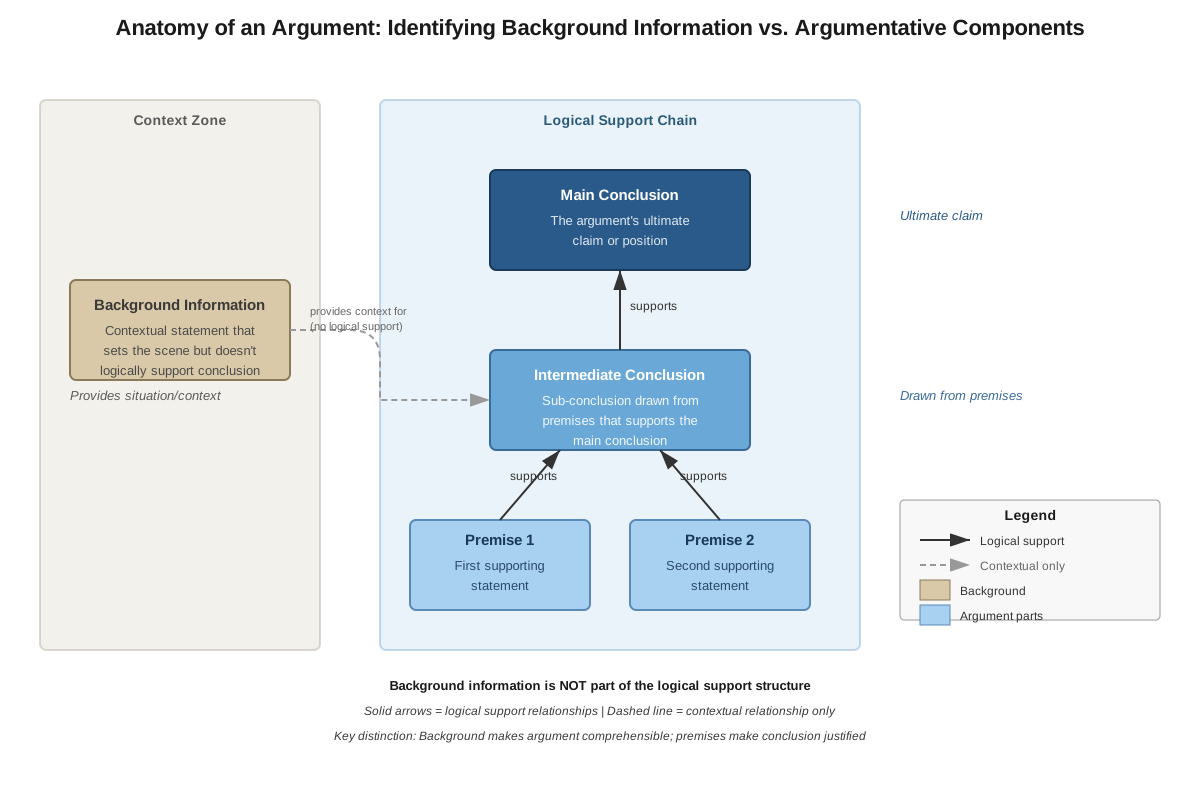
The LSAT role of background information specifically tests your ability to distinguish contextual setup from the argument's core logical machinery. Background information typically provides necessary context, establishes the situation being discussed, or presents facts that make the argument comprehensible without directly supporting the conclusion or serving as the conclusion itself. Mastering this distinction is essential because the LSAT frequently includes answer choices that mischaracterize background information as evidence, premises, or conclusions, deliberately exploiting test-takers' tendency to conflate different argumentative elements.
Understanding role questions connects fundamentally to your broader Logical Reasoning competency. These questions require you to first identify an argument's conclusion and premises—skills central to virtually every Logical Reasoning question type—then add an additional analytical layer by categorizing the function of specific statements. This skill transfers directly to strengthening/weakening questions, assumption questions, and parallel reasoning questions, all of which require precise understanding of argumentative structure. Students who excel at role questions typically demonstrate superior performance across all Logical Reasoning question types because they've developed the architectural vision necessary to see arguments as constructed objects rather than undifferentiated blocks of text.
Learning Objectives
- [ ] Identify how Role of background information appears in LSAT questions
- [ ] Explain the reasoning pattern behind Role of background information
- [ ] Apply Role of background information to solve LSAT-style problems accurately
- [ ] Distinguish background information from premises, evidence, and intermediate conclusions
- [ ] Recognize the linguistic markers and structural positions that typically signal background information
- [ ] Evaluate answer choices by matching functional descriptions to actual argumentative roles
- [ ] Analyze complex arguments containing multiple types of supporting statements and contextual information
Prerequisites
- Argument structure fundamentals: Understanding conclusions, premises, and evidence is essential because role questions require identifying these elements before determining what isn't serving those functions.
- Indicator word recognition: Familiarity with conclusion indicators ("therefore," "thus") and premise indicators ("because," "since") helps distinguish background from argumentative components.
- Basic logical relationships: Knowing how statements support or oppose each other enables recognition of when a statement provides context rather than logical support.
- Reading comprehension skills: The ability to parse complex sentences and identify main ideas versus supporting details transfers directly to distinguishing background from argument.
Why This Topic Matters
Role of background information questions appear with significant frequency on the LSAT, typically comprising 2-4 questions per Logical Reasoning section. Given that each LSAT includes two Logical Reasoning sections, test-takers can expect to encounter 4-8 such questions on any given exam administration. This frequency, combined with the medium difficulty rating, makes these questions high-value targets for score improvement—they're common enough to significantly impact your score but accessible enough that focused preparation yields reliable gains.
In real-world applications, the skill of identifying background versus argumentative content proves invaluable for legal practice. Attorneys must constantly distinguish between contextual facts and legally relevant evidence, between case background and the actual grounds for a legal claim. When reading case law, lawyers must identify which portions of judicial opinions constitute binding precedent (the ratio decidendi) versus illustrative background (obiter dicta). Similarly, when constructing legal arguments, attorneys must provide sufficient context for decision-makers without diluting their core reasoning with excessive background detail.
On the LSAT, role of background information questions most commonly appear in these formats: "The claim that [specific statement] plays which one of the following roles in the argument?" or "The statement that [specific statement] serves which one of the following functions?" The referenced statement is typically located in the argument's opening sentences, though it can appear anywhere. These questions test whether you can resist the temptation to view every statement as directly supporting the conclusion and instead recognize when the author is simply setting the stage for the argument to follow.
Core Concepts
Defining Background Information
Background information consists of statements that provide context, establish the setting, or present generally accepted facts that make an argument comprehensible without directly supporting the argument's conclusion through logical inference. These statements answer questions like "What situation are we discussing?" or "What facts do we need to understand before the argument begins?" rather than "Why should we accept the conclusion?"
The critical distinction lies in the relationship between the statement and the conclusion. A premise provides a reason to believe the conclusion—if the premise is true, it makes the conclusion more likely to be true. Background information, by contrast, simply makes the argument intelligible or relevant. Consider this example: "Many companies have recently adopted remote work policies. TechCorp should therefore invest in video conferencing infrastructure." The first sentence provides background that explains why the recommendation matters, but it doesn't logically support the conclusion that TechCorp specifically should invest in infrastructure.
Structural Position and Function
Background information typically appears in specific structural locations within LSAT arguments:
- Opening statements: Most commonly, background appears in the first one or two sentences, establishing context before the argument proper begins
- Parenthetical asides: Sometimes background appears mid-argument in parentheses or set off by dashes
- Concessive clauses: Statements beginning with "although," "while," or "despite" often provide background context
- Definitional statements: Explanations of terms or concepts that will be used in the argument
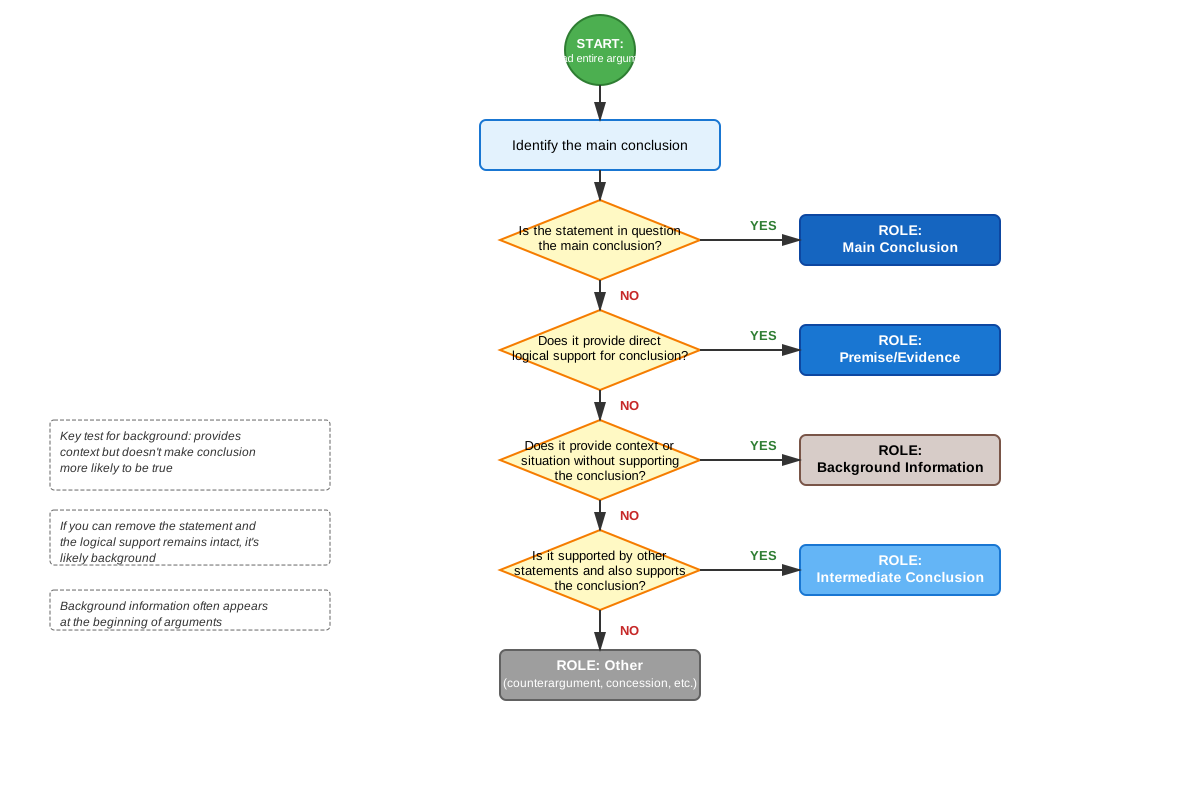
The functional test for background information involves asking: "If I removed this statement, would the logical connection between the remaining premises and conclusion be weakened?" If the answer is no—if the argument's logical structure remains intact—the statement likely serves as background rather than as a premise.
Background Versus Premises
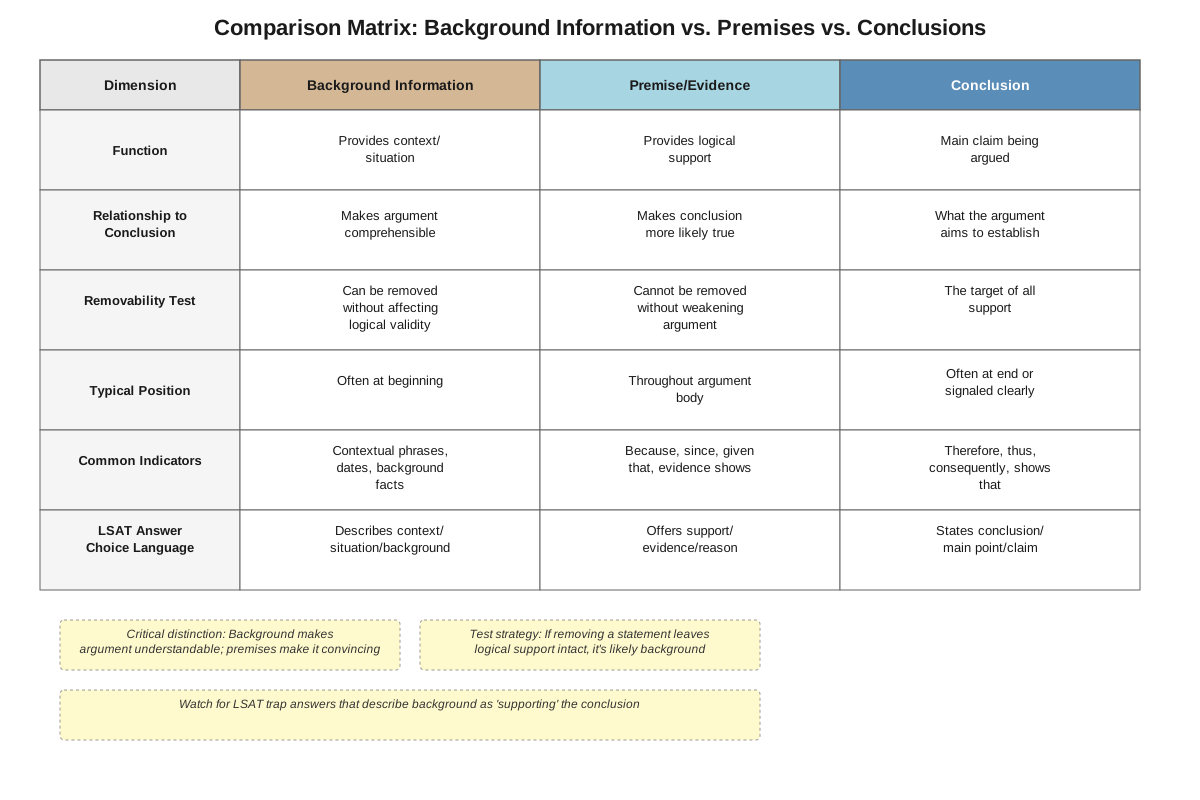
| Feature | Background Information | Premises |
|---|---|---|
| Logical relationship | No inferential connection to conclusion | Directly supports conclusion through logical inference |
| Necessity | Makes argument comprehensible or relevant | Provides reasons to believe conclusion |
| Typical position | Often at beginning or in parenthetical remarks | Typically follows background and precedes conclusion |
| Removal test | Argument's logic remains intact | Argument's logical support is weakened |
| Answer to | "What's the situation?" | "Why believe the conclusion?" |
Background Versus Intermediate Conclusions
An intermediate conclusion is a statement that serves both as a conclusion (supported by some premises) and as a premise (supporting the main conclusion). This differs fundamentally from background information, which never receives support from other statements and never provides support to the conclusion. The key diagnostic: if other statements in the argument are offered as reasons to believe the statement in question, it cannot be mere background—it must be playing an argumentative role.
Common Background Information Types
Contextual facts: Statements establishing the general situation or environment in which the argument takes place. Example: "The pharmaceutical industry has faced increasing regulatory scrutiny in recent years."
Historical information: Past events or trends that set the stage for the current discussion. Example: "Throughout the 1990s, urban crime rates declined steadily."
Definitional or explanatory content: Clarifications of terms or concepts that will be used in the argument. Example: "Biodegradable plastics are materials that can be broken down by microorganisms."
Scope-setting statements: Claims that establish what the argument will or won't address. Example: "This analysis focuses exclusively on domestic policy implications."
Commonly accepted facts: Widely acknowledged truths that require no support within the argument. Example: "Water freezes at 32 degrees Fahrenheit."
Recognition Strategies
Effective identification of background information requires systematic analysis:
- Locate the conclusion first: Always identify what the author is trying to prove before analyzing other statements
- Identify explicit premises: Find statements that clearly support the conclusion with indicator words or logical connections
- Test remaining statements: For any statement not clearly serving as conclusion or premise, ask whether it provides logical support or merely context
- Check for support relationships: Determine whether the statement receives support from other statements (making it an intermediate conclusion) or provides support to the conclusion (making it a premise)
- Apply the removal test: Mentally remove the statement and assess whether the argument's logical structure is damaged
Answer Choice Patterns
LSAT answer choices for role questions follow predictable patterns. Correct answers typically use functional language like "provides context for," "establishes the background against which," "introduces the phenomenon that," or "presents a situation that the argument addresses." Incorrect answers often mischaracterize background as "evidence for," "a reason to believe," "supports the conclusion that," or "an intermediate conclusion."
Concept Relationships
The identification of background information depends fundamentally on prior mastery of argument structure analysis. The logical flow proceeds: Argument structure recognition → Conclusion identification → Premise identification → Background information recognition. You cannot accurately identify background until you've identified what isn't background—namely, the conclusion and premises.
Within the broader category of method, role, and structure questions, background information recognition connects to several related skills. Role of evidence questions ask about statements that do provide logical support, making them the functional opposite of background information questions. Method of reasoning questions require understanding how premises support conclusions, which depends on distinguishing premises from non-argumentative content like background. Argument structure questions may ask about the overall organization, requiring recognition of which portions constitute context versus argumentation.
The skill of identifying background information also supports performance on other Logical Reasoning question types. Assumption questions require identifying gaps between premises and conclusions—a task made easier when you've correctly excluded background information from consideration as premises. Strengthen and weaken questions ask you to evaluate what would affect the argument's logical force, which requires knowing which statements are actually doing logical work versus merely providing context. Parallel reasoning questions demand matching argumentative structures, which becomes more accurate when you can distinguish structural elements from contextual elements.
High-Yield Facts
⭐ Background information provides context or establishes a situation without directly supporting the conclusion through logical inference.
⭐ The removal test is diagnostic: if removing a statement doesn't weaken the logical connection between premises and conclusion, it's likely background.
⭐ Background information most commonly appears in the opening sentences of LSAT arguments, before the argumentative content begins.
⭐ Correct answer choices for background information typically use language like "provides context," "establishes the situation," or "introduces the phenomenon."
⭐ Background information never receives support from other statements in the argument—if it does, it's an intermediate conclusion, not background.
- Background information can include historical facts, contextual details, definitions, or commonly accepted truths that make the argument comprehensible.
- Premises answer "Why believe the conclusion?" while background information answers "What situation are we discussing?"
- Concessive clauses beginning with "although," "while," or "despite" often signal background information rather than premises.
- Background information makes an argument relevant or intelligible but doesn't make the conclusion more likely to be true.
- Incorrect answer choices often mischaracterize background as "evidence," "support," or "a reason to believe the conclusion."
- Multiple statements in a single argument can serve as background information—it's not limited to one statement.
- Background information differs from counterarguments or opposing views, which are acknowledged and then refuted within the argument.
- The same statement could theoretically serve as background in one argument but as a premise in another, depending on its relationship to the conclusion.
- Role questions always reference a specific statement from the passage—you must analyze that particular statement, not the argument generally.
- Time pressure makes test-takers prone to misidentifying background as premises because they rush through structural analysis.
Quick check — test yourself on Role of background information so far.
Try Flashcards →Common Misconceptions
Misconception: Any statement appearing at the beginning of an argument must be background information. → Correction: While background commonly appears early, arguments can begin directly with premises. Position alone doesn't determine function—you must analyze the logical relationship to the conclusion.
Misconception: Background information is unimportant to the argument and can be ignored. → Correction: Background information serves the crucial function of making the argument comprehensible and relevant. While it doesn't provide logical support, it's necessary for understanding why the argument matters and what situation it addresses.
Misconception: If a statement is true or factual, it must be background information. → Correction: Premises are also typically presented as factual claims. The distinction isn't about truth value but about function—whether the statement provides logical support for the conclusion or merely establishes context.
Misconception: Background information and intermediate conclusions are the same thing because neither is the main conclusion. → Correction: Intermediate conclusions receive support from premises and provide support to the main conclusion, making them integral to the argument's logical structure. Background information does neither—it only provides context.
Misconception: Every argument contains background information. → Correction: Some LSAT arguments begin directly with premises supporting a conclusion, containing no background information at all. Don't force yourself to identify background when none exists.
Misconception: Longer statements are more likely to be background information. → Correction: Length has no correlation with function. A single word could theoretically serve as background, while a lengthy statement might be a complex premise.
Misconception: Background information always comes from sources external to the argument. → Correction: Background information is simply any contextual content within the argument itself, regardless of whether it references external facts or internal considerations.
Worked Examples
Example 1: Technology Adoption Argument
Argument: "Over the past decade, smartphones have become ubiquitous in developed nations. A recent study found that employees who use smartphones for work-related tasks outside normal business hours report higher stress levels than those who don't. Therefore, companies should discourage employees from using smartphones for work purposes during personal time."
Question: The statement that smartphones have become ubiquitous in developed nations plays which one of the following roles in the argument?
Analysis:
Step 1 - Identify the conclusion: "Therefore, companies should discourage employees from using smartphones for work purposes during personal time." The conclusion indicator "therefore" makes this clear.
Step 2 - Identify the premises: "A recent study found that employees who use smartphones for work-related tasks outside normal business hours report higher stress levels than those who don't." This provides a reason to believe the conclusion—it establishes a negative consequence of the behavior the conclusion recommends against.
Step 3 - Analyze the remaining statement: "Over the past decade, smartphones have become ubiquitous in developed nations." Does this provide logical support for the conclusion? No—the conclusion would be equally well-supported whether smartphones were ubiquitous or rare. The ubiquity of smartphones doesn't make it more or less true that companies should discourage their use during personal time.
Step 4 - Apply the removal test: If we removed the first sentence, would the logical connection between the premise (the study's findings) and the conclusion (companies should discourage use) be weakened? No—the argument's logical structure remains intact.
Step 5 - Determine the function: The first statement establishes context by explaining why this issue matters and why we're discussing smartphone use specifically. It makes the argument relevant to contemporary circumstances but doesn't support the conclusion.
Correct answer description: "Provides background information about the prevalence of the technology discussed in the argument" or "Establishes the context in which the problem addressed by the argument has arisen."
Connection to learning objectives: This example demonstrates how to identify background information by systematically analyzing each statement's relationship to the conclusion and applying the removal test to distinguish context from logical support.
Example 2: Environmental Policy Argument
Argument: "Industrial agriculture relies heavily on synthetic fertilizers. These fertilizers often contain nitrogen compounds that, when they run off into waterways, cause algae blooms that deplete oxygen and kill fish. Some environmental advocates have proposed banning synthetic fertilizers entirely. However, such a ban would be counterproductive because organic farming methods cannot currently produce sufficient food to meet global demand, and widespread food shortages would cause far greater harm than fertilizer runoff."
Question: The statement that industrial agriculture relies heavily on synthetic fertilizers plays which one of the following roles in the argument?
Analysis:
Step 1 - Identify the conclusion: "However, such a ban would be counterproductive" is the main conclusion, with the reasoning following "because" serving as support. The conclusion opposes banning synthetic fertilizers.
Step 2 - Identify the premises: Two premises support this conclusion: (1) "organic farming methods cannot currently produce sufficient food to meet global demand," and (2) "widespread food shortages would cause far greater harm than fertilizer runoff." These provide reasons to believe the ban would be counterproductive.
Step 3 - Analyze other statements: "These fertilizers often contain nitrogen compounds that, when they run off into waterways, cause algae blooms that deplete oxygen and kill fish" explains the environmental problem. "Some environmental advocates have proposed banning synthetic fertilizers entirely" introduces the proposal the argument opposes. Neither directly supports the conclusion that the ban would be counterproductive.
Step 4 - Focus on the target statement: "Industrial agriculture relies heavily on synthetic fertilizers." Does this support the conclusion? No—whether agriculture relies heavily or minimally on synthetic fertilizers doesn't affect whether a ban would be counterproductive. This statement establishes what we're discussing and why the issue matters (because agriculture depends on these fertilizers), but it doesn't provide logical support for the conclusion.
Step 5 - Apply the removal test: Without the first sentence, the argument would still work logically: "Fertilizers cause environmental problems, some want to ban them, but a ban would be counterproductive because organic methods can't feed everyone and food shortages would be worse." The logical structure remains intact.
Correct answer description: "Provides background information about the current role of the substance whose prohibition is discussed in the argument" or "Establishes the context that makes the proposed policy relevant."
Connection to learning objectives: This example shows how background information can appear in arguments with multiple non-argumentative statements, requiring careful analysis to distinguish background from problem descriptions, opposing positions, and actual premises.
Exam Strategy
Systematic Approach to Role Questions
When encountering a role of background information question, follow this sequence:
- Read the question stem first to identify which specific statement you'll need to analyze
- Locate and bracket the referenced statement in the passage
- Identify the conclusion using indicator words or by asking "What is the author trying to prove?"
- Identify explicit premises that provide direct support for the conclusion
- Analyze the referenced statement's relationship to the conclusion using the removal test
- Predict the answer before looking at choices (e.g., "This provides context" or "This is background")
- Evaluate answer choices by matching functional descriptions to your analysis
Trigger Words and Phrases
In question stems, watch for:
- "plays which one of the following roles"
- "serves which one of the following functions"
- "figures in the argument in which one of the following ways"
- "is used in the argument to"
In answer choices indicating background, look for:
- "provides context for"
- "establishes the background"
- "introduces the phenomenon"
- "presents the situation"
- "describes the circumstances"
In answer choices indicating NOT background (incorrect for background questions):
- "supports the conclusion"
- "provides evidence for"
- "is a reason to believe"
- "is an intermediate conclusion"
- "is the main conclusion"
Process of Elimination Strategy
Eliminate answer choices that:
- Describe the statement as providing logical support, evidence, or reasons for the conclusion
- Characterize the statement as a conclusion (main or intermediate)
- Describe relationships the statement doesn't have with other parts of the argument
- Use language suggesting the statement is essential to the argument's logical structure
Favor answer choices that:
- Use contextual or situational language
- Describe the statement as establishing, introducing, or presenting rather than supporting or proving
- Acknowledge the statement's role in making the argument comprehensible or relevant
- Distinguish the statement from the argument's logical machinery
Time Allocation
Role questions typically require 60-90 seconds for accurate completion. Allocate time as follows:
- 10-15 seconds: Read question stem and locate referenced statement
- 20-30 seconds: Identify conclusion and premises
- 15-20 seconds: Analyze the referenced statement's function
- 15-25 seconds: Evaluate answer choices
If you find yourself spending more than 90 seconds, you likely haven't clearly identified the conclusion. Return to that step before proceeding.
Memory Techniques
The CRISP Acronym for Background Information
Context - Does it provide context?
Removal - Would removing it weaken the logic?
Inference - Does it support the conclusion through inference?
Support - Does it receive support from other statements?
Position - Is it positioned before the argument begins?
If the answer is YES to C, NO to R, NO to I, NO to S, and often YES to P, you're likely dealing with background information.
The Stage-Setting Visualization
Visualize arguments as theatrical productions. Background information is the stage setting—the scenery, props, and context that make the play comprehensible. The premises and conclusion are the actual dialogue and action. Just as removing a backdrop doesn't change what the actors say or do, removing background doesn't change the logical relationships in the argument.
The Foundation vs. Frame Distinction
Think of background information as the frame around a picture—it makes the picture presentable and defines its boundaries, but it isn't part of the image itself. Premises are the foundation of a building—remove them and the structure collapses. This distinction helps remember that background is adjacent to the argument rather than integral to its logical structure.
The Question Test Mnemonic
Background answers: "What's the Situation?" (WS)
Premises answer: "Why Believe?" (WB)
When analyzing a statement, ask both questions. If it answers WS but not WB, it's background.
Summary
Role of background information questions test your ability to distinguish contextual setup from the logical machinery of arguments. Background information provides context, establishes situations, or presents facts that make arguments comprehensible without directly supporting conclusions through logical inference. The key diagnostic tool is the removal test: if removing a statement doesn't weaken the logical connection between premises and conclusion, it likely serves as background. These statements typically appear at the beginning of arguments and answer "What situation are we discussing?" rather than "Why believe the conclusion?" Success on these questions requires systematic analysis—first identifying the conclusion and premises, then analyzing remaining statements to determine their function. Correct answer choices use contextual language like "provides background" or "establishes the situation," while incorrect choices mischaracterize background as evidence, support, or conclusions. Mastering this skill enhances performance across all Logical Reasoning question types by developing precise understanding of argumentative architecture.
Key Takeaways
- Background information provides context without logically supporting the conclusion—it makes arguments comprehensible and relevant but doesn't make conclusions more likely to be true
- The removal test is your most reliable diagnostic: if removing a statement doesn't weaken the logical connection between premises and conclusion, it's likely background
- Always identify the conclusion and premises first before attempting to identify background information
- Background information most commonly appears in opening sentences but can appear anywhere in an argument
- Correct answers use contextual language ("provides background," "establishes the situation") while incorrect answers use logical support language ("evidence for," "supports the conclusion")
- Background information never receives support from other statements—if it does, it's an intermediate conclusion
- Multiple statements in a single argument can serve as background; don't assume only one statement can fill this role
Related Topics
Role of Evidence Questions: These questions ask about statements that do provide logical support for conclusions, making them the functional complement to background information questions. Mastering background identification makes evidence identification more accurate by process of elimination.
Method of Reasoning Questions: These questions require understanding how premises support conclusions, which depends on accurately distinguishing premises from background information. The skills developed for role questions transfer directly to method questions.
Argument Structure Questions: These broader questions ask about overall argumentative organization, requiring recognition of which portions constitute context versus argumentation. Background identification is a component skill for these more comprehensive questions.
Intermediate Conclusion Identification: Understanding the difference between background information and intermediate conclusions is crucial, as both can appear in similar positions but serve fundamentally different functions in arguments.
Assumption Questions: These questions require identifying gaps between premises and conclusions—a task made significantly easier when you've correctly excluded background information from consideration as premises.
Practice CTA
Now that you've mastered the core concepts of identifying the role of background information, it's time to put your knowledge into practice. Work through the practice questions systematically, applying the removal test and the CRISP acronym to each problem. Pay special attention to distinguishing background from premises in the answer choices—this is where most students lose points. Review the flashcards to reinforce the key distinctions between background information, premises, and conclusions. Remember: these questions are highly learnable, and consistent practice with the systematic approach outlined in this guide will translate directly into points on test day. Your ability to see argumentative architecture clearly is developing with each practice problem you complete.
Sign up free to keep reading
Create a free AnvayaPrep account to finish this LSAT guide on Role of background information — plus flashcards and practice questions.