Overview
Role of evidence questions represent a critical category within LSAT logical reasoning sections, testing a student's ability to identify the precise function that a particular statement plays within an argument's structure. These questions, part of the broader family of method, role, and structure questions, require test-takers to step back from evaluating whether an argument is sound and instead analyze how its components fit together mechanically. Unlike assumption or strengthen/weaken questions that ask students to engage with an argument's content, role of evidence questions demand recognition of structural relationships—distinguishing premises from conclusions, identifying supporting versus opposing evidence, and recognizing intermediate conclusions that serve dual functions.
Understanding LSAT role of evidence questions is essential because they appear with consistent frequency on every administration of the exam, typically comprising 2-4 questions per test. These questions assess a fundamental skill that underlies all logical reasoning: the ability to deconstruct arguments into their component parts and understand how those parts relate to one another. This metacognitive skill—thinking about how arguments work rather than just what they say—separates high scorers from average performers. Students who master role of evidence questions develop a sophisticated understanding of argumentative architecture that benefits them across all question types.
Within the broader landscape of logical reasoning, role of evidence questions occupy a unique position. They bridge the gap between basic argument comprehension and advanced critical reasoning skills. While they don't require students to evaluate logical validity or identify flaws, they demand precise understanding of argumentative structure that forms the foundation for more complex question types. Mastering these questions strengthens performance on parallel reasoning, method of reasoning, and even assumption questions, as all require recognizing how evidence functions within argumentative frameworks.
Learning Objectives
- [ ] Identify how Role of evidence appears in LSAT questions
- [ ] Explain the reasoning pattern behind Role of evidence
- [ ] Apply Role of evidence to solve LSAT-style problems accurately
- [ ] Distinguish between different types of evidence roles (premises, conclusions, intermediate conclusions, counterevidence, background information)
- [ ] Recognize common wrong answer patterns in role of evidence questions
- [ ] Analyze complex arguments with multiple layers of support to identify the specific function of targeted statements
Prerequisites
- Basic argument structure: Understanding the distinction between premises (supporting statements) and conclusions (claims being supported) is fundamental, as role questions explicitly test this knowledge
- Indicator words: Familiarity with conclusion indicators (therefore, thus, hence) and premise indicators (because, since, for) helps quickly identify statement functions
- Argument identification: The ability to locate the main conclusion within a passage is essential, as determining a statement's role requires knowing what it relates to
- Reading comprehension: Strong comprehension skills enable accurate parsing of complex arguments where multiple claims interact
Why This Topic Matters
Role of evidence questions test a universally applicable analytical skill: understanding how arguments are constructed. In legal practice, law school, and professional contexts, the ability to identify what function a piece of evidence serves—whether it supports a claim, opposes it, or provides necessary context—is indispensable. Lawyers must constantly analyze how different pieces of evidence relate to their case theory, distinguishing between direct support, circumstantial evidence, and background information. This same analytical framework applies to policy analysis, business strategy, and academic research.
On the LSAT specifically, role of evidence questions appear in approximately 10-15% of all logical reasoning questions, making them a high-yield topic for focused study. They typically appear 2-4 times per test across both logical reasoning sections, and their predictable structure makes them excellent candidates for score improvement. Unlike some question types that require extensive outside knowledge or creative thinking, role questions reward systematic analysis and pattern recognition—skills that improve rapidly with targeted practice.
These questions commonly appear in several formats. The most frequent asks students to identify the role of a specific statement (often italicized or referenced by line number) within the argument. Another common variant presents the entire argument and asks about the relationship between two specific claims. Occasionally, questions ask about the argumentative technique or method used, which overlaps significantly with role analysis. The arguments themselves range from straightforward two-premise structures to complex multi-layered reasoning chains with intermediate conclusions, counterarguments, and qualifications.
Core Concepts
Understanding Evidence Roles
Evidence in logical reasoning refers to any statement used to support, oppose, or contextualize a claim. The role of evidence describes the specific function that statement performs within the argument's architecture. Unlike content-focused questions that ask whether evidence is sufficient or relevant, role questions ask only what job the evidence is doing—regardless of how well it performs that job.
The fundamental distinction in any argument is between premises (statements offered as support) and conclusions (statements being supported). However, role of evidence questions test more nuanced categories:
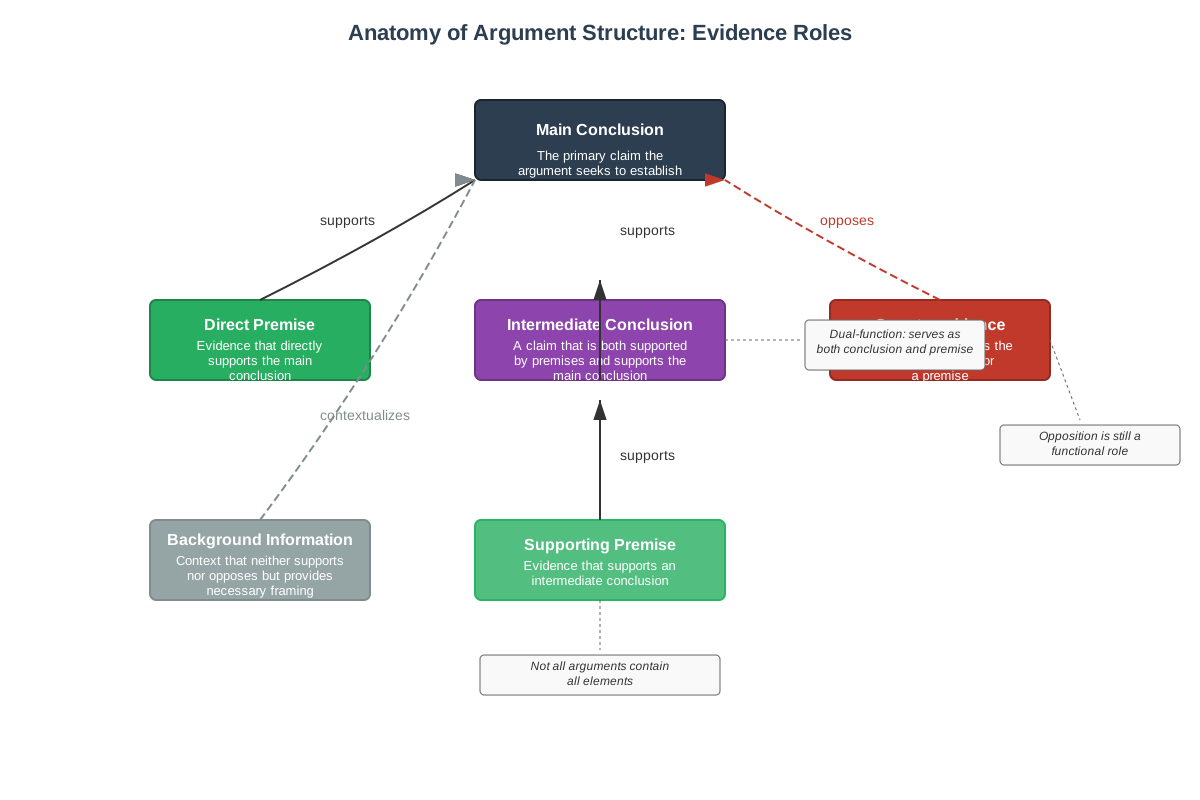
- Main conclusion: The primary claim the argument seeks to establish
- Intermediate conclusion: A claim that is both supported by other premises and used to support the main conclusion
- Direct premise: Evidence offered in direct support of a conclusion
- Background information: Context that frames the argument without directly supporting the conclusion
- Counterevidence: Information that appears to oppose the conclusion but is typically refuted or explained away
- Concession: An acknowledgment of a point against the argument's position
- Illustration/Example: A specific instance used to clarify or demonstrate a general claim
Identifying Statement Functions
To determine a statement's role, apply this systematic analysis:
Step 1: Locate the main conclusion. Ask "What is the author ultimately trying to prove?" The main conclusion is the statement that everything else supports but which itself supports nothing else.
Step 2: Identify the target statement. Role questions typically highlight or reference a specific claim. Mark this clearly.
Step 3: Determine the relationship. Ask: "Does the target statement support the conclusion, oppose it, or do something else?" Then ask: "Is anything offered in support of the target statement itself?"
Step 4: Match to role categories. Based on the relationships identified, classify the statement's function using precise terminology.
The Intermediate Conclusion
The intermediate conclusion (also called a subsidiary conclusion) is the most frequently tested and commonly misunderstood role. This statement serves a dual function: it is supported by some premises and in turn supports the main conclusion. Recognizing intermediate conclusions is crucial because they appear in approximately 40% of role of evidence questions.
Consider this structure:
- Premise A → Intermediate Conclusion B → Main Conclusion C
Statement B is a conclusion relative to A (A supports B) but a premise relative to C (B supports C). This dual nature makes intermediate conclusions the "hinge" of complex arguments.
Indicators of intermediate conclusions:
- Conclusion indicators (therefore, thus, so) followed by additional reasoning
- Statements that answer "why?" for one claim while themselves requiring justification
- Claims positioned in the middle of an argument's logical flow
Counterevidence and Concessions
Arguments often acknowledge opposing viewpoints or contrary evidence. Understanding how these function is essential for role questions.
Counterevidence is information that appears to undermine the conclusion. In well-constructed arguments, counterevidence is presented then refuted, explained away, or shown to be outweighed by supporting evidence. Its role is to represent an opposing position that the argument addresses.
Concessions are acknowledgments that a point against the argument's position is valid. Unlike counterevidence that gets refuted, concessions are accepted as true but shown to be insufficient to undermine the main conclusion. The typical pattern is: "While X is true [concession], nevertheless Y [main conclusion] because Z [supporting evidence]."
Background Information vs. Premises
Not every statement in an argument directly supports the conclusion. Background information provides context, defines terms, or establishes the situation being discussed without itself constituting evidence for the conclusion.
| Feature | Background Information | Premise |
|---|---|---|
| Function | Provides context or setup | Directly supports conclusion |
| Relationship to conclusion | Enables understanding | Provides reason to believe |
| Removal test | Argument becomes unclear | Argument becomes weaker |
| Common position | Beginning of argument | Middle or near conclusion |
For example: "The city council is considering a new zoning law" is background information. "The new zoning law would reduce traffic congestion" is a premise if the conclusion is that the law should be passed.
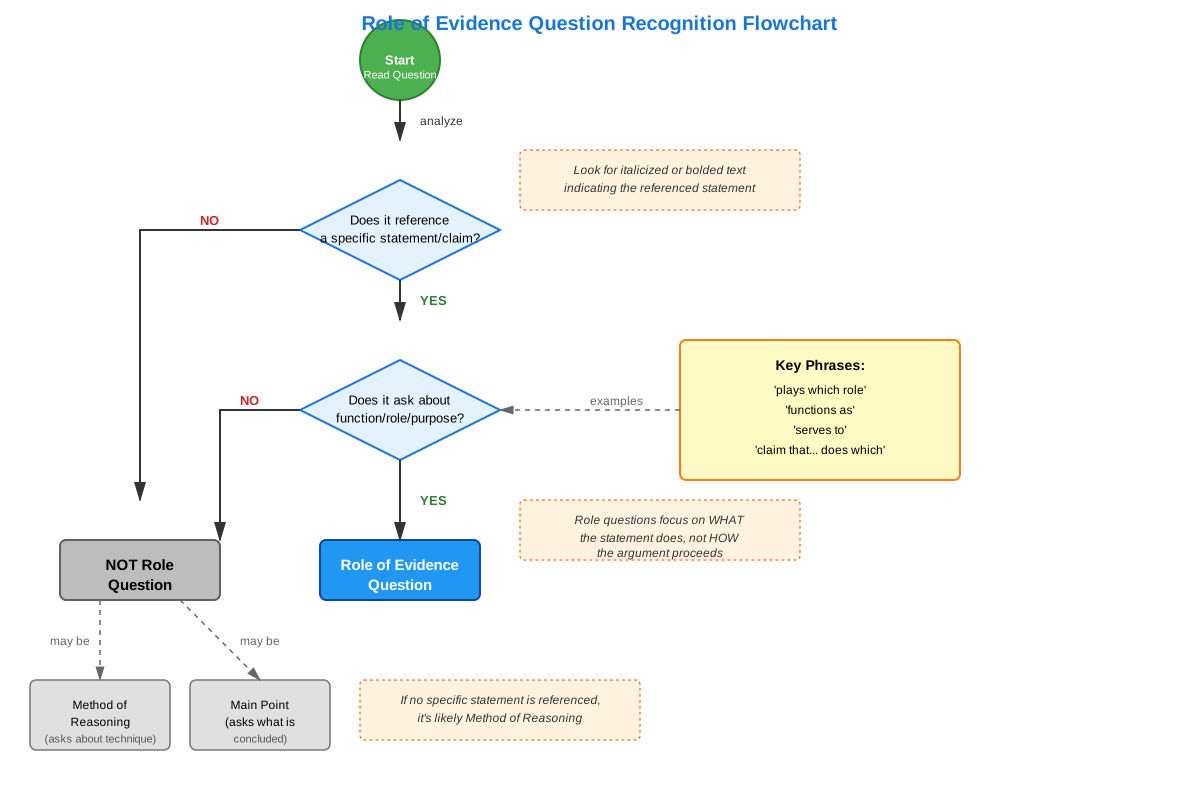
Recognizing Role Question Stems
Role of evidence questions use distinctive language patterns. Recognizing these stems immediately signals the analytical approach required:
- "The claim that [statement] plays which one of the following roles in the argument?"
- "The statement that [statement] serves which function in the argument?"
- "In the argument, the portion in boldface plays which of the following roles?"
- "The argument does which of the following?"
- "The argument proceeds by..."
- "Which one of the following most accurately describes the role played in the argument by the claim that [statement]?"
These stems all signal that the question tests structural understanding rather than content evaluation.
Concept Relationships
The concepts within role of evidence analysis form a hierarchical structure. At the foundation lies basic argument structure (premise/conclusion distinction), which enables recognition of main conclusions. Understanding main conclusions allows identification of direct premises (statements that support the main conclusion without themselves being supported).
This foundation enables recognition of more complex roles: Intermediate conclusions emerge when a statement functions as both premise and conclusion → this dual nature creates argumentative chains where reasoning proceeds in stages → these chains often incorporate counterevidence that is then refuted → which may include concessions that acknowledge valid opposing points → all of this occurs within a framework that may include background information providing necessary context.
The relationship to prerequisite knowledge is direct: Indicator words help identify statement functions → Argument identification skills enable location of main conclusions → Reading comprehension allows accurate parsing of complex relationships → all of which combine to enable role analysis.
Role of evidence questions connect to other logical reasoning question types through shared analytical skills. The structural analysis required for role questions directly supports method of reasoning questions (which ask how an argument proceeds) and parallel reasoning questions (which require matching argumentative structures). Understanding evidence roles also strengthens performance on assumption questions (by clarifying what premises actually establish) and strengthen/weaken questions (by identifying which claims need support or are vulnerable to attack).
High-Yield Facts
⭐ Role of evidence questions ask about function, not quality: The question is what job a statement performs, not whether it performs that job well or whether the argument is sound.
⭐ Intermediate conclusions are both supported and supporting: They receive support from some premises and provide support to the main conclusion, serving as a "bridge" in the argument.
⭐ The main conclusion is the statement that everything else supports but which itself supports nothing else: It is the ultimate point of the argument.
⭐ Background information provides context but doesn't directly support the conclusion: Removing it makes the argument harder to understand but not necessarily weaker.
⭐ Counterevidence is presented to be refuted or explained away: Its role is to represent an opposing view that the argument addresses, not to actually undermine the argument.
- Concessions acknowledge valid opposing points while maintaining the main conclusion remains sound despite them.
- Direct premises support the conclusion without themselves requiring support within the argument.
- Role questions typically reference specific statements through italics, boldface, or line references.
- The correct answer to a role question must accurately describe both what supports the statement and what the statement supports.
- Approximately 40% of role questions involve identifying intermediate conclusions, making this the highest-yield specific role to master.
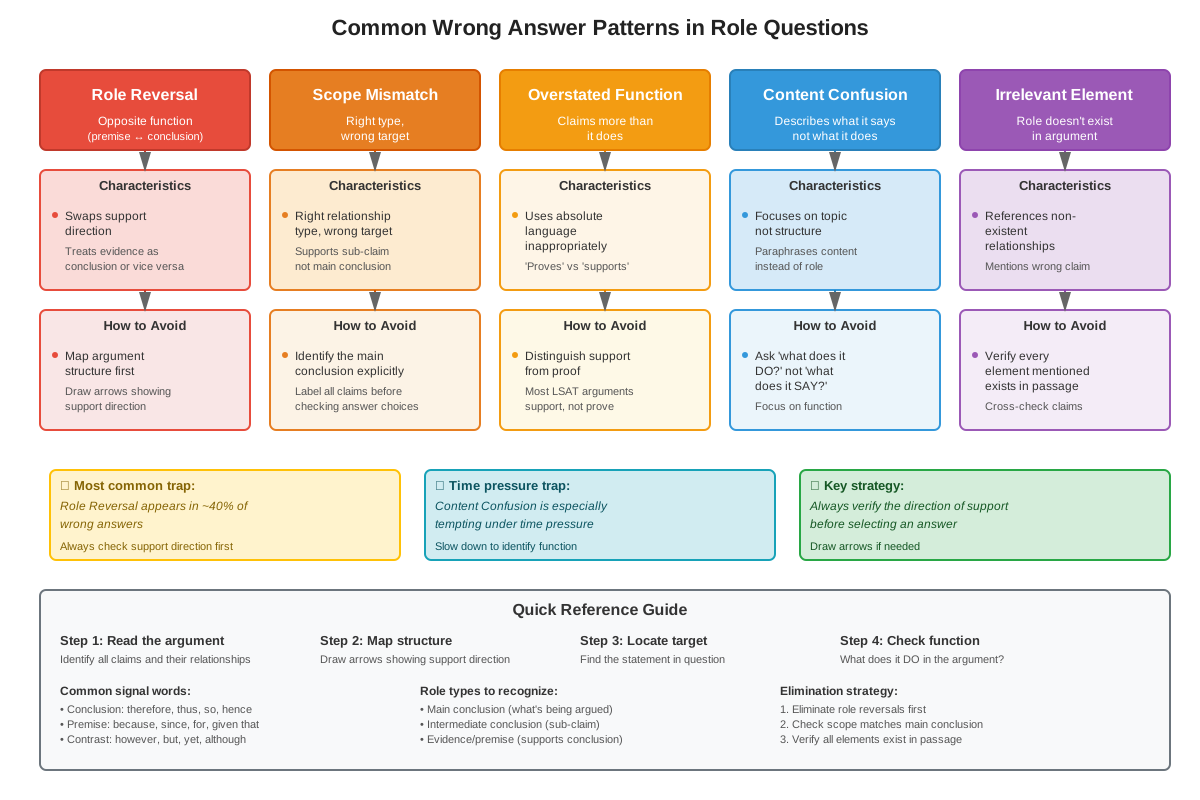
- Wrong answers often confuse the direction of support (claiming a premise is a conclusion or vice versa).
- Statements can serve multiple functions simultaneously (e.g., an example that also serves as a premise).
- The position of a statement in the passage does not reliably indicate its role—conclusions can appear first, premises last.
- Role questions never require evaluating whether the reasoning is valid or the premises are true.
- Recognizing conclusion indicators (therefore, thus, hence, so) and premise indicators (because, since, for, as) accelerates role identification.
Quick check — test yourself on Role of evidence so far.
Try Flashcards →Common Misconceptions
Misconception: The conclusion always appears at the end of the argument.
Correction: Conclusions can appear anywhere in the passage—beginning, middle, or end. The conclusion's position is determined by its logical function (what it supports and what supports it), not its physical location. Many arguments state the conclusion first, then provide supporting premises.
Misconception: Every statement in an argument is either a premise or a conclusion.
Correction: Arguments contain multiple types of statements including background information, concessions, counterevidence, illustrations, and qualifications. Not every statement directly participates in the premise-conclusion structure. Background information, for instance, provides context without supporting the conclusion.
Misconception: If a statement is supported by evidence, it must be the main conclusion.
Correction: Intermediate conclusions are also supported by evidence but are not the main conclusion. The distinguishing feature of the main conclusion is that it supports nothing else—it is the argument's ultimate point. Intermediate conclusions both receive support and provide support to something else.
Misconception: Counterevidence weakens the argument, so it can't be part of the argument's structure.
Correction: Counterevidence is often deliberately included in arguments to be refuted or explained away. Its role is to represent an opposing position that the argument addresses. Including and refuting counterevidence can actually strengthen an argument by demonstrating the author has considered alternative views.
Misconception: The correct answer to a role question should describe whether the evidence is good or sufficient.
Correction: Role questions ask only about function, not quality. The correct answer describes what job the statement performs (supports the conclusion, provides background, etc.) without evaluating whether it performs that job well. An answer choice that says "provides strong support" or "insufficient evidence" is evaluating quality and is likely wrong.
Misconception: Background information and premises are the same thing because both appear before the conclusion.
Correction: Background information provides context or setup but doesn't give reasons to believe the conclusion. Premises provide direct support—reasons why the conclusion should be accepted. The test is: if you removed the statement, would the argument be weaker (premise) or just less clear (background)?
Misconception: A statement can only serve one role in an argument.
Correction: Statements can serve multiple functions simultaneously. A specific example might also function as a premise. An intermediate conclusion is by definition both a conclusion (relative to its supporting premises) and a premise (relative to the main conclusion). The question typically asks for the primary or most significant role.
Worked Examples
Example 1: Identifying an Intermediate Conclusion
Argument: "Studies show that regular exercise reduces stress hormones in the bloodstream. Therefore, people who exercise regularly experience less anxiety. Since reduced anxiety improves workplace productivity, companies should encourage employee exercise programs."
Question: The claim that people who exercise regularly experience less anxiety plays which role in the argument?
Analysis:
Step 1: Identify the main conclusion. Ask: "What is the ultimate point?" The main conclusion is "companies should encourage employee exercise programs"—this is what the argument is ultimately trying to establish.
Step 2: Locate the target statement. The question asks about "people who exercise regularly experience less anxiety."
Step 3: Determine relationships.
- What supports the target statement? "Studies show that regular exercise reduces stress hormones" supports it (indicated by "therefore").
- What does the target statement support? It supports "companies should encourage employee exercise programs" through the intermediate claim about productivity.
Step 4: Classify the role. The target statement is supported by evidence (the studies) AND supports the main conclusion (through the productivity link). This is the defining characteristic of an intermediate conclusion.
Correct Answer: "It is a conclusion supported by evidence about stress hormones and used to support the argument's main conclusion about company policy."
Common Wrong Answers:
- "It is the main conclusion" (Wrong: it supports something else—the claim about companies)
- "It is a premise offered in support of the conclusion" (Wrong: it is itself supported by other evidence)
- "It is background information" (Wrong: it directly supports the conclusion)
Example 2: Distinguishing Background from Premise
Argument: "The city's water supply comes from a reservoir 50 miles north of downtown. Recent tests detected elevated levels of agricultural runoff in the reservoir. Agricultural runoff contains pesticides harmful to human health. The city should therefore invest in advanced water filtration systems."
Question: The statement that the city's water supply comes from a reservoir 50 miles north of downtown plays which role in the argument?
Analysis:
Step 1: Identify the main conclusion. "The city should invest in advanced water filtration systems" is the ultimate claim.
Step 2: Locate the target statement. "The city's water supply comes from a reservoir 50 miles north of downtown."
Step 3: Determine relationships.
- Does anything support this statement? No evidence is offered for it; it's presented as fact.
- Does this statement support the conclusion? Not directly. The conclusion is supported by: (1) runoff detected in reservoir, (2) runoff contains harmful pesticides. The location of the reservoir doesn't provide a reason to install filtration.
Step 4: Apply the removal test. If we removed this statement, would the argument be weaker or just less clear? The argument would be less clear (we wouldn't know what water supply is being discussed) but not weaker—the reasoning from "harmful substances detected" to "need filtration" remains intact.
Correct Answer: "It provides background information establishing the context for the argument but does not itself support the conclusion."
Common Wrong Answers:
- "It is a premise supporting the conclusion" (Wrong: it doesn't give a reason to believe the conclusion)
- "It is an intermediate conclusion" (Wrong: nothing supports it, and it doesn't support the conclusion)
- "It is a concession to an opposing viewpoint" (Wrong: it doesn't acknowledge any opposing position)
Exam Strategy
Systematic Approach to Role Questions
Phase 1: Identify the question type (5 seconds). Look for stems containing "role," "function," "serves to," or "the argument proceeds by." This signals structural analysis rather than content evaluation.
Phase 2: Find and bracket the main conclusion (10-15 seconds). Before looking at the target statement, identify what the argument is ultimately trying to prove. This provides the reference point for all other roles. Ask: "What is the author's main point?" Look for conclusion indicators, but don't rely on them exclusively.
Phase 3: Locate and mark the target statement (5 seconds). Role questions typically reference a specific claim. Mark it clearly so you can track its relationships.
Phase 4: Map the relationships (15-20 seconds). Draw arrows showing what supports what:
- Does anything support the target statement? (If yes, it's some type of conclusion)
- Does the target statement support anything? (If yes, it's some type of premise)
- Both? (Intermediate conclusion)
- Neither? (Likely background or counterevidence)
Phase 5: Predict the answer (5-10 seconds). Before looking at choices, articulate the role in your own words: "This is an intermediate conclusion because X supports it and it supports Y."
Phase 6: Eliminate and select (15-20 seconds). Use process of elimination, focusing on direction of support.
Exam Tip: Spend more time on the argument analysis (Phases 2-4) than on the answer choices. If you correctly map the relationships, the right answer becomes obvious.
Trigger Words and Phrases
In question stems:
- "plays which role" → structural analysis required
- "functions in the argument" → identify the job the statement performs
- "the argument proceeds by" → method/role hybrid
- "most accurately describes the role" → precision matters; wrong answers will be close
In answer choices:
- "main conclusion" vs. "intermediate conclusion" → does it support anything else?
- "premise" vs. "background" → does it give a reason to believe the conclusion?
- "concession" vs. "counterevidence" → is it accepted as valid or refuted?
- "illustration" vs. "premise" → does it merely clarify or actually support?
Process of Elimination Strategy
Eliminate answers that reverse the direction of support. If the target statement is supported by other evidence, eliminate choices calling it a premise. If it supports the conclusion, eliminate choices calling it the main conclusion.
Eliminate answers that misidentify what the statement relates to. If an answer says the statement supports claim X, but you've identified it supports claim Y, eliminate it even if the role type (premise, conclusion) is correct.
Eliminate answers that evaluate quality rather than function. Choices containing "strong," "weak," "sufficient," or "inadequate" are evaluating the evidence rather than describing its role.
Eliminate answers that describe roles not present in the argument. If there's no counterevidence in the argument, eliminate choices mentioning "opposing view" or "alternative explanation."
Time Allocation
Role of evidence questions should take 60-75 seconds on average—slightly less than the 90-second average for logical reasoning questions overall. They reward systematic analysis over creative thinking, making them good candidates for quick points. Allocate:
- 30-40 seconds: Argument analysis (finding conclusion, mapping relationships)
- 20-30 seconds: Answer choice evaluation
- 10-15 seconds: Final verification
If a role question is taking more than 90 seconds, mark it and move on. These questions are typically more straightforward than assumption or flaw questions, so extended time suggests you're overcomplicating the analysis.
Memory Techniques
The PICS Mnemonic for Statement Types
Premise: Provides support, receives none
Intermediate conclusion: Is supported, provides support (the "bridge")
Conclusion: Receives support, provides none (the "destination")
Setup: Background information that provides context
The Support Arrow Test
Visualize arrows showing support direction:
- Premise → Conclusion (one-way support)
- Premise → Intermediate Conclusion → Main Conclusion (chain)
- Background ⊥ Conclusion (no support arrow)
If you can't draw a support arrow from statement X to statement Y, then X doesn't serve as a premise for Y.
The "Therefore Test" for Conclusions
Insert "therefore" before the statement. If it sounds natural and the argument makes sense, the statement is likely a conclusion. If it sounds awkward, it's likely a premise or background.
Example: "Studies show exercise reduces stress. [Therefore] people who exercise experience less anxiety." ✓ Natural—this is a conclusion.
The "Because Test" for Premises
Insert "because" before the statement and connect it to the conclusion. If it provides a reason, it's a premise.
Example: "Companies should encourage exercise [because] studies show exercise reduces stress." ✓ This provides a reason—it's a premise.
The Removal Test for Background vs. Premise
Mentally remove the statement:
- If the argument becomes weaker (less convincing), it was a premise
- If the argument becomes unclear (harder to understand) but not weaker, it was background
The "But Nevertheless" Pattern for Concessions
Concessions typically follow this pattern: "[Concession], but nevertheless [main conclusion]" or "While [concession], [main conclusion]."
Example: "While the program is expensive, it should still be implemented because..."
Summary
Role of evidence questions test the ability to identify the specific function a statement performs within an argument's structure. These questions require distinguishing between main conclusions (the ultimate point), intermediate conclusions (claims that are both supported and supporting), premises (statements offered as support), background information (context without direct support), counterevidence (opposing views presented to be refuted), and concessions (acknowledged opposing points). Success requires systematic analysis: first identifying the main conclusion, then mapping the relationships between statements by determining what supports what. The most commonly tested role is the intermediate conclusion, which serves as a bridge between basic premises and the main conclusion. Unlike content-focused questions, role questions never require evaluating whether reasoning is sound or evidence is sufficient—only what job each statement performs. Mastering these questions develops structural analysis skills that enhance performance across all logical reasoning question types, as understanding how arguments are built is fundamental to evaluating their strength, identifying their assumptions, and recognizing their flaws.
Key Takeaways
- Role of evidence questions ask about function (what job a statement performs), never quality (how well it performs that job)
- The main conclusion is supported by everything else but supports nothing; intermediate conclusions are both supported and supporting
- Map relationships systematically: identify the main conclusion first, then determine what supports the target statement and what the target statement supports
- Background information provides context without directly supporting the conclusion; premises provide reasons to believe the conclusion
- Counterevidence and concessions represent opposing views but serve different functions: counterevidence is refuted, concessions are acknowledged as valid but insufficient
- Approximately 40% of role questions test identification of intermediate conclusions, making this the highest-yield specific role to master
- The correct answer must accurately describe both what supports the statement and what the statement supports—direction of support is crucial
Related Topics
Method of Reasoning Questions: These questions ask how an argument proceeds or what argumentative technique is used, requiring similar structural analysis to role questions but focusing on the overall strategy rather than individual statement functions. Mastering role of evidence provides the foundation for method questions.
Parallel Reasoning Questions: These require matching the structure of one argument to another, which depends on accurately identifying the role each component plays. Understanding evidence roles enables recognition of structural parallels.
Argument Structure Questions: A broader category encompassing role, method, and structure questions. Mastering role of evidence is essential preparation for this entire question family.
Main Point Questions: These ask for the argument's main conclusion, which is the foundational skill for all role analysis. Role questions build on main point identification by asking about other components' relationships to that conclusion.
Assumption Questions: Understanding what role each statement plays helps identify gaps in reasoning—what must be assumed for premises to support conclusions. Role analysis clarifies what the premises actually establish versus what the conclusion claims.
Practice CTA
Now that you understand how to identify and analyze the role of evidence in LSAT arguments, it's time to apply these skills to practice questions. Work through the accompanying practice set, focusing on systematically mapping relationships before evaluating answer choices. Pay special attention to intermediate conclusions, as these appear most frequently and are most commonly confused with other roles. Use the worked examples as models for your own analysis, and remember: accuracy matters more than speed initially. As you internalize the systematic approach, your speed will naturally increase. Each practice question you complete strengthens your ability to deconstruct arguments—a skill that will serve you throughout the LSAT and beyond. You've built the foundation; now build the mastery through deliberate practice.
Sign up free to keep reading
Create a free AnvayaPrep account to finish this LSAT guide on Role of evidence — plus flashcards and practice questions.