Overview
Role of comparison questions represent a sophisticated category within LSAT Logical Reasoning that tests a student's ability to identify and analyze how comparative statements function within an argument's logical structure. These questions ask test-takers to determine what purpose a comparison serves—whether it's supporting a conclusion, providing context, introducing an objection, or serving another argumentative function. Unlike questions that ask about the overall structure of an argument or the method of reasoning employed, role of comparison questions zoom in specifically on comparative elements and require precise understanding of how these elements contribute to the argument's logical framework.
Understanding role of comparison is essential for LSAT success because comparisons appear frequently in Logical Reasoning passages, often serving as pivotal elements that either strengthen or weaken arguments. The LSAT tests whether students can distinguish between comparisons used as evidence, comparisons that illustrate a point, comparisons that introduce counterexamples, and comparisons that serve other rhetorical purposes. This skill directly relates to the broader category of method, role, and structure questions, which collectively assess a test-taker's ability to analyze arguments from a meta-logical perspective rather than evaluating their truth or validity.
The ability to identify the role of comparison connects deeply to other Logical Reasoning skills, including recognizing argument structure, understanding evidence relationships, and distinguishing between premises and conclusions. When students master this topic, they develop a more nuanced understanding of how arguments are constructed and can more effectively evaluate the logical relationships between different components of complex reasoning passages. This analytical skill proves invaluable not only for role questions specifically but also for strengthening, weakening, and assumption questions where comparative statements often play crucial roles.
Learning Objectives
- [ ] Identify how Role of comparison appears in LSAT questions
- [ ] Explain the reasoning pattern behind Role of comparison
- [ ] Apply Role of comparison to solve LSAT-style problems accurately
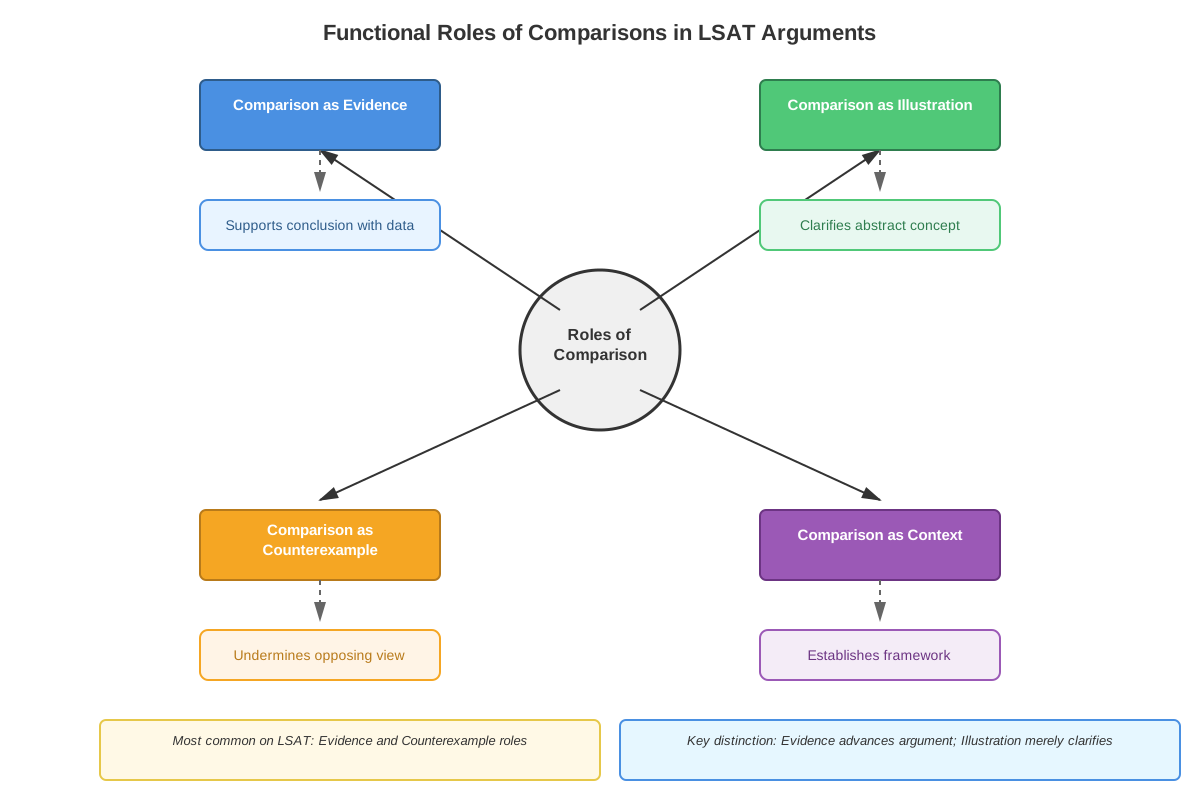
- [ ] Distinguish between different types of comparative functions within arguments (evidence, illustration, counterexample, context)
- [ ] Recognize trigger language that signals role of comparison questions
- [ ] Evaluate answer choices by matching them precisely to the comparative element's actual function
- [ ] Analyze complex arguments containing multiple comparisons and determine each comparison's distinct role
Prerequisites
- Basic argument structure: Understanding premises, conclusions, and how they relate is essential because role questions require identifying where comparisons fit within this framework
- Familiarity with evidence types: Recognizing different forms of support (examples, statistics, analogies) helps distinguish how comparisons function as evidence versus other roles
- Understanding of logical indicators: Knowledge of conclusion indicators ("therefore," "thus") and premise indicators ("because," "since") enables accurate identification of where comparisons appear in argument flow
- Basic reading comprehension: The ability to parse complex sentences and identify main ideas is necessary before analyzing the specific role of comparative elements
Why This Topic Matters
Role of comparison questions appear with significant frequency on the LSAT, typically comprising 2-4 questions per exam across the Logical Reasoning sections. These questions test a critical analytical skill that law schools value highly: the ability to dissect complex arguments and understand how each component contributes to the overall reasoning. In legal practice, attorneys must constantly analyze how different pieces of evidence, precedents, and arguments function within larger legal frameworks—exactly the skill that role of comparison questions assess.
On the LSAT, role of comparison appears most commonly in three question types: explicit role questions that ask "The comparison to X serves which function?", method of reasoning questions where understanding the comparison's role is necessary to identify the overall argumentative strategy, and structure questions where the comparison represents one element of the argument's architecture. These questions typically appear in the medium-to-difficult range, with correct answer rates often falling between 45-65%, making them excellent opportunities for prepared students to gain competitive advantage.
In real-world applications, the analytical skills developed through mastering role of comparison extend far beyond standardized testing. Legal professionals regularly encounter arguments that use comparisons to establish precedent, distinguish cases, provide context for novel situations, or support policy recommendations. Understanding whether a comparison functions as direct evidence, an illustrative example, a contrasting case, or background information directly impacts how one evaluates and responds to legal arguments. This same skill applies to policy analysis, business strategy, and any field requiring sophisticated critical thinking about complex arguments.
Core Concepts
Understanding Role Questions
Role questions ask test-takers to identify what function a specific statement, claim, or element serves within an argument's logical structure. When these questions focus on comparisons, they're testing whether students can recognize how comparative statements contribute to the argument's reasoning. The key distinction is that role questions don't ask whether the comparison is valid, true, or effective—only what purpose it serves in the argument as constructed.
Role of comparison questions typically present an argument containing one or more comparative statements, then ask about a specific comparison's function. The question stem might read: "The comparison between X and Y serves primarily to..." or "The author's reference to X in relation to Y functions in the argument to..." These questions require students to step back from evaluating the argument's merit and instead analyze its architecture.
Types of Comparative Functions
Comparisons in LSAT arguments serve several distinct functions, and recognizing these categories is crucial for selecting correct answers:
Evidence for the Main Conclusion: The comparison directly supports the argument's primary claim. For example, if an argument concludes that Policy A will succeed, a comparison showing that Policy A resembles successful Policy B serves as evidence for this conclusion.
Illustrative Example: The comparison clarifies or demonstrates a point already established rather than providing independent support. If an argument claims that certain strategies are effective, a comparison to a specific instance where such a strategy worked illustrates rather than proves the claim.
Counterexample or Contrasting Case: The comparison introduces a situation that differs from the main subject, often to highlight distinctions or address potential objections. An argument might compare two scenarios to show why reasoning that applies to one doesn't apply to the other.
Background or Context: The comparison provides situational information that helps readers understand the argument's subject without directly supporting the conclusion. This might establish the significance of an issue or explain why the topic matters.
Intermediate Conclusion Support: In complex arguments with multiple layers, a comparison might support a subsidiary conclusion that itself supports the main conclusion, creating a chain of reasoning.
Analyzing Argument Structure with Comparisons
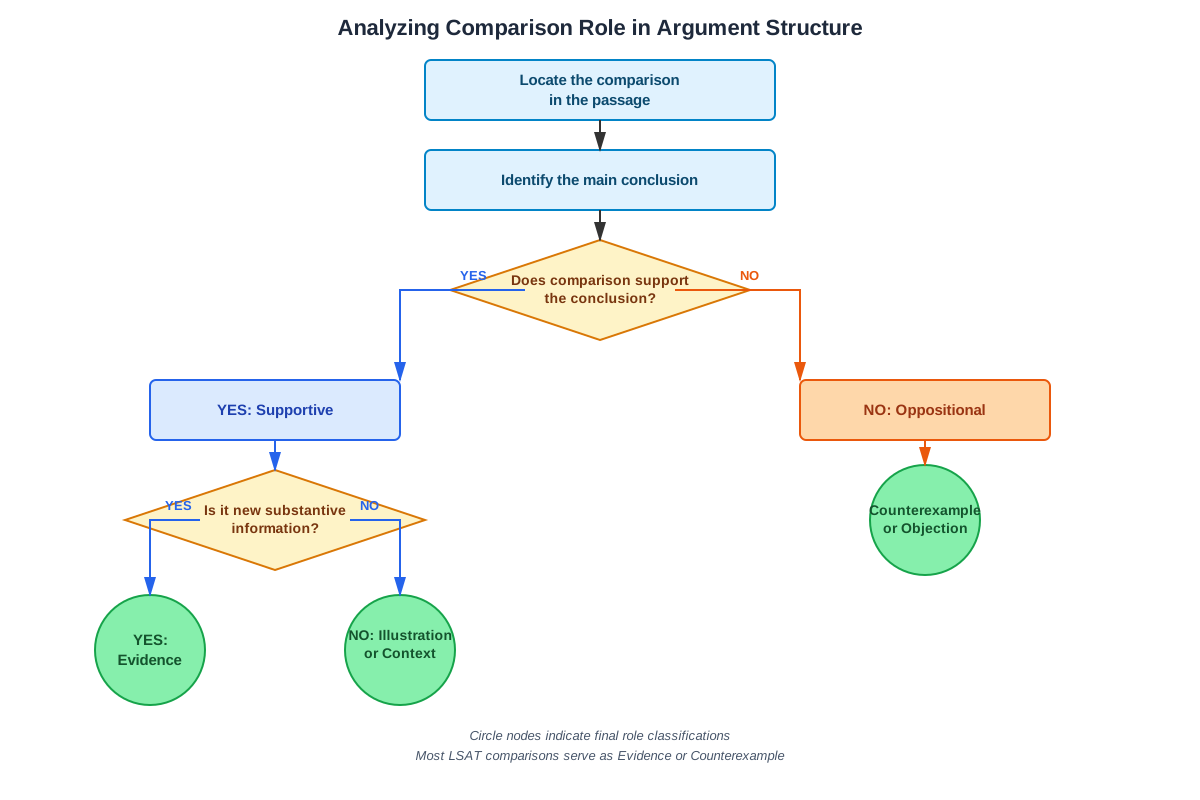
To identify a comparison's role accurately, students must first map the argument's overall structure. This process involves several steps:
- Identify the main conclusion: Determine what the argument ultimately aims to establish
- Locate all premises: Find every piece of evidence or reasoning offered in support
- Identify the comparison: Pinpoint the specific comparative statement in question
- Trace logical connections: Determine what the comparison directly supports or relates to
- Evaluate the relationship: Assess whether the comparison provides evidence, illustration, contrast, or context
Consider this structure: "Conclusion: X will succeed. Premise 1: X shares characteristics with Y. Premise 2: Y succeeded. Comparison: X is similar to Y in relevant ways." Here, the comparison functions as evidence by establishing a relevant similarity that supports the predictive conclusion.
Common Comparison Patterns
Certain comparison patterns appear repeatedly on the LSAT, and recognizing these patterns accelerates analysis:
| Pattern Type | Structure | Typical Function |
|---|---|---|
| Analogical | "X is like Y; Y has property P; therefore X has property P" | Direct evidence for conclusion |
| Contrastive | "Unlike X, Y has property P; therefore X lacks P" | Evidence through distinction |
| Illustrative | "For example, just as X relates to Y..." | Clarification of abstract point |
| Contextual | "Compared to previous situations..." | Background information |
| Precedential | "In similar case Y, outcome O occurred" | Evidence for predicted outcome |
Distinguishing Role from Method
While closely related, role questions differ from method of reasoning questions. Method questions ask about the overall argumentative strategy or technique employed throughout an argument ("The argument proceeds by..."), while role questions focus on what function a specific element serves. A comparison might be part of an argument that proceeds by analogy (method), while the comparison itself serves to provide evidence for an intermediate conclusion (role). Understanding this distinction prevents confusion when encountering questions that seem to blend these categories.
Precision in Answer Choice Matching
Role of comparison questions demand exceptional precision in matching answer choices to the comparison's actual function. Wrong answers often describe functions that sound plausible but don't accurately capture what the comparison does in the specific argument. Common traps include:
- Overstating the comparison's importance: An answer might claim the comparison establishes the main conclusion when it only supports a subsidiary point
- Misstating the direction of support: An answer might reverse what the comparison actually demonstrates
- Confusing illustration with evidence: An answer might claim the comparison proves something when it merely illustrates an already-established point
- Misidentifying the target: An answer might claim the comparison supports one claim when it actually supports a different one
Concept Relationships
The concepts within role of comparison form an interconnected analytical framework. Understanding role questions as a category provides the foundation for recognizing how comparative functions operate within arguments. The ability to analyze argument structure enables identification of where comparisons fit within the logical flow, which in turn allows accurate determination of their specific function. Recognizing common comparison patterns accelerates this analytical process by providing templates for quickly categorizing comparative statements.
This topic connects directly to prerequisite knowledge of argument structure: identifying premises and conclusions is necessary before determining what role a comparison plays in connecting them. The skill also builds toward more advanced Logical Reasoning tasks—understanding how comparisons function as evidence prepares students for assumption questions (what must be true for the comparison to support the conclusion?) and strengthening/weakening questions (how would additional information about the comparison affect the argument?).
The relationship map flows as follows: Basic Argument Structure → enables → Identifying Comparison Location → leads to → Determining Comparative Function → supports → Selecting Precise Answer Choice → develops → Advanced Argument Analysis Skills
High-Yield Facts
⭐ Role of comparison questions ask what function a comparative statement serves, not whether the comparison is valid or effective
⭐ The most common comparative functions are: evidence for conclusion, illustrative example, counterexample, background context, and intermediate conclusion support
⭐ Comparisons serving as evidence directly support a claim; comparisons serving as illustrations clarify an already-established point
⭐ Question stems typically include phrases like "serves to," "functions in the argument to," or "plays which role"
⭐ Wrong answers often overstate or understate the comparison's importance within the argument's structure
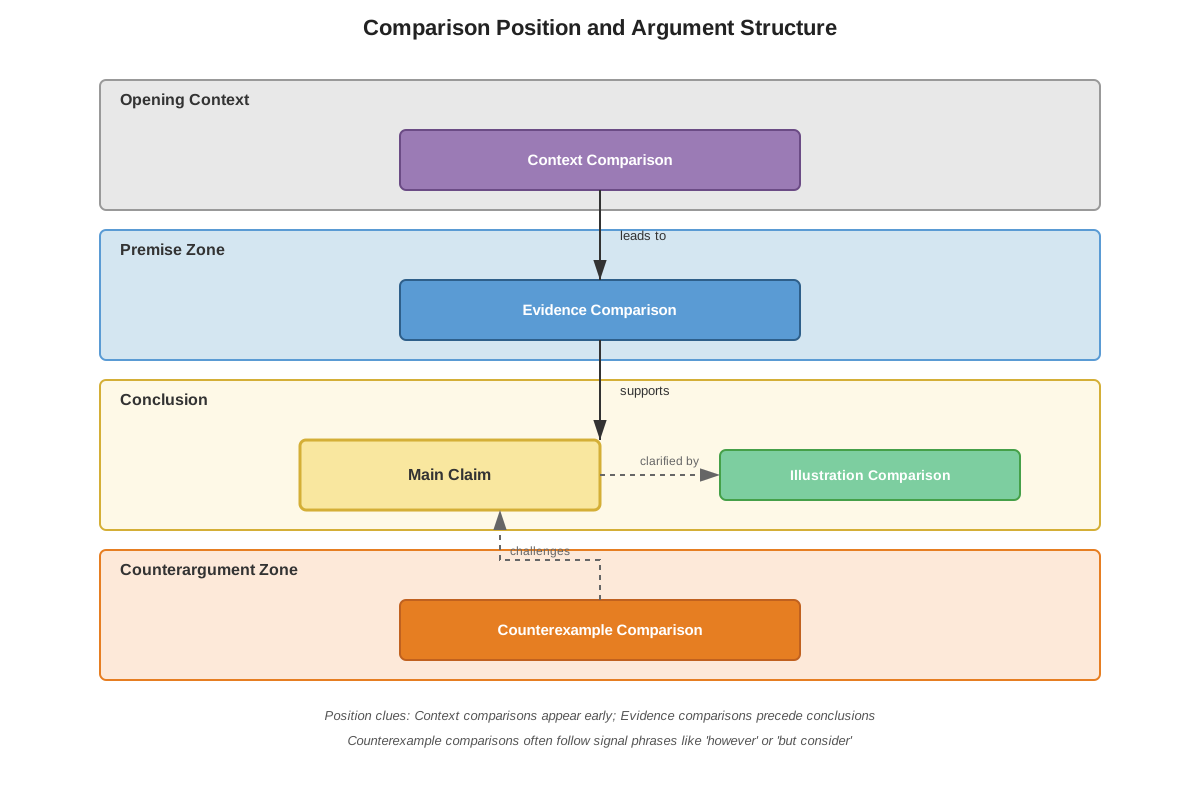
- Comparisons can appear in premises, conclusions, or background information, and their location affects their role
- Multiple comparisons in a single argument may serve different functions
- The same type of comparison (e.g., analogy) can serve different roles depending on argument structure
- Identifying the main conclusion first is essential for determining what the comparison supports
- Role questions require understanding the argument as written, not evaluating whether it should be structured differently
Quick check — test yourself on Role of comparison so far.
Try Flashcards →Common Misconceptions
Misconception: All comparisons in arguments serve as evidence for the main conclusion → Correction: Comparisons serve various functions including illustration, context-setting, addressing objections, and supporting intermediate conclusions. The specific role depends on the argument's structure and what claim the comparison most directly relates to.
Misconception: If a comparison appears early in the passage, it must be providing background or context → Correction: A comparison's position in the passage doesn't determine its logical role. A comparison in the first sentence might provide crucial evidence for the conclusion, while a comparison near the end might offer mere illustration. Logical function, not physical location, determines role.
Misconception: Analogies always function as direct evidence → Correction: While analogies often provide evidence, they can also serve illustrative purposes. An argument might establish a principle through other means, then use an analogy to help readers understand how that principle applies, making the analogy illustrative rather than evidential.
Misconception: The comparison's role is whatever the author says it is → Correction: Authors sometimes signal a comparison's intended role ("For example..." suggests illustration), but the actual logical function depends on how the comparison relates to other argument elements. A comparison introduced as an example might actually function as evidence if it's the primary support for a claim.
Misconception: If a comparison is between two similar things, it must be supporting the conclusion through analogy → Correction: Comparisons between similar things can serve multiple functions. They might provide context (showing the issue isn't unique), illustrate a point (demonstrating how a principle applies), or even introduce a contrasting case (showing that despite similarities, important differences exist).
Misconception: Role questions are asking for my evaluation of whether the comparison is effective → Correction: Role questions ask only what function the comparison serves in the argument as constructed, not whether it serves that function well. Even a weak or flawed comparison has a role, and identifying that role correctly is what the question tests.
Worked Examples
Example 1: Evidence vs. Illustration
Passage: "The proposed traffic management system will reduce congestion in our city. Similar systems have successfully reduced traffic in comparable cities like Springfield and Riverside, which share our population density and road infrastructure. Just as these cities saw 30% reductions in peak-hour delays, we can expect similar improvements. For instance, Springfield's implementation of timed traffic signals—much like what we're proposing—led to smoother traffic flow throughout the downtown area."
Question: The comparison to Springfield's timed traffic signals serves primarily to:
Analysis:
First, identify the main conclusion: "The proposed traffic management system will reduce congestion in our city."
Next, locate the comparisons:
- Comparison 1: Our city to Springfield and Riverside (similar systems, population density, road infrastructure)
- Comparison 2: Expected results to these cities' 30% reductions
- Comparison 3: Springfield's timed signals to our proposal
Now analyze each comparison's role:
- Comparisons 1 and 2 provide direct evidence for the conclusion by establishing relevant similarities and successful outcomes
- Comparison 3 (the question's focus) comes after the evidential comparisons and provides a specific instance
The key distinction: The argument has already established that similar systems work in similar cities. The Springfield traffic signals comparison doesn't add new evidence for the conclusion—it illustrates the type of improvement already claimed. The phrase "For instance" signals this illustrative function.
Correct Answer: "Provide a specific example of the type of improvement the argument predicts"
Why other answers fail:
- "Establish that the proposed system resembles successful systems" - This was already done by the earlier comparisons
- "Serve as the primary evidence for the conclusion" - The earlier comparisons serve this function; this one illustrates
- "Introduce a potential objection to the proposal" - The comparison supports rather than challenges the argument
Example 2: Intermediate Conclusion Support
Passage: "The university should adopt open-access publishing for faculty research. Traditional publishing restricts access to those who can afford expensive journal subscriptions, limiting the dissemination of knowledge. In contrast, open-access models make research freely available to anyone with internet access. This increased accessibility benefits society broadly, as evidenced by medical research: open-access medical studies reach practitioners in developing countries who couldn't otherwise access them, leading to improved patient care in those regions. Since academic research aims to advance knowledge and benefit society, and open-access publishing achieves these goals more effectively than traditional publishing, the university should embrace this model."
Question: The comparison between open-access and traditional publishing models serves to:
Analysis:
Map the argument structure:
- Main conclusion: "The university should adopt open-access publishing"
- Intermediate conclusion: "Open-access publishing achieves academic research goals more effectively"
- Supporting premises: Traditional publishing restricts access; open-access increases accessibility; increased accessibility benefits society
Locate the comparison: "Traditional publishing restricts access... In contrast, open-access models make research freely available"
Trace the logical connection: This comparison doesn't directly support the main conclusion (that the university should adopt open-access). Instead, it establishes a difference in accessibility, which supports the claim that open-access better achieves research goals, which then supports the main conclusion.
The medical research example serves a different function—it provides evidence that increased accessibility benefits society. The traditional vs. open-access comparison establishes the accessibility difference itself.
Correct Answer: "Establish a key difference that supports the claim that open-access publishing better serves academic research goals"
Why this is correct: The comparison supports an intermediate conclusion (open-access is more effective) rather than the main conclusion (the university should adopt it). This demonstrates how comparisons can function at different levels within complex arguments.
Exam Strategy
When approaching role of comparison questions on the LSAT, employ this systematic process:
Step 1: Identify the Question Type
Watch for trigger phrases: "serves to," "functions to," "plays which role," "the comparison to X is used to." These signal that you need to analyze function, not validity.
Step 2: Locate and Bracket the Comparison
Find the exact comparative statement referenced in the question. Bracket it or mark it clearly so you're analyzing the right element.
Step 3: Map the Argument Structure
Before determining the comparison's role, identify:
- The main conclusion (what is the argument ultimately trying to establish?)
- All premises and sub-conclusions
- The logical flow connecting these elements
Step 4: Determine Direct Connections
Ask: What does this comparison most directly support or relate to? Does it support the main conclusion, a subsidiary point, or provide context without supporting any specific claim?
Step 5: Categorize the Function
Place the comparison into one of the major categories: evidence, illustration, contrast/counterexample, context, or intermediate support.
Step 6: Pre-phrase an Answer
Before looking at answer choices, articulate in your own words what the comparison does. This prevents answer choices from misleading you.
Step 7: Eliminate and Select
Use process of elimination, watching for these common wrong answer patterns:
- Overstating importance (claiming the comparison establishes the main conclusion when it only supports a subsidiary point)
- Misstating direction (reversing what the comparison actually shows)
- Confusing function types (calling illustration "evidence" or vice versa)
- Referencing the wrong target (claiming the comparison supports X when it supports Y)
Exam Tip: If you're torn between two answers, one claiming the comparison "establishes" or "proves" something and another claiming it "illustrates" or "provides an example of" something, check whether the argument has already established that point through other means. If so, the comparison likely illustrates rather than establishes.
Time Allocation: Spend 1:15-1:30 on these questions. They require careful analysis but shouldn't consume excessive time. If you've correctly identified the argument structure, determining the comparison's role should follow naturally.
Memory Techniques
EPIC Framework for comparison functions:
- Evidence (directly supports a conclusion)
- Parallel example (illustrates an already-made point)
- Intermediate support (supports a sub-conclusion)
- Context (provides background without supporting specific claims)
The "Support Chain" Visualization: Picture the argument as a chain connecting premises to conclusion. When you identify a comparison, visualize which link in the chain it forms or strengthens. Does it connect directly to the conclusion (evidence), strengthen a middle link (intermediate support), or hang alongside the chain as decoration (illustration)?
Question Stem Triggers Mnemonic - "SURF":
- Serves to
- Used to
- Role in the argument
- Functions to
When you see these phrases, you know you're dealing with a role question.
The "Already Established" Test: For distinguishing evidence from illustration, ask: "Has the argument already established this point through other means?" If yes, the comparison likely illustrates. If no, it likely provides evidence. Remember: Already established = Illustration (A comes before I alphabetically, helping you remember the connection).
Summary
Role of comparison questions test the ability to identify what function comparative statements serve within LSAT Logical Reasoning arguments. These questions require students to analyze argument structure, locate specific comparisons, and determine whether those comparisons provide evidence for conclusions, illustrate already-established points, introduce contrasts, supply context, or support intermediate conclusions. Success depends on distinguishing between different comparative functions and matching answer choices precisely to the comparison's actual role rather than its intended or potential role. The key analytical skill involves mapping the argument's logical structure first, then determining what the comparison most directly supports or relates to within that structure. Common pitfalls include confusing illustration with evidence, overstating the comparison's importance, and selecting answers that describe plausible but inaccurate functions. Mastering this topic requires systematic analysis, precise answer matching, and understanding that role questions ask what function an element serves, not whether it serves that function effectively.
Key Takeaways
- Role of comparison questions ask what function a comparative statement serves in an argument's logical structure, not whether the comparison is valid or effective
- The five primary comparative functions are: evidence for conclusion, illustrative example, counterexample/contrast, background context, and intermediate conclusion support
- Always map the argument's overall structure before determining a comparison's specific role
- Comparisons that provide evidence directly support a claim not yet established; comparisons that illustrate clarify or demonstrate an already-established point
- Wrong answers frequently overstate the comparison's importance, misstate what it supports, or confuse different functional categories
- Trigger phrases like "serves to," "functions to," and "plays which role" signal role questions requiring functional analysis
- Precision in answer matching is critical—select the answer that describes exactly what the comparison does, not what it might do or could do
Related Topics
Method of Reasoning Questions: These questions ask about the overall argumentative strategy employed in a passage. Mastering role of comparison provides foundation for understanding how specific elements contribute to broader methods like reasoning by analogy, arguing through counterexample, or supporting claims through parallel cases.
Argument Structure Questions: These questions require identifying how an argument's components fit together. Understanding comparison roles is essential for these questions when comparative statements appear as key structural elements.
Assumption Questions: Once you understand what role a comparison plays, you can more easily identify what must be assumed for that comparison to successfully serve its function—a critical skill for assumption questions involving comparative reasoning.
Strengthen and Weaken Questions: Knowing whether a comparison serves as evidence, illustration, or another function helps determine what additional information would strengthen or weaken its contribution to the argument.
Practice CTA
Now that you've mastered the core concepts of role of comparison, it's time to put your knowledge into practice. Work through the practice questions to reinforce your ability to identify comparative functions quickly and accurately. Use the flashcards to drill the key distinctions between evidence and illustration, and between different types of comparative roles. Remember: understanding these concepts intellectually is just the first step—developing the speed and accuracy to apply them under timed conditions is what will elevate your LSAT score. Each practice question you complete strengthens your pattern recognition and builds the analytical reflexes you need for test day success.
Sign up free to keep reading
Create a free AnvayaPrep account to finish this LSAT guide on Role of comparison — plus flashcards and practice questions.