Overview
The role of concession is a critical argumentative technique that appears frequently in LSAT Logical Reasoning sections, particularly within method, role, and structure questions. A concession occurs when an author acknowledges a point that appears to weaken their own argument or supports an opposing viewpoint, but then proceeds to argue for their conclusion anyway. Understanding how concessions function within arguments is essential for success on the LSAT because these questions test your ability to analyze the structural components of reasoning and identify how different statements contribute to an argument's overall logic.
On the LSAT, recognizing concessions helps you navigate complex arguments where authors strategically acknowledge counterpoints before refuting them or demonstrating why their conclusion still holds despite apparent weaknesses. This argumentative move serves multiple purposes: it can make an argument appear more balanced and reasonable, preemptively address objections, or set up a contrast that strengthens the author's ultimate position. Questions about the role of concession typically ask you to identify what function a particular statement serves within the argument's structure, requiring you to distinguish between premises that support the conclusion, concessions that acknowledge opposing views, and rebuttals that counter those concessions.
Within the broader landscape of Logical Reasoning, understanding concessions connects directly to your ability to analyze argument structure, identify conclusions and premises, recognize counterarguments, and evaluate the strength of reasoning. This skill is foundational for multiple question types beyond role questions, including strengthen/weaken questions, method of reasoning questions, and parallel reasoning questions. Mastering the role of concession enhances your overall ability to dissect complex arguments and understand how authors build persuasive cases even when acknowledging potential weaknesses.
Learning Objectives
- [ ] Identify how Role of concession appears in LSAT questions
- [ ] Explain the reasoning pattern behind Role of concession
- [ ] Apply Role of concession to solve LSAT-style problems accurately
- [ ] Distinguish concessions from other argument components such as premises, conclusions, and counterarguments
- [ ] Recognize common linguistic markers that signal concessions in LSAT passages
- [ ] Evaluate how concessions strengthen or weaken arguments depending on their context and follow-up
- [ ] Predict answer choices that correctly describe the role of a concession within an argument
Prerequisites
- Basic argument structure: Understanding the distinction between premises and conclusions is essential because concessions function as a specific type of statement within arguments that neither directly supports nor constitutes the main conclusion.
- Counterargument recognition: Familiarity with opposing viewpoints helps distinguish between concessions (acknowledgments of opposing points) and the author's own supporting evidence.
- Conditional reasoning fundamentals: Many concessions involve conditional statements or exceptions, requiring comfort with "if-then" logic and understanding how qualifications affect claims.
- Question stem identification: Knowing how to recognize role questions versus other Logical Reasoning question types ensures proper approach and strategy application.
Why This Topic Matters
Understanding the role of concession has significant real-world applications beyond test-taking. In legal reasoning, attorneys regularly acknowledge weaknesses in their cases before explaining why their position should prevail anyway. In academic writing, scholars demonstrate intellectual honesty by acknowledging counterevidence while maintaining their thesis. In business negotiations, effective communicators concede minor points to build credibility while preserving their core objectives. This argumentative technique reflects sophisticated reasoning that balances acknowledgment of complexity with persuasive advocacy.
On the LSAT, role of concession questions appear with notable frequency, typically comprising 2-4 questions per test across both Logical Reasoning sections. These questions most commonly appear as "role" or "method of reasoning" questions, with stems like "The claim that X plays which one of the following roles in the argument?" or "The author mentions Y in order to..." When a concession is involved, the correct answer typically describes how the author acknowledges a point contrary to their conclusion before proceeding with their argument.
The LSAT tests this concept in several characteristic ways: passages may contain explicit concessions using signal words like "admittedly," "granted," or "although"; implicit concessions where the author acknowledges a limitation without explicit markers; and complex arguments where multiple concessions appear at different structural points. Questions may ask about the role of the concession itself, the role of the statement that follows the concession (often a rebuttal or qualification), or how the concession relates to the argument's overall structure. Recognizing these patterns enables efficient and accurate question analysis.
Core Concepts
Definition and Function of Concessions
A concession in logical reasoning is a statement where an author acknowledges a point that appears to undermine, weaken, or contradict their own position or that supports an opposing viewpoint. The key characteristic distinguishing concessions from other argument components is that they temporarily grant validity to a claim that runs counter to the author's ultimate conclusion. However, concessions are strategic rhetorical moves—authors make them not to abandon their position but to demonstrate awareness of complexity, build credibility, or set up a more nuanced argument.
The function of a concession within an argument structure is multifaceted. First, it serves to preemptively address potential objections, showing that the author has considered alternative perspectives. Second, it can make an argument appear more balanced and reasonable, potentially increasing its persuasiveness. Third, concessions often set up contrasts that actually strengthen the author's position by showing that even when acknowledging certain points, the conclusion still follows. Finally, concessions can narrow the scope of an argument, clarifying exactly what the author is and is not claiming.
Structural Patterns of Concession
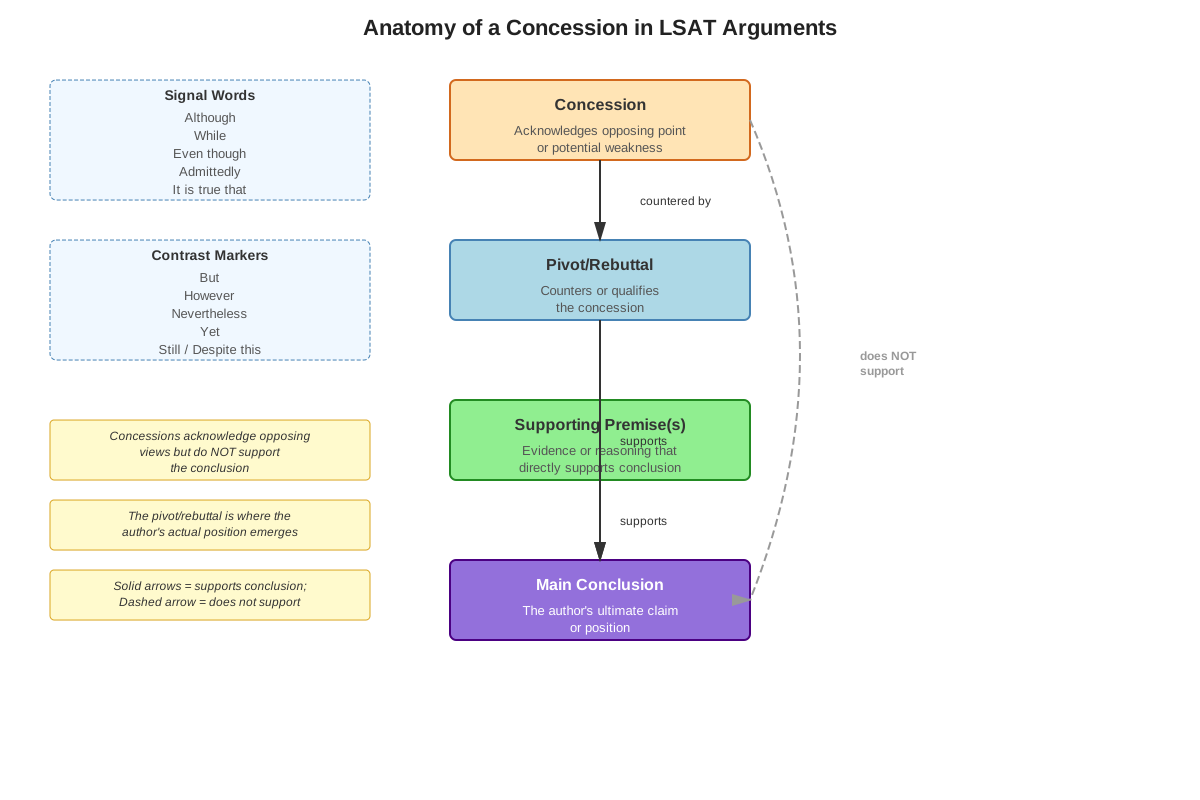
Concessions follow predictable structural patterns in LSAT arguments. The most common pattern is the concession-rebuttal structure: the author acknowledges a contrary point (concession), then uses transition words like "however," "nevertheless," "but," or "yet" to introduce a statement that counters the concession or explains why the conclusion holds despite it. For example: "Although the new policy may increase costs in the short term [concession], it will ultimately save money by preventing more expensive problems later [rebuttal supporting conclusion]."
Another common pattern is the concession-qualification structure, where the author acknowledges a general point but then qualifies or limits its applicability. For instance: "While it's true that exercise benefits most people [concession], individuals with certain medical conditions should avoid strenuous activity [qualification that narrows the claim]." This pattern helps authors make precise claims while acknowledging broader truths.
A third pattern is the concession-despite structure, where the conclusion explicitly states that it holds despite the conceded point. Signal phrases include "despite," "in spite of," "even though," and "notwithstanding." For example: "Despite the high initial investment [concession], the project should proceed because the long-term benefits outweigh the costs [conclusion]."
Linguistic Markers of Concessions
Recognizing linguistic markers that signal concessions dramatically improves efficiency in identifying these argument components. Common concession indicators include:
Explicit concession words:
- Although, though, even though
- While, whereas
- Granted, admittedly
- It is true that, certainly
- To be sure, no doubt
- Despite, in spite of
Phrases acknowledging opposing views:
- Critics argue that...
- Some may object that...
- It might be said that...
- One could claim that...
Qualifying language:
- May, might, could
- In some cases, sometimes
- To some extent, partially
When these markers appear, the statement they introduce often functions as a concession, though context always determines the precise role. The statement following the concession typically contains the author's actual position, often introduced by contrastive conjunctions like "however," "but," "nevertheless," or "yet."
Distinguishing Concessions from Similar Elements
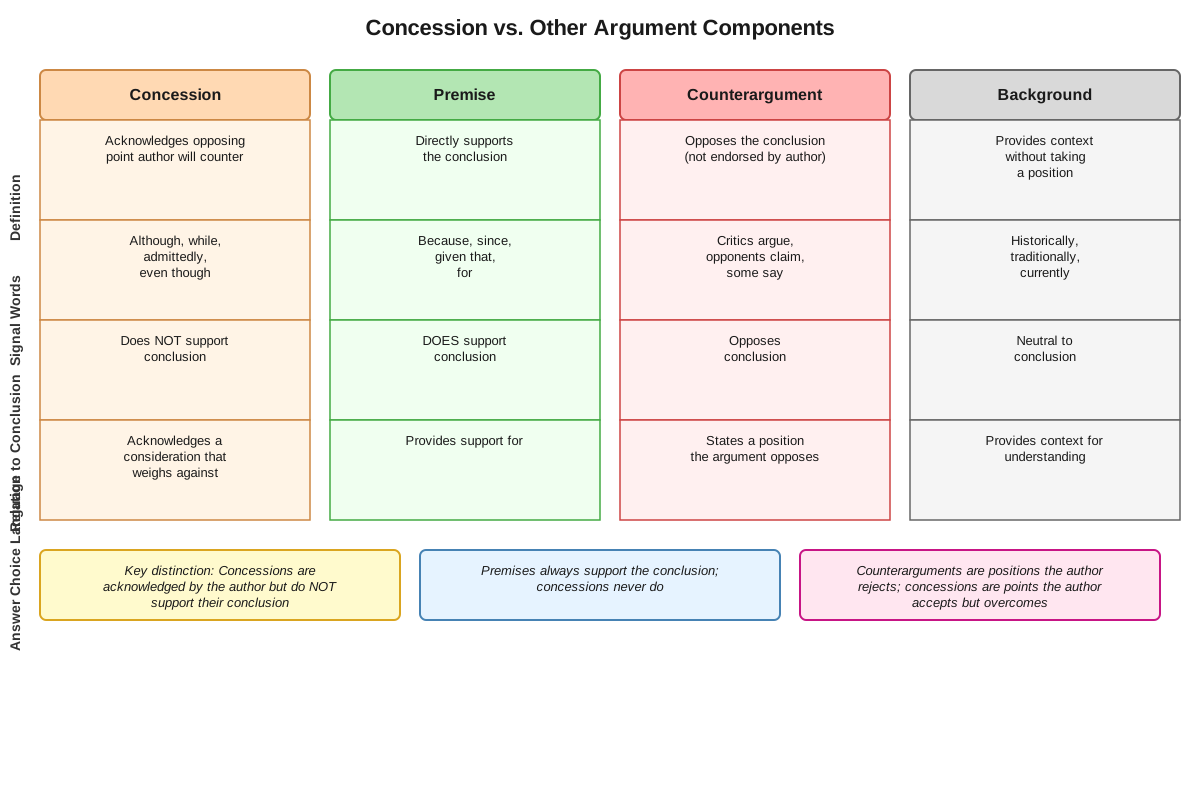
Understanding what concessions are not is as important as understanding what they are. The following table clarifies key distinctions:
| Element | Definition | Relationship to Conclusion | Example |
|---|---|---|---|
| Concession | Acknowledges a point contrary to or potentially weakening the conclusion | Appears to oppose but is strategically acknowledged | "Although the plan is expensive..." |
| Premise | Provides direct support for the conclusion | Supports and leads to conclusion | "The plan will save lives, so..." |
| Counterargument | An opposing position the author rejects | Directly opposes conclusion; author argues against it | "Some claim the plan won't work, but they're wrong because..." |
| Background/Context | Neutral information setting up the argument | Neither supports nor opposes | "The plan was proposed last year..." |
| Intermediate Conclusion | A sub-conclusion supporting the main conclusion | Supports ultimate conclusion | "Therefore, the plan is feasible, which means we should implement it" |
The critical distinction is that concessions acknowledge validity in a contrary point without the author fully rejecting it, whereas counterarguments are opposing views the author actively refutes. Premises always support the conclusion, while concessions appear to undermine it before the author explains why the conclusion holds anyway.
Role Questions and Concessions
When the LSAT asks about the role of a concession, correct answer choices typically describe the statement as:
- Acknowledging a consideration that might be taken to weaken the argument
- Conceding a point that appears to support an opposing position
- Granting a claim that the argument nevertheless goes on to challenge or qualify
- Acknowledging a potential objection before responding to it
- Presenting a consideration that the argument seeks to show is outweighed by other factors
Incorrect answer choices often mischaracterize concessions as:
- Direct support for the conclusion (confusing concession with premise)
- The main conclusion itself
- Evidence that undermines the argument (failing to recognize the strategic nature of concessions)
- A claim the author rejects entirely (confusing concession with counterargument)
Strategic Use of Concessions in Arguments
Authors employ concessions strategically to strengthen their overall arguments. By acknowledging potential weaknesses or opposing viewpoints, authors demonstrate intellectual honesty and thoroughness, which can make their conclusions more persuasive. This technique is particularly effective in legal and academic contexts where audiences expect balanced consideration of multiple perspectives.
Concessions also allow authors to narrow their claims precisely. Rather than making overly broad assertions vulnerable to counterexamples, authors can concede exceptions while maintaining their core position. For example, instead of claiming "All businesses benefit from social media marketing," an author might concede "While some businesses may not benefit from social media marketing [concession], most companies in consumer-facing industries see significant returns on such investments [qualified conclusion]."
Additionally, concessions set up effective contrasts. By first acknowledging a contrary point, authors create a rhetorical structure where their subsequent rebuttal or qualification appears more forceful. The pattern "Yes, X is true, but Y is more important" leverages the concession to emphasize the strength of the author's actual position.
Concept Relationships
The role of concession connects intimately with multiple aspects of argument analysis. At the foundational level, understanding argument structure (premises, conclusions, and their relationships) enables recognition of how concessions fit within the overall logical framework. A concession is neither a standard premise nor the conclusion, but rather a special structural element that acknowledges contrary considerations.
The relationship flows as follows: Argument Structure → enables identification of → Concessions → which often precede → Rebuttals or Qualifications → which support → Conclusions. This chain shows how concessions function as intermediate steps in complex arguments.
Concessions also connect closely to counterargument analysis. While counterarguments are opposing positions that authors refute, concessions are acknowledgments of valid points that might support counterarguments. The distinction is subtle but crucial: Counterargument (opposing view) ← partially acknowledged by → Concession ← responded to by → Rebuttal → supporting → Conclusion.
Furthermore, understanding concessions enhances performance on strengthen/weaken questions. Recognizing that an author has already conceded certain points helps identify what would genuinely strengthen or weaken the argument versus what the author has already addressed. Similarly, method of reasoning questions often test whether you recognize that an author has employed the concession-rebuttal pattern as their argumentative strategy.
The concept also relates to conditional reasoning because concessions often involve qualifications and exceptions that create conditional relationships. For example, "Although X is generally true [concession], when Y occurs, Z follows instead [qualified conditional claim]."
High-Yield Facts
⭐ Concessions acknowledge points that appear to weaken or contradict the author's conclusion, but the author proceeds with their argument anyway.
⭐ Common linguistic markers of concessions include "although," "while," "granted," "admittedly," "to be sure," and "despite."
⭐ The concession-rebuttal pattern is the most frequent structure: concession followed by "however," "but," "nevertheless," or "yet" introducing the author's actual position.
⭐ Concessions are NOT premises—they do not directly support the conclusion; instead, they acknowledge contrary considerations.
⭐ Correct answers describing concessions typically use phrases like "acknowledges a consideration that might be taken to weaken" or "concedes a point before arguing for the conclusion anyway."
- Concessions make arguments appear more balanced and reasonable by demonstrating the author has considered alternative perspectives.
- The statement immediately following a concession often contains the author's main point or a rebuttal to the conceded point.
- Concessions differ from counterarguments: concessions acknowledge validity in a contrary point, while counterarguments are opposing views the author actively refutes.
- Authors use concessions strategically to narrow claims, preempt objections, and set up effective contrasts.
- Role questions about concessions frequently appear 2-4 times per LSAT test across both Logical Reasoning sections.
- Implicit concessions (without explicit markers) require careful attention to context and the relationship between statements.
- Concessions can appear at various points in an argument: beginning (before the main argument), middle (interrupting the flow), or even after the conclusion (acknowledging limitations).
Quick check — test yourself on Role of concession so far.
Try Flashcards →Common Misconceptions
Misconception: Concessions weaken arguments and should be avoided.
Correction: Concessions actually strengthen arguments by demonstrating intellectual honesty, preempting objections, and showing that the conclusion holds even when acknowledging contrary points. Strategic concessions make arguments more persuasive and nuanced.
Misconception: Any statement using "although" or "while" is automatically a concession.
Correction: While these words often signal concessions, context determines function. "Although" can also introduce background information or contrast without conceding a point contrary to the conclusion. Always analyze the relationship between the statement and the argument's conclusion.
Misconception: Concessions and counterarguments are the same thing.
Correction: Concessions acknowledge validity in a point that might oppose the conclusion, while counterarguments are opposing positions that the author actively refutes or rejects. Concessions say "yes, this is true, but..."; counterarguments say "some claim this, but they're wrong because..."
Misconception: If an author concedes a point, they're abandoning their position on that issue.
Correction: Concessions are strategic acknowledgments, not abandonments. Authors concede specific points while maintaining their overall conclusion, often explaining why the conclusion holds despite the conceded point or why other considerations outweigh it.
Misconception: The concession is always the first statement in an argument.
Correction: While concessions often appear early to set up the main argument, they can appear anywhere in the argument structure—beginning, middle, or end. Some arguments even contain multiple concessions at different points.
Misconception: Concessions always require explicit rebuttal.
Correction: Not all concessions are followed by explicit rebuttals. Sometimes authors concede a point simply to narrow their claim or acknowledge complexity without directly arguing against the conceded point. The conclusion may simply be compatible with the concession rather than opposing it.
Worked Examples
Example 1: Identifying a Concession's Role
Passage: "Although implementing the new software system will require significant upfront training costs and may temporarily reduce productivity, the company should proceed with the implementation. The long-term efficiency gains will far exceed the short-term costs, and delaying further will only make the eventual transition more difficult as our current system becomes increasingly outdated."
Question: The claim that implementing the new software system will require significant upfront training costs and may temporarily reduce productivity plays which one of the following roles in the argument?
Answer Choices:
(A) It is the main conclusion of the argument.
(B) It provides direct support for the argument's conclusion.
(C) It acknowledges considerations that might be taken to weaken the argument's conclusion.
(D) It states an objection that the argument goes on to reject as invalid.
(E) It provides background information that contextualizes the argument.
Solution:
Step 1: Identify the conclusion. The conclusion is signaled by "should": "the company should proceed with the implementation." This is what the author is ultimately arguing for.
Step 2: Analyze the role of the statement in question. The statement about "significant upfront training costs" and "temporarily reduce productivity" appears after "Although," a classic concession marker. These are negative consequences that would seem to argue against implementation.
Step 3: Determine the relationship to the conclusion. The statement acknowledges points that would appear to weaken the case for implementation (the conclusion), but the author proceeds to argue for implementation anyway, explaining why these costs are outweighed by long-term benefits.
Step 4: Evaluate answer choices:
- (A) is incorrect—this is not the conclusion; the conclusion is that the company should proceed.
- (B) is incorrect—this statement does not support the conclusion; it presents considerations against it.
- (C) is correct—this perfectly describes a concession: acknowledging considerations that might weaken the conclusion.
- (D) is incorrect—the author doesn't reject these points as invalid; they acknowledge them as real but outweighed by other factors.
- (E) is incorrect—this is not neutral background; it presents specific considerations against the conclusion.
Answer: (C)
Connection to Learning Objectives: This example demonstrates how to identify concessions through linguistic markers ("Although"), distinguish them from premises and conclusions, and recognize the correct characterization in answer choices ("acknowledges considerations that might be taken to weaken").
Example 2: Complex Concession-Rebuttal Structure
Passage: "Some critics argue that the city's new bike lane initiative will increase traffic congestion by reducing available lanes for cars. While it is true that the immediate effect may include some traffic slowdowns during peak hours, this criticism fails to account for the long-term benefits. Studies from similar cities show that comprehensive bike infrastructure ultimately reduces overall traffic as more commuters shift to cycling. Moreover, the health and environmental benefits of increased cycling far outweigh the minor inconvenience of slightly longer commute times for drivers."
Question: The author's statement that "the immediate effect may include some traffic slowdowns during peak hours" serves primarily to
Answer Choices:
(A) present the main conclusion that the argument is designed to establish
(B) concede a point raised by critics before arguing that it is outweighed by other considerations
(C) provide evidence that directly supports the argument's conclusion
(D) describe a consequence that the argument claims will not actually occur
(E) introduce a counterargument that the argument will demonstrate is based on faulty reasoning
Solution:
Step 1: Identify the overall argument structure. The author is arguing in favor of the bike lane initiative despite critics' concerns. The conclusion is implicit but clear: the bike lane initiative is worthwhile or should proceed.
Step 2: Locate the statement in question within the structure. It appears after "While it is true that," a concession marker. The statement acknowledges that traffic slowdowns may occur—a point that supports the critics' position.
Step 3: Analyze what follows. After conceding this point, the author uses "this criticism fails to account for" and "Moreover" to introduce rebuttals and considerations that outweigh the conceded slowdowns.
Step 4: Evaluate answer choices:
- (A) is incorrect—this is not the conclusion; it's a point against the author's position.
- (B) is correct—the author concedes the critics' point about slowdowns but then argues other benefits outweigh this concern.
- (C) is incorrect—this doesn't support the conclusion; it's a negative consequence the author acknowledges.
- (D) is incorrect—the author doesn't deny slowdowns will occur; they concede they may happen.
- (E) is incorrect—the author doesn't claim this point is based on faulty reasoning; they acknowledge it as valid but outweighed.
Answer: (B)
Connection to Learning Objectives: This example shows how concessions can acknowledge points raised by critics, demonstrates the concession-rebuttal pattern with multiple rebuttals following the concession, and illustrates how to distinguish concessions from counterarguments that are rejected as invalid.
Exam Strategy
When approaching LSAT questions involving the role of concession, follow this systematic process:
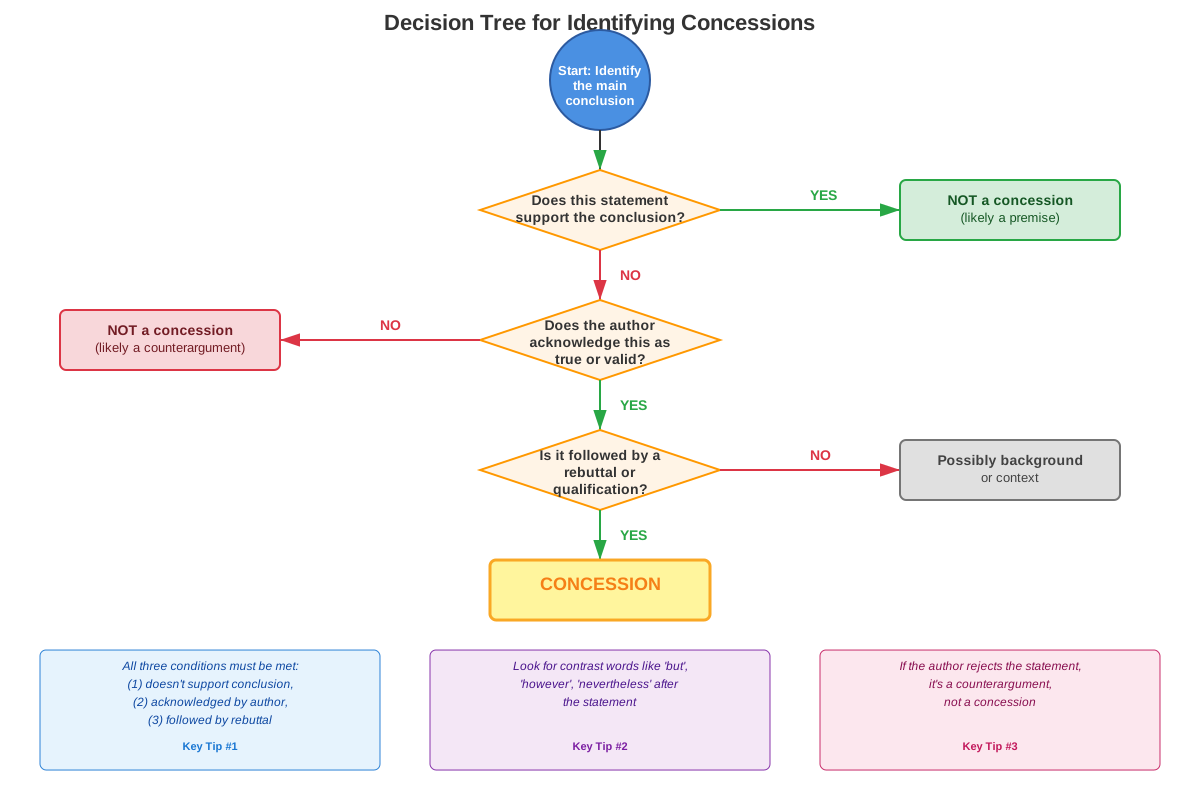
Step 1: Identify the conclusion first. Before analyzing any statement's role, determine what the author is ultimately arguing for. This provides the reference point for understanding whether a statement supports, opposes, or acknowledges contrary considerations regarding that conclusion.
Step 2: Look for linguistic markers. Scan for concession indicators like "although," "while," "granted," "admittedly," "to be sure," "despite," and "it is true that." When these appear, the following statement likely functions as a concession. Pay special attention to what comes after contrastive conjunctions like "however," "but," "nevertheless," and "yet"—this often contains the author's actual position.
Step 3: Apply the "appears to weaken" test. Ask yourself: "Does this statement present a consideration that would seem to argue against the conclusion?" If yes, and the author acknowledges it without fully rejecting it, you've likely identified a concession.
Step 4: Distinguish from premises and counterarguments. Verify that the statement doesn't directly support the conclusion (which would make it a premise) and that the author isn't rejecting it as invalid (which would make it a counterargument being refuted). Concessions occupy the middle ground: acknowledged as having some validity but not undermining the conclusion.
Step 5: Predict answer language. Before looking at choices, predict that the correct answer will describe the statement as "acknowledging," "conceding," "granting," or "admitting" a point that "might be taken to weaken," "appears to oppose," or "could support an objection to" the conclusion.
Process of elimination tips:
- Eliminate answers describing the statement as the conclusion itself
- Eliminate answers claiming the statement directly supports the conclusion
- Eliminate answers saying the author rejects the statement as false or invalid
- Eliminate answers describing the statement as neutral background information when it clearly relates to the conclusion's strength
Time allocation: Role questions, including those about concessions, should typically take 60-90 seconds. If you've identified the conclusion and recognized the concession markers, you can move quickly. If the structure is complex, invest the extra 20-30 seconds to map the argument carefully—accuracy matters more than speed.
Exam Tip: When you see "although," "while," or "granted" in an LSAT argument, immediately mark that statement and note what follows the contrastive conjunction. This structure appears in 15-20% of Logical Reasoning passages and is highly testable.
Memory Techniques
Mnemonic for Concession Markers - "AWGAD":
- Although / Admittedly
- While
- Granted
- Admittedly (also: "it is true that")
- Despite
Visualization Strategy: Picture a concession as a "strategic retreat" in a debate. The arguer takes one step backward (acknowledging a contrary point) to set up a stronger forward movement (the rebuttal or main argument). This visual helps remember that concessions are tactical moves, not abandonments of position.
The "Yes, But" Pattern: Remember that concessions typically follow a "Yes, But" structure:
- Yes (concession): "I acknowledge this contrary point"
- But (rebuttal/main argument): "However, my conclusion still holds because..."
When you see this pattern, you've identified a concession-rebuttal structure.
Acronym for Distinguishing Elements - "CPRB":
- Concession: Acknowledges contrary point
- Premise: Supports conclusion
- Rebuttal: Responds to concession or counterargument
- Background: Neutral context
The "Appears to Weaken" Touchstone: Create a mental touchstone question: "Does this statement appear to weaken the conclusion, yet the author acknowledges it anyway?" If yes, it's likely a concession. This single question can quickly identify concessions even without explicit markers.
Summary
The role of concession represents a sophisticated argumentative technique where authors strategically acknowledge points that appear to weaken their conclusions or support opposing viewpoints, yet proceed with their arguments anyway. Mastering this concept requires understanding that concessions are neither premises (which support conclusions) nor counterarguments (which authors reject), but rather acknowledged contrary considerations that demonstrate intellectual honesty and set up effective rebuttals. The most common structural pattern is concession-rebuttal, typically signaled by markers like "although," "while," or "granted," followed by contrastive conjunctions like "however" or "but" introducing the author's actual position. On the LSAT, role of concession questions test your ability to identify these structural elements and distinguish them from other argument components. Success requires recognizing linguistic markers, understanding the strategic function of concessions in strengthening arguments, and predicting answer choices that accurately describe statements as "acknowledging considerations that might be taken to weaken" the conclusion. This skill is essential not only for role questions but for comprehensive argument analysis across all Logical Reasoning question types.
Key Takeaways
- Concessions acknowledge points that appear to weaken or contradict the author's conclusion, but the author argues for their conclusion anyway—they are strategic rhetorical moves, not abandonments of position.
- The concession-rebuttal pattern (concession + "however/but/nevertheless" + rebuttal) is the most frequently tested structure on the LSAT.
- Linguistic markers like "although," "while," "granted," "admittedly," and "despite" reliably signal concessions and should trigger immediate recognition.
- Concessions differ from premises (which support conclusions) and counterarguments (which authors reject); they occupy a middle ground of acknowledged contrary considerations.
- Correct answer choices for concession role questions typically describe statements as "acknowledging considerations that might be taken to weaken" or "conceding a point before arguing for the conclusion anyway."
- Always identify the conclusion first before analyzing any statement's role—this provides the reference point for understanding whether a statement functions as a concession.
- Concessions strengthen arguments by demonstrating thoroughness, preempting objections, and showing that conclusions hold even when acknowledging contrary points.
Related Topics
Counterargument Analysis: Understanding how authors present and refute opposing viewpoints builds directly on concession recognition. While concessions acknowledge valid contrary points, counterargument analysis involves identifying opposing positions that authors actively reject. Mastering concessions provides the foundation for distinguishing between acknowledged limitations and rejected alternatives.
Strengthen and Weaken Questions: Recognizing concessions helps identify what would genuinely strengthen or weaken arguments versus what authors have already addressed. When an author has conceded a point, answer choices exploiting that concession may be less effective than those addressing unacknowledged vulnerabilities.
Method of Reasoning Questions: These questions often test whether you recognize that an author has employed specific argumentative strategies, including the concession-rebuttal pattern. Understanding concessions enables you to identify and describe these methods accurately.
Argument Structure Mapping: Advanced argument analysis involves creating mental or written maps of how premises, concessions, rebuttals, and conclusions relate. Mastering concessions is essential for complete structural understanding.
Parallel Reasoning Questions: These questions require matching argument structures, including concession patterns. Recognizing when and how concessions appear in the original argument helps identify parallel structures in answer choices.
Practice CTA
Now that you've mastered the role of concession, it's time to put your knowledge into practice. Attempt the practice questions and flashcards to reinforce these concepts and build the pattern recognition skills essential for LSAT success. Remember, understanding the theory is just the first step—consistent practice with real LSAT-style questions transforms knowledge into the automatic recognition and analysis skills that lead to top scores. Each practice question you work through strengthens your ability to spot concessions instantly and analyze their roles accurately under timed conditions. You've built a solid foundation; now make it instinctive through deliberate practice.
Sign up free to keep reading
Create a free AnvayaPrep account to finish this LSAT guide on Role of concession — plus flashcards and practice questions.