Overview
The role of counterexample is a critical concept within LSAT Logical Reasoning that tests a student's ability to identify and understand how arguments use specific examples to challenge or refute general claims. On the LSAT, method, role, and structure questions frequently ask test-takers to recognize when an author introduces a counterexample and to articulate precisely what function that counterexample serves within the argument's logical framework. Understanding this concept is essential because it appears regularly across multiple question types and requires students to move beyond simply comprehending what an argument says to analyzing how the argument is constructed and what purpose each component serves.
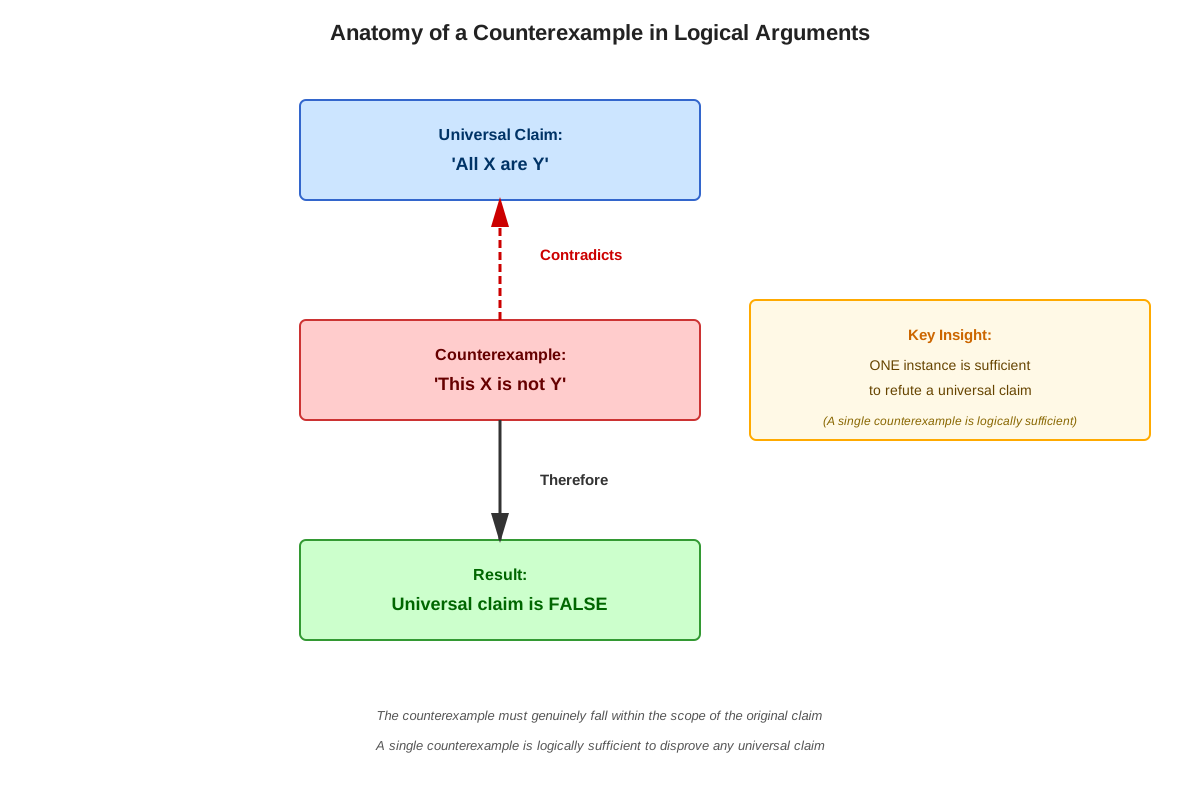
A counterexample functions as a specific instance that demonstrates the falsity of a universal or general claim. When an argument presents a statement like "All X are Y," a single counterexample—one X that is not Y—is sufficient to disprove that claim entirely. The LSAT tests this concept not by asking students to generate counterexamples themselves, but rather by requiring them to identify when a counterexample appears in an argument and to describe its precise role in the reasoning structure. This might involve recognizing that a counterexample refutes an opponent's position, undermines a general principle, or demonstrates an exception to a proposed rule.
Mastery of the LSAT role of counterexample concept connects directly to broader skills in argument analysis, including understanding how evidence relates to conclusions, recognizing different types of support and opposition within arguments, and distinguishing between various argumentative moves. This topic sits at the intersection of formal logic and practical reasoning, making it foundational for success not only on role questions but also on strengthen/weaken questions, flaw questions, and parallel reasoning questions where counterexamples frequently appear as answer choices or within stimulus arguments.
Learning Objectives
- [ ] Identify how Role of counterexample appears in LSAT questions
- [ ] Explain the reasoning pattern behind Role of counterexample
- [ ] Apply Role of counterexample to solve LSAT-style problems accurately
- [ ] Distinguish between counterexamples and other types of evidence in arguments
- [ ] Recognize the logical sufficiency of a single counterexample to refute universal claims
- [ ] Evaluate whether a purported counterexample genuinely contradicts the claim it targets
- [ ] Predict common incorrect answer choices in role of counterexample questions
Prerequisites
- Basic argument structure: Understanding premises, conclusions, and how they relate is essential because counterexamples function as a specific type of premise that opposes a claim
- Universal vs. particular statements: Recognizing the difference between "all," "some," "most," and "none" statements is necessary because counterexamples specifically target universal claims
- Logical negation: Knowing how to negate claims helps identify when an example truly contradicts a statement
- Evidence types: Familiarity with different forms of support (examples, analogies, principles) provides context for understanding counterexamples as a distinct category
Why This Topic Matters
In real-world reasoning, counterexamples serve as one of the most powerful tools for critical thinking and scientific inquiry. When someone proposes a sweeping generalization, a single well-chosen counterexample can expose the flaw in that reasoning, forcing a revision of the claim. This pattern appears constantly in legal reasoning, scientific debate, policy analysis, and everyday argumentation. Lawyers use counterexamples to challenge opposing counsel's characterizations of precedent; scientists use them to falsify hypotheses; and effective communicators use them to demonstrate exceptions to proposed rules.
On the LSAT, counterexample questions appear with significant frequency, typically comprising 2-4 questions per test across the Logical Reasoning sections. These questions most commonly appear as role questions (asking "which one of the following most accurately describes the role played in the argument by...") but also surface in method of reasoning questions (asking how an arguer responds to another's position) and occasionally in structure questions. The LSAT particularly favors scenarios where one speaker makes a general claim and another speaker responds with a specific example that contradicts it, or where a single argument presents a theory and then introduces an exception that challenges it.
Common manifestations include: dialogue arguments where Speaker B provides a counterexample to Speaker A's universal claim; arguments that present a scientific or philosophical principle followed by an observation that contradicts it; and arguments that discuss proposed rules or policies while noting specific cases where those rules fail. The test-makers frequently construct wrong answer choices that confuse counterexamples with supporting examples, analogies, or alternative explanations, making precise understanding of this concept essential for avoiding traps.
Core Concepts
Definition and Logical Structure of Counterexamples
A counterexample is a specific instance or case that demonstrates the falsity of a general or universal claim. The logical power of a counterexample derives from a fundamental principle of formal logic: a single negative instance is sufficient to disprove a universal affirmative statement. If someone claims "All swans are white," observing even one black swan completely refutes that claim. This asymmetry between proof and disproof—where universal claims require examining all instances to prove but only one instance to disprove—makes counterexamples particularly potent argumentative tools.
The structure of a counterexample argument typically follows this pattern:
- General claim presented: A universal or broad statement is made (explicitly or implicitly)
- Counterexample introduced: A specific case is described that falls within the scope of the general claim
- Contradiction demonstrated: The specific case possesses characteristics that contradict what the general claim predicts
- Conclusion drawn: The general claim is therefore false, requires qualification, or needs revision
For a counterexample to be valid, it must genuinely fall within the category addressed by the general claim while simultaneously violating the claim's prediction. If someone claims "All mammals lay eggs" and you respond "platypuses lay eggs," you haven't provided a counterexample—you've provided a supporting example. But if you respond "dolphins give live birth," you've provided a valid counterexample because dolphins are mammals (falling within the claim's scope) but don't lay eggs (contradicting the claim's prediction).
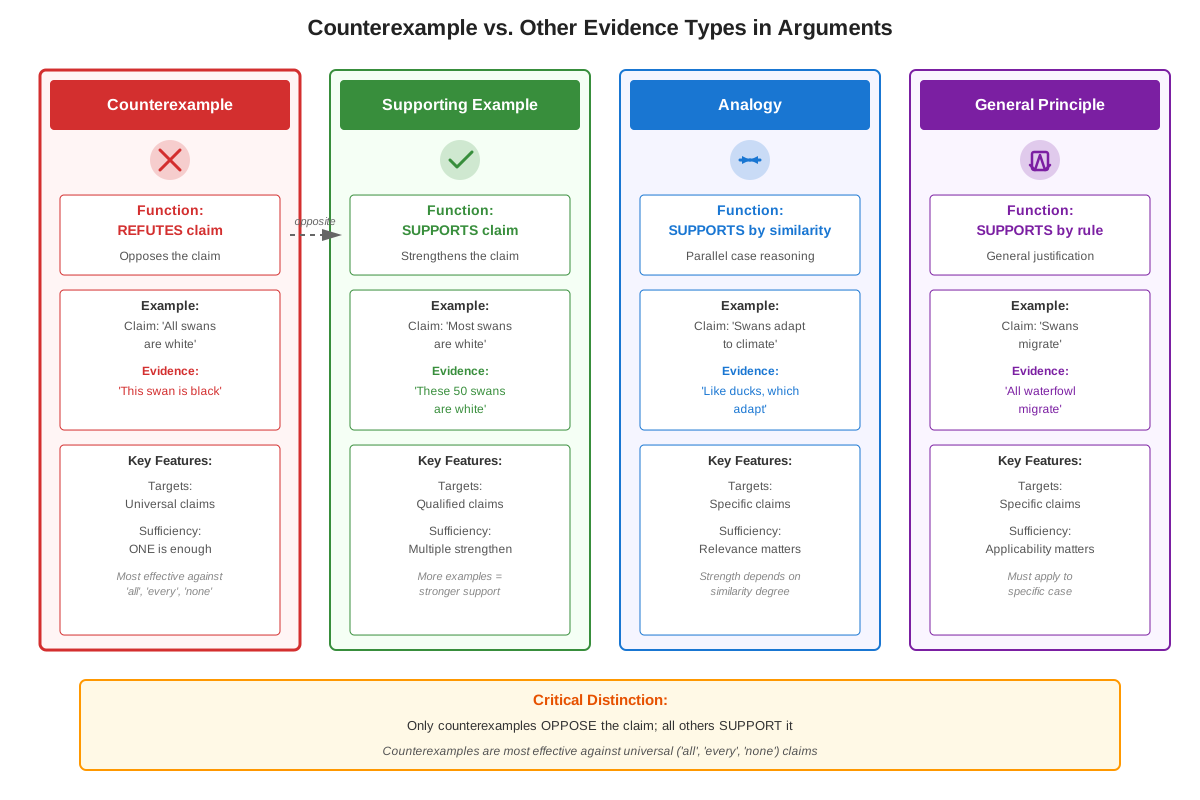
Counterexamples vs. Other Evidence Types
Understanding what counterexamples are requires distinguishing them from other types of evidence that appear in LSAT arguments:
| Evidence Type | Function | Relationship to Claim | Example |
|---|---|---|---|
| Counterexample | Refutes/contradicts | Shows claim is false | "Not all birds fly; penguins cannot fly" |
| Supporting Example | Confirms/illustrates | Shows claim is true in specific case | "Birds fly; robins fly" |
| Analogy | Compares situations | Suggests similar logic applies | "Just as birds need wings to fly, planes need wings" |
| Alternative Explanation | Provides different cause | Competes with proposed explanation | "The bird died not from disease but from starvation" |
| Exception | Acknowledges limitation | Narrows scope without refuting | "Most birds fly, though some species cannot" |
The LSAT frequently tests whether students can distinguish counterexamples from these other evidence types, particularly supporting examples (which students often confuse with counterexamples) and exceptions (which acknowledge limitations without necessarily refuting the original claim).
Role of Counterexamples in Argument Structure
Within LSAT arguments, counterexamples serve several distinct functions, and role questions require identifying the specific function in context:
Refuting an opponent's position: The most common role involves one arguer presenting a general claim and another arguer (or the same arguer reconsidering) introducing a counterexample that demonstrates the claim's falsity. The counterexample serves as the primary evidence for rejecting the initial position.
Demonstrating a flaw in reasoning: Sometimes an argument presents a principle or rule and then introduces a counterexample to show that the principle cannot be universally applied. Here, the counterexample functions to reveal limitations in the proposed reasoning.
Motivating a qualification or revision: Rather than completely rejecting a claim, a counterexample might prompt the arguer to revise the claim to be more nuanced or limited in scope. The counterexample serves as evidence that the original formulation was too broad.
Supporting a conclusion by elimination: In some arguments, a counterexample to an alternative explanation strengthens the arguer's preferred explanation by eliminating a competing hypothesis.
Identifying Counterexamples in LSAT Stimuli
Certain linguistic markers frequently signal the presence of a counterexample in LSAT arguments:
- Contrast words: "but," "however," "yet," "although," "nevertheless"
- Negation phrases: "not all," "it is not the case that," "fails to," "does not"
- Specific-to-general transitions: "for instance," "consider," "take the case of," followed by a specific example that contradicts a prior general claim
- Dialogue structure: Speaker B responding to Speaker A with "But what about..." or "Consider, however..."
When analyzing an argument, students should actively look for the relationship between general claims and specific examples. If a specific example supports the general claim, it's not a counterexample. If it contradicts the general claim, it is a counterexample. The key question to ask is: "Does this specific case show that the general claim is false or requires limitation?"
Scope Considerations in Counterexamples
A critical aspect of evaluating counterexamples involves determining whether the example genuinely falls within the scope of the claim it purports to refute. The LSAT tests this through wrong answer choices that describe examples as counterexamples when they actually address different claims or fall outside the relevant category.
For a counterexample to be valid:
- It must be an instance of the category mentioned in the general claim
- It must possess characteristics that contradict what the general claim asserts about that category
- It must be relevant to the same context or domain as the original claim
For example, if someone claims "All professional athletes are wealthy," citing a wealthy doctor is not a counterexample (doctors aren't professional athletes, so they fall outside the scope). Citing a professional athlete who is not wealthy would be a valid counterexample.
Concept Relationships
The role of counterexample concept connects to multiple other Logical Reasoning skills in a hierarchical and functional network. At the foundation, basic argument structure (premises and conclusions) provides the framework within which counterexamples operate—a counterexample functions as a specific type of premise that opposes another claim. This foundational understanding leads directly to recognizing evidence types, where counterexamples represent one category among several ways arguments support or oppose claims.
The relationship flows as follows: Argument Structure → Evidence Types → Counterexamples as Specific Evidence → Role in Argument → Application to Question Types
Counterexamples connect horizontally to strengthen and weaken questions because introducing a counterexample to an argument's assumption or principle weakens that argument, while showing that a purported counterexample doesn't actually apply can strengthen an argument. They also relate to flaw questions, where failing to consider potential counterexamples represents a common reasoning error (overgeneralization).
The concept links forward to parallel reasoning questions, where students must recognize when answer choices employ counterexamples in structurally similar ways to the stimulus argument. It also connects to principle questions, where counterexamples can demonstrate that a proposed principle doesn't apply universally.
Understanding counterexamples enhances performance on method of reasoning questions by enabling students to recognize when an arguer "responds by providing a case that contradicts the general claim" or "challenges the position by citing an exception." This precise understanding of argumentative moves is essential for selecting correct answers that accurately describe reasoning patterns.
High-Yield Facts
⭐ A single counterexample is logically sufficient to disprove a universal affirmative claim (e.g., "All X are Y" is disproven by one X that is not Y)
⭐ Counterexamples refute or challenge claims; supporting examples confirm or illustrate claims—the LSAT frequently tests this distinction in wrong answer choices
⭐ For an example to be a counterexample, it must fall within the scope of the original claim while contradicting that claim's prediction
⭐ Role questions about counterexamples typically ask about the function of a specific statement within the argument's structure, not whether the counterexample is valid
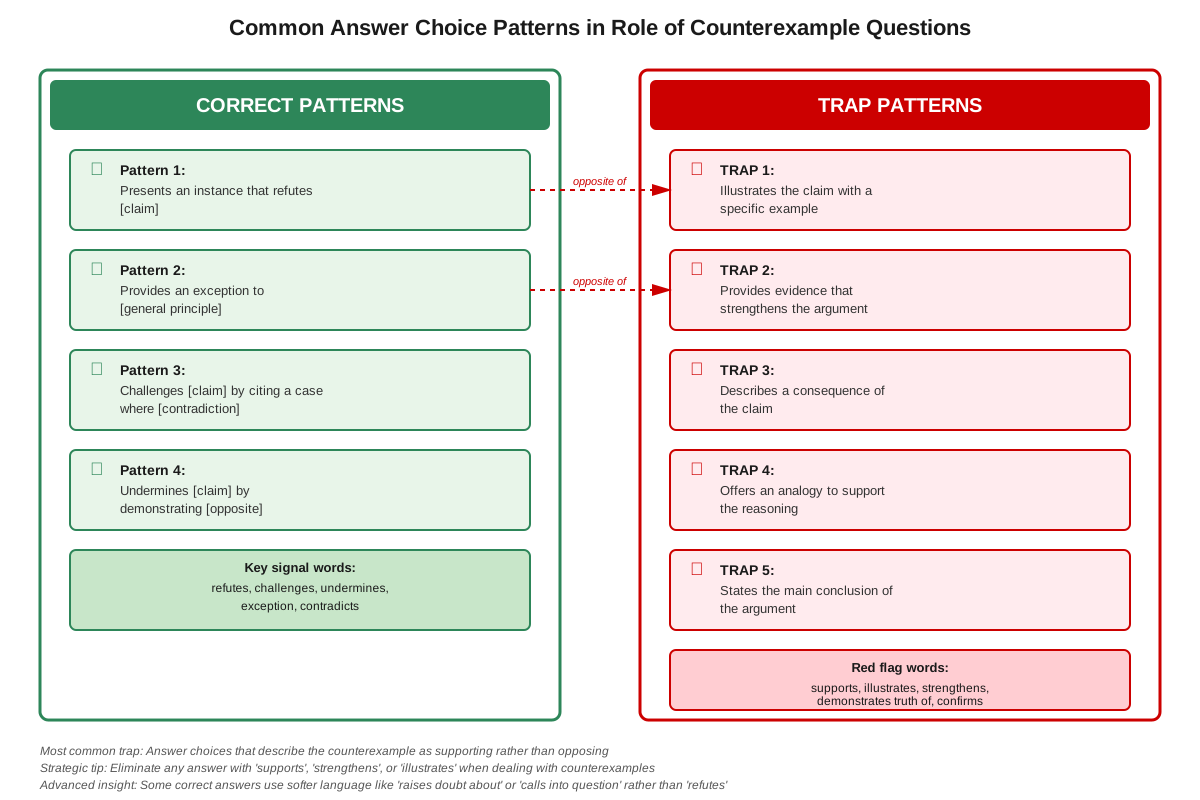
⭐ Common wrong answers describe counterexamples as "supporting" or "illustrating" the claim they actually refute
- Counterexamples most frequently appear in dialogue arguments where Speaker B responds to Speaker A's general claim
- The phrase "but consider" or "however" often introduces a counterexample in LSAT stimuli
- Counterexamples to necessary condition claims are particularly powerful because they show the condition isn't actually necessary
- An exception acknowledged by the arguer is not the same as a counterexample that refutes the arguer's position
- Counterexamples can appear in conditional reasoning as cases where the sufficient condition is met but the necessary condition is not
Quick check — test yourself on Role of counterexample so far.
Try Flashcards →Common Misconceptions
Misconception: Any example that differs from the main claim is a counterexample → Correction: A counterexample must specifically contradict the claim by falling within its scope while violating its prediction. An example from a different category or context is not a counterexample, even if it differs from the claim.
Misconception: Counterexamples only work against claims using the word "all" → Correction: While counterexamples are most powerful against universal claims, they can also challenge claims using "most," "typically," or "generally" by demonstrating that the claim overstates the frequency or strength of a relationship. A single counterexample doesn't disprove "most" claims but can be part of evidence suggesting the claim is false.
Misconception: If an argument mentions an exception, that exception is always functioning as a counterexample → Correction: An arguer might acknowledge an exception while still maintaining their general claim (e.g., "Most birds fly, though penguins do not"). This acknowledged exception isn't functioning as a counterexample to refute the arguer's position; it's a qualification the arguer includes. A counterexample typically comes from an opponent or serves to undermine a claim the arguer is critiquing.
Misconception: Counterexamples and analogies serve the same function in arguments → Correction: Counterexamples provide specific instances that contradict general claims, while analogies compare two situations to suggest similar reasoning applies. An analogy might support or oppose a claim, but it does so through comparison rather than direct contradiction.
Misconception: The correct answer to a role question about a counterexample will always use the word "counterexample" → Correction: LSAT answer choices often describe the function without using the term "counterexample," instead saying things like "cites a case that contradicts," "provides an instance that undermines," or "presents an exception that challenges." Students must recognize the concept even when the specific terminology varies.
Worked Examples
Example 1: Dialogue Argument with Counterexample
Stimulus:
"Politician: All effective environmental policies require economic sacrifice from citizens. Therefore, any policy that doesn't impose economic costs cannot protect the environment.
Critic: That's not true. Consider energy efficiency standards for appliances. These standards protect the environment by reducing energy consumption, yet they actually save consumers money over time rather than imposing economic costs."
Question: The critic's statement that energy efficiency standards save consumers money serves which one of the following functions in the critic's response?
Analysis:
First, identify the politician's claim: "All effective environmental policies require economic sacrifice" (universal claim). The politician concludes that policies without economic costs cannot protect the environment.
Second, examine what the critic does: The critic introduces energy efficiency standards as a specific case. Let's check if this is a counterexample:
- Does it fall within the scope? Yes—it's an environmental policy
- Does it contradict the claim? Yes—the politician says all effective environmental policies require economic sacrifice, but energy efficiency standards are effective (they protect the environment) yet don't require sacrifice (they save money)
Third, determine the function: The critic uses this specific case to demonstrate that the politician's universal claim is false. The energy efficiency standards example shows that at least one effective environmental policy exists that doesn't require economic sacrifice, thereby refuting the politician's "all" claim.
Correct answer pattern: "It provides a case that contradicts the politician's general claim about environmental policies" or "It serves as a counterexample to the politician's assertion that all effective environmental policies require economic sacrifice."
Wrong answer patterns to avoid:
- "It supports the politician's position with additional evidence" (confuses counterexample with supporting example)
- "It offers an analogy to illustrate the politician's point" (confuses counterexample with analogy)
- "It provides an alternative explanation for environmental protection" (confuses counterexample with competing hypothesis)
Example 2: Single-Speaker Argument with Self-Refutation
Stimulus:
"Psychologist: It has been claimed that all human behavior is ultimately motivated by self-interest. According to this view, even apparently altruistic acts are really performed because they make the actor feel good, which is a form of self-interest. However, this claim cannot be correct. Consider parents who sacrifice their own lives to save their children. In such cases, the parents receive no benefit whatsoever—not even the satisfaction of feeling good about their actions, since they do not survive to experience any such feeling."
Question: The psychologist's reference to parents who sacrifice their lives for their children serves primarily to:
Analysis:
First, identify the claim being challenged: "All human behavior is ultimately motivated by self-interest." This is a universal claim about human motivation.
Second, examine the parents example:
- Does it fall within the scope? Yes—sacrificing one's life to save a child is human behavior
- Does it contradict the claim? Yes—the psychologist argues these parents receive no benefit, including no feeling of satisfaction, so their behavior is not motivated by self-interest
Third, note the structure: The psychologist explicitly states "this claim cannot be correct" and then introduces the parents example with "Consider..." This signals that the example is meant to refute the claim.
Fourth, evaluate the logical force: The psychologist is arguing that this single example is sufficient to disprove the universal claim that "all" human behavior is self-interested. One instance of non-self-interested behavior refutes the "all" claim.
Correct answer pattern: "Demonstrate that the claim about self-interest cannot account for all human behavior" or "Provide a counterexample to the view that all human actions are motivated by self-interest."
Key reasoning: The parents example functions as a counterexample because it presents a specific case of human behavior that, according to the psychologist's analysis, lacks the self-interested motivation that the universal claim says all human behavior must have. This single case is presented as sufficient to refute the universal claim.
Exam Strategy
When approaching LSAT questions involving the role of counterexample, employ this systematic strategy:
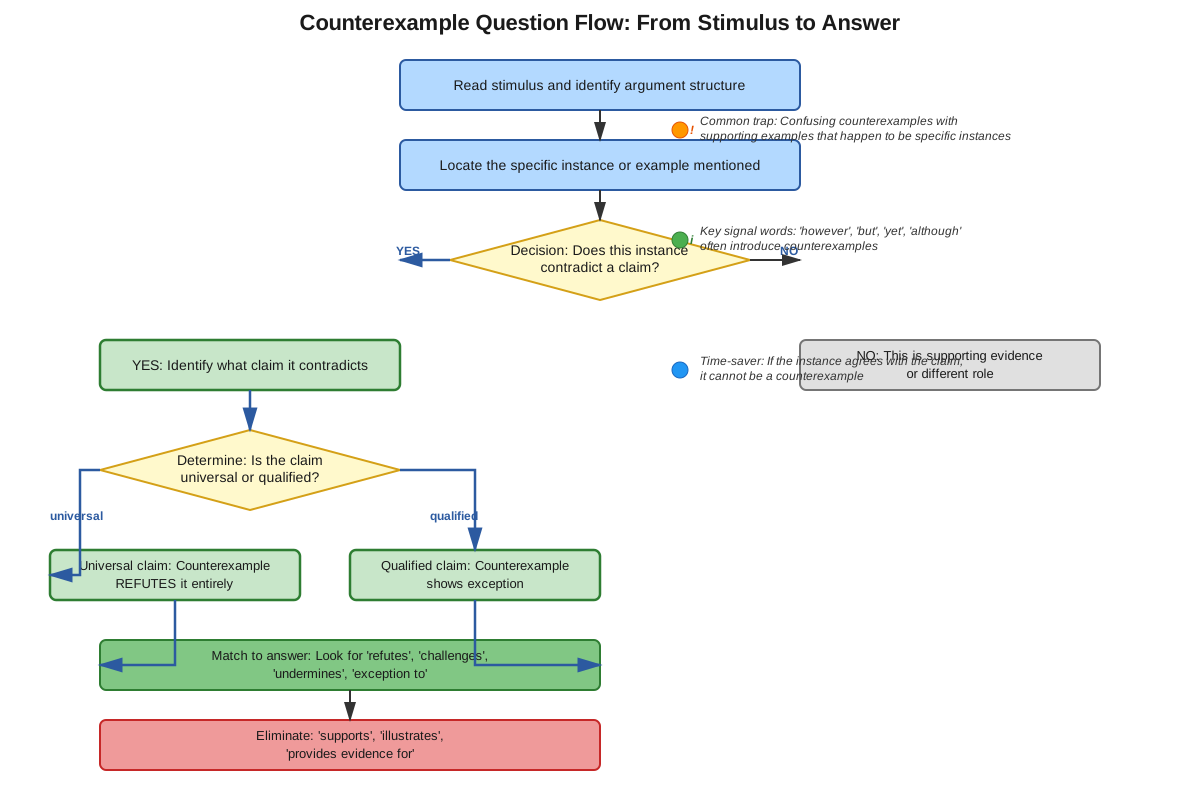
Step 1: Identify universal or general claims in the stimulus. Look for words like "all," "every," "always," "never," "no," or broad generalizations without explicit quantifiers. These are the claims most vulnerable to counterexamples. Mark them as you read.
Step 2: Look for specific examples or cases mentioned after general claims. Pay special attention to examples introduced after contrast words ("but," "however," "yet") or in dialogue where Speaker B responds to Speaker A. Ask yourself: "Is this example meant to support or contradict the general claim?"
Step 3: Apply the counterexample test. For any specific example, ask:
- Does this fall within the category of the general claim?
- Does this contradict what the general claim predicts?
- If yes to both, it's likely a counterexample
Step 4: Determine the precise function. Even after identifying a counterexample, you must determine its specific role: Is it refuting an opponent's view? Demonstrating a flaw? Motivating a qualification? The correct answer must capture this specific function.
Trigger words and phrases to watch for:
- "Consider," "take the case of," "for instance" followed by a contradicting example
- "But," "however," "yet," "nevertheless" introducing a specific case
- "Not all," "it is not true that," "this fails to account for"
- In dialogue: "That's incorrect," "I disagree," followed by an example
Process of elimination tips:
- Eliminate answers that describe the example as "supporting" or "illustrating" the claim it actually contradicts
- Eliminate answers that describe the example as an "analogy" when it's actually a direct counterexample
- Eliminate answers that misidentify which claim the counterexample targets (sometimes multiple claims appear in an argument)
- Eliminate answers that describe the counterexample as "proving" the arguer's conclusion when it only refutes an opposing view
Time allocation: Role questions typically require 60-90 seconds. Spend 30-40 seconds carefully reading and analyzing the stimulus structure, 10-15 seconds identifying what the question asks about, and 20-30 seconds evaluating answer choices. Don't rush the stimulus analysis—misunderstanding the argument structure leads to incorrect answers even when you understand counterexamples conceptually.
Exam Tip: If you're stuck between two answer choices, return to the stimulus and trace exactly what claim the example contradicts. The correct answer must accurately describe both what is being contradicted and how the contradiction functions in the argument's overall structure.
Memory Techniques
Mnemonic for identifying counterexamples: "SCOPE"
- Specific instance provided
- Contradicts a general claim
- Opposing (not supporting) the claim
- Proves the claim false or limited
- Example falls within the claim's category
Visualization strategy: Picture a counterexample as a "shield" that blocks an arrow. The arrow represents a universal claim trying to hit all targets in a category. The shield (counterexample) is one member of that category that blocks the arrow, proving the arrow can't hit everything. This image reinforces that the counterexample must be within the category (a valid shield) and must block the claim (contradict it).
Acronym for counterexample functions: "RDM"
- Refute an opponent's position
- Demonstrate a flaw or limitation
- Motivate a qualification or revision
Memory phrase: "One black swan sinks all swans are white." This classic example reminds you that a single counterexample is sufficient to disprove a universal claim, and the counterexample must be within the category (a swan) while contradicting the claim (not white).
Contrast reminder: "Counterexamples CONTRADICT, supporting examples CONFIRM." The alliteration helps you remember the fundamental distinction that the LSAT tests most frequently.
Summary
The role of counterexample is a high-yield LSAT Logical Reasoning concept that requires students to identify when arguments use specific instances to refute or challenge general claims. A counterexample must fall within the scope of the claim it targets while simultaneously contradicting that claim's prediction, and a single counterexample is logically sufficient to disprove a universal affirmative statement. On the LSAT, counterexamples most commonly appear in dialogue arguments where one speaker responds to another's general claim, and in role questions that ask students to identify the function of a specific statement within an argument's structure. Success requires distinguishing counterexamples from supporting examples, analogies, and other evidence types, as well as precisely identifying which claim the counterexample targets and what function it serves. The concept connects to broader skills in argument analysis, evidence evaluation, and recognizing reasoning patterns, making it foundational for multiple question types beyond just role questions.
Key Takeaways
- A counterexample is a specific instance that demonstrates the falsity of a general or universal claim by falling within the claim's scope while contradicting its prediction
- One valid counterexample is sufficient to disprove any universal affirmative claim ("All X are Y" is refuted by a single X that is not Y)
- Counterexamples refute or challenge claims, while supporting examples confirm or illustrate claims—the LSAT frequently tests this distinction
- Role questions about counterexamples ask about the function of a statement within the argument's structure, requiring precise identification of what claim is being contradicted and how
- Common wrong answers describe counterexamples as supporting evidence, analogies, or alternative explanations rather than recognizing their refutational function
- Look for contrast words ("but," "however"), dialogue structures, and specific examples following general claims as signals that a counterexample may be present
- Mastering counterexamples enhances performance on role questions, method of reasoning questions, strengthen/weaken questions, and flaw questions
Related Topics
Strengthen and Weaken Questions: Understanding counterexamples directly enhances ability to recognize when answer choices weaken arguments by providing counterexamples to key assumptions or principles, and when arguments can be strengthened by showing that potential counterexamples don't actually apply.
Flaw Questions: Many flawed arguments commit the error of overgeneralization or fail to consider potential counterexamples. Recognizing this flaw type requires understanding what counterexamples are and how they function.
Method of Reasoning Questions: These questions frequently ask how one arguer responds to another, and "provides a counterexample" is a common correct answer pattern. Mastering counterexamples enables precise identification of this reasoning method.
Necessary and Sufficient Conditions: Counterexamples to conditional claims (showing the sufficient condition met without the necessary condition, or the necessary condition absent despite the sufficient condition being met) represent an advanced application of counterexample reasoning.
Principle Questions: Both applying principles and identifying principles require understanding how counterexamples can demonstrate that a proposed principle doesn't hold universally, making counterexample recognition essential for these question types.
Practice CTA
Now that you've mastered the role of counterexample, it's time to put your knowledge into practice. Work through the practice questions to reinforce your ability to identify counterexamples in LSAT arguments, distinguish them from other evidence types, and accurately describe their function in argument structure. Use the flashcards to drill the key distinctions and trigger words until recognizing counterexamples becomes automatic. Remember: understanding the concept is just the first step—consistent practice with real LSAT-style questions transforms that understanding into the quick, accurate analysis you need on test day. You've built a strong foundation; now strengthen it through application!
Sign up free to keep reading
Create a free AnvayaPrep account to finish this LSAT guide on Role of counterexample — plus flashcards and practice questions.