Overview
Role of example questions represent a critical category within LSAT Logical Reasoning that tests a student's ability to identify and analyze how specific examples function within an argument's structure. These questions ask test-takers to determine what purpose a particular example, illustration, or instance serves in the author's reasoning. Unlike questions that ask about the main conclusion or overall structure, role of example questions zoom in on one specific component—typically a concrete case, scenario, or illustration—and require students to articulate its precise function within the broader argumentative framework.
Understanding the role of example is essential for LSAT success because these questions appear regularly on every administration of the exam and directly test reading comprehension, analytical reasoning, and the ability to distinguish between different argumentative functions. Students must recognize whether an example supports a claim, illustrates a principle, provides a counterexample to refute an opposing view, or serves another specific purpose. The LSAT rewards precision here: answer choices often contain subtle distinctions, and selecting the correct answer requires both careful reading of the stimulus and a sophisticated understanding of argumentative structure.
Within the broader landscape of Logical Reasoning, role of example questions belong to the family of method, role, and structure questions—question types that focus on how arguments are constructed rather than whether they are valid or sound. Mastering this topic builds directly on understanding argument structure (premises, conclusions, and intermediate claims) and prepares students for related question types including Method of Reasoning questions, which ask how an argument proceeds, and Argument Structure questions, which require identifying relationships between multiple claims. The analytical skills developed through role of example questions transfer directly to Reading Comprehension passages, where understanding how authors use examples to support broader claims is equally crucial.
Learning Objectives
- [ ] Identify how Role of example appears in LSAT questions
- [ ] Explain the reasoning pattern behind Role of example
- [ ] Apply Role of example to solve LSAT-style problems accurately
- [ ] Distinguish between different functions examples can serve (support, illustration, counterexample, analogy)
- [ ] Recognize common wrong answer patterns in role of example questions
- [ ] Analyze complex arguments containing multiple examples and identify each example's distinct role
Prerequisites
- Basic argument structure: Understanding premises, conclusions, and supporting evidence is essential because role of example questions require identifying where the example fits within the argument's framework
- Indicator words: Familiarity with conclusion indicators (therefore, thus, hence) and premise indicators (because, since, for) helps locate the example's position relative to other claims
- Claim types: Distinguishing between factual claims, generalizations, and principles enables students to understand what the example is meant to support or illustrate
- Question stem recognition: Ability to identify question types from their stems ensures proper approach and strategy application
Why This Topic Matters
Role of example questions test a fundamental skill that extends far beyond standardized testing: the ability to analyze how arguments are constructed and how evidence functions within reasoning. In legal practice, attorneys must constantly evaluate how specific cases, precedents, and hypothetical scenarios function within legal arguments—whether they support a rule, distinguish a precedent, or illustrate an exception. This same analytical skill applies to academic research, policy analysis, and critical reading in any professional context.
On the LSAT specifically, role of example questions appear with high frequency, typically comprising 2-4 questions per Logical Reasoning section. Given that each LSAT contains two scored Logical Reasoning sections with approximately 25-26 questions each, students can expect to encounter 4-8 role of example questions per exam administration. These questions appear across all difficulty levels, from relatively straightforward examples that clearly support a stated conclusion to complex arguments where examples serve multiple or subtle functions.
Role of example questions commonly appear in several formats: the question stem might ask "The claim that [specific example] serves which one of the following roles in the argument?" or "The author mentions [example] in order to..." or "The [example] functions in the argument as..." The stimulus typically contains an argument with one or more concrete examples embedded within more general claims, and the correct answer precisely describes the example's argumentative function. Wrong answers often describe functions that other parts of the argument serve, or they mischaracterize the example's relationship to the conclusion.
Core Concepts
Understanding Examples in Arguments
An example in logical reasoning refers to a specific instance, case, illustration, or scenario that an author presents within an argument. Examples are concrete rather than abstract—they describe particular situations, events, objects, or individuals rather than general principles or universal claims. The role of example refers to the specific function that example serves within the argument's structure: what work it does, what claim it supports, or what purpose it accomplishes.
Examples can appear anywhere in an argument's structure. They might appear as premises supporting the main conclusion, as illustrations clarifying an abstract principle, as evidence for an intermediate claim, or even as counterexamples challenging an opposing position. The key to role of example questions is identifying not just that something is an example, but precisely what argumentative work it performs.
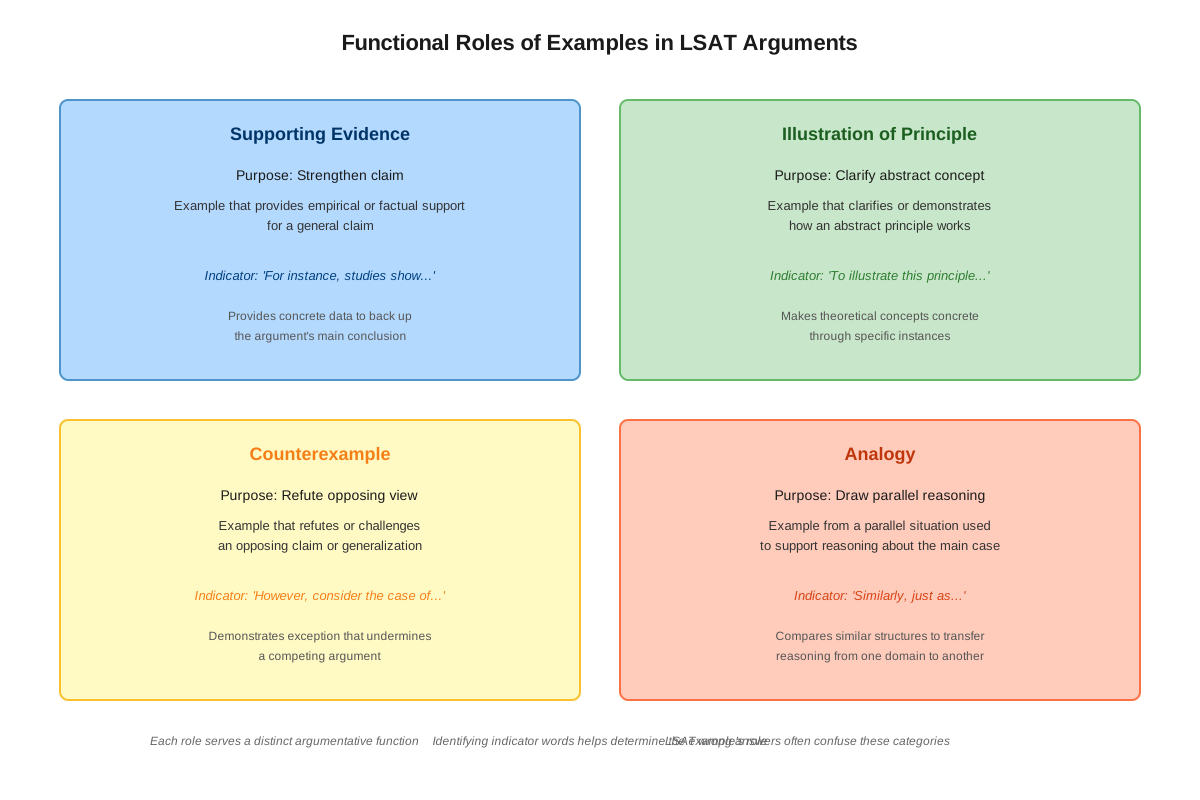
Primary Functions of Examples
Examples serve several distinct functions in LSAT arguments, and recognizing these functions is crucial for selecting correct answers:
| Function | Description | Typical Language |
|---|---|---|
| Supporting Evidence | The example provides a specific instance that supports a general claim or conclusion | "For instance," "For example," "Consider that" |
| Illustration | The example clarifies or makes concrete an abstract principle without necessarily proving it | "To illustrate," "This can be seen in," "As in the case of" |
| Counterexample | The example contradicts or challenges a claim, often one attributed to others | "However," "But consider," "Yet" |
| Analogy | The example draws a parallel to another situation to support reasoning | "Similarly," "Just as," "Like" |
| Intermediate Support | The example supports a sub-conclusion that itself supports the main conclusion | Multiple indicator words in sequence |
Supporting Evidence Function
When an example functions as supporting evidence, it provides a concrete instance that makes a general claim more credible or demonstrates that a principle holds in practice. The logical relationship flows from the specific example to the general conclusion. For instance, if an argument concludes "Most restaurants fail within their first year," and provides "Three restaurants on Main Street all closed within eight months of opening" as evidence, this example serves as supporting evidence for the general claim.
The strength of this function depends on how representative the example is. LSAT arguments often use examples as supporting evidence even when a single example cannot definitively prove a universal claim—the example still serves that supporting role within the argument's structure, regardless of whether the argument is ultimately strong or weak.
Illustration Function
The illustration function differs subtly but importantly from supporting evidence. When an example illustrates, it clarifies or makes concrete an abstract concept, principle, or claim that has already been established or asserted. The example doesn't prove the claim; rather, it helps the reader understand what the claim means in practical terms.
For instance, if an argument states "Complex systems often fail in unpredictable ways" and then describes how a minor software bug caused a major system crash, the software example illustrates what "unpredictable failure" means rather than proving that complex systems fail unpredictably. The distinction matters on the LSAT: answer choices might say "provides evidence for" versus "illustrates the application of," and only one will be correct based on the example's actual function.
Counterexample Function
A counterexample serves to refute, challenge, or cast doubt on a claim—typically a claim the author opposes or a generalization the author wants to show is false. Counterexamples demonstrate that a universal claim doesn't hold in all cases or that a principle has exceptions. The logical force of a counterexample is negative: it shows what isn't true rather than establishing what is true.
In LSAT arguments, counterexamples often appear when the author is responding to an opposing view. The argument might present a position held by others, then introduce a specific case that contradicts that position. For example: "Some argue that all successful companies prioritize short-term profits. However, Company X achieved tremendous success while consistently prioritizing long-term research over quarterly earnings." Here, Company X serves as a counterexample to the claim about successful companies.
Analogy Function
When an example functions as an analogy, it draws a parallel between two situations to suggest that what holds true in one case should hold true in another. Analogical reasoning is common in LSAT arguments, particularly in legal and ethical contexts. The example presents a comparable situation where a principle or outcome is accepted, implying that the same principle or outcome should apply to the case under discussion.
For instance: "Just as we don't hold knife manufacturers liable when someone uses a knife to commit a crime, we shouldn't hold software companies liable when someone uses their software for illegal purposes." The knife manufacturer example serves as an analogy, suggesting that the two situations are relevantly similar and should be treated consistently.
Identifying the Example in the Stimulus
Before determining an example's role, students must first identify which part of the argument constitutes the example. Examples are typically:
- Concrete and specific rather than abstract and general
- Descriptive of particular cases, scenarios, or instances
- Subordinate to broader claims or principles in the argument
- Introduced with transitional phrases or indicator words
The LSAT question stem will usually specify which claim or statement to analyze, often by quoting it directly or referring to it by subject matter. Students should locate this claim in the stimulus, then analyze its relationship to surrounding claims to determine its function.
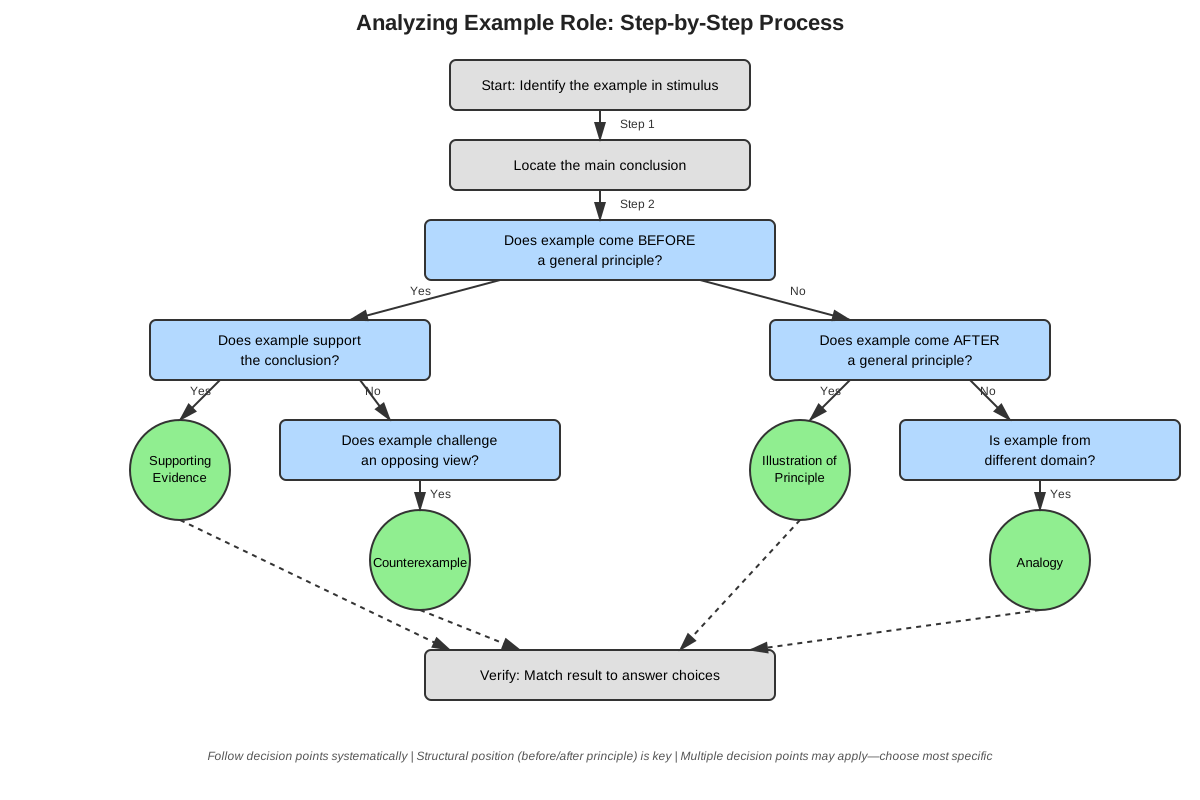
Analyzing Relationships to Other Claims
To determine an example's role, trace its logical relationships:
- What claim does the example relate to most directly? Look for the general principle, conclusion, or assertion that the example connects to.
- Does the example support or challenge that claim? Determine whether the relationship is positive (supporting, illustrating) or negative (refuting, providing a counterexample).
- Is the relationship direct or indirect? The example might support an intermediate claim that itself supports the main conclusion.
- What would the argument lose without the example? This helps distinguish between essential supporting evidence and supplementary illustration.
Concept Relationships
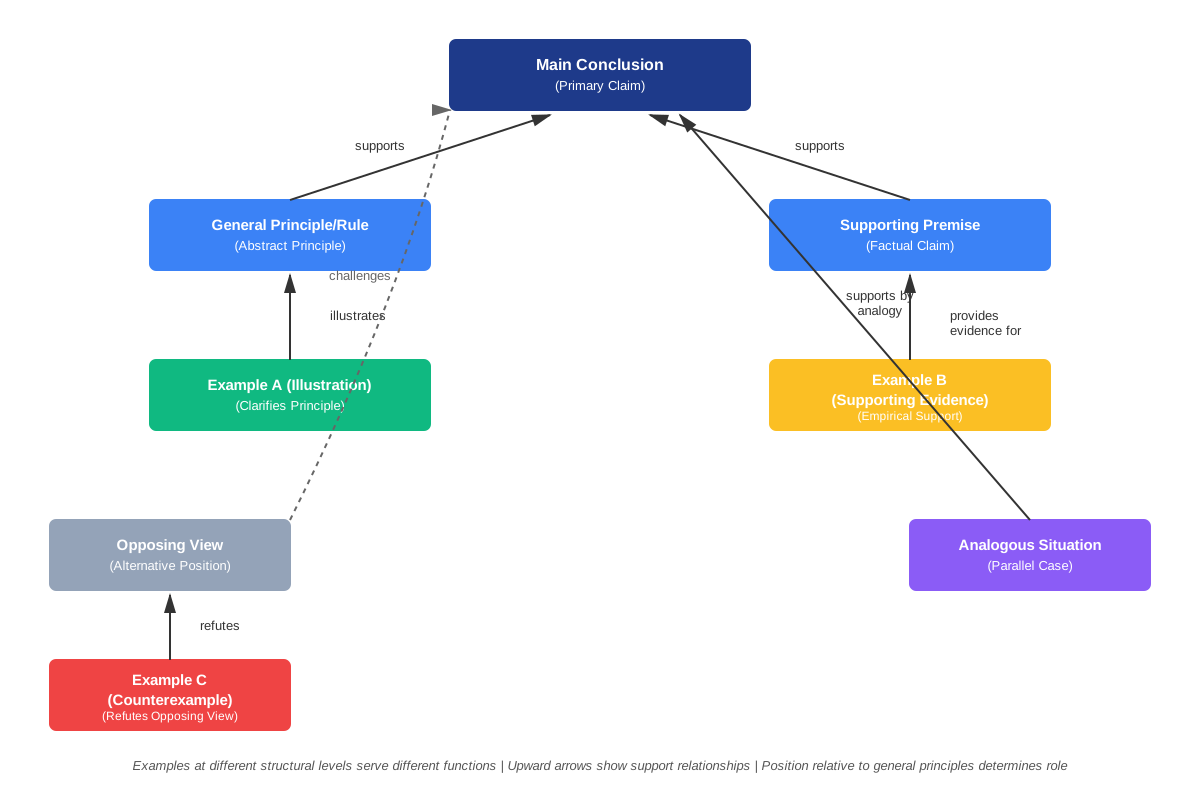
The concepts within role of example questions form an interconnected system. Understanding examples as argumentative components requires first recognizing basic argument structure (premises and conclusions). Once an example is identified, determining its specific function (supporting evidence, illustration, counterexample, or analogy) depends on analyzing its logical relationships to other claims in the argument. These relationships flow in specific directions: examples typically relate to more general claims, and the nature of that relationship (supportive, illustrative, or challenging) determines the example's role.
The relationship map flows as follows:
Argument Structure Recognition → Example Identification → Relationship Analysis → Function Determination → Answer Selection
Role of example questions connect to prerequisite knowledge of indicator words because these words often signal the function an example serves. They connect forward to Method of Reasoning questions because both question types analyze how arguments are constructed rather than evaluating their validity. Understanding role of example also supports Reading Comprehension skills, particularly questions about how authors use specific details to support broader claims in passages.
Within the family of method, role, and structure questions, role of example questions are more focused than general structure questions (which might ask about the entire argument's organization) but more specific than method questions (which describe overall reasoning patterns). This middle-ground specificity makes role of example questions excellent practice for developing precise analytical reading skills.
Quick check — test yourself on Role of example so far.
Try Flashcards →High-Yield Facts
⭐ Role of example questions ask about the function of a specific instance or illustration within an argument's structure, not about whether the argument is valid or strong
⭐ Examples typically support general claims, but they can also illustrate principles, provide counterexamples, or serve as analogies
⭐ The correct answer must precisely describe what the example does in the argument, not what other parts of the argument do
⭐ Supporting evidence and illustration are distinct functions: evidence proves or makes credible, while illustration clarifies or makes concrete
⭐ Counterexamples challenge or refute claims, typically claims attributed to others or opposing positions
- Examples are concrete and specific, while the claims they relate to are typically general or abstract
- The question stem usually quotes or describes the specific example to analyze, making identification straightforward
- Wrong answers often describe the function of the conclusion, a different premise, or a claim the example supports rather than the example itself
- An example can support an intermediate claim that itself supports the main conclusion—this is still a supporting function
- Analogies draw parallels between situations to suggest similar treatment or outcomes
- The same concrete statement could serve different functions in different arguments depending on context and relationships
- Indicator words like "for example," "for instance," "consider," and "such as" often introduce examples
- Role of example questions reward precision: answer choices often differ by subtle distinctions in wording
Common Misconceptions
Misconception: Any specific instance mentioned in an argument is the example the question asks about → Correction: The question stem specifies which claim to analyze; arguments may contain multiple examples, and students must focus on the one the question identifies
Misconception: If an example appears before the conclusion, it must be supporting evidence → Correction: Examples can appear anywhere in an argument's structure; their function depends on logical relationships, not physical position in the text
Misconception: Illustration and supporting evidence are the same thing → Correction: Supporting evidence makes a claim more credible or provides proof, while illustration clarifies what a claim means without necessarily proving it; the distinction is crucial for selecting correct answers
Misconception: The correct answer should describe what the entire argument does → Correction: Role of example questions ask specifically about one component's function, not the argument's overall method or structure; correct answers are narrowly focused on the specified example
Misconception: If an example is weak or unrepresentative, it doesn't serve a supporting function → Correction: Role questions ask what function the example serves in the argument as presented, not whether it serves that function well; even a weak example can serve as supporting evidence if that's how the author uses it
Misconception: Counterexamples only appear in arguments that explicitly mention opposing views → Correction: While counterexamples often challenge stated opposing positions, they can also challenge implicit assumptions or general principles without explicit attribution to others
Misconception: The correct answer must use the exact same words as the stimulus → Correction: Correct answers typically paraphrase the example's function using different language; students must understand the underlying logical relationship rather than matching surface-level wording
Worked Examples
Example 1: Supporting Evidence Function
Stimulus: "Urban gardens provide significant environmental benefits to cities. The Greenway Community Garden in Portland reduced local air temperature by an average of 3 degrees Fahrenheit during summer months and absorbed approximately 2,000 pounds of carbon dioxide annually. Therefore, cities should invest in creating more community garden spaces."
Question: The claim about the Greenway Community Garden serves which function in the argument?
Analysis:
Step 1: Identify the argument structure
- Main conclusion: "Cities should invest in creating more community garden spaces"
- General claim: "Urban gardens provide significant environmental benefits"
- Specific example: The Greenway Community Garden data
Step 2: Determine the example's relationship to other claims
- The Greenway example provides concrete data (temperature reduction, carbon absorption)
- This data relates to the general claim about environmental benefits
- The general claim supports the main conclusion about investment
Step 3: Identify the function
- The example provides a specific instance that demonstrates the general claim is true
- It offers measurable evidence that urban gardens deliver environmental benefits
- This is supporting evidence, not mere illustration, because it makes the general claim more credible
Correct Answer: "Provides evidence for the claim that urban gardens provide significant environmental benefits to cities"
Why other answers are wrong:
- "Illustrates what is meant by environmental benefits" - Too weak; the example does more than clarify meaning
- "Serves as the main conclusion" - Incorrect; the example is evidence, not what the argument concludes
- "Provides an analogy" - Incorrect; no parallel situation is being drawn
Example 2: Counterexample Function
Stimulus: "Critics claim that abstract art requires no technical skill and that anyone could create it. However, Jackson Pollock spent years mastering traditional painting techniques before developing his drip painting method, and his work demonstrates sophisticated understanding of color theory, composition, and spatial relationships. These critics fundamentally misunderstand the nature of abstract art."
Question: The reference to Jackson Pollock serves which role in the argument?
Analysis:
Step 1: Identify the argument structure
- Opposing view: "Abstract art requires no technical skill and anyone could create it"
- Counterexample: Jackson Pollock's background and expertise
- Main conclusion: "These critics fundamentally misunderstand the nature of abstract art"
Step 2: Determine the example's relationship to other claims
- The Pollock example directly contradicts the critics' claim
- It shows a specific case where an abstract artist did possess significant technical skill
- This challenges the universal claim that abstract art requires no skill
Step 3: Identify the function
- The example refutes the opposing position by showing it doesn't hold in at least one case
- This is a counterexample because it demonstrates the critics' claim is false
- The example's logical force is negative—it shows what isn't true
Correct Answer: "Provides a counterexample to the critics' claim about abstract art and technical skill"
Why other answers are wrong:
- "Supports the conclusion that critics misunderstand abstract art" - While ultimately true, this doesn't precisely describe the example's immediate function; it works by first serving as a counterexample
- "Illustrates what abstract art is" - Incorrect; the example challenges a claim rather than clarifying a concept
- "Provides evidence that all abstract artists have technical training" - Incorrect; the example is about one artist and serves to refute, not to prove a universal claim
Exam Strategy
Approaching Role of Example Questions
When encountering a role of example question, follow this systematic approach:
- Read the question stem first to identify which specific claim or example to analyze
- Locate that claim in the stimulus and bracket or mark it
- Read the entire argument to understand the full context and structure
- Identify the main conclusion to understand the argument's ultimate goal
- Trace the logical relationship between the specified example and other claims
- Predict the function before looking at answer choices
- Eliminate answers that describe other parts of the argument or mischaracterize the relationship
- Select the answer that most precisely describes the example's specific function
Exam Tip: The question stem is your guide. It tells you exactly which claim to analyze, so don't waste time analyzing other examples or components in the argument.
Trigger Words and Phrases
Question stems for role of example questions typically include:
- "The claim that [X] serves which one of the following roles..."
- "The author mentions [X] in order to..."
- "[Example] functions in the argument as..."
- "The reference to [X] serves to..."
- "Which one of the following most accurately describes the role played by [X]..."
In the stimulus, watch for these phrases that often introduce examples:
- "For example," "For instance," "Consider," "Such as"
- "To illustrate," "As in the case of"
- "However," "But," "Yet" (often introducing counterexamples)
- "Similarly," "Just as," "Like" (often introducing analogies)
Process of Elimination Strategy
Wrong answers in role of example questions typically fall into these categories:
- Describes the conclusion: States what the argument concludes rather than what the example does
- Describes a different component: Accurately describes another premise or claim but not the specified example
- Reverses the relationship: Says the example is supported by a claim when actually the example supports that claim
- Wrong function: Correctly identifies the example but mischaracterizes its function (e.g., says "illustrates" when it actually "provides evidence for")
- Too broad or too narrow: Describes a function that's more general or more specific than what the example actually does
Eliminate answers that:
- Use language about what the argument "concludes" or "establishes" (unless the example itself is a conclusion, which is rare)
- Describe relationships the example doesn't have
- Confuse supporting with being supported
- Describe functions that other parts of the argument serve
Time Allocation
Role of example questions typically require 60-90 seconds:
- 15-20 seconds: Read question stem and locate the example
- 20-30 seconds: Read and analyze the full argument
- 10-15 seconds: Predict the function
- 15-25 seconds: Evaluate answer choices and select
These questions are generally more straightforward than complex reasoning questions, so don't overthink them. If you've correctly identified the logical relationship, the right answer should match your prediction closely.
Memory Techniques
SICA Mnemonic for Example Functions
Remember the four primary functions examples serve with SICA:
- Supporting evidence (proves or makes credible)
- Illustration (clarifies or makes concrete)
- Counterexample (refutes or challenges)
- Analogy (draws parallel)
The "What Does It Do?" Question
When analyzing an example's role, always ask: "What does this specific claim DO in the argument?" This focuses attention on function rather than content. Visualize the example as an active component performing work within the argument's structure.
Relationship Direction Arrows
Visualize logical relationships with directional arrows:
- Supporting evidence: Example → General Claim
- Illustration: General Claim → Example (for clarification)
- Counterexample: Example ⊥ Opposing Claim (contradicts)
- Analogy: Situation A ≈ Situation B (parallel)
The "Remove It" Test
To distinguish between supporting evidence and illustration, imagine removing the example from the argument:
- If removing it significantly weakens the argument's credibility, it's likely supporting evidence
- If removing it makes the argument less clear but not less credible, it's likely illustration
This isn't foolproof but provides a useful heuristic for borderline cases.
Summary
Role of example questions test the ability to identify and analyze how specific instances, illustrations, or cases function within an argument's logical structure. These questions require students to distinguish between different functions examples can serve: providing supporting evidence that makes general claims more credible, illustrating abstract principles to clarify their meaning, serving as counterexamples that refute opposing positions, or functioning as analogies that draw parallels between situations. Success on these questions depends on careful reading to identify the specified example, systematic analysis of its logical relationships to other claims in the argument, and precise understanding of the distinctions between different argumentative functions. The correct answer must accurately describe what the specific example does in the argument, not what other components do or what the argument accomplishes overall. Students should approach these questions by first locating the example mentioned in the question stem, then tracing its relationship to surrounding claims, predicting its function, and selecting the answer that most precisely matches that function while eliminating answers that describe other parts of the argument or mischaracterize the example's role.
Key Takeaways
- Role of example questions ask about the specific function a particular instance or illustration serves within an argument's structure
- The four primary functions are supporting evidence, illustration, counterexample, and analogy—each serves a distinct logical purpose
- Supporting evidence makes claims more credible or proves them, while illustration clarifies meaning without necessarily proving anything
- The question stem identifies which specific claim to analyze; focus exclusively on that claim's function, not other parts of the argument
- Correct answers precisely describe the example's relationship to other claims; wrong answers often describe what other components do
- Trace logical relationships by identifying what claim the example relates to and whether it supports, clarifies, or challenges that claim
- These questions appear 4-8 times per LSAT and are essential for achieving high Logical Reasoning scores
Related Topics
Method of Reasoning Questions: These questions ask how an argument proceeds overall rather than focusing on one specific component. Mastering role of example questions builds the analytical skills needed to describe entire argumentative methods, as both question types require understanding how arguments are constructed.
Argument Structure Questions: These questions ask about relationships between multiple claims in an argument. Role of example questions develop the ability to trace logical relationships, which directly transfers to analyzing how conclusions, sub-conclusions, and premises relate to each other.
Principle Questions: Many principle questions involve applying general rules to specific cases or identifying principles that examples illustrate. Understanding how examples relate to general claims in role questions prepares students for analyzing principle-example relationships.
Parallel Reasoning Questions: These questions require identifying arguments with similar structures. Since analogies are one function examples can serve, understanding analogical reasoning in role questions helps with recognizing parallel structures.
Practice CTA
Now that you understand how examples function in LSAT arguments, it's time to apply this knowledge to actual practice questions. Work through the practice problems systematically, using the strategies outlined in this guide. Pay special attention to distinguishing between supporting evidence and illustration, as this distinction appears frequently in answer choices. Review the flashcards to reinforce the four primary functions examples serve and the trigger words that signal each function. Remember: precision matters on the LSAT, and role of example questions reward careful analysis of logical relationships. With focused practice, you'll develop the ability to quickly identify examples' functions and confidently select correct answers. Your investment in mastering this high-yield topic will pay dividends across multiple questions on test day.
Sign up free to keep reading
Create a free AnvayaPrep account to finish this LSAT guide on Role of example — plus flashcards and practice questions.