Overview
Role of hypothesis questions represent a critical category within LSAT Logical Reasoning that tests a student's ability to identify the function a particular statement plays within an argument's structure. These questions ask test-takers to recognize how a specific claim—often labeled as a hypothesis, assumption, or proposition—contributes to the overall reasoning pattern. Unlike questions that ask what an argument assumes or concludes, role questions focus on the architectural function of explicitly stated components within the passage.
Understanding the role of hypothesis is essential for LSAT success because these questions appear regularly on every administration of the exam and require a sophisticated understanding of argumentative structure. Students must move beyond simply comprehending what an argument says to analyzing how its parts work together. This skill directly translates to higher scores because it demonstrates the analytical reasoning abilities that law schools value: the capacity to dissect complex arguments, identify their components, and understand how evidence, claims, and conclusions interact.
Within the broader landscape of Logical Reasoning, role of hypothesis questions belong to the family of method, role, and structure questions—a category that examines the mechanics of argumentation rather than its content or validity. Mastering this topic builds upon foundational skills in identifying conclusions and premises while preparing students for more advanced tasks like evaluating argument strength and identifying reasoning patterns. The ability to recognize how a hypothesis functions within an argument also strengthens performance on assumption questions, strengthen/weaken questions, and parallel reasoning questions, making this a high-leverage topic for overall LSAT improvement.
Learning Objectives
- [ ] Identify how Role of hypothesis appears in LSAT questions
- [ ] Explain the reasoning pattern behind Role of hypothesis
- [ ] Apply Role of hypothesis to solve LSAT-style problems accurately
- [ ] Distinguish between different functional roles a hypothesis can play (main conclusion, intermediate conclusion, premise, opposing view, etc.)
- [ ] Recognize common question stems that signal role of hypothesis questions
- [ ] Evaluate answer choices by matching functional descriptions to actual argumentative roles
- [ ] Analyze complex arguments with multiple hypotheses and determine each statement's specific function
Prerequisites
- Argument structure fundamentals: Understanding the basic components of arguments (premises, conclusions, evidence) is essential because role questions ask about how these components function within a specific argument.
- Conclusion identification skills: The ability to locate an argument's main conclusion provides the reference point for determining what role other statements play in supporting or opposing that conclusion.
- Premise recognition: Recognizing what counts as evidence or support helps distinguish premises from other argumentative elements when analyzing statement roles.
- Indicator word knowledge: Familiarity with conclusion indicators (therefore, thus, hence) and premise indicators (because, since, for) aids in quickly identifying the function of statements within arguments.
Why This Topic Matters
Role of hypothesis questions test a fundamental skill that extends far beyond standardized testing: the ability to understand how arguments are constructed and how their components interact. In legal practice, attorneys must constantly analyze how different pieces of evidence, testimony, and legal precedent function within an overall case strategy. Recognizing whether a statement serves as a main claim, supporting evidence, or an opposing view to be refuted is essential for effective legal reasoning and persuasive writing.
On the LSAT specifically, role questions appear with significant frequency—typically 2-4 questions per Logical Reasoning section, which translates to approximately 4-8 questions per complete exam. This represents roughly 7-10% of all Logical Reasoning questions, making it a high-yield topic that directly impacts overall scores. These questions often appear at medium difficulty levels, meaning they serve as crucial score differentiators between average and high-performing test-takers.
Role of hypothesis questions commonly appear in several formats on the exam. The most frequent presentation involves an argument with multiple claims where one specific statement is referenced, and test-takers must identify its function. These questions may reference scientific hypotheses being tested, competing theories being evaluated, intermediate conclusions supporting a main point, or opposing viewpoints being acknowledged and refuted. The LSAT particularly favors arguments where a hypothesis is introduced, evidence is presented, and then the hypothesis is either supported or challenged—requiring students to recognize whether the hypothesis functions as the argument's conclusion or as a position the argument opposes.
Core Concepts
Understanding the Role of Hypothesis Framework
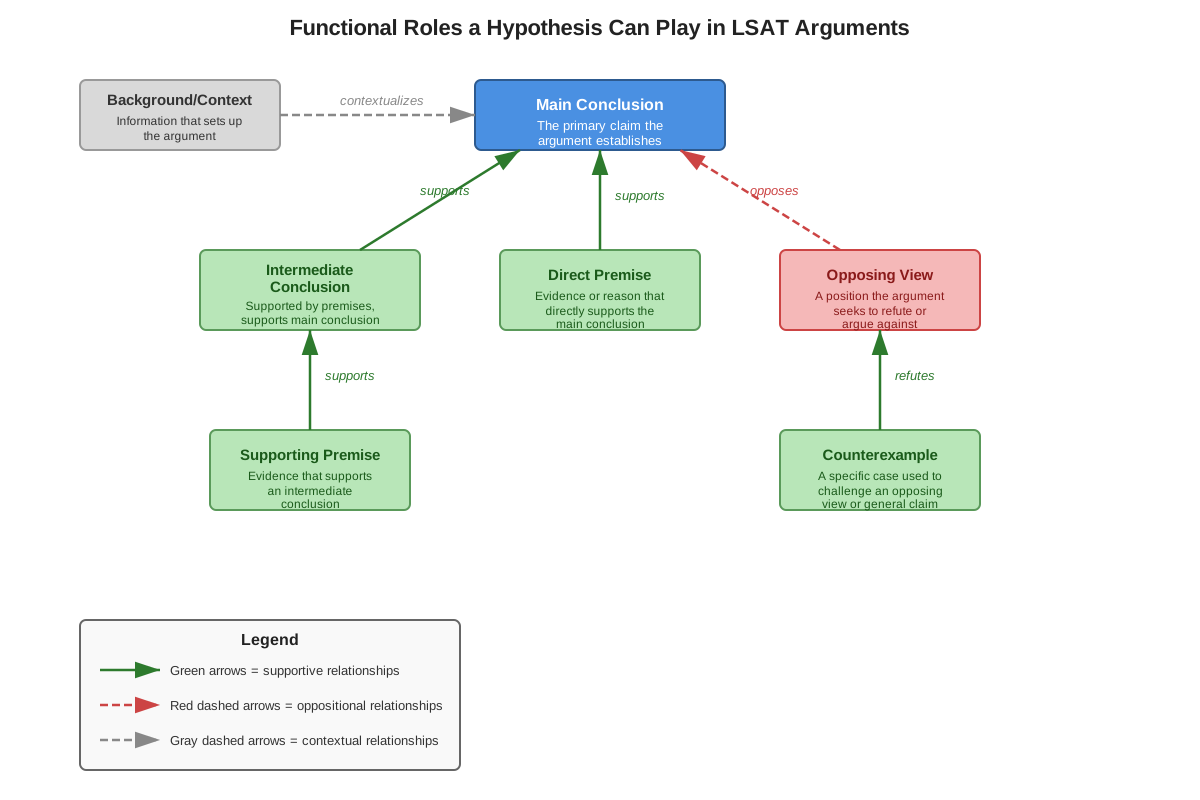
The role of hypothesis in LSAT Logical Reasoning refers to the function that a particular statement—often called a hypothesis, claim, or proposition—serves within an argument's overall structure. Unlike content-focused questions that ask what an argument says or whether it's valid, role questions examine the architectural relationship between statements. A hypothesis might serve as the main conclusion the argument aims to establish, an intermediate step in a chain of reasoning, a premise providing support, or even a position the argument seeks to refute.
The term "hypothesis" in LSAT contexts typically refers to a proposed explanation, theory, or claim that requires support or testing. However, the functional role this hypothesis plays varies dramatically depending on the argument's structure. Consider this distinction: in one argument, "Hypothesis X is correct" might be the main conclusion the author defends with evidence. In another argument, "Hypothesis X is correct" might be a claim the author explicitly argues against, presenting evidence that undermines it.
Common Functional Roles in LSAT Arguments
Understanding the specific roles a hypothesis can play is crucial for accurately answering these questions. The following table outlines the most common functional roles:
| Functional Role | Description | Typical Indicators |
|---|---|---|
| Main Conclusion | The primary claim the argument aims to establish | "Therefore," "thus," "consequently" |
| Intermediate Conclusion | A claim supported by some premises and used to support the main conclusion | Serves as both conclusion and premise |
| Supporting Premise | Evidence or reasoning offered to support a conclusion | "Because," "since," "given that" |
| Opposing View | A position the argument acknowledges but disagrees with | "Some believe," "critics argue," "it might seem" |
| Hypothesis Under Evaluation | A claim being tested or examined by the evidence presented | "To test this," "the hypothesis that," "the theory suggests" |
| Background Information | Context provided to frame the argument without directly supporting the conclusion | Appears early; sets up the scenario |
Identifying Question Stems for Role Questions
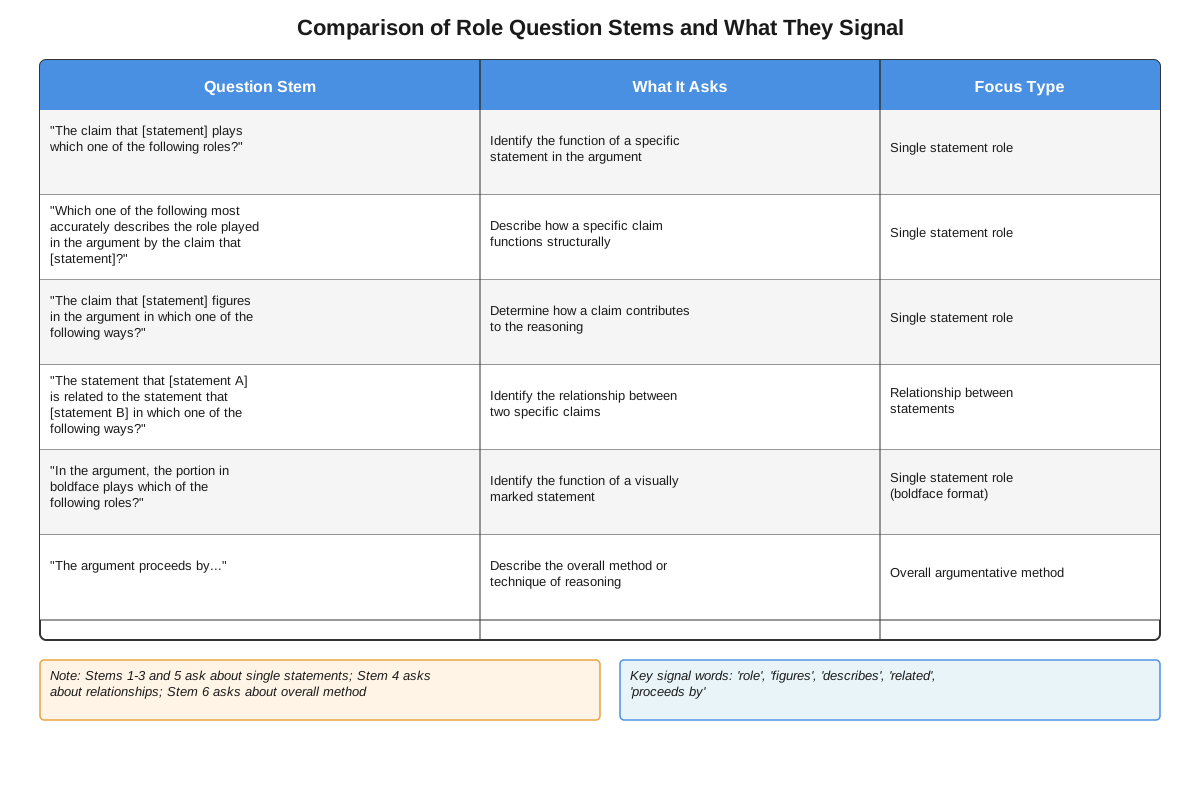
LSAT role of hypothesis questions use distinctive question stems that signal the need to identify a statement's function. Recognizing these stems immediately helps students activate the appropriate analytical approach:
- "The claim that [statement] plays which one of the following roles in the argument?"
- "The statement that [statement] figures in the argument in which one of the following ways?"
- "In the argument, the hypothesis that [statement] serves to..."
- "The proposition that [statement] is used by the author to..."
- "Which one of the following most accurately describes the role played in the argument by the claim that [statement]?"
These question stems share a common feature: they reference a specific statement from the passage and ask about its function rather than its truth value or logical validity.
The Analytical Process for Role Questions
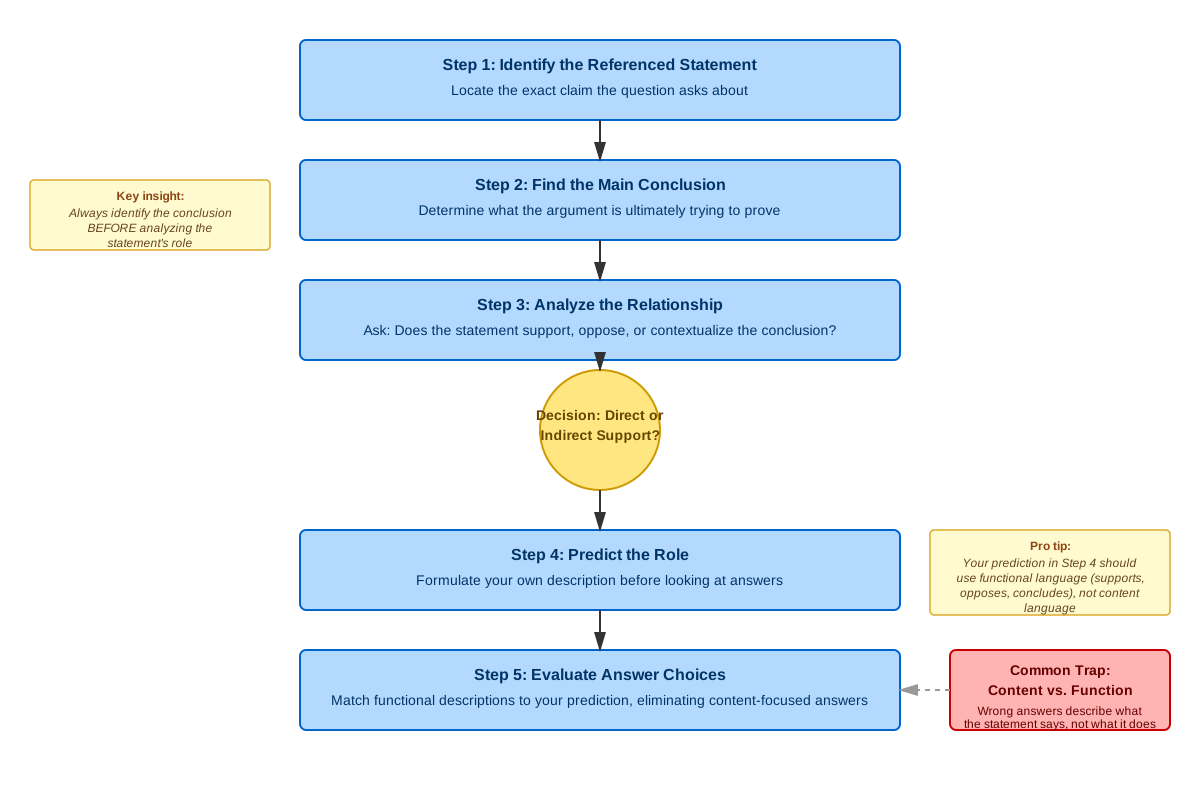
Solving role of hypothesis questions requires a systematic approach:
- Identify the main conclusion first: Before determining any statement's role, locate what the argument is ultimately trying to prove. This provides the reference point for all other statements.
- Map the argument structure: Create a mental or written outline showing how statements relate. Which statements support others? Which statements are supported by others?
- Locate the referenced statement: Find the exact claim the question asks about within the passage.
- Determine its structural relationship: Ask these questions:
- Does this statement support the main conclusion directly?
- Does this statement support an intermediate point that then supports the conclusion?
- Is this statement itself the main conclusion?
- Does the argument argue against this statement?
- Does this statement provide context without directly supporting the conclusion?
- Match to answer choices: Evaluate each answer choice by comparing its functional description to the actual role you've identified.
Hypothesis as Main Conclusion vs. Premise
A critical distinction in role questions involves recognizing whether a hypothesis serves as what the argument is trying to prove (conclusion) or as evidence for that proof (premise). Consider this example:
"Recent studies show that meditation reduces stress hormones. The hypothesis that meditation improves mental health is therefore well-supported."
Here, "meditation improves mental health" is the main conclusion—the claim being established. The studies serve as premises supporting this hypothesis.
Contrast with:
"The hypothesis that meditation improves mental health has gained acceptance. This explains why so many corporations now offer meditation programs to employees."
In this version, "meditation improves mental health" functions as a premise—an accepted claim used to explain corporate behavior (the conclusion).
Hypothesis as Opposing View
A particularly common LSAT pattern involves presenting a hypothesis that the argument ultimately rejects. This structure appears frequently because it tests whether students can distinguish between claims the author endorses versus claims the author merely acknowledges:
"Some researchers hypothesize that increased screen time causes attention problems in children. However, recent longitudinal studies show no causal relationship between screen time and attention span when controlling for other variables. The hypothesis is therefore unfounded."
Here, the hypothesis about screen time serves as an opposing view—a position introduced specifically to be refuted. Students who fail to recognize this structure might incorrectly identify the hypothesis as the argument's conclusion, when in fact the argument concludes that the hypothesis is wrong.
Intermediate Conclusions and Complex Structures
More challenging role questions involve arguments with multiple layers, where a hypothesis serves as an intermediate conclusion—a claim that is both supported by some evidence and used to support a further conclusion:
"Studies show meditation reduces cortisol levels. This indicates that meditation reduces stress. Therefore, meditation should be recommended for anxiety disorders."
In this structure:
- "Meditation reduces cortisol levels" = premise
- "Meditation reduces stress" = intermediate conclusion (supported by the cortisol claim, supports the recommendation)
- "Meditation should be recommended for anxiety disorders" = main conclusion
If the question asks about the role of "meditation reduces stress," the correct answer must capture its dual function as both a conclusion drawn from evidence and a premise supporting a further claim.
Concept Relationships
The role of hypothesis concept connects intimately with other Logical Reasoning skills in a hierarchical relationship. At the foundation lies argument structure identification—the ability to distinguish premises from conclusions. This prerequisite skill enables students to then analyze how those components function, which is precisely what role questions test.
The relationship flows as follows: Basic argument structure → Role identification → Method of reasoning → Parallel reasoning. Understanding roles prepares students for method of reasoning questions, which ask not just what role a statement plays but what technique or strategy the argument employs. Both role and method questions then provide the foundation for parallel reasoning questions, which require recognizing identical argumentative structures across different content.
Within the topic itself, concepts connect through a decision tree structure. First, determine whether the referenced statement is something the argument supports or opposes. If the argument supports it, determine whether it's the ultimate conclusion or an intermediate step. If it's an intermediate step, determine whether it functions primarily as a sub-conclusion or as a premise. If the argument opposes the statement, determine whether it's presented as an opposing view to refute or as a hypothesis under examination.
The role of hypothesis also connects forward to assumption questions because understanding what role a statement plays helps identify what unstated assumptions must link premises to conclusions. Similarly, it connects to strengthen and weaken questions because recognizing whether a hypothesis is the argument's conclusion or a view it opposes determines whether evidence supporting that hypothesis strengthens or weakens the argument.
High-Yield Facts
⭐ Role questions ask about function, not truth: The question never asks whether a statement is true or false, only what role it plays in the argument's structure.
⭐ The main conclusion is the reference point: To determine any statement's role, first identify what the argument ultimately aims to prove.
⭐ Opposing views are statements the argument disagrees with: When an argument presents a hypothesis it then argues against, that hypothesis is an opposing view, not the conclusion.
⭐ Intermediate conclusions serve dual functions: They are supported by some premises and support the main conclusion, making them both conclusions and premises simultaneously.
⭐ Question stems reference specific statements: Role questions always point to a particular claim in the passage and ask about its function.
- Background information provides context but doesn't directly support the conclusion through logical inference.
- Premises can be facts, studies, observations, or accepted claims used as evidence.
- The same statement type (e.g., "hypothesis") can play different roles in different arguments.
- Conclusion indicators (therefore, thus, hence) signal that what follows is being established, not assumed.
- Premise indicators (because, since, given that) signal that what follows is being used as support.
- Role questions appear more frequently in the second half of Logical Reasoning sections.
- Correct answers to role questions use functional language (supports, establishes, refutes) rather than content descriptions.
- Arguments can have multiple hypotheses playing different roles within the same passage.
Quick check — test yourself on Role of hypothesis so far.
Try Flashcards →Common Misconceptions
Misconception: A hypothesis always serves as the argument's main conclusion.
Correction: A hypothesis can play various roles—it might be the conclusion, a premise, an intermediate step, or even a position the argument opposes. The term "hypothesis" simply indicates a proposed explanation or theory, but its function depends on the argument's structure.
Misconception: If the argument presents evidence for a hypothesis, that hypothesis must be what the argument concludes.
Correction: The argument might present evidence for a hypothesis as a preliminary step before using that supported hypothesis to establish a further conclusion. The hypothesis would then be an intermediate conclusion, not the main point.
Misconception: The first statement in an argument cannot be the conclusion.
Correction: Conclusions can appear anywhere in an argument—beginning, middle, or end. The conclusion's position doesn't determine its role; its logical relationship to other statements does.
Misconception: Role questions require evaluating whether the argument is logically valid.
Correction: Role questions are purely structural. They ask what function a statement serves, not whether the argument successfully proves its point or contains logical flaws.
Misconception: If an argument mentions a hypothesis and then provides evidence, the evidence must support that hypothesis.
Correction: The argument might present evidence that contradicts or undermines the hypothesis, especially when the hypothesis represents an opposing view the argument aims to refute.
Misconception: Background information and premises are the same thing.
Correction: Premises directly support the conclusion through logical inference, while background information provides context or sets up the scenario without serving as evidence for the conclusion.
Misconception: The longest or most complex statement in an argument is usually the conclusion.
Correction: Conclusions can be simple or complex, short or long. Their role is determined by logical function, not length or complexity.
Worked Examples
Example 1: Hypothesis as Opposing View
Passage: "Some nutritionists hypothesize that eating frequent small meals throughout the day boosts metabolism more effectively than eating three larger meals. However, recent controlled studies comparing the two eating patterns found no significant difference in metabolic rate between groups. Additionally, participants eating three meals reported better appetite control. The hypothesis that frequent small meals boost metabolism is therefore not supported by current evidence."
Question: The hypothesis that eating frequent small meals boosts metabolism plays which role in the argument?
Analysis Process:
Step 1: Identify the main conclusion. The argument concludes: "The hypothesis that frequent small meals boost metabolism is therefore not supported by current evidence." The conclusion indicator "therefore" signals this claim.
Step 2: Map the argument structure:
- Opening: Some nutritionists hypothesize [frequent small meals boost metabolism]
- Evidence 1: Studies found no metabolic difference
- Evidence 2: Three-meal participants had better appetite control
- Conclusion: The hypothesis is not supported
Step 3: Determine the hypothesis's role. The hypothesis is introduced as something "some nutritionists" believe, then the argument presents evidence against it, and finally concludes it's unsupported. The hypothesis is clearly a position the argument opposes.
Step 4: Evaluate answer choices:
- (A) "It is the main conclusion" - INCORRECT. The conclusion is that this hypothesis is NOT supported.
- (B) "It is a premise supporting the conclusion" - INCORRECT. The hypothesis doesn't support the conclusion; evidence against it does.
- (C) "It is an opposing view that the argument refutes" - CORRECT. The argument presents this hypothesis specifically to argue against it.
- (D) "It is an intermediate conclusion" - INCORRECT. The argument never establishes this hypothesis as true.
Answer: (C) - The hypothesis functions as an opposing view that the argument refutes with evidence.
Connection to Learning Objectives: This example demonstrates how to identify role of hypothesis in LSAT questions (Objective 1), explains the reasoning pattern where a hypothesis serves as an opposing view (Objective 2), and applies the analytical process to solve the problem accurately (Objective 3).
Example 2: Hypothesis as Intermediate Conclusion
Passage: "Archaeological evidence shows that ancient Mesopotamian cities had sophisticated water management systems, including aqueducts and drainage networks. This indicates that these civilizations possessed advanced engineering knowledge. Such engineering expertise would have required formal education systems to transmit technical knowledge across generations. Therefore, ancient Mesopotamia likely had established schools or apprenticeship programs."
Question: The claim that ancient Mesopotamian civilizations possessed advanced engineering knowledge plays which role in the argument?
Analysis Process:
Step 1: Identify the main conclusion. The conclusion indicator "therefore" signals the final claim: "ancient Mesopotamia likely had established schools or apprenticeship programs."
Step 2: Map the argument structure:
- Premise: Archaeological evidence of water management systems
- Intermediate claim: These civilizations possessed advanced engineering knowledge
- Further reasoning: Such expertise requires formal education systems
- Main conclusion: Mesopotamia likely had schools/apprenticeships
Step 3: Analyze the referenced statement's function. "Possessed advanced engineering knowledge" is supported by the archaeological evidence (making it a conclusion from that evidence) and is then used to support the claim about education systems (making it a premise for the main conclusion).
Step 4: Recognize the dual function. This statement is both:
- A conclusion drawn from the archaeological evidence
- A premise supporting the final conclusion about education
This dual function defines an intermediate conclusion.
Step 5: Evaluate answer choices:
- (A) "It is the main conclusion" - INCORRECT. The main conclusion is about education systems.
- (B) "It is a premise offered in support of the conclusion" - PARTIALLY CORRECT but incomplete. It does support the conclusion, but it's also itself supported by evidence.
- (C) "It is an intermediate conclusion used to support the main conclusion" - CORRECT. This captures both functions.
- (D) "It is background information" - INCORRECT. It directly supports the conclusion through logical inference.
Answer: (C) - The claim functions as an intermediate conclusion, both supported by evidence and supporting the main point.
Connection to Learning Objectives: This example illustrates a more complex reasoning pattern (Objective 2) where a hypothesis serves multiple functions, demonstrates how to distinguish between different functional roles (Objective 4), and shows the application process for complex argument structures (Objective 6).
Exam Strategy
Approaching Role of Hypothesis Questions
When encountering a role question on the LSAT, implement this strategic approach:
First 15 seconds: Read the question stem carefully to identify exactly which statement's role you need to determine. Underline or mentally note the specific claim referenced.
Next 30-45 seconds: Read the passage with structure in mind. As you read, actively identify:
- The main conclusion (mark with "C")
- Major premises (mark with "P")
- The specific statement the question references (mark with "?")
Next 20-30 seconds: Determine the referenced statement's function by asking:
- Does the argument support this claim or oppose it?
- If supported, is this the ultimate point or a step toward it?
- If opposed, is this an opposing view being refuted?
Final 30-45 seconds: Evaluate answer choices by elimination, looking for functional language that matches your analysis.
Exam Tip: Always identify the main conclusion before attempting to determine any other statement's role. The conclusion serves as your reference point for all structural relationships.
Trigger Words and Phrases
Certain words in passages signal specific roles:
Conclusion indicators (the statement that follows is being established):
- Therefore, thus, hence, consequently, so, accordingly, it follows that
Premise indicators (the statement that follows is being used as support):
- Because, since, for, given that, as indicated by, the reason is
Opposing view indicators (the statement that follows is a position the argument may disagree with):
- Some believe, critics argue, it might seem, one hypothesis suggests, the traditional view holds
Intermediate conclusion indicators (the statement serves dual functions):
- This shows/indicates/demonstrates [intermediate conclusion], which means/implies [main conclusion]
Process of Elimination Tips
When evaluating answer choices for role questions:
- Eliminate answers that describe content rather than function: If an answer choice restates what the statement says rather than what it does, eliminate it.
- Eliminate answers that contradict the argument's direction: If the argument clearly supports a hypothesis, eliminate answers saying it opposes or refutes it.
- Watch for "main conclusion" trap answers: The LSAT frequently includes "it is the main conclusion" as a trap answer for intermediate conclusions or major premises. Verify that no further claim is being established.
- Eliminate answers with absolute language that doesn't match: If an answer says a statement "proves" or "establishes with certainty" but the argument uses tentative language, eliminate it.
- Prefer answers that capture dual functions: For complex arguments, answers acknowledging that a statement both receives support and provides support are often correct for intermediate conclusions.
Time Allocation
Role questions typically require 60-90 seconds to complete accurately. Allocate time as follows:
- 15 seconds: Read and understand the question stem
- 45 seconds: Read and map the passage structure
- 30 seconds: Evaluate answer choices
If you exceed 90 seconds, mark the question for review and move on. Role questions rarely require more than 90 seconds when approached systematically, so extended time usually indicates confusion that won't resolve quickly.
Memory Techniques
The CROP Mnemonic
Remember the four most common roles with CROP:
- Conclusion (main point being established)
- Refuted view (opposing position argued against)
- Outline/Background (context without direct support)
- Premise (evidence supporting the conclusion)
The "Support Flow" Visualization
Visualize arguments as arrows showing support flow:
[Premise] → [Intermediate Conclusion] → [Main Conclusion]
                    ↑
              [Supporting Premise]
When determining a statement's role, ask: "Where does this fit in the support flow?" If arrows point toward it, it's a conclusion. If arrows point away from it, it's a premise. If arrows point both toward and away, it's an intermediate conclusion.
The "Opposing View" Red Flag
Create a mental red flag for phrases like "some believe," "critics argue," or "one hypothesis suggests." These phrases often introduce opposing views that the argument will refute. When you see these triggers, immediately consider whether the argument ultimately agrees or disagrees with what follows.
The Question Stem Pattern
Remember that role question stems always follow this pattern: [Reference to specific statement] + [Question about function]. Train yourself to recognize this pattern instantly, which activates the structural analysis mindset rather than content evaluation.
Summary
The role of hypothesis in LSAT Logical Reasoning questions tests the ability to identify what function a specific statement serves within an argument's structure. Unlike questions focused on content or validity, role questions examine the architectural relationships between claims—whether a hypothesis serves as the main conclusion, a supporting premise, an intermediate step, or an opposing view being refuted. Success on these questions requires a systematic approach: first identifying the argument's main conclusion to establish a reference point, then mapping how other statements relate to that conclusion, and finally matching the referenced statement's actual function to answer choices that use functional rather than content-based language. The most common pattern involves distinguishing whether the argument supports or opposes a hypothesis, with particular attention to opposing views that are introduced specifically to be refuted. Intermediate conclusions present additional complexity by serving dual functions—both receiving support from premises and providing support for the main conclusion. Mastering role of hypothesis questions builds essential skills for other Logical Reasoning question types and represents a high-yield topic that appears consistently across LSAT administrations, making it crucial for achieving competitive scores.
Key Takeaways
- Role questions ask about a statement's function within an argument's structure, not about its truth value or the argument's validity
- Always identify the main conclusion first—it serves as the reference point for determining all other statements' roles
- Opposing views are statements the argument disagrees with; don't confuse them with the argument's conclusion
- Intermediate conclusions serve dual functions: they are both supported by evidence and used to support the main conclusion
- Question stems for role questions always reference a specific statement and ask about its function using phrases like "plays which role" or "figures in the argument in which way"
- The same type of statement (hypothesis, claim, theory) can play different roles in different arguments depending on structural relationships
- Correct answers use functional language (supports, establishes, refutes, provides context) rather than merely restating content
Related Topics
Method of Reasoning Questions: After mastering role of hypothesis, students should progress to method of reasoning questions, which ask not just what role statements play but what overall argumentative technique or strategy the argument employs. Understanding roles provides the foundation for recognizing methods.
Parallel Reasoning Questions: These questions require identifying arguments with identical structures, which builds directly on the ability to analyze how statements function within arguments. Mastering role identification makes parallel reasoning questions significantly more manageable.
Assumption Questions: Understanding what role each statement plays helps identify gaps in reasoning that assumptions must fill. If you know a statement is a premise supporting a conclusion, you can better identify what unstated assumption connects them.
Argument Structure Questions: This broader category includes role questions but also encompasses questions about how arguments are organized, how they respond to objections, and how they use evidence. Role of hypothesis provides essential skills for this entire category.
Practice CTA
Now that you've mastered the core concepts of role of hypothesis questions, it's time to put your knowledge into practice. Attempt the practice questions and flashcards to reinforce your understanding and build the pattern recognition skills essential for LSAT success. Remember: understanding the concepts is just the first step—consistent practice with real LSAT-style questions transforms that understanding into the automatic recognition and quick analysis that leads to top scores. Each practice question you complete strengthens your ability to quickly identify argument structure and accurately determine statement roles under timed conditions. You've built the foundation; now build the speed and confidence that will serve you on test day.
Sign up free to keep reading
Create a free AnvayaPrep account to finish this LSAT guide on Role of hypothesis — plus flashcards and practice questions.