Overview
Role of principle questions represent a sophisticated category within LSAT Logical Reasoning that tests a student's ability to identify how a general principle functions within an argument. Unlike questions that ask you to apply a principle or identify a principle that justifies reasoning, role of principle questions specifically ask you to describe what function a principle serves in the argument's structure. These questions fall under the broader umbrella of method, role, and structure questions, which collectively assess your understanding of how arguments are constructed rather than whether the arguments are valid or sound.
Understanding role of principle questions is essential for LSAT success because they appear regularly on every administration of the exam and require a unique analytical skill set. Rather than evaluating the content or truth of an argument, these questions demand that you step back and analyze the architecture of reasoning itself. You must recognize whether a principle is being used as a premise to support a conclusion, as a general rule being illustrated by a specific case, as a standard against which something is being evaluated, or in another structural capacity. This meta-level analysis distinguishes strong test-takers from average ones.
The lsat role of principle question type connects intimately with other Logical Reasoning concepts, particularly argument structure, conditional reasoning, and the distinction between general rules and specific applications. Mastering this topic strengthens your overall analytical reading skills and prepares you for the nuanced reasoning required throughout the LSAT, including in Reading Comprehension passages that discuss legal principles and their applications. The ability to identify how principles function in arguments is also foundational to legal reasoning itself, making this topic both practically and academically significant for future law students.
Learning Objectives
- [ ] Identify how Role of principle appears in LSAT questions
- [ ] Explain the reasoning pattern behind Role of principle
- [ ] Apply Role of principle to solve LSAT-style problems accurately
- [ ] Distinguish between different functional roles a principle can play in an argument
- [ ] Recognize common wrong answer patterns in role of principle questions
- [ ] Analyze the relationship between general principles and specific applications within argument structures
Prerequisites
- Basic argument structure: Understanding premises, conclusions, and how they relate is essential because role of principle questions require identifying where principles fit within this structure.
- Conditional reasoning fundamentals: Many principles are expressed as conditional statements (if-then relationships), so recognizing these patterns helps identify how principles function.
- Distinction between general and specific statements: Role of principle questions often hinge on recognizing when a statement expresses a broad rule versus a particular instance.
- Familiarity with standard LSAT question stems: Knowing how the LSAT phrases different question types helps you quickly identify role of principle questions and activate the appropriate strategy.
Why This Topic Matters
Role of principle questions test a fundamental skill in legal reasoning: the ability to understand how general rules relate to specific cases. In legal practice, attorneys must constantly navigate between abstract legal principles and concrete factual situations, determining how rules apply, when they serve as justification, and how they structure arguments. The LSAT assesses this skill because it predicts success in law school case analysis and legal writing.
On the LSAT, role of principle questions typically appear 2-4 times per Logical Reasoning section, making them a high-frequency question type that can significantly impact your score. These questions appear in several formats: they may ask about the role of an explicitly stated principle, the function of a general rule in relation to a specific case, or how a normative standard operates within an argument. The difficulty level ranges from medium to challenging, with harder versions involving complex nested reasoning or principles that serve multiple functions simultaneously.
Common manifestations include arguments where a principle is invoked to justify a policy recommendation, cases where a general rule is illustrated through a specific example, situations where a principle serves as an evaluative standard, and instances where a principle functions as a major premise in a deductive argument. Recognizing these patterns quickly allows you to anticipate answer choices and eliminate wrong options efficiently, saving valuable time during the exam.
Core Concepts
What is a Principle in LSAT Arguments?
A principle in LSAT Logical Reasoning is a general rule, standard, or guideline that applies across multiple situations. Principles are typically expressed as broad statements that establish how things should be done, what criteria should be used for evaluation, or what relationships exist between categories of things. For example, "People should not be held responsible for consequences they could not reasonably foresee" is a principle because it establishes a general standard applicable to many specific situations.
Principles differ from specific factual claims in their level of generality and their prescriptive or descriptive scope. While a specific claim might state "John was not responsible for the accident," a principle would state the general rule that determines when anyone should or should not be held responsible. Understanding this distinction is crucial because role of principle questions specifically ask about these general statements, not about particular facts or conclusions.
The Role of Principle Question Type
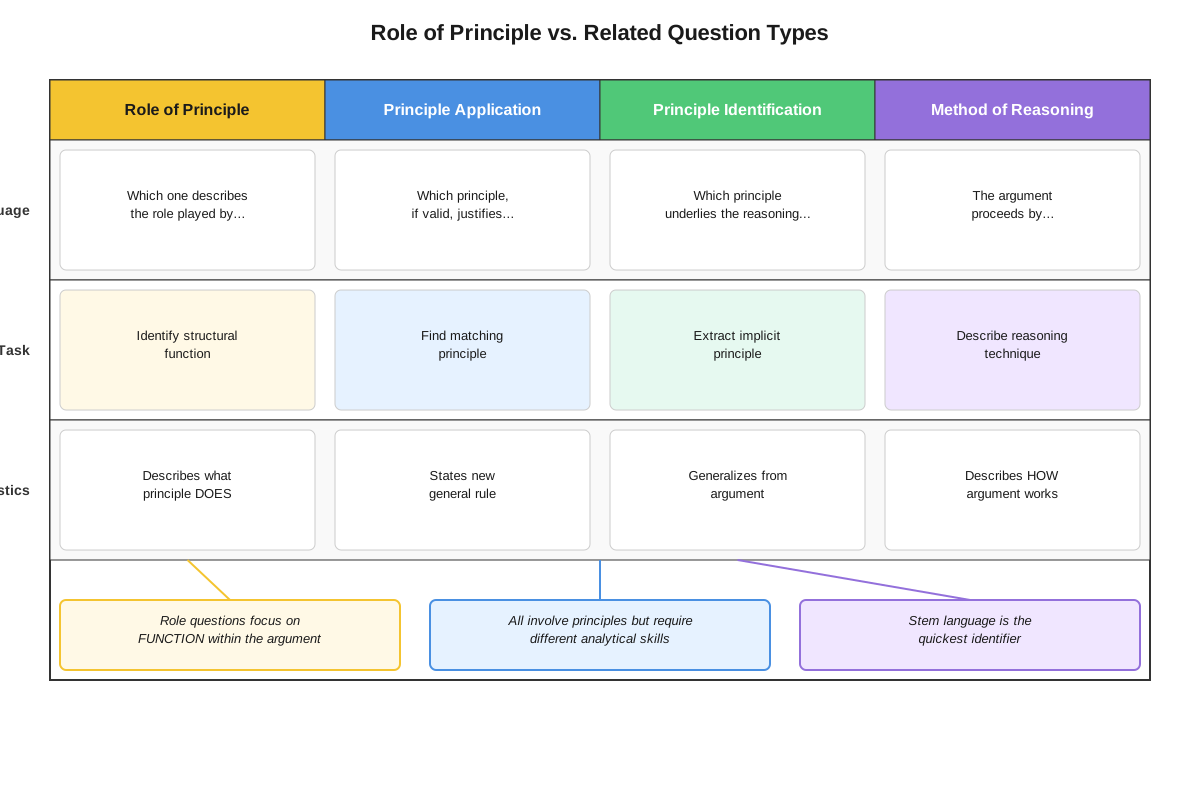
Role of principle questions ask you to identify what function a principle serves within the argument's structure. The question stem typically includes phrases like:
- "The principle stated above figures in the argument in which one of the following ways?"
- "The claim that [principle] plays which one of the following roles in the argument?"
- "The generalization serves which one of the following functions in the argument?"
These questions are not asking whether the principle is true, whether it's sufficient to prove the conclusion, or whether it's the best principle to use. Instead, they ask you to describe the structural role the principle plays—essentially, to identify its job in the argument's architecture.
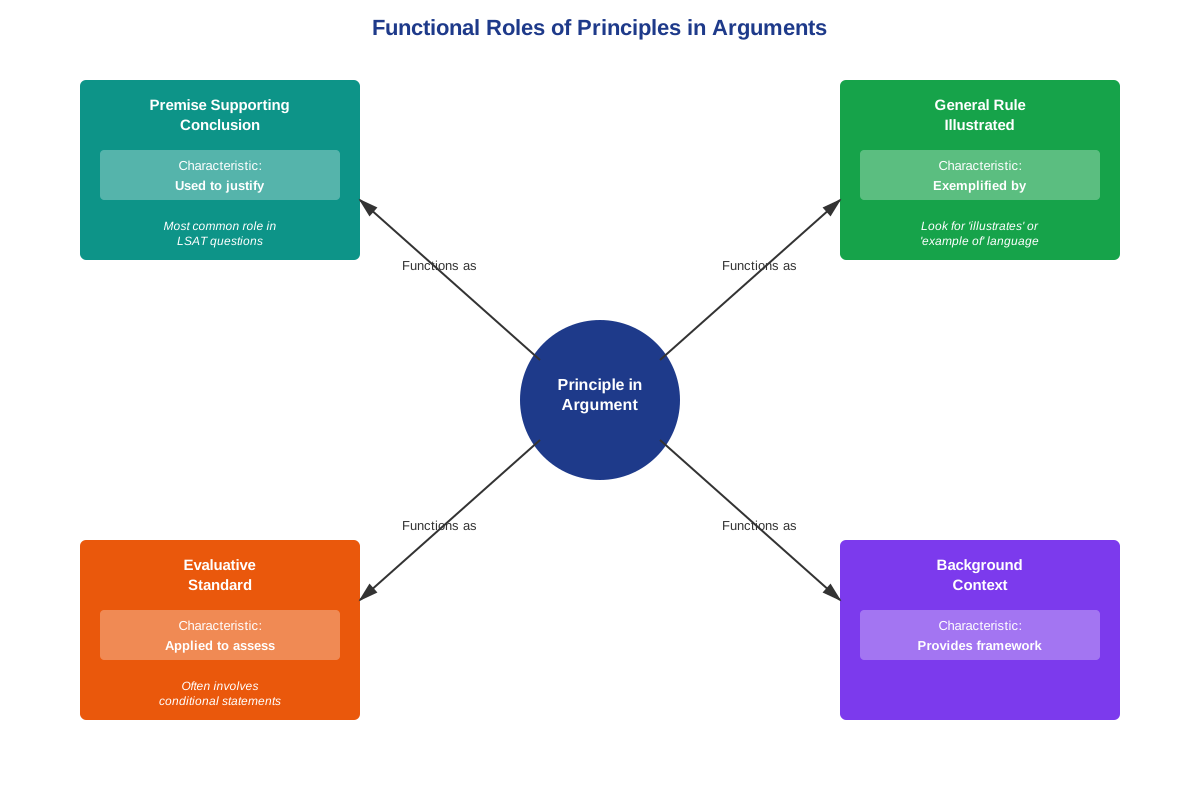
Common Roles Principles Play
Principles can serve several distinct functions in LSAT arguments:
| Role | Description | Example Context |
|---|---|---|
| Premise/Support | The principle provides direct support for the conclusion | "We should adopt this policy because it follows the principle that..." |
| General Rule Being Illustrated | A specific case demonstrates or exemplifies the principle | "This situation shows the principle that... in action" |
| Evaluative Standard | The principle serves as a criterion for judgment | "According to the principle that..., we can evaluate whether..." |
| Major Premise in Deduction | The principle functions as the general rule in a deductive argument | "All actions following principle X are justified; this action follows principle X; therefore..." |
| Background Context | The principle establishes a framework without directly supporting the conclusion | "Given the accepted principle that..., we must consider..." |
| Intermediate Conclusion | The principle is itself supported by other premises and then supports the main conclusion | "Because of facts A and B, we can establish principle X, which means conclusion Y follows" |
Analyzing Argument Structure for Principle Roles
To identify a principle's role, follow this systematic approach:
- Locate the conclusion: Identify what the argument is ultimately trying to prove or recommend
- Identify the principle: Find the general statement (often recognizable by broad language like "all," "should," "whenever," or "in general")
- Trace the logical flow: Determine whether the principle comes before or after other claims in the reasoning chain
- Test the relationship: Ask whether the principle directly supports the conclusion, whether it's being illustrated by specifics, or whether it serves another function
- Eliminate based on direction: Wrong answers often reverse the relationship (claiming the principle is supported when it actually provides support)
The Principle-Application Relationship
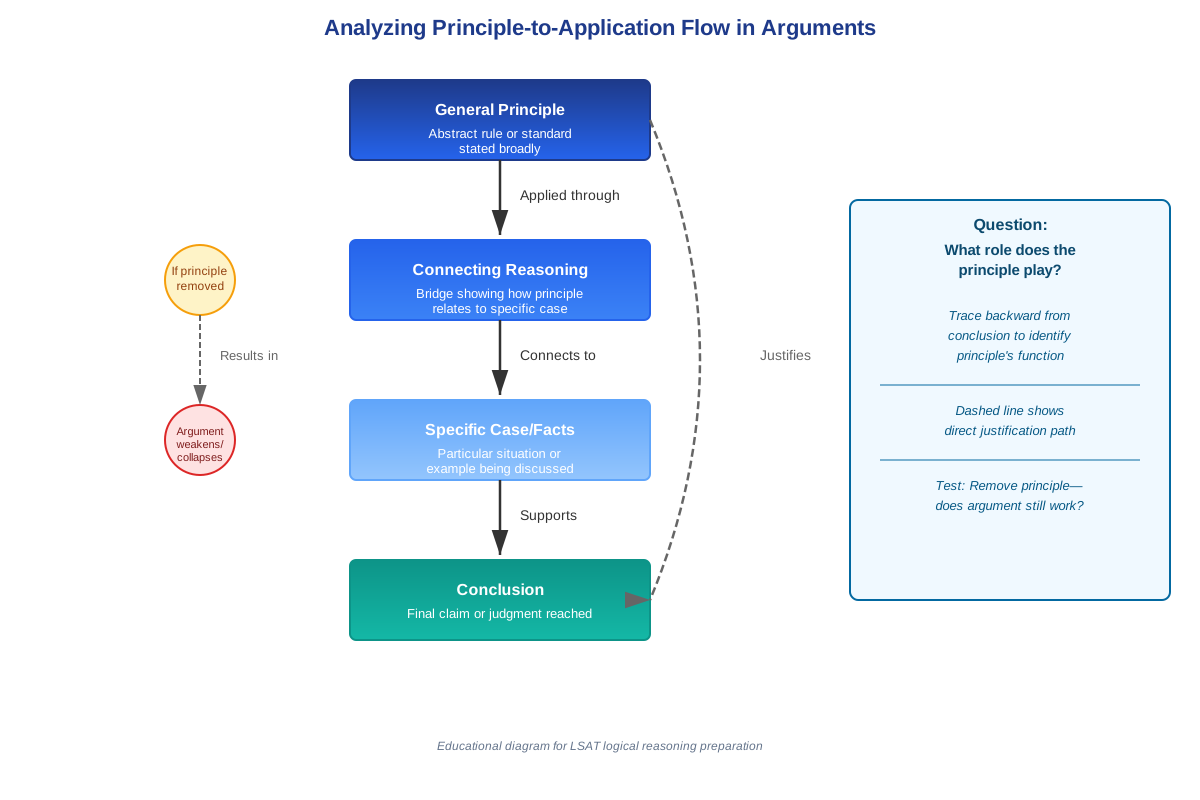
A critical pattern in role of principle questions involves the relationship between general principles and specific applications. Arguments often move in one of two directions:
From Specific to General (Inductive): The argument presents specific cases or facts and derives or illustrates a general principle from them. Here, the principle's role is typically as a conclusion or generalization supported by the specifics.
From General to Specific (Deductive): The argument starts with a general principle and applies it to a specific situation to reach a conclusion. Here, the principle's role is typically as a premise or major assumption that justifies the specific conclusion.
Distinguishing these directions is essential because wrong answers frequently describe the relationship backwards. If an argument uses a principle to justify a specific recommendation, a wrong answer might claim the principle is "illustrated by" or "derived from" the specific case.
Normative vs. Descriptive Principles
Principles can be normative (prescriptive, stating what should be) or descriptive (stating what is generally true). Normative principles use language like "should," "ought," "must," or "is justified," while descriptive principles use language like "typically," "generally," or "always is." The role a principle plays often depends on whether it's normative or descriptive:
- Normative principles frequently serve as evaluative standards or justifications for recommendations
- Descriptive principles often serve as background assumptions or explanatory frameworks
Recognizing this distinction helps you predict what role the principle likely plays and what language the correct answer will use.
Concept Relationships
The concepts within role of principle questions form an interconnected system. The fundamental principle-application relationship underlies all other concepts—you cannot identify a principle's role without understanding whether it's being applied to specifics or derived from them. This relationship directly connects to argument structure analysis, which provides the framework for determining where the principle fits in the logical flow.
The various common roles principles play (premise, illustration, standard, etc.) represent different manifestations of how the principle-application relationship can function. Each role type connects back to basic conditional reasoning when principles are expressed as if-then statements, and to premise-conclusion relationships when principles serve as support.
Normative vs. descriptive principles cuts across all other concepts, affecting how principles function regardless of their structural role. A normative principle serving as a premise functions differently than a descriptive principle in the same position, even though both are premises.
The relationship map flows as follows:
Argument Structure → identifies → Principle Location → analyzed through → Principle-Application Relationship → determines → Specific Role (premise/illustration/standard/etc.) → modified by → Normative vs. Descriptive Nature → leads to → Correct Answer Selection
This topic connects to prerequisite knowledge of basic argument structure by adding a layer of sophistication—instead of just identifying premises and conclusions, you're now categorizing types of premises and their functions. It relates to conditional reasoning because many principles are conditional statements, and understanding their logical form helps identify their role. The connection to method, role, and structure questions is direct: role of principle questions are a specific subtype within this broader category, sharing the meta-analytical approach of examining how arguments work rather than whether they're correct.
High-Yield Facts
⭐ Role of principle questions ask about function, not truth or sufficiency—they want to know what job the principle does in the argument, not whether it's correct or adequate.
⭐ The most common wrong answer reverses the direction of support—if the principle supports the conclusion, wrong answers often claim the conclusion supports or illustrates the principle.
⭐ Principles are general statements that apply across multiple cases—if a statement is specific to one situation, it's not functioning as a principle.
⭐ Question stems containing "figures in," "plays which role," or "functions as" signal role of principle questions—recognizing these phrases immediately activates the correct strategy.
⭐ When a principle comes before a specific case in the argument, it typically serves as a premise or standard—the logical flow indicates the principle is being applied downward to the specific.
- Role of principle questions appear 2-4 times per Logical Reasoning section, making them high-frequency and high-impact.
- Principles serving as premises directly support the conclusion, while principles serving as illustrations are supported by specific examples.
- The phrase "general rule" or "generalization" in a question stem often indicates a role of principle question.
- Normative principles (using "should" or "ought") frequently serve as evaluative standards or justifications for policy recommendations.
- When an argument moves from specific facts to a general principle, the principle typically functions as a conclusion or intermediate conclusion.
- Wrong answers often use correct terminology but apply it to the wrong element of the argument (describing the role of the conclusion instead of the principle).
- Principles expressed as conditional statements (if-then) often serve as major premises in deductive arguments.
- The correct answer must accurately describe both what the principle does AND what it does it to (what it supports or what supports it).
- Background principles that establish context without directly supporting the conclusion are less common but appear in harder questions.
- Multiple principles can appear in a single argument, each playing different roles—the question will specify which principle's role you need to identify.
Quick check — test yourself on Role of principle so far.
Try Flashcards →Common Misconceptions
Misconception: Role of principle questions are asking whether the principle is true or valid.
Correction: These questions ask only about the structural function the principle serves in the argument, not about its truth value. Even if a principle is false or questionable, you can still correctly identify that it serves as a premise supporting the conclusion.
Misconception: If a principle appears early in the argument, it must be a premise.
Correction: Position alone doesn't determine role. An argument might state a principle early and then spend the rest of the passage supporting or illustrating that principle with specific examples, making the principle a conclusion rather than a premise.
Misconception: "Illustrated by" and "supported by" mean the same thing in answer choices.
Correction: These phrases indicate opposite relationships. If a principle is "illustrated by" specific cases, those cases demonstrate the principle (the principle is the conclusion). If a principle is "supported by" evidence, that evidence proves the principle is true. However, if a principle "supports" a conclusion, it serves as a premise.
Misconception: The longest or most complex statement in the argument must be the principle.
Correction: Principles are identified by their generality and scope, not their length or complexity. A short statement like "Fairness requires equal treatment" is a principle, while a long description of a specific situation is not, regardless of complexity.
Misconception: Role of principle questions are the same as principle application questions.
Correction: Principle application questions ask you to apply a principle to a new situation or identify which principle justifies reasoning. Role of principle questions ask you to describe what function a principle already plays in a given argument—they're analyzing structure, not applying content.
Misconception: If the principle is a general rule, it must be serving as a premise.
Correction: General rules can serve various functions. An argument might present specific evidence to establish a general rule (making the rule a conclusion), or it might use a general rule to evaluate a specific case (making it a standard), or it might cite a general rule as background context without using it to directly support the conclusion.
Misconception: The correct answer will use the same words as the argument.
Correction: Correct answers typically paraphrase and describe the principle's function using different terminology. Looking for word matches often leads to trap answers that quote the argument but mischaracterize the principle's role.
Worked Examples
Example 1: Principle as Premise
Argument: "Companies have a moral obligation to minimize environmental harm whenever doing so does not threaten their financial viability. TechCorp can afford to implement new pollution controls without jeopardizing its profits. Therefore, TechCorp has a moral obligation to implement these controls."
Question: The claim that companies have a moral obligation to minimize environmental harm whenever doing so does not threaten their financial viability plays which one of the following roles in the argument?
Analysis:
Step 1 - Identify the conclusion: "TechCorp has a moral obligation to implement these controls" (signaled by "therefore").
Step 2 - Identify the principle: "Companies have a moral obligation to minimize environmental harm whenever doing so does not threaten their financial viability" (this is a general rule applying to all companies).
Step 3 - Trace the logical flow: The argument structure is:
- General principle about all companies (first sentence)
- Specific fact about TechCorp (second sentence)
- Specific conclusion about TechCorp (third sentence)
Step 4 - Test the relationship: The principle is being applied to TechCorp's specific situation. The principle states a general rule, the second sentence establishes that TechCorp meets the conditions of that rule, and the conclusion follows by applying the rule to this specific case.
Step 5 - Identify the role: The principle serves as a major premise in a deductive argument. It provides the general rule that, combined with the specific fact about TechCorp, logically necessitates the conclusion.
Correct Answer: "It is a general claim that is applied to a specific case to reach the argument's conclusion."
Why wrong answers fail:
- "It is a conclusion supported by the claim about TechCorp's financial situation" - WRONG: This reverses the direction of support; the principle supports the conclusion, not vice versa.
- "It is a specific application of a more general principle" - WRONG: The principle IS the general statement, not a specific application.
- "It is a hypothesis that the argument seeks to establish" - WRONG: The argument assumes the principle is true and uses it to reach a conclusion; it doesn't try to prove the principle.
Example 2: Principle as Conclusion
Argument: "In the past decade, every major technological innovation that succeeded commercially was one that made existing tasks easier rather than requiring users to learn entirely new skills. The smartphone succeeded because it simplified communication and information access. Streaming services succeeded because they made entertainment more convenient. Based on this pattern, we can conclude that technological innovations are most likely to succeed commercially when they reduce the effort required for familiar activities rather than demanding new competencies from users."
Question: The claim that technological innovations are most likely to succeed commercially when they reduce the effort required for familiar activities rather than demanding new competencies from users plays which one of the following roles in the argument?
Analysis:
Step 1 - Identify the conclusion: The final sentence, introduced by "we can conclude that," is the conclusion. This sentence states the principle.
Step 2 - Identify the principle: "Technological innovations are most likely to succeed commercially when they reduce the effort required for familiar activities rather than demanding new competencies from users" - this is a general rule about all technological innovations.
Step 3 - Trace the logical flow:
- Specific observation about the past decade (first sentence)
- Specific examples: smartphones and streaming services (second and third sentences)
- General principle (final sentence, marked as conclusion)
Step 4 - Test the relationship: The argument moves from specific cases to a general rule. The specific examples of successful innovations are used as evidence to support the general principle. This is inductive reasoning—generalizing from particular instances.
Step 5 - Identify the role: The principle serves as the conclusion of the argument, specifically a generalization derived from specific examples.
Correct Answer: "It is a generalization that the argument seeks to establish on the basis of specific examples."
Why wrong answers fail:
- "It is a premise that supports the claim about smartphones and streaming services" - WRONG: The causation goes the opposite direction; the examples support the principle, not vice versa.
- "It serves as a standard by which the argument evaluates technological innovations" - WRONG: The argument isn't evaluating innovations against a standard; it's deriving a standard from observations.
- "It is an assumption required for the argument's reasoning to be valid" - WRONG: The principle is explicitly stated and is what the argument is trying to prove, not an unstated assumption.
Exam Strategy
Identifying Role of Principle Questions
Immediately recognize these questions by their distinctive stems:
- "plays which one of the following roles"
- "figures in the argument in which way"
- "functions in the argument as"
- "serves which purpose"
When you see these phrases, activate your structural analysis mode rather than content evaluation mode. You're analyzing architecture, not assessing validity.
The Three-Step Approach
Step 1: Bracket and Label (15 seconds)
Physically bracket the principle mentioned in the question stem within the argument. Label the conclusion with a "C" and any other major structural elements. This visual organization prevents confusion about what supports what.
Step 2: Determine Direction (10 seconds)
Ask: "Does the principle support something else, or does something else support the principle?" Draw a simple arrow showing the direction of support. This single determination eliminates approximately 60% of wrong answers, which typically reverse this direction.
Step 3: Match Function to Answer (20 seconds)
With the direction clear, match the principle's function to answer choice language:
- If the principle supports the conclusion → look for "premise," "used to support," "provides justification"
- If examples support the principle → look for "illustrated by," "generalization from," "conclusion based on"
- If the principle evaluates something → look for "standard," "criterion," "basis for evaluation"
Trigger Words in Answer Choices
High-probability correct answer language:
- "serves as a premise" (when principle supports conclusion)
- "is a generalization supported by" (when specifics support principle)
- "provides a standard for evaluating" (when principle is used to judge)
- "is applied to a specific case" (when general rule is used deductively)
High-probability wrong answer language:
- "is assumed without justification" (principles in these questions are stated, not assumed)
- "is called into question" (role questions don't involve challenging claims)
- "is proven false" (role questions don't evaluate truth)
- Any answer that reverses the support direction you identified
Process of Elimination Strategy
Eliminate answers in this order:
- First pass: Eliminate any answer that reverses the direction of support (removes 2-3 answers typically)
- Second pass: Eliminate answers that describe the role of the wrong element (describing the conclusion's role instead of the principle's role)
- Third pass: Eliminate answers that use role language that doesn't match the argument type (e.g., "illustrated by examples" when no examples are present)
- Final selection: Choose the answer that accurately describes both the principle's function AND its relationship to other argument elements
Time Allocation
Spend approximately 45-60 seconds on role of principle questions:
- 10 seconds: Read and identify question type
- 20 seconds: Read argument and identify structure
- 15 seconds: Determine principle's role
- 15-20 seconds: Eliminate wrong answers and confirm correct answer
These questions reward careful structural analysis more than speed, so don't rush the identification phase. Investing 5 extra seconds in correctly determining the direction of support saves 20 seconds of confusion in the answer choices.
Common Traps to Avoid
Trap: Choosing an answer that accurately describes something in the argument but describes the wrong element's role. Avoidance: Always verify that the answer describes the specific principle mentioned in the question stem, not the conclusion or another premise.
Trap: Selecting an answer that uses sophisticated-sounding language but doesn't match the actual logical structure. Avoidance: Translate answer choices into simple terms: "Does this say the principle supports the conclusion or that the conclusion supports the principle?"
Trap: Overthinking the relationship and seeing complexity that isn't there. Avoidance: Most role of principle questions involve straightforward premise-conclusion or example-generalization relationships. Start with the simplest interpretation.
Memory Techniques
The PIGS Acronym for Common Roles
Premise - The principle supports the conclusion
Illustration - Specific cases demonstrate the principle
Generalization - The principle is derived from specifics (a type of conclusion)
Standard - The principle serves as an evaluative criterion
When you identify a principle, quickly run through PIGS to categorize its role.
The Arrow Visualization
Visualize the argument as a series of boxes connected by arrows:
[Principle] → [Conclusion] = Principle is a premise
[Examples] → [Principle] = Principle is a generalization
[Principle] ← → [Case] = Principle is a standard for evaluation
Drawing quick arrows on your scratch paper makes the relationship concrete and prevents reversal errors.
The "Support Direction" Mantra
Before looking at answer choices, state aloud (or mentally): "The principle supports X" or "X supports the principle," filling in what X is. This verbal commitment prevents you from being swayed by attractively worded wrong answers that reverse the relationship.
The Question Stem Decoder
Memorize these equivalencies:
- "Figures in" = "plays a role as"
- "Functions as" = "serves as"
- "Plays which role" = "does what job"
Translating formal LSAT language into everyday terms makes the question more approachable and reduces cognitive load.
Summary
Role of principle questions test your ability to identify the structural function a general rule or standard plays within an argument's logical architecture. Unlike questions that ask you to evaluate truth or apply principles to new situations, these questions require meta-analytical skills—you must step back from the content and analyze how the argument is constructed. The key to mastering these questions lies in accurately determining the direction of support: does the principle support other claims (making it a premise or standard), or do other claims support the principle (making it a conclusion or generalization)? Most wrong answers exploit confusion about this directional relationship by reversing it. Success requires systematic analysis: identify the conclusion, locate the principle, trace the logical flow, and match the principle's function to answer choice language. The most common roles principles play are as premises supporting conclusions, as generalizations supported by specific examples, as standards for evaluation, and as major premises in deductive arguments. By recognizing these patterns and avoiding the trap of reversed relationships, you can consistently answer role of principle questions correctly and efficiently.
Key Takeaways
- Role of principle questions ask about structural function, not truth, validity, or sufficiency—focus on what job the principle does in the argument
- The direction of support is critical: determine whether the principle supports something else or something else supports the principle before examining answer choices
- Principles are general statements applicable across multiple cases; specific factual claims are not principles regardless of their importance to the argument
- The most common wrong answers reverse the support relationship, claiming the principle is supported when it actually provides support, or vice versa
- Common roles include premise (supporting the conclusion), generalization (supported by examples), standard (evaluating something), and major premise (in deductive reasoning)
- Question stems containing "figures in," "plays which role," or "functions as" reliably signal role of principle questions
- Systematic structural analysis—bracketing elements, labeling the conclusion, and drawing support arrows—prevents confusion and increases accuracy
Related Topics
Principle Application Questions: After mastering role of principle questions, students should study how to apply stated principles to new situations, which requires understanding both the principle's logical structure and how to match it to novel cases.
Method of Reasoning Questions: These questions ask how an argument proceeds or what argumentative technique it employs, building on the structural analysis skills developed through role of principle questions but applying them more broadly.
Argument Part Questions: Similar to role of principle questions but asking about the role of specific claims rather than principles, these questions extend your structural analysis skills to all argument components.
Parallel Reasoning Questions: Understanding how principles function in arguments provides a foundation for recognizing parallel logical structures across different content domains.
Sufficient Assumption Questions: These questions often involve identifying what principle, if added, would make an argument valid, connecting principle analysis to formal logical sufficiency.
Practice CTA
Now that you understand how to identify and analyze the role of principle in LSAT arguments, it's time to apply these skills to actual practice questions. The concepts you've learned—identifying support direction, recognizing common roles, and avoiding reversal traps—will become automatic only through repeated application. Challenge yourself with the practice questions and flashcards designed for this topic, focusing on articulating why wrong answers fail before confirming the correct answer. Each practice question you complete strengthens your pattern recognition and builds the confidence you need to excel on test day. Remember: role of principle questions are highly learnable and predictable—consistent practice transforms them from challenging obstacles into reliable score-boosters. Start practicing now to cement your mastery of this high-yield question type.
Sign up free to keep reading
Create a free AnvayaPrep account to finish this LSAT guide on Role of principle — plus flashcards and practice questions.