Overview
Role question traps represent one of the most challenging aspects of Logical Reasoning on the LSAT. These questions ask test-takers to identify the function or purpose of a specific statement, claim, or piece of evidence within an argument. While the question stem itself is straightforward—typically asking "which one of the following most accurately describes the role played by the claim that..."—the answer choices are deliberately crafted to mislead even well-prepared students. Understanding these traps is essential because they exploit common misreadings of argument structure and confuse the relationship between premises, conclusions, intermediate conclusions, and background information.
Role questions appear regularly on every LSAT administration, typically comprising 2-4 questions per test. They fall within the broader category of method, role, and structure questions, which collectively test a student's ability to analyze how arguments are constructed rather than whether the arguments are valid or sound. Mastering role question traps requires developing a precise understanding of argument anatomy and learning to recognize the subtle differences between answer choices that may seem nearly identical at first glance.
The significance of this topic extends beyond simply answering role questions correctly. The analytical skills required to avoid these traps—carefully tracking the function of each statement, distinguishing between different types of support, and recognizing the difference between what a statement says versus what it does—are fundamental to success across all Logical Reasoning question types. Students who master role question traps develop a more sophisticated understanding of argumentative structure that improves performance on strengthen, weaken, assumption, and flaw questions as well.
Learning Objectives
- [ ] Identify how role question traps appear in LSAT questions
- [ ] Explain the reasoning pattern behind role question traps
- [ ] Apply role question traps to solve LSAT-style problems accurately
- [ ] Distinguish between the content of a statement and its structural function within an argument
- [ ] Recognize the five most common types of role question traps and their distinguishing features
- [ ] Develop a systematic approach to pre-phrasing the correct answer before reviewing answer choices
Prerequisites
- Basic argument structure: Understanding the distinction between premises, conclusions, and background information is essential because role questions specifically test the ability to identify these components.
- Indicator words and phrases: Familiarity with conclusion indicators (therefore, thus, hence) and premise indicators (because, since, for) helps quickly map argument structure.
- Conditional reasoning fundamentals: Many role question traps involve statements that establish conditional relationships or serve as sufficient/necessary conditions.
- Reading comprehension skills: The ability to parse complex sentences and identify the main point versus supporting details is critical for avoiding content-based confusion.
Why This Topic Matters
Role questions test a fundamental legal reasoning skill: the ability to understand how arguments are constructed and how different pieces of evidence function within a larger persuasive framework. This skill is essential for law school success, where students must analyze judicial opinions, distinguish holdings from dicta, and understand how different legal principles support or undermine arguments. The LSAT uses role questions to assess whether candidates can think structurally about arguments rather than merely reacting to their content.
On the LSAT, role questions appear with high frequency—typically 2-4 questions per Logical Reasoning section, meaning 4-8 questions per complete test. This represents approximately 7-15% of all Logical Reasoning questions, making them a high-yield topic for focused study. Role questions often appear in the medium-to-difficult range of question difficulty, with trap answers designed to catch students who read quickly or fail to distinguish between similar structural functions.
These questions commonly appear in several formats: identifying the role of the main conclusion, recognizing intermediate conclusions that serve as both conclusion and premise, distinguishing between background context and evidential support, identifying counterexamples or objections that the argument addresses, and recognizing concessions that the argument acknowledges before refuting. The trap answers exploit predictable misreadings of these structural elements, making pattern recognition essential for consistent performance.
Core Concepts
Understanding Role Questions
Role questions ask test-takers to identify the function or purpose of a specific statement within an argument's structure. Unlike other question types that ask about content (what makes the argument stronger or weaker), role questions focus exclusively on structure (what job a particular statement performs). The question stem typically includes phrases like "the claim that X plays which one of the following roles" or "the statement that Y figures in the argument in which one of the following ways."
The key to answering role questions correctly lies in distinguishing between what a statement says (its content) and what it does (its function). A statement might describe a scientific finding, but its function could be to serve as evidence for a conclusion, to provide background context, or to represent an opposing view that the argument refutes. This distinction between content and function is where most role question traps operate.
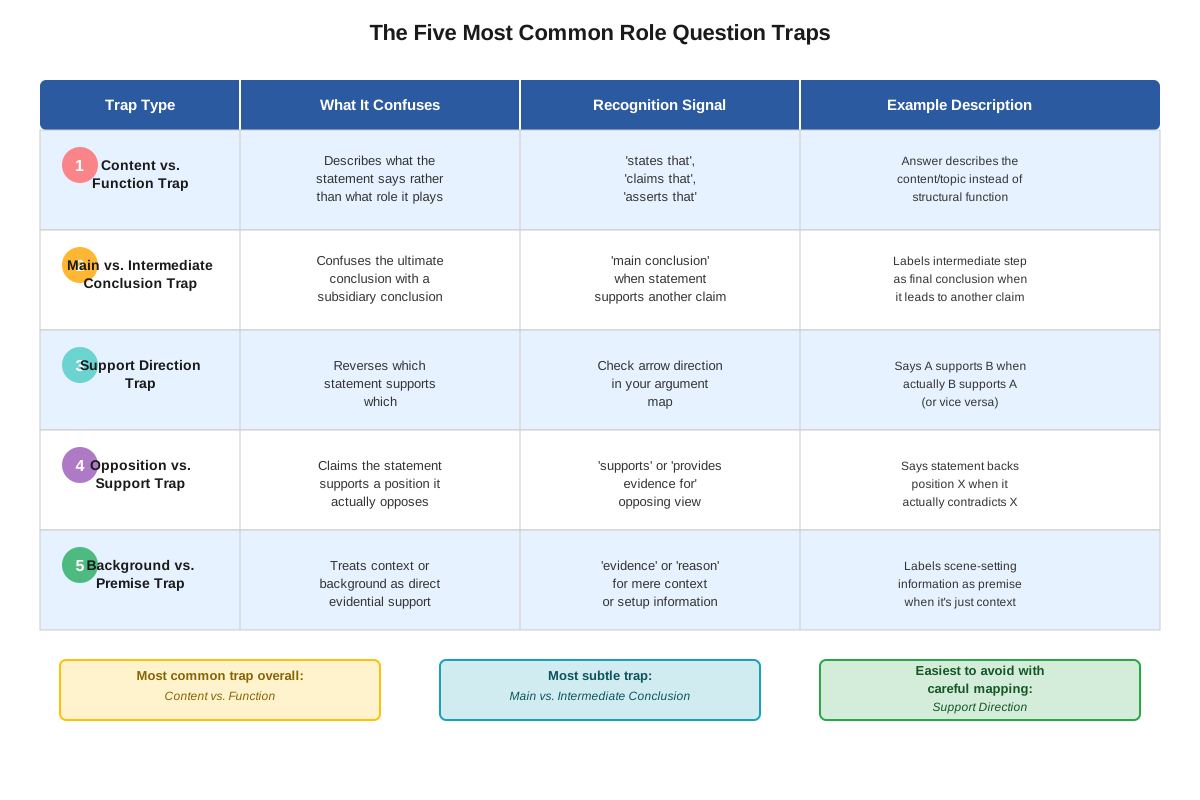
The Five Primary Role Question Traps
Trap 1: Confusing Main Conclusion with Intermediate Conclusion
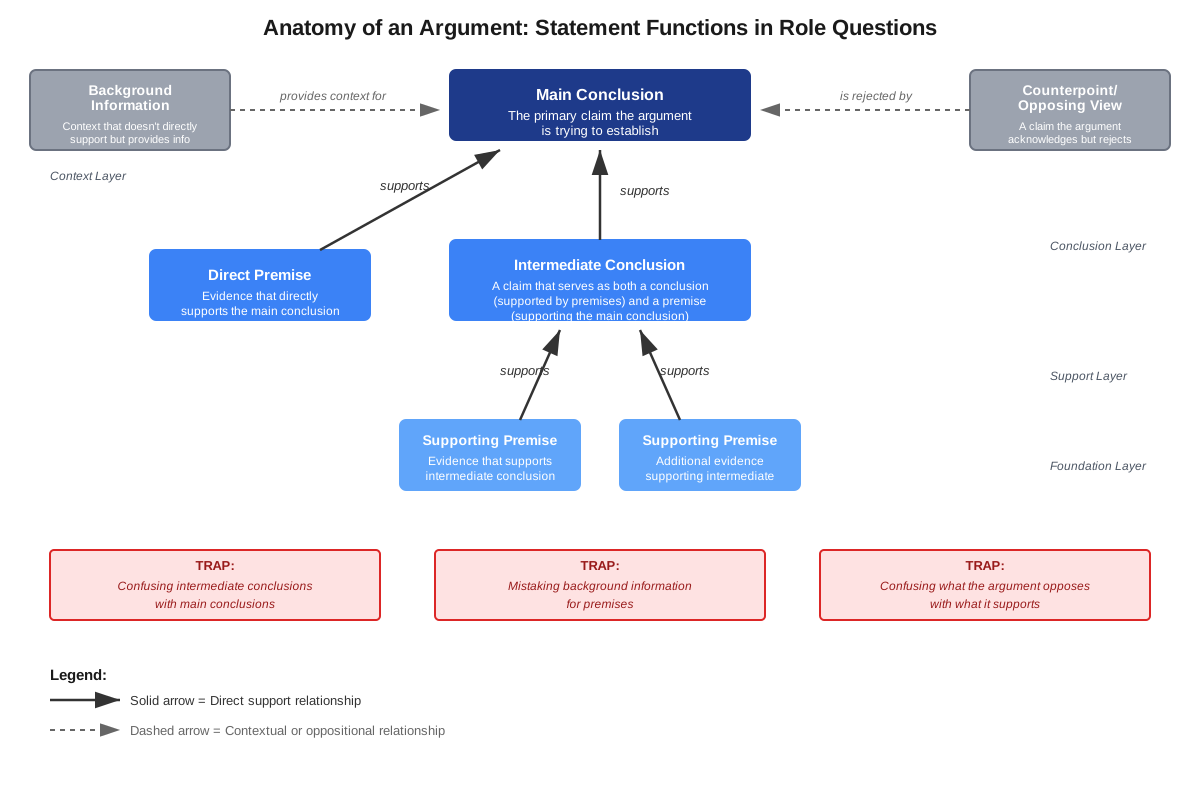
The most common role question trap involves answer choices that misidentify intermediate conclusions as main conclusions or vice versa. An intermediate conclusion serves a dual function: it is supported by some premises and in turn supports the main conclusion. Many arguments follow this structure: Premise → Intermediate Conclusion → Main Conclusion. Trap answers will describe the intermediate conclusion as "the main conclusion" or describe the main conclusion as "a subsidiary conclusion that supports the argument's main point."
To avoid this trap, students must identify the ultimate point the argument is trying to establish. The main conclusion is the statement that everything else supports but which itself doesn't support anything else. Ask: "What is the author ultimately trying to convince me of?" The answer to that question is the main conclusion, regardless of how many intermediate steps the argument takes to get there.
Trap 2: Mischaracterizing the Type of Support
Another frequent trap involves answer choices that correctly identify a statement as evidence but mischaracterize the type of support it provides. The LSAT distinguishes between several types of evidential support:
| Type of Support | Function | Example Language in Answer Choices |
|---|---|---|
| Direct evidence | Directly supports the conclusion | "provides evidence for the conclusion" |
| Analogical evidence | Supports through comparison | "provides an analogy that supports" |
| Principle | General rule applied to specific case | "states a principle that the argument applies" |
| Background context | Sets up the situation | "provides context for understanding" |
| Counterexample | Shows an exception | "presents a case that contradicts" |
Trap answers will identify a statement as providing one type of support when it actually provides another. For example, an answer might claim a statement "provides direct evidence" when it actually "states a general principle that the argument then applies to a specific case."
Trap 3: Confusing Opponent's View with Author's Concession
Many LSAT arguments present opposing viewpoints or acknowledge potential objections. Role question traps frequently exploit the distinction between:
- Opponent's view: A position the argument explicitly rejects or argues against
- Author's concession: A point the author acknowledges as true but argues is insufficient or irrelevant
- Author's position: The view the argument defends
Trap answers will describe an opponent's view as "a position the argument defends" or describe the author's concession as "a view the argument rejects." The key distinction is that concessions are acknowledged as true but are then explained away or shown to be compatible with the main conclusion, while opponent's views are presented as incorrect or inadequately supported.
Trap 4: Mistaking Background for Evidence
Not every statement in an argument serves an evidential function. Some statements provide background information or context that helps readers understand the situation without actually supporting the conclusion. Role question traps often include answer choices that describe background statements as "evidence" or "support" for the conclusion.
To distinguish background from evidence, ask: "Does this statement give me a reason to believe the conclusion is true, or does it just help me understand what we're talking about?" Background information is typically descriptive and neutral, while evidence is presented as a reason to accept the conclusion.
Trap 5: Reversing the Direction of Support
Perhaps the most subtle trap involves answer choices that reverse the direction of logical support. These answers correctly identify two statements but incorrectly describe which one supports which. For example, if Statement A supports Statement B, a trap answer might say "Statement B provides support for Statement A."
This trap is particularly dangerous because students who correctly identify both statements but fail to carefully track the direction of support will select the wrong answer. The solution is to always use directional language when pre-phrasing: "Statement X supports Statement Y" rather than just noting that the statements are related.
Systematic Approach to Role Questions
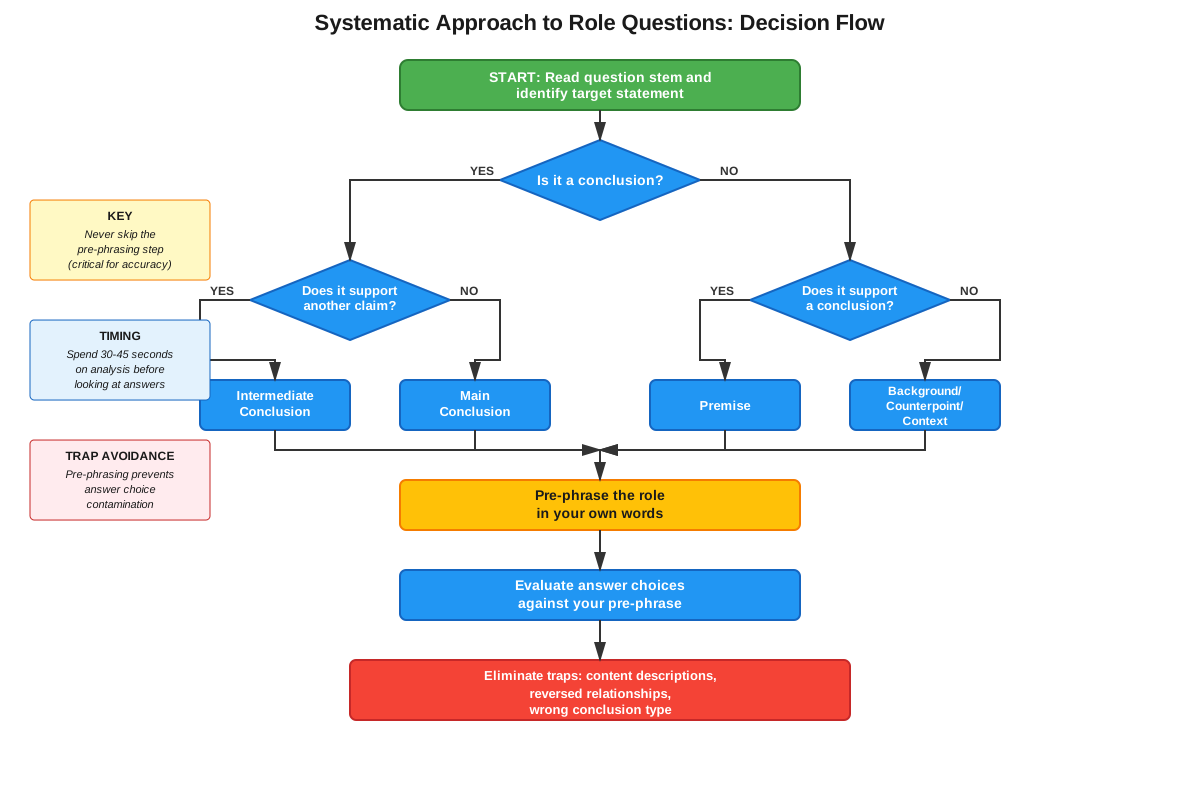
A reliable method for avoiding lsat role question traps involves four steps:
- Identify the statement in question: Locate the exact claim referenced in the question stem and bracket it or mark it clearly.
- Map the complete argument structure: Before looking at answer choices, identify all major components: main conclusion, intermediate conclusions (if any), premises, background information, and any opposing views or concessions.
- Determine the function: Ask specifically what job the statement performs. Does it support something? If so, what? Is it supported by something? If so, what? Does it provide context, represent an opposing view, or serve as a concession?
- Pre-phrase the answer: Formulate in your own words what the correct answer should say before reviewing the choices. This prevents trap answers from seeming attractive.
Common Structural Patterns
Certain argument structures appear repeatedly on the LSAT, and recognizing these patterns helps avoid role question traps:
Pattern 1: Premise → Intermediate Conclusion → Main Conclusion
- The intermediate conclusion is both supported (by premises) and supporting (the main conclusion)
- Trap: Calling the intermediate conclusion the main conclusion
Pattern 2: Concession → Rebuttal → Conclusion
- The author acknowledges a point but then explains why it doesn't undermine the conclusion
- Trap: Describing the concession as a view the argument rejects
Pattern 3: Background → Problem → Solution (Conclusion)
- Initial statements set context, then identify an issue, then propose a resolution
- Trap: Describing background as evidence for the conclusion
Pattern 4: Opponent's View → Counterargument → Author's Conclusion
- The argument presents and refutes an opposing position
- Trap: Describing the opponent's view as the author's position
Concept Relationships
The concepts within role question traps are hierarchically organized. At the foundation lies the ability to distinguish content from function—this is the master skill that enables all other aspects of role question analysis. From this foundation, students must develop the ability to identify basic argument components (premises, conclusions, background), which then enables recognition of more complex structures (intermediate conclusions, concessions, opposing views).
The five primary traps connect to each other through their common exploitation of structural ambiguity. Trap 1 (main vs. intermediate conclusion) relates directly to Trap 5 (reversing support direction) because both involve confusion about which statements support which. Trap 2 (mischaracterizing support type) connects to Trap 4 (background vs. evidence) because both involve misunderstanding the nature of a statement's contribution to the argument. Trap 3 (opponent's view vs. concession) stands somewhat apart but connects to the broader theme of distinguishing between what the argument endorses versus what it merely acknowledges.
The systematic approach to role questions integrates all these concepts: mapping argument structure addresses Traps 1 and 5, determining function addresses Traps 2 and 4, and careful attention to the author's stance addresses Trap 3. This integration demonstrates why role questions, despite their narrow focus, require comprehensive understanding of argument structure.
Connection to prerequisite knowledge: Basic argument structure provides the vocabulary (premise, conclusion) that role questions test in complex contexts. Indicator words help identify these components quickly. Conditional reasoning appears when role questions ask about statements that establish sufficient or necessary conditions. Reading comprehension skills prevent content-based confusion that makes trap answers attractive.
Quick check — test yourself on Role question traps so far.
Try Flashcards →High-Yield Facts
⭐ Role questions ask about function (what a statement does), not content (what a statement says).
⭐ The main conclusion is the ultimate point the argument tries to establish; everything else either supports it or provides context.
⭐ Intermediate conclusions are both supported by premises and support the main conclusion—they serve a dual function.
⭐ Background information provides context but doesn't give reasons to believe the conclusion is true.
⭐ A concession is a point the author acknowledges as true but argues is insufficient or compatible with the conclusion.
- An opponent's view is a position the argument explicitly rejects or argues against, not merely acknowledges.
- The direction of support matters: "A supports B" is different from "B supports A," and trap answers often reverse this direction.
- Not every statement in an argument serves an evidential function; some statements are purely descriptive or contextual.
- Answer choices that use vague language like "plays a role in establishing" are often traps because they don't specify the precise function.
- Pre-phrasing the correct answer before reviewing choices dramatically reduces susceptibility to trap answers.
- Role questions typically appear in the medium-to-difficult range and are worth the time investment to answer carefully.
- The most common trap involves confusing intermediate conclusions with main conclusions.
Common Misconceptions
Misconception: If a statement appears early in the argument, it must be a premise rather than the conclusion.
Correction: Conclusions can appear anywhere in an argument—beginning, middle, or end. The conclusion is determined by its function (what is being supported), not its position. Many arguments state the conclusion first, then provide supporting evidence.
Misconception: Any statement the author agrees with is part of the author's position that the argument defends.
Correction: Authors often acknowledge points (concessions) without defending them. A concession is accepted as true but is then shown to be insufficient, irrelevant, or compatible with the main conclusion. The argument defends only the main conclusion and the reasoning that supports it.
Misconception: Background information and evidence are the same thing because both appear before the conclusion.
Correction: Background information provides context or describes a situation without giving reasons to believe the conclusion. Evidence provides specific reasons to accept the conclusion as true. Background is descriptive; evidence is justificatory.
Misconception: If two statements are related, the one that appears first must support the one that appears second.
Correction: The direction of support is determined by logical relationship, not textual order. A statement can support a claim that appeared earlier in the passage. Always ask "which statement gives me a reason to believe which other statement?" rather than relying on order.
Misconception: Role questions are just asking me to identify the conclusion, so I can answer them quickly.
Correction: While some role questions ask about the conclusion, many ask about other components (premises, intermediate conclusions, concessions, opposing views, background). Each requires careful analysis of function. Role questions deserve full attention and systematic analysis.
Worked Examples
Example 1: Intermediate Conclusion Trap
Argument: "Studies show that regular exercise reduces stress levels. Since reduced stress improves cognitive function, and improved cognitive function enhances work performance, companies should encourage employees to exercise regularly."
Question: The claim that reduced stress improves cognitive function plays which one of the following roles in the argument?
Answer Choices:
(A) It is the main conclusion of the argument.
(B) It is an intermediate conclusion that supports the main conclusion.
(C) It is a premise offered in support of the claim that exercise reduces stress.
(D) It provides background information about the relationship between stress and cognition.
(E) It is a concession that the argument acknowledges before presenting its main point.
Analysis:
Step 1: Identify the statement in question: "reduced stress improves cognitive function"
Step 2: Map the complete argument structure:
- Premise 1: Studies show regular exercise reduces stress levels
- Intermediate Conclusion 1: Reduced stress improves cognitive function
- Intermediate Conclusion 2: Improved cognitive function enhances work performance
- Main Conclusion: Companies should encourage employees to exercise regularly
Step 3: Determine the function: The statement "reduced stress improves cognitive function" is supported by the premise about exercise reducing stress (through the indicator "since"), and it in turn supports the claim about work performance. This makes it an intermediate conclusion.
Step 4: Pre-phrase: "It's an intermediate conclusion—it's supported by the exercise-stress connection and supports the work performance claim."
Evaluating choices:
- (A) TRAP - This confuses intermediate conclusion with main conclusion. The main conclusion is about what companies should do.
- (B) CORRECT - Accurately identifies it as an intermediate conclusion that supports the main conclusion.
- (C) TRAP - This reverses the direction of support. The exercise-stress claim supports this statement, not vice versa.
- (D) TRAP - This mischaracterizes evidence as background. The statement provides a reason to believe the conclusion, not just context.
- (E) TRAP - This misidentifies the statement's relationship to the argument. It's not a concession but a claim the argument endorses.
Answer: (B)
Learning objective connection: This example demonstrates how to identify role question traps (Objective 1), explains the reasoning pattern of confusing intermediate and main conclusions (Objective 2), and shows the systematic application of the four-step method (Objective 3).
Example 2: Concession vs. Opponent's View
Argument: "Some critics argue that renewable energy cannot meet current power demands. While it's true that current renewable capacity is insufficient, this overlooks the rapid technological advances in energy storage. With improved battery technology, renewable sources will soon provide reliable baseload power. Therefore, we should invest heavily in renewable energy infrastructure now."
Question: The statement that current renewable capacity is insufficient plays which one of the following roles?
Answer Choices:
(A) It is the main conclusion that the argument seeks to establish.
(B) It is a view that the argument presents and then refutes as false.
(C) It is a concession that the argument acknowledges but argues is not decisive.
(D) It provides evidence that renewable energy cannot meet power demands.
(E) It is background information about the current state of renewable energy.
Analysis:
Step 1: Identify the statement: "current renewable capacity is insufficient"
Step 2: Map the argument structure:
- Opponent's view: Renewable energy cannot meet current power demands
- Concession: Current renewable capacity is insufficient (acknowledged as true)
- Counterargument: This overlooks rapid technological advances in storage
- Supporting premise: Improved battery technology will enable reliable baseload power
- Main conclusion: We should invest heavily in renewable energy infrastructure now
Step 3: Determine the function: The author explicitly acknowledges this point as true ("While it's true that...") but then argues it doesn't support the critics' conclusion because technology is advancing. This is a concession—a point acknowledged but shown to be insufficient or irrelevant.
Step 4: Pre-phrase: "It's a concession—the author admits it's true but argues it doesn't matter because of technological advances."
Evaluating choices:
- (A) TRAP - Confuses a concession with the main conclusion. The conclusion is about investment.
- (B) TRAP - Confuses concession with opponent's view. The author acknowledges this as true, not false.
- (C) CORRECT - Accurately identifies it as a concession that is acknowledged but not decisive.
- (D) TRAP - Reverses the argument's logic. The statement is acknowledged but then shown not to support that conclusion.
- (E) TRAP - Mischaracterizes a concession as neutral background. The statement is acknowledged as true in a specific argumentative context.
Answer: (C)
Learning objective connection: This example shows how to identify the concession vs. opponent's view trap (Objective 1), explains the reasoning pattern behind this distinction (Objective 2), and demonstrates systematic application to reach the correct answer (Objective 3).
Exam Strategy
When approaching role questions on the LSAT, begin by reading the question stem carefully to identify exactly which statement's role you need to determine. Before reading the argument, note the statement in question so you can mark it immediately when you encounter it. This prevents confusion in complex arguments with multiple similar claims.
Trigger words and phrases to watch for:
In question stems:
- "plays which one of the following roles"
- "figures in the argument in which one of the following ways"
- "functions in the argument to"
- "serves which one of the following purposes"
In arguments (indicating structure):
- "While it's true that..." (signals concession)
- "Critics argue..." (signals opponent's view)
- "This shows that..." (signals conclusion)
- "Since..." or "Because..." (signals premise)
- "Therefore..." or "Thus..." (signals conclusion)
Process-of-elimination strategy:
- Eliminate answers that misidentify the basic category (premise vs. conclusion vs. background)
- Eliminate answers that reverse the direction of support
- Eliminate answers that mischaracterize the type of support or relationship
- Choose between remaining answers by checking precise wording against your pre-phrase
Time allocation advice:
Role questions deserve 90-120 seconds of careful attention. They reward systematic analysis and punish rushing. Invest time in mapping the argument structure before reviewing answer choices—this upfront investment prevents cycling through trap answers multiple times. If you find yourself re-reading answer choices repeatedly, return to the argument and re-map its structure rather than continuing to compare confusing options.
Exam Tip: Never select an answer choice for a role question without being able to articulate exactly why the statement performs that function. If you can't explain the relationship in your own words, you're likely falling for a trap.
Memory Techniques
CRISP - A mnemonic for the systematic approach to role questions:
- Circle the statement in question
- Read and map the complete argument structure
- Identify the function (what does it do?)
- State your pre-phrase before looking at choices
- Prove your answer by checking the direction and type of support
The Support Direction Test: Visualize arrows showing support relationships. Draw an arrow from supporting statement to supported statement. If you can't draw a clear arrow, the statement might be background rather than evidence.
The "So What?" Test for distinguishing background from evidence: After reading a statement, ask "So what? Why does this matter for the conclusion?" If the answer is "It gives me a reason to believe the conclusion," it's evidence. If the answer is "It helps me understand the situation," it's background.
The Concession Signal: Remember "While/Although/Even though" at the beginning of a sentence typically signals a concession. The author acknowledges the point but the word "but" or "however" that follows introduces why it doesn't matter.
Visualization for intermediate conclusions: Picture a staircase. Premises are the bottom step, intermediate conclusions are middle steps (both standing on something and supporting something above), and the main conclusion is the top step (supported by everything but supporting nothing).
Summary
Role question traps represent a high-yield LSAT topic that tests the ability to distinguish between what statements say and what they do within argument structure. The five primary traps—confusing main and intermediate conclusions, mischaracterizing support type, confusing opponent's views with concessions, mistaking background for evidence, and reversing support direction—exploit predictable misreadings of argumentative structure. Success requires a systematic approach: identify the statement in question, map the complete argument structure, determine the precise function, and pre-phrase the answer before reviewing choices. The key insight is that role questions test structural analysis, not content evaluation. Students must develop the ability to track how statements relate to each other functionally, distinguishing between premises that support, conclusions that are supported, intermediate conclusions that do both, background that contextualizes, concessions that acknowledge, and opposing views that the argument refutes. Mastering these distinctions requires careful attention to indicator words, support direction, and the difference between what an author endorses versus what an author merely acknowledges. With systematic practice, students can consistently avoid trap answers and achieve high accuracy on this question type.
Key Takeaways
- Role questions test function (what a statement does) rather than content (what it says)—this distinction is fundamental to avoiding all traps
- Intermediate conclusions serve dual functions: they are both supported by premises and support the main conclusion, making them the most commonly misidentified element
- Concessions are points the author acknowledges as true but argues are insufficient or irrelevant, while opponent's views are positions the argument explicitly rejects
- Background information provides context without giving reasons to believe the conclusion; evidence provides justificatory support
- Pre-phrasing the correct answer before reviewing choices dramatically reduces susceptibility to trap answers
- The direction of support matters critically—"A supports B" is fundamentally different from "B supports A"
- A systematic four-step approach (identify, map, determine function, pre-phrase) provides consistent accuracy on role questions
Related Topics
Argument Structure Fundamentals: Understanding how to identify premises, conclusions, and the relationships between them provides the foundation for all role question analysis. Mastering role question traps deepens this foundational knowledge by requiring precise distinctions between similar structural elements.
Method of Reasoning Questions: These questions ask how an argument proceeds or what argumentative technique it employs. The skills developed for avoiding role question traps—particularly tracking the function of different statements—transfer directly to method questions.
Parallel Reasoning Questions: These require matching the structure of one argument to another. The precise structural analysis required for role questions provides essential preparation for recognizing parallel argumentative patterns.
Flaw Questions: Many flaws involve misunderstanding the relationship between premises and conclusions. The ability to accurately identify what supports what, developed through role question practice, helps recognize when arguments fail to provide adequate support.
Assumption Questions: Identifying assumptions requires understanding what role different statements play and what gaps exist in the support structure. Role question skills enable more precise identification of missing premises.
Practice CTA
Now that you understand the five primary role question traps and the systematic approach to avoiding them, it's time to apply this knowledge. Work through the practice questions carefully, using the four-step method for each one: identify the statement, map the structure, determine the function, and pre-phrase before reviewing choices. Pay special attention to questions where you're tempted by trap answers—these reveal which distinctions you need to strengthen. The flashcards will help reinforce the key distinctions between intermediate conclusions, concessions, background information, and other structural elements. Remember: role questions reward careful, systematic analysis. Invest the time to master this high-yield topic, and you'll see improvement not just on role questions but across all Logical Reasoning question types. Your ability to think structurally about arguments is one of the most valuable skills you can develop for LSAT success.
Sign up free to keep reading
Create a free AnvayaPrep account to finish this LSAT guide on Role question traps — plus flashcards and practice questions.