Overview
Subargument structure is a critical component of LSAT Logical Reasoning that tests a student's ability to recognize and analyze how arguments are built from multiple layers of reasoning. Unlike simple arguments that move directly from premise to conclusion, many LSAT arguments contain intermediate steps where one claim is supported by evidence and then used to support a further conclusion. Understanding this hierarchical reasoning structure is essential for success on method, role, and structure questions, which frequently ask test-takers to identify the function of specific statements within complex argumentative passages.
The LSAT regularly presents arguments where authors build their case through multiple stages of reasoning. A subargument occurs when a premise is itself supported by additional evidence before being used to support the main conclusion. Recognizing these structures allows students to map the logical architecture of an argument, distinguishing between main conclusions, intermediate conclusions (which serve as both conclusions of subarguments and premises for the main argument), and supporting premises. This skill is particularly valuable because approximately 15-20% of Logical Reasoning questions directly test the ability to identify the role or function of specific statements within an argument's structure.
Mastery of lsat subargument structure connects directly to broader Logical Reasoning competencies. It builds upon fundamental argument analysis skills—identifying conclusions and premises—while preparing students for more advanced tasks like evaluating argument strength, identifying assumptions, and recognizing reasoning patterns. Students who can quickly diagram subargument structures gain significant advantages in time management and accuracy across multiple question types, including Role of a Statement questions, Method of Reasoning questions, and even some Strengthen/Weaken questions where understanding the argument's architecture clarifies which component needs support or attack.
Learning Objectives
- [ ] Identify how Subargument structure appears in LSAT questions
- [ ] Explain the reasoning pattern behind Subargument structure
- [ ] Apply Subargument structure to solve LSAT-style problems accurately
- [ ] Distinguish between main conclusions, intermediate conclusions, and supporting premises within complex arguments
- [ ] Diagram multi-layered arguments to reveal their hierarchical structure
- [ ] Recognize common linguistic markers that signal subargument relationships
Prerequisites
- Basic argument structure: Understanding what constitutes a premise and conclusion is fundamental, as subarguments are built from these same components arranged in hierarchical relationships
- Conclusion indicators and premise indicators: Recognizing words like "therefore," "thus," "because," and "since" enables students to track the direction of reasoning within subarguments
- Logical reasoning question types: Familiarity with how LSAT questions are formatted and what they ask helps students recognize when subargument analysis is required
Why This Topic Matters
Understanding subargument structure has practical applications beyond standardized testing. Legal reasoning, academic research, policy analysis, and business strategy all require the ability to follow complex chains of reasoning where intermediate conclusions build toward larger claims. Lawyers must trace how evidence supports findings, which in turn support legal conclusions. Researchers must understand how preliminary results support hypotheses, which then support broader theoretical claims. The analytical skills developed through studying subargument structure transfer directly to these professional contexts.
On the LSAT specifically, subargument structure appears with remarkable frequency and in multiple question formats. Role of a Statement questions, which explicitly ask test-takers to identify the function of a particular claim within an argument, appear 2-4 times per Logical Reasoning section. Method of Reasoning questions, which require understanding the overall argumentative strategy, appear 1-3 times per section and often involve recognizing subargument patterns. Additionally, Structure questions that ask students to identify parallel reasoning or describe an argument's organization frequently test subargument recognition. Collectively, questions requiring subargument analysis constitute approximately 15-20% of each Logical Reasoning section, making this a high-yield topic for score improvement.
Common manifestations in LSAT passages include arguments where statistical evidence supports an intermediate claim about correlation, which then supports a causal conclusion; arguments where expert testimony establishes a factual premise, which then supports a policy recommendation; and arguments where analogical reasoning establishes a principle, which then applies to a specific case. The LSAT deliberately constructs these multi-layered arguments to test sophisticated analytical thinking, and students who can quickly map these structures gain substantial competitive advantages.
Core Concepts
What is a Subargument?
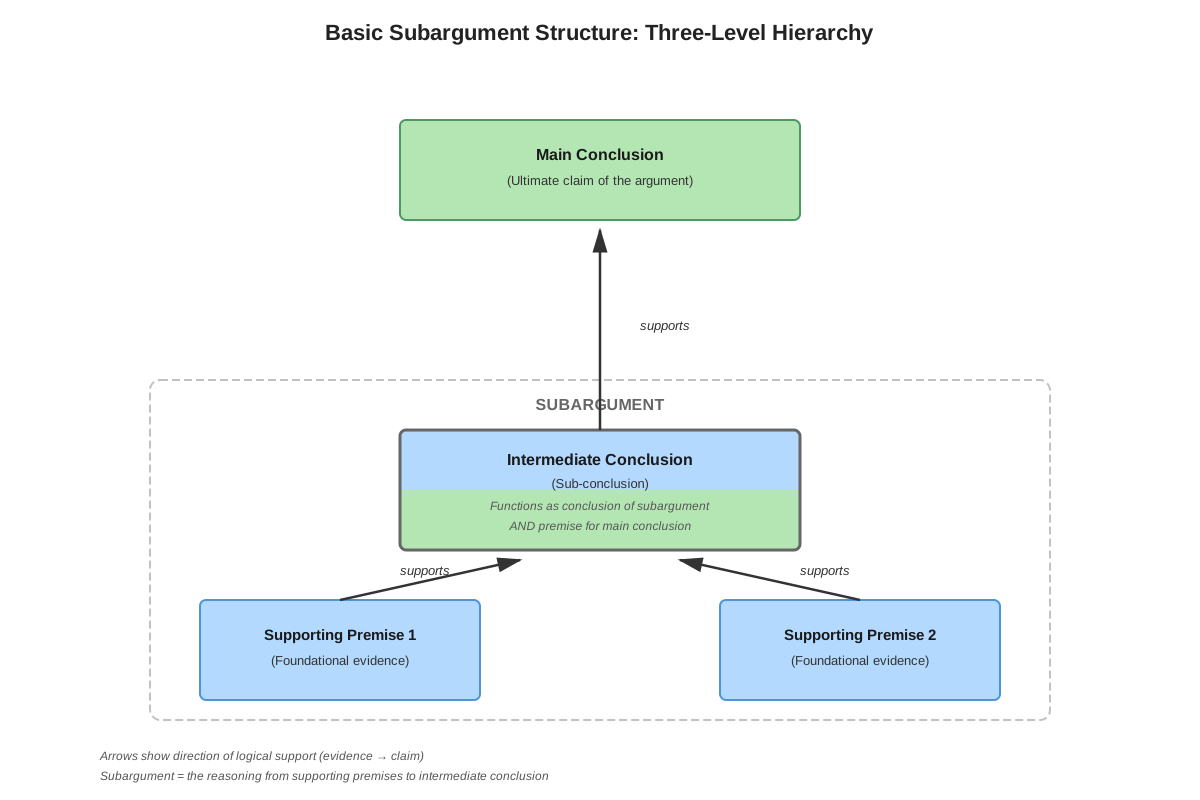
A subargument is a self-contained unit of reasoning within a larger argument where one or more premises support an intermediate conclusion, and that intermediate conclusion then serves as a premise for the main conclusion. The defining characteristic of subargument structure is this dual role: a statement functions simultaneously as the conclusion of one line of reasoning and as a premise for another. This creates a hierarchical or layered argumentative architecture rather than a simple linear progression from premises to conclusion.
Consider this basic structure:
- Premise A supports Intermediate Conclusion B
- Intermediate Conclusion B (now functioning as a premise) supports Main Conclusion C
The reasoning from A to B constitutes the subargument. Statement B is the intermediate conclusion—it's what the subargument establishes, and it's also what the main argument uses as evidence. Recognizing this dual function is the key analytical skill for mastering subargument structure.
Components of Subargument Structure
Understanding the distinct roles of each component clarifies how subarguments function:
| Component | Function | Identifying Features |
|---|---|---|
| Supporting Premise | Provides evidence for intermediate conclusion | Appears with premise indicators; supports but is not supported |
| Intermediate Conclusion | Conclusion of subargument; premise for main argument | Has both support (from below) and supports something else (above) |
| Main Conclusion | Ultimate claim of entire argument | Supported by other claims but doesn't support anything further |
| Main Premise | Directly supports main conclusion (not part of subargument) | Supports main conclusion without itself being supported |
The intermediate conclusion is the most challenging element to identify because it occupies a middle position in the logical chain. Students must ask two questions about any statement: "Is this claim supported by other statements?" and "Does this claim support other statements?" Only when both answers are "yes" have they identified an intermediate conclusion.
Recognizing Subargument Indicators
While not all subarguments are explicitly signaled, certain linguistic patterns frequently mark their presence:
Sequential reasoning markers:
- "Since X, it follows that Y. Therefore, Z."
- "Given that X, we can conclude Y. Thus, Z."
- "X proves Y, which means Z."
Embedded conclusion indicators:
- "Because X, Y must be true. This shows that Z."
- "X demonstrates Y. Consequently, Z."
Structural patterns:
- Evidence → Intermediate finding → Final conclusion
- Data → Interpretation → Implication
- Observation → Generalization → Application
The presence of multiple conclusion indicators ("therefore," "thus," "hence," "so") within a single argument often signals subargument structure, as each indicator marks a distinct inferential step.
Diagramming Subargument Structure
Visual representation helps clarify relationships within complex arguments. The standard diagramming approach uses arrows to show support relationships:
Simple argument:
Premise → ConclusionArgument with subargument:
Supporting Premise → Intermediate Conclusion → Main ConclusionComplex subargument with multiple supporting premises:
Premise A + Premise B → Intermediate Conclusion → Main Conclusion
                                                    ↑
                                            Main Premise
When diagramming, follow these steps:
- Identify the main conclusion (what is the author's ultimate claim?)
- Identify what directly supports the main conclusion
- Determine whether any supporting statements are themselves supported
- Draw arrows from support to supported claim
- Look for statements that have arrows both pointing to them and extending from them (these are intermediate conclusions)
Common Subargument Patterns on the LSAT
The LSAT employs several recurring subargument structures:
Pattern 1: Evidence-Based Subargument
- Statistical/empirical data supports a factual claim
- That factual claim supports a broader conclusion or recommendation
- Example: "Studies show 80% correlation → This indicates causation → Therefore, we should implement policy X"
Pattern 2: Definitional Subargument
- A definition or criterion is established
- A case is shown to meet that definition
- A conclusion follows from the categorization
- Example: "Mammals are warm-blooded → Whales are warm-blooded → Therefore, whales are mammals"
Pattern 3: Analogical Subargument
- Two situations are shown to be similar
- A principle from one situation is established
- That principle is applied to the second situation
- Example: "Case A resembles Case B → Principle X applied in Case A → Therefore, Principle X should apply in Case B"
Pattern 4: Elimination Subargument
- Alternative explanations are ruled out
- One explanation remains
- That explanation supports a further conclusion
- Example: "Not X, not Y, not Z → Must be W → Therefore, action based on W is justified"
The Dual Role of Intermediate Conclusions
The most sophisticated aspect of subargument structure is recognizing how intermediate conclusions function bidirectionally in argumentative logic. An intermediate conclusion is simultaneously:
- A conclusion relative to its supporting premises (it's what those premises establish)
- A premise relative to the main conclusion (it's evidence for the ultimate claim)
This dual nature means that attacks on an argument can target either relationship:
- Challenging the support for the intermediate conclusion undermines the subargument
- Challenging how the intermediate conclusion supports the main conclusion undermines the main argument
- Both vulnerabilities exist simultaneously
On Role of a Statement questions, the LSAT frequently asks about intermediate conclusions, and correct answers must capture both aspects: "a claim that is supported by evidence and that in turn supports the argument's main conclusion" or "an intermediate conclusion used to establish the argument's main point."
Concept Relationships
Subargument structure builds directly upon fundamental argument analysis skills. The ability to identify premises and conclusions (prerequisite knowledge) extends into recognizing that some conclusions serve as premises for further reasoning. This creates a hierarchical relationship: basic argument identification → subargument recognition → complex argument mapping.
Within the topic itself, the concepts connect as follows:
Subargument definition → Component identification → Diagramming technique → Pattern recognition → Application to questions
Each concept enables the next: understanding what subarguments are allows students to identify their components; identifying components enables accurate diagramming; diagramming reveals patterns; and pattern recognition accelerates question-solving.
Subargument structure also connects forward to related Logical Reasoning topics. Understanding how intermediate conclusions function is essential for assumption identification (assumptions can exist between supporting premises and intermediate conclusions, or between intermediate conclusions and main conclusions). It's also crucial for strengthen/weaken questions (knowing which component of a multi-layered argument to target). Finally, it directly enables success on method of reasoning questions, where describing an argument's structure requires recognizing its subargument architecture.
The relationship can be mapped as:
Premise/Conclusion Identification → Subargument Structure → Method/Role/Structure Questions
                                                          → Assumption Questions
                                                          → Strengthen/Weaken Questions
High-Yield Facts
⭐ An intermediate conclusion is any statement that both receives support from other statements and provides support to further statements
⭐ Role of a Statement questions appear 2-4 times per Logical Reasoning section and frequently test subargument recognition
⭐ The presence of multiple conclusion indicators in a single argument strongly suggests subargument structure
⭐ Intermediate conclusions are the most commonly tested component in subargument structure questions
⭐ Correct answer choices for intermediate conclusions typically include phrases like "serves as" or "functions as" to indicate dual role
- Subarguments create hierarchical rather than linear argument structures
- Supporting premises in subarguments only provide support; they don't receive support from other statements in the argument
- Main conclusions are supported by other statements but don't themselves support anything further
- The LSAT often places intermediate conclusions in the middle of passages, surrounded by both supporting and supported statements
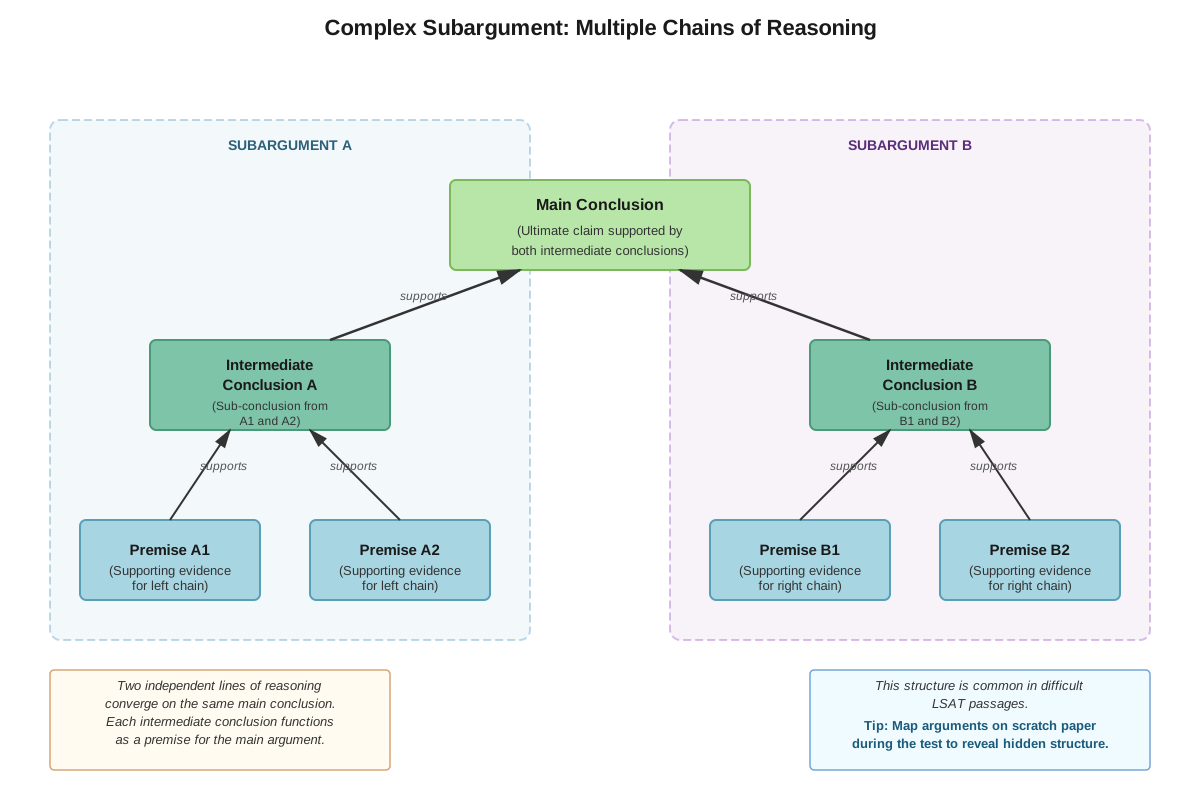
- Diagramming reveals subargument structure more reliably than reading alone, especially under time pressure
- Some arguments contain multiple subarguments supporting different aspects of the main conclusion
- Recognizing subargument structure helps eliminate wrong answers that misidentify statement roles
Quick check — test yourself on Subargument structure so far.
Try Flashcards →Common Misconceptions
Misconception: Every argument with multiple premises contains a subargument.
Correction: Subarguments require an intermediate conclusion—a statement that is both supported and supporting. Multiple independent premises supporting a single conclusion do not constitute a subargument; they're simply multiple lines of support converging on one conclusion.
Misconception: The intermediate conclusion is always located in the middle of the passage.
Correction: While intermediate conclusions often appear between their supporting premises and the main conclusion, the LSAT deliberately varies placement. An intermediate conclusion can appear first (with support following), last (with the main conclusion earlier), or anywhere in the passage. Position is not a reliable identifier; logical function is.
Misconception: Longer arguments always contain subarguments, while shorter arguments never do.
Correction: Argument length doesn't determine structure. A two-sentence argument can contain a subargument ("X, so Y. Therefore Z."), while a lengthy argument might simply provide extensive support for a single conclusion without intermediate steps.
Misconception: Background information or context statements are part of the subargument.
Correction: Not all statements in an argument participate in its logical structure. Background information, definitions, or contextual claims that aren't used as evidence don't function as premises in subarguments. Only statements that actively support or are supported by other claims are part of the argumentative structure.
Misconception: If a statement has a conclusion indicator, it must be the main conclusion.
Correction: Conclusion indicators mark inferential steps, not necessarily the final conclusion. In subargument structures, intermediate conclusions have conclusion indicators ("thus," "therefore") because they're conclusions of subarguments, even though they're not the argument's ultimate point. The main conclusion is determined by logical function (what is ultimately being argued), not by indicator words alone.
Misconception: Subarguments always involve causal reasoning or statistical evidence.
Correction: While evidence-based subarguments are common on the LSAT, subargument structure is a formal logical relationship that can appear with any content type—analogies, definitions, principles, expert testimony, or hypothetical scenarios. The structure depends on how claims support each other, not on the subject matter.
Worked Examples
Example 1: Identifying Subargument Structure
Passage: "Recent studies have shown that employees who work from home report 30% higher job satisfaction than those who work in offices. This indicates that remote work arrangements improve employee well-being. Companies seeking to retain top talent should therefore implement flexible remote work policies."
Question: The claim that remote work arrangements improve employee well-being plays which role in the argument?
Step 1: Identify the main conclusion
Ask: What is the author's ultimate point? What is being argued for?
Answer: "Companies should implement flexible remote work policies" (signaled by "therefore")
Step 2: Identify what supports the main conclusion
The claim about improving employee well-being directly supports the policy recommendation. If remote work improves well-being, that's a reason to implement remote work policies.
Step 3: Identify what supports the well-being claim
The statistical evidence (30% higher satisfaction) supports the well-being claim. The author uses this data to establish that remote work improves well-being.
Step 4: Diagram the structure
Studies show 30% higher satisfaction → Remote work improves well-being → Companies should implement remote work policies
(Supporting Premise)                    (Intermediate Conclusion)          (Main Conclusion)
Step 5: Characterize the role
The well-being claim is an intermediate conclusion. It's supported by statistical evidence and it supports the policy recommendation. It functions as both a conclusion (of the subargument) and a premise (for the main argument).
Answer: The claim is an intermediate conclusion that is supported by statistical evidence and that in turn supports the argument's main recommendation.
Connection to Learning Objectives: This example demonstrates how to identify subargument structure (Objective 1), explains the reasoning pattern where evidence supports an intermediate finding that supports a conclusion (Objective 2), and shows the application process for solving structure questions (Objective 3).
Example 2: Complex Subargument with Multiple Components
Passage: "Archaeological evidence shows that ancient civilizations in coastal regions developed maritime technology earlier than inland civilizations. Additionally, coastal civilizations established trade networks spanning thousands of miles, while inland civilizations' trade remained regional. These factors demonstrate that proximity to oceans accelerated technological and economic development. Given this historical pattern, modern landlocked nations face inherent disadvantages in economic development. Therefore, international development aid should prioritize infrastructure connecting landlocked nations to seaports."
Question: Which of the following most accurately describes the argument's structure?
Step 1: Identify all conclusions (look for conclusion indicators)
- "These factors demonstrate that..." (intermediate conclusion)
- "Therefore..." (main conclusion)
Step 2: Map the support relationships
Supporting Premises:
- Archaeological evidence about maritime technology
- Evidence about trade network differences
These support → "Proximity to oceans accelerated development" (Intermediate Conclusion 1)
Intermediate Conclusion 1 + "Given this historical pattern" supports → "Landlocked nations face disadvantages" (Intermediate Conclusion 2)
Intermediate Conclusion 2 supports → "Development aid should prioritize port infrastructure" (Main Conclusion)
Step 3: Create complete diagram
Maritime tech evidence + Trade network evidence → Proximity to oceans accelerated development
                                                                    ↓
                                                   Landlocked nations face disadvantages
                                                                    ↓
                                                   Aid should prioritize port infrastructure
Step 4: Recognize the pattern
This is a multi-layered subargument structure where:
- A subargument establishes a historical principle
- That principle is applied to modern circumstances (second intermediate conclusion)
- The modern application supports a policy recommendation
Answer: The argument uses historical evidence to establish a general principle, applies that principle to contemporary circumstances, and draws a policy conclusion from that application.
Connection to Learning Objectives: This example shows how subargument structure appears in complex LSAT passages (Objective 1), illustrates a multi-stage reasoning pattern (Objective 2), and demonstrates the analytical process for mapping hierarchical arguments (Objectives 4 and 5).
Exam Strategy
Approaching Subargument Questions
When encountering questions about argument structure or statement roles, follow this systematic approach:
Step 1: Identify the question type
Trigger phrases include:
- "The claim that X plays which role..."
- "Which one of the following most accurately describes the argument's structure..."
- "The statement that X functions in the argument to..."
- "The argument proceeds by..."
Step 2: Locate the main conclusion first
Before analyzing any other component, determine the argument's ultimate point. Ask: "What is the author trying to convince me of?" The main conclusion is never an intermediate conclusion, so identifying it first eliminates confusion.
Step 3: Work backward from the main conclusion
Ask: "What directly supports this conclusion?" Statements that directly support the main conclusion are either main premises or intermediate conclusions. To distinguish them, ask: "Is this statement itself supported by other statements?"
Step 4: Diagram quickly
Under time pressure, use abbreviated diagramming:
- Draw arrows from support to supported
- Mark the main conclusion with a star or circle
- Identify any statement with arrows both pointing to it and extending from it (intermediate conclusion)
Step 5: Match to answer choices
For Role questions, eliminate answers that:
- Describe the wrong component (e.g., calling an intermediate conclusion the main conclusion)
- Describe only one function of an intermediate conclusion (e.g., saying it's supported but not mentioning that it supports something else)
- Mischaracterize the support relationship (e.g., saying a premise is supported when it isn't)
Time Allocation
Subargument questions typically require 60-90 seconds:
- 15-20 seconds: Read the passage
- 20-30 seconds: Diagram the structure
- 10-15 seconds: Identify the specific statement's role
- 20-30 seconds: Evaluate answer choices
Investing time in accurate diagramming pays dividends in answer choice evaluation, as the visual representation makes wrong answers obvious.
Process of Elimination Tips
For Role of a Statement questions:
- Eliminate answers that describe the wrong component (if the statement is an intermediate conclusion, eliminate answers describing main conclusions or supporting premises)
- Eliminate answers that describe only half the function of intermediate conclusions
- Eliminate answers using absolute language ("the only evidence," "the sole support") unless clearly warranted
For Method of Reasoning questions:
- Eliminate answers that describe reasoning patterns not present in the argument
- Eliminate answers that reverse the order of reasoning
- Eliminate answers that omit the subargument when one exists
Red flag phrases in wrong answers:
- "The main conclusion" (when referring to an intermediate conclusion)
- "Provides evidence but is not itself supported" (when referring to an intermediate conclusion that IS supported)
- "The only premise" (when multiple premises exist)
Memory Techniques
The "Bridge" Mnemonic
Remember that intermediate conclusions are BRIDGES:
- Both supported and supporting
- Role is dual
- In the middle (logically, not always physically)
- Direction goes both ways
- Gets support from below
- Extends support upward
- Subargument conclusion
The Three-Question Test
For any statement, ask:
- Is it supported? (Does evidence point to it?)
- Does it support? (Does it point to something else?)
- What does it support? (The main conclusion or something else?)
- If YES, NO, N/A → Supporting Premise
- If NO, YES, Main Conclusion → Main Premise
- If YES, YES, Main Conclusion → Intermediate Conclusion
- If NO, YES, Nothing → Main Conclusion
Visualization Strategy
Picture arguments as buildings:
- Foundation = Supporting premises (bottom level)
- Middle floors = Intermediate conclusions (supported from below, support above)
- Roof = Main conclusion (top level, supported but doesn't support anything higher)
Subarguments are the middle floors—they rest on foundations and hold up the roof.
The "Therefore Test"
When uncertain whether a statement is an intermediate conclusion, try inserting "therefore" before it and after it:
- "Evidence X, therefore [statement], therefore main conclusion"
- If both "therefores" make logical sense, the statement is an intermediate conclusion
Summary
Subargument structure represents a critical analytical skill for LSAT success, requiring students to recognize hierarchical relationships within complex arguments. The defining feature of subargument structure is the intermediate conclusion—a statement that simultaneously functions as the conclusion of one line of reasoning and as a premise for another. Mastering this topic requires understanding three core components: supporting premises that provide evidence without themselves being supported, intermediate conclusions that both receive and provide support, and main conclusions that represent the argument's ultimate claim. The LSAT tests subargument recognition primarily through Role of a Statement questions and Method of Reasoning questions, which together constitute 15-20% of Logical Reasoning sections. Success depends on systematic analysis: identifying the main conclusion first, working backward to map support relationships, diagramming the structure to reveal hierarchical patterns, and matching statement functions to answer choices that accurately capture dual roles. Students who master subargument structure gain advantages across multiple question types, as understanding argumentative architecture clarifies where assumptions exist, which components to strengthen or weaken, and how reasoning patterns function.
Key Takeaways
- Intermediate conclusions are the heart of subargument structure—they're both supported by evidence and used to support further claims, creating hierarchical argument architecture
- Subargument questions appear 2-4 times per Logical Reasoning section, making this a high-yield topic for score improvement
- Multiple conclusion indicators in a single argument strongly signal subargument structure, as each marks a distinct inferential step
- Diagramming reveals structure more reliably than reading alone—visual mapping of support relationships clarifies which statements are intermediate conclusions
- The main conclusion is determined by logical function, not position—it's what the argument ultimately establishes, regardless of where it appears in the passage
- Correct answers for intermediate conclusion roles must capture both functions—being supported and providing support—while wrong answers typically describe only one aspect
- Systematic analysis beats intuition—following a consistent process (identify main conclusion, work backward, diagram, match to answers) produces higher accuracy under time pressure
Related Topics
Assumption Questions: Understanding subargument structure is essential for assumption questions because assumptions can exist at multiple levels—between supporting premises and intermediate conclusions, or between intermediate conclusions and main conclusions. Mastering subargument structure enables students to identify which inferential gap the question targets.
Strengthen and Weaken Questions: These questions require knowing which component of an argument to target. In arguments with subarguments, students must determine whether to strengthen/weaken the support for the intermediate conclusion or the support for the main conclusion, making subargument recognition crucial.
Method of Reasoning Questions: These questions explicitly ask students to describe how arguments proceed, requiring precise understanding of subargument structure. Success on method questions depends directly on the ability to map hierarchical reasoning patterns.
Parallel Reasoning Questions: Matching argument structures requires recognizing when both arguments contain subarguments with similar patterns. Students who can quickly identify subargument structure in the original argument can efficiently eliminate answer choices with different structures.
Practice CTA
Now that you understand subargument structure, it's time to apply these concepts to actual LSAT questions. The practice questions and flashcards will reinforce your ability to identify intermediate conclusions, diagram complex arguments, and solve Role of a Statement questions efficiently. Remember: subargument recognition is a skill that improves dramatically with deliberate practice. Each question you analyze strengthens your pattern recognition and speeds your diagramming. Approach the practice materials systematically, using the strategies and techniques covered in this guide. Your investment in mastering subargument structure will pay dividends across multiple question types and significantly boost your Logical Reasoning score. You've built the foundation—now apply it!
Sign up free to keep reading
Create a free AnvayaPrep account to finish this LSAT guide on Subargument structure — plus flashcards and practice questions.