Overview
Using counterexample to refute is a fundamental argumentative technique that appears frequently in LSAT Logical Reasoning sections, particularly within method, role, and structure questions. This reasoning pattern involves challenging a general claim or universal statement by presenting a single specific instance that contradicts it. When someone asserts "All X are Y," a counterexample demonstrates at least one X that is not Y, thereby undermining or completely refuting the original claim. Understanding this technique is crucial because the LSAT regularly tests whether students can identify when an argument employs this strategy, evaluate its effectiveness, or recognize its structural role within a dialogue.
The power of counterexamples lies in their logical efficiency: a single well-chosen instance can dismantle an entire generalization. On the LSAT, this appears in various formats—one speaker might make a sweeping claim while another responds with a specific case that contradicts it, or an argument might internally use counterexamples to dismiss competing theories. The test-makers favor this pattern because it assesses critical thinking skills essential for legal reasoning, where attorneys must both construct and dismantle arguments by finding exceptions to rules or precedents.
This topic connects intimately with broader Logical Reasoning concepts including argument structure analysis, identifying conclusions versus premises, understanding conditional logic, and recognizing different types of evidence. Mastering counterexample refutation enables students to excel not only on method questions (which ask "how does the argument proceed?") but also on role questions (which ask about the function of specific statements) and structure questions (which require understanding the relationship between argumentative components). This skill also supports performance on flaw questions, strengthen/weaken questions, and parallel reasoning questions where counterexample patterns frequently appear.
Learning Objectives
- [ ] Identify how using counterexample to refute appears in LSAT questions
- [ ] Explain the reasoning pattern behind using counterexample to refute
- [ ] Apply using counterexample to refute to solve LSAT-style problems accurately
- [ ] Distinguish between effective and ineffective counterexamples in argumentative contexts
- [ ] Recognize the structural markers and language patterns that signal counterexample refutation
- [ ] Evaluate whether a counterexample successfully undermines a claim or merely presents an exception
- [ ] Construct counterexamples to test the validity of universal claims in practice problems
Prerequisites
- Basic argument structure: Understanding premises, conclusions, and how evidence supports claims is essential because counterexamples function as a specific type of evidence that contradicts rather than supports.
- Universal versus particular statements: Recognizing the difference between "all," "every," "none" (universal quantifiers) and "some," "many," "most" (particular quantifiers) is necessary because counterexamples specifically target universal claims.
- Conditional logic fundamentals: Familiarity with "if-then" statements helps because counterexamples often challenge conditional claims by showing the antecedent can be true while the consequent is false.
- Distinction between necessary and sufficient conditions: This background enables students to understand why a single counterexample can refute a claim about sufficiency but not necessarily about necessity.
Why This Topic Matters
In legal practice, attorneys constantly employ counterexamples to challenge opposing arguments, question witness testimony, and argue against the application of legal precedents. A prosecutor might claim "All defendants who flee the scene are guilty," while a defense attorney responds with cases of innocent people who fled due to fear or confusion. This real-world application makes counterexample reasoning a natural fit for the LSAT, which aims to assess skills directly relevant to law school and legal practice.
Counterexample questions appear with remarkable frequency on the LSAT, showing up in approximately 15-20% of Logical Reasoning sections. They most commonly appear as method of reasoning questions (asking "Which one of the following describes the technique used in the argument?"), role questions (asking about the function of a specific statement), and structure questions (asking how two speakers relate to each other). Additionally, counterexample reasoning appears indirectly in strengthen/weaken questions where answer choices might provide counterexamples to premises or conclusions.
On the exam, counterexample patterns typically manifest in three ways: (1) dialogues where Speaker B refutes Speaker A's generalization with a specific case, (2) single arguments that dismiss alternative theories by citing counterexamples, and (3) arguments that defend a position by showing that counterexamples to competing views exist. Recognizing these patterns quickly allows students to predict answer choices and eliminate incorrect options efficiently, saving valuable time during the test.
Core Concepts
The Logical Structure of Counterexample Refutation
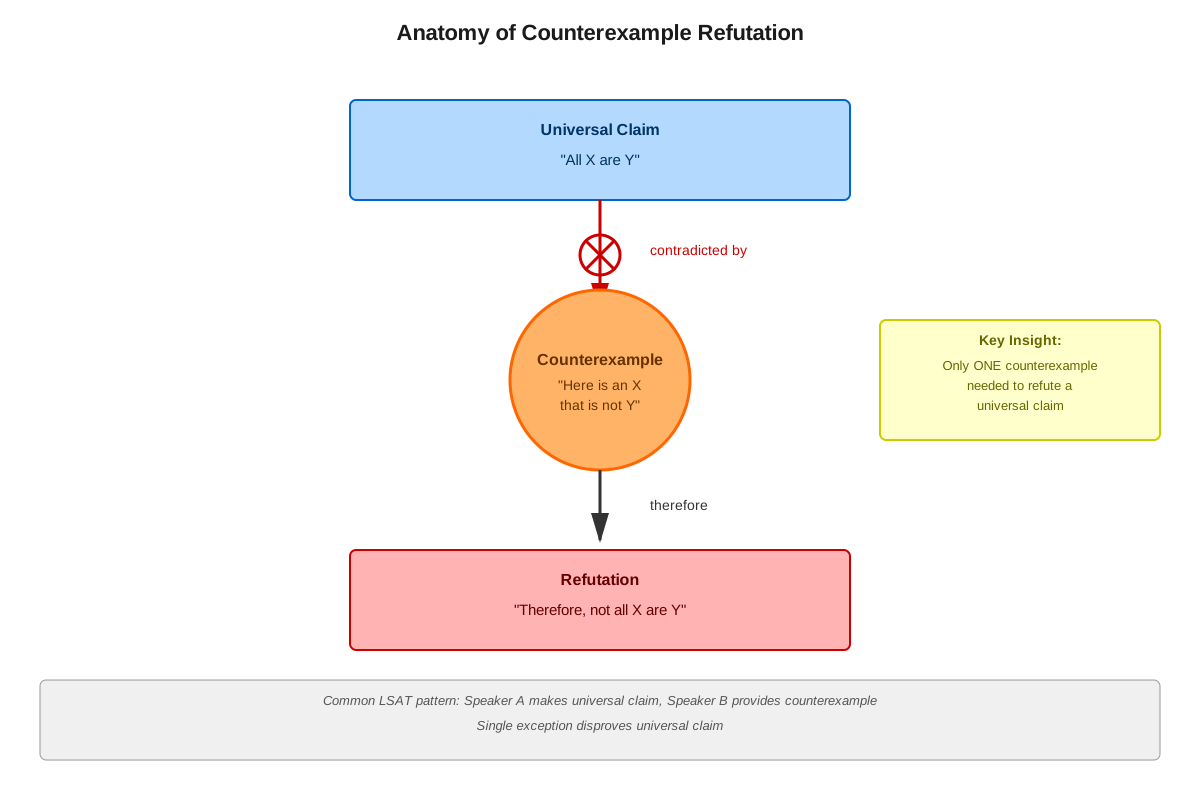
Using counterexample to refute operates on a fundamental principle of formal logic: a single negative instance can disprove a universal affirmative claim. When someone asserts "All S are P" (where S represents a subject class and P represents a predicate), this claim makes a sweeping statement about every member of category S. To refute this claim, one need only demonstrate a single instance of S that is not P. This single instance—the counterexample—proves the universal claim false.
The logical form follows this pattern:
- Original Claim: All X have property Y (or: If X, then Y)
- Counterexample: Here is an X that lacks property Y (or: Here is an X without Y)
- Conclusion: Therefore, the original claim is false (or: The claim is too broad/overstated)
This structure differs fundamentally from other forms of refutation. Rather than attacking the reasoning process, questioning the reliability of evidence, or proposing alternative explanations, counterexample refutation directly contradicts the content of a claim through concrete evidence. The strength of this approach lies in its decisiveness—if the counterexample is genuine and relevant, the refutation is complete.
Types of Claims Vulnerable to Counterexamples
Not all claims are equally susceptible to counterexample refutation. Understanding which statements can be effectively challenged with counterexamples is crucial for LSAT success.
Universal Affirmative Claims ("All X are Y") are maximally vulnerable. A single genuine counterexample completely refutes them. Example: "All successful entrepreneurs dropped out of college" can be refuted by citing a single successful entrepreneur with a degree.
Universal Negative Claims ("No X are Y") are equally vulnerable. One instance of an X that is Y disproves the entire claim. Example: "No vegetarians eat fish" is refuted by identifying a single vegetarian who consumes fish.
Conditional Claims ("If X, then Y") can be refuted by showing X occurring without Y. Example: "If a company raises prices, it loses customers" is challenged by a company that raised prices and gained customers.
Claims with absolute language ("always," "never," "every," "none," "must," "cannot") invite counterexample refutation because they admit no exceptions.
In contrast, particular claims ("Some X are Y," "Many X are Y") and probabilistic claims ("Most X are Y," "X usually leads to Y") are resistant to counterexample refutation. A single contrary instance doesn't disprove "Most birds can fly" because the claim already acknowledges exceptions. This distinction is frequently tested on the LSAT.
Effective versus Ineffective Counterexamples
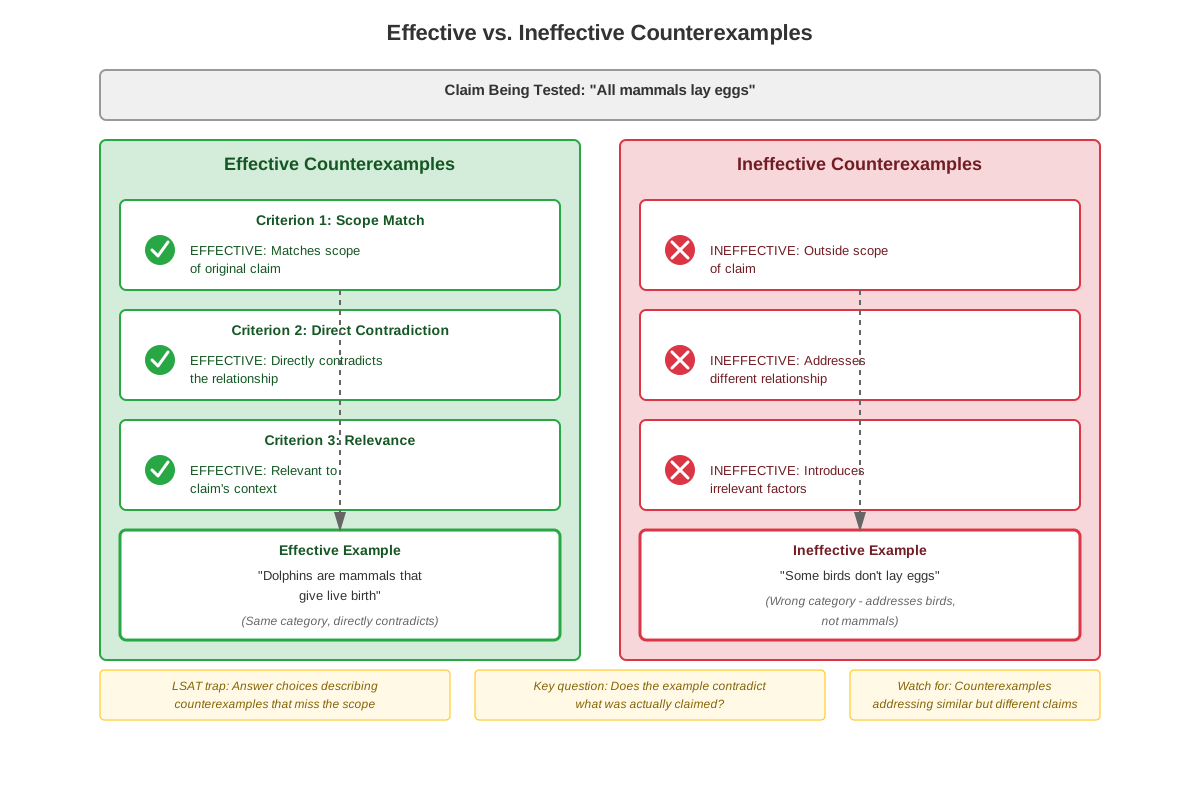
The LSAT often tests whether students can distinguish between counterexamples that successfully refute claims and those that fail to do so. An effective counterexample must meet three criteria:
- Relevance: The example must fall within the scope of the original claim. If someone claims "All professional athletes are wealthy," citing a poor amateur athlete is irrelevant because the claim specifically concerns professionals.
- Accuracy: The counterexample must be factually true or at least plausible within the argument's context. Hypothetical or imaginary cases may work in some logical contexts but can be challenged on factual grounds.
- Genuine contradiction: The example must actually contradict the claim rather than merely presenting a different case. If someone claims "All effective medicines are expensive," citing an expensive medicine that doesn't work is not a counterexample—it doesn't show an effective medicine that's inexpensive.
Ineffective counterexamples fail on one or more of these dimensions. Common failures include: addressing a different claim than the one actually made (straw man), citing cases outside the claim's scope, presenting exceptions that the original claim already acknowledged, or misunderstanding what the claim actually asserts.
Structural Markers in LSAT Questions
LSAT using counterexample to refute questions contain predictable language patterns that signal this reasoning technique. Recognizing these markers accelerates question identification and solution.
In the stimulus, watch for:
- Dialogue format where Speaker B responds to Speaker A
- Phrases like "but consider," "however," "what about," "take the case of"
- Specific examples following general claims
- Contrasting language: "while you claim all X are Y, here is an X that is not Y"
In answer choices for method questions, look for:
- "Cites a case that contradicts..."
- "Provides an example that undermines..."
- "Presents an instance that challenges..."
- "Offers a counterexample to..."
- "Refutes by identifying an exception to..."
In answer choices for role questions, watch for:
- "Serves as a counterexample to..."
- "Functions to undermine the claim that..."
- "Provides evidence against the generalization..."
The Relationship Between Counterexamples and Argument Strength
Understanding how counterexamples affect argument strength is essential for strengthen/weaken questions. A successful counterexample completely refutes a universal claim, but its impact on qualified or probabilistic claims is more nuanced.
| Claim Type | Counterexample Impact | Example |
|---|---|---|
| Universal Affirmative | Complete refutation | "All swans are white" → One black swan disproves it |
| Universal Negative | Complete refutation | "No metals conduct heat" → One conductive metal disproves it |
| Strong Generalization | Significant weakening | "Virtually all X are Y" → Counterexample shows claim is overstated |
| Probabilistic Claim | Minimal impact | "Most X are Y" → One contrary case doesn't disprove "most" |
| Existential Claim | No impact | "Some X are Y" → Counterexample to one instance doesn't affect claim |
This table reveals why LSAT questions often hinge on the precise wording of claims. The difference between "all," "virtually all," and "most" determines whether a counterexample succeeds or fails.
Counterexamples in Multi-Party Dialogues
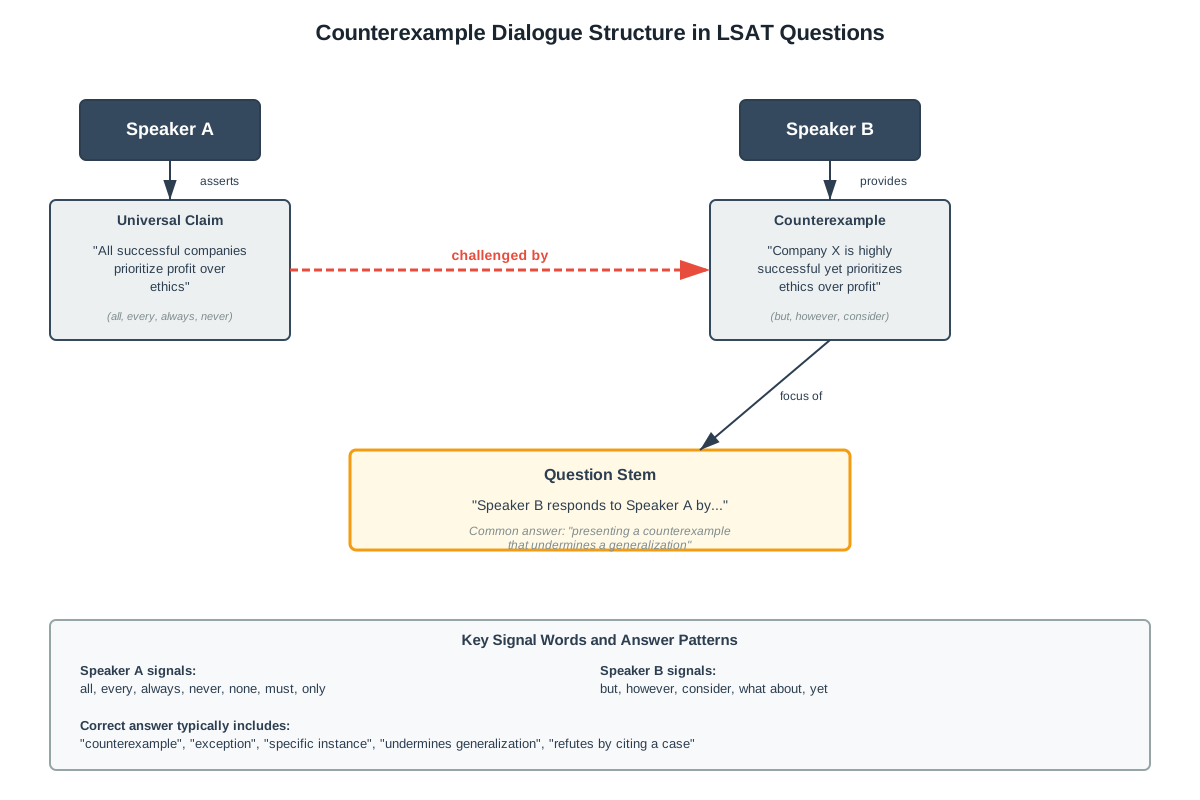
Many LSAT questions present conversations between two or more speakers where counterexample refutation structures the exchange. The typical pattern follows this sequence:
Speaker A makes a general claim, often with universal or strong language. This claim may be the speaker's conclusion or a premise supporting their conclusion.
Speaker B responds by presenting a specific case that contradicts Speaker A's generalization. Speaker B may explicitly state that this case refutes the claim, or the refutation may be implicit.
The question then asks about the method, role, or structure of this exchange. Correct answers will identify that Speaker B uses a counterexample to challenge, undermine, refute, or cast doubt on Speaker A's claim.
Understanding this dialogue structure helps predict answer choices and eliminate options that mischaracterize the relationship between speakers (such as claiming Speaker B supports, extends, or merely restates Speaker A's position).
Concept Relationships
The concepts within counterexample refutation form an interconnected logical framework. The logical structure of counterexample refutation serves as the foundation, establishing why single instances can disprove universal claims. This structure directly determines types of claims vulnerable to counterexamples—only universal and absolute claims are fully susceptible, while particular and probabilistic claims resist this form of refutation.
Understanding claim vulnerability leads naturally to distinguishing effective versus ineffective counterexamples, since effectiveness depends on whether the original claim is actually universal and whether the counterexample genuinely contradicts it. This distinction becomes practically applicable through recognizing structural markers in LSAT questions, which signal when counterexample reasoning appears and guide answer choice selection.
The relationship between counterexamples and argument strength synthesizes these concepts, showing how the impact of a counterexample varies based on claim type. Finally, counterexamples in multi-party dialogues represents the applied form where these concepts appear in actual LSAT questions, requiring students to identify the technique within realistic argumentative contexts.
This topic connects to prerequisite knowledge of argument structure by treating counterexamples as a specific type of evidence with unique logical properties. It builds on conditional logic by showing how counterexamples can refute conditional claims. It relates to strengthen/weaken questions because counterexamples represent a powerful weakening strategy. It also connects to flaw questions when arguments improperly dismiss counterexamples or when arguments themselves rely on irrelevant counterexamples.
The progression flows: Basic Logic → Argument Structure → Types of Evidence → Counterexample Refutation → Method/Role/Structure Questions → Advanced Argument Analysis.
High-Yield Facts
⭐ A single genuine counterexample completely refutes any universal claim ("all," "every," "none," "never").
⭐ Counterexamples cannot refute particular claims ("some," "many") or probabilistic claims ("most," "usually") because these claims already acknowledge exceptions.
⭐ An effective counterexample must fall within the scope of the original claim—citing cases outside the claim's domain does not constitute refutation.
⭐ Method questions asking about counterexample refutation typically include phrases like "cites a case that contradicts," "provides an example that undermines," or "presents an instance that challenges."
⭐ In dialogue questions, when Speaker B presents a specific case after Speaker A makes a general claim, Speaker B is likely using counterexample refutation.
- Counterexample refutation attacks the content of a claim, not the reasoning process or evidence quality.
- Claims with absolute language ("always," "must," "cannot," "impossible") are maximally vulnerable to counterexamples.
- A counterexample need not be the most common case—even a rare exception refutes a universal claim.
- Hypothetical counterexamples can be effective if they demonstrate logical possibility, though factual counterexamples are stronger.
- The absence of counterexamples does not prove a universal claim true—it merely means the claim hasn't been disproven yet.
- Counterexamples to necessary conditions show that the condition is not actually necessary; counterexamples to sufficient conditions show that the condition is not actually sufficient.
- When an argument dismisses a theory by citing counterexamples to that theory, the counterexamples function as evidence against the theory.
Quick check — test yourself on Using counterexample to refute so far.
Try Flashcards →Common Misconceptions
Misconception: Any example that differs from the main case presented constitutes a counterexample. → Correction: A counterexample must specifically contradict a general claim, not merely present a different scenario. If no universal claim is made, presenting another case is just providing additional examples, not refuting anything.
Misconception: Counterexamples can effectively refute claims that use "most" or "many." → Correction: Claims like "Most X are Y" already acknowledge that some X are not Y. A single contrary instance doesn't disprove "most"—you would need evidence that the majority actually falls on the other side. Counterexamples only fully refute universal claims.
Misconception: If a counterexample is rare or unusual, it doesn't count as a valid refutation. → Correction: The frequency or typicality of a counterexample is irrelevant to its logical force. Even a single, highly unusual case completely refutes "All X are Y." The claim "All swans are white" is false even if only one black swan exists among millions of white ones.
Misconception: Providing a counterexample to someone's premise refutes their entire argument. → Correction: A counterexample only refutes the specific claim it contradicts. If an argument has multiple premises, refuting one premise weakens but doesn't necessarily destroy the argument—the conclusion might still follow from the remaining premises. Always identify exactly what the counterexample targets.
Misconception: Counterexamples and alternative explanations are the same thing. → Correction: A counterexample is a specific instance that contradicts a general claim, while an alternative explanation offers a different causal account of the same phenomenon. If someone claims "All successful companies advertise heavily," a counterexample would be a successful company that doesn't advertise. An alternative explanation would suggest that factors other than advertising cause success.
Misconception: If you can imagine a counterexample, the claim is refuted. → Correction: The counterexample must be actual or at least plausible within the argument's context. Purely imaginary or physically impossible counterexamples don't refute claims about the real world. However, in logical or mathematical contexts, demonstrating logical possibility can be sufficient.
Misconception: Counterexamples only appear in dialogue questions. → Correction: While counterexample refutation is common in dialogues, single-speaker arguments also use this technique. An argument might dismiss a competing theory by citing counterexamples to it, or defend a position by noting that counterexamples to alternative views exist.
Worked Examples
Example 1: Classic Dialogue Format
Stimulus:
Politician: Every successful economic policy implemented in our country has included significant tax reductions. Therefore, our current economic proposal must include tax cuts if it is to succeed.
Economist: The economic recovery of 1995 succeeded without any tax reductions. In fact, that policy included modest tax increases on the highest earners.
Question: The economist responds to the politician by
(A) questioning the politician's authority to make economic claims
(B) providing evidence that contradicts a generalization on which the politician's argument depends
(C) proposing an alternative economic policy
(D) demonstrating that the politician's conclusion is internally inconsistent
(E) showing that tax increases are more effective than tax reductions
Analysis:
First, identify the politician's argument structure. The politician makes a universal claim as a premise: "Every successful economic policy implemented in our country has included significant tax reductions." This is a sweeping generalization using the universal quantifier "every." The politician then draws a conclusion based on this premise: the current proposal must include tax cuts to succeed.
Next, examine the economist's response. The economist presents a specific case: the 1995 economic recovery. Crucially, this case has two properties: (1) it was successful, and (2) it did not include tax reductions—in fact, it included tax increases. This specific case directly contradicts the politician's universal claim that "every" successful policy included tax reductions.
This is a textbook example of using counterexample to refute. The economist doesn't attack the politician's reasoning process, doesn't question the evidence quality, and doesn't propose alternatives. Instead, the economist presents a single historical instance that proves the universal claim false.
Evaluating the answer choices:
(A) is incorrect because the economist addresses the content of the claim, not the politician's credentials.
(B) is correct. The "generalization" is the politician's claim about every successful policy, and the economist "provides evidence that contradicts" it by citing the 1995 case. This is the counterexample pattern.
(C) is incorrect because the economist doesn't propose any policy, merely cites a historical case.
(D) is incorrect because the economist doesn't show internal inconsistency within the politician's argument—rather, the economist shows the argument rests on a false premise.
(E) is incorrect because the economist doesn't make a comparative claim about effectiveness, only demonstrates that success is possible without tax reductions.
Answer: (B)
Connection to Learning Objectives: This example demonstrates how to identify counterexample refutation in dialogue format (Objective 1), explains the reasoning pattern of contradicting a universal claim with a specific instance (Objective 2), and shows how to apply this understanding to select the correct answer (Objective 3).
Example 2: Single-Argument Structure
Stimulus:
Some researchers claim that creativity requires complete freedom from constraints. However, this view is mistaken. Many of history's greatest creative works were produced under significant constraints. Beethoven composed his most celebrated symphonies while deaf. The strict formal requirements of the sonnet did not prevent Shakespeare from producing masterpieces. The limited color palette available to Renaissance painters did not diminish their artistic achievements. These examples demonstrate that constraints and creativity are not incompatible.
Question: Which one of the following most accurately describes the argumentative technique employed in the passage?
(A) It establishes a general principle by examining multiple similar cases
(B) It refutes a claim by presenting cases that contradict it
(C) It supports a theory by eliminating alternative explanations
(D) It questions the motives of those who hold an opposing view
(E) It demonstrates that a claim is self-contradictory
Analysis:
First, identify the claim being challenged. The argument explicitly states that "some researchers claim that creativity requires complete freedom from constraints." This is a universal claim about a necessary condition: creativity requires (i.e., needs, cannot exist without) complete freedom from constraints. In logical form: If creativity, then complete freedom from constraints.
Next, examine the argument's strategy. The passage presents three specific historical cases:
- Beethoven creating masterpieces while deaf (a significant constraint)
- Shakespeare producing great sonnets within strict formal requirements (constraints)
- Renaissance painters achieving greatness with limited color palettes (constraints)
Each case presents an instance of genuine creativity existing alongside significant constraints. These cases directly contradict the claim that creativity requires complete freedom from constraints. If creativity required complete freedom, these constrained creative achievements would be impossible. Yet they exist.
This is counterexample refutation in a single-argument format. Rather than a dialogue, the argument itself identifies a claim and then refutes it by citing multiple counterexamples. The use of multiple counterexamples (rather than just one) strengthens the refutation, but the logical technique remains the same: presenting specific instances that contradict a general claim.
Evaluating the answer choices:
(A) is incorrect because the argument doesn't establish a principle from similar cases—it refutes a principle by showing contradictory cases.
(B) is correct. The argument "refutes a claim" (that creativity requires complete freedom) "by presenting cases that contradict it" (creative achievements produced under constraints). This precisely describes counterexample refutation.
(C) is incorrect because the argument doesn't eliminate alternatives—it directly contradicts a specific claim with concrete examples.
(D) is incorrect because the argument never questions motives, only the validity of the claim.
(E) is incorrect because the argument doesn't show the claim is self-contradictory (internally inconsistent)—it shows the claim is contradicted by external evidence.
Answer: (B)
Connection to Learning Objectives: This example shows that counterexample refutation appears in single-argument format, not just dialogues (Objective 1). It demonstrates the reasoning pattern of using specific instances to refute universal claims about necessary conditions (Objective 2). It also illustrates how multiple counterexamples can be used together, extending the basic pattern (Objective 4).
Exam Strategy
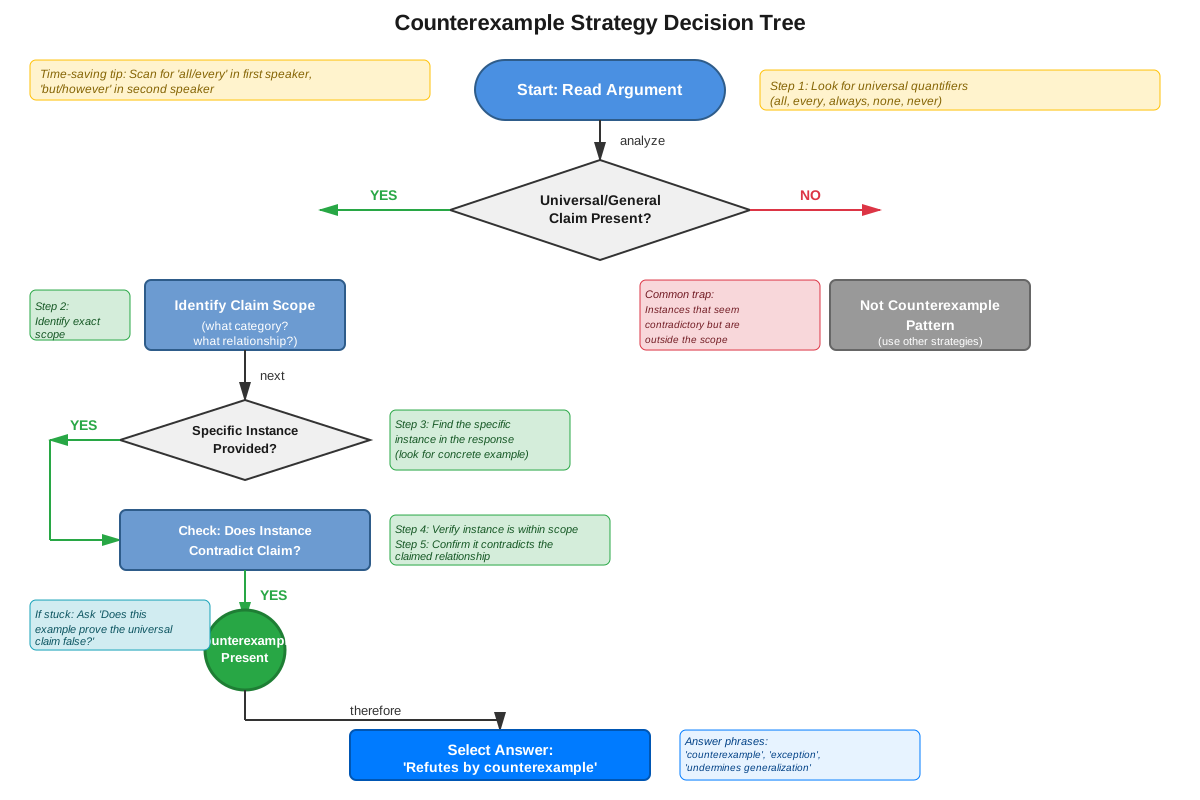
When approaching method, role, and structure questions involving counterexamples, follow this systematic process:
Step 1: Identify Universal or Absolute Claims
Scan the stimulus for words like "all," "every," "none," "never," "always," "must," "requires," "cannot," or "impossible." These signal claims vulnerable to counterexample refutation. Underline or mentally note these claims, as they're likely targets for refutation.
Step 2: Look for Specific Cases Following General Claims
After identifying a universal claim, watch for specific examples, particular instances, or concrete cases mentioned subsequently. The structural pattern "general claim → specific case" strongly suggests counterexample refutation. In dialogues, this often appears as Speaker A making a broad claim and Speaker B responding with "But what about..." or "Consider the case of..."
Step 3: Verify the Contradiction
Confirm that the specific case actually contradicts the general claim. Ask: "Does this example show that the universal claim is false?" If the claim is "All X are Y," does the example show an X that is not Y? If the claim is "X requires Y," does the example show X existing without Y? This verification step prevents confusion with other argument patterns.
Step 4: Eliminate Answer Choices Systematically
For method questions, eliminate answers that describe:
- Attacking reasoning quality rather than claim content
- Proposing alternatives rather than refuting claims
- Supporting or extending the original claim
- Questioning motives or authority
- Showing internal inconsistency
Favor answers containing phrases like "contradicts," "undermines," "challenges," "refutes," "counterexample," or "exception."
Step 5: Watch for Trap Answers
Common trap answers in counterexample questions include:
- Answers that correctly identify a counterexample but mischaracterize what it refutes (refuting the wrong claim)
- Answers that describe the counterexample as "supporting" or "illustrating" rather than "refuting"
- Answers that claim the argument shows the original claim is "impossible" when it merely shows the claim is false
- Answers that confuse counterexamples with alternative explanations
Time Allocation Advice
Counterexample questions are typically among the faster questions to solve once you recognize the pattern. Aim to spend 45-60 seconds on straightforward counterexample method questions. The pattern recognition should be nearly automatic: universal claim + specific contradictory case = counterexample refutation. If you find yourself spending more than 90 seconds, you may be overcomplicating the analysis. Return to the basic question: "Does this specific case contradict that general claim?"
Trigger Phrases for Rapid Recognition
In stimuli: "but consider," "however," "what about," "take the case of," "for example," "in fact"
In answer choices: "cites a case," "provides an example," "presents an instance," "offers a counterexample," "identifies an exception," "contradicts," "undermines," "challenges," "refutes"
Memory Techniques
The "ALL-ONE" Mnemonic
Remember: ALL claims fall to ONE counterexample.
This captures the essential principle that universal claims (ALL, EVERY, NONE, NEVER) can be completely refuted by a single (ONE) contradictory instance. When you see absolute language, think "ALL-ONE" to remind yourself that counterexample refutation is likely relevant.
The "SCOPE-TRUE-CONTRA" Checklist
For evaluating whether a counterexample is effective, remember SCOPE-TRUE-CONTRA:
- SCOPE: Does the example fall within the scope of the original claim?
- TRUE: Is the example factually accurate or plausible?
- CONTRA: Does it genuinely contradict the claim?
All three must be satisfied for an effective counterexample.
Visualization Strategy: The Broken Umbrella
Visualize a universal claim as an umbrella that supposedly covers all cases. A counterexample is like finding a hole in the umbrella—even one hole proves the umbrella doesn't provide complete coverage. This image reinforces that a single exception breaks a universal claim.
The Dialogue Pattern: "A-Says-All, B-Shows-One"
For dialogue questions, remember the rhythm: A-Says-All, B-Shows-One. Speaker A makes a sweeping claim (Says-All), and Speaker B presents a specific case (Shows-One) that contradicts it. This rhythmic pattern helps you quickly identify counterexample refutation in two-speaker formats.
Acronym for Vulnerable Claims: AMEN
Claims using AMEN language are vulnerable to counterexamples:
- Always
- Must
- Every
- Never
When you spot AMEN words, anticipate counterexample refutation.
Summary
Using counterexample to refute is a powerful logical technique that challenges universal or absolute claims by presenting specific instances that contradict them. This method operates on the principle that a single genuine counterexample completely disproves any claim asserting "all," "every," "none," or "never." On the LSAT, this pattern appears frequently in method, role, and structure questions, typically in dialogue format where one speaker makes a broad generalization and another responds with a contradictory case, or in single arguments that dismiss competing theories by citing counterexamples. Effective counterexamples must meet three criteria: relevance to the claim's scope, factual accuracy or plausibility, and genuine contradiction of the claim's content. Students must distinguish between claims vulnerable to counterexample refutation (universal and absolute statements) and those resistant to it (particular and probabilistic claims). Recognizing structural markers—such as absolute language followed by specific cases, or dialogue patterns where Speaker B presents instances after Speaker A's generalization—enables rapid identification of this reasoning technique and accurate answer selection.
Key Takeaways
- A single counterexample completely refutes any universal claim ("all," "every," "none," "never"), but cannot refute particular claims ("some," "many") or probabilistic claims ("most," "usually")
- Effective counterexamples must be relevant to the claim's scope, factually accurate or plausible, and genuinely contradictory to the claim's content
- In LSAT dialogues, the pattern "Speaker A makes universal claim → Speaker B presents specific case" typically signals counterexample refutation
- Method question answer choices describing counterexample refutation use phrases like "cites a case that contradicts," "provides an example that undermines," or "presents an instance that challenges"
- Counterexample refutation attacks the content of a claim through contradictory evidence, not the reasoning process, evidence quality, or arguer's credibility
- Watch for absolute language (always, must, cannot, impossible) as signals that counterexample refutation may be relevant
- Multiple counterexamples strengthen a refutation but aren't necessary—logically, one genuine counterexample suffices to disprove a universal claim
Related Topics
Flaw Questions and Hasty Generalizations: Understanding counterexample refutation helps identify when arguments commit the flaw of overgeneralizing from limited cases—essentially, making universal claims vulnerable to counterexamples. Mastering counterexamples enables you to recognize when arguments fail to consider exceptions.
Strengthen and Weaken Questions: Counterexamples represent a powerful weakening strategy. Many weaken questions ask you to identify answer choices that provide counterexamples to the argument's premises or reasoning. Conversely, strengthen questions may ask you to eliminate potential counterexamples.
Conditional Logic and Sufficient/Necessary Conditions: Counterexamples to conditional claims ("If X, then Y") show cases where X occurs without Y, demonstrating that X is not sufficient for Y. This connects counterexample reasoning to formal conditional logic analysis.
Parallel Reasoning Questions: Some parallel reasoning questions feature counterexample refutation in the original argument, requiring you to identify answer choices with the same logical structure: universal claim refuted by specific contradictory instance.
Principle Questions: Understanding counterexamples helps evaluate whether specific situations conform to or violate stated principles, which is essential for both principle-application and principle-identification questions.
Practice CTA
Now that you've mastered the conceptual framework of using counterexample to refute, it's time to cement your understanding through active practice. Attempt the practice questions associated with this topic, focusing on identifying the structural patterns you've learned: universal claims, specific contradictory cases, and the relationship between them. As you work through problems, consciously apply the "SCOPE-TRUE-CONTRA" checklist to evaluate counterexamples and use the trigger phrases to accelerate your recognition of this reasoning pattern. Remember, recognizing counterexample refutation quickly and accurately will save you valuable time on test day while boosting your accuracy on method, role, and structure questions. Each practice question you complete strengthens the neural pathways that make pattern recognition automatic. You've built the foundation—now build the speed and confidence that come from application!
Sign up free to keep reading
Create a free AnvayaPrep account to finish this LSAT guide on Using counterexample to refute — plus flashcards and practice questions.