Overview
Negation parallel flaw represents one of the most sophisticated question types within LSAT logical reasoning, requiring test-takers to identify structurally identical flawed arguments where negation plays a critical role in the logical error. This topic sits at the intersection of parallel reasoning questions and flaw identification, demanding both pattern recognition skills and deep understanding of logical structure. When an argument commits a negation error—such as confusing "not A" with "B" or improperly negating conditional statements—parallel flaw questions ask students to find another argument that makes the exact same structural mistake, even when the content is entirely different.
Understanding negation parallel flaws is essential for LSAT success because these questions test multiple competencies simultaneously: the ability to abstract logical structure from content, recognize common reasoning errors, and match patterns across different contexts. These questions typically appear in the Logical Reasoning sections and are considered medium-to-high difficulty because they require students to move beyond surface-level content analysis to identify the underlying logical architecture. The LSAT frequently tests whether students can recognize when an argument improperly handles negation in conditional reasoning, confuses necessary and sufficient conditions, or makes unwarranted inferences based on negative statements.
The relationship between negation parallel flaw questions and broader LSAT concepts is fundamental. These questions build upon basic conditional logic, flaw identification, and parallel reasoning skills while adding the complexity of tracking how negation operates within logical structures. Mastering this topic strengthens overall logical reasoning abilities and prepares students for the most challenging question types on the exam, where multiple layers of analysis must occur simultaneously under time pressure.
Learning Objectives
- [ ] Identify how Negation parallel flaw appears in LSAT questions
- [ ] Explain the reasoning pattern behind Negation parallel flaw
- [ ] Apply Negation parallel flaw to solve LSAT-style problems accurately
- [ ] Distinguish between different types of negation errors in parallel flaw contexts
- [ ] Abstract logical structure from content to match flawed reasoning patterns
- [ ] Recognize common negation errors in conditional statements and their parallels
- [ ] Evaluate answer choices efficiently by eliminating structurally dissimilar arguments
Prerequisites
- Basic conditional logic (if-then statements): Understanding how conditional statements work is essential because negation parallel flaws often involve improper handling of conditionals
- Flaw identification skills: Students must recognize common logical errors before they can match them across different arguments
- Parallel reasoning fundamentals: The ability to abstract structure from content forms the foundation for all parallel reasoning questions
- Understanding of logical negation: Knowing how negation operates in formal logic is crucial for identifying when arguments mishandle negative statements
- Necessary vs. sufficient conditions: Many negation parallel flaws involve confusing these concepts, particularly when negated
Why This Topic Matters
Negation parallel flaw questions represent approximately 3-5% of all Logical Reasoning questions on the LSAT, appearing consistently across multiple test administrations. While this may seem like a small percentage, these questions are strategically important because they test fundamental logical reasoning skills that apply across many other question types. Students who master negation parallel flaws develop stronger abilities in conditional reasoning, flaw identification, and structural analysis—skills that improve performance on 30-40% of all Logical Reasoning questions.
In real-world applications, the ability to recognize parallel flawed reasoning with negation is invaluable for legal practice. Attorneys must identify when opposing counsel makes structurally similar errors across different cases, recognize patterns in judicial reasoning, and construct arguments that avoid common logical pitfalls. The skill of abstracting logical structure from content—central to negation parallel flaw questions—is precisely what enables lawyers to apply precedents, distinguish cases, and identify analogous reasoning patterns.
On the LSAT, negation parallel flaw questions typically appear as "parallel flaw" or "parallel reasoning" question stems, specifically asking which answer choice exhibits the same flawed reasoning as the stimulus. These questions commonly involve conditional logic errors, improper contrapositive formation, confusion between "some" and "none," or unwarranted inferences from negative premises. The LSAT tests these patterns because they represent genuine reasoning errors that appear frequently in legal contexts, from statutory interpretation to case analysis.
Core Concepts
Understanding Negation in Logical Reasoning
Negation in logical reasoning refers to the logical opposite of a statement. Understanding how negation operates is fundamental to identifying negation parallel flaw questions. The negation of "all A are B" is "some A are not B" (not "no A are B," which is a common error). The negation of "some A are B" is "no A are B." When arguments mishandle these relationships, they commit negation errors that can be paralleled across different contexts.
In LSAT questions, negation errors frequently involve conditional statements. The proper negation of "if A, then B" is "A and not B" (the condition occurs but the consequence doesn't). However, flawed arguments often incorrectly treat "not A" or "if not A, then not B" as equivalent to the negation, creating structural errors that appear repeatedly across different content areas.
The Structure of Parallel Flaw Questions
Parallel reasoning questions ask test-takers to identify arguments with identical logical structure, regardless of content. When combined with negation errors, these questions require students to:
- Identify the flaw in the original argument
- Determine how negation contributes to that flaw
- Abstract the logical structure from the specific content
- Match that structure across answer choices with different content
- Verify that the negation operates identically in the parallel argument
The key challenge is maintaining focus on structure rather than content. An argument about politics and an argument about biology can be structurally identical if they make the same logical moves with negation.
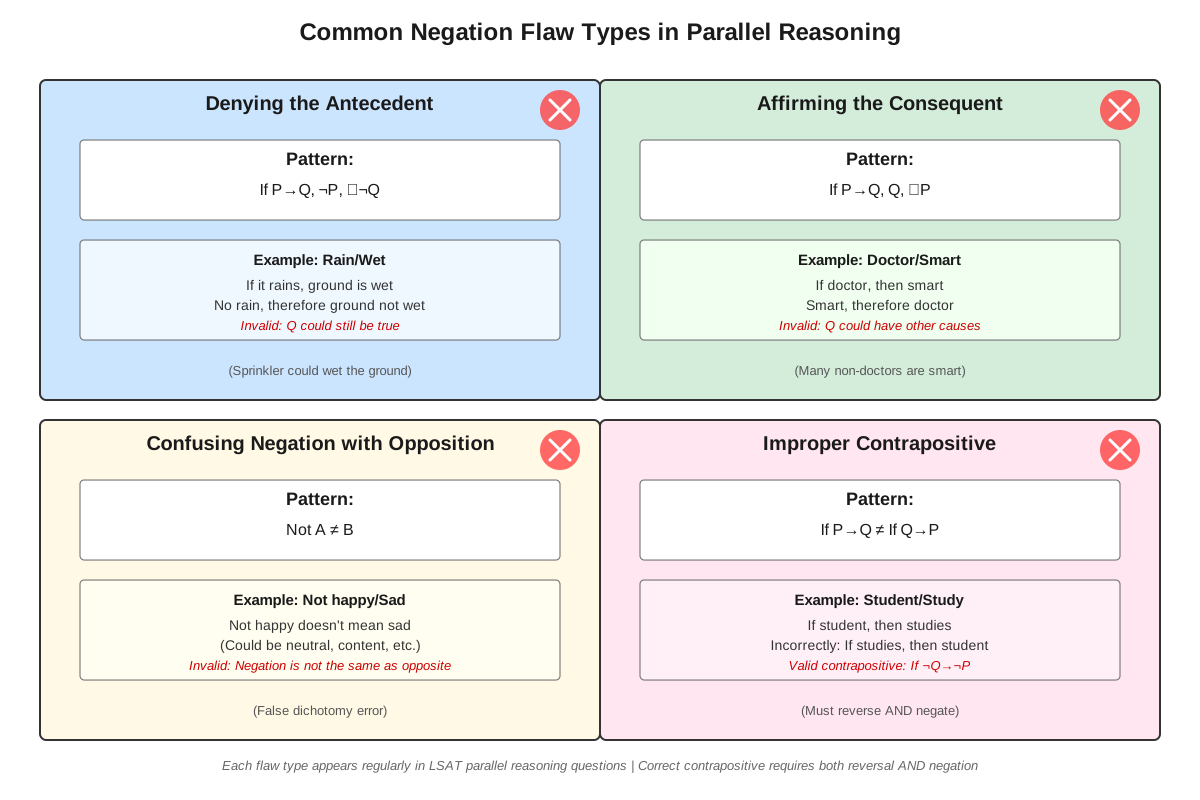
Common Negation Flaw Patterns
Several negation flaw patterns appear repeatedly on the LSAT:
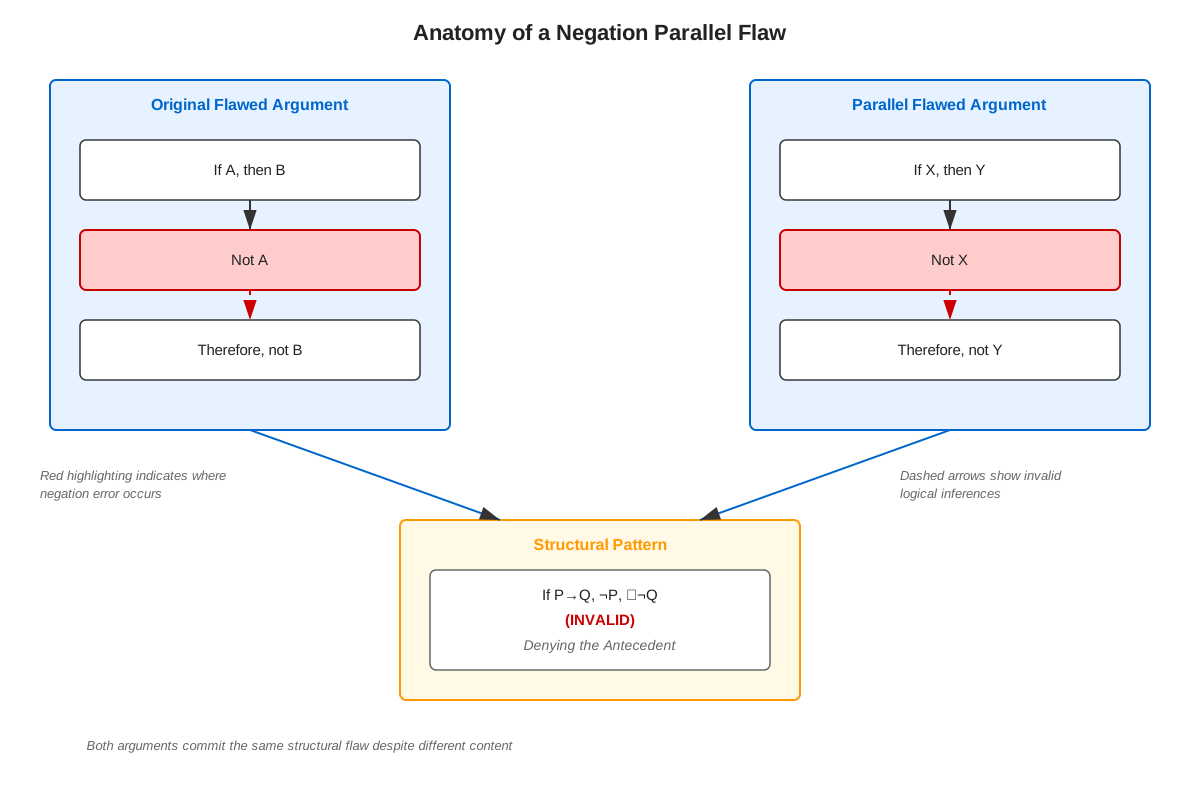
Denying the Antecedent: The argument assumes that if A→B, then not-A→not-B. This is invalid because the conditional only tells us what happens when A occurs, not what happens when A doesn't occur.
Affirming the Consequent: The argument assumes that if A→B and B is true, then A must be true. This ignores that B could occur for other reasons.
Improper Contrapositive: The argument confuses the contrapositive (if A→B, then not-B→not-A, which is valid) with invalid negations like "if not-A, then not-B."
Confusing Absence with Opposite: The argument treats the absence of something as equivalent to its opposite. For example, "not happy" doesn't necessarily mean "sad"—it could mean neutral or any other state.
Quantifier Negation Errors: The argument improperly negates quantified statements, such as treating "not all" as equivalent to "none" or "some not" as equivalent to "all not."
Abstracting Logical Structure
The critical skill for negation parallel flaw questions is abstraction—the ability to represent arguments in structural form. Consider this flawed argument:
"If the company is profitable, it will expand. The company is not profitable. Therefore, it will not expand."
The abstract structure is:
- If P, then Q
- Not P
- Therefore, not Q
This structure (denying the antecedent) can appear with any content. A parallel might be:
"If it's raining, the ground is wet. It's not raining. Therefore, the ground is not wet."
Both arguments share the identical flaw structure, even though one discusses business and the other discusses weather.
Negation in Conditional Chains
Complex negation parallel flaws often involve conditional chains where negation appears at multiple points. For example:
"If A, then B. If not B, then C. A occurred. Therefore, not C."
This argument confuses the contrapositive relationship and makes an unwarranted inference. The parallel must maintain the same structural relationships between the conditionals and their negations, including where negation appears in the chain and how conclusions are drawn.
Matching Negation Scope and Position
In parallel flaw questions, the scope and position of negation must match exactly. If the original argument negates the sufficient condition, the parallel must also negate the sufficient condition. If the original negates a universal claim, the parallel must negate a universal claim in the same structural position. This precision distinguishes correct answers from attractive wrong answers that are "close but not quite" parallel.
| Original Flaw Element | Must Match in Parallel |
|---|---|
| Position of negation (premise vs. conclusion) | Exact same position |
| Type of statement negated (conditional, universal, particular) | Same type |
| Role in argument (sufficient, necessary, intermediate) | Same role |
| Number of negations | Same number |
| Relationship between negated and non-negated elements | Same relationship |
Concept Relationships
The concepts within negation parallel flaw questions form a hierarchical structure. At the foundation lies basic negation understanding—knowing how to properly negate different types of statements. This leads to recognizing negation errors, which requires comparing proper negation with the flawed negation in an argument. Once negation errors are identified, structural abstraction becomes possible, allowing students to represent the argument in formal logical terms. This abstraction then enables pattern matching, where the abstract structure is compared against answer choices. Finally, verification ensures that all structural elements, including the position and scope of negation, align perfectly.
The connection to prerequisite topics is direct: conditional logic provides the framework for understanding how negation operates in if-then statements, while flaw identification supplies the vocabulary and categories for naming the errors. Parallel reasoning fundamentals teach the abstraction skills necessary to move from content to structure. Together, these prerequisites enable students to handle the complexity of negation parallel flaw questions.
Within the broader LSAT curriculum, mastering negation parallel flaws strengthens performance on sufficient assumption questions (which often involve conditional logic), necessary assumption questions (which require understanding what must be true), and strengthen/weaken questions (which test understanding of argument structure). The relationship flows both ways: improving at negation parallel flaws enhances these other question types, while practicing those question types builds skills applicable to parallel flaw questions.
Concept Flow: Basic Negation → Negation Errors → Structural Abstraction → Pattern Recognition → Answer Choice Elimination → Verification
Quick check — test yourself on Negation parallel flaw so far.
Try Flashcards →High-Yield Facts
⭐ The negation of "all" is "some not," not "none"—this distinction appears frequently in parallel flaw questions
⭐ Denying the antecedent (if A→B, not-A, therefore not-B) is one of the most common negation flaws tested on the LSAT
⭐ In parallel flaw questions, the position of negation (premise vs. conclusion) must match exactly between stimulus and answer choice
⭐ The contrapositive of "if A, then B" is "if not-B, then not-A"—any other negation pattern is flawed
⭐ Parallel flaw questions require matching structure, not content—different topics can have identical logical structures
- Affirming the consequent involves incorrectly inferring the sufficient condition from the necessary condition
- Absence of evidence is not evidence of absence—confusing these is a common negation error
- "Not all" means "at least one is not," which is logically equivalent to "some are not"
- Multiple negations in an argument must appear in the same structural positions in the parallel
- The scope of negation (whether it applies to the entire statement or just part) must match in parallel arguments
- Conditional chains with negation require tracking which elements are negated at each step
- Wrong answers in parallel flaw questions often match content similarity rather than structural similarity
Common Misconceptions
Misconception: Parallel flaw questions require finding arguments about similar topics → Correction: Parallel flaw questions require matching logical structure regardless of content; the correct answer often discusses a completely different topic to test whether students can abstract structure from content
Misconception: "Not A" is the same as "opposite of A" → Correction: Negation means "not the case that A," which includes all possibilities except A; the opposite is just one specific alternative, making this confusion a common source of negation flaws
Misconception: If an argument has a conditional statement and negation, it automatically commits a negation flaw → Correction: Negation can be used correctly in arguments (such as in valid contrapositive reasoning); the flaw occurs only when negation is mishandled in specific ways like denying the antecedent
Misconception: The parallel must use similar grammatical structures or sentence patterns → Correction: Logical structure and grammatical structure are independent; an argument can be grammatically different but logically parallel, and vice versa
Misconception: Finding one matching element (like both having conditionals) means the arguments are parallel → Correction: Every structural element must match, including the type of flaw, position of negation, number of premises, and relationship between statements; partial matching is insufficient
Misconception: The correct answer will be the same length as the stimulus → Correction: Length is irrelevant to logical structure; a shorter or longer argument can be structurally identical if it contains the same logical moves
Misconception: Negation parallel flaws only involve conditional statements → Correction: While conditional statements are common, negation flaws can also involve categorical statements, causal claims, and quantified statements; any argument type can mishandle negation
Worked Examples
Example 1: Denying the Antecedent
Stimulus: "If the museum receives additional funding, it will extend its hours. The museum did not receive additional funding. Therefore, the museum will not extend its hours."
Analysis:
- Identify the structure: If F, then E. Not F. Therefore, not E.
- Identify the flaw: This is denying the antecedent—the argument assumes that the sufficient condition is the only way for the necessary condition to occur
- Abstract the pattern: The argument takes a conditional, negates the sufficient condition, and concludes that the necessary condition won't occur
- What the parallel must have: A conditional statement, negation of the sufficient condition in a premise, and a conclusion that negates the necessary condition
Correct Parallel: "If a student studies diligently, she will pass the exam. This student did not study diligently. Therefore, she will not pass the exam."
Why it's parallel:
- Both have: If S, then P
- Both negate the sufficient: Not S
- Both conclude by negating the necessary: Therefore, not P
- Both commit the same flaw: assuming the sufficient condition is necessary
Wrong Answer Example: "If a student studies diligently, she will pass the exam. This student passed the exam. Therefore, she studied diligently."
Why it's wrong: This commits a different flaw (affirming the consequent), even though it uses similar content. The position of negation doesn't match—there's no negation in this argument at all.
Example 2: Improper Quantifier Negation
Stimulus: "All of the committee members support the proposal. Therefore, it is not the case that some committee members oppose the proposal."
Analysis:
- Identify the structure: All X are Y. Therefore, not (some X are not-Y).
- Identify the flaw: This appears valid at first, but the conclusion should state "no committee members oppose" rather than "not some oppose." The argument confuses the proper negation of "some."
- Abstract the pattern: Universal affirmative premise leading to an improperly stated negative conclusion about the complementary set
- What the parallel must have: A universal statement and a conclusion that improperly negates a particular statement
Correct Parallel: "All of the students passed the test. Therefore, it is not the case that some students failed the test."
Why it's parallel:
- Both start with universal affirmatives: All X are Y
- Both conclude with improper negations of particular statements
- Both make the same structural move from universal to negated particular
- The logical form is identical even though the content differs
Learning Objective Connection: This example demonstrates how to identify negation parallel flaws (Objective 1), explains the reasoning pattern of improper quantifier negation (Objective 2), and shows the application process for solving these questions (Objective 3).
Exam Strategy
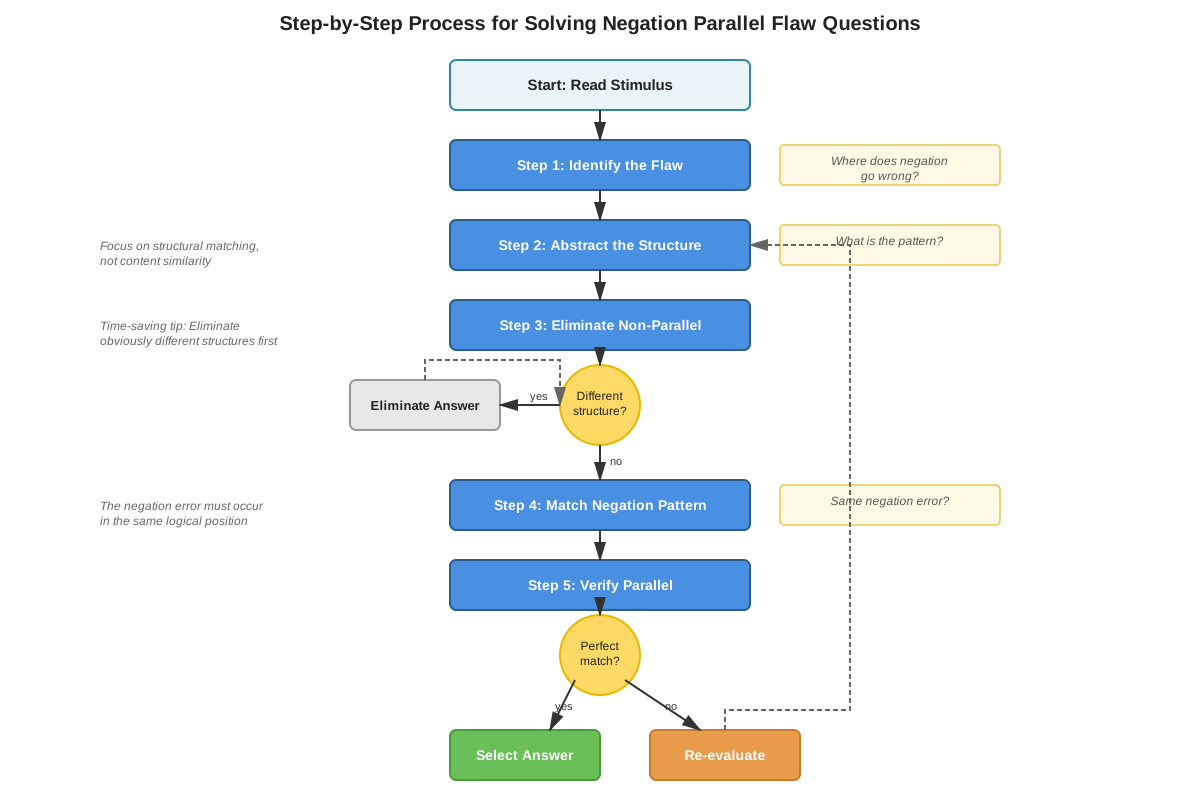
When approaching negation parallel flaw questions on the LSAT, follow this systematic process:
Step 1: Identify the Flaw First (30 seconds)
Before looking at answer choices, determine what logical error the stimulus commits. Ask: "Where does negation appear?" and "How is it misused?" Common trigger phrases include "not," "no," "none," "fails to," and "absence of."
Step 2: Create a Structural Template (15 seconds)
Write down the abstract structure using variables. For example: "If A→B, Not A, Therefore Not B." This template becomes your matching criterion.
Step 3: Scan for Structural Markers (10 seconds per answer)
Look for answers that have the same number of premises, similar conditional indicators ("if," "when," "all"), and negation in similar positions. Eliminate answers that lack these basic structural features immediately.
Step 4: Verify Negation Position and Scope (15 seconds)
For remaining answers, check that negation appears in the exact same structural position (same premise number, same role in the argument) and applies to the same type of element (sufficient vs. necessary condition, subject vs. predicate).
Exam Tip: Wrong answers often match the content domain (e.g., both about institutions) or match some but not all structural elements. The LSAT designs these to trap students who don't fully abstract the structure.
Trigger Words to Watch:
- "Not," "no," "none," "never" (explicit negation)
- "Fails to," "lacks," "without," "absence of" (implicit negation)
- "If," "when," "all," "every" (conditional/universal statements that may be negated)
- "Some," "most," "many" (quantifiers whose negation is frequently tested)
Time Allocation:
- Stimulus analysis: 45 seconds
- Answer choice elimination: 60 seconds (12 seconds per choice)
- Verification: 15 seconds
- Total: 2 minutes maximum
Process of Elimination Tips:
- Eliminate answers with different numbers of premises immediately
- Eliminate answers where negation appears in different positions (e.g., stimulus negates in premise, answer negates in conclusion)
- Eliminate answers with different types of statements (e.g., stimulus uses conditionals, answer uses causal claims)
- Between final two choices, map each element explicitly to verify complete structural match
Memory Techniques
NEGATE Mnemonic for analyzing negation parallel flaws:
- Note where negation appears
- Extract the logical structure
- Generalize to abstract form
- Analyze the type of flaw
- Test each answer systematically
- Eliminate non-matching structures
Visualization Strategy: Picture the argument as a flowchart with boxes for premises and conclusion. Mark negations with red X's. The parallel must have red X's in the exact same boxes, even if the words in the boxes are completely different.
Conditional Negation Rhyme:
"If A then B is what we see,
Not-B then not-A sets us free.
But not-A first? That's not the way—
The consequent might still hold sway."
This reminds students that the contrapositive (not-B→not-A) is valid, but denying the antecedent (not-A→not-B) is not.
Quantifier Negation Table (memorize this):
| Statement | Proper Negation |
|---|---|
| All X are Y | Some X are not Y |
| Some X are Y | No X are Y |
| No X are Y | Some X are Y |
The "Structure Over Content" Mantra: Before looking at each answer choice, repeat: "Different words, same moves." This reinforces that content similarity is irrelevant and structural identity is everything.
Summary
Negation parallel flaw questions test the ability to identify structurally identical flawed arguments where negation plays a central role in the logical error. Success requires three integrated skills: recognizing how negation is mishandled in the original argument, abstracting that flawed structure into a formal pattern independent of content, and matching that pattern precisely across answer choices with different subject matter. The most common negation flaws involve conditional reasoning errors (denying the antecedent, affirming the consequent, improper contrapositive formation) and quantifier negation mistakes (confusing "not all" with "none," treating absence as opposite). Students must focus exclusively on logical structure rather than content similarity, verify that negation appears in identical positions and scopes, and systematically eliminate answers that fail to match every structural element. Mastering this question type strengthens overall logical reasoning abilities and improves performance across multiple LSAT question types that involve conditional logic, structural analysis, and flaw identification.
Key Takeaways
- Negation parallel flaw questions require matching logical structure, not content—arguments about completely different topics can be structurally identical
- The position and scope of negation must match exactly between the stimulus and correct answer, including which premise contains negation and what type of statement is negated
- Denying the antecedent (if A→B, not-A, therefore not-B) is the most frequently tested negation flaw pattern on the LSAT
- Abstract the argument structure using variables before evaluating answer choices to avoid being distracted by content similarity
- The proper contrapositive (if A→B, then not-B→not-A) is valid; any other negation pattern of a conditional is flawed
- Quantifier negations follow specific rules: "not all" means "some not," and "not some" means "none"—confusing these creates common parallel flaws
- Systematic elimination based on structural markers (number of premises, types of statements, position of negation) is more efficient than reading every answer choice completely
Related Topics
Sufficient Assumption Questions: Understanding negation parallel flaws strengthens the ability to identify what conditional statements would make arguments valid, as both require precise understanding of how conditionals and their negations operate.
Necessary Assumption Questions: These questions often involve understanding what must be true for an argument to work, which requires recognizing when negation would destroy the argument—a skill developed through parallel flaw practice.
Formal Logic and Conditional Chains: Mastering negation parallel flaws provides the foundation for handling complex conditional chains, multiple sufficient or necessary conditions, and formal logic games that appear in the Analytical Reasoning section.
Flaw Question Types: All flaw questions benefit from the structural analysis skills developed through parallel flaw practice, particularly the ability to abstract reasoning patterns and identify specific error types.
Strengthen and Weaken Questions: Understanding how negation operates in flawed arguments helps identify what information would strengthen or weaken those arguments, as negation often plays a key role in answer choices.
Practice CTA
Now that you understand the structure and strategy behind negation parallel flaw questions, it's time to apply these concepts to actual LSAT-style problems. The practice questions and flashcards will reinforce your ability to abstract logical structure, recognize negation patterns, and match flawed reasoning across different contexts. Remember: each practice question you work through builds the pattern recognition skills that make these questions faster and more intuitive on test day. Approach each practice problem systematically using the NEGATE mnemonic, and review both correct and incorrect answers to understand why the structure does or doesn't match. Your investment in deliberate practice with this challenging question type will pay dividends across multiple sections of the LSAT.
Sign up free to keep reading
Create a free AnvayaPrep account to finish this LSAT guide on Negation parallel flaw — plus flashcards and practice questions.