Overview
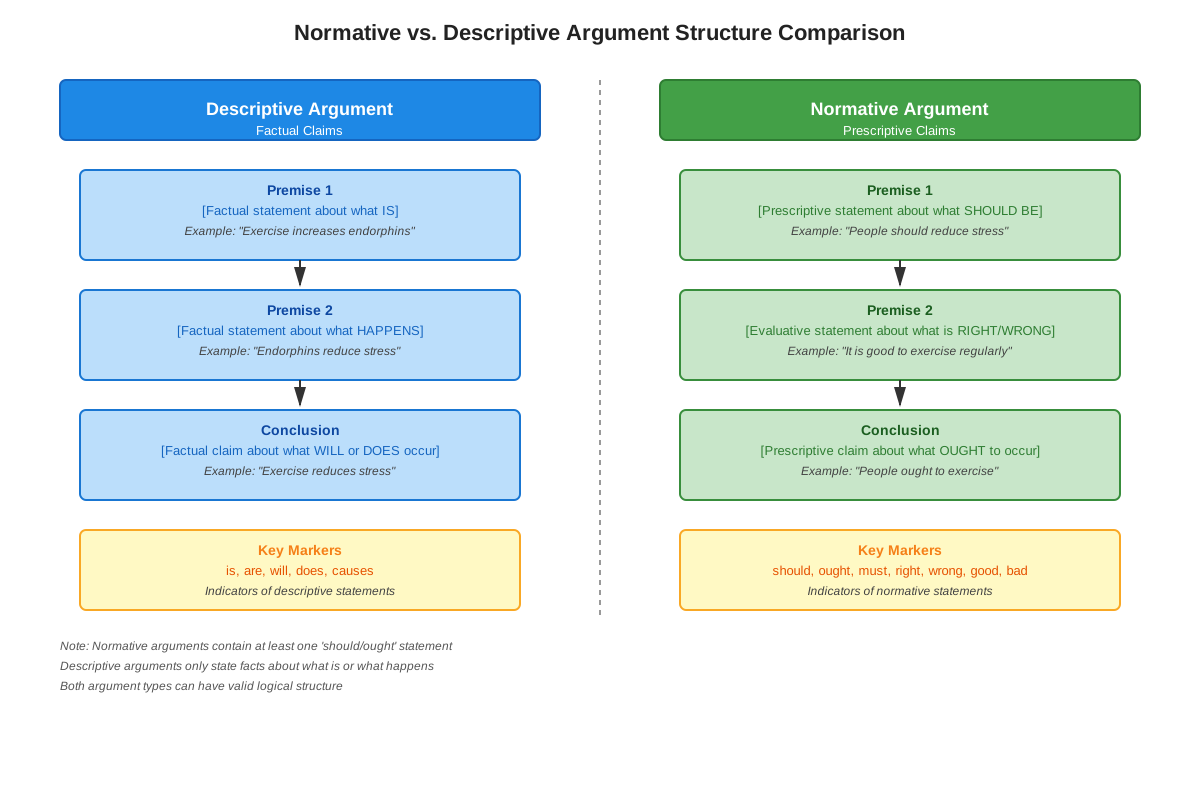
Normative parallel arguments represent a specialized category within LSAT parallel reasoning questions that test a student's ability to match the logical structure of arguments containing prescriptive or evaluative statements. Unlike descriptive arguments that simply state facts about what is or what happens, normative arguments make claims about what should be, what ought to* happen, or what is morally right, wrong, good, or bad. These arguments form the backbone of ethical reasoning, policy recommendations, and value judgments that appear frequently throughout the LSAT.
Understanding normative parallel arguments is essential for LSAT success because they appear in both Parallel Reasoning and Parallel Flaw questions, which together constitute approximately 8-12% of all Logical Reasoning questions on any given test. The challenge lies not merely in identifying that an argument is normative, but in recognizing the precise logical structure that connects normative premises to normative conclusions. Students must distinguish between different types of normative claims (moral obligations, prudential recommendations, aesthetic judgments) and match both the normative force and the logical scaffolding of the original argument.
Within the broader landscape of LSAT Logical Reasoning, normative parallel arguments connect directly to fundamental skills in argument analysis, structural mapping, and categorical reasoning. They require students to abstract away from specific content about ethics, policy, or values and focus purely on the formal relationships between premises and conclusions. Mastering this topic strengthens overall parallel reasoning abilities while developing the critical skill of separating an argument's content from its structure—a competency that proves invaluable across all LSAT question types.
Learning Objectives
- [ ] Identify how Normative parallel arguments appears in LSAT questions
- [ ] Explain the reasoning pattern behind Normative parallel arguments
- [ ] Apply Normative parallel arguments to solve LSAT-style problems accurately
- [ ] Distinguish between normative and descriptive statements within argument structures
- [ ] Match the specific type of normative claim (obligation, recommendation, evaluation) across parallel arguments
- [ ] Recognize when normative force differs between answer choices despite superficial structural similarity
- [ ] Evaluate whether both premises and conclusions maintain parallel normative character
Prerequisites
- Basic argument structure identification: Understanding premises, conclusions, and logical connectors is essential because parallel reasoning requires mapping these components across different arguments
- Conditional reasoning fundamentals: Recognizing if-then relationships helps identify when normative claims are conditional versus categorical
- Argument diagramming skills: The ability to visually represent argument structure accelerates the process of comparing parallel structures
- Familiarity with standard parallel reasoning questions: Understanding the general approach to matching argument structure provides the foundation for handling the normative subset
Why This Topic Matters
Normative parallel arguments appear in real-world contexts whenever individuals must evaluate ethical reasoning, policy proposals, or value-based recommendations. Legal professionals—the target audience for LSAT preparation—regularly encounter normative arguments in judicial opinions, legislative debates, and ethical guidelines. The ability to recognize when two arguments share the same normative structure, even when discussing entirely different subjects, is fundamental to legal reasoning and precedent analysis.
On the LSAT, normative parallel arguments appear in approximately 3-5 questions per test, distributed across both Parallel Reasoning and Parallel Flaw question types. These questions typically appear in the medium-to-difficult range, with correct answer rates often falling between 40-60% among test-takers. The LSAT specifically tests normative parallels because they require sophisticated analytical skills: students must simultaneously track logical structure, normative force, and the distinction between "is" and "ought" statements.
Common manifestations include arguments about moral obligations in professional contexts, policy recommendations based on value judgments, aesthetic evaluations following similar reasoning patterns, and ethical principles applied to specific cases. The test writers frequently create trap answers that match either the content domain (ethics to ethics) or the surface grammar without preserving the underlying normative structure, making these questions particularly challenging for unprepared students.
Core Concepts
Understanding Normative vs. Descriptive Claims
The foundational distinction in normative parallel arguments separates descriptive claims (statements about what is, was, or will be the case) from normative claims (statements about what should be, ought to be, or has value). Descriptive claims can be verified through observation or evidence: "The temperature is 72 degrees" or "Most voters prefer candidate A." Normative claims express values, obligations, or recommendations: "We should reduce carbon emissions" or "It is wrong to break promises."
In LSAT normative parallel arguments, this distinction becomes critical because a true parallel must match not only the logical structure but also the normative character of each component. An argument moving from descriptive premises to a descriptive conclusion cannot parallel an argument moving from normative premises to a normative conclusion, even if the logical form appears identical.
Types of Normative Claims
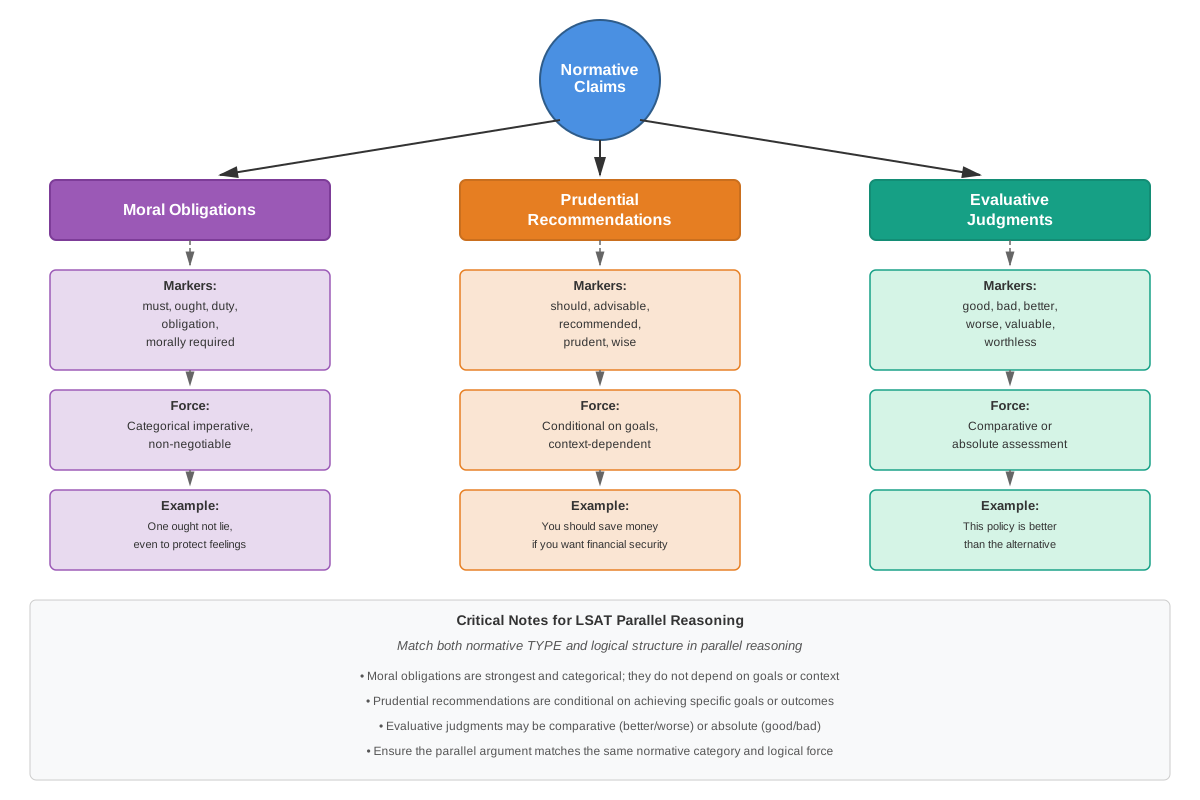
Normative statements on the LSAT fall into several categories, each with distinct logical properties:
Moral obligations use language like "must," "should," "ought," "required," "duty," or "obligation." These express what is morally necessary or prohibited. Example: "Citizens ought to vote in elections."
Prudential recommendations suggest what is advisable or beneficial without invoking moral necessity. They use terms like "would be wise," "advisable," "beneficial," or "in one's interest." Example: "Investors should diversify their portfolios."
Evaluative judgments assess quality, worth, or desirability using terms like "good," "bad," "better," "worse," "valuable," or "worthless." Example: "Classical music is superior to popular music."
Permissibility claims address what is allowed or acceptable, using "may," "permissible," "acceptable," or "allowed." Example: "It is permissible to break a promise to prevent harm."
Structural Patterns in Normative Arguments
Normative parallel arguments follow several common structural patterns that appear repeatedly on the LSAT:
Normative Principle to Specific Application: The argument begins with a general normative principle, then applies it to a specific case to reach a normative conclusion. Structure: "All X should do Y. Z is an X. Therefore, Z should do Y."
Descriptive Fact to Normative Conclusion: The argument moves from purely descriptive premises about facts or consequences to a normative conclusion about what should be done. Structure: "Action A produces outcome B. Outcome B is desirable. Therefore, we should do A."
Comparative Normative Evaluation: The argument compares two options based on normative criteria to conclude which is better or preferable. Structure: "X has more of quality Q than Y. Quality Q is valuable. Therefore, X is better than Y."
Conditional Normative Claim: The argument establishes when a normative obligation or recommendation applies. Structure: "If condition C obtains, then one should do A. Condition C obtains. Therefore, one should do A."
Matching Normative Force
A critical but often overlooked aspect of normative parallel arguments involves matching the strength of normative force. An argument concluding "one must do X" (strong obligation) does not parallel an argument concluding "one may do X" (mere permission) or "it would be good to do X" (weak recommendation). The LSAT frequently includes trap answers that preserve logical structure while shifting normative force.
Consider this comparison:
| Original Argument | Trap Answer | True Parallel |
|---|---|---|
| "Doctors must maintain confidentiality because patients have a right to privacy." | "Doctors may maintain confidentiality because it benefits patients." | "Teachers must grade fairly because students have a right to equal treatment." |
| Strong obligation from rights | Weak permission from benefits | Strong obligation from rights |
Mixed Normative-Descriptive Arguments
Many LSAT normative parallel arguments combine descriptive and normative elements. The key is tracking which premises are descriptive versus normative and ensuring the parallel argument maintains the same pattern. An argument with two descriptive premises and one normative conclusion must be matched with another argument following that exact pattern, not one with three normative premises.
Example structure: "Fact about consequences (descriptive) + Value judgment about those consequences (normative) → Normative recommendation"
This must parallel: "Different fact about consequences (descriptive) + Value judgment about those consequences (normative) → Normative recommendation"
The Is-Ought Gap
Philosophers identify the "is-ought gap" as the logical space between descriptive facts and normative conclusions. On the LSAT, arguments that leap from purely descriptive premises to normative conclusions often contain this gap. When matching parallel arguments, students must recognize whether the original argument bridges this gap (through an implicit normative premise) or leaves it unbridged. The parallel must replicate this feature.
An argument stating "Pollution causes health problems; therefore, we should reduce pollution" contains an implicit normative premise (we should prevent health problems). The parallel must similarly move from descriptive fact to normative conclusion with a comparable implicit bridge.
Concept Relationships
The concepts within normative parallel arguments form an interconnected hierarchy. At the foundation lies the descriptive-normative distinction, which determines whether an argument qualifies as normative at all. This distinction feeds into identifying types of normative claims, since different normative categories (obligation, recommendation, evaluation, permission) carry different logical properties and must be matched precisely.
The structural patterns concept builds upon both previous elements, showing how normative claims combine with descriptive facts and other normative claims to form complete arguments. Understanding these patterns enables recognition of normative force matching, which represents a more nuanced analysis of how strongly a conclusion commits to a normative position.
Finally, mixed normative-descriptive arguments and the is-ought gap integrate all previous concepts, representing the most sophisticated level of analysis where students must track multiple claim types simultaneously and recognize implicit normative premises.
This topic connects to prerequisite knowledge through argument structure identification (providing the framework for analyzing any argument) and conditional reasoning (since many normative claims take conditional form: "If X, then one should Y"). It relates to broader parallel reasoning by adding the normative dimension to structural matching, and connects to assumption questions through the is-ought gap, where implicit normative premises often function as necessary assumptions.
Relationship map: Descriptive-Normative Distinction → Types of Normative Claims → Structural Patterns → Normative Force Matching → Mixed Arguments & Is-Ought Gap → Complete Parallel Analysis
High-Yield Facts
- ⭐ A true normative parallel must match both logical structure AND the normative/descriptive character of each premise and conclusion
- ⭐ Arguments with normative conclusions require at least one normative premise (explicitly stated or implicit)
- ⭐ The strength of normative force (must/should/may/good) must match between parallel arguments
- ⭐ Descriptive premises about consequences often combine with normative value judgments to yield normative conclusions
- ⭐ Trap answers frequently match content domain (ethics to ethics) while failing to match structure
- Moral obligation language ("must," "ought," "duty") carries stronger normative force than recommendation language ("advisable," "beneficial")
- Evaluative comparisons ("better," "worse") require both options to be evaluated on the same normative dimension
- Conditional normative claims ("If X, then one should Y") must be matched with other conditional normative structures
- An argument moving from general principle to specific application must be paralleled with the same deductive pattern
- The presence of an is-ought gap (jumping from facts to values) must be replicated in the parallel argument
Quick check — test yourself on Normative parallel arguments so far.
Try Flashcards →Common Misconceptions
Misconception: If two arguments discuss similar ethical topics, they must be parallel.
Correction: Content similarity is irrelevant to parallel reasoning. An argument about medical ethics and one about environmental policy can be perfect parallels if they share logical structure and normative character, while two arguments about medical ethics may have completely different structures.
Misconception: Any argument with "should" in the conclusion is automatically parallel to any other argument with "should" in the conclusion.
Correction: The normative force must match, but so must the entire logical structure. Two arguments can both conclude with "should" while having completely different premise structures (one deductive from principle, one inductive from consequences).
Misconception: Descriptive premises cannot lead to normative conclusions.
Correction: While purely descriptive premises alone cannot logically yield normative conclusions without an implicit normative premise, LSAT arguments frequently combine descriptive facts with normative value judgments. The key is recognizing when a normative premise (explicit or implicit) bridges the is-ought gap.
Misconception: Parallel reasoning questions only test logical structure, not the type of claims being made.
Correction: For normative parallel arguments, the normative versus descriptive character of each component is part of the structure that must be matched. An argument with two descriptive premises and a normative conclusion has a different structure than one with three normative premises.
Misconception: If the logical form matches (like modus ponens), the arguments are parallel regardless of normative content.
Correction: The normative dimension adds an additional layer of structure. "If P then Q; P; therefore Q" in purely descriptive terms differs structurally from "If P then one should Q; P; therefore one should Q" because the latter includes normative force as part of its structure.
Misconception: Recommendation language ("it would be wise to") and obligation language ("one must") are interchangeable in parallel arguments.
Correction: These represent different strengths of normative force. A true parallel must match this strength. An argument concluding with a strong obligation cannot parallel one concluding with a weak recommendation, even if the logical form is otherwise identical.
Worked Examples
Example 1: Identifying True Normative Parallel
Original Argument: "All professionals have an obligation to maintain competence in their field. Doctors are professionals. Therefore, doctors have an obligation to maintain competence in their field."
Analysis: This argument follows a categorical syllogism structure (All A are B; C is A; therefore C is B) with normative content throughout. The premises and conclusion all contain normative claims about obligation. The normative force is strong ("obligation").
Answer Choice A: "All citizens should vote in elections. Maria is a citizen. Therefore, Maria should vote in elections."
Evaluation of A: This matches the categorical syllogism structure perfectly. All components are normative (using "should"). The normative force is strong obligation. This is a strong candidate. ✓
Answer Choice B: "All birds have wings. Robins are birds. Therefore, robins have wings."
Evaluation of B: This matches the categorical syllogism structure, but all components are purely descriptive (stating facts about physical characteristics). The normative character does not match. Eliminate. ✗
Answer Choice C: "All professionals may maintain competence in their field. Doctors are professionals. Therefore, doctors may maintain competence in their field."
Evaluation of C: This matches the categorical syllogism structure and maintains normative content throughout. However, "may" expresses permission (weak normative force) rather than obligation (strong normative force). The normative force does not match. Eliminate. ✗
Answer Choice D: "Maintaining competence benefits professionals. Doctors are professionals. Therefore, doctors benefit from maintaining competence."
Evaluation of D: The structure differs significantly. The first premise is descriptive (stating a fact about benefits), and the conclusion is descriptive (stating what benefits doctors). The normative character does not match. Eliminate. ✗
Answer Choice E: "All teachers have an obligation to treat students fairly. Treating students fairly requires grading consistently. Therefore, teachers have an obligation to grade consistently."
Evaluation of E: While this contains normative content about obligations, the structure differs. This is a chain argument (A→B; B→C; therefore A→C) rather than a categorical syllogism. The structure does not match. Eliminate. ✗
Correct Answer: A
Key Takeaway: The correct parallel matched both the categorical syllogism structure AND the normative character of all components AND the strength of normative force (strong obligation).
Example 2: Normative Argument with Mixed Premises
Original Argument: "Reducing carbon emissions would significantly slow climate change. Slowing climate change is morally imperative. Therefore, we should reduce carbon emissions."
Analysis: This argument has a descriptive premise (fact about consequences), a normative premise (moral evaluation), and a normative conclusion (recommendation). The structure is: Descriptive fact about means-end relationship + Normative evaluation of end → Normative recommendation about means.
Answer Choice A: "Increasing exercise improves health. Improving health is desirable. Therefore, people should exercise more."
Evaluation of A: First premise is descriptive (fact about consequences). Second premise is normative (evaluative judgment). Conclusion is normative (recommendation). The structure matches perfectly: Descriptive means-end + Normative evaluation → Normative recommendation. ✓
Answer Choice B: "Reducing carbon emissions would significantly slow climate change. Climate change causes economic damage. Therefore, reducing carbon emissions would prevent economic damage."
Evaluation of B: All three components are descriptive (stating facts about causal relationships). No normative element appears. The normative character does not match. Eliminate. ✗
Answer Choice C: "We should reduce carbon emissions. Reducing emissions requires new technology. Therefore, we should develop new technology."
Evaluation of C: This begins with a normative premise rather than a descriptive one. The structure is: Normative claim + Descriptive means-end → Normative conclusion. The order and character of premises do not match. Eliminate. ✗
Answer Choice D: "Slowing climate change is morally imperative. Reducing carbon emissions is morally imperative. Therefore, we should do both."
Evaluation of D: Both premises are normative rather than having one descriptive and one normative. The structure does not match. Eliminate. ✗
Answer Choice E: "Increasing exercise improves health. Therefore, people should exercise more."
Evaluation of E: This has only one premise (descriptive) leading to a normative conclusion. The original argument has two premises. The structure does not match. Eliminate. ✗
Correct Answer: A
Key Takeaway: When an argument mixes descriptive and normative premises, the parallel must maintain the same sequence and character of premise types, not just match the conclusion's normative character.
Exam Strategy
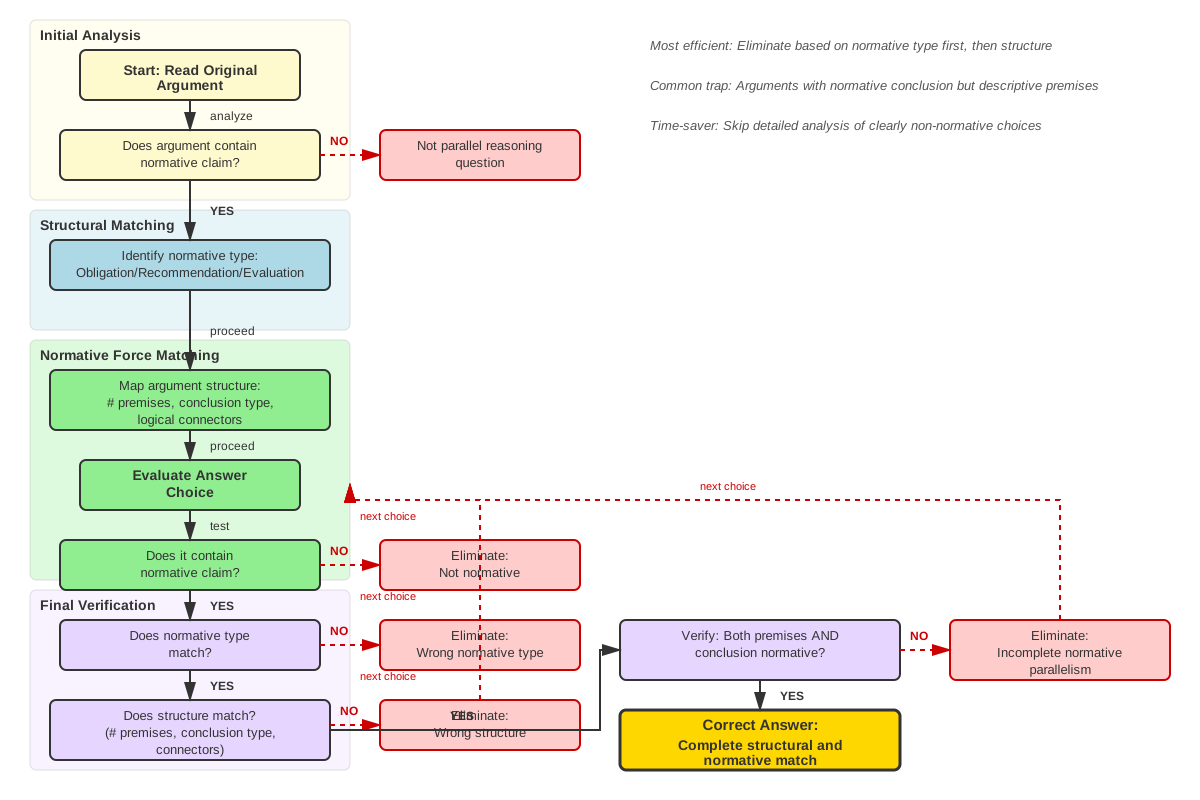
When approaching normative parallel arguments on the LSAT, implement a systematic three-stage analysis process:
Stage 1: Classify Each Component (15-20 seconds)
Read the original argument and mark each premise and the conclusion as either [D] for descriptive or [N] for normative. Note the specific type of normative claim (obligation, recommendation, evaluation, permission) and its strength. Create a quick structural map: "[D] + [N-strong obligation] → [N-strong obligation]"
Stage 2: Identify Structural Pattern (10 seconds)
Determine whether the argument follows categorical syllogism, conditional reasoning, means-end reasoning, principle-to-application, or another pattern. This structural skeleton must be preserved in the correct answer.
Stage 3: Eliminate and Confirm (30-40 seconds)
Scan answer choices for immediate eliminations based on normative character mismatches. Many wrong answers can be eliminated in 3-5 seconds by spotting that all components are descriptive or that normative force differs. For remaining choices, verify complete structural match.
Exam Tip: Trap answers often match either content (ethics to ethics) or surface grammar (both use "should") without matching complete structure. Always verify BOTH logical form AND normative character.
Trigger words for normative claims: should, ought, must, duty, obligation, required, right, wrong, good, bad, better, worse, advisable, beneficial, valuable, worthwhile, permissible, allowed, may (in permissive sense)
Trigger words for descriptive claims: is, are, was, were, will be, causes, results in, leads to, produces, consists of, contains, has the property of
Process-of-elimination priorities:
- First, eliminate choices where normative/descriptive character of any component differs
- Second, eliminate choices where normative force strength differs (must vs. should vs. may)
- Third, eliminate choices where logical structure differs (syllogism vs. conditional vs. means-end)
- Finally, verify the remaining choice(s) match completely
Time allocation: Spend 60-75 seconds total on normative parallel questions. They require more careful analysis than average questions but should not exceed 90 seconds. If stuck between two choices after 75 seconds, make an educated guess and move forward.
Memory Techniques
Mnemonic for checking parallel structure - "SNFS":
- Structure (logical form: syllogism, conditional, etc.)
- Normative character (is each component descriptive or normative?)
- Force (strength of normative claims: must/should/may/good)
- Sequence (order of premise types if mixed)
Visualization strategy: Picture normative claims as arrows pointing upward (toward ideals, what should be) and descriptive claims as horizontal lines (stating what is). An argument's structure can be visualized as a pattern of arrows and lines that must match exactly in the parallel.
Acronym for normative claim types - "MORE":
- Moral obligations (must, ought, duty)
- Opinions/evaluations (good, bad, better, worse)
- Recommendations (should, advisable, wise)
- Entitlements/permissions (may, allowed, permissible)
Memory aid for is-ought gap: "Facts alone can't tell you what to do—you need values too." Any argument jumping from purely descriptive premises to a normative conclusion has an implicit normative premise bridging the gap.
Summary
Normative parallel arguments constitute a high-yield LSAT topic requiring students to match both logical structure and normative character across arguments. The fundamental skill involves distinguishing descriptive claims (statements about what is) from normative claims (statements about what should be, what is good, or what is obligatory), then ensuring that parallel arguments preserve not only the logical form but also the normative versus descriptive nature of each component. Students must recognize different types of normative claims—moral obligations, prudential recommendations, evaluative judgments, and permissibility claims—and match the strength of normative force across parallel arguments. Common structural patterns include principle-to-application arguments, descriptive-to-normative reasoning, comparative evaluations, and conditional normative claims. Success requires systematic analysis: classify each component as descriptive or normative, identify the structural pattern, and eliminate answer choices that fail to match either dimension. The most frequent trap answers preserve content similarity or surface grammar while failing to match complete structure, making careful component-by-component verification essential for consistent accuracy.
Key Takeaways
- Normative parallel arguments must match both logical structure AND the normative/descriptive character of every component
- Descriptive claims state facts about what is; normative claims express what should be, what is good, or what is obligatory
- The strength of normative force (must vs. should vs. may vs. good) must match between parallel arguments
- Arguments mixing descriptive and normative premises require parallels that preserve the same sequence and character of premise types
- Trap answers frequently match content domain or surface grammar without matching complete structure
- Systematic classification of each component as [D] or [N] prevents errors and accelerates elimination
- The is-ought gap reminds us that purely descriptive premises cannot yield normative conclusions without an implicit normative premise
Related Topics
Parallel Flaw Questions with Normative Content: Building on normative parallel arguments, these questions require matching both the structure and the specific logical flaw while maintaining normative character. Mastering basic normative parallels provides the foundation for this more complex variation.
Necessary Assumption Questions and the Is-Ought Gap: Many necessary assumption questions involve identifying the implicit normative premise that bridges from descriptive facts to normative conclusions. Understanding normative parallel arguments strengthens the ability to spot these missing normative links.
Principle Questions: These questions often involve applying normative principles to specific cases or identifying which principle justifies a normative conclusion. The structural patterns learned in normative parallel arguments transfer directly to principle question analysis.
Strengthen/Weaken Questions with Normative Conclusions: Understanding how normative arguments are structured helps identify what would strengthen or weaken them, particularly when distinguishing between challenging the descriptive facts versus challenging the normative evaluation.
Practice CTA
Now that you understand the structure and strategy behind normative parallel arguments, it's time to put this knowledge into practice. Work through the practice questions systematically, applying the SNFS framework (Structure, Normative character, Force, Sequence) to each problem. Use the flashcards to reinforce your ability to quickly distinguish normative from descriptive claims and recognize common structural patterns. Remember: consistent accuracy on these questions comes from methodical analysis, not intuition. Each practice question you complete strengthens your pattern recognition and builds the confidence needed to tackle these high-value questions efficiently on test day. You've got this!
Sign up free to keep reading
Create a free AnvayaPrep account to finish this LSAT guide on Normative parallel arguments — plus flashcards and practice questions.