Overview
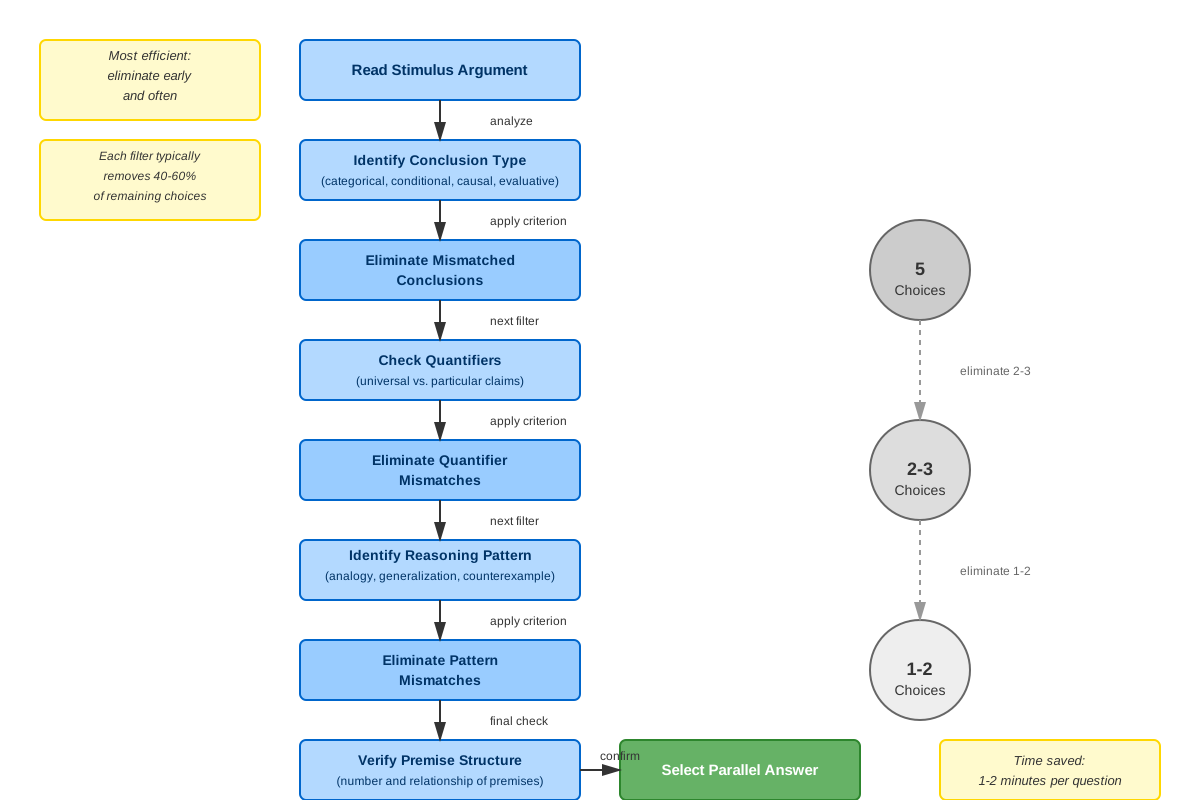
Parallel answer elimination is a strategic approach used to efficiently solve Parallel Reasoning questions on the LSAT Logical Reasoning section. Rather than attempting to fully understand and match every structural element of the stimulus argument with each answer choice, this technique focuses on systematically eliminating answer choices that fail to match key structural features of the original argument. This method leverages the fact that wrong answers in Parallel Reasoning questions typically contain at least one glaring structural mismatch that can be identified quickly, allowing test-takers to narrow down options before investing time in detailed analysis.
This topic represents a critical skill set for LSAT success because Parallel Reasoning questions appear consistently on every LSAT administration, typically comprising 2-4 questions per test. These questions are notoriously time-consuming when approached without a systematic strategy, as they require comparing complex logical structures across multiple lengthy answer choices. By mastering parallel answer elimination, students can reduce the time spent on these questions from 3-4 minutes to under 2 minutes while simultaneously improving accuracy. The technique transforms what many students perceive as the most challenging question type into a manageable, systematic process.
Within the broader context of logical reasoning, parallel answer elimination connects directly to fundamental skills in argument analysis, structural pattern recognition, and efficient test-taking strategy. This approach builds upon core competencies in identifying argument components (premises, conclusions, intermediate conclusions), recognizing reasoning patterns (conditional logic, causal reasoning, analogical reasoning), and understanding logical relationships. The elimination strategy also reinforces critical thinking about what makes arguments structurally similar versus merely topically related, a distinction that appears throughout the LSAT in various question types.
Learning Objectives
- [ ] Identify how Parallel answer elimination appears in LSAT questions
- [ ] Explain the reasoning pattern behind Parallel answer elimination
- [ ] Apply Parallel answer elimination to solve LSAT-style problems accurately
- [ ] Distinguish between structural parallelism and mere topical similarity in arguments
- [ ] Systematically evaluate answer choices using multiple elimination criteria in sequence
- [ ] Recognize the most common structural mismatches that eliminate wrong answers
- [ ] Develop a time-efficient workflow for Parallel Reasoning questions that maximizes accuracy
Prerequisites
- Argument structure identification: Understanding premises, conclusions, and intermediate conclusions is essential because parallel answer elimination requires matching these structural components across arguments.
- Basic logical reasoning patterns: Familiarity with conditional statements, causal reasoning, and analogical arguments enables recognition of when answer choices deviate from the stimulus pattern.
- Quantifier recognition: Ability to distinguish between universal claims (all, every, none) and particular claims (some, most) is necessary because quantifier mismatches are frequent elimination criteria.
- Conclusion indicators and premise indicators: Knowledge of signal words helps quickly identify argument structure, which is the foundation for parallel matching.
Why This Topic Matters
Parallel reasoning questions test a fundamental legal skill: the ability to recognize when two situations share the same logical structure despite different content. This mirrors the legal practice of applying precedent, where attorneys must identify when past cases share relevant structural similarities with current cases. Law schools value this skill because it demonstrates abstract reasoning ability and the capacity to see beyond surface-level details to underlying logical patterns.
On the LSAT, Parallel Reasoning questions appear with high frequency and predictability. Each LSAT typically contains 2-4 Parallel Reasoning questions, with approximately 1-2 appearing in each Logical Reasoning section. These questions are distributed across two main types: "Parallel Reasoning" (matching valid or flawed arguments) and "Parallel Flaw" (specifically matching flawed reasoning patterns). Together, these question types account for roughly 4-8% of the total LSAT score, making them a high-yield area for focused preparation.
The lsat parallel answer elimination strategy matters particularly because these questions are disproportionately time-consuming. Without a systematic approach, students often spend 3-4 minutes per question, reading and re-reading five lengthy arguments to find structural matches. This time drain compromises performance on other questions. However, students who master elimination techniques can consistently solve these questions in 90-120 seconds, creating valuable time for more challenging questions elsewhere in the section. Additionally, Parallel Reasoning questions have a higher-than-average difficulty rating, with many students scoring below 50% accuracy without strategic training, but achieving 80%+ accuracy after mastering elimination techniques.
Core Concepts
Understanding Parallel Reasoning Questions
Parallel reasoning questions ask test-takers to identify an answer choice that exhibits the same logical structure as the argument presented in the stimulus. The question stem typically includes phrases like "Which one of the following arguments is most similar in its reasoning to the argument above?" or "The flawed pattern of reasoning in which one of the following is most similar to that in the argument above?" The key insight is that parallelism refers exclusively to logical structure, not to topic, subject matter, or conclusion truth value.
The stimulus argument and correct answer must match across multiple structural dimensions:
- Number and type of premises (factual claims, conditional statements, causal claims, etc.)
- Logical relationships between premises (supporting, contrasting, building upon)
- Type of conclusion (universal, particular, conditional, causal, prescriptive)
- Reasoning pattern (deductive, inductive, analogical, causal, conditional)
- Logical validity or flaw type (if the argument is flawed)
The Elimination Strategy Framework
Parallel answer elimination operates on a fundamental principle: wrong answers in Parallel Reasoning questions almost always contain at least one obvious structural mismatch that can be identified without fully analyzing the entire argument. Rather than attempting to understand each answer choice completely and then comparing it holistically to the stimulus, the elimination approach involves checking specific structural features in sequence and eliminating any answer choice that fails to match.
The systematic elimination process follows this hierarchy:
Step 1: Identify the stimulus structure - Before examining answer choices, invest 30-45 seconds analyzing the stimulus argument to identify:
- The conclusion (what is being argued)
- The number of premises
- The type of reasoning (conditional, causal, analogical, etc.)
- Any notable structural features (quantifiers, intermediate conclusions, counterexamples)
- Whether the reasoning is valid or contains a flaw
Step 2: Create an elimination checklist - Based on the stimulus analysis, note 3-4 key structural features that must appear in the correct answer. These become your elimination criteria.
Step 3: Apply criteria sequentially - Scan each answer choice for your first criterion. Eliminate any choice that fails this test before moving to the next criterion. This prevents wasting time on choices that are already eliminated.
Step 4: Verify the remaining choice - Once you've narrowed to 1-2 options, verify the match more carefully before selecting.
Key Structural Elements for Elimination
Certain structural features serve as particularly effective elimination criteria because they're easy to identify quickly and frequently differ between the stimulus and wrong answers:
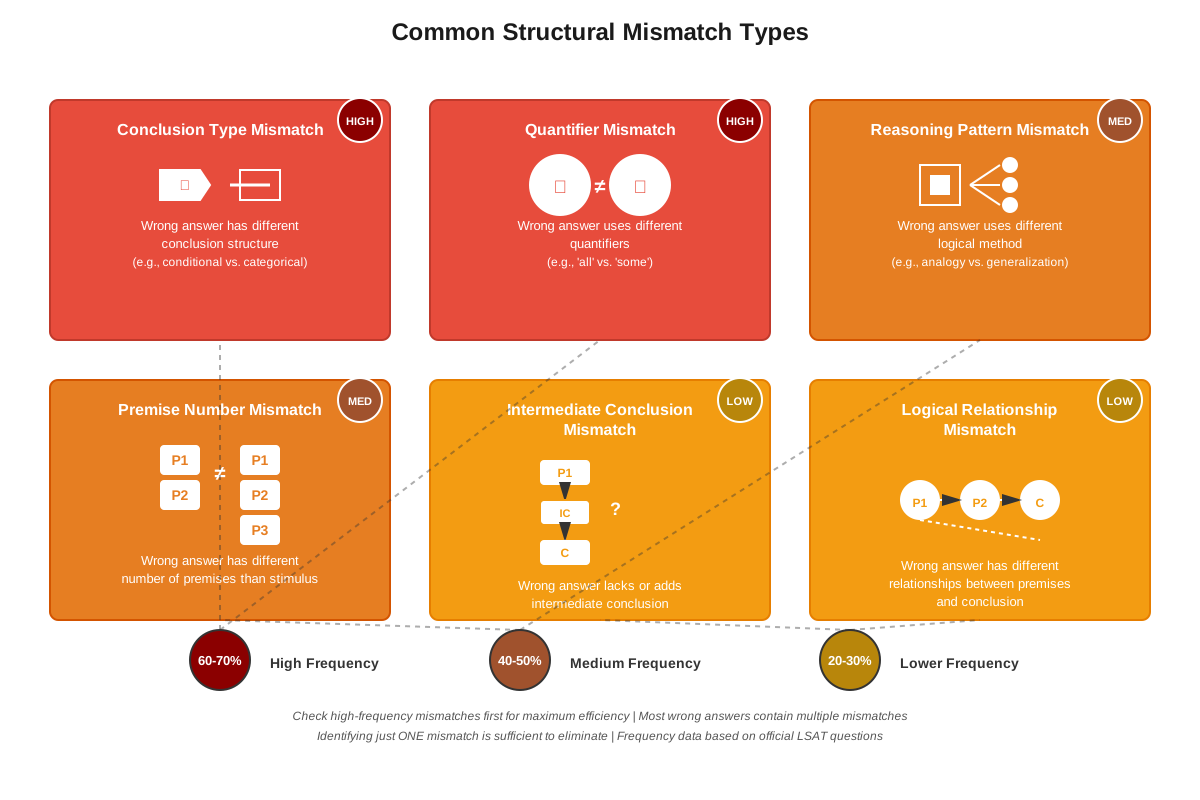
Quantifiers: Arguments using "all," "every," or "none" must be matched with answer choices using universal quantifiers, not "some" or "most." This single criterion often eliminates 2-3 answer choices immediately.
Conclusion type: A prescriptive conclusion ("should," "ought," "must do") cannot parallel a descriptive conclusion ("is," "will be"). A conditional conclusion ("if...then") cannot parallel a categorical conclusion.
Number of premises: If the stimulus has three distinct premises, answer choices with only two premises can be eliminated immediately.
Reasoning pattern: A causal argument ("X causes Y") cannot parallel conditional reasoning ("if X, then Y"), even though these may appear similar on surface reading.
Presence of counterexamples or exceptions: If the stimulus acknowledges an exception or counterexample, the correct answer must also acknowledge one.
Common Structural Patterns
Understanding frequently tested argument structures accelerates the elimination process:
| Pattern Type | Structure | Example Indicator |
|---|---|---|
| Conditional Chain | If A→B, If B→C, Therefore If A→C | "If...then" appearing multiple times |
| Causal Reasoning | X causes Y, Y is present, Therefore X is present | "Because," "causes," "results in" |
| Analogical | X has properties A, B, C; Y has properties A, B; Therefore Y has C | "Similarly," "likewise," "just as" |
| Categorical Syllogism | All A are B, All B are C, Therefore All A are C | "All," "every," "none" |
| Sufficient/Necessary Confusion | Treats sufficient condition as necessary or vice versa | Conditional language with reversed logic |
Flaw Parallelism
In Parallel Flaw questions, the correct answer must contain the same logical error as the stimulus. Common flaws that appear in parallel questions include:
- Confusing correlation with causation: Observing that X and Y occur together and concluding X causes Y
- Confusing sufficient and necessary conditions: Treating "if A then B" as equivalent to "if B then A"
- Unrepresentative sample: Drawing a general conclusion from an atypical example
- False dichotomy: Assuming only two options exist when more are possible
- Circular reasoning: Using the conclusion as support for itself
- Appeal to inappropriate authority: Citing an expert outside their area of expertise
When matching flaws, both the flaw type and the structural context must match. An answer choice might contain the same flaw type but in a different structural position, making it incorrect.
Concept Relationships
The parallel answer elimination strategy integrates multiple foundational logical reasoning skills into a unified approach. At its base, the technique requires argument structure identification → which enables → structural feature extraction → which enables → systematic comparison → which produces → efficient elimination.
The relationship between parallel reasoning and other LSAT question types is significant. Skills developed through parallel answer elimination transfer directly to Flaw questions (identifying reasoning errors), Method of Reasoning questions (describing argument structure), and Strengthen/Weaken questions (understanding how arguments function). Conversely, proficiency in these other question types enhances parallel reasoning performance by deepening structural analysis skills.
Within the elimination strategy itself, concepts build hierarchically. Quantifier matching serves as the fastest, most surface-level elimination criterion, often applied first. Conclusion type matching operates at a similar level of accessibility. These quick checks narrow the field to 2-3 choices. Next, premise structure analysis requires deeper engagement but eliminates choices that passed initial screening. Finally, reasoning pattern verification confirms the match between the remaining choice(s) and the stimulus.
The relationship between structural parallelism and topical similarity represents a critical distinction. Wrong answers often share subject matter with the stimulus (both discuss medicine, both discuss economics) but differ structurally. Recognizing this distinction prevents the common error of selecting answers that "feel similar" without being logically parallel.
High-Yield Facts
⭐ Parallel Reasoning questions require matching logical structure, not topic or subject matter - the correct answer may discuss completely different content while maintaining identical reasoning patterns.
⭐ Quantifier mismatches eliminate answer choices immediately - if the stimulus uses "all" or "every," answer choices using "some" or "most" cannot be correct.
⭐ The conclusion type must match exactly - prescriptive conclusions must parallel prescriptive conclusions; conditional conclusions must parallel conditional conclusions.
⭐ Wrong answers typically fail on the first or second elimination criterion - most incorrect choices contain obvious structural mismatches that can be identified in 10-15 seconds.
⭐ Parallel Flaw questions require matching both the flaw type and the structural context - an answer with the same flaw in a different structural position is incorrect.
- The number of premises in the stimulus and correct answer must match - if the stimulus has three distinct supporting claims, the answer must also have three.
- Conditional reasoning ("if...then") and causal reasoning ("X causes Y") are structurally different and cannot parallel each other.
- Intermediate conclusions in the stimulus must be matched by intermediate conclusions in the correct answer.
- The presence of counterexamples, exceptions, or qualifications in the stimulus must be reflected in the correct answer.
- Answer choices that introduce new structural elements not present in the stimulus (such as analogies when the stimulus contains none) can be eliminated.
- The logical validity or invalidity must match - a valid argument cannot parallel an invalid one.
- Temporal relationships (past, present, future) and their logical function must align between stimulus and answer.
- The scope of the conclusion must match - a conclusion about "most" cannot parallel a conclusion about "all."
Quick check — test yourself on Parallel answer elimination so far.
Try Flashcards →Common Misconceptions
Misconception: Parallel Reasoning questions require finding arguments about the same topic or subject matter.
Correction: Parallelism refers exclusively to logical structure, not content. The correct answer often discusses a completely different subject while maintaining identical reasoning patterns. An argument about economics can parallel an argument about biology if their logical structures match.
Misconception: If an answer choice reaches the same conclusion as the stimulus, it must be parallel.
Correction: The truth value or specific content of the conclusion is irrelevant. What matters is the type of conclusion (universal vs. particular, conditional vs. categorical, prescriptive vs. descriptive) and how it relates to the premises. Two arguments can reach opposite conclusions while being structurally parallel.
Misconception: Parallel Flaw questions require finding the same real-world error (like a math mistake or factual error).
Correction: Parallel Flaw questions focus on logical errors in reasoning structure, not factual mistakes. The flaw must be a pattern of invalid inference, such as confusing correlation with causation or treating a sufficient condition as necessary.
Misconception: All five answer choices must be read completely before making a decision.
Correction: The elimination strategy is specifically designed to avoid this time-consuming approach. Most answer choices can be eliminated after reading only the first sentence or two by identifying structural mismatches with key features of the stimulus.
Misconception: Conditional statements and causal statements are interchangeable in parallel reasoning.
Correction: These represent fundamentally different logical structures. "If X, then Y" (conditional) establishes a relationship of sufficiency, while "X causes Y" (causal) establishes a productive relationship. Arguments using one cannot parallel arguments using the other, even if they appear similar on casual reading.
Misconception: The correct answer must use similar language or vocabulary to the stimulus.
Correction: Structural parallelism is independent of word choice. The correct answer may use completely different vocabulary, sentence structure, and phrasing while maintaining logical parallelism. Conversely, wrong answers often use similar language to create a false sense of parallelism.
Misconception: Longer answer choices are more likely to be correct because they provide more detail.
Correction: Answer length has no correlation with correctness in Parallel Reasoning questions. The LSAT deliberately varies answer length to prevent test-takers from using length as a shortcut. Focus on structural features, not verbosity.
Worked Examples
Example 1: Basic Parallel Reasoning
Stimulus: "All professional athletes train daily. Maria trains daily. Therefore, Maria is a professional athlete."
Analysis:
- Structure: All A are B. C is B. Therefore, C is A.
- Flaw: Affirms the consequent (treats a necessary condition as sufficient)
- Conclusion type: Categorical, universal claim
- Number of premises: Two
- Reasoning pattern: Invalid categorical syllogism
Answer Choices:
(A) "All roses are flowers. This plant is a flower. Therefore, this plant is a rose."
- Structure: All A are B. C is B. Therefore, C is A. ✓
- Flaw: Affirms the consequent ✓
- Conclusion type: Categorical ✓
- This matches perfectly
(B) "Most professional athletes train daily. Maria trains daily. Therefore, Maria is probably a professional athlete."
- First premise uses "most" not "all" - ELIMINATE (quantifier mismatch)
(C) "All professional athletes train daily. If Maria is a professional athlete, she trains daily."
- Conclusion is conditional, not categorical - ELIMINATE (conclusion type mismatch)
(D) "All professional athletes train daily. Maria is a professional athlete. Therefore, Maria trains daily."
- Structure: All A are B. C is A. Therefore, C is B.
- This is VALID reasoning, but stimulus is INVALID - ELIMINATE (validity mismatch)
(E) "Some professional athletes train daily. Maria trains daily. Therefore, Maria might be a professional athlete."
- First premise uses "some" not "all" - ELIMINATE (quantifier mismatch)
Correct Answer: (A)
Elimination Efficiency: By checking quantifiers first, we eliminated (B) and (E) in under 10 seconds. Checking conclusion type eliminated (C). Checking validity eliminated (D). This left only (A) to verify.
Example 2: Complex Parallel Flaw
Stimulus: "Studies show that countries with higher chocolate consumption have more Nobel Prize winners. Therefore, eating chocolate must improve cognitive function and lead to greater intellectual achievement."
Analysis:
- Structure: Correlation observed between X and Y. Therefore, X causes Y.
- Flaw: Confuses correlation with causation (ignores alternative explanations like wealth causing both)
- Conclusion type: Causal claim
- Number of premises: One (the correlation)
- Reasoning pattern: Causal inference from correlation
Answer Choices:
(A) "Research indicates that students who eat breakfast score higher on tests. Therefore, schools should provide breakfast to improve test scores."
- This argues for a policy based on correlation, but doesn't explicitly claim causation in the same way
- The conclusion is prescriptive ("should"), not causal ("causes") - ELIMINATE (conclusion type mismatch)
(B) "Data reveals that cities with more parks have lower crime rates. Therefore, building parks must reduce criminal behavior."
- Structure: Correlation between X and Y. Therefore, X causes Y. ✓
- Flaw: Confuses correlation with causation ✓
- Conclusion type: Causal ✓
- This matches perfectly
(C) "If a city has many parks, it will have lower crime rates. This city has many parks. Therefore, it will have lower crime rates."
- This uses conditional reasoning (if-then), not causal reasoning - ELIMINATE (reasoning pattern mismatch)
(D) "Most cities with parks have lower crime rates. This city has parks. Therefore, this city probably has lower crime rates."
- Uses "most" and "probably" (inductive reasoning), not universal causal claim - ELIMINATE (reasoning pattern and strength mismatch)
(E) "Cities with parks have lower crime rates. Cities with lower crime rates are more desirable. Therefore, cities with parks are more desirable."
- This is a valid chain of reasoning with no causal flaw - ELIMINATE (flaw type mismatch)
Correct Answer: (B)
Elimination Efficiency: Checking for causal vs. conditional reasoning eliminated (C) immediately. Checking conclusion type (causal claim vs. prescriptive or conditional) eliminated (A). Checking for the specific flaw (correlation→causation) eliminated (D) and (E).
Exam Strategy
Primary Strategy: Always analyze the stimulus structure before reading answer choices. Invest 30-45 seconds identifying key structural features that will serve as elimination criteria. This upfront investment saves 60-90 seconds during answer choice evaluation.
Trigger Words in Question Stems:
- "Most similar in its reasoning" → Standard Parallel Reasoning
- "Parallel flaw" or "flawed pattern of reasoning" → Must match both structure and flaw type
- "Most closely conforms to" → Same as parallel reasoning
- "Employs which one of the following techniques" → Method of Reasoning (related but different)
Optimal Elimination Sequence:
- Quantifiers (5-10 seconds per choice): Scan for "all," "some," "most," "none" and eliminate mismatches immediately
- Conclusion type (5-10 seconds per choice): Identify whether conclusions are categorical, conditional, causal, or prescriptive
- Number of premises (10-15 seconds per choice): Count distinct supporting claims
- Reasoning pattern (15-20 seconds per choice): Identify conditional, causal, analogical, or other patterns
- Detailed verification (20-30 seconds): Fully analyze remaining 1-2 choices
Time Allocation:
- Stimulus analysis: 30-45 seconds
- First elimination pass (quantifiers + conclusion type): 30-45 seconds
- Second elimination pass (premises + reasoning pattern): 30-45 seconds
- Final verification: 20-30 seconds
- Total target time: 2 minutes
Process-of-Elimination Tips:
- Read strategically: For answer choices, read the conclusion first, then check if it matches the stimulus conclusion type. If not, eliminate without reading the premises.
- Use physical notation: Mark answer choices with specific mismatch reasons (write "Q" for quantifier mismatch, "C" for conclusion type mismatch) to avoid reconsidering eliminated choices.
- Trust first-pass eliminations: If an answer choice fails a clear structural criterion, don't second-guess the elimination. Wrong answers in Parallel Reasoning are definitively wrong.
- Watch for "close but not quite": The LSAT often includes answer choices that match 80-90% of the structure but fail on one critical element. These are designed to trap students who don't verify all structural features.
Common Trap Patterns:
- Answer choices that discuss the same topic as the stimulus but use different logical structure
- Choices that match the conclusion but use different reasoning to reach it
- Choices that contain the same flaw type but in a different structural context (in Parallel Flaw questions)
- Choices that are valid when the stimulus is invalid, or vice versa
Memory Techniques
QCPR Mnemonic for elimination sequence:
- Quantifiers (all, some, most, none)
- Conclusion type (categorical, conditional, causal, prescriptive)
- Premise count (number of supporting claims)
- Reasoning pattern (conditional, causal, analogical, etc.)
Visualization Strategy: Picture the stimulus argument as a physical structure (like a building or bridge). Each premise is a support beam, and the conclusion is the roof. The correct answer must have the same number of beams in the same configuration supporting the same type of roof. This mental image helps maintain focus on structure rather than content.
The "Different Content, Same Blueprint" Principle: Remember that parallel reasoning is like two houses built from the same blueprint but with different materials. One might be brick and the other wood, but the structural design is identical. This metaphor reinforces that topic differences are irrelevant while structural similarities are essential.
Flaw Matching Acronym - CAUSE:
- Correlation ≠ Causation
- Authority (inappropriate)
- Unrepresentative sample
- Sufficient/Necessary confusion
- Equivocation (term shift)
These represent the five most common flaws in Parallel Flaw questions.
The "Structure First, Content Never" Mantra: Repeat this phrase when approaching Parallel Reasoning questions to maintain focus on logical structure and avoid the trap of topical similarity.
Summary
Parallel answer elimination is a systematic, time-efficient strategy for solving LSAT Parallel Reasoning questions by identifying and eliminating answer choices that fail to match key structural features of the stimulus argument. Rather than attempting to fully understand all five answer choices and compare them holistically to the stimulus, this approach focuses on checking specific structural elements in sequence—quantifiers, conclusion type, number of premises, and reasoning pattern—eliminating choices that fail each criterion before moving to the next. This method leverages the fact that wrong answers in Parallel Reasoning questions contain obvious structural mismatches that can be identified quickly, typically within 10-20 seconds per choice. The strategy transforms these notoriously time-consuming questions from 3-4 minute challenges into 2-minute systematic processes. Success requires understanding that parallelism refers exclusively to logical structure, not topic or subject matter, and that the correct answer must match the stimulus across multiple dimensions: quantifier type, conclusion type, premise structure, reasoning pattern, and logical validity or flaw type. Mastering this elimination approach not only improves accuracy on Parallel Reasoning questions but also reinforces fundamental argument analysis skills that transfer to other Logical Reasoning question types.
Key Takeaways
- Parallel answer elimination focuses on systematically eliminating structurally mismatched answer choices rather than attempting to fully analyze all options
- Parallelism refers exclusively to logical structure, never to topic, subject matter, or conclusion content
- The optimal elimination sequence is QCPR: Quantifiers, Conclusion type, Premise count, Reasoning pattern
- Wrong answers typically fail on the first or second elimination criterion, making it unnecessary to read all choices completely
- Quantifier mismatches (all vs. some, every vs. most) provide the fastest elimination criterion and often eliminate 2-3 choices immediately
- In Parallel Flaw questions, both the flaw type and its structural context must match between stimulus and correct answer
- Investing 30-45 seconds analyzing the stimulus structure before reading answer choices saves 60-90 seconds during elimination and improves accuracy
Related Topics
Method of Reasoning Questions: These questions ask test-takers to describe the argumentative technique used in a stimulus. Mastering parallel reasoning enhances the ability to identify and articulate argument structures, which directly supports Method of Reasoning performance.
Flaw Questions: Understanding common logical flaws is essential for Parallel Flaw questions. Conversely, practice with Parallel Flaw questions deepens recognition of how flaws function in different structural contexts, improving general flaw identification skills.
Conditional Logic: Many Parallel Reasoning questions involve conditional statements (if-then relationships). Advanced study of conditional logic, including contrapositives and conditional chains, enables faster recognition of conditional patterns in parallel questions.
Formal Logic and Quantifiers: Deeper study of universal and particular quantifiers, including their logical relationships and valid inference patterns, strengthens the quantifier-matching elimination criterion.
Argument Structure Mapping: Advanced techniques for visually diagramming argument structure provide a powerful tool for complex Parallel Reasoning questions, particularly those involving multiple premises or intermediate conclusions.
Practice CTA
Now that you understand the systematic approach to parallel answer elimination, it's time to apply these strategies to actual LSAT questions. The practice questions and flashcards have been specifically designed to reinforce the QCPR elimination sequence and help you recognize common structural patterns and mismatches. Start with the flashcards to build rapid recognition of quantifiers, conclusion types, and reasoning patterns, then move to the practice questions to apply the full elimination strategy under timed conditions. Remember: every Parallel Reasoning question you practice strengthens not just this specific skill but your overall argument analysis abilities across all Logical Reasoning question types. Your investment in mastering this high-yield topic will pay dividends throughout the LSAT and in your future legal studies.
Sign up free to keep reading
Create a free AnvayaPrep account to finish this LSAT guide on Parallel answer elimination — plus flashcards and practice questions.