Overview
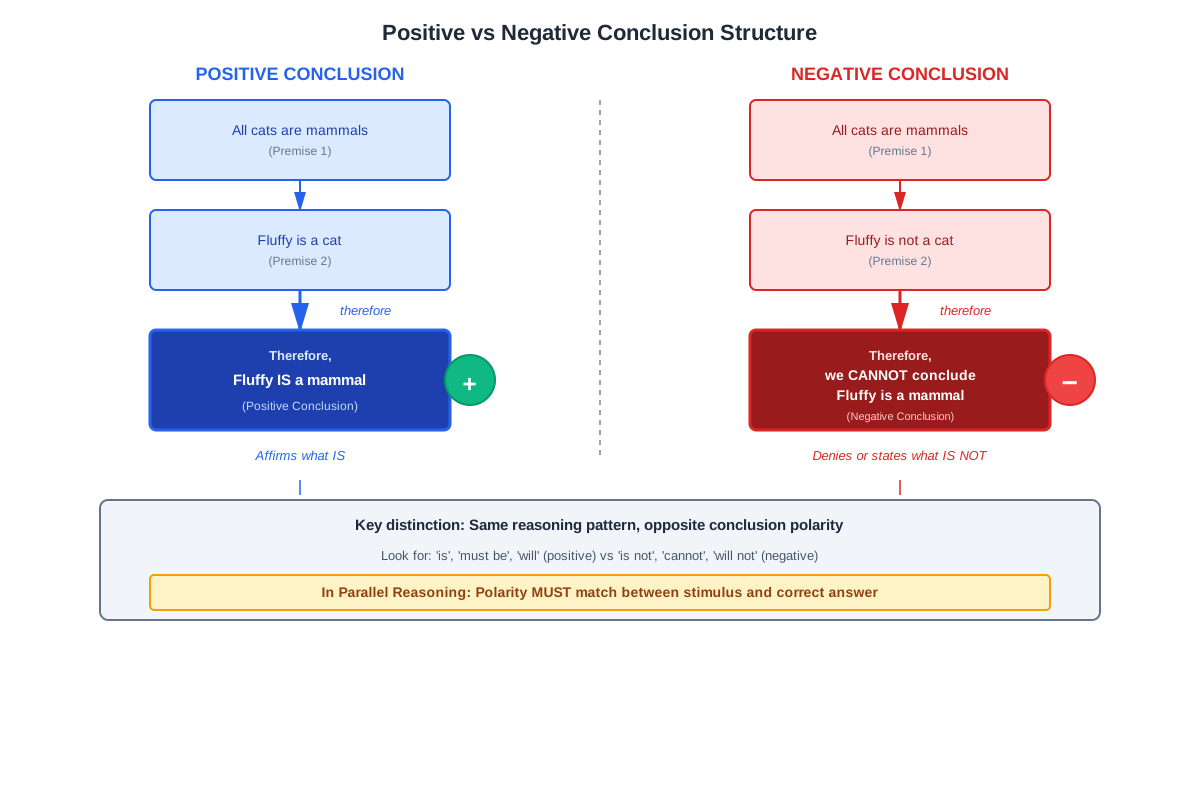
Positive versus negative conclusion is a critical distinction in LSAT Logical Reasoning, particularly within Parallel Reasoning questions. This concept refers to whether an argument's conclusion affirms something (positive) or denies something (negative). While this may seem like a simple grammatical distinction, it represents a fundamental structural element that the LSAT tests rigorously. When matching argument structures in Parallel Reasoning questions, the polarity of the conclusion—whether it states what is the case or what is not the case—must align between the original argument and the correct answer choice.
Understanding positive versus negative conclusions becomes essential because the LSAT frequently uses this structural feature to create wrong answer choices that are otherwise tempting. An argument might have identical logical structure, similar subject matter, and comparable reasoning patterns, yet differ solely in whether the conclusion is positive or negative. Test-makers exploit this distinction because students often focus on content rather than form, leading them to select answers that "feel right" but structurally mismatch the stimulus. Mastering this concept requires training the eye to look past surface-level content and identify the underlying logical architecture.
This topic connects intimately with broader logical reasoning principles, including argument structure analysis, formal logic, and conditional reasoning. The ability to distinguish positive from negative conclusions also enhances performance on Strengthen/Weaken questions, Assumption questions, and Must Be True questions, where recognizing what an argument actually claims versus what it denies proves crucial. Within Parallel Reasoning specifically, this skill combines with pattern recognition of reasoning types (causal, conditional, analogical) to form a complete approach to matching argument structures.
Learning Objectives
- [ ] Identify how Positive versus negative conclusion appears in LSAT questions
- [ ] Explain the reasoning pattern behind Positive versus negative conclusion
- [ ] Apply Positive versus negative conclusion to solve LSAT-style problems accurately
- [ ] Distinguish between explicitly negative conclusions and implicitly negative conclusions in complex argument structures
- [ ] Recognize when conclusion polarity mismatches eliminate answer choices in Parallel Reasoning questions
- [ ] Analyze arguments with multiple conclusion indicators to determine the ultimate conclusion's polarity
Prerequisites
- Basic argument structure identification: Understanding premises, conclusions, and conclusion indicators is necessary because determining whether a conclusion is positive or negative requires first identifying what the conclusion actually is.
- Familiarity with Parallel Reasoning question types: Students should recognize that these questions ask them to match logical structure rather than content, as positive versus negative conclusion is one structural element among several.
- Understanding of logical operators: Knowledge of negation, "not," "no," and other negative terms helps identify when conclusions deny rather than affirm propositions.
- Conditional reasoning fundamentals: Many arguments with negative conclusions involve conditional statements, and recognizing the difference between negating a sufficient condition versus a necessary condition matters for structural matching.
Why This Topic Matters
In real-world reasoning and professional contexts, distinguishing what someone claims is true from what they claim is not true represents a fundamental comprehension skill. Legal reasoning, which the LSAT prepares students for, constantly requires parsing whether arguments establish the presence or absence of elements, whether they affirm or deny claims, and whether conclusions support action or caution against it. Misreading conclusion polarity in legal contexts can lead to opposite interpretations of precedent, statutes, or contractual obligations.
On the LSAT specifically, lsat positive versus negative conclusion appears with high frequency in Parallel Reasoning questions, which typically constitute 1-2 questions per Logical Reasoning section. Given that each LSAT contains two Logical Reasoning sections, students can expect to encounter 2-4 Parallel Reasoning questions per test, and conclusion polarity serves as a primary structural feature in approximately 60-70% of these questions. Beyond Parallel Reasoning, this concept appears in Flaw questions where arguments improperly shift from negative to positive claims (or vice versa), and in Method of Reasoning questions where describing an argument's structure requires noting whether it "concludes that X is the case" or "concludes that X is not the case."
Common manifestations include arguments concluding "therefore, the policy should not be implemented" versus "therefore, the policy should be implemented," or "thus, the hypothesis is false" versus "thus, the hypothesis is true." The LSAT also tests this through double negatives, where conclusions like "it is not the case that the plan will fail" are actually positive (the plan will succeed), creating additional complexity that separates high scorers from average performers.
Core Concepts
Defining Positive Conclusions
A positive conclusion affirms that something is the case, exists, should happen, or possesses a particular quality. Positive conclusions make affirmative claims about reality, recommendations, or logical consequences. Structurally, positive conclusions assert propositions without negation operators in their main claim. Examples include:
- "Therefore, the company will increase profits"
- "Thus, the defendant is guilty"
- "Consequently, we should adopt the new policy"
- "It follows that the theory is correct"
Importantly, positive conclusions can contain negative terms within them while remaining structurally positive. For instance, "Therefore, the plan is unsuccessful" is a positive conclusion because it affirms a state (unsuccessfulness) rather than denying a state. The conclusion asserts what is the case about the plan.
Defining Negative Conclusions
A negative conclusion denies that something is the case, rejects a claim, argues against an action, or asserts the absence of a quality. Negative conclusions contain negation operators that reverse or deny propositions. These include:
- "Therefore, the company will not increase profits"
- "Thus, the defendant is not guilty"
- "Consequently, we should not adopt the new policy"
- "It follows that the theory is incorrect"
The critical distinction lies in whether the conclusion's main assertion is affirmative or negative. "The theory is incorrect" (positive conclusion affirming incorrectness) differs structurally from "The theory is not correct" (negative conclusion denying correctness), even though they may seem semantically equivalent.
Structural Markers of Conclusion Polarity
| Feature | Positive Conclusion | Negative Conclusion |
|---|---|---|
| Primary verb form | Affirmative | Contains "not," "never," "no" |
| Logical structure | Asserts P | Asserts ~P (not-P) |
| Recommendation form | "Should do X" | "Should not do X" |
| Existence claims | "X exists" | "X does not exist" |
| Causal claims | "X causes Y" | "X does not cause Y" |
Implicit Negation and Complex Structures
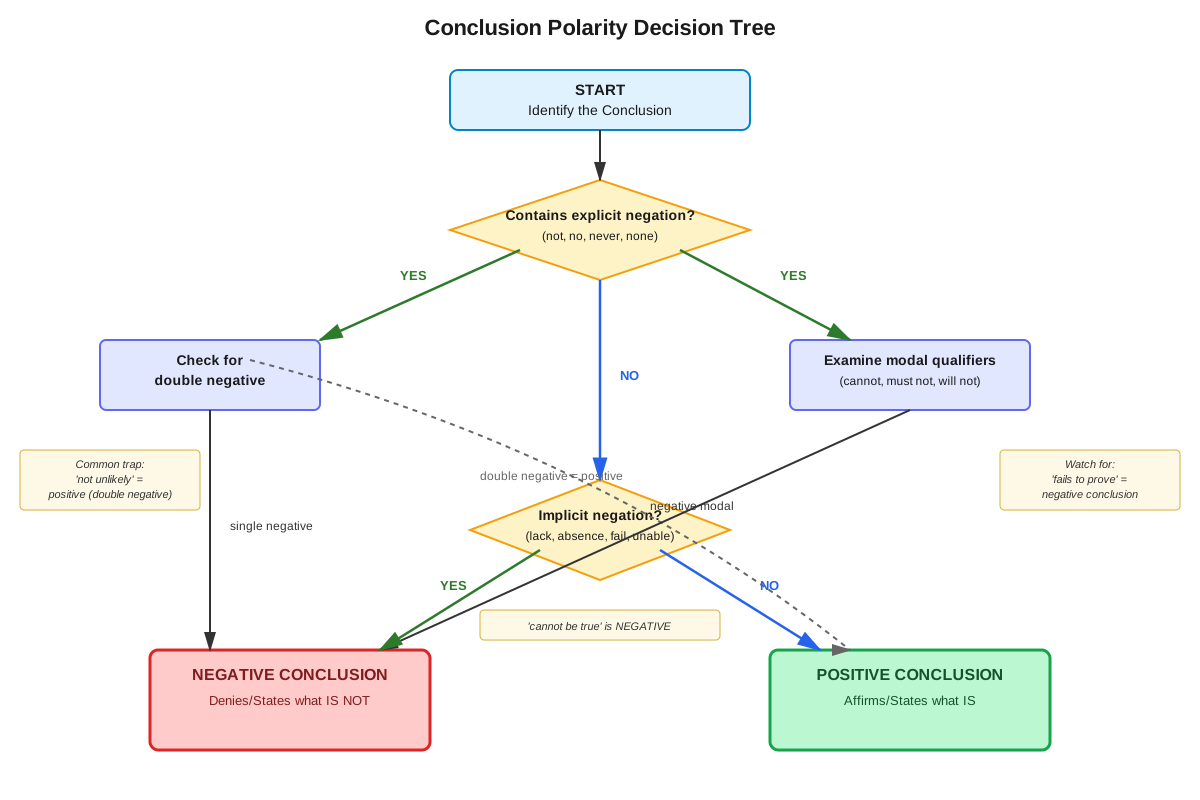
Some conclusions embed negation within seemingly positive structures. Consider: "Therefore, the absence of evidence proves the claim false." This conclusion is positive in form (it affirms something about evidence and the claim) but contains negative semantic content. For LSAT purposes, focus on the grammatical structure: does the conclusion's main verb or claim contain explicit negation?
Double negatives create particular complexity: "It is not true that the policy will not work" is actually a positive conclusion (the policy will work) because the two negations cancel. The LSAT occasionally tests whether students can recognize that multiple negations affect polarity.
Application in Parallel Reasoning
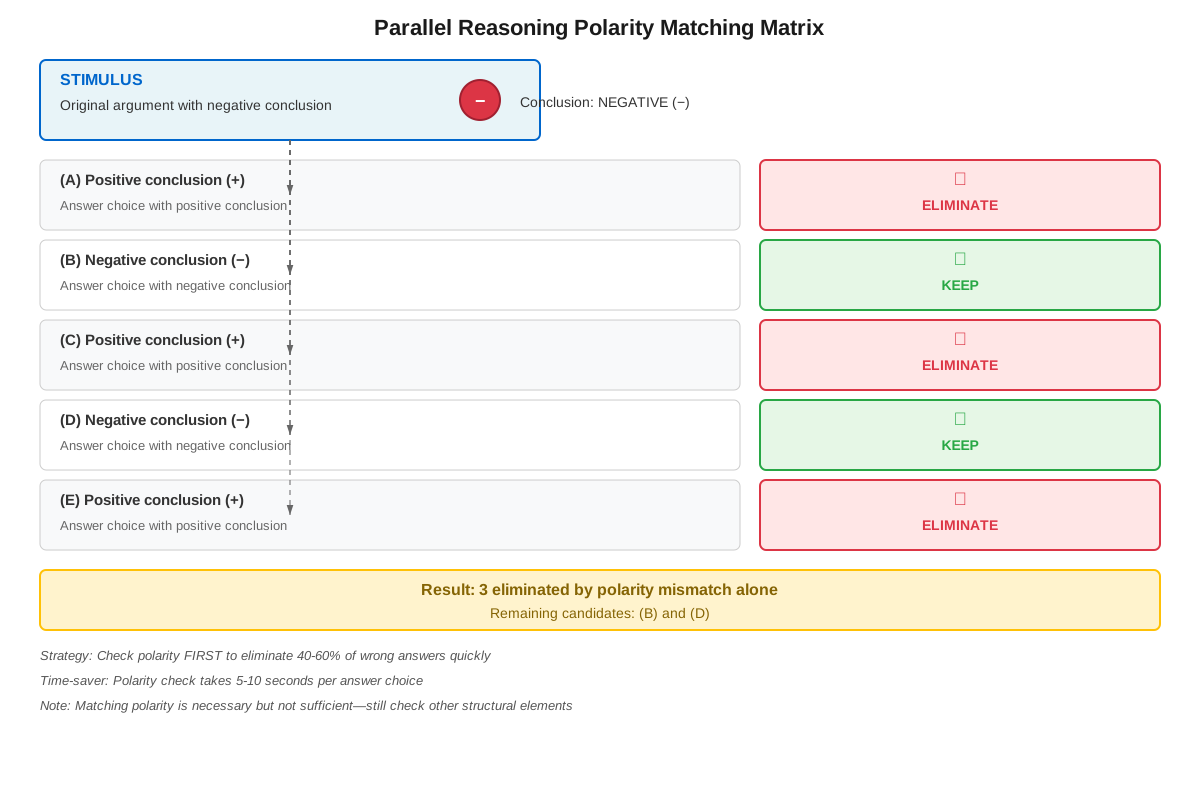
In parallel reasoning questions, matching conclusion polarity is non-negotiable. If the stimulus concludes "Therefore, we should not implement the regulation," the correct answer must also conclude with a negative recommendation ("should not," "ought not," "must not"). An answer concluding "Therefore, we should implement the regulation" fails to parallel the structure regardless of how well other elements match.
The LSAT creates wrong answers by:
- Flipping conclusion polarity while maintaining other structural elements
- Using semantically similar but structurally different conclusions
- Embedding negation in premises while keeping conclusions positive (or vice versa)
- Using implicit negation that students might miss
Recognition Strategies
To identify conclusion polarity quickly:
- Locate the conclusion using indicators (therefore, thus, consequently, so, hence)
- Identify the main verb or claim in the conclusion
- Check for negation operators immediately before or within the main claim
- Distinguish semantic from structural negation (is it grammatically negative?)
- Count negations if multiple appear (even number = positive, odd = negative)
Polarity in Different Argument Types
Causal arguments: "X causes Y" (positive) versus "X does not cause Y" (negative)
Conditional arguments: "If P, then Q" (positive) versus "If P, then not-Q" (negative conclusion about the consequent)
Analogical arguments: "A is like B in relevant ways" (positive) versus "A is not like B in relevant ways" (negative)
Principle application: "The principle applies" (positive) versus "The principle does not apply" (negative)
Understanding how polarity manifests across argument types enables faster pattern recognition and more accurate matching in Parallel Reasoning questions.
Concept Relationships
The concept of positive versus negative conclusions connects hierarchically and laterally to multiple logical reasoning skills. At the foundational level, argument structure identification enables recognition of conclusions, which then allows determination of conclusion polarity. This creates a dependency chain: argument structure → conclusion identification → polarity determination.
Within Parallel Reasoning questions, conclusion polarity works alongside other structural elements: reasoning type (causal, conditional, analogical), premise structure (number and type of premises), and logical validity (whether the reasoning is sound or flawed). These elements must all match simultaneously, creating a relationship map:
Parallel Reasoning Question → Requires matching:
- Reasoning type (causal, conditional, etc.)
- Premise structure (number, type, relationships)
- Conclusion polarity (positive vs. negative)
- Logical validity (valid vs. flawed)
Conclusion polarity also connects to formal logic and negation, particularly in understanding how "not," "no," "never," and other operators function. This relationship extends to conditional reasoning, where negating sufficient versus necessary conditions produces different logical outcomes, affecting whether conclusions affirm or deny consequents.
The concept relates to Flaw questions through polarity shifts—arguments that improperly move from negative premises to positive conclusions or vice versa commit structural errors. Similarly, in Assumption questions, recognizing conclusion polarity helps identify what must be true to bridge premises to that specific type of conclusion.
Quick check — test yourself on Positive versus negative conclusion so far.
Try Flashcards →High-Yield Facts
⭐ Conclusion polarity must match exactly in Parallel Reasoning questions—if the stimulus has a negative conclusion, the correct answer must also have a negative conclusion.
⭐ Positive conclusions affirm claims; negative conclusions deny claims—the distinction is grammatical and structural, not merely semantic.
⭐ Double negatives create positive conclusions—"not impossible" means "possible" (positive polarity).
⭐ Semantic negativity differs from structural negativity—"The plan is unsuccessful" is a positive conclusion (affirms unsuccessfulness).
⭐ Approximately 60-70% of Parallel Reasoning questions test conclusion polarity matching as a primary elimination criterion.
- Conclusion polarity appears in the main claim, not in subordinate clauses or premises.
- Negation operators include "not," "no," "never," "none," "neither," and "nor."
- Recommendations with "should not" or "ought not" are negative conclusions.
- Existence claims with "does not exist" or "is absent" are negative conclusions.
- Causal denials ("X does not cause Y") are negative conclusions even when embedded in complex sentences.
- Implicit negation through words like "lacks," "fails," or "unable" typically creates positive conclusions that affirm a negative state.
- Parallel Reasoning questions may match polarity while mismatching other structural elements to create wrong answers.
- Conclusion polarity can be tested through conditional statements where the consequent is negated.
- Questions asking to identify flawed reasoning may hinge on improper polarity shifts between premises and conclusions.
- Time-efficient test-takers check conclusion polarity first when eliminating Parallel Reasoning answer choices.
Common Misconceptions
Misconception: If a conclusion contains any negative word, it's a negative conclusion.
Correction: Structural position matters. "The plan is unsuccessful" contains negative semantic content but is a positive conclusion because it affirms a state. Only negation of the main claim creates a negative conclusion.
Misconception: Positive and negative conclusions that seem to mean the same thing can be treated as equivalent in Parallel Reasoning.
Correction: "The theory is false" (positive) and "The theory is not true" (negative) may be semantically similar but are structurally different. The LSAT tests structure, not meaning, so these cannot substitute for each other.
Misconception: Premises containing negation affect whether the conclusion is positive or negative.
Correction: Conclusion polarity depends solely on the conclusion itself. An argument can have entirely negative premises yet reach a positive conclusion, or vice versa. Premise polarity and conclusion polarity are independent structural features.
Misconception: Double negatives are always confusing and should be avoided in analysis.
Correction: Double negatives follow consistent logical rules: two negations cancel to create positive polarity. "It is not the case that the policy will not work" equals "The policy will work" (positive). Recognizing this pattern is testable and valuable.
Misconception: Conclusion polarity is less important than reasoning type in Parallel Reasoning questions.
Correction: All structural elements are equally important. An answer choice can perfectly match reasoning type but fail to parallel the argument if conclusion polarity differs. Successful test-takers check multiple structural features simultaneously, with polarity being among the quickest to verify.
Misconception: Implicit negation through words like "fails" or "lacks" creates negative conclusions.
Correction: These words typically create positive conclusions that affirm a negative state. "The experiment fails to prove the hypothesis" is a positive conclusion (it affirms failure). True negative conclusions require negation of the main verb or claim: "The experiment does not prove the hypothesis."
Worked Examples
Example 1: Basic Polarity Identification
Stimulus: "All effective medications undergo rigorous testing. This new drug has not undergone rigorous testing. Therefore, this new drug is not an effective medication."
Analysis:
- Identify the conclusion: "Therefore, this new drug is not an effective medication"
- Locate the main claim: "is not an effective medication"
- Check for negation: The word "not" directly negates the main verb "is"
- Determine polarity: This is a negative conclusion because it denies that the drug possesses a quality (effectiveness)
Parallel Structure Required: Any correct parallel must conclude with a negative claim, such as "Therefore, this candidate is not qualified" or "Thus, the building does not meet standards."
Wrong Answer Example: "Therefore, this new drug is ineffective" would be a positive conclusion (affirming ineffectiveness) and would NOT parallel the structure despite seeming semantically similar.
Example 2: Complex Parallel Reasoning Question
Stimulus: "Economic forecasters predicted that inflation would rise significantly this quarter. However, inflation remained stable. When expert predictions fail to materialize, the models used to generate those predictions require revision. Therefore, the economic models used by these forecasters should be revised."
Structural Analysis:
- Reasoning type: Principle application (general rule applied to specific case)
- Premise structure: Failed prediction + general principle about failed predictions
- Conclusion polarity: Positive ("should be revised" affirms a recommendation)
Answer Choice A: "Medical researchers predicted the treatment would cure the disease. The treatment did not cure the disease. When treatments fail, researchers should abandon them. Therefore, researchers should not continue using this treatment."
- Reasoning type: Principle application ✓
- Premise structure: Failed prediction + general principle ✓
- Conclusion polarity: Negative ("should not continue") ✗
- Verdict: INCORRECT due to polarity mismatch
Answer Choice B: "Weather forecasters predicted heavy rainfall. Heavy rainfall did not occur. When forecasts prove inaccurate, the forecasting methods need improvement. Therefore, these weather forecasting methods need improvement."
- Reasoning type: Principle application ✓
- Premise structure: Failed prediction + general principle ✓
- Conclusion polarity: Positive ("need improvement" affirms a recommendation) ✓
- Verdict: CORRECT—all structural elements match, including conclusion polarity
Key Lesson: Answer Choice A matched reasoning type and premise structure but failed on conclusion polarity. The stimulus recommends action (positive: "should be revised") while Choice A recommends against action (negative: "should not continue"). This single structural difference eliminates an otherwise tempting answer.
Exam Strategy
When approaching LSAT questions involving positive versus negative conclusions, implement this systematic process:
Step 1: Identify the conclusion immediately using conclusion indicators (therefore, thus, so, consequently, hence). Circle or underline it to maintain focus on the argument's ultimate claim.
Step 2: Determine polarity before reading answer choices in Parallel Reasoning questions. Mark "POS" or "NEG" next to the stimulus conclusion. This pre-commitment prevents confusion when evaluating multiple answer choices.
Step 3: Use polarity as a first-pass elimination criterion. In Parallel Reasoning questions, quickly scan answer choice conclusions for polarity. Eliminate any that mismatch before analyzing other structural elements. This can eliminate 2-3 answer choices in seconds.
Trigger words for negative conclusions:
- "not," "no," "never," "none," "neither," "nor"
- "should not," "ought not," "must not," "cannot"
- "does not," "will not," "did not," "is not"
- "fails to," "unable to," "impossible to" (when negating the main claim)
Trigger words that create positive conclusions despite negative content:
- "is unsuccessful," "is ineffective," "is false" (affirming negative states)
- "lacks," "absent," "missing" (affirming absence)
- "fails," "unable" (when these ARE the main claim, not negating it)
Time allocation: Spend 5-10 seconds determining conclusion polarity in the stimulus, then 2-3 seconds per answer choice checking polarity before deeper analysis. This investment saves time by preventing detailed analysis of structurally incompatible answers.
Process of elimination tip: In Parallel Reasoning questions, create a checklist:
- [ ] Conclusion polarity matches
- [ ] Reasoning type matches
- [ ] Premise structure matches
- [ ] Logical validity matches
Eliminate answer choices that fail any criterion. Conclusion polarity is typically the fastest to check, making it an efficient starting point.
Advanced strategy: When two answer choices both match conclusion polarity, use other structural elements as tiebreakers. However, never select an answer with mismatched polarity regardless of how well other elements align—polarity mismatches are absolute disqualifiers.
Memory Techniques
Mnemonic for Polarity Check: "MAIN"
- Main claim location (find the conclusion)
- Affirm or deny (does it assert or negate?)
- Identify negation operators (not, no, never)
- Number of negations (even = positive, odd = negative)
Visualization Strategy: Picture positive conclusions as green checkmarks (✓) affirming claims, and negative conclusions as red X marks (✗) denying claims. When reading arguments, mentally place these symbols next to conclusions to reinforce polarity recognition.
Acronym for Negative Operators: "NO NUNS"
- Not
- O (no)
- Never
- Unable
- Neither
- S (should not)
Polarity Flip Reminder: "Two wrongs make a right"—two negations create positive polarity, just as two wrongs (in the saying) paradoxically make a right. This helps remember that double negatives yield positive conclusions.
Structural vs. Semantic Memory Aid: "Structure over Substance"—when determining polarity, focus on grammatical structure (presence/absence of negation operators) rather than semantic content (whether the idea seems negative). This prevents the common error of treating "is unsuccessful" as a negative conclusion.
Summary
Positive versus negative conclusion represents a fundamental structural distinction in LSAT Logical Reasoning, particularly within Parallel Reasoning questions. Positive conclusions affirm claims, recommendations, or states of affairs, while negative conclusions deny them through negation operators like "not," "no," or "never." This distinction is grammatical and structural rather than semantic—conclusions can contain negative content while remaining structurally positive (e.g., "is unsuccessful" affirms a state). The LSAT rigorously tests this concept by creating wrong answer choices that match argument structure in every way except conclusion polarity. Successful test-takers systematically identify conclusion polarity in stimuli before evaluating answer choices, using polarity as a rapid elimination criterion. Understanding that double negatives create positive conclusions, that premise polarity operates independently from conclusion polarity, and that structural form trumps semantic meaning enables accurate parallel reasoning matching. This skill appears in 60-70% of Parallel Reasoning questions and extends to Flaw questions, Method of Reasoning questions, and other Logical Reasoning question types where precise argument structure analysis determines correct answers.
Key Takeaways
- Conclusion polarity—positive (affirming) versus negative (denying)—must match exactly in Parallel Reasoning questions and serves as an efficient first-pass elimination criterion.
- Structural negation differs from semantic negation: "The plan is unsuccessful" (positive conclusion affirming a negative state) versus "The plan is not successful" (negative conclusion denying a positive state).
- Negation operators ("not," "no," "never," "should not") in the main claim create negative conclusions, while their absence creates positive conclusions.
- Double negatives produce positive conclusions because two negations cancel logically and grammatically.
- Premise polarity and conclusion polarity are independent—arguments can have negative premises with positive conclusions or vice versa without affecting structural matching requirements.
- Approximately 60-70% of Parallel Reasoning questions test conclusion polarity as a primary structural element, making this a high-yield concept for score improvement.
- Time-efficient test-taking involves checking conclusion polarity within seconds and eliminating mismatched answer choices before analyzing other structural elements.
Related Topics
Conditional Reasoning and Negation: Understanding how negation affects sufficient and necessary conditions deepens comprehension of how conclusions can affirm or deny conditional relationships. Mastering positive versus negative conclusions provides foundation for recognizing when arguments conclude "If P, then Q" versus "If P, then not-Q."
Argument Structure and Conclusion Identification: Before determining polarity, students must accurately identify conclusions. Advanced work in argument structure analysis builds on polarity recognition to map complete logical relationships.
Formal Logic and Logical Operators: The study of negation, conjunction, disjunction, and other logical operators extends polarity concepts into symbolic logic, enabling analysis of complex arguments with multiple logical relationships.
Flaw Question Types: Many logical flaws involve improper shifts between positive and negative claims. Mastering conclusion polarity enables recognition of flaws like "absence of evidence treated as evidence of absence" or improper contraposition.
Parallel Flaw Questions: These combine parallel reasoning structure matching with flaw identification, requiring students to match both the type of flaw and structural elements including conclusion polarity.
Practice CTA
Now that you understand the critical distinction between positive and negative conclusions, it's time to cement this knowledge through active practice. Attempt the practice questions designed specifically for this topic, focusing on rapidly identifying conclusion polarity before analyzing other structural elements. Use the flashcards to drill recognition of negation operators and structural patterns until polarity identification becomes automatic. Remember: this single structural element can eliminate multiple wrong answers in seconds, making it one of the highest-yield skills for improving Parallel Reasoning performance. Your investment in mastering this concept will pay dividends across multiple Logical Reasoning question types. Begin practicing now to transform this knowledge into test-day performance.
Sign up free to keep reading
Create a free AnvayaPrep account to finish this LSAT guide on Positive versus negative conclusion — plus flashcards and practice questions.