Overview
Predictive parallel arguments represent a specialized category within LSAT parallel reasoning questions that require test-takers to identify arguments sharing the same logical structure when that structure involves predictions, forecasts, or projections about future events or outcomes. Unlike standard parallel reasoning questions that may involve any type of logical structure, predictive parallel arguments specifically deal with reasoning patterns that extrapolate from current or past evidence to make claims about what will happen, what is likely to occur, or what should be expected in the future.
These questions are essential for LSAT success because they test multiple cognitive skills simultaneously: pattern recognition, abstract reasoning, and the ability to distinguish between superficial content similarities and genuine structural parallels. The LSAT frequently uses predictive reasoning structures because they mirror the types of arguments lawyers encounter in practice—projecting case outcomes, anticipating legal consequences, or forecasting the effects of policy changes. Mastering predictive parallel arguments requires understanding not just that an argument makes a prediction, but precisely how that prediction is supported and what logical moves connect the evidence to the conclusion.
Within the broader landscape of logical reasoning, predictive parallel arguments sit at the intersection of several critical skills. They require facility with conditional reasoning (understanding if-then relationships), causal reasoning (recognizing cause-and-effect claims), and analogical reasoning (drawing parallels between similar situations). Success with these questions demonstrates the ability to see past surface-level content differences—one argument might discuss economic trends while another discusses weather patterns—and identify the underlying logical skeleton that both arguments share. This abstraction skill is fundamental to legal reasoning and is therefore heavily weighted in LSAT scoring.
Learning Objectives
- [ ] Identify how predictive parallel arguments appear in LSAT questions
- [ ] Explain the reasoning pattern behind predictive parallel arguments
- [ ] Apply predictive parallel arguments to solve LSAT-style problems accurately
- [ ] Distinguish between superficial content similarities and genuine structural parallels in predictive arguments
- [ ] Recognize the specific types of evidence-to-prediction relationships that characterize different predictive argument structures
- [ ] Evaluate answer choices efficiently by identifying structural mismatches in predictive reasoning patterns
Prerequisites
- Basic argument structure: Understanding premises, conclusions, and how they connect is essential because parallel reasoning requires mapping these components across different arguments
- Conditional logic fundamentals: Recognizing if-then statements and their implications is necessary since many predictive arguments rely on conditional relationships
- Causal reasoning basics: Distinguishing correlation from causation matters because predictive arguments often involve causal claims about future outcomes
- Pattern recognition skills: The ability to abstract from specific content to general structure underlies all parallel reasoning tasks
Why This Topic Matters
Predictive parallel arguments appear with significant frequency on the LSAT, typically comprising 2-4 questions per test across the Logical Reasoning sections. These questions carry substantial weight because they test sophisticated reasoning skills that correlate strongly with law school success. Legal practice constantly requires making predictions—about case outcomes, jury responses, regulatory changes, or opposing counsel's strategies—based on structured analysis of available evidence. The ability to recognize when two predictive arguments share the same logical structure, despite different subject matter, demonstrates the kind of abstract reasoning essential for legal analysis.
In real-world legal contexts, attorneys must frequently evaluate whether precedent cases genuinely parallel current situations or merely appear similar on the surface. A lawyer arguing by analogy must ensure that the logical structure of the precedent matches the current case, not just that both involve similar topics. This same skill—distinguishing structural identity from content similarity—is precisely what lsat predictive parallel arguments test. Furthermore, legal writing often involves constructing predictive arguments about how courts will rule, how statutes will be interpreted, or how parties will behave, making the ability to recognize and construct sound predictive reasoning patterns directly applicable to legal practice.
On the LSAT, predictive parallel arguments most commonly appear as "parallel reasoning" questions (asking which answer choice exhibits reasoning most similar to the stimulus) or "parallel flaw" questions (asking which answer choice contains a flaw most similar to the flawed reasoning in the stimulus). Less frequently, they appear in "method of reasoning" questions where understanding the predictive structure helps identify how the argument proceeds. The questions typically present a stimulus argument that makes a prediction based on certain evidence, then ask test-takers to identify which answer choice follows the same logical pattern.
Core Concepts
Structure of Predictive Arguments
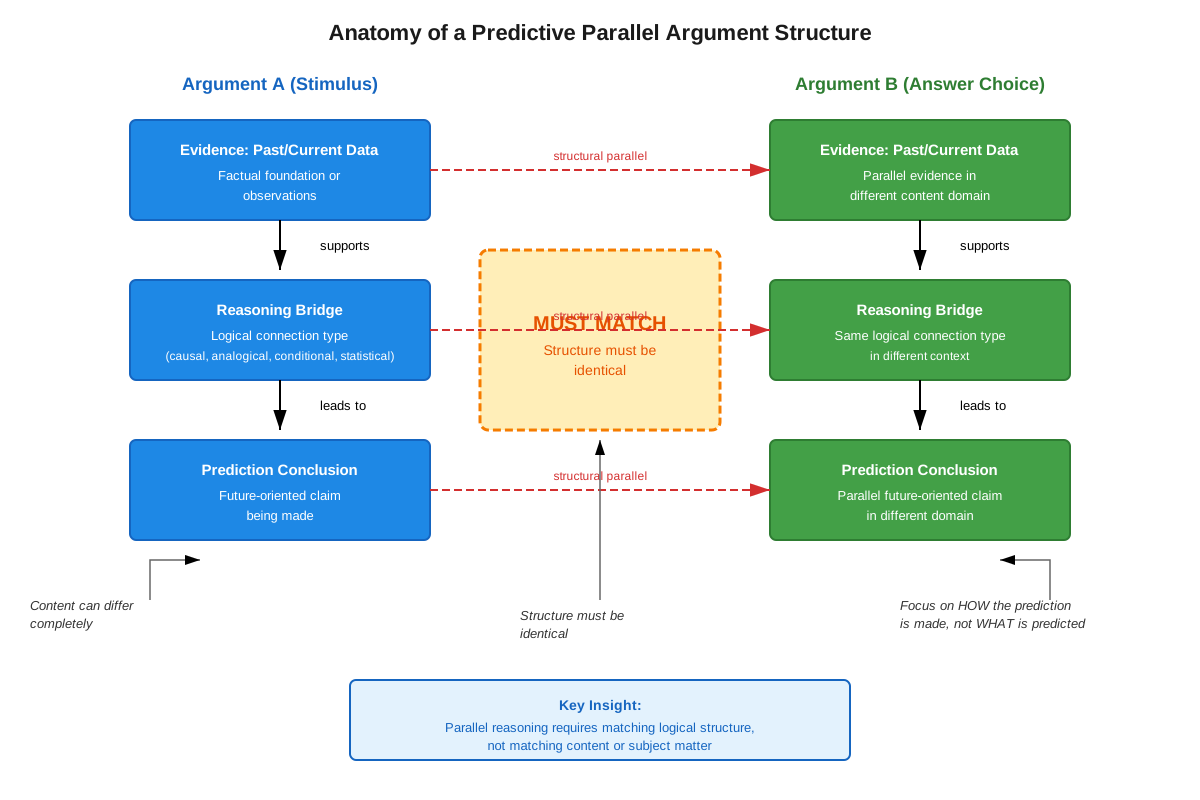
Predictive parallel arguments share a common architecture: they move from evidence about current conditions, past patterns, or established relationships to a conclusion about what will happen, what is likely to occur, or what should be expected. The key structural elements include:
- Evidence base: Information about past events, current conditions, trends, patterns, or established relationships
- Inferential bridge: The logical connection that justifies moving from the evidence to the prediction (often implicit)
- Predictive conclusion: A claim about a future state, outcome, or event
The strength and nature of the inferential bridge varies significantly across different predictive argument types, and matching this bridge correctly is crucial for identifying genuine parallels.
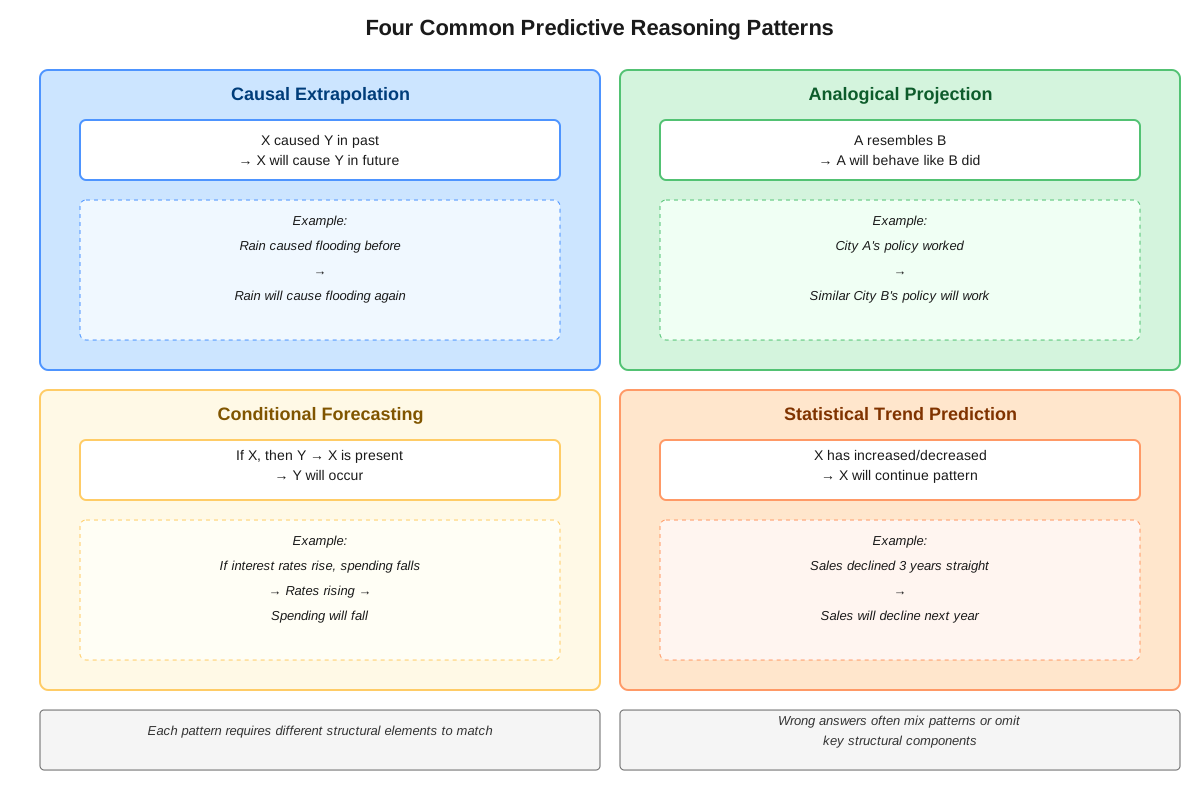
Types of Predictive Reasoning Patterns
Pattern-based predictions extrapolate from observed regularities. The structure follows: "X has occurred in circumstances A, B, and C; circumstances similar to A, B, and C are present now; therefore, X will occur again." For example: "Every time interest rates have risen above 5%, housing sales have declined within six months. Interest rates just exceeded 5%, so housing sales will decline soon."
Causal predictions rely on identified cause-effect relationships. The structure follows: "X causes Y; X is present (or will be present); therefore, Y will occur." For example: "Excessive rainfall causes flooding in this valley. The forecast predicts excessive rainfall, so flooding will occur."
Conditional predictions use if-then relationships to project outcomes. The structure follows: "If X, then Y; X will occur (or is occurring); therefore, Y will occur." For example: "If the legislation passes, taxes will increase. The legislation will pass, so taxes will increase."
Analogical predictions draw parallels between situations. The structure follows: "Situation A led to outcome X; Situation B is relevantly similar to Situation A; therefore, Situation B will lead to outcome X." For example: "When Company A implemented flexible scheduling, productivity increased. Company B is implementing flexible scheduling and is similar to Company A in relevant ways, so Company B's productivity will increase."
Trend-based predictions project current trajectories into the future. The structure follows: "X has been changing in direction D at rate R; nothing will interrupt this change; therefore, X will continue changing in direction D." For example: "The city's population has grown 3% annually for five years. This growth will continue, so the population will be 15% larger in five years."
Distinguishing Content from Structure
The most critical skill for lsat predictive parallel arguments is separating superficial content from underlying structure. Two arguments can discuss completely different topics yet share identical logical structures. Consider:
| Argument 1 | Argument 2 | Shared Structure |
|---|---|---|
| "Whenever unemployment rises above 6%, consumer spending falls. Unemployment just hit 6.5%, so consumer spending will fall." | "Whenever this plant receives less than 4 hours of sunlight, its leaves droop. The plant is now receiving only 3 hours of sunlight, so its leaves will droop." | Pattern-based prediction: Past correlation → Current condition matches → Future outcome predicted |
The content differs entirely (economics vs. botany), but the logical structure is identical: both identify a reliable pattern, note that current conditions match the pattern's trigger, and predict the pattern's usual outcome will occur.
Structural Mismatches to Recognize
Several common structural differences disqualify answer choices as genuine parallels:
Temporal direction mismatches: The stimulus predicts forward while an answer choice explains backward (from effect to cause rather than cause to effect).
Certainty level mismatches: The stimulus makes a definite prediction ("will occur") while an answer choice makes a probabilistic claim ("might occur" or "is likely").
Evidence type mismatches: The stimulus relies on statistical patterns while an answer choice relies on expert testimony or theoretical principles.
Scope mismatches: The stimulus makes a specific prediction about a particular case while an answer choice makes a general claim about all cases of a type.
Conditional structure mismatches: The stimulus affirms the antecedent (If A then B; A; therefore B) while an answer choice denies the consequent (If A then B; not-B; therefore not-A) or commits a conditional reasoning error.
Flawed Predictive Parallel Arguments
When questions ask for parallel flaws in predictive reasoning, common error patterns include:
Hasty generalization: Predicting based on insufficient sample size or unrepresentative examples.
False causation: Assuming correlation implies causation and predicting based on this assumption.
Overlooking alternative explanations: Predicting outcome X while ignoring that factors other than the cited cause could produce X.
Inappropriate analogy: Predicting based on similarity between situations that differ in relevant respects.
Temporal confusion: Reversing cause and effect or confusing correlation with temporal sequence.
Concept Relationships
The concepts within predictive parallel arguments form an interconnected system. Understanding argument structure (premises and conclusions) provides the foundation for recognizing predictive reasoning patterns (pattern-based, causal, conditional, analogical, and trend-based). These patterns represent different ways of constructing the inferential bridge between evidence and prediction. The ability to distinguish content from structure depends on first identifying which pattern an argument employs, then abstracting that pattern from its specific subject matter.
This abstraction process connects directly to structural mismatch recognition—once the stimulus argument's structure is abstracted, each answer choice can be evaluated for structural alignment. The various types of mismatches (temporal, certainty, evidence type, scope, and conditional) represent specific ways that answer choices can fail to parallel the stimulus structure.
For flawed predictive arguments, the relationship flows from understanding sound predictive patterns to recognizing specific ways those patterns can be executed incorrectly. Each flaw type represents a breakdown in the inferential bridge between evidence and prediction.
The relationship to prerequisite knowledge operates as follows: Basic argument structure → enables identification of → Predictive reasoning patterns → which require → Conditional and causal reasoning → to properly abstract → Structural parallels → while avoiding → Content-based distractors.
Quick check — test yourself on Predictive parallel arguments so far.
Try Flashcards →High-Yield Facts
⭐ Predictive parallel arguments require matching logical structure, not content similarity—arguments about completely different topics can be perfect parallels if their reasoning patterns match.
⭐ The inferential bridge (how evidence connects to prediction) must match exactly—pattern-based predictions don't parallel causal predictions even if both make predictions.
⭐ Certainty level must match—"will definitely occur" predictions don't parallel "might occur" or "probably will occur" predictions.
⭐ Temporal direction matters critically—forward predictions (cause to effect) don't parallel backward explanations (effect to cause).
⭐ The type of evidence cited must parallel—statistical patterns, expert opinions, theoretical principles, and analogies represent different evidence types that must match.
- Conditional structure must be preserved—affirming the antecedent doesn't parallel denying the consequent, even though both involve conditional reasoning.
- Scope must align—predictions about specific instances don't parallel generalizations about all instances of a type.
- In parallel flaw questions, both the structure and the specific flaw type must match—a hasty generalization doesn't parallel a false causation error.
- Multiple predictive elements can appear in a single argument—complex arguments might combine pattern recognition with causal reasoning, and all elements must parallel.
- Negations matter—predicting something will occur doesn't parallel predicting something won't occur, even if the reasoning pattern is otherwise identical.
- The number of premises should generally match—arguments with multiple independent lines of evidence don't typically parallel arguments with single premises.
Common Misconceptions
Misconception: If two arguments discuss similar topics, they must be parallel. → Correction: Topic similarity is irrelevant to structural parallelism; two arguments about economics might have completely different structures, while an argument about economics and one about biology might be perfect structural parallels.
Misconception: All predictive arguments have the same structure. → Correction: Predictive arguments employ diverse reasoning patterns (pattern-based, causal, conditional, analogical, trend-based), and these different patterns are not structurally parallel to each other.
Misconception: If both arguments make predictions and both are valid, they must be parallel. → Correction: Valid arguments can employ entirely different reasoning structures; validity concerns whether the conclusion follows from the premises, while parallelism concerns whether the logical structure matches.
Misconception: Parallel flaw questions just require finding another flawed argument. → Correction: The specific type of flaw must match, not just the presence of some flaw; a hasty generalization doesn't parallel a false causation error even though both are flawed.
Misconception: Longer answer choices are more likely to be correct parallels because they're more detailed. → Correction: Length is irrelevant to structural parallelism; concise arguments can perfectly parallel longer arguments if the logical structure matches, and verbose arguments can fail to parallel despite extensive detail.
Misconception: If an answer choice reaches the same conclusion as the stimulus, it must be parallel. → Correction: Reaching the same conclusion is neither necessary nor sufficient for parallelism; different conclusions can be reached through identical reasoning structures (making them parallel), while the same conclusion can be reached through different structures (making them non-parallel).
Worked Examples
Example 1: Pattern-Based Prediction
Stimulus: "Historical data shows that whenever this region experiences a drought lasting more than three months, agricultural yields decline by at least 20% the following year. The region is currently in its fourth month of drought conditions. Therefore, agricultural yields will decline by at least 20% next year."
Analysis: This argument employs a pattern-based predictive structure:
- Evidence: Historical pattern (drought > 3 months → 20% yield decline)
- Current condition: The pattern's trigger is present (currently in month 4 of drought)
- Prediction: The pattern's usual outcome will occur (yields will decline 20%)
The reasoning moves from observed regularity to current circumstances matching that regularity to prediction of the regular outcome.
Correct Parallel: "Studies indicate that whenever students spend less than 10 hours per week on homework, their test scores drop by at least 15 points. Maria is currently spending only 8 hours per week on homework. Therefore, Maria's test scores will drop by at least 15 points."
Why it parallels:
- Both cite historical/empirical patterns (drought→yield decline / homework→test scores)
- Both note current conditions match the pattern's trigger (4 months drought / 8 hours homework)
- Both predict the pattern's typical outcome (20% decline / 15-point drop)
- Both use definite predictions ("will decline" / "will drop")
- Both specify quantitative thresholds (3 months, 20% / 10 hours, 15 points)
Incorrect Answer: "Research shows that excessive screen time can harm children's development. This child watches six hours of television daily. Therefore, this child's development might be harmed."
Why it fails: Changes certainty level from definite ("will decline") to possible ("might be harmed"), and uses vaguer evidence ("can harm" vs. specific historical pattern with quantified outcomes).
Example 2: Flawed Analogical Prediction
Stimulus: "When Company X implemented a four-day workweek, employee satisfaction increased dramatically. Company Y is planning to implement a four-day workweek. Therefore, Company Y will also see dramatically increased employee satisfaction."
Analysis: This argument uses analogical prediction with a critical flaw:
- Evidence: Outcome in one case (Company X: 4-day week → satisfaction increase)
- Similarity claim: Another case shares one feature (Company Y: also implementing 4-day week)
- Prediction: Same outcome will occur (Company Y: satisfaction will increase)
Flaw: Assumes that because two situations share one feature (four-day workweek), they're similar in all relevant respects, ignoring potential differences (company culture, industry, employee demographics, compensation structure, etc.) that might affect the outcome.
Correct Parallel: "When City A installed bike lanes on major streets, traffic congestion decreased significantly. City B is planning to install bike lanes on major streets. Therefore, City B will also see significantly decreased traffic congestion."
Why it parallels the flaw:
- Both cite a single case as evidence (Company X / City A)
- Both note one shared feature (four-day week / bike lanes)
- Both predict identical outcomes (satisfaction increase / congestion decrease)
- Both commit the same flaw: assuming one shared feature makes situations relevantly similar while ignoring potential differences (Company Y might have different culture / City B might have different traffic patterns, public transit, population density, etc.)
Incorrect Answer: "Studies of 500 companies show that flexible scheduling improves retention rates. Company Z is implementing flexible scheduling. Therefore, Company Z will see improved retention."
Why it fails: Uses statistical evidence from many cases rather than a single analogical case, making this a pattern-based prediction rather than a flawed analogical prediction. The reasoning structure differs fundamentally even though both make predictions about workplace policies.
Exam Strategy
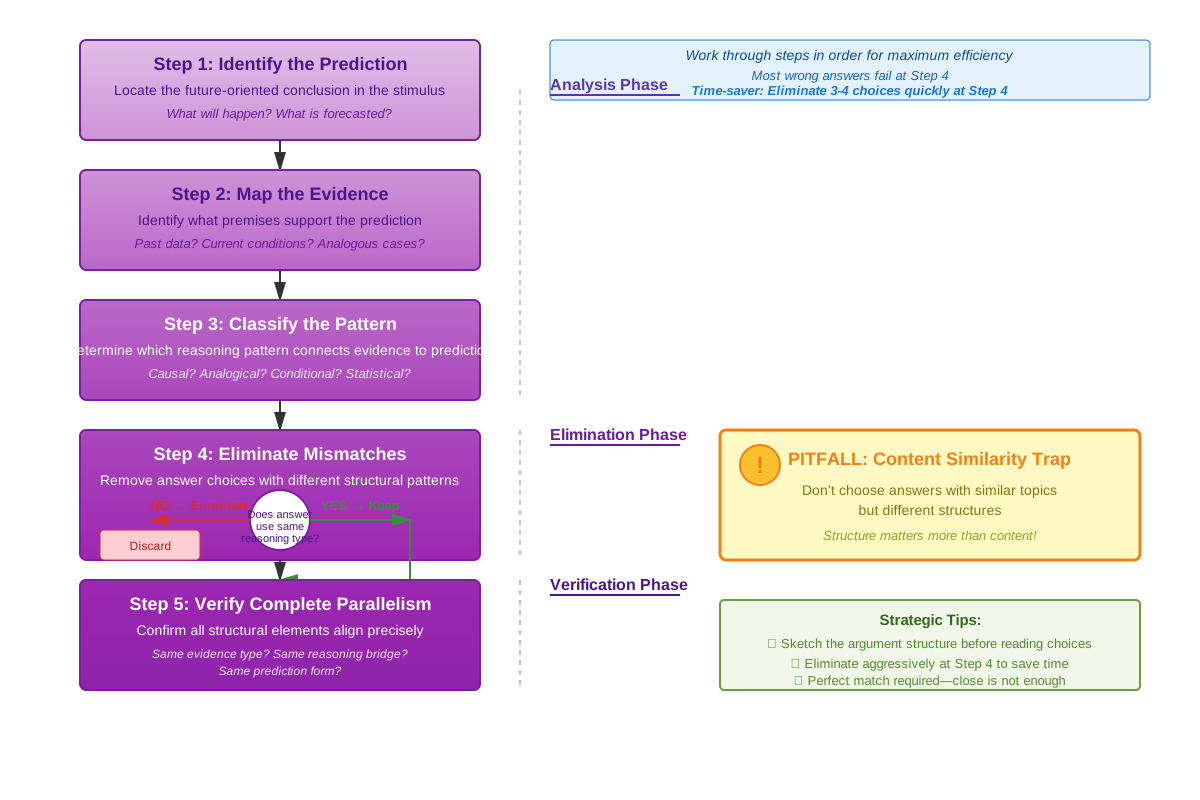
When approaching predictive parallel arguments on the LSAT, employ this systematic process:
Step 1: Identify the predictive conclusion (usually signaled by future-tense verbs: "will occur," "will increase," or modal verbs: "should happen," "is likely to"). Underline or mentally note this conclusion.
Step 2: Map the evidence structure. Ask: What type of evidence supports this prediction? Is it a historical pattern, a causal relationship, a conditional statement, an analogy, or a trend? Write a brief structural note (e.g., "pattern → current match → prediction").
Step 3: Note structural details:
- Certainty level (definite vs. probable vs. possible)
- Quantitative specifics (percentages, thresholds, timeframes)
- Number of premises (single vs. multiple lines of evidence)
- Any conditional or causal language
Step 4: Abstract the structure from content. Mentally rephrase using variables: "Whenever X occurs, Y follows. X is occurring. Therefore, Y will follow."
Step 5: Evaluate answer choices systematically:
- Eliminate choices with wrong temporal direction (explaining past rather than predicting future)
- Eliminate choices with mismatched certainty levels
- Eliminate choices with different evidence types
- Check remaining choices for complete structural alignment
Exam Tip: Don't be distracted by answer choices that discuss similar topics to the stimulus. The LSAT deliberately includes wrong answers with content similarity but structural differences. Conversely, correct answers often discuss completely unrelated topics.
Trigger words for predictive arguments:
- Future indicators: "will," "shall," "is going to," "is likely to," "should," "can be expected to"
- Pattern language: "whenever," "every time," "historically," "typically," "usually," "in the past"
- Causal language: "causes," "leads to," "results in," "produces," "brings about"
- Conditional language: "if...then," "provided that," "assuming that," "given that"
- Analogical language: "similarly," "likewise," "just as," "in the same way"
Time allocation: Spend 30-40 seconds analyzing the stimulus structure, then 15-20 seconds per answer choice. If you've correctly abstracted the structure, wrong answers should be eliminable quickly based on obvious mismatches.
Process of elimination priorities:
- First pass: Eliminate answers with wrong temporal direction or grossly different structures
- Second pass: Eliminate answers with certainty level mismatches
- Third pass: Check remaining answers for complete structural alignment, including all details
Memory Techniques
PREDICT mnemonic for analyzing predictive argument structure:
- Premises: What evidence is provided?
- Reasoning type: Pattern, Causal, Conditional, Analogical, or Trend?
- Evidence specifics: Quantitative details, thresholds, timeframes?
- Direction: Forward prediction (not backward explanation)?
- Inferential bridge: How does evidence connect to conclusion?
- Certainty: Definite, probable, or possible?
- Temporal markers: Future-tense verbs, modal verbs?
Visualization strategy: Picture the argument as a bridge. The evidence is the foundation on one side (present/past), the prediction is the destination on the other side (future), and the reasoning pattern is the bridge structure connecting them. Parallel arguments must have identically constructed bridges, even if the landscapes (content) differ completely.
The "Content Blindfold" technique: When checking for parallels, mentally replace all content words with generic placeholders (X, Y, Z, A, B, C). If the arguments still match when reduced to pure structure, they're genuine parallels.
MATCH acronym for parallel flaw questions:
- Method: Same reasoning pattern?
- Assumptions: Same unstated assumptions?
- Type of flaw: Same specific error?
- Conclusion strength: Same level of certainty?
- How many flaws: Single flaw in both, or multiple?
Summary
Predictive parallel arguments test the ability to recognize identical logical structures across arguments that make predictions about future events or outcomes, regardless of content differences. Success requires distinguishing between five main predictive reasoning patterns—pattern-based, causal, conditional, analogical, and trend-based—and recognizing that genuine parallels must match not just in making predictions, but in the specific type of inferential bridge connecting evidence to prediction. The critical skill is abstracting logical structure from content, recognizing that arguments about completely different topics can be perfect structural parallels while arguments about similar topics can have entirely different structures. Effective approach involves systematically mapping the stimulus argument's structure, noting key details like certainty level and evidence type, then evaluating answer choices for complete structural alignment while avoiding content-based distractors. For parallel flaw questions, both the reasoning structure and the specific type of flaw must match.
Key Takeaways
- Predictive parallel arguments require matching logical structure, not content—topic similarity is irrelevant and often deliberately misleading
- Five main predictive patterns exist (pattern-based, causal, conditional, analogical, trend-based), and these different patterns don't parallel each other
- The inferential bridge connecting evidence to prediction must match exactly, including certainty level, temporal direction, and evidence type
- Systematic structural analysis (identifying conclusion, mapping evidence, abstracting structure) prevents content-based distraction
- In parallel flaw questions, both the reasoning structure and the specific flaw type must match
- Temporal direction matters critically—forward predictions don't parallel backward explanations
- Quantitative details, scope, and conditional structure must align for genuine parallelism
Related Topics
Parallel Flaw Questions: Building on predictive parallel arguments, these questions require identifying not just structural parallels but matching flawed reasoning patterns, demanding recognition of specific error types like hasty generalization, false causation, and inappropriate analogy.
Sufficient Assumption Questions: These often involve predictive reasoning where the correct answer provides the missing link that would make a prediction follow logically from the evidence, requiring understanding of what makes predictive inferences valid.
Strengthen/Weaken Questions with Predictions: Many strengthen and weaken questions involve predictive arguments, and understanding predictive reasoning structures helps identify what evidence would support or undermine such predictions.
Method of Reasoning Questions: These sometimes ask test-takers to describe how a predictive argument proceeds, requiring the same structural analysis skills used in parallel reasoning questions.
Mastering predictive parallel arguments provides essential foundation for these related question types and develops the abstract reasoning skills central to LSAT success.
Practice CTA
Now that you've mastered the conceptual framework for predictive parallel arguments, it's time to cement your understanding through active practice. Attempt the practice questions to apply these concepts to actual LSAT-style problems, and use the flashcards to reinforce the key distinctions between different predictive reasoning patterns. Remember: recognizing these structures becomes faster and more intuitive with deliberate practice. Each question you analyze strengthens your pattern-recognition abilities and builds the confidence needed for test-day success. Your investment in mastering this high-yield topic will pay dividends across multiple questions on every LSAT Logical Reasoning section.
Sign up free to keep reading
Create a free AnvayaPrep account to finish this LSAT guide on Predictive parallel arguments — plus flashcards and practice questions.