Overview
Reversal parallel flaw represents one of the most sophisticated and frequently tested patterns in LSAT logical reasoning questions. This concept appears when an argument commits a logical error by reversing a conditional relationship—confusing sufficient and necessary conditions—and test-takers must identify another argument that commits the exact same structural error. Understanding reversal parallel flaws requires mastery of conditional logic, the ability to abstract argument structures from their content, and the skill to match flawed reasoning patterns across different contexts. These questions typically appear in "parallel flaw" question types, where the stimulus presents a flawed argument and answer choices contain various arguments, only one of which mirrors the exact logical structure and flaw of the original.
The reversal parallel flaw is essential for LSAT success because it combines multiple high-level reasoning skills that the exam tests extensively. First, it requires recognizing conditional statements and their proper logical relationships. Second, it demands the ability to identify when an argument illegitimately reverses these relationships. Third, it necessitates abstracting the logical structure from specific content to match patterns across different subject matters. This multi-layered cognitive task separates high scorers from average performers, making it a critical area for focused study.
Within the broader landscape of parallel reasoning questions, reversal parallel flaws occupy a central position. They connect directly to fundamental conditional logic concepts, formal fallacies, and argument structure analysis. Mastering this topic strengthens performance not only on parallel flaw questions but also on assumption questions, strengthen/weaken questions, and necessary assumption questions—all of which frequently involve conditional reasoning. The reversal flaw is particularly insidious because it often appears superficially logical, making it an ideal tool for the LSAT to distinguish between test-takers who truly understand logical structure from those who rely on intuitive but imprecise reasoning.
Learning Objectives
- [ ] Identify how Reversal parallel flaw appears in LSAT questions
- [ ] Explain the reasoning pattern behind Reversal parallel flaw
- [ ] Apply Reversal parallel flaw to solve LSAT-style problems accurately
- [ ] Distinguish reversal flaws from other common conditional logic errors (negation, contrapositive confusion)
- [ ] Abstract the logical structure of arguments containing reversal flaws independent of content
- [ ] Predict common wrong answer patterns in parallel flaw questions involving reversals
- [ ] Recognize trigger language that signals potential reversal flaws in argument stimuli
Prerequisites
- Conditional logic fundamentals: Understanding "if-then" statements, sufficient and necessary conditions, and proper symbolic notation is essential because reversal flaws specifically involve mishandling these relationships.
- Contrapositive formation: Knowing how to correctly form contrapositives (If A→B, then ~B→~A) is necessary to distinguish legitimate logical moves from reversal errors.
- Argument structure analysis: The ability to identify premises, conclusions, and logical connections is required because parallel flaw questions demand matching structural patterns, not content.
- Basic formal fallacies: Familiarity with common logical errors provides context for understanding why reversals constitute flawed reasoning.
- Parallel reasoning question types: General understanding of how parallel questions work helps focus specifically on the reversal flaw pattern within this broader category.
Why This Topic Matters
Reversal parallel flaws appear with remarkable frequency on the LSAT, making them a high-yield study investment. Approximately 15-20% of parallel flaw questions involve reversal errors as the primary flaw being tested. Additionally, reversal flaws appear in other question types—particularly flaw questions, assumption questions, and strengthen/weaken questions—meaning that mastering this pattern provides benefits across multiple question categories. The LSAT consistently tests whether students can recognize when an argument incorrectly assumes that because A is sufficient for B, B must be sufficient for A, or when an argument confuses necessary conditions with sufficient ones.
In real-world applications, understanding reversal flaws protects against common reasoning errors in legal analysis, policy evaluation, and everyday decision-making. Legal reasoning frequently involves conditional relationships: "If the defendant had malicious intent, then they are guilty of first-degree murder" does not mean "If guilty of first-degree murder, then the defendant had malicious intent" (other mental states might also lead to that verdict). Policy arguments often commit reversal flaws: "If we implement this education reform, test scores will improve" gets illegitimately reversed to "If test scores improved, we must have implemented this reform," ignoring other possible causes.
On the LSAT, reversal parallel flaws most commonly appear in parallel flaw questions (question stem: "The flawed reasoning in which one of the following is most similar to that in the argument above?"). They also appear in flaw identification questions, where recognizing the reversal helps select the correct answer describing the error. Less frequently, they appear in assumption questions where the argument depends on treating a reversal as valid. Understanding this pattern enables test-takers to quickly eliminate wrong answers and confidently select correct ones, often saving 30-45 seconds per question—time that proves invaluable on this timed exam.
Core Concepts
The Basic Structure of Reversal Flaws
A reversal parallel flaw occurs when an argument establishes a conditional relationship in one direction (A→B) but then treats the reverse relationship (B→A) as if it were equally valid without justification. The fundamental error involves confusing the directionality of logical relationships. In conditional logic, if A is sufficient for B, this means whenever A occurs, B must occur. However, this tells us nothing definitive about what happens when B occurs—B might result from A, or from C, D, or numerous other causes.
The reversal flaw takes several common forms:
- Sufficient-to-Necessary Reversal: The argument states that A is sufficient for B, then concludes that A is necessary for B
- Necessary-to-Sufficient Reversal: The argument states that A is necessary for B, then concludes that A is sufficient for B
- Simple Conditional Reversal: The argument establishes "If A, then B" and later treats this as "If B, then A"
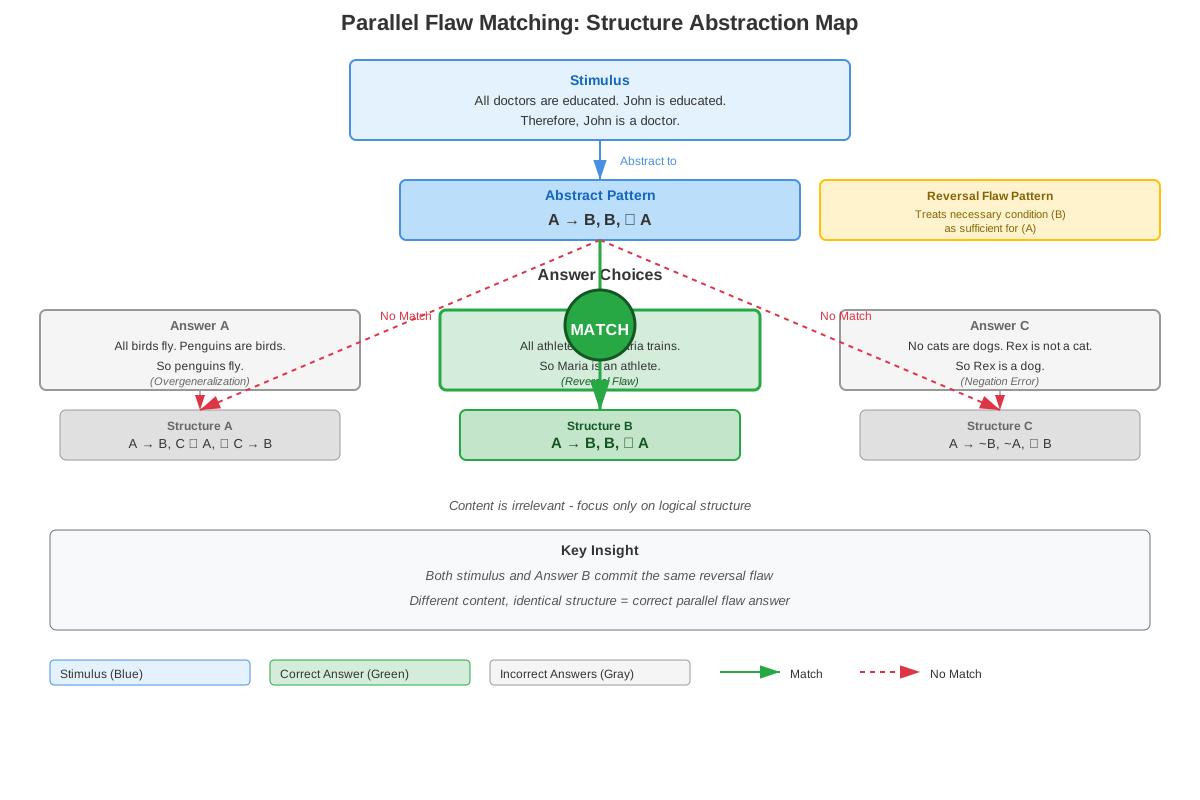
Consider this basic example: "All doctors are college graduates. Therefore, all college graduates are doctors." The premise establishes: Doctor → College Graduate. The conclusion illegitimately reverses this to: College Graduate → Doctor. This reversal is obviously flawed when stated so plainly, but the LSAT disguises these errors through complex language, abstract concepts, and embedded clauses.
Symbolic Representation and Pattern Recognition
Understanding reversal flaws requires facility with symbolic representation. When an argument commits a reversal flaw, the logical structure follows this pattern:
Premise: A → B
Conclusion: B → A (or equivalent)
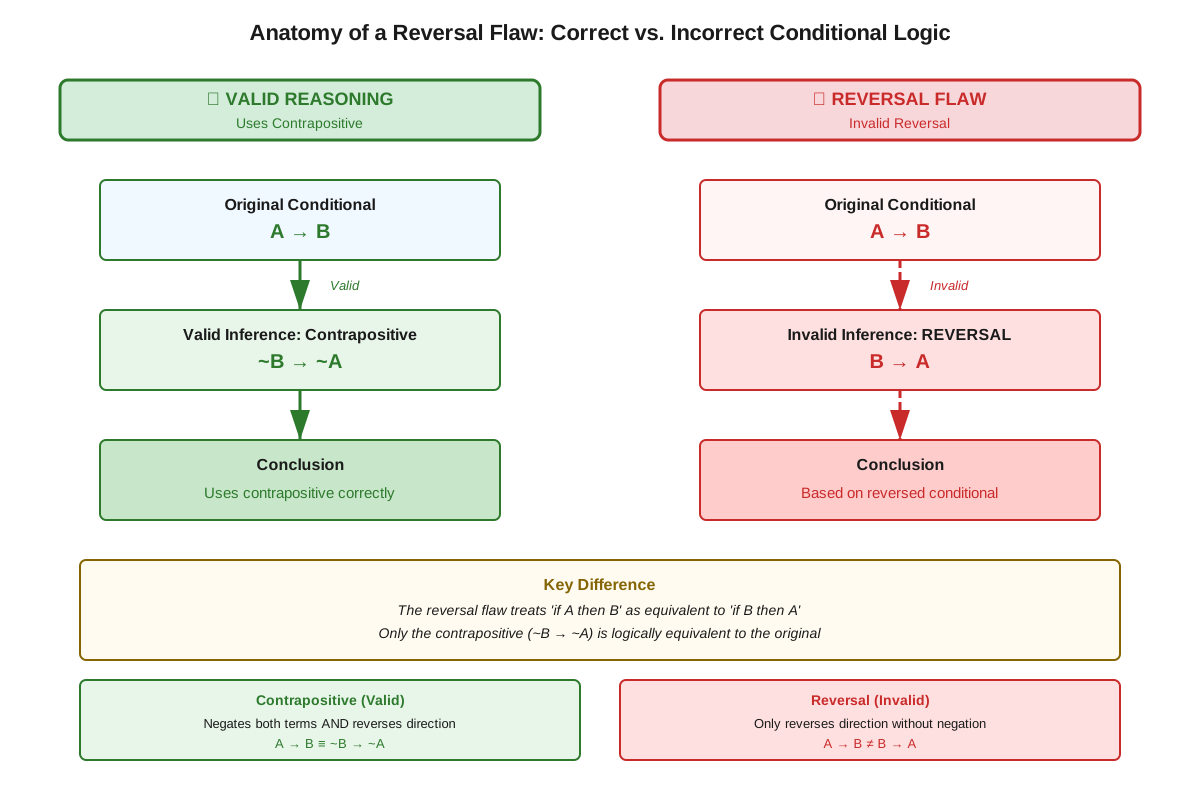
This differs from valid logical operations. The valid contrapositive would be: ~B → ~A. The reversal flaw confuses the original conditional with its converse (the reverse), which is not logically equivalent.
| Logical Operation | Form | Validity |
|---|---|---|
| Original Conditional | A → B | Given as true |
| Contrapositive | ~B → ~A | Valid (logically equivalent) |
| Converse (Reversal) | B → A | Invalid (commits reversal flaw) |
| Inverse | ~A → ~B | Invalid (different error) |
Recognizing this pattern requires abstracting from content. Whether the argument discusses "doctors and college graduates," "rain and wet streets," or "economic policies and inflation," the structural pattern remains identical. The LSAT tests whether students can see past surface content to identify underlying logical architecture.
Necessary vs. Sufficient Condition Reversals
A particularly common and challenging variant involves confusing necessary and sufficient conditions. Understanding the distinction is crucial:
- Sufficient condition: If present, guarantees the result (A is sufficient for B means A → B)
- Necessary condition: Must be present for the result, but doesn't guarantee it (A is necessary for B means B → A, or equivalently, ~A → ~B)
The reversal flaw occurs when arguments treat necessary conditions as if they were sufficient, or vice versa. Example: "Oxygen is necessary for fire. There is oxygen present. Therefore, there will be fire." This argument treats a necessary condition (oxygen) as if it were sufficient, reversing the proper logical relationship. The correct conditional is: Fire → Oxygen. The argument illegitimately reverses this to: Oxygen → Fire.
Similarly, arguments may establish that something is sufficient and then conclude it is necessary: "Studying hard is sufficient for passing the exam. Therefore, studying hard is necessary for passing the exam." This reverses Studying Hard → Passing into Passing → Studying Hard, ignoring that other factors (natural aptitude, prior knowledge) might also be sufficient for passing.
Language Triggers and Indicator Words
The LSAT uses specific language patterns to signal conditional relationships that may be reversed. Recognizing these triggers helps identify potential reversal flaws:
Sufficient Condition Indicators (what comes after is sufficient):
- If, when, whenever, all, any, every, each
- Example: "If it rains" means Rain → [consequence]
Necessary Condition Indicators (what comes after is necessary):
- Only, only if, must, required, unless, until, without
- Example: "Only if you study" means [result] → Study
Arguments committing reversal flaws often use these indicators in premises but then draw conclusions that flip the relationship. Watch for premises using "if" followed by conclusions using "only if" with the same terms—this often signals a reversal.
Parallel Flaw Matching Strategy
When a stimulus presents an argument with a reversal flaw, the correct answer must contain an argument with the identical structural flaw. This requires a systematic approach:
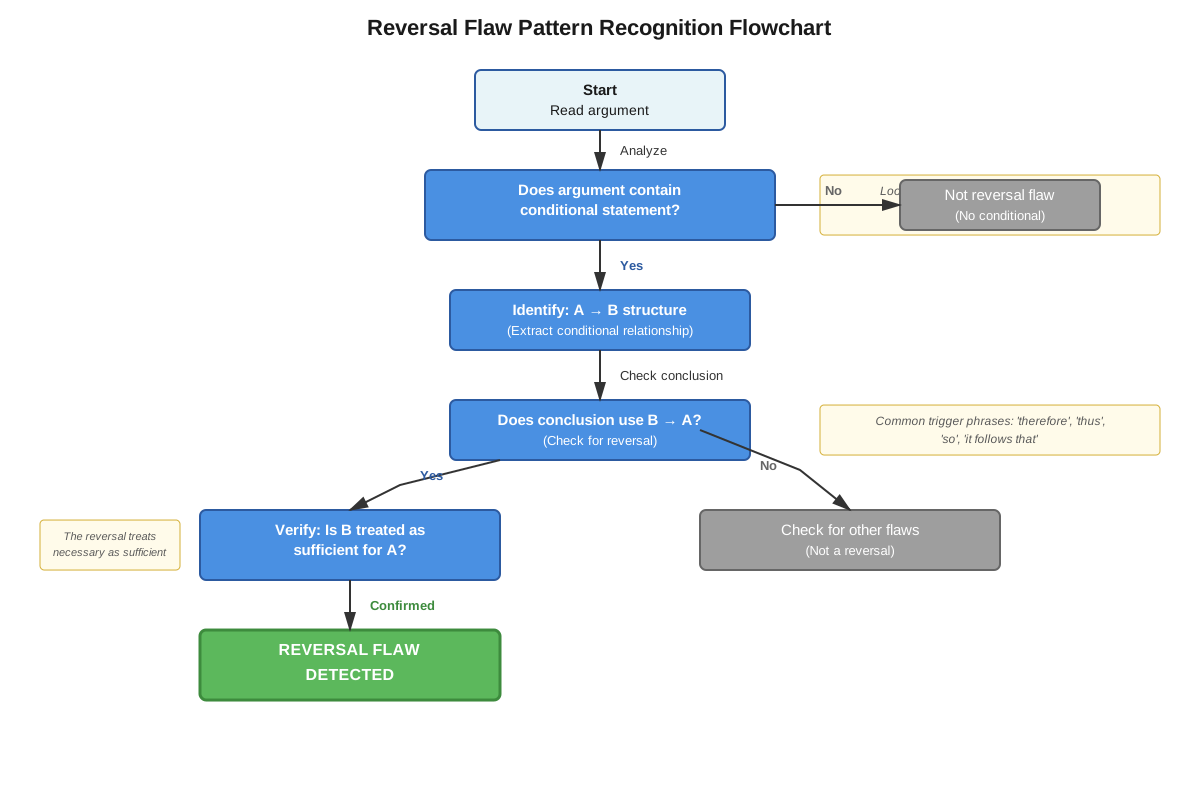
- Identify the conditional relationship in the stimulus: Determine what the premise actually establishes (A→B)
- Identify the conclusion: Determine what the argument concludes (often B→A)
- Confirm the reversal flaw: Verify that the conclusion reverses the premise's conditional
- Abstract the structure: Remove all content, leaving only the logical skeleton
- Match the structure: Find the answer choice with the same skeleton
The correct answer will have the same number of conditional statements, the same reversal pattern, and the same relationship between premises and conclusion. Wrong answers typically commit different flaws (negation errors, scope shifts, causal confusion) or present valid reasoning.
Common Variations and Disguises
The LSAT disguises reversal flaws through several techniques:
Embedded Conditionals: The conditional relationship appears within a complex sentence rather than as a simple "if-then" statement. Example: "The presence of certain bacteria indicates contamination" establishes Bacteria → Contamination, but this might be reversed in a conclusion.
Implicit Conditionals: The conditional relationship is implied rather than explicitly stated. Example: "Only experienced pilots can fly this aircraft" means Flying This Aircraft → Experienced, but an argument might reverse this implicitly.
Multiple Conditionals: The argument chains several conditional statements, then reverses one link in the chain. Example: A→B→C in premises, but conclusion treats B→A or C→B.
Quantifier Confusion: Using "all," "some," or "most" to obscure the reversal. Example: "All successful entrepreneurs take risks" (Successful Entrepreneur → Takes Risks) reversed to "All risk-takers are successful entrepreneurs" (Takes Risks → Successful Entrepreneur).
Concept Relationships
The reversal parallel flaw concept sits at the intersection of multiple logical reasoning skills. At its foundation lies conditional logic, which provides the framework for understanding sufficient and necessary conditions. Without mastery of basic conditional statements, recognizing reversals becomes nearly impossible. The reversal flaw specifically represents one type of formal fallacy—an error in logical structure rather than content.
Within the broader category of parallel reasoning questions, reversal flaws represent one specific pattern among many. Other parallel flaw patterns include causal reasoning errors, sampling problems, and equivocation. However, reversal flaws are among the most common, making them a priority for study.
The relationship map flows as follows:
Conditional Logic → enables recognition of → Sufficient/Necessary Conditions → which can be mishandled through → Reversal Flaws → which appear in → Parallel Flaw Questions → requiring → Structural Abstraction → to match → Flawed Reasoning Patterns
Additionally, reversal flaws connect to contrapositive formation because students must distinguish legitimate logical operations (forming contrapositives) from illegitimate ones (reversing conditionals). They also relate to assumption questions because arguments committing reversal flaws implicitly assume that the reversed conditional is valid—identifying this assumption helps answer those questions.
Understanding reversal flaws enhances performance on flaw questions (where the task is describing the error), strengthen/weaken questions (where understanding the flaw helps identify what would fix or worsen the argument), and necessary assumption questions (where the argument depends on the reversal being valid).
Quick check — test yourself on Reversal parallel flaw so far.
Try Flashcards →High-Yield Facts
⭐ A reversal flaw occurs when an argument establishes A→B but concludes B→A without justification
⭐ The converse (reversal) of a conditional statement is NOT logically equivalent to the original statement
⭐ Necessary conditions can be reversed: if A is necessary for B, then B→A (this is correct, not a flaw)
⭐ Sufficient conditions cannot be reversed: if A is sufficient for B (A→B), we cannot conclude B→A
⭐ In parallel flaw questions, the correct answer must commit the exact same structural error as the stimulus
- The contrapositive (~B→~A) is the only valid transformation of A→B; the converse (B→A) is invalid
- "Only if" introduces a necessary condition: "A only if B" means A→B (B is necessary for A)
- "If" introduces a sufficient condition: "If A then B" means A→B (A is sufficient for B)
- Wrong answers in parallel flaw questions often commit different flaws or present valid reasoning
- Reversal flaws appear in approximately 15-20% of parallel flaw questions on the LSAT
- Content is irrelevant in parallel reasoning—only logical structure matters for matching
- Multiple conditionals in a chain can be reversed at any link, creating the same fundamental error
- Implicit conditionals (not stated as "if-then") can still be reversed, creating the same flaw
- Recognizing reversal flaws requires abstracting from specific content to see underlying structure
- Time-efficient test-takers symbolize the stimulus conditional before evaluating answer choices
Common Misconceptions
Misconception: If an argument reverses a conditional, it must be committing a reversal flaw.
Correction: Reversing a necessary condition statement is actually correct. If the premise states "A is necessary for B" (meaning B→A), then concluding A→B would be the reversal flaw. The direction matters based on what type of condition is established.
Misconception: The contrapositive and the converse are the same thing.
Correction: The contrapositive (~B→~A) is logically equivalent to the original (A→B) and is always valid. The converse (B→A) is the reversal and is not logically equivalent—it may be true or false independently of the original statement.
Misconception: In parallel flaw questions, the correct answer must discuss similar content to the stimulus.
Correction: Content is completely irrelevant in parallel reasoning questions. An argument about medicine can parallel an argument about economics if they share the same logical structure. Focus exclusively on structure, not subject matter.
Misconception: If both the stimulus and an answer choice are flawed, that answer choice must be correct.
Correction: Both must commit the exact same flaw with the same structure. An answer choice might be flawed in a different way (causal error, sampling problem, etc.) and would be incorrect even though it contains flawed reasoning.
Misconception: Reversal flaws only appear in formal "if-then" statements.
Correction: Conditional relationships can be expressed in many ways without using "if-then" language. Statements like "All A are B," "A requires B," "B is essential for A," and "Whenever A, then B" all express conditional relationships that can be reversed incorrectly.
Misconception: The correct answer in a parallel flaw question must have the same number of sentences as the stimulus.
Correction: Sentence count is irrelevant. What matters is the number and type of logical moves (premises, intermediate conclusions, final conclusions) and whether the same structural flaw occurs.
Misconception: If an argument seems obviously wrong, it must be committing a reversal flaw.
Correction: Arguments can be flawed in many ways. An obviously wrong argument might commit a scope shift, causal confusion, sampling error, or other fallacy. Identify the specific structural error rather than assuming it's a reversal.
Worked Examples
Example 1: Basic Reversal Flaw
Stimulus: "All members of the chess club are honor students. Keisha is an honor student. Therefore, Keisha must be a member of the chess club."
Analysis:
Step 1 - Identify the conditional in the premise:
"All members of the chess club are honor students" = Chess Club Member → Honor Student
Step 2 - Identify what the conclusion claims:
"Keisha is an honor student, therefore she's in chess club" = Honor Student → Chess Club Member
Step 3 - Recognize the flaw:
The argument reverses the conditional. The premise establishes that chess club membership is sufficient for being an honor student, but the conclusion treats being an honor student as sufficient for chess club membership. This is a classic reversal flaw.
Step 4 - Abstract the structure:
Premise: A → B
Premise: B (about specific case)
Conclusion: A (about specific case)
This is the affirming the consequent fallacy, a type of reversal flaw.
Correct Parallel Answer: "All professional athletes are physically fit. Marcus is physically fit. Therefore, Marcus must be a professional athlete."
This commits the identical flaw: Professional Athlete → Physically Fit (premise), then reverses to Physically Fit → Professional Athlete (conclusion).
Wrong Answer Example: "All professional athletes are physically fit. Marcus is not physically fit. Therefore, Marcus is not a professional athlete."
This is actually valid reasoning (contrapositive), not a flaw. It correctly applies ~B → ~A.
Example 2: Necessary/Sufficient Confusion
Stimulus: "Having a valid passport is necessary for international travel. Chen has a valid passport. Therefore, Chen will engage in international travel."
Analysis:
Step 1 - Identify the conditional:
"Having a valid passport is necessary for international travel" means: International Travel → Valid Passport
Note: "Necessary for" means the condition must be present for the result, so the result points to the necessary condition.
Step 2 - Identify the conclusion:
"Chen has a valid passport, therefore Chen will travel internationally" = Valid Passport → International Travel
Step 3 - Recognize the flaw:
The argument reverses the conditional. The premise establishes that a passport is necessary (but not sufficient) for international travel. The conclusion treats having a passport as sufficient for international travel. This reverses the proper relationship.
Step 4 - Abstract the structure:
Premise: B → A (A is necessary for B)
Premise: A (specific case)
Conclusion: B (specific case)
Correct Parallel Answer: "Oxygen is necessary for combustion. This room contains oxygen. Therefore, combustion will occur in this room."
This commits the identical flaw: Combustion → Oxygen (premise), reversed to Oxygen → Combustion (conclusion).
Wrong Answer Example: "Having a valid passport is necessary for international travel. Chen does not have a valid passport. Therefore, Chen will not engage in international travel."
This is valid reasoning (contrapositive): International Travel → Valid Passport, so ~Valid Passport → ~International Travel. This is correct logic, not a flaw.
Exam Strategy
When approaching parallel flaw questions involving reversals, employ this systematic strategy:
Step 1 - Identify and Symbolize (15-20 seconds): Read the stimulus and immediately identify any conditional relationships. Write down the symbolic form (A→B) on your scratch paper. This external representation prevents mental confusion and provides a reference for evaluating answer choices.
Step 2 - Locate the Flaw (10 seconds): Determine exactly where and how the argument goes wrong. If it's a reversal, note whether it reverses a sufficient condition to necessary, necessary to sufficient, or simply flips a conditional. Write down what the flawed conclusion claims (B→A).
Step 3 - Abstract the Structure (5 seconds): Remove all content from your mental model. Think only in terms of "If X then Y" and "concludes Y then X." This abstraction is crucial because answer choices will use completely different content.
Step 4 - Predict the Pattern (5 seconds): Before reading answer choices, predict what the correct answer must look like structurally. It must have the same number of conditional statements and reverse the same type of relationship.
Step 5 - Eliminate Systematically (30-40 seconds): Evaluate each answer choice:
- Eliminate any answer with valid reasoning (correct contrapositive use, proper conditional logic)
- Eliminate any answer committing a different type of flaw (causal, sampling, equivocation)
- Eliminate any answer with a different structural pattern (different number of premises, different logical moves)
Trigger Words to Watch:
- "Only if" signals necessary conditions—be alert for these being treated as sufficient
- "All," "every," "any" introduce sufficient conditions—watch for reversal in conclusions
- "Must," "required," "necessary" indicate necessary conditions—check if conclusions treat them as sufficient
- "If," "when," "whenever" introduce sufficient conditions—verify conclusions don't reverse them
Time Allocation: Parallel flaw questions deserve 90-120 seconds. They require careful analysis but reward systematic approaches. Don't rush—accuracy matters more than speed on these high-value questions.
Process of Elimination Tips:
- Wrong answers often present valid reasoning—eliminate these first as they're easiest to spot
- Wrong answers may commit different flaws (causal reasoning errors are common distractors)
- Wrong answers may have superficially similar content but different structure
- If stuck between two choices, re-symbolize both and compare directly to your stimulus symbolization
Red Flags for Wrong Answers:
- Answer choice uses contrapositive correctly (this is valid, not flawed)
- Answer choice discusses causation when stimulus discusses conditional relationships
- Answer choice has different number of logical steps than stimulus
- Answer choice conclusion follows validly from its premises
Memory Techniques
Mnemonic for Reversal Flaw Recognition - "CONVERSE FAILS":
- Conditional established
- Original direction noted
- New conclusion examined
- Verify direction flipped
- Eliminate valid reasoning
- Recognize structural match
- Symbolize for clarity
- Evaluate each answer
- Find identical flaw
- Abstract from content
- Identify sufficient/necessary
- Logic structure only
- Select matching pattern
Visualization Strategy: Picture conditional statements as one-way arrows. The reversal flaw is trying to drive the wrong way on a one-way street. When you see A→B, visualize an arrow pointing from A to B. A reversal flaw tries to go backward from B to A on that same arrow—an illegal move.
Acronym for Valid Operations - "ONLY CON":
- Original conditional (A→B) - valid
- Negation of both, reversed (contrapositive: ~B→~A) - valid
- Logical equivalence only for these
- You cannot reverse without negating
CONverse (B→A) - invalid (the reversal flaw)
Memory Palace Technique: Associate reversal flaws with a physical location where things go backward incorrectly. Imagine a train station where someone tries to board a train going the opposite direction—they have the right platform (similar content) but wrong direction (flawed structure). This concrete image helps recall that reversal flaws maintain similar elements but flip the crucial directional relationship.
Rhyme for Necessary vs. Sufficient:
"If it's necessary, point TO it you must,
If it's sufficient, point FROM it we trust."
This helps remember that necessary conditions are pointed TO (B→A means A is necessary for B), while sufficient conditions are pointed FROM (A→B means A is sufficient for B).
Summary
Reversal parallel flaws represent a critical pattern in LSAT logical reasoning where arguments illegitimately reverse conditional relationships, treating A→B as if it were equivalent to B→A. This flaw appears frequently in parallel flaw questions, requiring test-takers to identify the structural error in a stimulus argument and match it to an answer choice with identical flawed reasoning but different content. Mastery requires understanding the distinction between sufficient and necessary conditions, recognizing that only the contrapositive (~B→~A) is logically equivalent to the original conditional, and developing the ability to abstract logical structure from specific content. The most common variants involve treating necessary conditions as if they were sufficient (or vice versa) and simple reversal of "if-then" statements. Success on these questions demands systematic symbolization of conditional relationships, careful identification of where arguments reverse these relationships, and disciplined elimination of answer choices that commit different flaws or present valid reasoning. Because reversal flaws appear in 15-20% of parallel flaw questions and connect to numerous other question types involving conditional logic, mastering this pattern provides substantial returns across the entire logical reasoning section.
Key Takeaways
- Reversal parallel flaws occur when arguments flip conditional relationships (A→B to B→A) without justification, creating invalid reasoning that must be matched structurally in parallel flaw questions
- The converse (reversal) of a conditional is NOT logically equivalent to the original; only the contrapositive (~B→~A) maintains logical equivalence with A→B
- Necessary conditions point TO them (B→A means A is necessary for B), while sufficient conditions point FROM them (A→B means A is sufficient for B)—reversing either creates a flaw
- Content is completely irrelevant in parallel reasoning questions; focus exclusively on matching the logical structure and type of flaw, not the subject matter
- Systematic symbolization of conditionals (writing A→B on scratch paper) prevents confusion and enables accurate comparison between stimulus and answer choices
- Wrong answers in parallel flaw questions typically present valid reasoning, commit different types of flaws, or have different structural patterns than the stimulus
- Recognizing trigger words ("only if" for necessary, "if" for sufficient, "all" for sufficient) helps identify conditional relationships that might be reversed in conclusions
Related Topics
Formal Fallacies in Conditional Logic: Beyond reversal flaws, study other conditional logic errors including denying the antecedent, affirming the consequent (a specific type of reversal), and confusing inverse with contrapositive. Mastering reversal flaws provides the foundation for recognizing these related errors.
Sufficient and Necessary Assumption Questions: These questions frequently involve conditional reasoning where understanding reversal flaws helps identify what an argument improperly assumes. If an argument commits a reversal flaw, it assumes the reversed conditional is valid—recognizing this helps select correct answers.
Strengthen and Weaken Questions with Conditional Logic: Arguments containing conditional reasoning can be strengthened by supporting the conditional relationship or weakened by showing the reversal is false. Understanding reversal flaws helps predict what would fix or undermine such arguments.
Parallel Reasoning (Valid Arguments): After mastering parallel flaws, study parallel reasoning questions that require matching valid argument structures. The same abstraction skills apply, but the task shifts to recognizing correct logical patterns rather than flawed ones.
Formal Logic and Conditional Chains: Advanced conditional reasoning involves chaining multiple conditionals (A→B→C→D) and properly deriving conclusions. Reversal flaws can occur at any link in these chains, making this an important progression from basic reversal recognition.
Practice CTA
Now that you understand reversal parallel flaws—their structure, common variations, and strategic approach—it's time to cement this knowledge through active practice. Attempt the practice questions designed specifically for this topic, focusing on applying the systematic symbolization and elimination strategies covered in this guide. As you work through problems, consciously abstract from content to structure, and verify that you can articulate exactly why wrong answers fail to match the stimulus pattern. Use the flashcards to reinforce trigger words, valid operations, and the distinction between necessary and sufficient conditions. Remember: recognizing reversal flaws is a learnable skill that improves dramatically with deliberate practice. Each question you analyze strengthens your pattern recognition and builds the automaticity needed for test-day success. You've invested the time to understand the concept—now invest the practice time to master its application and watch your logical reasoning score improve.
Sign up free to keep reading
Create a free AnvayaPrep account to finish this LSAT guide on Reversal parallel flaw — plus flashcards and practice questions.