Overview
Undermatching structure is a critical error pattern that appears frequently in LSAT Logical Reasoning questions, particularly within Parallel Reasoning questions. This concept refers to a common trap where test-takers incorrectly match answer choices to stimulus arguments by focusing on superficial similarities—such as subject matter, tone, or conclusion type—rather than the underlying logical structure of the argument. Understanding undermatching structure is essential because the LSAT specifically designs incorrect answer choices to exploit this tendency, making questions appear more difficult than they actually are for unprepared test-takers.
The ability to recognize and avoid undermatching structure separates high-scoring test-takers from those who plateau in the mid-range. When students undermatch, they fail to abstract the logical form of an argument and instead get distracted by content-based similarities. For example, if a stimulus argument discusses medical research and an answer choice also discusses medical research, students prone to undermatching may select that answer even if the logical structure is completely different. The LSAT rewards those who can strip away content and identify the skeleton of reasoning that remains.
Mastering this topic directly enhances performance on Parallel Reasoning questions, which typically appear 1-2 times per Logical Reasoning section, but the skills developed here also strengthen performance on Flaw questions, Method of Reasoning questions, and even some Strengthen/Weaken questions. The ability to identify logical structure independent of content is foundational to advanced LSAT performance and represents a key threshold that students must cross to achieve scores in the 165+ range.
Learning Objectives
- [ ] Identify how Undermatching structure appears in LSAT questions
- [ ] Explain the reasoning pattern behind Undermatching structure
- [ ] Apply Undermatching structure to solve LSAT-style problems accurately
- [ ] Distinguish between structural matching and content-based matching in answer choices
- [ ] Diagram the logical form of arguments to prevent undermatching errors
- [ ] Recognize the specific trap patterns that exploit undermatching tendencies
- [ ] Develop a systematic approach to abstracting argument structure before evaluating answer choices
Prerequisites
- Basic argument structure: Understanding premises, conclusions, and how they connect is essential because undermatching occurs when students cannot properly identify these components independent of content
- Conditional reasoning fundamentals: Recognizing sufficient and necessary conditions helps identify structural patterns that must be matched in parallel reasoning questions
- Argument forms and validity: Familiarity with common valid and invalid argument patterns provides the framework for recognizing when structures truly match versus when they only appear similar
- Symbolic representation: The ability to represent arguments using variables (A, B, C) rather than concrete terms is the primary tool for avoiding content-based distractions
Why This Topic Matters
Understanding undermatching structure is crucial for LSAT success because it addresses one of the most common and costly error patterns among test-takers. Research on LSAT performance indicates that Parallel Reasoning questions have among the lowest accuracy rates for unprepared students, with many scoring below 50% on these question types. However, students who master structural analysis can achieve 90%+ accuracy because these questions have objectively correct answers based on logical form.
On the LSAT, undermatching structure appears most prominently in Parallel Reasoning questions (both "parallel the reasoning" and "parallel the flaw" variants), which typically constitute 2-4 questions per test. However, the underlying skill—distinguishing structure from content—is tested across multiple question types. Method of Reasoning questions require identifying the structural role of statements, Flaw questions demand recognition of error patterns regardless of subject matter, and even some Assumption questions require structural analysis to identify logical gaps.
The practical significance extends beyond test performance. Legal reasoning fundamentally requires the ability to apply precedents (past cases) to new situations based on structural similarity rather than superficial resemblance. Attorneys must recognize when two cases share the same logical structure even when they involve completely different subject matter—precisely the skill that avoiding undermatching structure develops. This makes the topic not merely a test-taking trick but a foundational analytical skill for legal practice.
Core Concepts
What is Undermatching Structure?
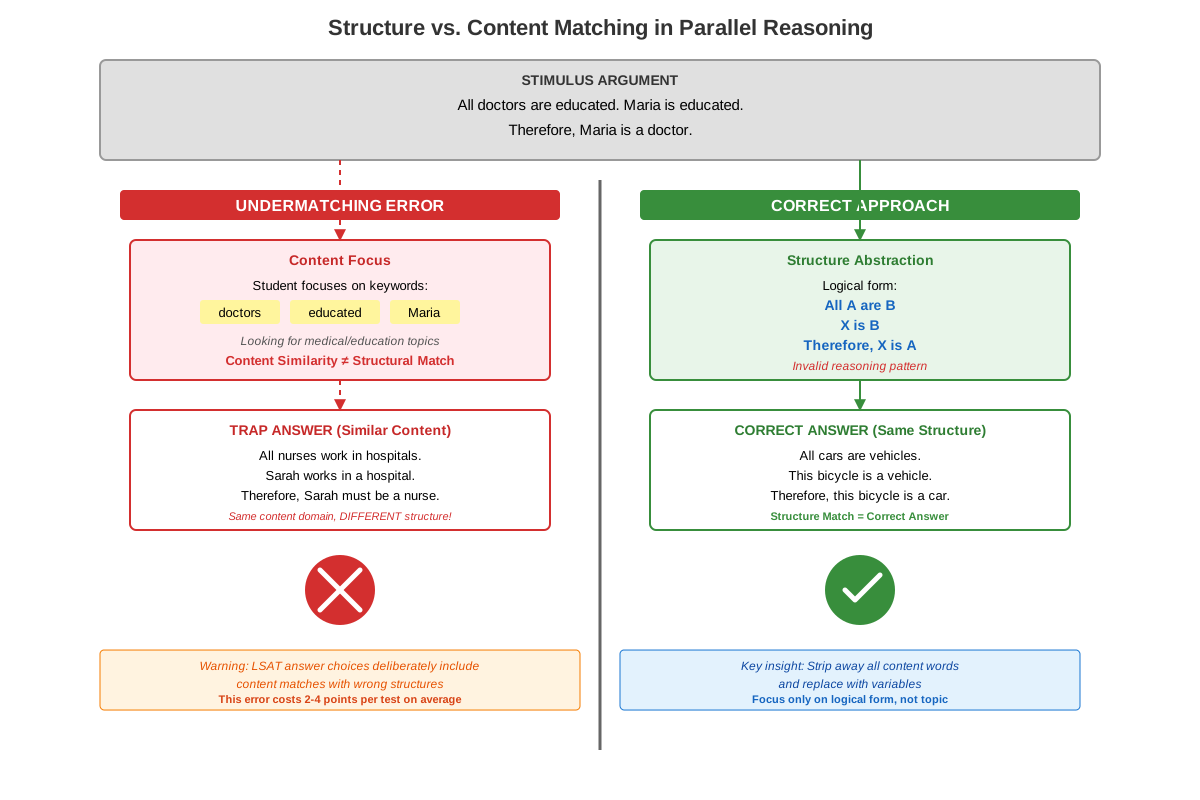
Undermatching structure occurs when a test-taker selects an answer choice based on superficial similarities to the stimulus argument rather than genuine structural parallelism. The term "undermatching" indicates that the student has matched at an insufficient level of abstraction—they have matched content, tone, or conclusion type without matching the actual logical architecture of the argument.
Consider this distinction: A stimulus argument might state "All doctors are educated. John is educated. Therefore, John is a doctor." The logical structure is: All A are B. X is B. Therefore, X is A. This is an invalid argument (affirming the consequent). An answer choice stating "All lawyers are professionals. Sarah is a professional. Therefore, Sarah is a lawyer" has the identical structure, even though the content is completely different. However, an answer choice stating "All doctors are educated. John is a doctor. Therefore, John is educated" discusses the same subject matter but has a completely different (and valid) structure: All A are B. X is A. Therefore, X is B.
Students who undermatch would incorrectly prefer the second answer choice because it maintains the medical/educational theme, even though the first answer choice is structurally parallel. This error stems from processing arguments at the content level rather than the structural level.
The Anatomy of Logical Structure
To avoid undermatching, students must understand what constitutes logical structure. Structure consists of several key elements:
Quantification patterns: Whether statements use universal quantifiers (all, every, none), particular quantifiers (some, most), or no quantifiers at all. An argument using "all" in its premises must be matched with an answer using "all" in corresponding positions.
Relationship types: The nature of connections between terms—causal relationships, conditional relationships, correlations, analogies, or categorical memberships. An argument that reasons from cause to effect must be matched with another cause-to-effect argument, not an effect-to-cause argument.
Number and role of premises: Whether the argument uses one premise or multiple premises, and whether premises work independently or interdependently. An argument with two independent premises supporting a conclusion cannot be matched with an argument where two premises must combine to support the conclusion.
Validity or invalidity: Whether the conclusion follows necessarily from the premises (valid) or commits a logical error (invalid). Parallel Flaw questions specifically require matching the type of flaw, not just matching valid to valid or invalid to invalid.
Conclusion type: Whether the conclusion is categorical, conditional, causal, comparative, or predictive. An argument concluding with a conditional statement ("If X, then Y") must be matched with another conditional conclusion.
Common Structural Patterns on the LSAT
The LSAT repeatedly tests certain structural patterns that students must recognize instantly:
| Pattern Name | Structure | Example |
|---|---|---|
| Affirming the Consequent | If A→B; B; Therefore A | If it rains, streets are wet. Streets are wet. So it rained. |
| Denying the Antecedent | If A→B; Not A; Therefore Not B | If it rains, streets are wet. It didn't rain. So streets aren't wet. |
| Absence of Evidence | No evidence for X; Therefore evidence against X | No proof ghosts exist; Therefore ghosts don't exist. |
| Correlation-Causation | X correlates with Y; Therefore X causes Y | Ice cream sales correlate with drowning; Therefore ice cream causes drowning. |
| False Dichotomy | Not A; Therefore B (when other options exist) | The plan isn't perfect; Therefore we should reject it. |
| Composition/Division | Parts have property X; Therefore whole has X | Each player is excellent; Therefore the team is excellent. |
The Abstraction Process
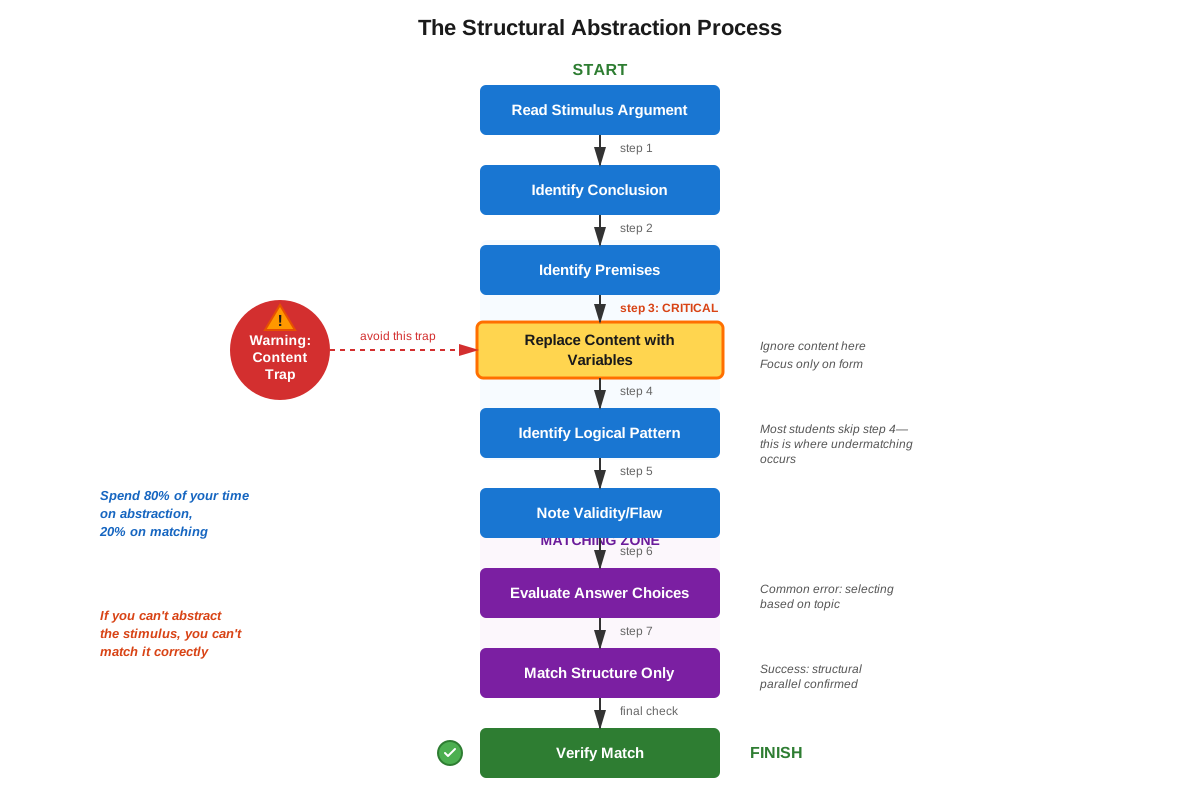
Successful structural matching requires a systematic abstraction process:
- Identify the conclusion: Determine exactly what the argument is trying to prove, including its logical form (categorical, conditional, causal, etc.)
- Identify each premise: List every piece of evidence or reasoning provided, noting the relationship between premises
- Map the logical connections: Determine how premises connect to the conclusion—do they work independently, combine necessarily, or form a chain of reasoning?
- Abstract to variables: Replace all content terms with neutral variables (A, B, C, or X, Y, Z), preserving only the logical relationships
- Note the validity status: Determine whether the reasoning is valid or contains a flaw, and if flawed, identify the specific error type
- Create a structural template: Write out the abstract form that any matching argument must follow
For example, given the argument "Most successful entrepreneurs take risks. Chen takes risks. Therefore, Chen will probably be a successful entrepreneur," the abstraction process yields:
- Conclusion: X will probably be A (predictive, probabilistic)
- Premise 1: Most A are B (quantified generalization)
- Premise 2: X is B (categorical statement about individual)
- Structure: Most A→B; X is B; Therefore X is probably A
- Flaw: Affirming the consequent with probabilistic language (the fact that most A are B doesn't mean most B are A)
Content-Based Distractors
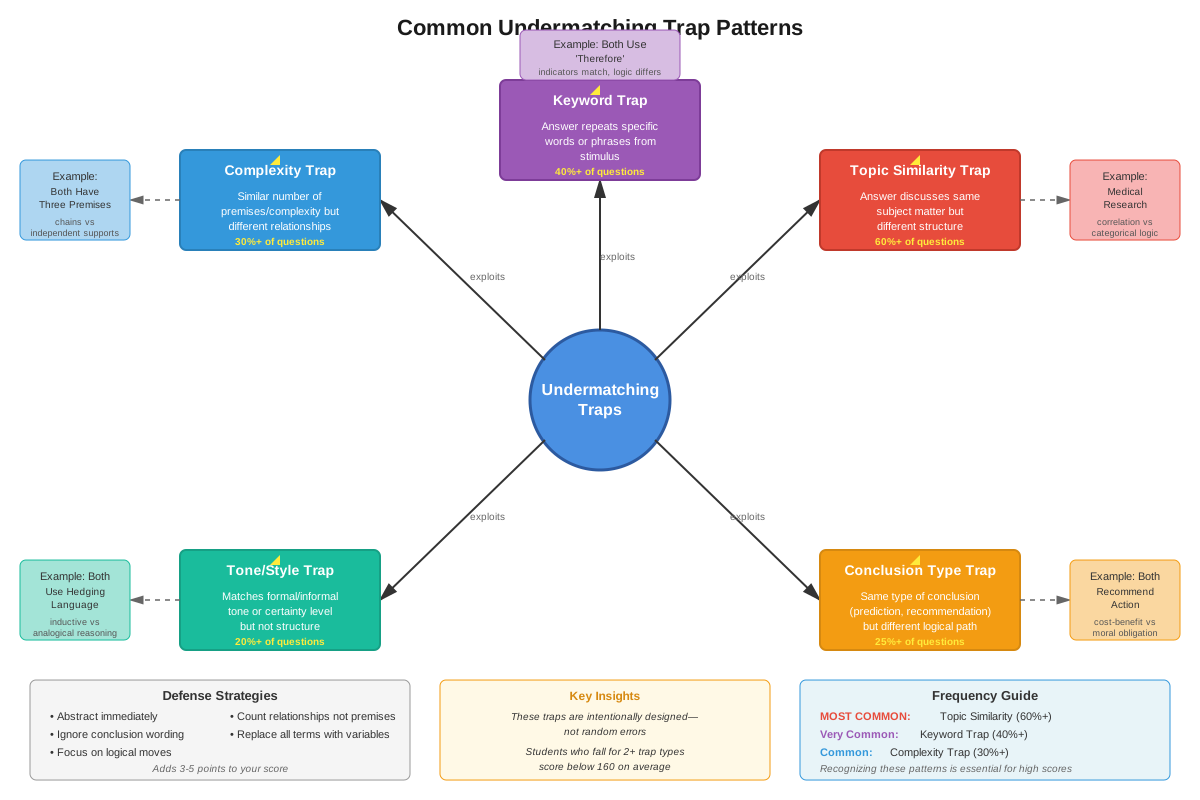
The LSAT deliberately constructs wrong answer choices that exploit undermatching tendencies. These distractors typically feature:
Subject matter similarity: Using the same domain as the stimulus (if stimulus discusses medicine, distractor discusses medicine) while having different structure
Tone matching: Replicating whether the argument is prescriptive, descriptive, critical, or supportive without matching logical form
Conclusion similarity: Reaching a similar type of conclusion (both recommend action, both make predictions) through different reasoning paths
Vocabulary overlap: Using the same or related terms as the stimulus to create false familiarity
Superficial complexity matching: If the stimulus seems complex, including complex-sounding language in distractors regardless of structural match
Recognizing these distractor types helps students maintain focus on structure rather than being seduced by content-based similarities.
Concept Relationships
The concept of undermatching structure sits at the intersection of several fundamental logical reasoning skills. At its foundation, it requires argument structure identification—the ability to distinguish premises from conclusions and understand their relationships. This foundational skill enables the abstraction process necessary to avoid undermatching.
Undermatching structure directly connects to parallel reasoning as the primary error pattern that prevents successful completion of these questions. The relationship flows: Parallel Reasoning questions test structural matching → Undermatching structure represents failure to match structurally → Avoiding undermatching enables correct structural matching → Success on Parallel Reasoning questions.
The concept also relates closely to formal logic and diagramming. The ability to represent arguments symbolically (using conditional notation, quantifier symbols, or variable substitution) provides the technical tool for avoiding content-based distractions. The relationship is bidirectional: formal logic skills prevent undermatching, and practicing structural abstraction strengthens formal logic abilities.
Additionally, undermatching structure connects to flaw recognition. Many Parallel Flaw questions require matching not just any structure but specifically matching the type of logical error. Understanding undermatching prevents students from matching "any flaw to any flaw" and instead requires precise flaw-type matching. The progression is: Identify flaw type in stimulus → Abstract the flaw structure → Match to answer with identical flaw structure → Avoid answers with different flaws despite content similarity.
Finally, the concept relates to Method of Reasoning questions, where students must identify the argumentative technique used. Undermatching in this context means selecting an answer that describes what the argument is about rather than how it reasons. The skill of structural analysis developed through avoiding undermatching directly transfers to accurately identifying reasoning methods.
High-Yield Facts
⭐ Undermatching structure is the single most common error pattern on Parallel Reasoning questions, accounting for approximately 60-70% of incorrect answer selections among unprepared test-takers.
⭐ Content similarity between stimulus and answer choice is often an indicator of a wrong answer on Parallel Reasoning questions—the LSAT deliberately uses different subject matter in correct answers to test structural abstraction.
⭐ The logical structure of an argument includes quantification (all, most, some, none), relationship type (causal, conditional, correlational), number of premises, and validity status—all must match for true parallelism.
⭐ Parallel Flaw questions require matching the specific type of flaw, not just matching "flawed to flawed"—an argument with affirming the consequent must be matched with another argument committing that same error.
⭐ Abstracting arguments to variables (replacing "doctors" with A, "educated" with B, etc.) is the most reliable technique for avoiding undermatching and identifying true structural parallelism.
- The conclusion type (categorical, conditional, causal, comparative, predictive) must match between stimulus and correct answer—an argument concluding with a conditional cannot be matched with a categorical conclusion.
- Premise relationships matter: two premises that work independently cannot be matched with two premises that must combine to support the conclusion.
- Valid arguments can only be matched with valid arguments, and invalid arguments must be matched with arguments containing the same logical error.
- The order of reasoning steps constitutes part of the structure—an argument that reasons from general principle to specific case cannot be matched with one reasoning from specific cases to general principle.
- Quantifier scope and strength must match precisely—"all" cannot be matched with "most," and "some" cannot be matched with "many."
- Conditional relationships must preserve direction—if the stimulus has "If A then B," the match must have "If X then Y," not "If Y then X."
- The presence or absence of counterevidence, alternative explanations, or qualifying statements constitutes structural elements that must be matched.
Quick check — test yourself on Undermatching structure so far.
Try Flashcards →Common Misconceptions
Misconception: If an answer choice discusses the same subject matter as the stimulus, it's more likely to be correct because it maintains thematic consistency.
Correction: Subject matter similarity is typically a red flag indicating a distractor designed to exploit undermatching. The LSAT deliberately uses different content in correct answers to test whether students can recognize structure independent of content. Parallel Reasoning questions specifically test the ability to see that arguments about completely different topics can share identical logical structure.
Misconception: As long as both the stimulus and answer choice are flawed arguments, they match for Parallel Flaw questions.
Correction: Parallel Flaw questions require matching the specific type of flaw, not just any flaw to any flaw. An argument that commits affirming the consequent cannot be matched with an argument that commits a correlation-causation error, even though both are invalid. The flaw type is part of the structure that must be matched precisely.
Misconception: If the conclusion of an answer choice "feels similar" to the stimulus conclusion, the reasoning is probably parallel.
Correction: Conclusion similarity in content or tone does not indicate structural parallelism. What matters is the logical form of the conclusion (categorical, conditional, causal, etc.) and how the premises support it. Two arguments can reach opposite conclusions yet share identical structure, or reach similar conclusions through completely different reasoning patterns.
Misconception: Complex-sounding arguments must be matched with other complex-sounding arguments, and simple arguments with simple ones.
Correction: Superficial complexity (vocabulary difficulty, sentence length, technical terminology) is independent of logical structure. A simply-worded argument can have complex logical structure, and a complex-sounding argument can have simple structure. The LSAT uses complexity mismatches to test whether students focus on structure rather than presentation.
Misconception: The first answer choice that seems structurally similar is probably correct, so there's no need to check all five answers.
Correction: The LSAT often includes multiple answer choices with partial structural similarity to the stimulus. The correct answer must match all structural elements, not just some. Students must evaluate all five choices and select the one with complete structural parallelism, as earlier choices often match some but not all structural features.
Misconception: Diagramming every argument is too time-consuming for test conditions, so structural analysis should be done mentally.
Correction: While full formal diagramming of all five answer choices may be excessive, creating a brief structural template for the stimulus (using variables or shorthand notation) actually saves time by providing a clear matching criterion. This prevents the need to repeatedly re-read the stimulus while evaluating answers and reduces errors from memory limitations.
Worked Examples
Example 1: Parallel Reasoning
Stimulus: "All effective managers are good communicators. Jamal is an effective manager. Therefore, Jamal is a good communicator."
Question: Which of the following most closely parallels the reasoning above?
Step 1 - Identify the conclusion: "Jamal is a good communicator" - This is a categorical statement about an individual.
Step 2 - Identify the premises:
- Premise 1: "All effective managers are good communicators" (universal conditional)
- Premise 2: "Jamal is an effective manager" (categorical statement about individual)
Step 3 - Abstract to structure:
- All A are B
- X is A
- Therefore, X is B
Step 4 - Assess validity: This is VALID reasoning (modus ponens). The conclusion follows necessarily from the premises.
Step 5 - Create matching template: We need an answer with:
- Universal statement (All A are B)
- Categorical statement placing individual in category A
- Conclusion placing that individual in category B
- Valid reasoning
Evaluating Answer Choices:
(A) "All effective managers are good communicators. Jamal is a good communicator. Therefore, Jamal is an effective manager."
Structure: All A are B; X is B; Therefore X is A. This is INVALID (affirming the consequent). The validity doesn't match, so this is incorrect despite discussing the same subject matter—a classic undermatch trap.
(B) "Most successful athletes train daily. Maria trains daily. Therefore, Maria is probably a successful athlete."
Structure: Most A are B; X is B; Therefore X is probably A. This is INVALID and uses "most" rather than "all." Doesn't match our template.
(C) "All professional chefs have culinary training. Chen has culinary training. Therefore, Chen is a professional chef."
Structure: All A are B; X is B; Therefore X is A. This is INVALID (affirming the consequent). Wrong validity status.
(D) "All professional chefs have culinary training. Chen is a professional chef. Therefore, Chen has culinary training."
Structure: All A are B; X is A; Therefore X is B. This is VALID and matches our template perfectly. The subject matter is completely different (chefs/training vs. managers/communication), but the structure is identical. This is the correct answer.
(E) "Some effective managers are good communicators. Jamal is an effective manager. Therefore, Jamal is a good communicator."
Structure: Some A are B; X is A; Therefore X is B. This is INVALID because "some" doesn't guarantee the conclusion. Quantifier doesn't match.
Key Insight: Answer choice (A) is the primary undermatch trap—it uses identical subject matter but has different (invalid) structure. Answer choice (D) is correct despite completely different content because it preserves the logical structure perfectly.
Example 2: Parallel Flaw
Stimulus: "No evidence has been found that the new medication causes side effects. Therefore, the medication definitely does not cause side effects."
Question: The flawed reasoning above most closely parallels which of the following?
Step 1 - Identify the flaw: This commits the "absence of evidence is not evidence of absence" fallacy. Just because we haven't found evidence of something doesn't prove it doesn't exist.
Step 2 - Abstract the structure:
- No evidence for X
- Therefore, not-X (stated with certainty)
- Flaw: Treating absence of evidence as conclusive evidence of absence
Step 3 - Create matching template: We need:
- Statement about lacking evidence for something
- Conclusion that the thing definitely doesn't exist/isn't true
- Same logical flaw (absence of evidence fallacy)
Evaluating Answer Choices:
(A) "No one has proven that ghosts exist. Therefore, ghosts probably don't exist."
Structure: No evidence for X; Therefore probably not-X. This is actually more reasonable because it uses "probably" rather than "definitely." The flaw is less severe, so this doesn't match. Also, students prone to undermatching might select this because it discusses "proving existence" like the stimulus, but the structure differs.
(B) "Scientists have searched extensively for extraterrestrial life but found none. Therefore, extraterrestrial life definitely does not exist."
Structure: No evidence for X (despite extensive search); Therefore definitely not-X. This matches perfectly—same flaw type, same certainty level, same logical error. The content is completely different (medication side effects vs. extraterrestrial life), but the structure is identical. This is the correct answer.
(C) "The medication has been proven safe in animal studies. Therefore, it will definitely be safe for humans."
Structure: Evidence for X in context A; Therefore X in context B. This is a different flaw (inappropriate generalization across contexts), not an absence-of-evidence flaw. Wrong despite discussing medication.
(D) "Some patients reported side effects. Therefore, the medication definitely causes side effects."
Structure: Some evidence for X; Therefore X. This is actually closer to valid reasoning (though it might overgeneralize). It's not an absence-of-evidence flaw—it's reasoning from positive evidence. Wrong flaw type.
(E) "No evidence has been found that the medication is effective. However, it might still be effective."
Structure: No evidence for X; But possibly X. This acknowledges that absence of evidence doesn't prove absence—it's actually avoiding the flaw rather than committing it. Wrong.
Key Insight: Answer choice (C) is the undermatch trap—it discusses medication like the stimulus but commits a completely different logical error. Answer choice (B) is correct because it commits the identical flaw despite discussing a completely unrelated topic.
Exam Strategy
When approaching Parallel Reasoning questions, implement this systematic process to avoid undermatching:
Before reading answer choices, invest 30-45 seconds creating a structural template of the stimulus. Write down the abstract form using variables or shorthand notation. This upfront investment prevents repeatedly re-reading the stimulus and provides a clear matching criterion. For example, jot down "All A→B; X is A; ∴ X is B" or "No evidence for X; ∴ definitely not-X."
Watch for trigger phrases that indicate structural elements requiring precise matching:
- Quantifiers: "all," "most," "some," "none," "many," "few"
- Conditionals: "if," "only if," "unless," "when," "whenever"
- Causation: "causes," "leads to," "results in," "produces"
- Certainty levels: "definitely," "must," "probably," "might," "could"
- Evidence language: "proves," "suggests," "indicates," "shows"
Use aggressive elimination based on structural mismatches. As soon as you identify one structural element that doesn't match, eliminate that answer choice immediately without reading the rest. Common quick eliminations:
- Wrong quantifier (stimulus uses "all," answer uses "most")
- Wrong validity status (stimulus is valid, answer is invalid)
- Wrong number of premises (stimulus has two premises, answer has one)
- Wrong conclusion type (stimulus concludes with conditional, answer concludes with categorical)
Beware of content-based attraction. If an answer choice discusses the same subject matter as the stimulus, treat it with suspicion rather than preference. The LSAT knows students are drawn to familiar content and deliberately exploits this tendency. Correct answers often use completely different subject matter to test pure structural recognition.
For Parallel Flaw questions specifically, first identify the exact flaw type in the stimulus before evaluating answers. Common flaw types include:
- Affirming the consequent
- Denying the antecedent
- Correlation-causation confusion
- Absence of evidence fallacy
- False dichotomy
- Composition/division
- Circular reasoning
- Ad hominem
Only select an answer that commits the identical flaw type, not just any flaw.
Time management: Parallel Reasoning questions typically require 90-120 seconds. If you find yourself exceeding two minutes, you're likely getting caught in content-based analysis rather than structural matching. Reset by returning to your structural template and evaluating answers purely against that template.
Verification step: Before selecting your answer, quickly verify that every structural element matches: quantifiers, relationships, number of premises, conclusion type, and validity status. This five-second check prevents careless errors from partial matching.
Memory Techniques
MATCH acronym for structural elements that must align:
- Method of reasoning (deductive, inductive, analogical)
- Amount/quantifiers (all, most, some, none)
- Type of conclusion (categorical, conditional, causal, comparative)
- Connections between premises (independent, interdependent, sequential)
- Health of reasoning (valid or specific flaw type)
Visualization strategy: Picture arguments as buildings. The content is the exterior decoration (brick, paint, windows), while the structure is the frame (beams, supports, foundation). Two buildings can look completely different on the outside but have identical frames. When matching arguments, mentally strip away the exterior and examine only the frame.
The "Content is Camouflage" mantra: Repeat this phrase when approaching Parallel Reasoning questions. It reinforces that subject matter similarity is typically a distractor rather than a helpful signal.
Variable substitution drill: Practice immediately translating arguments into abstract form. When you see "All doctors are educated," instantly think "All A are B." This automatic abstraction becomes faster with practice and prevents content-based distraction.
Flaw family grouping: Memorize flaw types in families:
- Conditional errors: Affirming consequent, denying antecedent
- Evidence errors: Absence of evidence, circular reasoning
- Causal errors: Correlation-causation, reversed causation
- Scope errors: Composition/division, inappropriate generalization
- Logical structure errors: False dichotomy, equivocation
Grouping flaws by family helps quickly identify which family the stimulus flaw belongs to, then match within that family.
Summary
Undermatching structure represents the primary error pattern preventing success on LSAT Parallel Reasoning questions, occurring when test-takers match arguments based on superficial content similarities rather than underlying logical structure. Mastering this topic requires developing the ability to abstract arguments to their logical form—identifying quantifiers, relationship types, premise structures, conclusion types, and validity status—independent of subject matter. The LSAT deliberately constructs wrong answer choices that exploit undermatching tendencies by using similar content, tone, or vocabulary while having different logical structures. Success requires systematic abstraction using variables or symbolic notation, creating structural templates before evaluating answer choices, and recognizing that content similarity often signals incorrect answers rather than correct ones. For Parallel Flaw questions specifically, students must match the exact flaw type, not just any invalid reasoning to any other invalid reasoning. The skills developed in avoiding undermatching—structural analysis, formal abstraction, and content-independent reasoning—transfer broadly across Logical Reasoning question types and represent foundational abilities for legal reasoning itself.
Key Takeaways
- Undermatching structure occurs when selecting answers based on content similarity rather than logical structure—the most common error on Parallel Reasoning questions
- Content similarity between stimulus and answer choice is often a red flag indicating a distractor, not a helpful signal
- True structural matching requires abstracting arguments to variables and matching quantifiers, relationships, premise structures, conclusion types, and validity status
- Parallel Flaw questions demand matching the specific flaw type, not just matching any flawed reasoning to any other flawed reasoning
- Creating a structural template of the stimulus before reading answer choices prevents undermatching and saves time
- The ability to recognize structure independent of content is foundational to advanced LSAT performance and legal reasoning generally
- Systematic abstraction and aggressive elimination based on structural mismatches are the keys to consistent accuracy on these questions
Related Topics
Formal Logic and Conditional Reasoning: Mastering undermatching structure naturally leads to deeper study of formal logic systems, including conditional chains, contrapositive formation, and quantifier relationships. These tools provide more sophisticated methods for representing argument structure symbolically.
Argument Diagramming Techniques: Building on structural abstraction skills, comprehensive diagramming methods (including premise-conclusion mapping, assumption identification, and logical gap analysis) extend the ability to visualize argument architecture.
Method of Reasoning Questions: The structural analysis skills developed through avoiding undermatching directly apply to identifying how arguments reason, distinguishing techniques like reasoning by analogy, applying general principles, or reasoning from counterexamples.
Flaw Question Types: Deep understanding of specific flaw types (necessary for Parallel Flaw questions) enhances performance on standard Flaw questions, where identifying the error type is the primary task rather than matching it.
Sufficient Assumption Questions: These questions require identifying the logical structure of arguments to determine what missing premise would make the reasoning valid—a direct application of structural analysis skills.
Practice CTA
Now that you understand the concept of undermatching structure and how to avoid this common trap, it's time to apply these skills to actual LSAT questions. Work through the practice questions provided, focusing on creating structural templates before evaluating answer choices. Use the flashcards to reinforce recognition of common structural patterns and flaw types. Remember: every Parallel Reasoning question you encounter is an opportunity to strengthen your structural analysis abilities—skills that will serve you not just on test day, but throughout your legal career. The difference between those who master this topic and those who don't often represents 10-15 points on the LSAT scale. You now have the tools to be in the mastery group.
Sign up free to keep reading
Create a free AnvayaPrep account to finish this LSAT guide on Undermatching structure — plus flashcards and practice questions.